CO、甲醛与甲醇燃烧综合动力学机理研究

CO、甲醛与甲醇燃烧综合动力学机理研究( Methanol Mechanis m 2008071016)
摘要:
本文构建了适用于 CO、甲醛、甲醇燃烧的统一详细动力学模型,基于层级式方法更新 H₂/O₂子机理与热力学参数,通过加权最小二乘法优化关键反应速率常数。研究新增 850–950 K、1.5–6 atm 下甲醛氧化的流场实验数据,模型经激波管、层流火焰、流动反应器等多工况验证,温度 300–3000 K、压力 0.03–20 atm,与实验结果高度吻合。灵敏度分析表明 CO+OH、HCO 分解等反应对点火与火焰速度影响显著。该模型包含 84 步反应与 18 种组分,可直接用于 CHEMKIN,为含氧燃料燃烧仿真提供可靠机理。
A Comprehensive Kinetic Mechanis m for CO, CH2O, and CH3OH Combustion
JUAN LI, 1 ZHENWEI ZHAO, 1 ANDREI KAZAKOV, 1 MARCOS CHAOS, 1 FREDERICK L. DRYER, 1 JAMES J. SCIRE, JR.2
1 Department of Mechanical and Aerospace Engineering, Princeton University, Princeton, NJ 08544
2 Advanced Fuel Research, Inc. , East Hartford, CT 06108
Received 27 May 2006; revised 18 September 2006; accepted 3 October 2006
DOI 10.1002/kin.20218
Published online in Wiley InterScience (www.interscience.wiley.com).
ABSTRACT:
New experimental profiles of stable species concentrations are reported for formaldehyde oxidation in a variable pressure flow reactor at initial temperatures of 850–950 K and at constant pressures ranging from 1.5 to 6.0 atm. These data, along with other data pub- lished in the literature and a previous comprehensive chemical kinetic model for methanol oxi- dation, are used to hierarchically develop an updated mechanis m for CO/H2O/H2/O2, CH2O, and CH3OH oxidation. Important modifications include recent revisions for the hydrogen–oxygen submechanis m (Li et al., Int JChem Kinet 2004, 36, 565), an updated submechanis m for methanol reactions, and kinetic and thermochemical parameter modifications based upon recently pub- lished information. New rate constant correlations are recommended for CO+ OH = CO2 + H (R23) and HCO + M = H + CO + M (R24), motivated by a new identification of the tempera- tures over which these rate constants most affect laminar flame speed predictions (Zhao et al., Int J Chem Kinet 2005, 37, 282). The new weighted least-squares fit of literature experimental data for (R23) yields k23 = 2.23 × 10⁵ T1.89 exp(583/T )cm3/mol/s and reflects significantly lower rate constant values at low and intermediate temperatures in comparison to another recently recommended correlation and theoretical predictions. The weighted least-squares fit of lit- erature results for (R24) yields k24 = 4.75 × 10¹¹ T0.66 exp(_7485/T ) cm3/mol/s, which predicts values within uncertainties of both prior and new (Friedrichs et al., Phys Chem Chem Phys 2002, 4, 5778; DeSain et al., Chem Phys Lett 2001, 347, 79) measurements. Use of either of the data correlations reported in Friedrichs et al. (2002) and DeSain et al. (2001) for this reaction sig- nificantly degrades laminar flame speed predictions for oxygenated fuels as well as for other hydrocarbons. The present C1/O2 mechanis m compares favorably against a wide range of ex- perimental conditions for laminar premixed flame speed, shock tube ignition delay, and flow reactor species time history data at each level of hierarchical development. Very good agree- ment of the model predictions with all of the experimental measurements is demonstrated.
OC 2007 Wiley Periodicals, Inc. Int J Chem Kinet 39: 109–136, 2007
INTRODUCTION
The hierarchical nature of hydrocarbon oxidation kinetics and the importance of s mall molecule and radical kinetics in controlling the oxidation of larger carbon number species are well-established notions [ 1,2]. The hydrogen–oxygen kinetic submechanis m [2] controls the most reactive radical pool composition of H, OH, O, and HO2 that attack the primary fuel. Carbon monoxide is a major intermediate species, and its conversion to CO2 is responsible for a significant fraction of the exothermicity accompanying hydro- carbon oxidation. It has been shown (e.g., [2,3]) that nearly all carbon atoms bonded to one another, to hy- drogen atoms, or hydroxyl groups are converted to CO through formaldehyde (CH2 O) and/or formyl radicals (HCO). Formyl radicals are a major source of H atoms and HO2 radicals in larger carbon number hydrocarbon combustion.
Methanol (CH3 OH), the simplest alcohol, converts to CO through CH2 O reactions and introduces ad- ditional species, particularly CH2 , CH3 , CH3 O, and CH2 OH [4]. Over almost all conditions of practical in- terest, methanol combustion produces CH3 in such mi- nor concentrations that no C2 hydrocarbon species are formed and, hence, no sooting occurs. The collection of kinetic phenomena involved in hydrogen/oxygen, car- bon monoxide, formaldehyde, and methanol is there- fore a representative of the s mall radical pool interac- tions that couple with methyl radical and higher carbon number species and radicals in hydrocarbon combus- tion systems.
Detailed mechanis ms for H2 , CO, CH2 O, and CH3 OH combustion are also individually of practi- cal importance. Hydrogen kinetic properties have long been of interest in terms of safety, given the major use of hydrogen in chemical synthesis and fuel refining. The proposed transition to a hydrogen energy economy further emphasizes the need to understand hydrogen safety issues [e.g., 5,6] as well as hydrogen combus- tion under mild combustion conditions and with very high-exhaust gas recirculation. Carbon monoxide and formaldehyde are primary pollutant species emitted from many combustion systems and are important in reforming chemistry to produce hydrogen from hydro- carbons, as well as in atmospheric chemistry, toxicity, and carcinogen assess ments and an alyses. Methanol is used as an oxygenate additive in gasoline and is also an attractive alternative to traditional transportation fu- els because of its nonsooting characteristics, its facile synthesis from a wide variety of feedstocks, and its possible interim role as a hydrogen carrier for fuel cell applications.
The combustion chemistry of each of the above species has been extensively studied previously. Ex- perimental data exist in the literature from laminar flame, shock tube, flow reactor, and static reactor ex- periments, collectively covering a wide range of ini- tial temperature, pressure, and equivalence ratio. Our group has had a long involvement in studying these s mall molecule kinetics in flow reactors (Yetter et al. [7,8]; Hochgreb and Dryer [9]; Kim et al. [ 10], Nor- ton and Dryer [ 11], Held and Dryer [4, 12], Mueller et al. [ 13– 17]). We have previously developed com- prehensive mechanis ms for CO [8], CH2 O [9], and CH3 OH [4], and our recent work on updating and de- veloping a comprehensive mechanis m for hydrogen– oxygen [ 18] that includes advances in chemical kinetic rate and thermochemical information as well as val- idation data sources points to the need to similarly revisit and update our prior work on carbon monox- ide, formaldehyde, and methanol kinetics. While the flow reactor data we have previously published for hy- drogen, carbon monoxide, and methanol systems, each covering a very wide range of pressures, our prior work on formaldehyde oxidation was limited to atmospheric pressure studies [9]. In that work, chemical an alyses were conducted using offline gas chromatography, an an alytical method with potentially higher uncertainties than can be achieved using the Fourier transform in- frared (FTIR) online an alytical methods available to- day. Formaldehyde oxidation obtained in a variable pressure flow reactor (VPFR) at initial temperatures of 850–950 K and constant pressures ranging from 1.5 to 6.0 atm to expand the range of validation con- ditions. Moreover, new experiments in other venues, especially for CH2 O oxidation, have appeared in the literature using shock tubes [ 19–22] and laminar pre- mixed flames [23]. In addition, there have been some elementary kinetic publications further addressing the important reactions involved in the C1 oxidation system (e.g., [ 19,24,25]).
Utilizing our recent work on hydrogen/oxygen ki- netics [ 18], and updating the CO/O2 , CH2 O/O2 , and CH3 OH/O2 mechanis ms with more recent kinetic and thermochemical information, a comprehensive mecha- nis m has been hierarchically developed [26] that satis- factorily reproduces new experimental targets as well as those utilized in the original mechanis m studies ap- pearing in [4,8,9]. This paper reports the key features of the updated mechanis m, summarizes the comparisons of predictions with experimental targets as performed in [26], and augments these earlier comparisons using the results with some additional, recently published, kinetic measurements and experimental validation data.
EXPERIMENTAL METHODS
The new experiments on formaldehyde oxidation re- ported here were conducted in the Princeton variable pressure flow reactor [27]. Detailed information on the VPFR instrumentation and experimental methodology can be found in other publications [28], and only a brief description is given here.
Carrier gas (N2 in this study) is heated by a pair of electrical resistance heaters and directed into a reactor duct. Oxygen is also introduced at the duct entrance. The carrier gas/oxygen mixture flows around a baffle plate into a gap serving asthe entrance toa diffuser. The vaporized fuel (trioxane with water in this study) flows into the center tube of a fuel injector and injects radi- ally outward into the gap where it rapidly mixes with the carrier gas and oxygen. The reacting mixture exits the diffuser into a constant area test section. Near the exit of the test section, a sampling probe is positioned on the reactor centerline to continuously extract and convectively quench a s mall percentage of the flow. At the same axial location, the local reaction gas temper- ature is measured with a type R thermocouple accurate to ±3 K.
The sample gas flows via heated Teflon lines to an- alytical equipment including a FTIR spectrometer, an electrochemical O2 ana lyzer, and a pair of nondisper- sive infrared a nalyzers for CO and CO2. Other sta- ble species of interest (e.g., CH2 O, H2 O) are mea- sured continuously online using FTIR spectrometry. The measurement uncertainties for the data reported here are O2 :±2%, CO:±2%, CO2 :±2%, CH2 O:±3%, and H2 O:±6% of reading.
The distance between the point of fuel injection and the sampling position is varied by moving the fuel vapor injector probe (with attached mixer/diffuser as- sembly) relative to the fixed sampling location. Mean axial velocity measurements along the centerline of the reactor are used to correlate distance with residence time. By these means, profiles of stable species versus residence time can be determined experimentally. The uncertainty in the residence time is approximately 5%.
In the present experiments, formaldehyde monomer was generated through the decomposition of 1,3,5- trioxane. Hochgreb and Dryer [9] also employed this technique in their atmospheric pressure flow reac- tor (APFR) experiments. Trioxane decomposition pro- ceeds by the concerted rupture of the three C O bonds to form three formaldehyde molecules [9,29]. Using gas chromatography, it was experimentally verified that CH2 O is the only product of trioxane decomposition, and trioxane decomposition is much faster than the subsequent reaction of formaldehyde at flow reactor conditions. For modeling purposes, 1 mol of triox-ane reactant could therefore be replaced by 3 mol of formaldehyde.
In earlier work, [9,29], trioxane was melted and de- livered as a liquid to the evaporator of a prior APFR. A similar methodology would have required a complex modification of the present reactor, and a different ap- proach to deliver trioxaneto thereactor was utilized. At 18◦ C, the solubility of trioxane in water is 17.2 g/100 mL [30]. Trioxane was dissolved in distilled water, and the unheated solution was volumetrically metered to a liquid vaporizer system located within the VPFR pres- sure shell and at the immediate entrance to the fuel vapor injector probe. The metered liquid flow was gas- blast atomized using heated nitrogen, and the nitrogen, water vapor, and trioxane vapor mixture was then in- jected into the reactor at the mixing location with hot carrier gas. It was verified that the decomposition rate of trioxane at the conditions of the reported experi- ments led to immediate formation of monomer during the injection and mixing process, well upstream of the radially uniform reaction region where the reported data were obtained. Due to heat addition limitations for the hot nitrogen used to vaporize the liquid reactant flow and the solubility limit of trioxane in water, the maximum initial CH2 O mole fraction investigated was limited to 500 ppm. Other than this limitation, the use of water to deliver the trioxane did not significantly affect the experiments, as the amount of water added was included in the kinetic modeling comparisons.
A series of moist formaldehyde oxidation experi- ments were conducted in the VPFR at initial tempera- tures of 850–950 K and in the pressure range of 1.5–6.0 atm. For all of the experiments, the total carbon and oxygen balances experimentally determined at each residence time were within 4% of the specified input. The nearly identical total carbon and oxygen concen- trations at each sampling location not only provide verification of the experimental measurements but also imply that any other carbon- or oxygen-containing sta- ble species present were only in negligible quantities. Although formic acid has been observed using these same diagnostics in VPFR experiments on methanol [4] and dimethyl ether [31] oxidation, none was de- tected in the present experiments on formaldehyde ox- idation. This is most likely the result of the very low fuel concentrations studied here, and that formic acid would be expected to be below detection limits.
UPDATED KINETIC MECHANIS MS FOR CO, CH2 O, AND CH3 OH COMBUSTION
We used a slightly modified version of the methanol mechanis m published by Held and Dryer [4] as a starting point in developing the present mechanis m.* In the course of the present work, a number of ther- mochemical parameters and rate constant correlations were modified to reflect more recent kinetic informa- tion. The revised H2/O2 submechanis m is discussed in detail and validated against a large set of hydro- gen/oxygen targets in a separate publication [ 18], and this submechanis m is absorbed without further mod- ifications in the present work. Revisions included the use of the heat of formation of OH recommended by Ruscicetal. [33], which isin very good agreement with recent experimental results [34]. For the current work, we utilized 3.0 kcal/mol as the standard heat of for- mation of HO2 at 298.15 K [35]. Very recently, Ruscic et al. [36] have updated this heat of formation to 2.94 ± 0.06 kcal/mol. This change makes no significant differ- ence in the level of comparison of computations with the targets utilized in the present work.
In addition to revising the components associated with the hydrogen–oxygen submechanis m, the follow- ing revisions were also adopted over the course of this work.
Thermochemical Data for CH2 OH
The thermochemical properties of CH2 OH, including enthalpy of formation, standard entropy, and heat ca- pacity at different temperatures, were updated to those reported by Johnson and Hudgens [37]. The data of Johnson and Hudgens also agree well with another re- cent IUPAC evaluation by Ruscicetal. [38]. These ther- modynamic properties were fitted with a 14-coefficient polynomial [39].
CO+ OH= CO2 + H (R23)
This well-studied reaction is of critical importance to combustion modeling because it is the main pathway to convert CO to CO2 , the oxidation of CO is responsi- ble for a major fraction of the energy release derived in oxidation of hydrocarbons, and CO2 dissociation im- portant in determining adiabatic flame temperatures as a function of pressure. The reaction proceeds through the formation of HOCO adducts and thus is pressure dependent, particularly at low temperatures [25,40]. Under most practical combustion conditions, however, the reaction can be treated as pressure-independent.
*In verifying the published mechanis m, we found that the model reported in [4] resulted in calculated flame speeds that were much higher than those shown in the publication. Dr. Held [32] concurs that the flame speed calculations reported in the paper resulted from the slightly modified version of the reported mechanis m, used as a basis in the current work.
The rate of oxidation of H2/CO/O2 and moist CO mixtures is very sensitive to reaction (R23) [8]. More- over, laminar flame speed predictions of hydrocarbons are strongly influenced by this reaction [41,42]. It is not surprising that targets such as shock tube ignition delay data or flow reactor data would constrain model parameters only over the particular range of temper- ature covered by the work. However, the temperature range over which laminar flame speed predictions are most sensitive to a particular elementary reaction has typically not been considered.
Recently, Zhao et al. [43] introduced a methodology to determine the temperature-dependent sensitivity of premixed laminar flame speeds to elementary rate constant and transport properties. An alyses were conducted by locally perturbing the parameter with a Gaussian function profile. The center of the Gaussian profile was moved with an assigned temperature mean, and the sensitivity of the predicted flame speed was determined as a function of the perturbation-assigned mean temperature. The a nalysis leads to the deter- mination of a “temperature window” in which the predicted laminar flame speed is found to be most sensitive to perturbations in the particular parameter. The temperature sensitivity of laminar flames for hydrogen/carbon monoxide mixtures with respect to (R23) was used as an application demonstration. The predicted laminar flame speed was shown to be most sensitive to the specific rate of (R23) in the temperature range 300–1900 K (Fig. 1).
Recently, Yu [44], Troe [45], Zhu et al. [46], and Senosiain et al. [25] performed detailed Rice– Ramsperger–Kassel–Marcus (RRKM) calculations to model the temperature and pressure dependence of this reaction. Most of these correlations were primarily cal- ibrated against high-temperature shock tube data and predict higher rates than experimental measurements at low to intermediate temperatures, as shown in Fig. 2 (the only exception being the results of Zhu et al. [46] which underpredict the majority of experimental data at the temperatures of interest). These temperatures include the temperature sensitivity window for CO laminar flame speed to this reaction. If one assumes that the theoretical fits misrepresent the specific rate of this reaction by comparison with the (presumably) more accurate experimental data at these temperatures, one would expect CO/H2 flame speeds to be overpre- dicted with the reaction models based on these rate parameters. Indeed, as shown in Fig. 3, GRI-Mech 3.0 [47], which uses the values of Yu [44], overpredicts the experimentally measured CO/H2/air laminar flame speeds of McLean et al. [48].
On the basis of the above considerations, we fit the entire body of experimentally measured rate constants
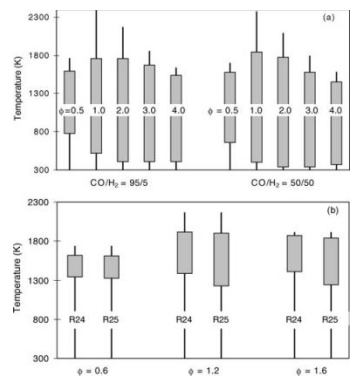
Figure 1 Sensitivity spectrum of reactions CO+ OH = CO2+ H, (R23), HCO+ M = H+ CO+ M, (R24), and HCO+ O2 = HO2+ CO, (R25), for a range of equivalence ratio predicted by the present C1/O2 kinetic mechanis m. The figures are taken from Zhao et al. [43]. Figure (a) is the sensitivity spectrum of (R23) for ambient CO/H2/air flames of two initial fuel compositions (95% CO+ 5% H2 and 50% CO+ 50% H2); (b) is that of (R24) and (R25) for ambient CH3OH/air flames. Bars indicate the temperature range where the sensitivity is more than 10% of the maximum value, and lines represent the temperature span for the specific flame.
available in the literature [44,49–54] by the method of weighted least squares to obtain a more representative correlation of the experimental measurements of this rate constant. The sum of weighted squared errors

is minimized by taking the rate constant, k, as


In Eq. (1), kexp is the rate constant measured experi- mentally at temperature Ti , and σi is the absolute error of log kexp at Ti . Equation (2) was used as the rate con- stant of reaction (R23) in this study. The values shown in parentheses in Eq. (2) are the 95% confidence inter- vals of the fitted parameters.
Figure 2 shows the comparison of this expression with literature results, including those of Lissianski et al. [54] which in the current study were recalcu- lated based on the present thermochemical data and the rate constant of the reverse reaction of (R23) provided in the original paper [54]. The new correlation pre- dicts specific rate constant values in close agreement with those obtained from the correlation of Yu et al.
[55] (within 6% at 800–3500 K) derived by fitting their high-temperature experimental measurements in a shock tube. In the temperature window of 800– 2000 K, predictions from the new expression agree well (within 10%) with those of Troe [45] at 1 atm, while they are about 20% lower than the theoretical predictions of Yu [44] and Senosiain et al. [25] at1atm.
Very recently, and since the thesis research on this work [26], another theoretical treatment of reaction
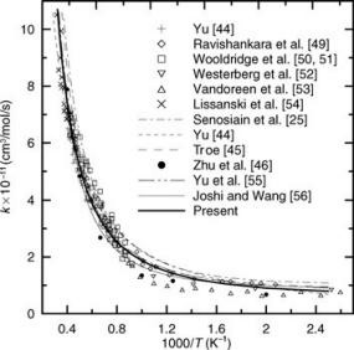
Figure 2 Rate constant of reaction CO+ OH → CO2 + H (R23). Symbols are experimental data (except for atmo- spheric pressure theoretical results of Zhu et al. [46]). Lines are the recommendations of Yu [44], Troe [45], Yu et al. [55] at 1 atm, Senosiain et al. [25] at 1 atm, Joshi and Wang [56] at the low-pressure limit, and that used in the present C1 mechanis m (Eq. (2)).
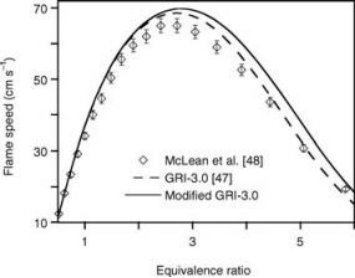
Figure 3 Laminar flame speed of CO/H2/air mixtures at 298 K and 1 atm. The fuel composition is 95% CO and 5% H2 . Symbols—experimental data of McLean et al. [48]; dotted line—predictions of GRI-Mech 3.0 [47]; solid line— predictions of GRI-Mech 3.0 modified by replacing the rate coefficients of reactions (R24) and (R25) with the recom- mendations of Friedrichs et al. [ 19] and DeSain et al. [24], respectively.
(R23) has appeared in the literature [56]. Joshi and Wang [56] have pointed out that consideration of both cis- and trans-isomeric forms of HOCO adduct as well as hindered rotation connecting the two (ignored in prior theoretical studies) leads to significant changes in the predicted thermal rate constant for reaction (R23). The resulting expression recommended by these au- thors is also plotted in Fig. 2. As can be seen, their re- sult is significantly lower at the intermediate tempera- tures of interest than the earlier theoretical predictions. Joshi and Wang have also indicated that “the treatment of the title reaction (R23) remains semi-empirical as more than one different model can satisfactory repro- duce a wide range of data.” The present empirical fit (Eq. (2)) is approximately half-way between the the- oretical results of Senosiain et al. [25] and the new results of Joshi and Wang [56].

Both the unimolecular decomposition and abstraction reactions of formyl radicals are the main pathways to generate CO during the high-temperature combustion of hydrocarbons. Because the H atom in HCO is very weakly bound, the dissociation reaction (R24) com- petes strongly with the H-abstraction reactions from HCO by H, OH, and O2. Timonen et al. [57,58] di- rectly measured the rate constant of reactions (R24) and (R25) in a heated tubular reactor below 832 and 713 K, respectively. More recently, Friedrichs et al.
[ 19] detected HCO in a shock tube for the first time by using frequency-modulated spectroscopy. Based on a reaction mechanis m primarily derived from GRI-Mech 3.0 [47], the rate constant of reaction (R24) was esti- mated by fitting the experimental HCO profiles at 835– 1230 K [ 19]. The work of Friedrichs et al. [ 19] infers that the rate of (R24) is about two times lower than the measurements of Timonen et al. [57]. DeSain et al. [24] also studied reaction (R25) at 296–673 K experi- mentally and reported a temperature-independent rate constant, which is about two times lower than that of Timonen et al. [58] at 1000 K.
In a flow reactor study of CH2 O/NO/O2 , Glarborg et al. [59] adopted the expressions of Friedrichs et al.
[ 19] and DeSain et al. [24] for reactions (R24) and (R25), respectively, in a revised kinetic mechanis m, which predicted their flow reactor measurements rea- sonably well. Incorporating these expressions within the present mechanis m also results in as good agree- ment with the flow reactor experiments of [9] as achieved using the recommendations of Timonen et al. [57,58]. Closer inspection, however, reveals that the ratio k24/k25 for the new correlations is almost the same as that used previously, and that the CH2 O/O2 system predictions under flow reactor conditions are sensitive to this ratio, rather than to the absolute mag- nitudes of the individual specific rate constants [9]. On the other hand, premixed laminar flame speeds of hydrocarbons, particularly those of simple oxygenates such as formaldehyde and methanol, are very sensitive to the absolute rates of (R24) and (R25) (e.g., [4]). Using the recommendations of [ 19,24] yields substan- tially different flame speed predictions from those ob- tained with the correlations of Timonen et al. [57,58]. Attempting to compensate for these discrepancies by combinatorial modifications of other elementary rate constants degrades the quality of predictions against other experimental targets.
Figure 3 compares the experimental flame speeds of CO/H2/air mixtures [48] with model predictions of GRI-Mech-3.0 [47] and with the predictions of a “modified” GRI-Mech-3.0 in which the rate coeffi- cient correlations for reactions (R24) and (R25) are replaced by the recommendations of Friedrichs et al. [ 19] and DeSain et al. [24], respectively. The overall uncertainty of the experimental flame speeds was re- ported to be ±3% [48]. Obviously, the predictions of the modified mechanis m are significantly degraded in comparison to those using the original mechanis m and depart substantially from the experiments, particularly at fuel rich equivalence ratios. Similar behavior was observed for the laminar flame speeds of other hydro- carbon/air mixtures, particularly those for CH3 OH/air and C2H5 OH/air mixtures. In further demonstration of the novel method of temperature-dependent sensitivity an alysis, Zhao et al. [43] showed that 1300–2000 and 1200–1900 K are the temperature windows where hy- drocarbon laminar flame speed predictions are most sensitive to reaction (R24) and (R25), respectively (Fig. 1). These temperature ranges are well above the range of conditions of both the recent measurements of [ 19,24], and the earlier measurements of Timonen et al. [57,58]. Extrapolation of the rate constant cor- relations recommended in [ 19,24] yields substantially lower values for the rate constants within these temper- ature ranges than extrapolation of those recommended in [57,58]. As a result of these an alyses, the correla- tions recommended previously by Timonen et al. [57] and those in [ 19,24] were not adopted in this study even though the reported rate measurements [ 19,24] appear to have s maller estimated uncertainties than the previ- ous measurements [57,58]. Instead, we again applied a weighted least-squares fitting to all experimental data available in the literature for k24 [ 19,20,57,60–73] to yield a new rate correlation,


Figure 4 compares this new correlation with the litera- ture data and the previous correlations. In the range of
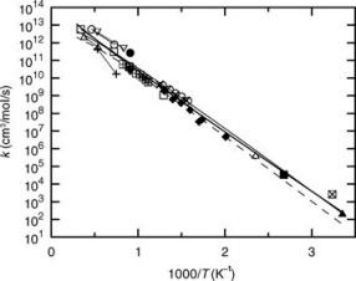
Figure 4 Rate constant of reaction HCO+ M →H+ CO+ M (R24). Symbols and lines with symbols are literature results: 田 Friedrichs et al. [ 19]; Hidaka et al. [20]: o Timonen et al. [57]; Pearson et al. [60]; -8- Schecker et al. [61]; 8- Browne et al. [62]; Bowman [63]; ▲ Ahumada et al. [64]; Baldwin et al. [65]; Wang et al. [66]; v Westbrook et al. [67]; Campbell et al. [68]; v Hochnadel et al [69]; Cherian et al. [70]; Cribb et al. [71]; Krasnoperov et al. [72]; Hippler et al. [73]. The dotted line is the recommendation of Timonen et al. [57], the dashed line is the recommendation of Friedrichs et al. [ 19], and the solid line represents the values used in the present model (Eq. (3)).
1500–2000 K, the prediction of Eq. (3) agrees with the data correlation of Timonen et al. [57] within 30% and is about 2–3 times higher than the correlation recom- mended by Friedrichs et al. [ 19]. Over 500–1300 K, where the rate coefficient of (R24) was measured by Friedrichs et al. [ 19], Timonen et al. [57], Krasnoperov et al. [72], and Hippler et al. [73], the current cor- relation predicts values almost equidistant from the measurements reported by Timonen et al. [57] and Friedrichs et al. [ 19].
It should be noted that the correlation shown in Eq. (3) was obtained by fitting low-pressure limit data. Timonen et al. [57] concluded, based on resonance the- ory, that significant deviations from the low-pressure limit would occur at (high) pressures beyond the scope of practical combustion processes, and reaction (R24) may be regarded as being in the low-pressure limit for most combustion applications. Recently, the pressure dependence of the rate constant of reaction (R24) has been measured by Krasnoperov et al. [72] and Hip- pler et al. [73], and the data show a somewhat unusual pressure falloff behavior. Based on their measurements and an isolated resonance model with variable reso- nance lifetimes, Hippler et al. [73] challenged the con- clusions drawn by Timonen et al. [57] and indicated
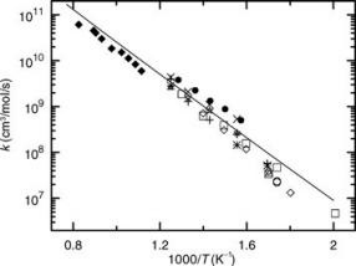
Figure 5 Pressure dependence of the rate constant of re-action (R24) as measured by Krasnoperov et al. [72] ( : 1 bar; ◇ : 10 bar; : 30 bar; o : 100 bar) and Hippler et al. [73] ( x : 1 bar; : 10 bar; 米 : 30 bar; + : 100 bar), the rate expression used in the present model (solid line) as well as the low pressure measurements of Friedrichs et al. [ 19] and Timonen et al. [57] ( and , respectively) are also shown for comparison.
that deviations from the low-pressure limit may occur even below atmospheric pressure; Krasnoperov [74], however, has questioned the experimental method and an alyses performed by Hippler et al. [73] when ob- taining low-pressure data (see [74,75] for full details). Figure5plots the pressure-dependent measurements of Krasnoperov et al. [72] and Hippler et al. [73] and com- pares them against the low-pressure data of Friedrichs et al. [ 19] and Timonen et al. [57] as well as Eq. (3). It is clearly seen that, even though falloff behavior is ob- served, the deviation from the low-pressure limit data is only significant at temperatures below 580 K; the calculated values (using Eq. (3)) are within a factor of 2–3 of the measured high-pressure data below this temperature. At lower temperatures and in any applica- tions related to combustion, the reaction of HCO with HO2 will be far more important than (R24). Therefore for combustion modeling, the use of a low-pressure limit rate constant for reaction (R24) causes no signif- icant differences in model predictions. Regardless of this result, more studies of the falloff behavior of (R24) are warranted.
Because there are few specific experimental rate constant measurements at high temperatures for (R25) (e.g., see NIST kinetics database; http://kinetics.nist. gov), the recommendation of Timonen et al. [58] was retained [93]. Given the fact that the new rate expression for (R24) (Eq. (3)) does not deviate considerably from the recommendation of Timonen et al. [57] over the temperature range relevant to flow reactor studies, retaining this rate coefficient does not significantly alter the k24/k25 ratio which, as mentioned above, is important for the CH2 O system at flow reactor conditions. More recently, Colberg and Friedrichs [76] published new measurements for the rate of reaction (R25) at both room temperature and in the temperature range of 739–1108 K. Implementing this newly proposed rate (k25 (295 K) = 3.55 × 10¹² ; k25 (739–1108 K) = 3.70 × 10¹³ exp(_1563/T ) cm3/ mol/s) in the present mechanis m has little impact on the quality of its predictions against targets discussed in the sections below. Under flow reactor conditions, this rate differs by no more than 20% from the recommendation of Timonen et al. [58], assuring a reasonable k24/k25 ratio. At higher temperatures (T > 1500 K), however, the new rate correlation yields values approximately twice those recommended in [58] and results in some differences in the modeling of laminar flame speeds (see Fig. 1). Laminar flame speed predictions are changed by approximately 10%, slightly more than typical uncertainties in modern measurements reported in the literature. On the basis of these results and considering that the new expression of Colberg and Friedrichs [76] has not been validated at higher temperatures, we continue to use the recommendation of [58] in the model reported here.
CH2 O-Related Reactions
In addition to the modifications inspecificrate constant correlations for reactions (R23), (R24), and (R25), other important reactions for the CH2 O/O2 system were reviewed and the rate constants were updated to those appearing in more recent publications. These reactions include
CH2 O+ M = H+ HCO+ M(R34)
CH2 O+ M = H2 + CO+ M(R35)
CH2 O+ H = HCO+ H2(R36)
CH2 O+ HO2 = HCO+ H2 O2(R40)
CH2 OH+ HCO = CH2 O+ CH2 O(R60)
Formaldehyde oxidation is very sensitive to the ab- straction reactions (R36) and (R40) under flow reac- tor conditions, and to the unimolecular decomposition reactions (R34) and (R35) in shock tube studies, as demonstrated earlier [9]. Eiteneer et al. [21] studied the ignition of CH2 O/O2/Ar mixtures behind reflected shock waves and developed an expression for the rate constant of reaction (R40) by fitting their data and liter- ature results. This new expression yields rates in close agreement with those used by Hochgreb and Dryer [9]
at intermediate temperatures (within 7% at 1000 K), while the predicted rate constant is about two times higher at 500 and 2000 K. In the current study, the rate correlation for (R40) suggested by Eiteneer et al. [21] was adopted.
Irdam et al. [77] performed formaldehyde pyroly- sis experiments and transition state theory calculations for reaction (R36). The recommended rate coefficient, adopted in the present study, was later found to be in excellent agreement with the direct measurements of Friedrichs et al. [78]. In a shock tube study of CH2 O thermal decomposition, Friedrichs et al. [22] measured the species time history profiles of CH2 O andHCO and conducted RRKM calculations for reactions (R34) and (R35). The authors also presented a new value for the rate constant of reaction (R60), which becomes impor- tant for mixtures with high concentrations of CH2 O. The recommendations of Friedrichs et al. [22] for reac- tions (R34), (R35), and (R60) were used in the current mechanis m. In addition, the rate coefficient of reac- tion,
CH2 OH+ HCO = CH3 OH+ CO (R59)
which competes with reaction (R60), was modified to 1 × 1013 cm3/mol/s, thus keeping the branching ratio, k60/k59 , the same as in the original mechanis m [4].
Furthermore, in an effort to include in the present model the most up-to-date rate information for the sys- tems treated in this study, the very recent measurements of the addition of OH and O2 to formaldehyde (reac- tions (R38) and (R39), respectively) have been adopted from the studies of Vasudevan et al. [79,80]. The rec- ommended rate constants [79,80] are within a factor of 2 of those suggested by Tsang and Hampson [81].
CH3 OH-Related Reactions
As in the case of formaldehyde, themethanol oxidation system is very sensitive to fuel abstraction and decom- position reactions [4]. There are several publications on the kinetics of these reactions that have appeared after the work of Held and Dryer [4]. In GRI-Mech 3.0 [47], the decomposition reactions of methanol were investigated using the RRKM theory and results were then fitted to several sets of experimental data pub- lished from 1984 to 1994. The obtained rate constants were expressed in Troe form [82] for the temperature and pressure dependence of the decomposition reac- tions. Koike et al. [83] have estimated the rate constant of the major decomposition reaction of methanol,
CH3 OH (+ M) = CH3 + OH (+ M) (R72)
from shock tube experiments of CH3 OH pyrolysis at 0.4–0.82 atm and 1400–2500 K. Under these condi- tions, the estimated rate constant isin reasonable agree- ment (about 50%) with that provided in GRI-Mech 3.0. In a more recent study, Krasnoperov and Michael [84] have reported the experimental recombination rates of CH3 and OH at conditions close to high-pressure limit that are lower than the high-pressure reverse rate of (R72) used by GRI-Mech. While detailed multichan- nel simulations of this system that would attempt to reconcile these new data are clearly warranted for fu- ture studies, the GRI-Mech 3.0 [47] rate constants for methanol decomposition reactions were adopted in the current study. There are two pathways for methanol abstraction reactions due to the two distinct sites of H atoms in CH3 OH molecules. Jimenez et al. [85] experimentally derived the total rate constants of the abstraction reaction
CH3 OH+ OH → products
at 235–360 K. The total rate constants agree within 20% with those of Bott and Cohen [86], which were used in the original mechanis m [4] and retained in the present work.
RESULTS AND DISCUSSION
The revised C1/O2 mechanis m as described above con- sists of 84 reversible elementary reactions among 18 species and the thermochemical data listed in Tables I and II, respectively. Reverse rate constants are com- puted from the forward rate constants and the equilib- rium constants. The first 31 reactions listed in Table I can be used as the comprehensive kinetic model for CO combustion, and it predicts the same behavior of CO/H2/O2 systems as that found using the entire C1 oxidation mechanis m. The absence of potential C2 submechanis m elements as well as CH2 (singlet and triplet states) reactions on CO, CH2 O, and CH3 OH oxidation predictions for the targets investigated here was tested by incorporating a C2HX (X = 1–6) reac- tion subset primarily taken from Wang et al. [ 112] and comparing predictions with the original mechanis m. Negligible differences were found for all of the cases studied here. For example, the compiled C2 mechanis m predicts less than 1% higher CH3 OH/air flame speeds than the present C1 model.
The current C1/O2 mechanis m has been compared against a wide range of experimental results, includ- ing laminar flame speeds, shock tube ignition delay data, and species profiles measured in flow reactor, shock tube, and burner-stabilized flame studies.
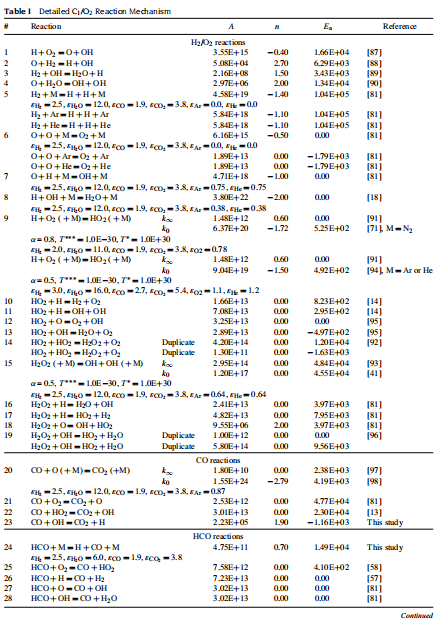
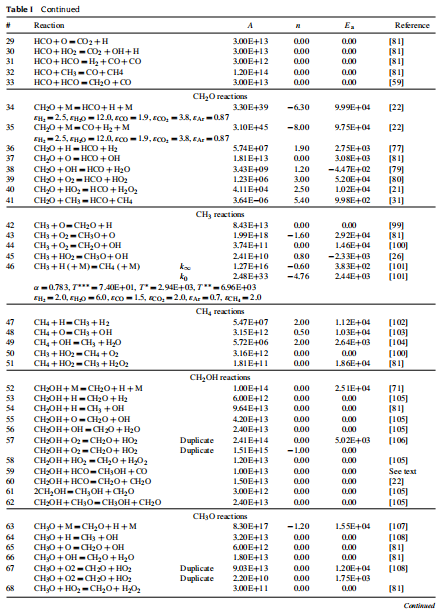
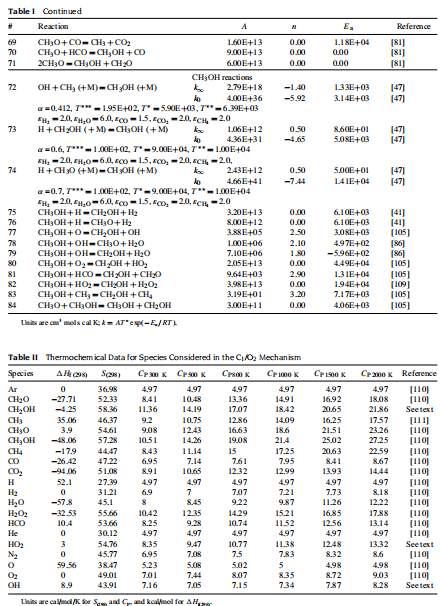
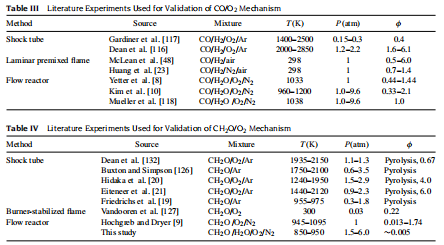
SENKIN code [ 113] was used to simulate experimen- tal conditions in shock tubes and flow reactors assum- ing adiabatic systems under constant volume and con- stant pressure, respectively. The PREMIX code [ 114] was used for flame calculations. We used the standard CHEMKIN transport package [ 115] with Soret effects and multicomponent diffusion included. To assure a fully converged flame speed prediction, a minimum of 1000 grid points was imposed in the PREMIX calcula- tions. Tables III–V list the experiments that the current CO/H2/O2 , CH2 O/O2 , and CH3 OH/O2 mechanis m has been compared against. Representative results for these comparisons are shown in Figs.6–26. The performance of each of the hierarchical submechanis ms involving carbon is discussed below.
CO/H2/O2 Mechanis m Predictions
Comparisons in Figs. 6 and 7 show that the predic- tions of the current CO oxidation mechanis m are in good agreement with thepremixed laminarflame speed measurements for CO/H2/O2/N2 mixtures at atmo-spheric pressure. Predictions also compare very well with shock tube ignition delay data, as demonstrated in Figs. 8 and 9. The predicted ignition delay times presented in these figures were defined as the time required for CO2 [ 116] or OH [ 117] concentration to reach aspecified value, similar to the criteria used in the experimental work. Figures 10 and 11 show the time history of major species under flow reactor conditions. Predictions using the current mechanis m agree very well with all of the experimental target information.
spheric pressure. Predictions also compare very well with shock tube ignition delay data, as demonstrated
in Figs. 8 and 9. The predicted ignition delay times presented in these figures were defined as the time required for CO2 [ 116] or OH [ 117] concentration to reach aspecified value, similar to the criteria used in the experimental work. Figures 10 and 11 show the time history of major species under flow reactor conditions. Predictions using the current mechanis m agree very well with all of the experimental target information. Sensitivity an alyses were performed based on the present CO oxidation mechanis m for three representa-tive cases: the laminar premixed flame speed at equiv-alence ratio of 5.0 [48], the mass fraction of CO in a VPFR case at 3.5 atm [ 118], and the ignition de-lay time under the shock tube conditions of Dean et al. [ 116]. The most sensitive reactions along with their sensitivity coefficients are shown in Fig. 12. The normalized sensitivity coefficient of a reaction is de-fined as, ∂ ln Y/∂ ln k , ∂ ln s/∂ ln k, and ∂ lnτ/∂ ln k for the disappearance of a species Y in a flow reactor, for laminar flame speed, and for ignition delay time,
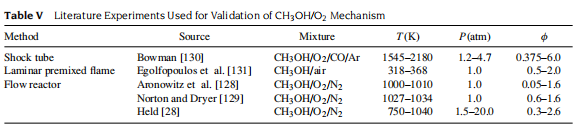
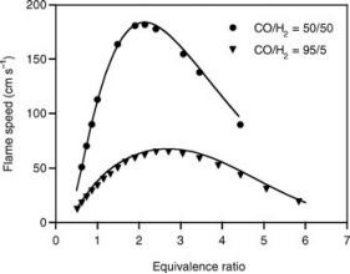
Figure 6 Laminar flame speeds of CO/H2/air mixtures at 298 K and 1 atm for two fuel compositions (95% CO+ 5% H2 or 50% CO+ 50% H2). Symbols represent the exper- imental data [48], and lines are predictions of the present CO/H2/O2 mechanis m.
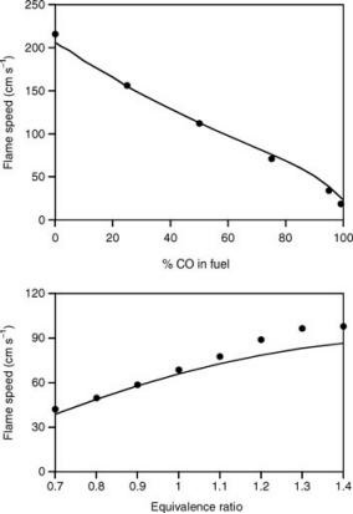
Figure 7 Laminar flame speeds for stoichiometric CO/H2/air mixtures (top) and reformer gas/air mixtures (bot- tom) at 298 K and 1 atm. Composition of reformer gas is 28% H2, 25% CO, and 47% N2 . Symbols represent the ex- perimental data of McLean et al. [48] (top), and Huang et al. [23] (bottom). Lines are predictions of the present CO/H2/O2 mechanis m.
详细内容请见附件
免责声明:
本页面/内容部分素材来源于互联网公 开 信 息,旨在传递更多信息,不代表本平台立场。
版权归原作者或机构所有,如涉及侵权,请通过平台联系我们,我们将在核实后第一时间处理。
本平台对转载内容的真实性、准确性不作任何保证,用户需自行判断并承担使用风险。