大家一起学标准之IEC61400-1(16)

点击听全文,今天大家继续一起学IEC61400-1。
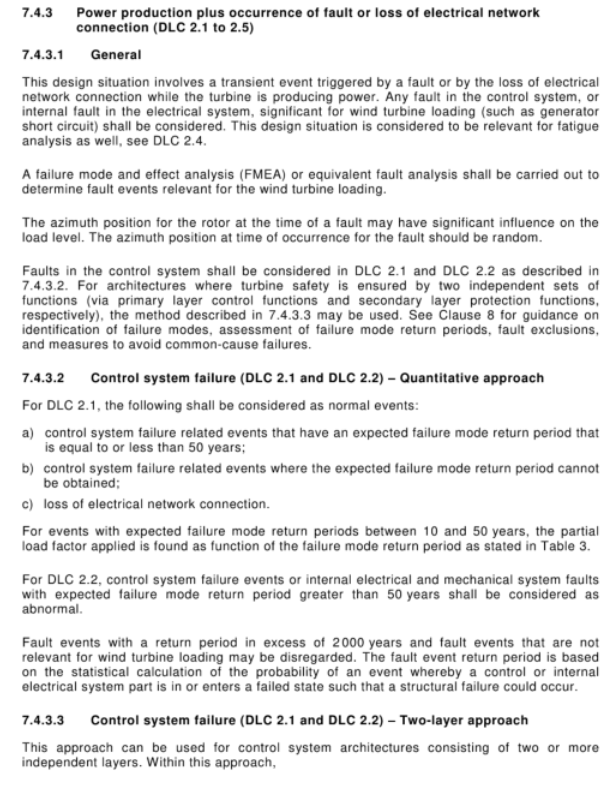

7.4.3 Power production plus occurrence of fault or loss of electrical network connection (DLC 2.1 to 2.5)
7.4.3.1 General
This design situation involves a transient event triggered by a fault or by the loss of electrical network connection while the turbine is producing power. Any fault in the control system, or internal fault in the electrical system, significant for wind turbine loading (such as generator short circuit) shall be considered. This design situation is considered to be relevant for fatigue a nalysis as well, see DLC 2.4.
A failure mode and effect an alysis (FMEA) or equivalent fault a nalysis shall be carried out to determine fault events relevant for the wind turbine loading.
The azimuth position for the rotor at the time of a fault may have significant influence on the load level. The azimuth position at time of occurrence for the fault should be random.
Faults in the control system shall be considered in DLC 2.1 and DLC 2.2 as described in 7.4.3.2. For architectures where turbine safety is ensured by two independent sets of functions (via primary layer control functions and secondary layer protection functions, respectively), the method described in 7.4.3.3 may be used. See Clause 8 for guidance on identification of failure modes, assessment of failure mode return periods, fault exclusions, and measures to avoid common-cause failures.
7.4.3.2 Control system failure (DLC 2.1 and DLC 2.2) – Quantitative approach
For DLC 2.1, the following shall be considered as normal events:
a) control system failure related events that have an expected failure mode return period that is equal to or less than 50 years;
b) control system failure related events where the expected failure mode return period cannot be obtained;
c) loss of electrical network connection.
For events with expected failure mode return periods between 10 and 50 years, the partial load factor applied is found as function of the failure mode return period as stated in Table 3.
For DLC 2.2, control system failure events or internal electrical and mechanical system faults with expected failure mode return period greater than 50 years shall be considered as abnormal.
Fault events with a return period in excess of 2000 years and fault events that are not relevant for wind turbine loading may be disregarded. The fault event return period is based on the statistical calculation of the probability of an event whereby a control or internal electrical system part is in or enters a failed state such that a structural failure could occur.
7.4.3.3 Control system failure (DLC 2.1 and DLC 2.2) – Two-layer approach
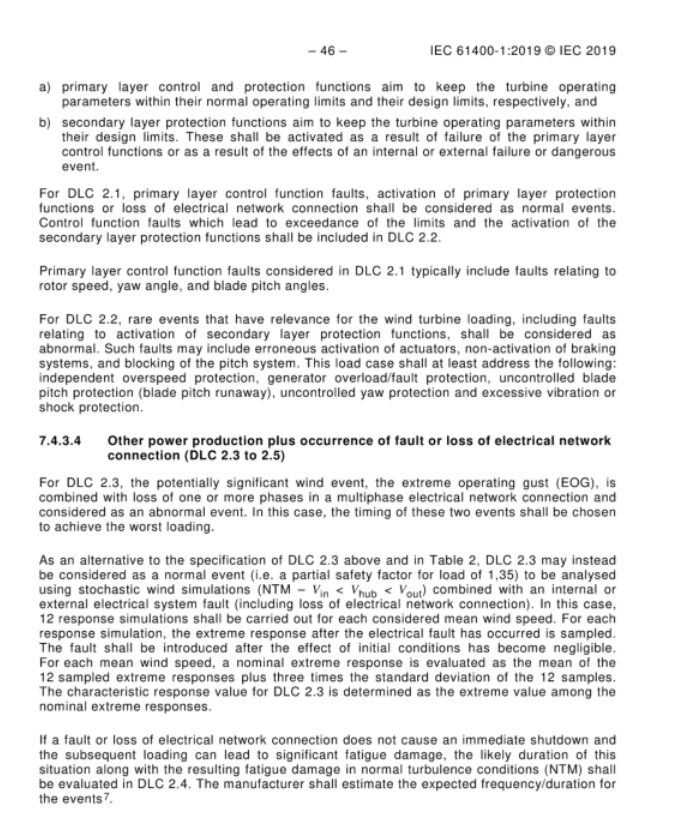
This approach can be used for control system architectures consisting of two or more independent layers. Within this approach,
a) primary layer control and protection functions aim to keep the turbine operating parameters within their normal operating limits and their design limits, respectively, and
b) secondary layer protection functions aim to keep the turbine operating parameters within their design limits. These shall be activated as a result of failure of the primary layer control functions or as a result of the effects of an internal or external failure or dangerous event.
For DLC 2.1, primary layer control function faults, activation of primary layer protection functions or loss of electrical network connection shall be considered as normal events. Control function faults which lead to exceedance of the limits and the activation of the secondary layer protection functions shall be included in DLC 2.2.
Primary layer control function faults considered in DLC 2.1 typically include faults relating to rotor speed, yaw angle, and blade pitch angles.
For DLC 2.2, rare events that have relevance for the wind turbine loading, including faults relating to activation of secondary protection functions, shall be considered as abnormal. Such faults may include erroneous activation of actuators, non-activation of braking systems, and blocking of the pitch system. This load case shall at least address the following: independent overspeed protection, generator overload/fault protection, uncontrolled blade pitch protection (blade pitch runaway), uncontrolled yaw protection and excessive vibration or shock protection.
7.4.3.4 Other power production plus occurrence of fault or loss of electrical network connection (DLC 2.3 to 2.5)
For DLC 2.3, the potentially significant wind event, the extreme operating gust (EOG), is combined with loss of one or more phases in a multiphase electrical network connection and considered as an abnormal event. In this case, the timing of these two events shall be chosen to achieve the worst loading.
As an alternative to the specification of DLC 2.3 above and in Table 2, DLC 2.3 may instead be considered as a normal event (i.e. a partial safety factor for load of 1,35) to be an alysed using stochastic wind simulations (NTM – Vin< Vhub< Vout) combined with an internal or external electrical system fault (including loss of electrical network connection). In this case, 12 response simulations shall be carried out for each considered mean wind speed. For each response simulation, the extreme response after the electrical fault has occurred is sampled. The fault shall be introduced after the effect of initial conditions has become negligible. For each mean wind speed, a nominal extreme response is evaluated as the mean of the 12 sampled extreme responses plus three times the standard deviation of the 12 samples. The characteristic response value for DLC 2.3 is determined as the extreme value among the nominal extreme responses.
If a fault or loss of electrical network connection does not cause an immediate shutdown and the subsequent loading can lead to significant fatigue damage, the likely duration of this situation along with the resulting fatigue damage in normal turbulence conditions (NTM) shall be evaluated in DLC 2.4. The manufacturer shall estimate the expected frequency/duration for the events.
For DLC 2.5, the event of low voltage ride through (LVRT) is considered as normal. The design low voltage ride through event shall be specified by voltage drop and duration.
7.4.3 发电工况叠加故障或电网连接丢失(DLC 2.1~2.5)
7.4.3.1 概述
该设计工况为机组发电运行过程中,由故障或电网掉电所触发的瞬态事件。应考虑所有对风力发电机组荷载具有显著影响的控制系统故障、电气系统内部故障(例如发电机短路)。该设计工况同样适用于疲劳分析,参见 DLC 2.4。
应开展失效模式与影响分析(FMEA)或等效故障分析,确定与风力发电机组荷载相关的故障事件。
故障发生时刻风轮所处方位角可能对荷载水平产生显著影响,故障发生时的方位角宜随机选取。
7.4.3.2 规定了 DLC 2.1 和 DLC 2.2 所需考虑的控制系统故障。对于依靠两套相互独立功能体系保障机组安全的架构(分别由第一层控制功能和第二层保护功能实现),可采用 7.4.3.3 所述方法。关于失效模式识别、失效模式重现期评估、可排除故障以及共因故障防范措施的指导内容参见第 8 章。
7.4.3.2 控制系统故障(DLC 2.1 和 DLC 2.2)—— 定量分析法
对于 DLC 2.1,下述事件应视为正常事件:
a) 与控制系统失效相关、失效模式预期重现期小于等于 50 年的事件;
b) 无法获取失效模式预期重现期的控制系统失效相关事件;
c) 电网连接丢失。
对于预期失效模式重现期介于 10 年~50 年之间的事件,所采用的荷载分项系数应按照表 3 规定,根据失效模式重现期确定。
对于 DLC 2.2,预期失效模式重现期大于 50 年的控制系统失效事件、电气与机械系统内部故障,应视为异常事件。
重现期超过 2000 年,以及与风力发电机组荷载无关的故障事件可不予考虑。故障事件重现期基于事件概率统计计算得到;该事件指控制系统或内部电气部件进入 / 处于失效状态,并可能引发结构失效。
7.4.3.3 控制系统故障(DLC 2.1 和 DLC 2.2)—— 双层架构分析法
该方法适用于具有两层及以上独立层级的控制系统架构。该方法中规定:
a) 第一层控制功能和保护功能分别用于将机组运行参数维持在正常运行限值和设计限值以内;
b) 第二层保护功能用于将机组运行参数维持在设计限值以内。当第一层控制功能失效,或是受内部、外部故障或危险事件影响时,第二层保护功能应被触发。
对于 DLC 2.1,第一层控制功能故障、第一层保护功能动作或电网连接丢失应视为正常事件。会造成参数超限并触发第二层保护功能的控制功能故障归入 DLC 2.2。
DLC 2.1 考虑的第一层控制功能故障通常包括与风轮转速、偏航角度、叶片桨距角相关的故障。
对于 DLC 2.2,与机组荷载相关的稀有事件(包括触发第二层保护功能的各类故障)应视为异常事件。此类故障包括执行机构误动作、制动系统拒动、变桨系统卡滞。该荷载工况至少应覆盖:独立超速保护、发电机过载 / 故障保护、叶片失控变桨保护(叶片变桨飞车)、偏航失控保护、过大振动或冲击保护。
7.4.3.4 其他发电工况叠加故障或电网连接丢失(DLC 2.3~2.5)
对于 DLC 2.3,将具有潜在显著影响的风况事件 —— 极端运行阵风(EOG)与多相电网一相或多相失电进行组合,并视为异常事件。此时应选取两类事件的发生时序,使机组承受最不利荷载。
作为上文及表 2 中 DLC 2.3 规定的替代方案,也可将 DLC 2.3 视作正常事件(即荷载分项安全系数取 1.35),采用随机风仿真(NTM,切入风速<轮毂高度风速<切出风速)结合内部或外部电气系统故障(含电网连接丢失)开展分析。此时,对每个选定的平均风速均应开展 12 次响应仿真。每次仿真采集电气故障发生后的极限响应;故障应在初始条件的影响基本消除后引入。针对每一平均风速,标称极限响应取 12 组极限响应采样值的平均值加上 3 倍采样标准差;DLC 2.3 的特征响应值取各组标称极限响应中的最大值。
若故障或电网连接丢失不会造成机组立即停机,且后续荷载会产生显著疲劳损伤,则应在 DLC 2.4 中评估该工况的预估持续时长,以及正常湍流模型(NTM)下产生的疲劳损伤。制造商应预估此类事件的预期发生频次与持续时长。
对于 DLC 2.5,低电压穿越(LVRT)事件视为正常事件。设计所用低电压穿越工况应明确电压跌落幅值与持续时间。
简单总结
本节规定风机发电叠加故障或电网脱网的荷载校核规则:需通过 FMEA 筛查影响机组荷载的故障,随机选取故障风轮方位角。可采用定量法或双层控制架构法区分正常、异常故障工况,剔除重现期极长、无荷载影响的故障。DLC2.3 校核极端阵风叠加电网缺相的最不利荷载,也可通过多组随机仿真计算;DLC2.4 评估故障未停机带来的长期疲劳损伤;DLC2.5 将低电压穿越归为正常工况,设计需明确电压跌落参数。
今天就学到这里,明天我们继续学习,每天十分钟大家一起学标准。