大家一起学标准之IEC61400-1(4)

点击听全文,今天大家继续一起学IEC61400-1。
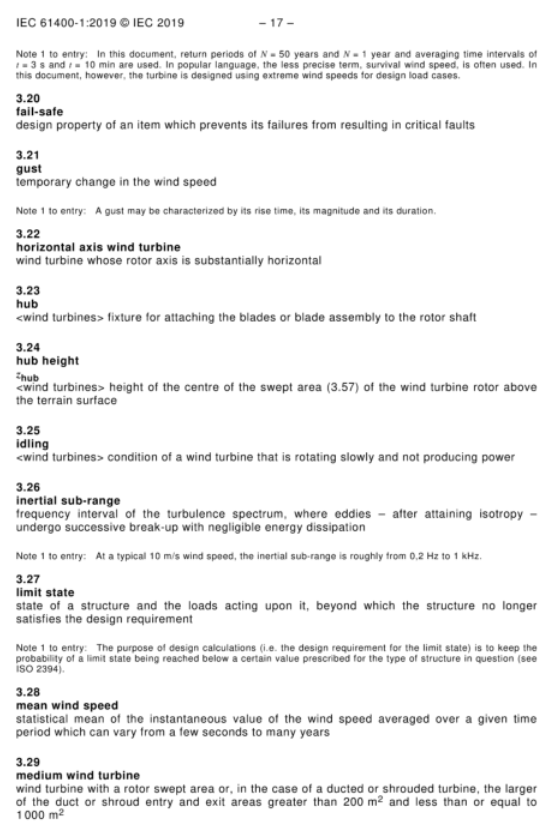
3.20 fail-safe 故障安全
design property of an item which prevents its failures from resulting in critical faults.
设备自身具备的设计特性,可避免自身失效引发致命重大故障。
3.21 gust 阵风
temporary change in the wind speed.
风速的瞬时短时突变。
Note 1 to entry: A gust may be characterized by its rise time, its magnitude and its duration.
本条注释 1:阵风可由上升时间、幅值大小、持续时长三个参数表征。
3.22 horizontal axis wind turbine 水平轴风力发电机组
wind turbine whose rotor axis is substantially horizontal。
风轮旋转主轴基本呈水平布置的风力发电机。
3.23 hub 轮毂
fixture for attaching the blades or blade assembly to the rotor shaft.
用于将单支叶片或叶片总成固定安装至风轮主轴的连接件。
3.24 hub height 轮毂高度
height of the centre of the swept area (3.57) of the wind turbine rotor above the terrain surface.
< 风机专用 > 风轮扫掠面几何中心距离地面地形的垂直高度。
3.25 idling 空转待机
condition of a wind turbine that is rotating slowly and not producing power.
风轮低速旋转、机组不向外输出电能的运行状态。
3.26 inertial sub-range 惯性子区
frequency interval of the turbulence spectrum, where eddies – after attaining isotropy – undergo successive break-up with negligible energy dissipation.
湍流谱中的一段频率区间:涡旋达到各向同性后逐级分裂耗散,此过程能量损耗可忽略不计。
Note 1 to entry: At a typical 10 m/s wind speed, the inertial sub-range is roughly from 0.2 Hz to 1 kHz.
本条注释 1:常规 10m/s 风速下,惯性子区大致范围为 0.2Hz ~ 1kHz。
3.27 limit state 极限状态
state of a structure and the loads acting upon it, beyond which the structure no longer satisfies the design requirement.
结构与所受载荷构成的临界状态,一旦超出该状态,结构将不再满足设计规定的安全要求。
Note 1 to entry: The purpose of design calculations (i.e. the design requirement for the limit state) is to keep the probability of a limit state being reached below a certain value prescribed for the type of structure in question (see ISO 2394).
本条注释 1:结构设计计算(即极限状态设计要求)的核心目的,是将结构抵达极限状态的概率控制在该类结构规范限定的允许值以内(参见 ISO 2394)。
3.28 mean wind speed 平均风速
statistical mean of the instantaneous value of the wind speed averaged over a given time period which can vary from a few seconds to many years.
对可从数秒至数年不等的给定时长内的瞬时风速取统计平均值。
3.29 medium wind turbine 中型风力发电机组
wind turbine with a rotor swept area or, in the case of a ducted or shrouded turbine, the larger of the duct or shroud entry and exit areas greater than 200 m² and less than or equal to 1000 m².
风轮扫掠面积大于 200㎡且不大于 1000㎡;对于导流罩式机组,取导流罩进出口面积中的较大值,满足该面积区间即为中型风机。
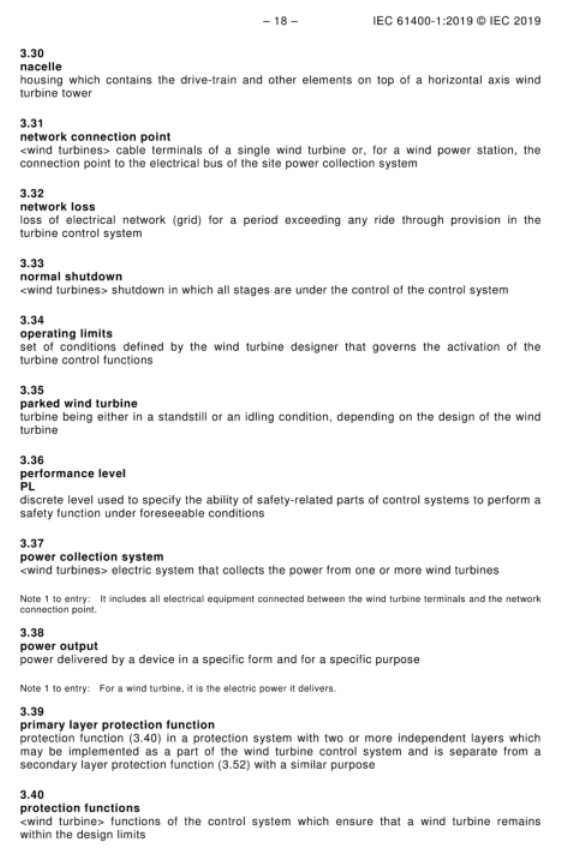
3.30 nacelle 机舱
housing which contains the drive-train and other elements on top of a horizontal axis wind turbine tower.
安装在水平轴风机塔筒顶端,容纳传动链及其他核心部件的舱体结构。
3.31 network connection point 并网点
cable terminals of a single wind turbine or, for a wind power station, the connection point to the electrical bus of the site power collection system.
单台风机的电缆接线端子;风电场场景下,指机组接入场内集电系统母线的连接点位。
3.32 network loss 电网失电 / 电网脱网
loss of electrical network (grid) for a period exceeding any ride through provision in the turbine control system.
电网供电中断,且断电时长超出风机控制系统具备的低电压穿越能力时长。
3.33 normal shutdown 正常停机
shutdown in which all stages are under the control of the control system.
停机全过程完全由机组控制系统有序管控的停机流程。
3.34 operating limits 运行限值
set of conditions defined by the wind turbine designer that governs the activation of the turbine control functions.
由风机设计方划定的一组边界条件,一旦触发将启动机组各类控制保护功能。
3.35 parked wind turbine 停机静置风机
turbine being either in a standstill or an idling condition, depending on the design of the wind turbine.
依据机组设计方案,风轮处于完全锁死静止或低速空转待机状态的风机。
3.36 performance level (PL) 性能等级
discrete level used to specify the ability of safety-related parts of control systems to perform a safety function under foreseeable conditions.
用于分级定义控制系统安全相关部件,在可预见工况下执行安全保护功能能力的离散等级。
3.37 power collection system 场内集电系统
electric system that collects the power from one or more wind turbines.
汇集单台或多台风机发电量的电气系统。
Note 1 to entry: It includes all electrical equipment connected between the wind turbine terminals and the network connection point.
本条注释 1:包含风机接线端子至电网并网点之间全部电气设备。
3.38 power output 输出功率
power delivered by a device in a specific form and for a specific purpose.
设备以特定形式、为特定用途向外输送的功率。
Note 1 to entry: For a wind turbine, it is the electric power it delivers.
本条注释 1:针对风力发电机组,特指其输出的电功率。
3.39 primary layer protection function 主层级保护功能
protection function (3.40) in a protection system with two or more independent layers which may be implemented as a part of the wind turbine control system and is separate from a secondary layer protection function (3.52) with a similar purpose.
多层独立防护体系中的第一层保护逻辑,可集成在机组主控系统内,与功能目的相近的次级保护层级相互独立、分设冗余。
3.40 protection functions 保护功能
functions of the control system which ensure that a wind turbine remains within the design limits.
控制系统内置的各类逻辑功能,用于保障机组运行参数始终不超出设计限值。
简单总结
该部分属于 IEC 61400-1:2019 第 3 章术语续篇,依次定义风况、机型、整机结构、电网接口、停机方式、安全防护层级、极限状态等核心专业名词,明确惯性湍流区间、中型风机面积界定、主次级保护架构等设计判定依据,是后续载荷工况、保护逻辑、机型分级设计的统一术语基准。
今天就学到这里,明天我们继续学习,每天十分钟大家一起学标准。