流体力学基础(第六版)核心内容整理(Fundamentals of FluidMechanics)

流体力学基础(第六版)核心内容整理(Fundamentals of FluidMechanics)
摘要:本文为流体力学经典教材《Fundamentals of Fluid Mechanics》第六版,面向工科本科入门课程。全书分流体静力学、伯努利方程、控制体积分析、可压缩流、叶轮机械等十二核心章节,系统讲解流体基础物性、量纲分析、边界层、管道流动等核心理论。教材配套 159 段流体实景视频、超 1300 道分层习题,创新采用 “已知 - 求解 - 点评” 标准化例题格式,同时提供 WileyPLUS 线上数字化学习平台,内置交互式动画、自动批改题库与 FlowLab 简易 CFD 工具。书中兼顾 SI 与英制两套单位,结合冰山、水黾、空化等工程实例,兼顾理论推导与工程仿真实操,是流体力学入门权威教学用书。
Achieve Positive Learning Outcomes
WileyPLUS combines robust course
with interactive teaching and learning resources all in one easy-to-use system.
It has helped over half a million students and instructors
achieve positive learning outcomes in their courses.
WileyPLUS contains everything you and your students need— and nothing more, including:
The entire textbook online—with dynamic links from homework to relevant sections. Students can use the online text and save up to half the cost of buying a new printed book.
Automated assigning & grading of homework & quizzes.
An interactive variety of ways to teach and learn the material.
Instant feedback and help for students … available 24/7.

“WileyPLUS helped me become more prepared. There were more resources available using WileyPLUS than just using a regular [printed] textbook, which helped out significantly. Very helpful...and very easy to use.”
— Student Victoria Cazorla, Dutchess County Community College
See and try
WileyPLUS in action! Details and Demo:
www.wileyplus.com
Why WileyPLUS for Engineering?
WileyPLUS offers today’s Engineering students the interactive and visual learning materials they need to help them grasp difficult concepts—and apply what they’ve learned to solve problems in a dynamic environment.
A robust variety of examples and exercises enable students to work problems, see their results, and obtain instant feedback including hints and reading references linked directly to the online text.
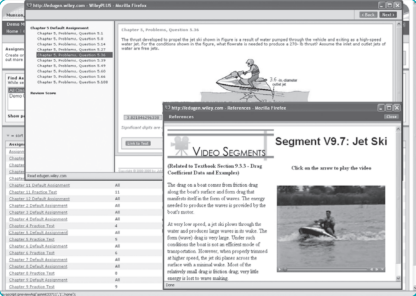
Students can visualize concepts from the text by linking to dynamic resources such as animations, videos, and interactive LearningWare.
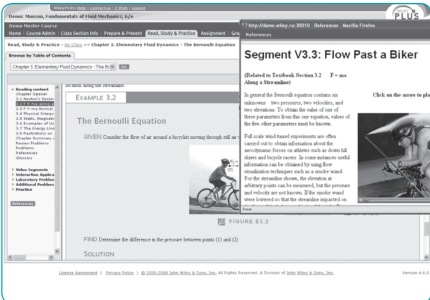
See and try WileyPLUS in action!
Details and Demo: www.wileyplus.com
WileyPLUS combines robust course management tools with the complete online text and all of the interactive teaching & learning resources you and your students need in one easy-to-use system.
“I loved this program [WileyPLUS] and I hope I can
use it in the future.” — Anthony Pastin, West Virginia University
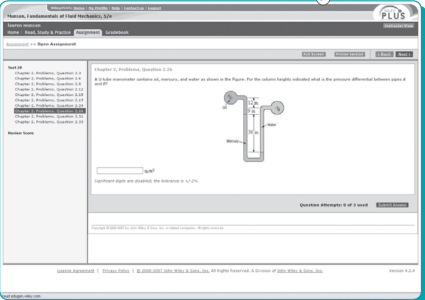
Algorithmic questions allow a group of students to work on the same problem with differing values. Students can also rework a problem with differing values for additional practice.
MultiPart Problems and GoTutorials lead students through a series of steps, providing instant feedback along the way, to help them develop a logical, structured approach to problem solving.
Or, they can link directly to the online text to read about this concept before attempting the problem again—with or without the same values.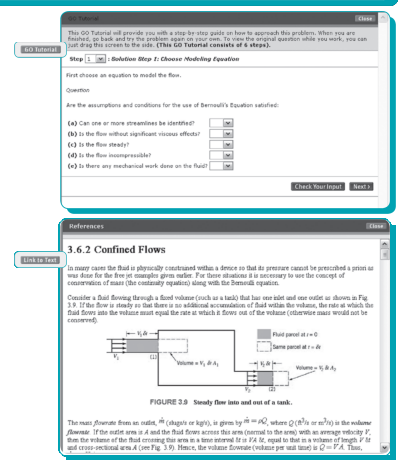
Wiley is committed to making your entire WileyPLUS experience productive & enjoyable by providing the help, resources, and personal support you & your students need, when you need it.
It’s all here: www.wileyplus.com
TECHNICAL SUPPORT:
A fully searchable knowledge base of FAQs and help documentation, available 24/7
Live chat with a trained member of our support staff during business hours
A form to fill out and submit online to ask any question and get a quick response
Instructor-only phone line during business hours: 1.877.586.0192
FACULTY-LED TRAINING THROUGH THE WILEY FACULTY NETWORK:
Register online: www.wherefacultyconnect.com
Connect with your colleagues in a complimentary virtual seminar, with a personal mentor in your field, or at a live workshop to share best practices for teaching with technology.

1ST DAY OF CLASS AND BEYOND!
Resources You & Your Students Need to Get Started & Use WileyPLUS from the first day forward.
2-Minute Tutorials on how to set up & maintain your WileyPLUS course
User guides, links to technical support & training options
WileyPLUS for Dummies: Instructors’ quick reference guide to using WileyPLUS
Student tutorials & instruction on how to register, buy, and use WileyPLUS

YOUR WileyPLUS ACCOUNT MANAGER:
Your personal WileyPLUS connection for any assistance you need!
SET UP YOUR WileyPLUS COURSE IN MINUTES!
Selected WileyPLUS courses with QuickStart contain pre-loaded assignments & presentations created by subject matter experts who are also experienced WileyPLUS users.

Interested? See and try WileyPLUS in action! Details and Demo: www.wileyplus.com
Sixth Edition Fundamentals of Fluid Mechanics
BRUCE R. MUNSON DONALD F. YOUNG
Department of Aerospace Engineering and Engineering Mechanics
THEODORE H. OKIISHI
Department of Mechanical Engineering
Iowa State University Ames, Iowa, USA
WADE W. HUEBSCH
Department of Mechanical and Aerospace Engineering West Virginia University
Morgantown, West Virginia, USA
To Erik and all others who possess the curiosity,
patience, and desire to learn
Publisher: Don Fowley
Editorial Assistant: Mark Owens
Acquistions Editor: Jennifer Welter
Media Editor: Lauren Sapira
Marketing Manager: Christopher Ruel
Production Manager: Dorothy Sinclair
Production Editor: Sandra Dumas
Senior Designer: Madelyn Lesure
Production Management Services: Ingrao Associates/Suzanne Ingrao
Cover: photo shows the development of vortices which the water strider uses for moving on the surface of
water by the transfer of momentum from the movement of its legs to the shed vortices (i.e. rowing). The fluid dynamics are visualized by adding thymol blue to the water surface. For more on water striders, see the
following in this text: Problem 1.103 in Chapter 1; Fluids in the News titled “Walking on water” in Sect. 1.9; and Video V10.3 “Water strider” in Chapter 10. Photo courtesy of David L. Hu and John W. M. Bush, MIT.
This book was typeset in 10/12 Times Roman by Aptara®, Inc., and printed and
bound by R. R. Donnelley/Jefferson City. The cover was printed by R. R. Donnelley/Jefferson City.
The paper in this book was manufactured by a mill whose forest management programs include sustained yield harvesting of its timberlands. Sustained yield harvesting principles ensure that the number of trees cut each year does not exceed the amount of new growth.
This book is printed on acid-free paper. ∞
Copyright © 2009, 2006, 2002, 1999, 1994, 1990 by John Wiley & Sons, Inc. All rights reserved.
No part of this publication may be reproduced, stored in a retrieval system or transmitted in any form or by any means, electronic, mechanical, photocopying, recording, scanning or otherwise, except as permitted under
Sections 107 or 108 of the 1976 United States Copyright Act, without either the prior written permission of the Publisher or authorization through payment of the appropriate per-copy fee to the Copyright Clearance Center, 222 Rosewood Drive, Danvers, MA 01923, (978) 750-8400, fax (978) 646-8600. Requests to the
Publisher for permission should be addressed to the Permission Department, John Wiley & Sons, Inc., 111 River Street, Hoboken, NJ 07030-5774, (201) 748-6011, fax (201) 748-6008. To order books or for
customer service call 1-800-CALL-WILEY (225-5945).
Munson, Bruce R., Young, Donald F., Okiishi, Theodore H., Huebsch, Wade W.
Fundamentals of Fluid Mechanics, Sixth Edition ISBN 978-0470-26284-9
Printed in the United States of America.
10 9 8 7 6 5 4 3 2 1
About the Authors
Bruce R. Munson, Professor Emeritus of Engineering Mechanics at Iowa State University, received his B.S. and M.S. degrees from Purdue University and his Ph.D. degree from the Aerospace Engi- neering and Mechanics Department of the University of Minnesota in 1970.
Prior to joining the Iowa State University faculty in 1974, Dr. Munson was on the mechanical engineering faculty of Duke University from 1970 to 1974. From 1964 to 1966, he worked as an en- gineer in the jet engine fuel control department of Bendix Aerospace Corporation, South Bend, Indiana.
Dr. Munson’s main professional activity has been in the area of fluid mechanics education and research. He has been responsible for the development of many fluid mechanics courses for studies in civil engineering, mechanical engineering, engineering science, and agricultural engineering and is the recipient of an Iowa State University Superior Engineering Teacher Award and the Iowa State University Alumni Association Faculty Citation.
He has authored and coauthored many theoretical and experimental technical papers on hy- drodynamic stability, low Reynolds number flow, secondary flow, and the applications of viscous in- compressible flow. He is a member of The American Society of Mechanical Engineers.
Donald F. Young, Anson Marston Distinguished Professor Emeritus in Engineering, received his B.S. degree in mechanical engineering, his M.S. and Ph.D. degrees in theoretical and applied mechanics from Iowa State Uiversity, and has taught both undergraduate and graduate courses in fluid mechanics at Iowa State for many years. In addition to being named a Distinguished Professor in the College of Engineer- ing, Dr. Young has also received the Standard Oil Foundation Outstanding Teacher Award and the Iowa State University Alumni Association Faculty Citation. He has been engaged in fluid mechanics research for more than 35 years, with special interests in similitude and modeling and the interdisciplinary field of biomedical fluid mechanics. Dr. Young has contributed to many technical publications and is the author or coauthor of two textbooks on applied mechanics. He is a Fellow of The American Society of Mechan- ical Engineers.
Ted H. Okiishi, Professor Emeritus of Mechanical Engineering at Iowa State University, joined the faculty there in 1967 after receiving his undergraduate and graduate degrees from that institution.
From 1965 to 1967, Dr. Okiishi served as a U.S. Army officer with duty assignments at the National Aeronautics and Space Administration Lewis Research Center, Cleveland, Ohio, where he participated in rocket nozzle heat transfer research, and at the Combined Intelligence Center, Saigon, Republic of South Vietnam, where he studied seasonal river flooding problems.
Professor Okiishi and his students have been active in research on turbomachinery fluid dy- namics. Some of these projects have involved significant collaboration with government and indus- trial laboratory researchers with two of their papers winning the ASME Melville Medal (in 1989 and 1998).
Dr. Okiishi has received several awards for teaching. He has developed undergraduate and gradu- ate courses in classical fluid dynamics as well as the fluid dynamics of turbomachines.
He is a licensed professional engineer. His professional society activities include having been a vice president of The American Society of Mechanical Engineers (ASME) and of the American Society for Engineering Education. He is a Life Fellow of The American Society of Mechanical En- gineers and past editor ofits Journal of Turbomachinery. He was recently honored with the ASME R. Tom Sawyer Award.
Wade W. Huebsch, Associate Professor in the Department of Mechanical and Aerospace Engineer- ing at West Virginia University, received his B.S. degree in aerospace engineering from San Jose State University where he played college baseball. He received his M.S. degree in mechanical engi- neering and his Ph.D. in aerospace engineering from Iowa State University in 2000.
Dr. Huebsch specializes in computational fluid dynamics research and has authored multiple journal articles in the areas of aircraft icing, roughness-induced flow phenomena, and boundary layer flow control. He has taught both undergraduate and graduate courses in fluid mechanics and has developed a new undergraduate course in computational fluid dynamics. He has received multi- ple teaching awards such as Outstanding Teacher and Teacher of the Year from the College of Engi- neering and Mineral Resources at WVU as well as the Ralph R. Teetor Educational Award from SAE. He was also named as the Young Researcher of the Year from WVU. He is a member of the American Institute of Aeronautics and Astronautics, the Sigma Xi research society, the Society of Automotive Engineers, and the American Society of Engineering Education.
Preface
This book is intended for junior and senior engineering students who are interested in learning some fundamental aspects of fluid mechanics. We developed this text to be used as a first course. The princi- ples considered are classical and have been well-established for many years. However, fluid mechanics education has improved with experience in the classroom, and we have brought to bear in this book our own ideas about the teaching of this interesting and important subject. This sixth edition has been pre- pared after several years of experience by the authors using the previous editions for introductory courses in fluid mechanics. On the basis of this experience, along with suggestions from reviewers, col- leagues, and students, we have made a number of changes in this edition. The changes (listed below, and indicated by the word New in descriptions in this preface) are made to clarify, update, and expand cer- tain ideas and concepts.
New to This Edition
In addition to the continual effort of updating the scope of the material presented and improving the presentation of all of the material, the following items are new to this edition.
With the wide-spread use of new technologies involving the web, DVDs, digital cameras and the like, there is an increasing use and appreciation of the variety of visual tools available for learning. This fact has been addressed in the new edition by the inclusion of numerous new illustrations, graphs, photographs, and videos.
Illustrations: The book contains more than 260 new illustrations and graphs. These illustrations range from simple ones that help illustrate a basic concept or equation to more complex ones that illustrate practical applications of fluid mechanics in our everyday lives.
Photographs: The book contains more than 256 new photographs. Some photos involve situations that are so common to us that we probably never stop to realize how fluids are involved in them. Others involve new and novel situations that are still baffling to us. The photos are also used to help the reader better understand the basic concepts and examples discussed.
Videos: The video library for the book has been significantly enhanced by the addition of 80 new video segments directly related to the text material. They illustrate many of the interesting and prac- tical applications of real-world fluid phenomena. There are now 159 videos.
Examples: All of the examples are newly outlined and carried out with the problem solving method of“Given, Find, Solution, and Comment.”
Learning objectives: Each chapter begins with a set of learning objectives. This new feature pro- vides the student with a brief preview of the topics covered in the chapter.
List of equations: Each chapter ends with a new summary of the most important equations in the chapter.
Problems: Approximately 30% new homework problems have been added for this edition. They are all newly grouped and identified according to topic. Typically, the first few problems in each group are relatively easy ones. In many groups of problems there are one or two new problems in which the student is asked to find a photograph/image of a particular flow situation and write a paragraph describing it. Each chapter contains new Life Long Learning Problems (i.e., one aspect of the life long learning as interpreted by the authors) that ask the student to obtain information about a given, new flow concept and to write a brief report about it.
Fundamentals of Engineering Exam: A set ofFE exam questions is newly available on the book web site.
原资料见附件
免责声明:
本页面/内容部分素材来源于互联网公 开 信 息,旨在传递更多信息,不代表本平台立场。
版权归原作者或机构所有,如涉及侵权,请通过平台联系我们,我们将在核实后第一时间处理。
本平台对转载内容的真实性、准确性不作任何保证,用户需自行判断并承担使用风险。