烃类燃烧小型详细化学反应动力学机理研究

烃类燃烧小型详细化学反应动力学机理研究(Williams_ hydrogencarbon mechanis m)
摘要:
本文提出一套适用于烃类燃烧的小型详细化学反应机理,聚焦1000 K 以上、100 atm 以下、当量比 < 3工况,剔除低温过氧化物与碳烟生成路径。机理采用层级构建,包含 H₂/CO、C₁–C₂子机理,并扩展至丙烷、丙烯、丙炔 / 丙二烯等 C₃燃料,共177 步基元反应、37 种组分。通过修正关键反应速率、热力学数据与三体效率,经激波管点火延迟、层流火焰速度多工况验证,模型预测精度与大型机理相当且计算高效。机理适用于自燃、爆燃、扩散火焰等场景,为工程燃烧模拟提供精简可靠的动力学工具。
A s mall detailed chemical-kinetic mechanis m for hydrocarbon combustion
M.V. Petrova*, F.A. Williams
Center for Energy Research, Department of Mechanical and Aerospace Engineering, University of California, San Diego, La Jolla, CA 92093, USA
Received 10 February 2005; received in revised form 21 July 2005; accepted 29 July 2005 Available online 29 September 2005
Abstract
A chemical-kinetic mechanis m is presented that is designed to be used for autoignition, deflagrations, detona- tions, and diffusion flames of a number of different fuels. To keep the mechanis m s mall, attention is restricted to pressures below about 100 atm, temperatures above about 1000 K, and equivalence ratios less than about 3 for the premixed systems, thereby excluding soot formation and low-temperature fuel–peroxide chemistry. Under these restrictions, hydrogen combustion is included with 21 steps among 8 chemical species, combustion of car- bon monoxide with 30 steps among 11 species, methane, methanol, ethane, ethylene, and acetylene combustion with 134 steps among 30 species, and propane, propene, allene, and propyne combustion with 177 steps among 37 species. The mechanis m has been extensively tested previously for all of these fuels except propane, propene, allene, and propyne. Tests are reported here for these last four fuels through comparisons with experiments and with predictions of other mechanis ms for deflagration velocities and shock-tube ignition.
◎ 2005 The Combustion Institute. Published by Elsevier Inc. All rights reserved.
Keywords: Chemical-kinetic mechanis ms; Autoignition; Deflagration; Propane combustion; Propene combustion; Allene and propyne combustion
1. Introduction
Descriptions of combustion processes, at the level of the elementary chemical steps that occur, on the ba- sis of their individual rate parameters, have enjoyed notable advance in recent years through the develop- ment of a variety of detailed chemical-kinetic mech- anis ms [1–8]. Different mechanis ms target different specific applications, but they have in common the principle that their elementary rate parameters must agree with what is known from fundamental rate mea- surements and computations, within the uncertainties of those fundamental studies. Since different elemen- tary steps are important in different applications, the broader the range of applications addressed, the larger must be the mechanis m. As a result, some mecha- nis ms for combustion now contain thousands of ele- mentary steps among hundreds of chemical species. There are, however, two major drawbacks to such large mechanis ms. One is the obvious fact that lim- ited computational facilities prohibit the use of very large mechanis ms in some combustion applications, notably in turbulent combustion, and even for sim- pler applications, it often can be inconvenient to make use of the large mechanis ms available in the literature. The other, perhaps less obvious drawback is that since there are uncertainties in values of every rate parame- ter, there is a greater formal cumulative uncertainty in predictions of a large mechanis m than of a s mall mechanis m. Since there also are obvious advantages to large mechanis ms, large and s mall detailed mecha- nis ms both have important places in combustion.
The present paper reports a s mall, yet detailed, mechanis m, aimed at a limited range of combustion problems and thoroughly validated against available experimental data for the fuels of interest. The valida- tions include the most recent autoignition data, which were not available for testing of the earlier mecha- nis ms. The aim of this work is to obtain a clearer un- derstanding of combustion chemistry under the condi- tions mentioned in the abstract, as well as to provide a mechanis m for the use of those investigators in need of manageable as well as reliable chemical-kinetic de- scriptions for C3 fuels.
The present mechanis m is built upon a base of well-validated and tested submechanis ms for com- bustion of hydrogen and C 1 and C2 fuels. Initially, only hydrogen combustion at moderate and low pres- sures [9] was considered. Later, the mechanis m pro- ceeded to include the combustion of carbon monox- ide [10,11] before going on to methane [12,13] and methanol [14,15]and then ethane [16], ethylene [17], and acetylene [18,19]. In addressing these latter hy- drocarbons, it becomes clear that a large number of elementary steps would be needed to describe prop- erly the low-temperature range, where there can be a negative temperature exponent for autoignition, or for predicting mechanis ms of soot production. To keep the mechanis m s mall, therefore, these processes were excluded, and only a limited range of combustion ap- plications was included, specifically the problems and conditions specified in the abstract. The submecha- nis m for formation of oxides of nitrogen was, how- ever, also investigated [12], and the ability to address combustion of heptane [20]and JP-10 [21]was added through lumping, since detailed chemistry descrip- tions for these last two fuels again would be exces- sively long. The present paper describes the exten- sion of this previously validated mechanis m to obtain a detailed elementary-chemistry description of com- bustion of hydrocarbon fuels with three carbon atoms, namely propane, propene, propyne, and allene. The intent of the paper is to document this extension by describing the pertinent reactions and reaction-rate parameters and to test the predictions of the current mechanis m for these additional fuels.
Interest in enlarging the mechanis m to encompass propane stems from the belief that the combustion of hydrocarbon fuels containing three or more carbon atoms is qualitatively different in some respects from
the combustion of such fuels having only one or two carbon atoms. In the combustion chemistry of most hydrocarbons, oxygen consumption is associated with radical production and fuel consumption with radi- cal removal [22,23]. The radical-removal effect of the fuel molecule is stronger for higher hydrocarbons, to such an extent that, for example, in propane autoigni- tion, in contrast to autoignition of methane or eth- ylene, for example, the radical buildup that leads to thermal runaway cannot occur until the fuel is almost completely depleted [24]. Capturing this qualitative difference of higher hydrocarbons necessitates ex- tending the mechanis m to include propane. Moreover, it is feasible to do this with a s mall mechanis m for propane while still dealing with elementary steps, but for heptane, for example, the mechanis m would have to be very large, if resort to lumping were prohibited. Even butane would require an appreciably larger de- tailed elementary mechanis m than propane, since the complexity of the fully detailed mechanis m increases very rapidly with the number of carbon atoms in the fuel molecule. Aside from its importance as a prac- tical fuel, propane, therefore, holds an almost unique place as a hydrocarbon fuel, representative of higher hydrocarbons, whose high-temperature detailed com- bustion chemistry is simple enough so that it can be described at the elementary-step level with a s mall mechanis m.
In combustion and autoignition processes, propane breaks down to propene before proceeding to prod- ucts. Similarly, propene combustion includes C3H4 chemistry. The inverse, however, does not occur; that is, propene does not play a significant role in the combustion of C3H4, and propane does not play any important role in the combustion of propene or C3H4, under the relatively fuel-lean conditions (φ < 3) discussed here. In studying propane com- bustion, it is therefore necessary to understand the combustion chemistry of propene and C3H4, but el- ementary steps involving propane are irrelevant to the combustion of these latter fuels. This observation points toward a strategy that is useful in developing a chemical-kinetic mechanis m for propane combus- tion: First identify a chemical-kinetic mechanis m for C3H4, testing it against available experimental data; then, using this mechanis m, determine a mechanis m for propene that is consistent with the available ex- perimental combustion data for this fuel; then, finally, keeping these mechanis ms fixed, find a successful mechanis m for propane. This strategy of hierarchi- cal submechanis ms was employed in the present work.
The current mechanis m, including references and rate parameters, is given in the following section. Changes that have been made for the previously val- idated hydrogen, C 1, and C2 reaction steps are dis-
evant chemical kinetics is presented. Experimental tests first of autoignition and then of burning-velocity predictions for allene, propyne, propene, and propane are exhibited. Finally, the conclusions that can be drawn from the study are summarized.
2. The current chemical-kinetic mechanis m
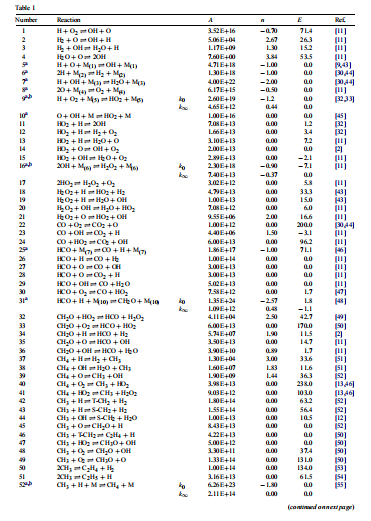
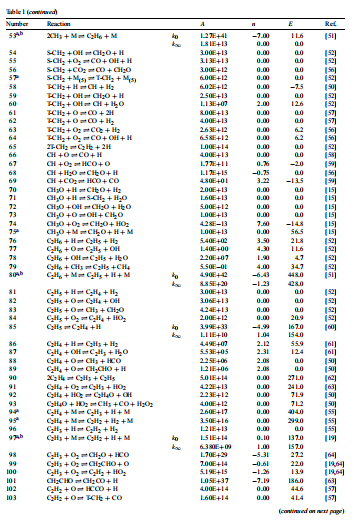
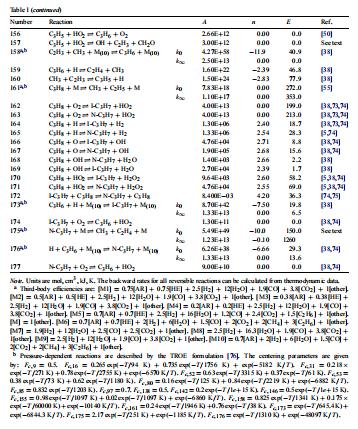
Table 1 summarizes the current detailed mecha- nis m [25]. This table facilitates brevity of the dis- cussion by enabling steps to be identified simply by the number in the table. Rate parameters as well as references are given for every reaction. All steps are reversible. The rate parameters are given only in the forward direction, and the rates in the backward direc- tion are calculated from thermochemical data. It was somewhat surprising to find large discrepancies in the thermochemical data from different sources [26,27] for certain species—discrepancies that produced no- ticeable differences in some of the curves to be shown later. This prompted investigation and validation of thermochemical data in the present work. It was de- termined that the compilation of Burcat [27], which includes, for example, the revised heat of formation of OH [28], is the most reliable and up to date, for the most part. These data, therefore, were adopted for current and future work, with one exception, namely the data for allyl, which were taken from Wang [29], a more recent evaluation that may be better than and is not far from the Burcat result. The C3H5 thermo- chemical properties had a significant effect on the ex- perimental comparisons for propane.
3. Changes to the previous H/C1/C2 mechanis m
This section describes relevant changes to our pre- vious H/C 1/C2 [25]submechanis m. The manageabil- ity of the current detailed mechanis m makes it very convenient for use in achieving our goal of under- standing the degree of involvement of various reac- tions in the given combustion processes. This section also describes some of the principal physics that came out of this study.
In the hydrogen submechanis m, the prefactor A of reaction 7 was increased by a little more than a factor of 2, well within experimental uncertainty, to improve agreement with measured burning velocities for a particular submechanis m[31]. We find that, with the current mechanis m as well, this improves burning- velocity agreements for hydrogen–air systems at the higher temperatures encountered in the vicinity of sto- ichiometric conditions, while this step is relatively unimportant at lower temperatures. The change for
step 9 is only an increase in the third-body efficiently of water, a revision that was needed for agreement with new autoignition data in wet atmospheres [32]. The revision in step 11 is a s mall one, based on reeval- uation [34] of information from which our previous value was attained, and it improves burning-velocity predictions for hydrogen and propane without affect- ing other previous comparisons significantly. Step 16 adds falloff, which originally [9] was not present, since falloff for this reaction becomes extremely im- portant as pressures approach and exceed 50 atm [32]. It has been observed [35] that the revised heat of formation of OH affects the rate parameters for this reaction, but we found that the resulting changes in the rate are s mall, well within uncertainty bounds, and therefore we have chosen not to modify our previous [25] result.
Propane autoignition times turn out to be quite sensitive to the rate of step 47. Our previous value for this rate was four times the value shown in Ta- ble 1. The s maller value increases propane autoigni- tion times and improves agreement with experiment. The original value was based on an older study [36] in which the uncertainty is appreciably larger than the change made here, and others have preferred lower rates [29], closer to our new value. The change does not have a significant influence on any of our previ- ous comparisons, except for s mall improvements in agreement between predicted and measured ignition times and burning velocities for methane [12,13] as a consequence of reducing concentrations of the most active radicals.
Step 105 is an example of a reaction with many channels, for which only one representative channel was chosen [18,19], for simplicity. The branching ra- tios and rate parameters for this step are likely to de- pend on both temperature and pressure; that is, it is not an actual elementary step but instead is only ap- proximated as one to achieve a s mall mechanis m. The rate for this step is higher than rates found elsewhere in the literature (although still within ranges of uncer- tainty) but is needed on the basis of autoignition and a number of different flame-structure measurements, where use of literature rates results in excessively slow acetylene disappearance, contrary to experiment [18,19].
In addition to depending strongly on the rate pa- rameters for step 47, propane ignition times are also quite sensitive to the rate parameters for step 107. The data used previously for this came from a detailed study of ketene pyrolysis [37], but the rate parame- ters obtained there have been revised in a more re- cent study [38]. The changes are not too large and are not likely to be inconsistent with the original [37] data, but they do improve agreement of our predic- tions with measured propane autoignition times very noticeably over certain ranges of conditions. We have changed the rate for these reasons and because the change does not appreciably affect our other results [17,19]. It may be noted that there are additional chan- nels for CH2CO + H, just as for C2H2 + OH, and certain of them are important for ketene pyrolysis in an inert atmosphere [37], but since we exclude such fuel-rich systems, we do not need such steps, and we therefore do not include them in our mechanis m.
4. Allene/propyne submechanis m
Reactions 135–177 in Table 1 summarize the rate parameters for the 43 steps involving species that contain three carbon atoms. The rate parameters are given in the forward direction, and the reverse rates are calculated from them by use of the thermochemi- cal data. Since different chaperon efficiencies are not fully available in the literature, we list only those that are available; for other reactions all species are as- signed chaperon efficiencies of unity. This is an il- lustration of the incompleteness of knowledge of de- tailed chemistry of these species, in comparison with species containing two or fewer carbon atoms[39,40].
Reactions 135–142 and 148–150 in Table 1 sum- marize the rate parameters and references for the C3H4 submechanis m. In the hierarchical spirit of our detailed mechanis m, this was the first C3 submech- anis m to be added on to our C2 submechanis m and validated against experimental data. Of the three sta- ble C3H4 isomers, allene and propyne are much more stable than cyclopropene, which is an intermediate in the isomerization of the other two and has a much higher entropy of formation [27]. It can be seen that the combustion properties of allene and propyne are quite similar. For example, it has been found that their ignition times measured in shock tubes are practi- cally identical [41]. These observations suggest that the isomerization of these two species typically is rapid under combustion conditions and that the C3H4 complex spends relatively little time in the cyclo- propene state [42]. In view of these observations, with the objective of achieving simplifications, only one species C3H4 is included in the present mechanis m. This species is viewed as representing both allene and propyne. This simplification eliminates the need to in- clude many reaction steps and rate parameters from the mechanis m. In particular, isomerization steps dis- appear, and cyclopropene is absent.
The selection of thermochemical and rate para- meters for C3H4 is made with this simplification in mind. Although the thermochemical data might best be taken to be an average of allene and propyne data, their values are close enough so that it is sufficient to use the properties of allene, which are intermedi- ate between those of propyne and cyclopropane but much closer to those of propyne. This choice sim- plifies procedures by enabling thermochemical prop- erties of just one real species to be used. For rate parameters, because of the presumed rapid isomeriza- tion, the more rapid rate for the two species allene or propyne was selected, since the chemistry will pro- ceed along the most rapid path available. A sensitivity an alysis [42] proved helpful in identifying important steps in the C3H4 submechanis m for the conditions given in the abstract.
For C3H4 decomposition, which is the initiation step for its autoignition (step 138), the propyne rate may be slightly higher [77]. Since falloff for this rate can become important at higher temperatures, and since falloff has not been addressed in the rate studies [72,77], an estimate of falloff was made in this study, and the result, given in Table 1, fits the rate constant in the literature [72] for the conditions considered there (1 atm). The rate parameters for the reaction with oxy-gen, step 150, are from the same source [72]; earlier studies did not include this reaction, but it was found to be important in reducing C3H4 ignition times. The rate parameters for attack on C3H4 by H, step 143, are for propyne, from the literature [38,70], as are those of the first O-attack, step 137, while the parameters for the second O-attack, step 135, are for allene [38], as are those for the OH-attack, step 140.
Propargyl is needed in the present mechanis m only because it influences C3H4 ignition times at the lower temperatures; it has no appreciable effect on any other results. Only five steps involving C3H3 were needed; many of the steps in the literature concerning this species become irrelevant under the conditions stud- ied, and therefore were not included. Only 15 steps in total involve C3H4or C3H3, so that a rather s mall ex- tension of our earlier chemistry enables the combus- tion of allene and propyne to be addressed. The rate parameters chosen for the reaction between propargyl and oxygen (step 141), two reactions with hydroper- oxyl (steps 139 to propyne and 149) and the reaction with formyl (step 148) all follow the recommenda- tions of Davis et al. [38]. All of these steps are needed for the high-temperature combustion of allene and propyne. For example, without step 141 predicted au- toignition times of stoichiometric allene mixtures at 3.5 atm are longer then the experimental results by more than a factor of 10 at initial temperatures below 1400 K.
详细内容请见附件
免责声明:
本页面/内容部分素材来源于互联网公 开 信 息,旨在传递更多信息,不代表本平台立场。
版权归原作者或机构所有,如涉及侵权,请通过平台联系我们,我们将在核实后第一时间处理。
本平台对转载内容的真实性、准确性不作任何保证,用户需自行判断并承担使用风险。