甲醇氧化降维反应机理研究

甲醇氧化降维反应机理研究(A dimensionally reduced reaction mechanis m for methanol oxidation)
摘要:
本文构建并系统简化了甲醇氧化反应机理,将包含 52 种组分、326 步基元反应的详细机理,降维为 14 步 C/H/O 主机理与 5 步含氮子机理组成的简化模型。通过路径与灵敏度分析确定关键中间态物种的稳态假设,在保证预测精度的前提下大幅降低计算量。经激波管点火延迟、流动反应器组分分布、层流预混火焰与部分预混火焰多工况验证,简化机理与详细机理、实验数据高度吻合。研究明确了甲醇氧化关键分支反应与速率参数,该机理适用于层流与湍流甲醇火焰数值模拟,兼顾热力学精度与工程计算效率。
Methanol has potential as an alternative fuel due to favorable combustion properties that include lower emissions of particulates and oxides of nitrogen. Disadvantages include high miscibility with water and potential difficulties with emissions of oxygenated species. Theoretical investigations of methanol oxidation in practical (e.g., turbulent and/or multidimensional) flow fields require chemistry descriptions that balance thermochemical fidelity, compactness, and mathematical properties (e.g., ‘‘stiffness’’). Recent studies of methane combustion in turbulent flames have shown, through the application of augmented (large scalar space) reduced reaction mechanis ms, that accurate chemistry is a prerequisite for quantitative predictions of kinetically influenced phenomena. The latter include extinction/reignition and pollutant emissions. The present work extends past work on augmented reduced mechanis ms to include methanol oxidation. The detailed and systematically reduced mechanis ms are comprehensively validated against shock tube, flow reactor, premixed, and partially premixed flame data. It is shown that the detailed starting mechanis m featuring 52 species and 326 reactions can be reduced to a 14-step mechanis m for the C/H/O system and a 5-step submechanis m for nitrogen-containing species without appreciable lack of generality.
Introduction
Past efforts aimed at producing systematically re- duced reaction mechanis ms have predominantly been aimed at ensuring good performance for a re- stricted window of applicability through the formu- lation of compact mechanis ms featuring around four or five independent scalars. Such efforts remain use- ful for many applications, and mechanis ms have been derived for methanol under premixed [1] and diffusion flame [2] conditions. However, it has also been shown [3,4], through the application of aug- mented reduced reaction mechanis ms [5], that com- prehensive chemistry is one prerequisite for the ac- curate prediction of kinetically influenced/ controlled phenomena in high Re number turbulent flames. Methanol is an alternative fuel that is com- paratively easily handled and, unlike hydrogen, does not possess unfavorable hazard-related properties. Methanol is non-sooting under most conditions and also yields low emissions of oxides of nitrogen. Dis- advantages include the potential formation of oxy- genated species such as formaldehyde and a high miscibility with water. Bowman [6] and, subse- quently, Westbrook and Dryer [7] developed the first comprehensive mechanis ms despite facing difficul- ties caused by a lack of elementary rate data. Norton and Dryer [8] identified the importance of the HO2 radical in the methanol combustion process, and Egolfopoulos et al. [9] made progress in the predic- tion of laminar burning velocities for a range of dif- ferent initial temperatures and pressures. Grotheer and Just [10] subsequently showed that difficulties in assigning the products of the reaction CH3 + OH had a significant impact upon the overall perfor- mance of earlier mechanis ms. Grotheer and co- workers [11,12] presented a mechanis m for laminar burning velocities and autoignition in a spark-igni- tion engine and identified the importance of the branching ratio of CH3OH + OH = CH2OH/ CH3O + H2O. Held and Dryer [13] recently de- veloped a comprehensive mechanis m for CH3OH oxidation in shock tubes, flow reactors, and premixed laminar flames and obtained good agreement de-i2oip[i,s]rd, s,e experimental and computational investigations of partially premixed fuel-rich methanol spray flames in order to simulate staged combustion. The present contribution takes into account the above studies in the development of a comprehensively validated and systematically reduced reaction mechanis m for the oxidation of methanol. The relationship with related studies is highlighted through the application of path and sensitivity an alyses.
Some Chemistry Issues in Methanol Oxidation
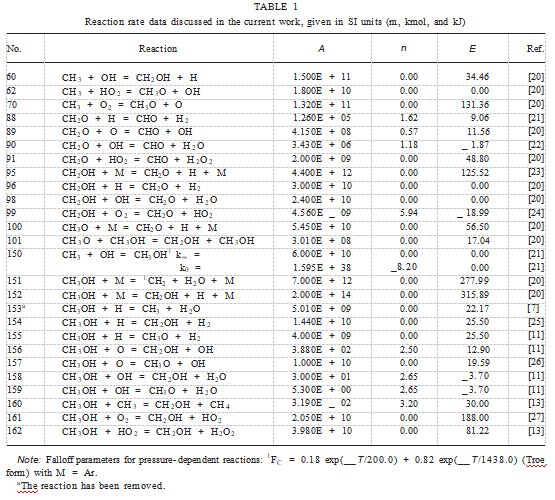
The applied C/H/N/O mechanis m is based on the work by Lindstedt and coworkers [16– 19]. The ad- dition of CH3OH reactions results in a 52-species mechanis m featuring 326 elementary steps. Key re- actions are shown in Table 1, and the computational procedures are outlined elsewhere [16]. The com- bined rates of the CH3OH + H (reactions 154 and 155) and CH3OH + OH (reactions 158 and 159) channels illustrate some of the difficulties inherent in the methanol oxidation chemistry.
CH3OH + H = CH2OH + H2 (154)
CH3OH + H = CH3O + H2 (155)
CH3OH + OH = CH2OH + H2O (158)
CH3OH + OH = CH3O + H2O (159)
Proposed branching ratios kb1 = (k154 + k155)/(k158 + k159) are in the range 0.2 ≤ kb1 ≤ 1.5 at 1500 K. The current ratio of 0.2 is comparatively close to the values of 0.25 and 0.5 used by Held and Dryer [13] and Grotheer et al. [11], but notably different from the values of 1.3 and 1.5 used by Egolfopoulos et al.
[9] and Li and Williams [14]. The branching ratios of the individual channels also differ significantly. Bond energies in methanol favor CH2OH formation, and the ab initio study of the CH3OH + H reaction by Lendvay et al. [28] indeed suggests that the branching ratio kb2 = k154/(k154 + k155) is signifi- cantly (≥0.90) in favor of this channel (reaction 154) at combustion temperatures. The current value of kb2 = 0.8 is reasonably close. Li and Williams [15] propose kb2 = 0.4 at 1500 K and a rate of the overall channel which is ~4 times higher than that adopted here [25]. There is good agreement [11,13,14] for the CH3OH + OH channel leading to CH2OH + H2O, but, as discussed below, uncertainties prevail for the branching ratio. The oxidation channels for the hydroxymethyl and methoxy radicals highlight further differences.
CH3O + M = CH2O + H + M (100)
CH3O + M = CH2OH + M (101)
The branching ratio kb3 = k100/k101 is subject to large variations with values 0.65 ≤ kb3 ≤ 9.2 pro- posed at 1500 K. The current work conforms with the suggestion (7.6) of Grotheer et al. [11], which is close to the value of 9.2 used by Held and Dryer [13]. Li and Williams [14], by contrast, prefer a value of 0.65. A comprehensive assess ment featuring a wide range of experimental data is arguably essential given the above differences.
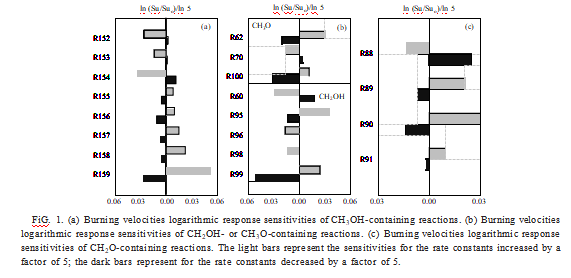
Some of the issues can be considered further in the context of laminar burning velocities. Each of the reactions featuring the oxidation of CH3OH and the main products (CH2OH, CH3O, CH2O) are thus the subject of a sensitivity an alysis. The logarithmic response coefficients are defined as v = ln(Su/Suo)/ ln(5), where Su and Suo are the baseline and per- turbed burning velocities and 5 is the perturbation factor. The reactions with the strongest effect on burning velocities for the case φ = 1.00 are shown in Fig. 1a–c.
Reaction 159 has the largest sensitivity coefficient (Fig. 1a), as increased methoxy formation leads to higher H radical production via CH3O decomposi- tion (reaction 100). In the present work, the branch- ing ratio kb4 = k158/(k158 + k159) is set to a tem- perature-independent value of 0.85 [11], which compares to the suggestion of 0.5 by Held and Dryer [13]. Reactions 95 and 99 are the two most sensitive CH2OH channels (Fig. 1b).
CH2OH + M = CH2O + H + M (95)
CH2OH + O2 = CH2O + HO2 (99)
The suggestion by Grotheer et al. [11] for reaction 95 is ~10 times slower than that of Hidaka et al. [23] at temperatures ≥2000 K, and the earlier value of Tsang [27] suggests a further increase. The deter- mination of Hidaka et al. [23] is adopted along with the rate of Grotheer et al. [24] for reaction 99.
The main CH2O reactions (reactions 88 and 90) exhibit similar sensitivity, but with opposite signs (Fig. 1c). The present work follows the Commission of European Communities (CEC) recommenda- tions [21,22]
CH2O + H = CHO + H2 (88)
CH2O + OH = CHO + H2O (90)
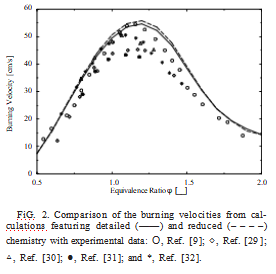
Lendvay et al. [28] have suggested that the reaction channel CH3OH + H = CH3 + H2O (reaction 153) is insignificant. Inclusion of reaction 153 does indeed have a tendency to lead to overpredictions of CH3 concentrations and, consequently, excessive formation of C2 species in methanol flames. The channel has therefore been removed. A comparison of computed and measured burning velocities with an unburned mixture temperature of 318 K and at atmospheric pressure is presented in Fig. 2. The agreement with the data set of Egolfopoulos et al. [9] is satisfactory. It should be noted that the other experimental data sets correspond to an initial tem- perature of 298 K.
Mechanis m Reduction
The reduced five-step mechanis m of Mu… ller and Peters [1] for premixed methanol flames was only validated against burning velocity data, and the de- velopment of the corresponding four- and five-step mechanis ms for counterflow diffusion flames [2] was also impaired by a lack of suitable experimental data. In the present work, the detailed C/H/N/O mech- anis m has been an alyzed through extensive path and sensitivity an alyses for a wide range of conditions. The cases considered include laminar burning ve- locities, ignition delay times in shock tubes, the chemical structure resulting from oxidation in flow reactors, fuel-lean low-pressure premixed methanol flames, and fuel-rich partially premixed flames at at- mospheric pressure. The present work also takes ad- vantage of the extensive validation of the C1/C2 de- tailed and systematically reduced submechanis ms for NOx formation under natural gas oxidation [18,19,33]. A detailed a nalysis considering all con- ditions indicates that the following species can be considered in steady state: CH, CHO, 1CH2, 3CH2, CH3O, CH2OH, C2H, CHCO, CH2CO, C2H3, C2H5, C, C2, CH2CHO, CH3CO, NH2, NH, N, N2H2, NNH, HNO, CN, NCO, HNCO, HOCN, HNO2, H2CN, HCNO, and HNC. By assembling all formation and destruction routes of each species, a system of balance equations (see below) can readily be derived in the classical manner of Peters [34].
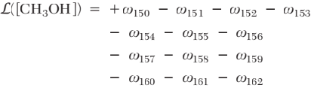
In the above example, L([X]) denotes the convec- tive-diffusive operator applied on methanol and xi the net forward rate of the reversible reaction step i. The 23 non-steady-state species and four elemen- tal balance equations for C, H, O, and N give rise to a 19-step global mechanis m for the non-steady-state C/H/O (CH3O, CH2O, C2H6, C2H4, C2H2, CH4, CH3, CO, CO2, H2, H2O, O2, O, OH, H, HO2, and H2O2) and C/H/O/N (NH3, HCN, NO, NO2, N2O, and N2) species.
Step I: C2H6 = C2H4 + 2 H
Step II: C2H4 + 2H = 2CH3
Step III: C2H2 + O + OH = 2CO + H2 + H
Step IV: CH4 + OH = CH3 + H2O
Step V: CH3 + O = CO + H2 + H
Step VI: CO + OH = CO2 + H
Step VII: O2 + H = OH + O
Step VIII: H2 + OH = H2O + H
Step IX: H2 + O = OH + H
Step X: H + H + M = H2 + M
Step XI: NH3 + O2 = NO + H2O + H
Step XII: 2NO + H = N2O + OH
Step XIII: NO2 + H = NO + OH
Step XIV: N2 + CH4 + O2 = HCN + NO + H2O + H
Step XV: N2 + OH + O = 2NO + H
Step XVI: CH3OH + 2H = 2H2 + CH2O
Step XVII: CH2O = CO + H2
Step XVIII: O2 + H + M = HO2 + M
Step XIX: 2HO2 = H2O2 + O2
The rates for each global step and the algebraic re- lationships required for the calculation of steady- state species concentrations are given elsewhere [33,35]. The above scheme may be considered to be the most compact general-purpose mechanis m pos- sible in the sense that any further reduction fails for at least one set of conditions. For example, the in- troduction of a steady-state assumption for HO2 leads to a broadening of the temperature and species profiles in partially premixed flames, and a steady- state approximation for H2O2 adversely effects com- putations at lower temperatures in flow reactors. Given the possible application of the current mech- anis m in the context of the modeling of ignition/ extinction phenomena in turbulent flames, such dis- crepancies are not considered acceptable. The introduction of a steady-state approximation for the CH3 radical is less problematic in the context of methanol as compared to methane oxidation. How- ever, the resulting deterioration in prediction quality for C2 species is arguably not acceptable. The math- ematical properties of the proposed mechanis m re- main excellent under all conditions tested.
Validation of the Reduced Mechanis m
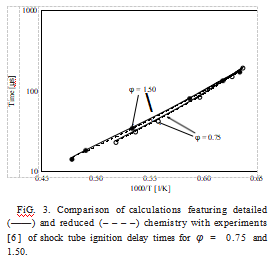
Bowman [6] performed shock-tube experiments featuring CH3OH/O2/Ar mixtures in a 3.8 cm stain- less steel shock tube. The cases with stoichiometries φ = 0.75 and 1.50 are considered here. Bowman [6] defined the ignition delay time as corresponding to the time where the maximum of the product of the CO and O-atom concentrations occurs, and the same definition has been adopted here. The agree- ment between experimental and computed ignition delay times is excellent with errors ≤5%, as shown in Fig. 3.
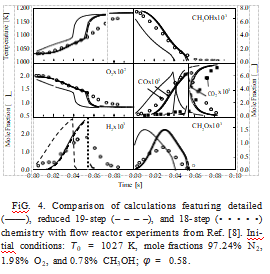
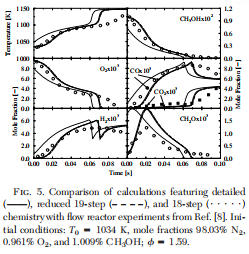
Norton and Dryer [8] performed a series of flow reactor experiments, and comparisons with data aris- ing from the cases with φ = 0.59 and 1.58 are pre- sented. The computed profiles are shifted by 19 ms to account for mixing duct related effects. A more complete discussion has been presented by Held and Dryer [13]. As shown in Figs. 4 and 5, the agree- ment is generally good, although computed levels of CH2O and H2 are arguably too high. The latter ob- servations do not constitute a consistent trend across the range of conditions considered, and the experi- mental study shows some evidence of diffusion of the gradients resulting from the sharp onset of ig- nition. Overall, the agreement is similar to that of Held and Dryer [13], who also observed a two-step ignition behavior. Comparisons of computed results obtained with the detailed and reduced mechanis ms indicate only modest differences. To illustrate the effects of introducing a steady-state approximation for H2O2, a systematically reduced 18-step mecha- nis m was also derived and tested. The temporal evo- lution of the solution is markedly different and fur- ther illustrates the sensitivity of CH3OH oxidation to the HO2/H2O2 system.
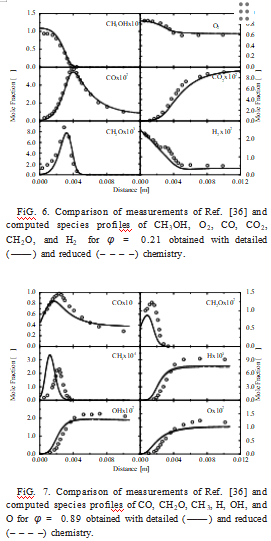
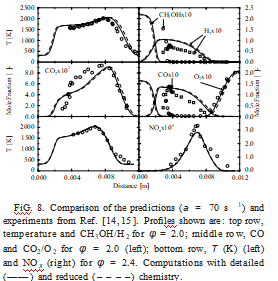
Vandooren and Van Tiggelen [36] investigated the oxidation of methanol in premixed flames using a Spalding-Botha burner and three different stoichi- ometries (φ = 0.21, 0.36, and 0.89). Comparisons between computations and experimental data are shown in Figs. 6 and 7 for the φ = 0.21 and 0.89 cases. The agreement between the experimental data and the computed main flame structure for the leaner case is arguably excellent, with the reduced and detailed mechanis ms producing almost identical results. Computed profiles of minor species for the richer of the two flames are shown in Fig. 7. There is a modest misalignment which may partly be due to probe effects. However, overall the agreement is good. It may be noted that CH2O levels are slightly underpredicted and that main radical levels are well reproduced. The introduction of the direct channel leading to the methyl radical (reaction 153) results in an overprediction of CH3 by around a factor of 2.Li and Williams [14,15] added welcome informa- tion for the important case of partially premixed combustion of methanol in a counterflow flame ge- ometry. Equivalence ratios of the premixed fuel stream were set equal to 2.00 [15] and 2.40 [14]. The investigators determined the strain rate through ve- locity measurements of methanol droplets. In both cases, the applied rate of strain has been increased from the measured value of 50 to 70 s__ 1. Such in- creases in the rate of strain are not uncommon in the modeling of counterflow flames, and the current adjustment is similar to that used in the seminal study of Dixon-Lewis and coworkers [37]. However, caution is required here, and it is possible that the modest overpredictions observed in the burning ve- locities for fuel-rich mixtures (Fig. 2) may be partly responsible for the broadening of the flame profiles shown in Fig. 8. The overall peak levels of major species are, however, comparatively well repro- duced. Li and Williams [14] also present measure- ments of oxides of nitrogen (here: Σ NO + NO2) for the flame with φ = 2.4, and the agreement is excellent (Fig. 8).
Conclusions
The present work has shown that an augmented (comprehensive) systematically reduced reaction mechanis m for methanol oxidation can reproduce the results obtained by a 52-species and 326-reac- tion-step mechanis m without apparent loss of gen- erality. The systematically reduced form features a 14-step mechanis m for the C/H/O system and a 5- step submechanis m for the nitrogen chemistry. The mathematical properties of the reduced mechanis m are not appreciably different from those of the start- ing mechanis m. As a result, the ~2.5 times reduc- tion in the required scalar space leads to a factor 5– 10 reduction in computational requirements for in- trinsically efficient solvers based on a Newton line- arization of the chemical source term. It has also been shown that the major features of methanol ox- idation can be well reproduced for a wide range of conditions, despite some remaining difficulties in key branching ratios. The latter are all retained ex- plicitly in the systematically reduced form, and any future developments can be directly incorporated. The overall level of agreement obtained would ap- pear sufficient to justify the application of the cur- rent reduced mechanis m to detailed studies of lam- inar and turbulent methanol flame structures.
Acknowledgment
The authors wish to gratefully acknowledge the assis- tance of Mr. K.-A. Rizos in preparing the current paper.
REFERENCES
1. Mu… ller, C. M., and Peters, N., in Reduced Kinetic Mechanis ms for Applications in Combustion Systems
(N. Peters and B. Rogg, eds.), Springer-Verlag, Berlin, 1993, pp. 142–155.
2. Mu… ller, C. M., Seshadri, K., and Chen, J. Y., in Reduced Kinetic Mechanis ms for Applications in Combustion Systems (N. Peters and B. Rogg, eds.), Springer-Ver- lag, Berlin, 1993, pp. 284–307.
3. Tang, Q., Xu, J., and Pope, S. B., Proc. Combust. Inst. 28:133 (2000).
4. Lindstedt, R. P., Louloudi, S., and Vaos, E. M., Proc. Combust. Inst. 28:149 (2000).
5. Sung, C. J., Law, C. K., and Chen, J. Y., Proc. Combust. Inst. 27:295 (1998).
6. Bowman, C. T., Combust. Flame 25:343 (1975).
7. Westbrook, C. K., and Dryer, F. L., Combust. Sci. Technol. 20:125 (1979).
8. Norton, T. S., and Dryer, F. L., Combust. Sci. Technol. 63:107 (1989).
9. Egolfopoulos, F. N., Du, D. X., and Law, C. K., Com- bust. Sci. Technol. 83:33 (1992).
10. Grotheer, H. H., and Just, T., Combust. Sci. Technol. 91:15 (1993).
11. Grotheer, H.-H., Kelm, S., Driver, H. S. T., Hutcheon, R. J., Lockett, R. D., and Robertson, G. N., Ber. Bun- sen-Ges. Phys. Chem. 96(10):1360 (1992).
12. Driver, H. S. T., Hutcheon, R. J., Lockett, R. D., Rob- ertson, G. N., Grotheer, H.-H., and Kelm, S., Ber. Bunsen-Ges. Phys. Chem. 96(10):1376 (1992).
13. Held, T. J., and Dryer, F. L., Int. J. Chem. Kinet. 30(11):805 (1998).
14. Li, S. C., and Williams, F. A., Proc. Combust. Inst. 27:485 (1998).
15. Li, S. C., and Williams, F. A., Proc. Combust. Inst. 26:1017 (1996).
16. Lindstedt, R. P., and Skevis, G., Combust. Sci. Technol. 125:73 (1997).
17. Lindstedt, R. P., and Skevis, G., Proc. Combust. Inst. 28:1801 (2000).
18. Juchmann, W., Latzel, H., Shin, D. I., Peiter, G., Dreier, T., Volpp, H.-R., Wolfrum, J., Lindstedt, R. P., and Leung, K. M., Proc. Combust. Inst. 27:469 (1998).
19. Sick, V., Hildenbrand, F., and Lindstedt, R. P., Proc. Combust. Inst. 27:1401 (1998).
20. Leung, K. M., and Lindstedt, R. P., Combust. Flame 102:129 (1995).
21. Baulch, D. L., Cobos, C. J., Cox, R. A., Frank, P., Hay- man, G., Just, T., Kerr, J. A., Murrels, T., Pilling, M. J., Troe, J., Walker, R. W., and Warnatz, J., J. Phys. Chem. Ref. Data 23:847 (1994).
22. Baulch, D. L., Cobos, C. J., Cox, R. A., Esser, C., Frank, P., Just, T., Kerr, J. A., Pilling, M. J., Troe, J., Walker, R. W., and Warnatz, J., J. Phys. Chem. Ref. Data 21:411 (1992).
23. Hidaka, Y., Oki, T., and Kawano, H., J. Phys. Chem. 93:7134 (1989).
24. Grotheer, H. H., Riekert, G., Walter, D., and Just, T., J. Phys. Chem. 92:4028 (1988).
25. Held, T. J., and Dryer, F. L., Proc. Combust. Inst. 25:901 (1994).
26. Warnatz, J., Rate Coefficients in the C/H/O System, Springer-Verlag, New York, 1984.
27. Tsang, W., J. Phys. Chem. Ref. Data 16:471 (1987).
28. Lendvay, G., Brces, T., and Mrta, F., J. Phys. Chem. 101:1588 (1997).
29. Wiser, W. H., and Hill, G. R., Proc. Combust. Inst. 5:553 (1954).
30. Gibbs, G. J., and Calcote, H. F., J. Chem. Eng. Data 4:226 (1959).
31. Metghalchi, M., and Keck, J. C., Combust. Flame 48:191 (1982).
32. Gu… lder, O… . L., Proc. Combust. Inst. 19:275 (1982).
33. Meyer, M. P., ‘‘The Application of Detailed and Sys- tematically Reduced Chemistry to Transient Laminar Flames,’’ Ph.D. thesis, University of London, July 2001.
34. Peters, N., Numerical Simulation of Combustion Phe- nomena, Springer-Verlag, Berlin, 1985.
35. Sandia National Laboratories, 2002, www.ca.sandia. gov/tdf/Workshop.html.
36. Vandooren, J., and Van Tiggelen, P. J., Proc. Combust. Inst. 18:473 (1980).
37. Dixon-Lewis, G., David, T., Gaskell, P. H., Fukutani, S., Jinno, H., Miller, J. A., Kee, R. J., S mooke, M. D., Peters, N., Effels berg, E., Warnatz, J., and Behrendt, F., Proc. Combust. Inst. 20:1893 (1984).
COMMENTS
J. Troe, University of Go…ttingen, Germany. Could you write a priority list of reactions for which you would like to see new and better measurements?
Author’s Reply. Several issues pose problems in recon- ciling the chemistry of methanol across the range of con- ditions considered. The importance of molecular oxygen reactions is well established, and progress has recently been made on the CH2O + O2 = CHO + HO2 reaction. However, the strong non-Arrhenius behavior of the CH2OH + O2 = CH2O + HO2 reaction, highlighted by Grotheer et al. (Ref. [24] in paper) remains of concern and new data, particularly in the temperature range 800–1400
K, would be most welcome. The higher mobility of the H radical in flames and the large negative sensitivity coeffi- cient associated with the reaction CH3OH + H = CH2OH + H2 remains an issue, along with the branching ratio to methoxy. The potential role of isomerization be- tween hydroxymethyl and methoxy at conditions typical of the leading edge of flame structures also merits further investigation.
●
Volker Sick, University of Michigan, USA. Given the ex- cellent agreement of the calculated ignition delay times and shock tube measurements, why is there such a discrepancy for the ignition in the flow reactor data?
Author’s Reply. The experimental flow reactor data is subject to two principal difficulties with respect to deter- mining the onset of ignition. The first is associated with the initial mixing duct that tends to introduce a constant offset of around 20 ms, and the second refers to the ‘‘dispersion’’ of sharp gradients. The current computational results for this geometry are fully consistent with other investigators (Ref. [13] in paper), and it would not appear possible to resolve this issue within the context of zero-dimensional computations.
●
Heinz Pitsch, Stanford University, USA. From my ex- perience with reduced kinetic mechanis ms for different fu- els, the steady state approximation can always be very well applied to the O radical with good accuracy for premixed flames, homogeneous autoignition, and plug flow reactor configurations. Are there any physical reasons for not ap- plying a steady state assumption for the O radical, or is this to simplify the numerical evaluation of the steady state re- lations?
Author’s Reply. It may indeed be possible to simplify the mechanis m somewhat further under certain conditions, and the O atom would be a good candidate. There are two reasons why we do not wish to pursue this route. Methanol can produce C2 and higher hydrocarbons under certain conditions, and the importance of reactions such as O + C2H2 and O + C2H4 are well established. It is also true, as suggested, that the mathematical properties of the re- duced mechanis m are improved by the retention of the O atom as a solved species. The latter is particularly true in the context of transient flames and for transported PDF calculations of turbulent flames in which the entire state space is typically explored.
免责声明:
本页面/内容部分素材来源于互联网公 开 信 息,旨在传递更多信息,不代表本平台立场。
版权归原作者或机构所有,如涉及侵权,请通过平台联系我们,我们将在核实后第一时间处理。
本平台对转载内容的真实性、准确性不作任何保证,用户需自行判断并承担使用风险。