二甲醚热分解反应及综合动力学模型研究(DMEZhaoEtal08)

摘要:
本文围绕二甲醚(DME)热解与氧化反应,采用 RRKM / 主方程理论重新计算 DME 单分子分解速率,并在 10 atm、980 K 高压下开展热解实验验证。基于层级法构建包含 55 种组分、290 步反应的 comprehensive 动力学模型,更新 H₂/O₂与 C₁-C₂子机理,修正甲基夺氢、OH 夺氢等关键反应速率。模型经激波管、流动反应器、搅拌釜、层流火焰等多工况验证,能准确复现高低温氧化、点火延迟、火焰速度与 NTC 行为,灵敏度分析揭示分解与夺氢反应的核心作用。该模型适用于 DME 清洁燃烧与替代燃料仿真。
Thermal Decomposition Reaction and a
Comprehensive Kinetic Model of Dimethyl Ether
ZHENWEI ZHAO, MARCOS CHAOS, ANDREI KAZAKOV, FREDERICK L. DRYER Department of Mechanical and Aerospace Engineering, Princeton University, Princeton, NJ 08544
Received 1 August 2006; revised 18 May 2007, 24 July 2007; accepted 27 July 2007
DOI 10.1002/kin.20285
Published online in Wiley InterScience (www.interscience.wiley.com).
ABSTRACT:
he unimolecular decomposition reaction of dimethyl ether (DME) was studied theoretically using RRKM/master equation calculations. The calculated decomposition rate is significantly different from that utilized in prior work (Fischer et al , Int J Chem Kinet 2000, 32, 713–740; Curran et al , Int J Chem Kinet 2000, 32, 741–759). DME pyrolysis experiments were performed at 980 K in a variable-pressure flow reactor at a pressure of 10 atm, a considerably higher pressure than previous validation data. Both unimolecular decomposition and radical abstraction are significant in describing DME pyrolysis, and hierarchical methodology was applied to produce a comprehensive high-temperature model for pyrolysis and oxidation that includes the new decomposition parameters and more recent s mall molecule/radical kinetic and thermochemical data. The high-temperature model shows improved agreement against the new pyrolysis data and the wide range of high-temperature oxidation data modeled in prior work, as well as new low-pressure burner-stabilized species profiles (Cool et al., Proc Combust Inst 2007, 31, 285–294) and laminar flame data for DME/methane mixtures (Chen et al., Proc Combust Inst 2007, 31, 1215–1222). The high-temperature model was combined with low-temperature oxidation chemistry (adopted from Fischer et al., Int J Chem Kinet 2000, 32, 713–740), with some modifications to several important reactions. The revised construct shows good agreement against high- as well as low-temperature flow reactor and jet-stirred reactor data, shock tube ignition delays, and laminar flame species as well as flame speed measurements. OC 2007 Wiley Periodicals, Inc. Int J Chem Kinet 40: 1–18, 2008
INTRODUCTION
As a result of its high-cetane number and low-sooting characteristics, dimethyl ether (DME) has been pro- posed as a promising alternative diesel fuel and fuel additive for reducing particulate and NOx emissions. Several experimental [ 1– 11] and theoretical (e.g., [12– 14]) studies have considered DME oxidation and py- rolysis characteristics previously. A detailed kinetic mechanis m for DME oxidation and pyrolysis [ 1,2] and its updated version [3] was developed based in part on comparisons with data from the Princeton Variable-Pressure Flow Reactor (VPFR) over tempera- ture and pressure ranges of 550–850 K and 12–18 atm, respectively. The model was also compared against results from a jet-stirred reactor [4,5], a shock-tube [6], and a counterflow diffusion flame [7]. More re- cently, Kaiser et al. [8] and McIlroy et al. [9] suc- cessfully compared model predictions with species profiles measured in low and atmospheric pressure, premixed, burner-stabilized flames. However, the abil- ity of the model to predict laminar flame speeds has been questioned [ 10, 11]. Since the development of this DME model [ 1,2], significant advances in fundamen- tals (mechanistic issues, thermochemical and kinetic parameters) have occurred particularly for H2/O2 and C1–C2 kinetics, which are especially relevant to flame conditions.
Moreover, the DME molecular decomposition re- action is significant at flow reactor, shock tube, and laminar flame conditions. Since the decomposition and abstraction pathways are coupled during both pyroly- sis and oxidation, an accurate description of the DME unimolecular decomposition process over a wide range of conditions is needed to further understand the con- tributions of the abstraction reactions in kinetic models describing high-temperature DME combustion. In the present work, the thermal decomposition of DME was studied theoretically and new DME pyrolysis measure- ments at high pressure and temperature were obtained in the Princeton VPFR. A model was assembled in a hierarchal manner, which incorporates new kinetic de- velopments in fundamental s mall molecules (e.g., H2 , CO), encompasses recent s mall molecule/radical ki- netics and thermochemistry updates, and implements the low-temperature reaction subset from [ 1,2] to yield a comprehensive model for DME combustion.
The calculated decomposition rate is significantly different from that used in prior studies [ 1,2]; however, the revised pyrolysis model better predicts the present pyrolysis measurements and literature data. Here, we show that further revisions ofthe DME comprehensive model allow for reasonable predictions of all of the prior literature data on DME pyrolysis and oxidation as well as new low-pressure DME burner-stabilized species data, and flame properties of DME/methane mixtures.
EXPERIMENTAL METHODS
The new dimethyl ether pyrolysis experiments reported herein were performed in the Princeton VPFR. Only a brief discussion of these experiments is given below as there exist several other publications providing de- tailed information on the VPFR instrumentation and experimental methodology (e.g., see [ 1]).
Nitrogen carrier gas is heated by a pair of electrical resistance heaters and directed into a reactor duct. The carrier gas flows around abaffle plate into a gap serving as the entrance to a diffuser. In the present study, a cer- tified standard gaseous mixture of DME and nitrogen (5% DME by volume) was used as fuel and delivered to the flow reactor by a calibrated mass flow controller (accurate to ±1% of full scale). The fuel/nitrogen mix- ture flows through a central injector tube and is rapidly mixed with a much larger flow of carrier gas through the reactor tube. The reactor is surrounded by elec- trical resistance thermostated heaters, which maintain the reactor the wall temperatures within close proxim- ity ( <50 K) of gas temperatures. The fuel/carrier gas mixture exits a mixer–diffuser section into a constant area test section. Near the exit of the test section, a sam- pling probe is positioned on the reactor centerline to continuously extract and convectively quench a s mall percentage of the flow. At the same axial location, the local reaction gas temperature is measured with a type R thermocouple accurate to ±3 K.
The extracted sample gas flows via heated Teflon lines to an alytical equipment including a Fourier trans- form infrared spectrometer (FTIR), an electrochemical O2 ana lyzer, and a pair of nondispersive infrared ana- lyzers for CO and CO2. Other stable species of interest (e.g., CH4 , H2 O) are measured continuously online us- ing FTIR spectrometry. The measurement uncertainties for the data reported here are CH3 OCH3 ±4%, CH2 O ±5%; O2 ±2%; CH4 ±2%, CO ±2%; CO2 ±2% of reading.
The distance between the point of fuel injection and the sampling position is varied by moving the fuel in- jector probe (with attached mixer/diffuser assembly) relative to the fixed sampling location. Mean axial ve- locity measurements along the centerline of the reac- tor are used to correlate distance with residence time. By this means, profiles of stable species versus reac- tion residence time can be determined experimentally. The uncertainty in the residence time is approximately 5%.
Two types of flow reactor experiments, species-time history and reactivity experiments, are compared with predictions in this paper. The methods utilized hereinto compare flow reactor data with plug flow model pre- dictions have been discussed extensively in previous publications; nonetheless, the subject remains puzzling to some readers. An extensive summary and detailed discussion of time shifting, initialization, and “abso- lute time” comparison methodologies are provided as Supplementary Material.
DIMETHYL ETHER UNIMOLECULAR DECOMPOSITION
During DME pyrolysis, initiation proceeds via uni- molecular decomposition: CH3 OCH3 = CH3 + CH3 O (R1), and the rate of this reaction is known to be sig- nificant in comparison to abstraction reactions with DME at flow reactor temperatures. Few estimates of this rate and its pressure falloff have appeared in the literature previously. Here, the decomposition of DME was further investigated theoretically based on the RRKM/master equation approach in a manner simi- lar to that used by Li et al. [ 15]. Initially, all of the competitive decomposition channels were considered, but their rate constants were found to be much lower than k1 , only becoming competitive at very high tem- peratures (above 3000 K). As a result, only the domi- nant channel, that is, reaction (R1), was considered in further detail.
Equilibrium geometries of the reactants and prod- ucts were optimized by the hybrid density functional B3LYP method [ 16– 19] with the 6-31G(d) basis set. Vibrational frequencies, calculated using the same method, were scaled by a factor of 0.96, and ener- gies were computed at G3B3 level of theory [20]. The Gaussian 98 package [21] was used for all the molec- ular orbital calculations. We also compared the energy barriers (including a zero-point energy, correction at 0 K) calculated by different theoretical methods, as well as available experimental results. We found all theoretical results to be in reasonable agreement. In particular, the energy barrier obtained in the present study matches very well the recent ab initio results of Nash and Francisco [ 12]. Similar to Li et al. [ 15], special consideration was given to the two hindered rotations around CH3 -internal rotors to evaluate the ro- tational potentials and to compute the density of states. Further details of these calculations (e.g., listings of vi- brational frequencies and rotational constants) as well as the computed rates (discussed below) are provided as a supplemental file.
The rate constants for the DME unimolecular de- composition were computed using an in-house com- puter code [ 15]. The microscopic rate coefficient for the simple-fission reaction (R1) was evaluated us- ing the prescribed high-pressure limit for this chan- nel and the molecular properties of reaction products. The high-pressure limit rate constant was calculated from microscopic reversibility using a rate expression of 2.75 × 1013 cm3/mol/s for the reverse reaction, that is, the recombination of CH3 O and CH3. We estimated the rate expression in the reverse direction as the re- combination of two radical species, which has no as- sociated activation energy and an A-factor normally varying between 1 × 10¹³ and 3 × 10¹³ , based on data for similar reactions [22–24]. The molecular parame- ters (reaction barriers, moments of inertia, and vibra- tional frequencies) are required as input for the sum and density-of-states computations, followed by the microscopic rate constant k(E) calculation based on RRKM theory [25]. With the input information for the collision model, rate constants were calculated after solving the master equation [25]. The in-house com- puter program was specifically designed for compu- tational efficiency (thus allowing extensive parametric studies without sacrificing accuracy). These features include arbitrary energy and temperature dependence of〈ΔEdown〉(see below), a more rigorous treatment of hindered rotations, and evaluation of microscopic rate coefficients for loose transition states from the prescribed high-pressure limit rate constant.
The energy increment was fixed at 1 cm__1 in all sum and density-of-states computations. The standard form of the exponential-down model was used for col- lision energy transfer. In the absence of reliable mea- surements in the falloff region that are normally used to calibrate the collision model, the model parameters had to be assigned a priori. Specifically, following rec- ommendations of Knyazev and Slagle [26] based on their extensive comparisons of theoretical predictions with the large body of experimental data, and account- ing for both temperature and energy dependencies of the main collision model parameter, the energy trans- fer per downward collision,〈ΔEdown〉, was calculated using the following expression:〈ΔEdown〉= ATE1/2 , where T is the temperature, E is the internal energy, and A is an adjustable constant taken as 4.313 × 10__3 and 3.458 × 10__3 cm__1/2 K__1 for N2 and Ar, respec- tively, in the present study. This calculation yields a value for〈ΔEdown〉of about 217 and 174 cm__1 for N2 and Ar at 298 K and the energy corresponding to the barrier of reaction (R1), which agree with the values determined experimentally for similar reactions by Knyazev and Tsang [27]. The collision frequency of DME with the bath gas was estimated from the Lennard–Jones parameters adopted from Kee et al.
[28]. An energy grain size of 10 cm__1 was used in the master equation solutions, and the resulting relaxation matrix size was 7410 × 7410. This grain size provided numerically convergent results for all temperatures and pressures considered in this study.
The calculated rate constant of reaction (R1) over the temperature range of 650–1350 K at 1 atm is pre- sented in Fig. 1. The rate constant agrees well with the experimental data of Batt et al. [29] by utilizing a〈ΔEdown〉of 300 cm__1 at 298 K for DME, which is consistent with the experimental work of Knyazev and Tsang [27] for similar species.
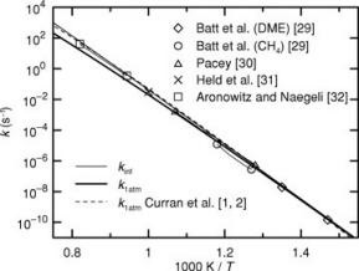
Figure 1 Rate constant of the reaction CH3OCH3 = CH3 + CH3O.
at the high-pressure limit is in very good agreement with the measurement of Pacey [30]. However, the present theoretical work gives a value significantly lower than the experimental data reported by Held et al. [31] and Aronowitz and Naegeli [32]. To fit the data from [31,32], a rate constant of at least (1–2) × 1014 has to be assigned to the reverse reaction of (R1), which is much higher than that of similar reactions ob- tained experimentally, for example [22–24], and theo- retically [33]. High values of (R1) are also inconsistent with the empirical “geometric mean rule,” for example [34–36], which provides an estimate for the recombi- nation rate coefficient of two radicals, A and B, kAB = 2(kAAkBB)1/2, based on self-recombination rate coeffi- cients kAA and kBB for A and B, respectively. By using experimental values for recombination of CH3 + CH3 [37–39] and CH3 O + CH3 O [40], one obtains a rate coefficient of about 2 × 10¹³ for the reverse rate co- efficient of R1, that is, a factor of 5–10 lower than the values needed to match the experimental data of [31,32].
The present rate coefficient at around 800 K is higher than the experimental data of Batt et al. [29] for the pyrolysis of DME in CH4 bath gas, by utiliz- ing a〈ΔEdown〉of 269 cm__1 at 298 K (the value was recommended in [27]). By assigning either a rate con- stant of 1.35 × 10¹³ to the reverse reaction of (R1) or a〈ΔEdown〉of 175 cm__1 at 298 K, the calculated rate constant fits the data well. Even so, under all condi- tions, the present an alysis results in a rate coefficient at 1 atm that is much lower (a factor of 3 at 1000 K) and exhibits a higher degree of falloff than that ob- tained by Curran et al. [2]. As a result of the relative importance of decomposition and radical abstractions from DME at flow reactor conditions, it is immediately evident that the abstraction channel parameters present in the Curran et al. model are not compatible with the present decomposition parameters. Consequently, a re- vised model description was pursued.
COMPREHENSIVE MODEL FOR DIMETHYL ETHER PYROLYSIS AND OXIDATION
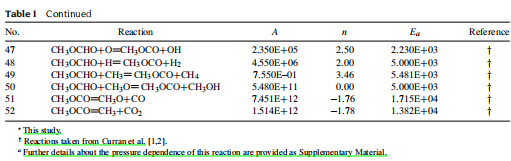
The present dimethyl ether model was assembled in a hierarchal manner. The detailed chemical kinetic re- action mechanis m consists of 290 reversible reactions amongst 55 species and is provided (along with as- sociated thermodynamic and transport parameters) as a supplemental file. The high-temperature decomposi- tion and oxidation portion of the model was updated to reflect recent advances in s mall molecule/radical kinetics and thermochemistry, to incorporate the new unimolecular decomposition results described above, and to re-evaluate both prior and new comparisons of predictions against DME pyrolysis and oxidation data. The present reaction scheme consists of a base- line H2/C1 -C2 submodel recently developed in our lab- oratory for H2 [41], H2/CO/CH2 O/CH3 OH [42], and C2H5 OH [43,44]. Table I lists DME-related reactions that were considered along with the baseline models. The DME high-temperature subset contains reactions with O2 as well as the thermal decomposition (R1) as initiation steps. As the radical pool becomes es- tablished, H-atom abstraction from the fuel becomes more important. These propagation reactions involve radicals (e.g., H, O, OH, HO2 , CH3 , CH3 O) reacting with the fuel. The methoxymethyl radical (CH3 OCH2 ) is formed by H-atom abstraction from DME. Its reac- tions include a thermal decomposition reaction form- ing formaldehyde and CH3 and reactions with O2 , HO2 , O, OH, CH3 , and CH3 O.
Among the H-atom abstraction reactions, the re- action of fuel with the methyl radical (CH3 OCH3 + CH3 = CH3 OCH2 + CH4 (R2)) is very important for describing fuel consumption at flow reactor and shock tube ignition delay conditions. The limited literature data for reaction (R2) are all restricted to low tempera- tures (≤1000 K). Rate measurements at higher temper- atures are not well established and exhibit considerable uncertainty. For example, Pacey [30] reports activation energy values for reaction (R2) with an uncertainty of almost±1.7kcal/mol with log(A) = 1013.5±0.4. During the course of this study, it was found necessary to in- crease the rate of reaction (R2) for temperatures higher than approximately900K. On the basis ofthese results, we performed least-squares modified Arrhenius fit of available experimental data [29–31,45] placing larger weight on the upper uncertainty estimates of Pacey
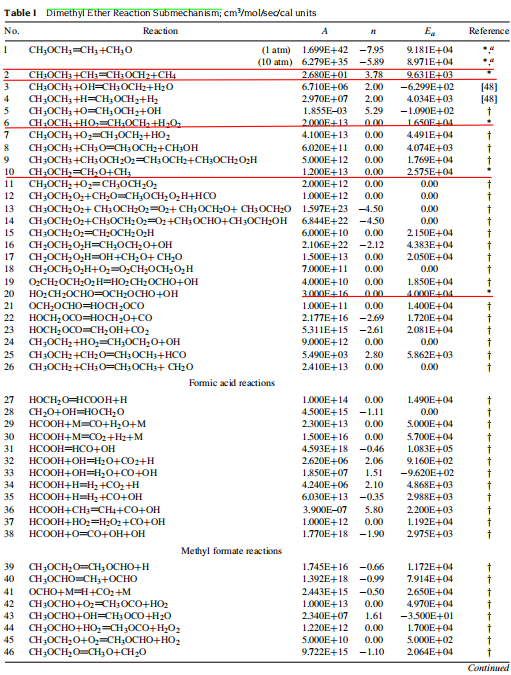
[30]. Figure 2 shows the results of this new correlation against the experimental data as well as the rate ex- pression used in the mechanis m of Curran et al. [ 1,2]. The present rate expression exhibits strong tempera- ture dependence, similar to the theoretical work of Wu et al. [46], although their rate is consistently lower than the experimental data (by approximately a factor of 3) and the present result. The present recommendation is a factor of 3.5 higher than that put forth by Curran et al. [ 1,2] at 1000 K.
The change in the rate expression of reaction (R2) is substantial; however, it is well justified by considering similar reactions for which rate measurements are bet- ter established. One such reaction is the H abstraction from acetone (CH3 COCH3 ) by methyl. On the basis of the measurements of Mousavipour and Pacey [47], the rate of this reaction at 1000 K is a factor of 1.2 faster than the measurement of Held et al. [31] for reaction (R2). However, the primary hydrogen bond dissocia- tion energy is higher for acetone than that for dimethyl ether by about 1 kcal/mol. One can thus reasonably expect the rate expression for reaction (R2) to be faster than the ana logous acetone reaction. One should also
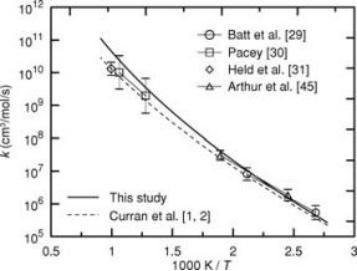
Figure 2 Arrhenius plots of rate constant expressions for CH3OCH3 + CH3 = CH3OCH2 + CH4 .
note that Held et al. [31] reported rate values for (R2) at 1005 K with considerably s maller uncertainty esti- mates than Pacey [30]. Held et al., however, did not measure the rate directly but relied on a computer sim- ulation where a kinetic mechanis m was used to match experimentally observed CH4 , C2H6 , and CH3 concen- trations. The determination of the rate of (R2) relied heavily on the rate of the methyl recombination reac- tion, which Held et al. note at the time of their work was only reliable within a factor of 3. Moreover, in the same study, Held et al. also estimated the rate of H abstraction from formaldehyde by methyl and reported a value which is nearly an order of magnitude lower than other more recent measurements. Consequently, the uncertainty estimates of Held et al. [31] are ques- tionable. Finally, it should be emphasized that, while we accept the present estimate for (R2) rate parameters in our mechanis m, it clearly needs further and rigorous investigation at temperatures above 900 K.
Hydrogen abstraction from DME by OH (CH3 OCH3 + OH = CH3 OCH2 + H2 O(R3))is also an important reaction affecting fuel consumption. Tranter and Walker [48] studied reaction (R3) experimentally at 753 K and their data are consistent with the recent experimental work of Bonard et al. [49] conducted at 295–660 K. The rate constant correlation presented by Tranter and Walker [48] was used in the present model, and it exhibits stronger temperature dependence than the correlation used by Curran et al. [ 1,2]. Tranter and Walker [48] also studied H abstraction from DME by H (CH3 OCH3 + H = CH3 OCH2 + H2 (R4)), andthisrate correlation was also adopted in the present mechanis m. It is about a factor of 1.5 higher than that appearing in the model of Curran et al. [ 1,2] at 1000 K.
The termination reaction between formyl and methyl radicals, HCO + CH3 = CO + CH4 , is also an important reaction in DME oxidation/pyrolysis due to the considerable amounts of HCO and CH3 present in the system. The temperature-independent rate constant in the original model of Curran et al. [ 1,2]
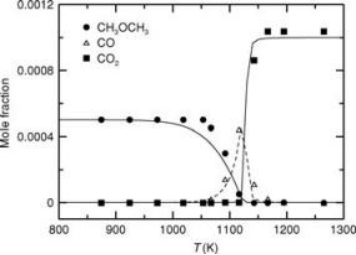
Figure 3 Reactivity profiles obtained in a flow reactor [59] compared against model predictions (P = 1 atm, 500 ppm DME, 3000 ppm O2, 3.34% H2O in balance N2, residence time (s) = 188 K/T ). Dashed lines correspond to open sym- bols.
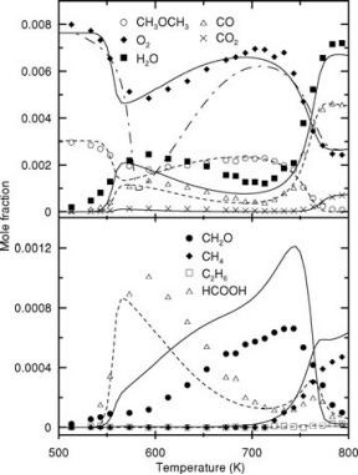
Figure 4 Measured [2] and computed species profiles in a variable pressure flow reactor (P = 12.5 atm, 3030 ppm DME, φ = 1.19, in balance N2, residence time = 1.8 s). Dashed lines correspond to open symbols; dash–dot line corresponds to the O2 profile predicted using the model of Dagaut et al. [5].
is 1.21 × 1014 cm3/mol/s. This value is near the colli- sion limit and likely exceeds the high-pressure limit for this reaction. In the present model, we used a rate constant of 2.65 × 1013 cm3/mol/s from Mulenko [50], which is also used in GRI-Mech 3.0 [51].
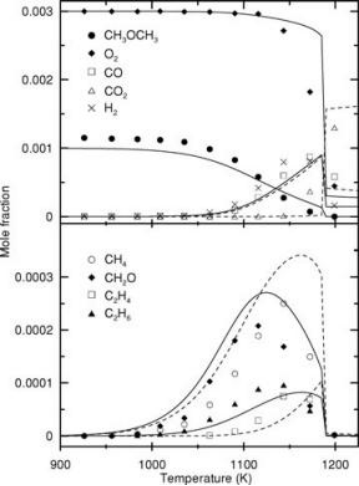
Figure 5 Jet-stirred reactor species profiles [4] versus model predictions (P = 1 atm, 0.1% DME, 0.3% O2 in bal- ance N2, residence time = 0.1 s). Dashed lines correspond to open symbols.
The low-temperature DME reaction subset from [ 1,2] was adopted in the present model. Reactions in this subset include chemistry for the formation of formic acid and methyl formate. Formic acid has been shown to be a major intermediate at low tempera- tures [2,52]; previous modeling efforts [4,5] did not treat these species. A number of reactions in the low- temperature DME oxidation process were updated in this study to improve agreement between modelpredic- tions and experimental targets. The low-temperature sequence stems from the addition of molecu- lar oxygen to the methoxymethyl radical to form methoxymethyl-peroxy (CH3 OCH2 O2 ), CH3 OCH2 + O2 = CH3 OCH2 O2 (R11). The rate for this reaction remains unchanged from the work of Curran et al. [ 1,2] and is set to 2.0 × 1012 cm3/mol/s. This value approaches the room temperature measurement of Sehested et al. [53]. The methoxymethyl radical may also decompose through β-scission to form formalde- hyde and the methyl radical CH3 OCH2 = CH2 O + CH3 (R10). In the present model, the rate of reac- tion (R10) has been reduced by approximately 25% to obtain good agreement with experimental results,
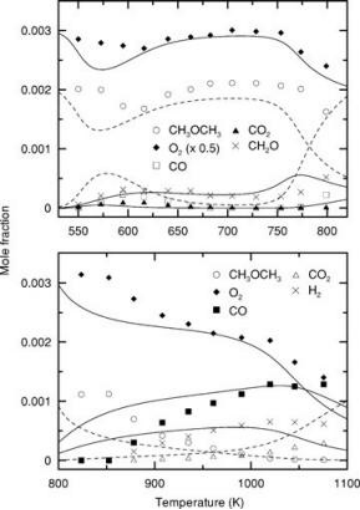
Figure 6 Jet-stirred reactor species profiles [5] versus model predictions (P = 10 atm; top: 0.2% DME, 0.6% O2; bottom: 0. 1% DME, 0.3% O2 in balance N2; residence time = 1 s). Dashed lines correspond to open symbols.
especially at intermediate temperatures (around 800 K). This rate reduction is well within the uncertainty es- timates of Loucks and Laidler [54] from which the rate expression was originally taken [2]. Recently, Li et al.
[55] have proposed anew rate for the decomposition re- action (R10) based on ab initio and density-functional theory studies; their calculated rate, however, is ap- proximately a factor of 3 faster than the rate currently employed over the temperature range of interest in this study.
Perhaps the most important step at low temper- atures is the isomerization of the methoxymethyl- peroxy radical CH3 OCH2 O2 = CH2 OCH2 O2H (R15). The hydroperoxy-methoxymethyl radical formed (CH2 OCH2 O2H) may undergo β-scission releasing two formaldehyde molecules and a hydroxyl radical (CH2 OCH2 O2H = CH2 O + CH2 O = OH (R17)), or it can react with molecular oxygen to form the O2 CH2 OCH2 O2H radical (CH2 OCH2 O2H + O2 = O2 CH2 OCH2 O2H (R18)). Similar to methoxymethyl- peroxy, the O2 CH2 OCH2 O2H radical also isomer- izes, yielding a hydroxyl molecule and a stable
carbonyl-hydroperoxide molecule (O2 CH2 OCH2 O2H = HO2 CH2 OCHO + OH (R19)), which, in turn, decomposes releasing an additional OH radical (HO2 CH2 OCHO = OCH2 OCHO + OH (R20)). The above sequence (R15, R18–R20) provides chain branching at low temperatures (below 700 K). As tem- perature increases, β-scission of the CH2 OCH2 O2H radical (R17) dominates leading to the negative tem- perature coefficient (NTC) region as the reactivity of the system decreases since only one reactive hy- droxyl molecule is released. Rate expressions for ki- netic steps (R15, R17–R19) remain unchanged from [ 1,2]. In the present model, the rate of reaction (R20) was increased by approximately 50% from the value proposed by Curran et al. [ 1,2]. The rate expression employed here for (R20) is different from the values published by Sahetchian et al. [56] for the decomposi- tion of organic hydroperoxides. This change, however, allowed for better agreement with experimental results at low temperatures, especially in terms of ignition delay measurements. Curran et al. [57] showed that shock tube ignition delay times are most sensitive to reaction (R20) at temperatures below 650 K, with es- sentially no sensitivity at higher temperatures. Further- more, Liu et al. [52] have shown that at temperatures below 650 K accumulation of hydroperoxymethyl for- mate (HO2 CH2 OCHO) did not occur in their experi- ments to the extent predicted by the model of Curran et al. [ 1,2], thus supporting the present increase in the rate of reaction (R20), which promotes the removal of this species.
One further modification of the low-temperature subset involves the rate of H abstraction from the fuel by the hydroperoxyl radical (CH3 OCH3 + HO2 = CH3 OCH2 + H2 O2 (R6)), to increase the reactivity of the system at temperatures above 750 K. The orig- inal rate expression [ 1,2] for reaction (R6) was taken from Walker [58] based on his recommendation for ab- straction of secondary H atoms from alkane molecules by HO2 radicals(i.e.,2.83 × 1012 exp(-17.69kcal/RT) cm3/mol/s per available H atom). In this study, the ac- tivation energy for reaction (R13) was adjusted down- ward by 1 kcal whereas the A-factor was increased by approximately 18% (i.e., 3.33 × 10¹² exp(-16.69 kcal/RT cm3/mol/s per available H atom). These revi- sions are within quoted uncertainty estimates [58].
详细内容请见附件
免责声明:
本页面/内容部分素材来源于互联网公 开 信 息,旨在传递更多信息,不代表本平台立场。
版权归原作者或机构所有,如涉及侵权,请通过平台联系我们,我们将在核实后第一时间处理。
本平台对转载内容的真实性、准确性不作任何保证,用户需自行判断并承担使用风险。