甲醇燃烧简化动力学机理研究与优化

甲醇燃烧简化动力学机理研究与优化(Reduced methanol kinetic mechanis ms for combustion applications)
摘要:
本文评估了甲醇燃烧的四步与五步简化动力学机理,通过自燃延迟与连续搅拌反应器(CSR)仿真对比现有模型,发现经典机理难以准确预测点火特性。研究通过添加引发反应与 CO₂逆反应,构建改进型五步简化机理 MMSC5,大幅提升点火延迟与平衡组分预测精度。计算采用有限差分法求解等压组分与能量方程,经 Bowman 激波管实验数据验证,在宽温度、压力与当量比下吻合良好。分析了初始温度、压力、配比与停留时间对点火与燃烧稳态的影响,证实该简化机理适用于自燃、火焰传播与反应器燃烧仿真,为工程甲醇燃烧计算提供高效可靠模型。
Abstract
Reduced chemical kinetic mechanis ms for methanol combustion were investigated by evaluating ignition delay magnitudes and combustion in a continuously stirred reactor. Unsteady computations were made to study the char- acteristics ofthe kinetic mechanis ms proposed in the literature and to compare the dependence of various parame- ters on methanol combustion. All computations were done under isobaric conditions, and, to capture the influence of all the reactions involved in the mechanis m, a very s mall time step was used. Finite-difference methods were used to solve the coupled differential equations. The five-step mechanis m developed by C.M. Mueller and N. Peters [in: N. Peters, B. Rogg (Eds.), Reduced Kinetic Mechanis ms for Applications in Combustion Systems, Springer- Verlag, New York, 1993, pp. 143–155] for premixed flames and both the five-step mechanis m and the four-step mechanis ms developed by C.M. Mueller, K. Seshadri, J.Y. Chen [ibid, pp. 284–307] for non-premixed flames were considered. It was found that the Mueller et al. five-step mechanis m, with some modifications, best supported the spontaneous ignition and continuous stirred reactor combustion. The results were validated by comparing calcu- lated ignition delays with available experimental data of C.T. Bowman [Combust. Flame 25 (1975) 343–354], and calculated final steady-state concentrations with chemical equilibrium calculations [J.-Y. Chen, Combust. Sci. Technol. 78 (1991) 127]. Initial temperature and concentration and the operating pressure of the system have a major effect on the delay of methanol ignition. The residence time of the continuous stirred reactor affects ignition delay and also changes the transient characteristic of chemical composition of the fuel–vapor mixture. The com- putations are intended to guide and explain many combustion studies that require a methanol kinetic mechanis m.
◎ 2005 The Combustion Institute. Published by Elsevier Inc. All rights reserved.
Keywords: Methanol kinetics; Ignition; Stirred reactor
1. Introduction
Reduced mechanis ms are useful for practical com- putations in which many complexities exist and more than one independent variable is used. Three well-known four- and five-step methanol oxidation reduced kinetic schemes have been advanced by Mueller and Peters [1]for established premixed flames (MP5) and by Mueller et al. [2] for established diffusion flames (MSC4 and MSC5). The formulation of the five-step mechanis m (MSC5) introduced steady-state approx- imations to the following species: CH2OH, CHO, OH, O, HO2, and H2O2 [2]. This work extends the methanol reduced kinetic model to be valid for ig-
nition, developing flames, and established steady or unsteady flames. It also improves the ability of the model to predict the equilibrium composition and temperature downstream of a premixed flame, using a modified MSC5 mechanis m built on an understanding of all of the known important elementary reactions. Some more recent mechanis ms might have updated kinetic constants for the elementary reactions, but the structure of the mechanis m is not different. Other arti- cles on methanol reduced kinetics either address only the steady state [3], postulate a mechanis m [4], or require at least 14 steps for the unsteady initiation process [5].
For one portion of our modified model develop- ment, spontaneous ignition and homogeneous oxida- tion were considered. We studied temporal behavior in a constant-pressure, adiabatic, spatially uniform situation: volume changed with time. A second un- steady configuration was also studied wherein the fresh premixed combustible gas was continuously in- troduced into a high-temperature environment with available chemical radicals. An ideal, continuous, stirred reactor achieves perfect mixing of reactants and products inside the control volume. The contin- uous stirred reactor (CSR) case was chosen to test the accuracy of the kinetic model when solving a combusting-flow process with a residence time. Un- der the infinite mixing rate assumption, the outflow temperature and concentrations are taken to be iden- tical to those inside the control volume. On exiting the volume after a finite residence time, the mixture is assumed to cease reacting; combustion need not be complete and chemical equilibrium need not ex- ist in the exit flow. Both inflow properties and initial properties within the volume are prescribed, and then
properties within the volume (and equivalently in the exit flow) are determined as functions of time. The mass inflow rate is held constant throughout the oper- ation. The implication of a constant pressure, a con- stant volume, and a constant mass inflow rate with temporally varying temperature and concentration is that the outflow rate must change with time in a con- trolled manner. Variable exit area can be used to main- tain the desired constant pressure. The constant ratio of the chamber volume to the volumetric inflow rate is called the “residence time,” although differences between inflow density and chamber density and/or unsteadiness cause this ratio to differ somewhat from a true time-dependent travel time.
2. Kinetic models
Our computations showed that the MSC4, MSC5, and MP5 kinetic models did not support the ignition delay characteristics. This was not surprising as the models were designed to describe established flame structures after the ignition delay period. Hence, these mechanis ms had to be modified by the addition of Reaction 96, an initiation reaction. So, we created modified mechanis ms MMSC964, MMSC965, and MMP965 (seeAppendix A). The rate of Reaction 96 was high prior to ignition and approximately zero af- ter ignition; therefore, it is very important to model ignition delay characteristics. However, the modified five-step mechanis m (MMP5) still did not support the ignition delay characteristics, even though it was suf- ficient to describe premixed flames. MMP5 predicted negative values for the mass fraction of the hydrogen molecule. Further, the mechanis m did not predict the correct characteristic temporal curves for all of the major species. It was concluded that MMP5 was not robust enough to predict ignition delay. Furthermore, MMSC965 overestimated the final adiabatic tempera- ture (calculated following Ref. [9]) by almost 600 K. Because of the absence of a backward reaction for Re- action 17, CO2, CO, and O2 were not at equilibrium after complete combustion. Hence, it overestimated the final concentration of CO2 and underestimated the final O2 and CO concentrations. So, MMSC965 was further modified by the addition of a backward reac- tion for Reaction 17. See Appendix A; Reactions 1 and 18 [1]produce the equilibrium balance for CO2 , CO, and O2 .
In our calculations, CH2O did not reach steady state, and, hence, MMSC964, which assumes steady state for CH2O, should not be used.
MMP5 implicitly contains a backward reaction for Reaction 17 (Appendix A). As this model also in- cludes the steady-state balance for the intermediate species CH, CH2, and CH3, combinations of a few reactions (Reactions 1, 2, 19, and 20 from Ref. [1]) provide the backward reaction for Reaction 17. How- ever, due to the problems mentioned earlier, the model was still not robust enough to predict spontaneous ig- nition characteristics. MMSC5, MMSC4, and MMP5 predict the same final adiabatic temperature when the above-mentioned modifications are made.
3. Governing equations and numerical method
The independent variables considered are the ma- jor species mass fractions and the temperature of the system. A system of quasi-linear ordinary differential equations is developed to govern the mass fractions of the eight major species CH3OH, O2, H2O, CO2, CO, H2, H, and CH2O, and temperature T . The interme- diate species were assumed to be at steady state, and simple algebraic equations were developed.
For both spontaneous ignition and CSR computa- tions, constant pressure and perfect gases were con-sidered. Also, for the CSR calculations, continuous flow was considered. All elementary reactions in- volved are assumed to be first order in terms of the re- actants (products) for forward (backward) reactions. Hence, the rate of production of species i due to a re- action between species j and k is

Wj and Wk are molecular weights, and Yj and Yk are mass fractions.
3.1. Spontaneous ignition
3.1.1. Species mass balance

3.1.2. Energy balance

3.2. Continuous stirred reactor
3.2.1. Total mass balance

3.2.2. Species mass balance

3.2.3. Energy balance

Here, m.out is the outlet mass flow rate; Wj and Wk are molecular weights; Yi , Yj, and Yk are mass frac- tions; Hi is the heat of formation of species i; f0 is the volumetric inflow rate; and V is the volume of the fluid in the CSR. The integer index i indicates one of the eight major species. The integer indices j and k can indicate major or steady-state species. Of course, only for certain combinations of the inte- ger values will Aijk be nonzero [1,2]. With the use of steady-state approximations for the intermediate species and the conservation of C, H, and O atoms, each overall species reaction rate Ri can be expressed, following standard practice[1,2], as a linear combina- tion of the five basic reduced reaction rates defined in Appendix A.
A perfect gas is assumed. The data for specific heats and heats of formation were obtained from Refs. [6–8]. A second-order-accurate finite-difference method was used to solve the coupled equations.
4. Chemical equilibrium
In the CSR calculations, the results of only the complete combustion cases were validated against the equilibrium code [9], because, in only these cases, the system reached chemical equilibrium. Extreme cases were chosen to be validated. The results matched to a certain order of accuracy. There were still s mall errors (less than 2.6%) in the final equilibrium con- centrations because the kinetic model does not con- sider the mass of steady-state species for mass bal- ances. Unlike the chemical equilibrium code, they were assumed to be negligible. The resulting OH and O equilibrium concentrations are comparable to the H and H2 equilibrium concentrations. As the steady- state species are not considered in the mass and mole balances for the reduced kinetics, there are some dif- ferences between the results of a full equilibrium calculation and the final state of the reduced kinetic calculation. This particular modified five-step kinetic model (MMSC5) is robust and can be used for model- ing ignition and flame-spread problems to determine flame propagation and spontaneous ignition charac- teristics.
5. Comparison with ignition experiments
The ignition delays, which are found experimen- tally by Bowman [10] for high initial temperatures, can be used to validate the kinetic model. He used argon as the inert gas. As seen in Table 1, the ig- nition delays predicted by the derived kinetic model MMSC5 matched very well the experimental results. For validation, fuel–oxidizer mixtures were consid- ered in both fuel-rich and lean regions. The experi- mental correlation [10] relates species concentration, initial temperature, and ignition-delay time:

Here, τmax is the ignition delay; Coxygen and Cmethanol are molecular oxygen and methanol con- centrations; T is the initial temperature; R is the universal gas constant; and A and E are kinetic con- stants. The correlation was compared with the calcu- lated ignition delays. From the log plot, the calculated values were found to be A = 3. 1E–13 s(mol/cm3)0.6 and E = 143.83 kJ/mol. The experimental values are A = 2. 1E–13 s(mol/cm3)0.6 and E = 151.5 kJ/mol.
6. Effect of parameters on spontaneous ignition
Fig. 1 is a general transient plot of the concentra- tions of major species (CH3OH, O2, H2O, CO2, CO,
H2, H, and CH2O) versus temperature. The computa- tions were done for wide parameter ranges to show the robustness of the model. These parameters in- clude initial temperature, initial stoichiometric com- position, operating pressure, and equivalence ratio.
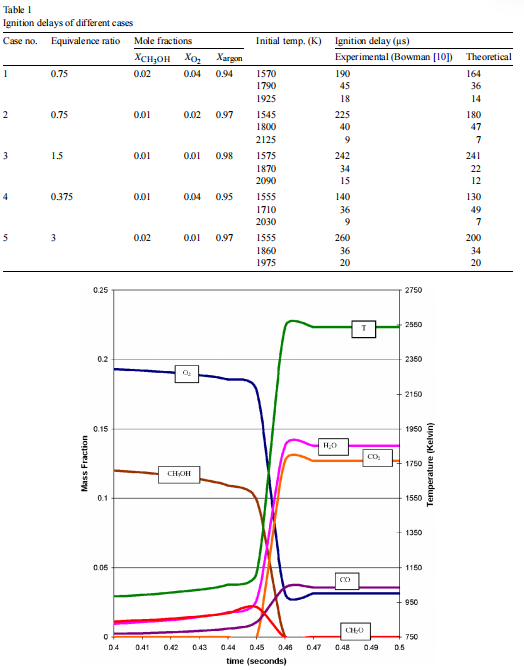
Fig. 1. Transient plots ofthe major species and temperature for the reduced MMSC5 mechanis m shown between 0.4 and 0.5 s.
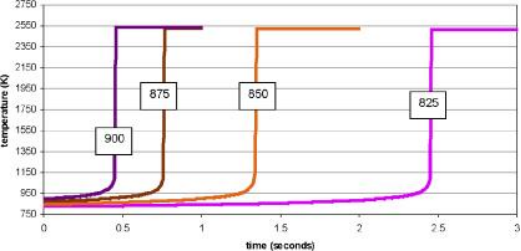
Fig. 2 shows that the reaction rates increase with in- creasing initial temperatures and the ignition delay decreases.
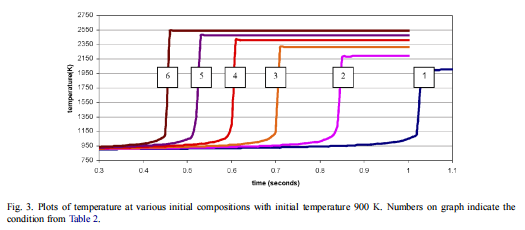
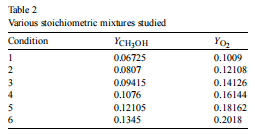
In all computations, the initial total mass of the mixture was kept constant. Hence, the mass frac-tion of the inert component was different for differ- ent initial fuel–oxidizer compositions. Table 2 indi- cates the six different stoichiometric conditions con- sidered. The amount of inert component varies from case to case here. Even though complete combus- tion occurred, the temporal characteristics of some of the product species (CO, H2, and H) were observed to differ between weaker (i.e., more inert mass) and stronger (i.e., less inert mass) stoichiometric compo- sitions and between fuel-rich and fuel-lean mixtures.
Fig. 3 shows that the adiabatic temperature is higher and the ignition delay is shorter for stronger stoichio-metric concentrations of fuel and oxygen. Fig. 4 in- dicates how the equivalence ratio can affect both the adiabatic temperature and the ignition delay.
As the total density of the system increases at higher pressures, the reaction rates of all the elemen- tary reactions involved increase with increasing pres- sure. Therefore, as the total pressure of the system increases, the ignition delay decreases. The final equi- librium concentrations of the major products, H2O and CO2, are very weakly dependent on pressure.
7. Effect of parameters on continuous stirred reactor
The computations for the well-stirred reactor were performed until the steady state was attained. Dif- ferent parameters were considered not only to test the robustness of the reduced kinetic mechanis m de- veloped, but also to understand when there exist sit- uations of incomplete combustion after the reactor has reached a steady state. The parameters studied in- clude inlet fuel–oxidizer composition, operating pres-sure of the reactor, initial temperature, and residence time of the reactor. Fig. 5 shows the transient plots for both complete and incomplete combustion cases at steady state. Both cases have the same operating conditions with respect to atmospheric pressure, resi- dence time (1 s), initial and inlet temperatures of the fuel–oxidizer mixture (900 K), and initial stoichio- metric mixture (methanol and oxygen mass fractions of 0.135 and 0.202, respectively). The only differ- ence is in the stoichiometric inlet concentrations, with complete combustion having larger concentrations equal to the initial concentrations and incomplete combustion having one-half the amounts of methanol and oxygen. If, at any time less than the residence time, the difference between influx and efflux equals the total reaction rate for each major species, then steady state has been attained but chemical equilib- rium may not have been reached.
If complete combustion occurs, the ignition delay decreases for stronger inlet (less inert) stoichiomet- ric concentrations of methanol and oxygen, in com- plete agreement with the spontaneous ignition solu- tion. However, slight differences would occur in the calculations for ignition delay and final adiabatic tem-peratures between the spontaneous ignition problem and CSR, because the species mass balance (Eq. (4)) and energy balance (Eq. (6)) of CSR are exactly the same as for the ignition delay problem (Eqs. (2) and (5), respectively) only when the residence time, V/f0, tends to infinity. The residence times consid- ered thus far are not large enough. To check the above-mentioned result, a large residence time (15 times greater than the original residence time) was considered. Then, the ignition delays ofthe CSR and spontaneous ignition problem matched. The reaction rate depends on the initial composition of the fuel– oxidizer mixture. For lower concentrations (more in- ert) of the stoichiometric mixture, the reaction time for the mixture is long and, hence, can be longer than the residence time of the reactor if the residence time is s mall. Therefore, in these cases, the steady state is not the equilibrium state. Also, the temporal plots of the species are different from that of com- plete combustion. The final adiabatic flame tempera- ture, as mentioned previously, is a function of the inlet concentration of the fuel–oxygen mixture. Therefore, the adiabatic temperature increases with stronger inlet concentrations. As a result, a greater percentage of the oxygen is consumed for weaker inlet concentrations, as the dissociation of CO2 to CO is predominant at higher temperatures. Thus, other species are present in scarce concentrations even after complete combus- tion of fuel.
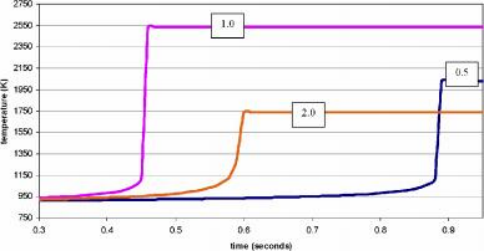
Fig. 4. Plots of temperature at various equivalence ratios with initial temperature 900 K.
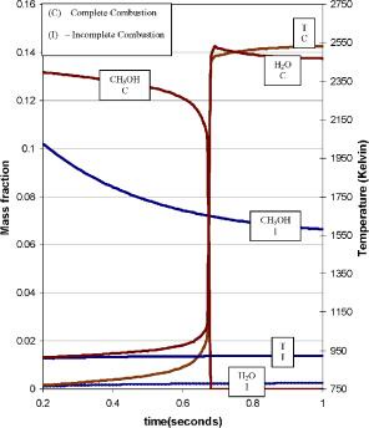
Fig. 5. Transient plots of mass fractions of CH3OH and H2O for both complete and incomplete combustion shown between 0.2 and 1 s.
For a residence time of 1 s, only fuel-rich mixtures achieve equilibrium. However, for fuel-lean mixtures, equilibrium does not occur owing to the fact that less fuel is present. Therefore, the chemical reaction time becomes longer than the residence time, and the fuel does not remain in the reactor long enough to react completely. The behavior characteristic of fuel-rich mixtures is the same as that observed for the sponta- neous ignition problem. However, there is a slight dif- ference in the oxygen-versus-time profile for the fuel- rich case because of the difference in the inlet and initial concentrations of oxygen. An inflection point is observed in the time profile of oxygen. This inflec- tion point corresponds to the time at which the inlet concentration of oxygen equals the reactor concen- tration. This particular phenomenon is not observed in the fuel-lean case due to incomplete combustion, even though there is a difference between the initial and inlet concentrations ofthe fuel.
A residence time of 1 s was used to an alyze the ef- fects of different operating pressures. As was the case for the spontaneous ignition problem, the ignition de- lay decreased at higher reactor pressures. The ignition delay was shorter than the residence time and exactly the same predicted in the spontaneous ignition prob- lem. For lower operating pressures, the residence time was not sufficiently long. The final adiabatic temper-ature increased as the total pressure of the reactor increased. As an increase in the pressure results in an increase in the total reaction rate, the amount of final products formed is greater.
The initial temperature of the system affects only the ignition delay. Further, the ignition delay in- creases with decreasing initial temperature. The lower the initial temperature, the longer the time needed to heat the fuel mixture for ignition. These cases cannot be compared with any of the cases in the sponta- neous ignition problem because the initial conditions of a spontaneous ignition problem are equivalent to the inlet conditions of the CSR but not to the initial conditions. Unlike the inlet temperature, the initial temperature of the fuel mixture does not affect the eventual reaction rates ofthe system. Hence, the final concentrations and the final adiabatic temperature re- main the same for all cases. The inlet composition and the operating pressure of the reactor affect primarily the eventual reaction rates ofthe system.
8. Conclusions
A modified five-step methanol kinetic model (MMSC5) was developed based on existing models [2]. This new kinetic model supports both sponta- neous ignition and CSR combustion. A detailed com- putational study was made of the effects of different parameters on spontaneous ignition characteristics and CSR combustion. These parametric studies in- clude the effects of temperature, pressure, and fuel– oxidizer composition. In the CSR, a steady state con- dition could be achieved before complete combustion of fuel. An understanding of this phenomenon will assist in many combustion studies. The final concen- trations obtained in the computations were validated by the chemical equilibrium code [9]. The results matched with a good level of accuracy. MMSC5 was generated by addition of Reaction 96 and by addition of the reverse reaction for elementary Reaction 17 (Appendix A). Addition of Reaction 96 permitted the kinetic model to support spontaneous ignition charac- teristics, and addition of reverse Reaction 17 achieved the expected final chemical equilibrium for CO2 and CO. Thus, we can conclude that step MMSC5 is a robust model that can predict spontaneous ignition [10] and CSR combustion and, hence, can be used effectively for many combustion studies involving methanol kinetic mechanis ms.
Acknowledgment
A portion of the UCI effort was supported by the NASA Microgravity Program.
Appendix A. Kinetic model
A.1. Reducedfive-step mechanis m of Mueller et al.
CH3OH + 2H 己 2H2 + CH2O, (I)
CH2O 己 CO + H2 , (II)
CO + H2O 己 CO2 + H2 , (III)
H + H + M 己 H2 + M, (IV)
3H2 + O2 己 2H + 2H2O. (V)
A.2. Overall reaction rates
WI = w86 + w87 + w96 ,
WII = w29 + w30 + w31 + w32 , WIII = w 18 ,
WIV = w5 + w 12 + w 15 + w 16 + w 17 + w21
+ w22 + w23 _ w32 _ w85 ,
WV = w 1 + w6 + w9 _ w 12 + w 13 _ w 17 .
A.3. Elementary reactions added
Reaction numbers are identical to those in Refs. [1,2] except for these additions:
17: O2 + M → O + O + M (backward reaction),
96: CH3OH + O2 → CH2OH + HO2 .
See Refs. [1,2] for rate constants of the elemen- tary reactions. The rate constants are given by Ki =
ArTne_Ea /RT , where i is the equation number and T is the temperature of the system. The subscript f implies a forward reaction and b implies a backward reaction.
References
[1] C.M. Mueller, N. Peters, in: N. Peters, B. Rogg (Eds.), Reduced Kinetic Mechanis ms for Applications in Combustion Systems, Springer-Verlag, New York, 1993, pp. 143–155.
[2] C.M. Mueller, K. Seshadri, J.Y. Chen, in: N. Peters, B. Rogg (Eds.), Reduced Kinetic Mechanis ms for Ap- plications in Combustion Systems, Springer-Verlag, New York, 1993, pp. 284–307.
[3] J.-Y. Chen, Combust. Sci. Technol. 78 (1991) 127.
[4] D. Aronowitz, R.J. Santoro, F.L. Dryer, I. Glass man, Proc. Combust. Inst. 17 (1979) 633–644.
[5] R.P. Lindstedt, M.P. Meyer, Proc. Combust. Inst. 29 (2002) 1395–1402.
[6] N.B. Vargaftik, Tables on the Thermophysical Prop- erties of Liquids and Gases, second ed., Hemisphere, Washington, DC, 1975.
[7] Y. Touloukian, Thermophysical Properties of Matter, vol. 11, Plenum, New York, 1970.
[8] C.L. Yaws, Physical Properties: A Guide to Physical, Thermodynamic, and Transport Property Data of In- dustrially Important Chemical Compounds, Chemical Engineering, New York, 1977.
[9] W.C. Reynolds, STANJAN Chemical Thermodynamic Equilibrium Code, available at: http://grashof.engr. colostate.edu/tools/equil.html.
[10] C.T. Bowman, Combust. Flame 25 (1975) 343–354.
免责声明:
本页面/内容部分素材来源于互联网公 开 信 息,旨在传递更多信息,不代表本平台立场。
版权归原作者或机构所有,如涉及侵权,请通过平台联系我们,我们将在核实后第一时间处理。
本平台对转载内容的真实性、准确性不作任何保证,用户需自行判断并承担使用风险。