正丁烷层流预混火焰芳烃与多环芳烃生成机理(nC4H10)

摘要:
本文通过实验与数值模拟,研究富氧预混层流正丁烷火焰中芳烃与多环芳烃(PAH)的生成机理。实验在常压、当量比 2.6 条件下开展,采用在线 GC/MS 测量从两环到五环的 PAH 及小分子组分;动力学模型包含 156 种组分、680 个反应。结果表明,苯主要由丙炔基复合生成,萘与菲通过环戊二烯基、茚基等共振稳定自由基耦合形成;H 原子夺氢是限制芳烃生长的关键步骤,少量 O₂可促进 PAH 生成。模型较好预测苯、萘、甲苯等组分,对苯乙炔、芘、荧蒽预测偏低,揭示了共振自由基在 PAH 生长中的核心作用。
Aromatic and Polycyclic Aromatic Hydrocarbon Formation in a Laminar Premixed n-Butane Flame
NICK M.MARINOV,*WILLIAM J.PITZ,and CHARLES K.WESTBROOK
Lawrence Livemore National Laboratory,Livermore,CA 94551
ANTONIO M.VINCITORE,MARCO J.CASTALDI,and SELIM M.SENKAN
University of Califoria at Los Angeles,Los Angeles,CA 90024
and
CARL F.MELIUS
Sandia National Laboratories,Livermore, CA 94551
Experimental and detailed chemical kinetic modeling work has been performed to investigate aromatic and polycyclic aromatic hydrocarbon(PAH)formation pathways in a premixed,rich,sooting,n-butane-oxygen- argon burner stabilized flame.An atmospheric pressure,laminar flat flame operated at an equivalence ratio of 2.6 was used to acquire experimental data for model validation.Gas composition an alysis was conducted by an on-line gas chromatograph/mass spectrometer technique.Measurements were made in the main reaction and post-reaction zones for a number of low molecular weight species,aliphatics,aromatics,and polycyclic aromatic hydrocarbons(PAHs)ranging from two to five-fused aromatic rings.
Reaction flux and sensitivity an alysis were used to help identify the important reaction sequences leading to aromatic and PAH growth and destruction in the n-butane flame.Reaction flux an alysis showed the propargyl recombination reaction was the dominant pathway to benzene formation.The consumption of propargyl by H atoms was shown to limit propargyl,benzene,and naphthalene formation in flames as exhibited by the large negative sensitivity coefficients.Naphthalene and phenanthrene production was shown to be plausibly formed through reactions involving resonantly stabilized cyclopentadienyl and indenyl radicals.
Many of the low molecular weight aliphatics,combustion by-products,aromatics, branched aromatics,and PAHs were fairly well simulated by the model.Additional work is required to understand the formation mechanis ms of phenyl acetylene,pyrene,and fluoranthene in the n-butane flame. ◎1998 by The Combustion Institute
INTRODUCTION
Butane is a naturally occurring alkane that is produced by the fractionation of crude oil in refinery operations or during natural gas pro- cessing.One of the uses of butane is to form ethylene by thermal cracking [1],which is used as the major feedstock to manufacture plastics. It can also be dehydrogenated to make 1,3- butadiene,which is a precursor to rubber.Large amounts of n-butane are consumed as fuel or a fuel component in internal combustion engines, industrial burners,and residential heating.Un- like hydrocarbon fuels with simpler structures such as methane or ethane,the thermochemical and combustion properties of n-butane are sim-ilar in many ways to more complex practical fuels.In addition to being a fuel component in gasoline,butane is used to control the volatility of the final product.It comprises about 6-8% by volume in gasoline and is the second largest component behind isopentane.Liquefied petro- leum gas(LPG),which is a mixture of butane and propane in a typical ratio of 60:40,is being examined as an alternative to gasoline in motor vehicles.As regulations become stricter,it is possible that LPG will increase in consumption because of its ability to burn cleaner than gas- oline.Butanes are a component in natural gas, comprising about 0.4 mol%average across the United States [2];n-butane also is contained at an average of 1.7%in refinery fuel gas,which is used in large quantities as a fuel in refineries [3]. Lastly,n-butane is also used in other chemical operations such as the manufacture of acetic acid,maleic anhydride,and isobutane and as a solvent in liquid-liquid extraction of heavy oils in a deasphalting process.
There are fundamental and practical reasons for examining the fuel-rich oxidation process of n-butane.The reaction sequences that lead to aromatic and polycyclic aromatic hydrocarbon (PAH)formation within an n-butane flame comprise a very complicated and poorly under- stood process.The fused-ring compounds have been suspected to be mutagenic and carcino- genic in nature,and currently their emissions are subject to regulatory control as mandated by the 1990 Clean Air Act Amendments.It has become necessary to have a full understanding of the chemistry involved when n-butane is used in combustion as regulations on pollutant emis- sions are becoming stricter.This understanding will allow industry and regulatory agencies to better evaluate the feasibility and relationship between the combustion process and pollutant emissions.
Many previous investigations have focused on the formation of aromatics and PAH in pre- mixed,laminar,fuel-rich flames for aliphatic fuels.Some of these have been experimental investigations [4-6],while others have com- bined experiments with chemical kinetic model- ing [7-10].We have recently investigated aro- matic and PAH formation in methane,ethane, ethylene,and propane flames [11-14].The chemical kinetic mechanis m used in the present study is based on one developed previously to describe these flames.The important features in the chemical kinetic mechanis m that we have been developing in this series of studies include the formation of two-ring and three-ring PAH via the reaction of resonantly stabilized radicals.
In this work,we have performed an experi- mental and modeling investigation of a pre- mixed,rich,laminar ,n- butane-oxygen-argon flame with the objective of identifying the im- portant reaction sequences that lead to the formation of aromatics,branched aromatics, and PAHs.As shown later,the modeling effort performed reasonably well when predicting the aromatic and PAH profiles as measured in the n-butane flame.In the following sections,the experimental apparatus is described,the chem- ical kinetic model is discussed,and the experi- mental and modeling results are compared.
EXPERIMENTAL
The experimental system has been described in a previous publication [11,14],and,thus, only a brief summary will be given here.The atmo- spheric pressure,premixed,laminar,flat fiame of 15.67%C₄H₁ 。/39.64%O₂/45.04%Ar(Φ= 2.6,9.34E-3 g/cm²per s mass flow rate through the burner)was stabilized over a cooled 50-mm diameter porous bronze burner.The flame was protected from the ambient environment by use of a concentric shield gas stream of argon.Gas sampling was performed using two quartz mi- croprobes operated at 50 torr internal pressure. The two probes were identical except for their orifice diameter.The probe having the s maller diameter was used to sample gases in the main reaction zone where there were sharp concen- tration gradients.The probe with the larger orifice diameter was used at distances larger than 0.40 cm from above the burner surface in order to sample gases in the sooty post-reaction zone.This combined sampling approach cou- pled with the on-line gas chromatograph/mass spectrometer(GC/MS)gas an alysis technique allowed the acquisition of spatially resolved species measurements of the n-butane flame.
The gas sampling system,which include the probe,silica-lined tubing,and GC valves,were maintained above 300℃ and at sub-ambient pressures to minimize the condensation and/or adsorption of PAHs on surfaces.The sampling system was also checked for possible catalytic activity at 300℃ by passing unburned gas mix- tures;none was observed.
Identification of species was accomplished by matching both the gas chromatographic reten- tion times to pure components and mass spec- tral fragmentation patterns to standard MS libraries [14].The species detected were sepa- rated using both capillary(0.25 mm×60 m HP-5)and packed bed(Porapak N and Hayesep DB)columns.Major species were an alyzed us- ing a thermal conductivity detector,while some of the minor and all trace species were an alyzed using the mass spectrometer.The estimated accuracy for the major species is±15%and± 20%for the remaining ones.The relative ion- ization cross-section (IC)method was used to quantify the following species [14]:C₃H₄(allene and propyne),C₄H₂(diacetylene),C₄H₄(viny-lacetylene),C₄H₆(1,2-or 1,3-butadiene,and 1-or 2-butyne),C₄H₈(1-or 2-butene),c-C₅H₆(cyclo- pentadiene),C₆H₅CH₃(toluene),C₆H₅C₂H₅
(ethylbenzene),C₆H₅C₂H₃(styrene),C₆H₅C₂H(phenylacetylene),CH₃C₆H₄CH₃(o-xylene),C₉H₈(indene) ,C₁₁H₁0 (methyl napthalene), C₁₂H₈(acenapthylene and biphenylene),C₁₂H₁0 (biphenyl),and C₁₈H₁0(cyclopenta[cd]pyrene and benzo[ghi]fluoranthene).Whenever possi- ble,the relative cross sections were based on direct calibrations ofthe reference compounds that were similar in chemical structure.We demonstrated that the uncertainty attributed to these species measurements should be less than a factor of two [14].
The temperature measurements were deter- mined by using 0.075-mm Pt-Pt/13%Rh thermo- couple wires with a bead diameter of ca.0.15 mm and were performed immediately after the concentration measurements.The thermocou- ple bead was freshly coated by silica and vitrified before each experiment to minimize catalysis. The thermocouple was kept in the flame for as little time as possible to prevent excessive soot buildup.Any accumulated soot was burned off by moving the thermocouple to the non-sooting region of the flame.However,some soot was deposited on the surface of the thermocouple, thus depressing the measured flame tempera- ture by an unknown quantity.We have assumed an emissivity value of 0.90 to reflect on the soot deposition on the thermocouple surface.The maximum radiation correction to the flame tem- perature was 105 K at 1.5 mm above the burner surface.The uncertainty in the flame tempera- ture is estimated to be±100 K.The radiative corrected temperature profile used in this flame study is shown in Fig.1(a).
COMPUTATIONAL MODEL AND MECHANIS M
The computational model used in this study is the Sandia laminar one-dimensional (1-D)pre- mixed flame(CHEMKIN/PREMIX)code [15, 16].The PREMIX code computes the species profiles for a burner-stabilized premixed lami- nar flame using the cold mass flow rate through the burner,feed-gas composition,pressure,and an estimated solution profile as input.The program can compute the temperature profile; however,heat losses to the burner surface and the external environment are unknown,and therefore an experimentally determined tem- perature profile is used as input.The code solves the governing equations for a steady, isobaric,1-D burner-stabilized premixed lami- nar flame by using a finite difference/modified- Newton method scheme.The numerical compu- tations performed in this study were carried out using the DEC ALPHA 440 Model series com- puter.
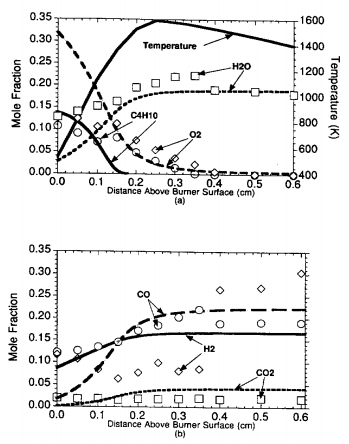
Fig.1.Comparison of model predictions with experimental concentration profiles in the n-butane flame.Symbols rep- resent the experimental measurements and the lines repre- sent the model predictions(a)Comparison to C₄H₁₀,O₂, H₂O,and the radiation corrected temperature profile used.(b)Comparison to CO,CO₂,and H₂ .
program can compute the temperature profile; however,heat losses to the burner surface and the external environment are unknown,and therefore an experimentally determined tem- perature profile is used as input.The code solves the governing equations for a steady, isobaric,1-D burner-stabilized premixed lami- nar flame by using a finite difference/modified- Newton method scheme.The numerical compu- tations performed in this study were carried out using the DEC ALPHA 440 Model series com- puter.
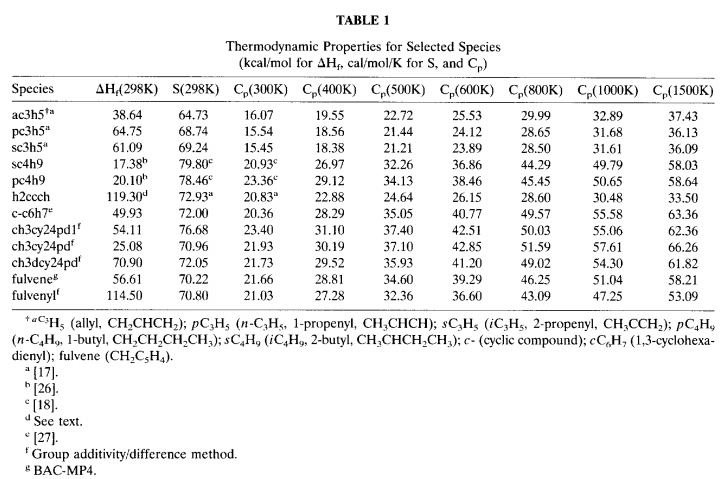
Thermochemical information was primarily obtained from the Chemkin thermodynamic database [17-20].Thermodynamic properties for those species not found in the literature or the Chemkin thermodynamic database were estimated by group additivity and difference methods [21-23].These estimated specific heats,standard state enthalpies,and standard state entropies data were fitted for the 300-K to 1500-K temperature range and extrapolated to 5000 K using the Harmonic Oscillator Equation and Exponential Function methods in THERM [24].The THERM program generates the 14 polynomial coefficients as used in the NASA Complex Chemical Equilibrium program [25]. The compilation of the thermochemical data in polynomial coefficient form may be obtained from the corresponding author or the data have been presented elsewhere [11].Additional or modified thermodynamic parameters used in this study are given in Table 1.
Transport properties were obtained from the Sandia CHEMKIN transport database [28]as found in the TRANDAT file of the Sandia TRANFIT program.Transport properties for species not found in the database were obtained using methods described by Wang and Fren- klach [29].
The full presentation of the original detailed chemical kinetic model was published in a prior publication [11],and a summary of the impor- tant revisions to the present model have been described elsewhere [13].The model was origi- nally developed using Miller-Melius's benzene formation submechanis m work [30],Tsang's propane and propene chemical kinetic reviews [31,32],Westbrook-Pitz n-butane submecha- nis m development [33],Emdee-Brezinsky- Glass man toluene and benzene oxidation chem- istry [34],and the Wang-Frenklach HACA reaction set for PAH formation [35].The model has been extended beyond this basic framework and currently consists of 156 species and 680 reactions.The present model has been revali- dated against our earlier methane and ethane data sets [11]and validated for propane [13]and the present study.Although these fuel-rich flames are sooting,we have not as yet included a submodel to treat soot production and de- struction.Additional reactions or modifications to the reaction rate parameters from Marinov [11]are presented in Table 2.
In our earlier studies we had proposed sev- eral reaction steps involving the combination of resonantly stabilized free radicals.Propargyl, allyl,1-methylallenyl,and cyclopentadienyl rad- icals were identified as an important aromatic and PAH precursor species that eventually lead to benzene,toluene,xylene,naphthalene,and phenanthrene formation in flames.
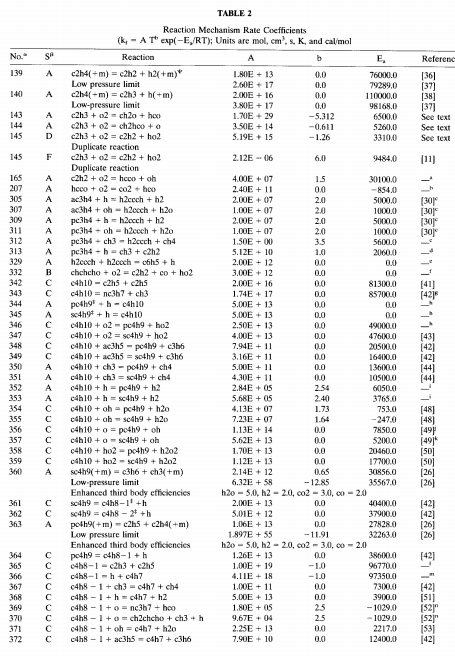
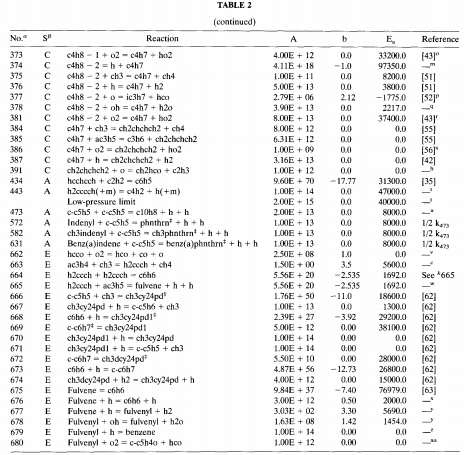
"The reaction order is in accordance to Marinov [11].
βS refers to the status of the chemical reaction.Letters A through F signify how the chemical reaction has been updated from the previous model [11].
A=Rate constant was adjusted;B= products were changed;C=reference is now cited;D=chemical reaction has been removed;E=chemical reaction has been added;F=no change was made.
Fall-off reaction in the Lindemann-Hinshelwood form:k =k₀[M]/(1+k₀[M/k)
phnthrn(phenanthrene);ch3phnthrn(methyl phenanthrene);benz(a)phnthrn(benz(a)phenanthrene);ch3cy24pd1 (methylcyclopentadienyl);ch3cy24pd(methyl cyclopentadiene);ch3dcy24pd(cyclopentadiene methyl radical);c-c6h7(1,3- cyclohexadienyl);fulvene(ch2c5h4).
"Reduced A factor by a factor of 5.Recent shock tube and modeling results of acetylene oxidation from Hidaka et al.[73] suggest the A-factor should be lowered by a factor of 3 for this reaction.
BRate expression was adjusted downward to within the prescribed uncertainty factor often as cited in [39].Products assigned as suggested in [30].
Rate expression adjusted in accordance to H-atom abstraction reactions for Propene +X,where X={OH,H,CH₃). Transition state theory fit to Whytock data [40].
"Rate constant adjusted downward from 3.0E+12 cm³/mol/s to include a second aromatic producing channel from propargyl recombination.
Perferred products than those listed in [11].
BA factor adjusted downward a factor of 1.8.
hEstimate.
Rate expressions for c4h10+h=sc4h9+h2 and c4h10+h=pc4h9+h2 were obtained by fitting data from [45-47] and using the relation ofkprimay/kscondary=0.509T⁰-14exp(-1150K/T)as obtained from [31]for abstraction reactions by H atoms involving primary and secondary hydrogens of propane with corrections made for reaction path degeneracies.
An alogy with Ethane +O.
kSubtracted the Ethane +O rate constant from the Propane +O to obtain a rate constant for abstraction of secondary H atoms.
Forward rate calculated from a reverse rate constant of 9.0E+12 and microscopic reversibility.
"Forward rate calculated from a reverse rate constant of 5.0E+13 and microscopic reversibility.
"Estimated from rate constant of 1-Butene +0.Products assumed.
"Assumed activation energy is equal to enthalpy of reaction at 298 K.A factor reduced from 4.0E+13[43]because of loss of rotor in transistion state for the case of allyl C-H.
PEstimated from rate constant of cis-2-butene +0=products and trans-2-butene +0=products.Products assumed.
9 The activation energy is assumed to be the same as c4h8-1+oh =c4h7 +h2o.The A-factor was obtained from [54] with rate constant evaluated at 1200 K.
'A factor twice c3h6+02=ac3h5+ho2 because 2-c4h8 has twice as many allylic C-H bonds as propene.Activation energy is equal to enthalpy of reaction at 298 K.
⁵An alogy with c5h9+02=penta-1,3-diene +ho2.Rate constant adjusted downward a factor of 3.Activation energy assumed to be zero.
'Activation energy for the high-and low-pressure limits were adjusted downward by 8.0 kcal/mol to reflect the change in the heat of formation value assigned to h2cccch.
"The activation energy was adjusted in accordance to [57].We have assumed the rate-limiting step to naphthalene production is the 8.0 kcal/mol intrinsic activation energy barrier associated with the scissioning of the first H atom.See text.
YRate expression is based on [30]with assigned products of choco (glyoxal radical)+o.Assumed choco automatically decomposes to hco and co,hence the products found in reaction 662.
WThis rate expression was obtained from allyl recombination data of [58-60].This rate expression is assumed to represent the upper limit to the kinetic rate expression for the allyl +propargyl reaction to products at 1 atm.We have also assumed the rate-controlling step for this reaction occurs at the entrance channel with 100%conversion to cyclic products based on the experimental findings of Hunts man [61].This rate expression was also extended to reaction 664.
×Assumed rate expression based on findings of [57].
Y Rate expression based on an alogous reactions of Benzene +X=Phenyl +XH,where X={OH,H}.
zRate constant assignment was estimated.
a Vinylic compounds react with O₂ at a rate constant of ca.1.0E+12 to 1.0E +13 cm³/mol/s.Products assumed.
nantly stabilized radicals play an important role in aromatic and PAH formation as these species can build up in concentration within the flame since they are relatively resistant to oxidation by O₂.In this study,we have continued to investi- gate the role of resonantly stabilized radicals in aromatic,branched aromatic,and PAH forma- tion in a premixed,rich,laminar,n-butane- oxygen-argon flame.
AN ALYSIS AND COMPARISON OF MODELING RESULTS TO THE
FLAME DATA
The comparison of the modeling results to the atmospheric flame data shows nearly systematic deviation in the measured profiles with the numerical simulation in the region near the burner surface (i.e.,0.0-0.10cm).We attribute this discrepancy to a number of possible factors. One possibility could be the fuel burns within the porous plug burner,which results in a s maller concentration of n-butane and O₂and higher quantities of reaction intermediates and/or products in the near-reaction zone.If the standard boundary condition at the burner sur- face using flow meter readings ofthe incoming reactants and the unburned gas temperature is used,then the PREMIX flame model would only predict n-butane,O₂,Ar,and molecules that exhibit high diffusivity )near the burner surface.Another possibility could be due to the difficulty of accessing the gases with the quartz microprobe extremely near the burner surface.This could result in a disturbance of the laminar flow field and upstream sampling of the flame.These explanations must be kept in mind when assessing the discrepancies between the predicted flame modeling results and the exper- imental data especially in the region near the burner surface.Shown below will be the mod- eling results as compared to the experimental measurements first for the low molecular weight species and then for the aromatic and PAH species.The key chemical reactions leading to different stable intermediates are identified by reaction flux an alysis.
详细内容请见附件
免责声明:
本页面/内容部分素材来源于互联网公 开 信 息,旨在传递更多信息,不代表本平台立场。
版权归原作者或机构所有,如涉及侵权,请通过平台联系我们,我们将在核实后第一时间处理。
本平台对转载内容的真实性、准确性不作任何保证,用户需自行判断并承担使用风险。