
可碎生物炭在生物炭改良土壤微观与宏观力学行为中的作用:基于离散元(DEM)的研究

论文题目
Role of Crushable Biochar in the Micro and Macro Mechanical Behaviour of Biochar-Amended Soil: A DEM Study
Yuanbing Xia1,2,3 ,Zhilin Ren3*,Gang Wei4,5 ,Yingkang Yao1,2
2 Hubei Key Laboratory of Blasting Engineering, Jianghan University, Wuhan 430056, China
研究内容
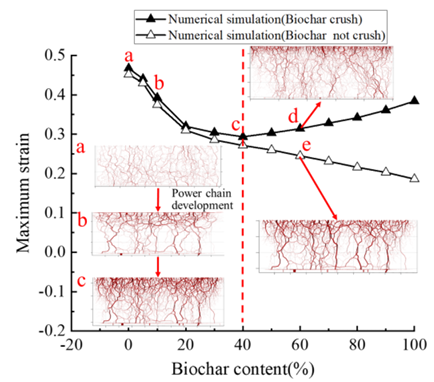
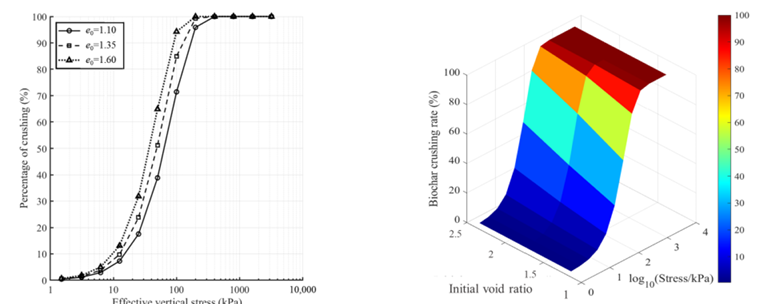
Abstract: This study investigates the microscale mechanis ms underlying the compressibility of biochar-amended soils through combined discrete element method (DEM) simulations and laboratory consolidation tests. A three-dimensional discrete element model was established based on the MatDEM platform, accounting for the particle crushing process of biochar particles and its impact on soil mechanical properties. The biochar agglomerate particles generated in the simulation exhibit irregular morphology, and particles within different size ranges were selected for investigation. According to the model and experimental results, the average relative error is about 7%. Results demonstrate that moderate biochar content effectively reduces soil compressibility by enhancing load transfer through stable force chains formed by biochar particles, which exhibit larger contact areas and higher stiffness compared to native soil particles. However, when the biochar content exceeds approximately 40%, particle crushing intensifies, particularly under high initial void ratios, leading to increased soil compressibility. Furthermore, a larger initial void ratio weakens interparticle confinement, promotes microcrack propagation, and thereby exacerbates comThis study investigates the microscale mechanis ms underlying the compressibility of biochar-amended soils through combined discrete element method (DEM) simulations and laboratory consolidation tests. A three-dimensional discrete element model was established based on the MatDEM platform, accounting for the particle crushing process of biochar particles and its impact on soil mechanical properties. The biochar agglomerate particles generated in the simulation exhibit irregular morphology, and particles within different size ranges were selected for investigation. According to the model and experimental results, the average relative error is about 7%. Results demonstrate that moderate biochar content effectively reduces soil compressibility by enhancing load transfer through stable force chains formed by biochar particles, which exhibit larger contact areas and higher stiffness compared to native soil particles. However, when the biochar content exceeds approximately 40%, particle crushing intensifies, particularly under high initial void ratios, leading to increased soil compressibility. Furthermore, a larger initial void ratio weakens interparticle confinement, promotes microcrack propagation, and thereby exacerbates com
Keywords: Biochar; Compressive properties; Particle fragmentation; MatDEM; Numerical simulation
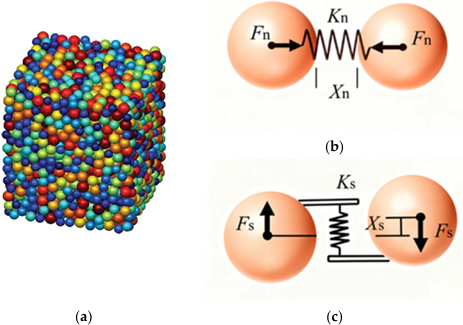
Fig.1 Schematic diagram of the linear elastic model: (a) A 3D stacking model; (b) normal contact; (c) tangential contact
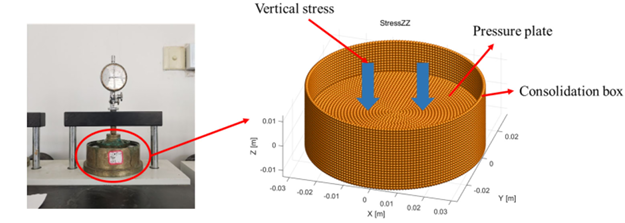
Fig.3 Numerical model of consolidation test for mixed soil samples
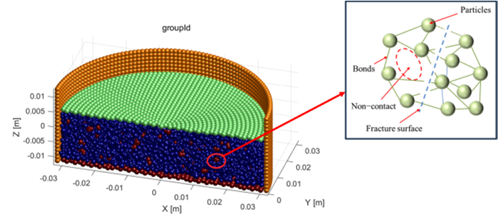
Fig.4 Fragmentation of biochar particles (showing joining and breaking of particles by decreasing the radius). Blue represents soil particles, and red represents biochar particles
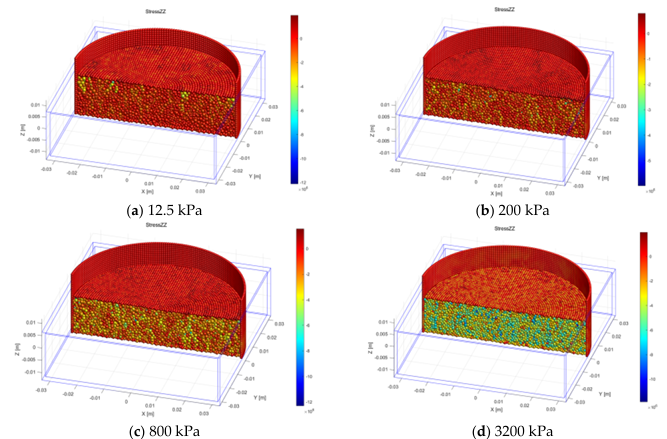
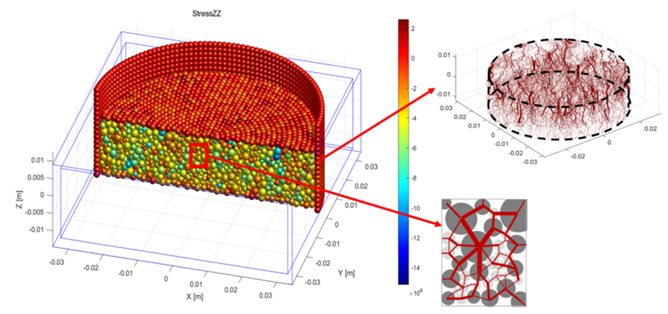
Fig.12 Internal stress distribution diagram of soil specimen under partial loading (section)
了解详情
Xia Y, Ren Z, Wei G, et al. Role of Crushable Biochar in the Micro and Macro Mechanical Behaviour of Biochar-Amended Soil: A DEM Study[J]. Materials, 2025, 18(20): 4700.