含液滴与颗粒的多相流(第二版)核心内容梳理

含液滴与颗粒的多相流(第二版)核心内容梳理(Multiphase Flows with Droplets and Particles)
摘要:
本文聚焦液滴与颗粒多相流体系内颗粒间、颗粒与壁面相互作用理论,是多相流数值模拟核心基础章节。系统阐述硬球、软球(DEM)两类碰撞模型:硬球通过冲量方程求解碰撞前后速度,计算高效;软球采用弹簧 - 阻尼类比,完整捕捉碰撞形变全过程,适配密相体系。同时介绍液桥、静电力、范德华力等颗粒黏附作用力,推导对应理论公式,分析颗粒团聚机理。还建立颗粒与壁面碰撞冲量模型,区分不同滑动工况下速度求解方法,探讨近壁流体润滑阻力、颗粒冲蚀效应,给出各类模型适用工况与数值计算要点,为流化床、气力输送等密相多相流仿真提供理论支撑。
Preface
Since the publication of the first edition of Multiphase Flow uith Droplets and Particles in 1998 there have been important advances in the science and technology of dispersed phase flows.The intent of the second edition is to include these advances while retaining the organized,pedagogical approach of the first edition.The primary change is the introduction of a new chapter, Chapter 7, on the effect of the dispersed phase particles on the turbulence of the carrier phase.The other chapters have been modified and revised to reflect the new material. Chapter 4 has been updated to include the new information on particle drag and heat transfer.In Chapter 6,a reassessment of the yolume-averaged conservation equations has been made with respect to the general applicability of the “two-fluid”concept.Chapter 8, on the equations for the dispersed phase,has been completely rewritten to include the current techniques for modeling dilute and dense flows. Chapter 9.on numerical modeling,has also been rewritten to include DNS and LES as well as volume-averaged equations for the k-E and Reynolds stress models.The exercises have been expanded and a solution manual is available to support the use of the book in an instructional environment.
The first edition of Multiphase Flow with Droplets and Particles included a FORTRAN computer program for the multiphase flow of particles in a quasi- one-dimensional duct based on the conservative variable approach.This has not been included in the second edition.Should anyone want the description of the model and the program,they can contact the senior author(CTC) directly.
Several books on or relating to dispersed phase flows have appeared since 1998.In 2006 Michaelides published Partieles,Bubbles,and.Drops:Their
Motion,Heat and Mass Transfer, which is an extension of the classic work, Bubbles,Drops and Particles (Clift,Grace and Weber,1978).Michaelides' book provides an excellent resource on particle-fluid interactions.Also,in 2006,the Mutiphase Flou Handbook appeared,which has several chapters devoted to dispersed phase flows.In 2007,Computational Methods for Multi- phase Flows was published by Prosperetti and Tryggvason.This book reviews various numerical techniquess such as immersed-boundary,lattice-Boltzmann and boundary-integral methods for detailed an alysis of fluid-particle flow sys- tems.Finally in 2009.Brennen published Fundamentals of Multiphase Flow, which gives an excellent background on fundamentals and focuses primarily on bubbly flows.
Authors
Clayton T.Crowe is Professor Emeritus at Washington State University (WSU)in Pullman,WA,retiring from the university in 2001.He received his Ph.D.from the University of Michigan in Ann Arbor.MI.in 1962.For seven years he worked in the rocket industry,before joining the Department of Me- chanical Engineering of WSU in 1969.He is the primary author of Engineering Fluid Mechanics currently in its 9th edition,coauthor of Multiphase Flow of Droplels and Particles(1998), and editor of the Multiphase Flow Handbook (2006).He received the ASME Fluids Engineering Award in 1995 and the International Prize for Multiphase Flows in 2001.In 2009 ASME recognized Professor Crowe for his contributions to the Society,and in 2010 he received the WSU Emeritus Society Award for Excellence.
John D.Schwarzkopf is cuirrently a staff scientist in the X-Theoreti- cal Design(XTD)Division of the Los Alamos National Laboratory in Los Alamos,NM.He received his Ph.D.in mechanical enigineering fron Wash- ington State University in 2008.His graduate work addressed turbulence modulation in particle-laden flows.Prior to receiving his Ph.D.,he worked in the electronics cooling industry for seven years:he is the coauthor on a patent in this area.Currently he is involved with code development and validation.
Martin Sommerfeld is currently Professor of Mechanical Process Engi- neering at the Martin-Luther University of Halle-Wittenberg in Germany.He received his Dipl.-Ing.degree in 1981 and his Dr,-Ing.degree in 1984 from the University of Aachen,Germany.Before his promotion to professor at Martin- Luther University he led a research group on two-phase flow at the University of Erlangen in Germany.He has performed detailed experimental studies of multiphase flows utilizing advanced digital image an alyses anid phase-Doppler anemometry.In 1997 he received the DECHEMA Award for his contributions to multiphase flow measurements,modeling,and numerical predictions.His current activities include development of models for flow aroind agglomer- ates,experimental an alysis with modern optical instrumentation,and direct numerical simulation.
Yutaka Tsuji retired from Osaka University,Japan,in 2007.After re- ceiving his DE from Osaka University in 1974,he directed his attention to numerical an alysis and measurements of fuid-solid flows.He has been the recipient of several prestigious awards,such as the JSME Metal in 1992 and the AIChE Thomas Baron Award in 1999,honoring his contributions to the field.Since retirement he has become the ma naging director of the Hosokawa Powder Technology Foundation promoting powder and particle technology. He is also the editor-in-chief for the KONA Powder and Particle Iournal.
Acknowledgments
Professor Crowe acknowledges the ideas and insights provided by his stu- dents and colleagues over the many years he was actively involved with mul- tiphase flow studies and activities.He is particularly thankful for the support of the Owen Science Library at Washington State University in providing ac- cessibility to the literature through electronic access and interlibrary loans. He acknowledges the continuous love and support of his wife,Jeannette,two incredible sons,Kevin and Chad (and Brenda),and two remarkable step- daughters,Marcia and Mary Ann,and their families.
Dr.Schwarzkopf acknowledges the contributions of his teachers and col- leagues.He is thankful for support provided by Los Alamos National Labora- tory.He is also indebted to his family and friends for their continued support and encouragement.
Professor Tsuji acknowledges the assistance and contributing research of former students in his laboratory. These people include:Dr.Toshitsugu Ta naka,Professor at Osaka University,Japan;Dr. Toshihiro Kawa- guchi,Associate Professor of Kansai University,Japan,and Dr.Takuya Tsuji, Associate Professor at Osaka University.
Clayton T.Crowe John D.Schwarzkopf Martin Sommerfeld Yutaka Tsuji
Chapter 1 Introduction
The flow of particles and droplets in fluids is a subcategory of multicomponent, multiphase flows.The flow of multicomponent,multiphase mixtures covers a wide spectrum of flow conditions and applications. A component is a chemical species such as nitrogen,oxygen,water or Freon.A phase refers to the solid, liquid or vapor state of the matter.Examples of single and multicomponent, multiphase flows are provided in Table 1.1.
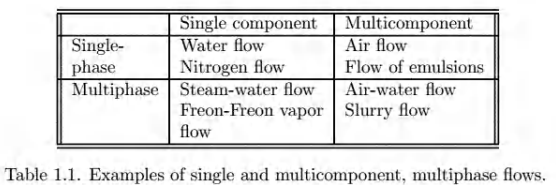
The flow of air,which is composed of a mixture of gases(nitrogen,oxy- gen,etc.),is the best example of a single-phase multicomponent flow.It is common practice to treat these types of flows as the flow of a single compo- nent with a viscosity and thermal conductivity which represents the mixture. Such an approach is practical unless the major constituents of the component gases have significantly different molecular weights.In this case the momen- tum associated with the diffusional velocities may be important.Also,the multicomponent nature of air will be important at high temperatures where dissociation occurs,or at very low temperatures where some species may con- dense out.
The flow of mixtures of liquids is also an important industrial application.
For example,water is sometimes used to flush oil from a well which gives rise to a multicomponent single-phase flow.If the two liquids are miscible,then
the mixture will be treated as a single-phase with modified properties.If the liquids are immiscible.then the liquid cannot be regarded as homogeneous and treatment of the flow problem becomes much more complex.In this situation one may have “globs”of oil in the water or for high oil content,globs of water carried by the oil.The mixtures of two liquids are generally referred to as emulsions.
Single-component,multiphase flows are typically the flow of a liquid with its vapor.The most cornnon example is stean-water flows which are found in a wide variety of industries.Another example of single-component,multiphase flows are refrigerants in a refrigeration system.
The flow of fluids of a single phase has occupied the attention of scientists and engineers for many years.The equations for the motion and thermal properties of single-phase fluids are well accepted (Navier-Stokes equations) and closed-form solutions for specific cases are well documented.The major difficulty is the modeling and quantification of turbulence and its influence on mass,momentum and energy transfer.The state-of-the art for multiphase flows is considerably more primitive in that the correct formulation of the governing equations is still subject to debate. For this reason,the study of multiphase flows represents a challenging and potentially fruitful area of endeavor for the scientist or engineer,
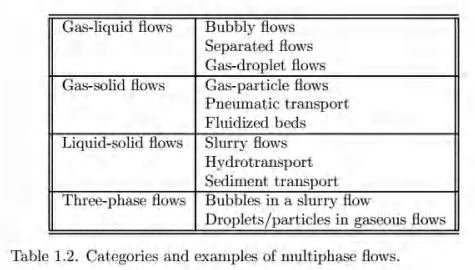
Multiphase flows can be subdivided into four categories:gas-liquid,gas- solid,liquid-solid and three-phase flows.Examples of these four categories are shown in Table 1.2.A gas-liquid fow can assume several different config- urations.For example,the motion of bubbles in a liquid in which the liquid is the continuous phase is a gas-liquid flow.On the other hand,the motion of liquid droplets in a gas is also a gas-liquid flow.In this case,the gas is the continuous phase.Also,a separated flow in which the liquid moves along the bottom of a pipe and the gas along the top is also a gas-liquid flow.In this situation both phases are continuous.The first two examples,bubbles in
a liquid and droplets in a gas,are known as dispersed phase Hows since one phase is dispersed and the other is continuous.By definition,one can pass fron one point to another in the continuous phase while remaining in the same medium.One cannot pass fron one droplet to another without going through the gas.
Gas-solid flows are usually considered to be a gas with suspended solid particles.This category includes pneurnatic transport as well as fnidized beds. Another example of a gas-solid flow would be the motion of particles down a chute or inclined plane.These are known as granular flows.Particle-particle and particle-wall interactions are much more important than the forces due to the interstitial gas.If the particles become motionless,the problem reduces to flow through a porous medium in which the viscous force on the particle surfaces is the primary mechanism affecting the gas flow.An example is a pebble-bed heat exchanger.It is not appropriate to refer to flow in a porous medium as a gas-solid flow since the solid phase is not in inotion.Gas-solid flow is another example of a dispersed phase flow since the particles constitute the dispersed phase and the gas is the continuous phase.
Liquid-solid flows consist of flows in which solid particles are carried by the liquid and are referred to as slurry flows.Slurry flows cover a wide spec- trum of applications from the transport of coals and ores to the flow of mud. These flows can also be classified as dispersed phase lows and are the focus of considerable interest in engineering research.Once again it is not appropriate to refer to the motion of liquid through a porous medium as a liquid-solid flow since the solid phase is not in motion.
Three-phase flows are also enicountered in engineering problems.For exam- ple,bubbles in a slurry flow gives rise to the presence of three plhases flowing together.There is little work reported in the literature on three-phase flows.
The subject of this book is the flow of particles or droplets in a fuid, specifically the flow of particles and/or droplets in a conveying gas as well as particles in a conveying liquid.The other area of dispersed phase flows, namely,bubbly flows.will not be addressed here.
The flow of particles and droplets in fuids has a wide application in in- dustrial processes.The removal of particulate material from exhaust gases is essential to the control of pollutants generated by power plants fired by fossil fuels.The efficient combustion of droplets and coal particles in a furnace de- pends on the interaction of particles or droplets with air.The generation of many food products depends on the drying of liquid droplets to powders in high temperature gas streams.The traiisport of powders ini pipes is conimon to many chemical and processing industries.
For many years.the design of systems with particle/droplet flows was based primarily on empiricism.However,more sophisticated measurement techniques have led to improved process conitrol and evaluation of fundamen- tal parameters.Increased computational capability has enabled the develop- ment of numerical models that can be used to complemenit engineering system design.The improved understanding of this is a rapidly growing field of tech-nology which will have far-reaching benefits in upgrading the operation and efficiency of current processes and in supporting the development of new and innovative approaches.
A curent status of multiphase flow technology in industrial applications can be found in the Multiphase Flou Handbook:(Crowe.2006).
1.1 Industrial applications
The objective of this book is to provide a background in this important area of fluid mechanics to assist those new to the field and to provide a resource to those actively involved in the design and development of multiphase sys- tems.In this chapter,examples of multiphase flows in industrial and energy conversion processes are outlined to illustrate the wide application of this technology.
1.1.1 Spray drying
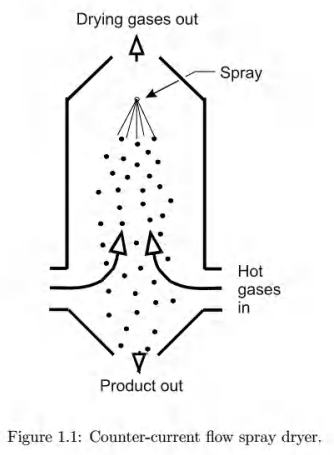
Many products such as foods,detergents and pharmaceuticals are produced through spray drying(Masters,1972).This is a process in which a liquid material is atomized,subjected to hot gases and dried into the form of a powder.The general configuration of a counter current flow spray dryer is shown in Figure 1.1. A slurry or concentrated mixture is introduced at the top of the dryer and atomized into droplets.Hot gases are fed into the bottom with a swirl component and move upward through the dryer.The droplets are dried as they fall through the hot rising gases to form a powder which is collected at the bottom and removed as the final product.
Accumulation of the dried product on the wall is to be avoided because of uncontrolled drying and the possibility of fire.Also.in the case of food production,the product cannot become too hot to avoid altering the taste.
The gas-droplet(particle)flow within the dryer is very complex.The swirling motion of the gases transports the particles toward the wall which may lead to impingement and accumulation.The temperature distribution in the dryer will depend on the local concenitration of the droplets as they fall through the dryer.High local concentrations will depress the local gas temperature and lead to less effective drying.The result may be a non- uniformly dried product reducing product quality.
Even though spray drying technology has been continuously improved through the years,it is still difficult to scale up models to prototype oper- ation.It is also difficult to determine,without actual testing,how modifying the design of a conventional dryer will affect performance.There have been significant progress(Verdurmen et al.,2004)in the developnent of numerical and an alytic tools that adequately simulate the gas-droplet fow field in the dryer.Such models or an alyses could be effectively used to improve the effi- ciency of current designs,predict off-design performanice and serve as a tool for scale-up of promising bench-scale designs to prototype operation.
1.1.INDUSTRIAL APPLICATIONS
1.1.2 Pollution control
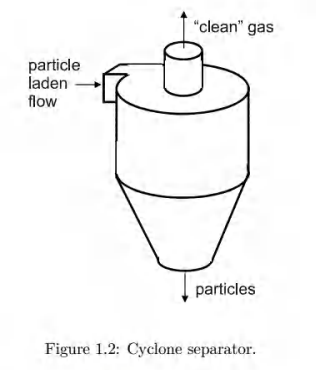
The removal of particles and droplets from industrial effluents is a very im- portant application of gas-particle and droplet flows(Jorgensen and Johnsen, 1981).Several devices are used to separate particles or droplets from gases.If the particles are sufficiently large(greater than 50 microns),a settling cham- ber can be used in which the condensed phase simply drops out of the flowing gas and is collected.For smaller particles(~5 microns),the cyclone separa- tor shown in Figure 1.2 is used.The gas-particle flow enters the device in a tangential direction as shown.The resulting vortex motion in the separator causes the particles to migrate toward the wall due to centrifugal acceleration and then fall toward the bottom where they are removed.The gases con- verge toward the center and form a vortex flow which exits through the top. The performance of the cyclone is quantified by the“cut size”which is the particle diameter above which all the particles are collected.Years of experi- ence in cyclone design have resulted in“standard”designs that,under normal operating conditions,have predictable performance.Numerical modeling or other approaches are needed to design cyclones for special applications such as hot-gas clean up.
The particles issuing from power plants operating with fossil fuels are on the order of a micron in diameter.In these applications,the electrostatic precipitator is generally used.The top view of a conventional electrostatic precipitator is shown in Figure 1.3.The high voltage applied to the wires cre- ates a corona with charged ions.These ions travel along the electric lines of force to the particles and accumulate on the particles.The resulting charged particles are moved toward the wall by Coulomb forces and deposited on the wall.Periodically the plates are vibrated (rapped)and the particles fall into a collection bin.The fluid mechanics of the electrostatic precipitator is quite complex.The particle-fluid interaction obviously influences the particle con- centration and the charge density.These,in turn,affect the electric field. Flow turbulence is also introduced by the structural ribs in the system.Elec- trostatic precipitators are still designed using empirical formulas because of the complexity of the fluid-particle-electrical field interactions.
Another pollution control device is the wet gas scrubber which is designed to remove particulate as well as gaseous pollutants.Scrubbers come in many configurations but the venturiscrubber shown in Figure 1.4 represents a simple design.Droplets are introduced upstream of the venturi and the particles are collected on the droplets.The droplets,being much larger than the particles, can be more easily separated from the flow.Sulfur dioxide can also be removed by using droplets mixed with lime.The sulfur dioxide is absorbed on the surface of the droplets.These droplets are collected,the sulfur products are removed and the droplets are reused in the scrubber.
原资料见附件
免责声明:
本页面/内容部分素材来源于互联网公 开 信 息,旨在传递更多信息,不代表本平台立场。
版权归原作者或机构所有,如涉及侵权,请通过平台联系我们,我们将在核实后第一时间处理。
本平台对转载内容的真实性、准确性不作任何保证,用户需自行判断并承担使用风险。