基于deform模具寿命的预测(中英文)

摘要
This paper describes the estimation method of die service life based on wear and the plastic deformation of dies in hot forging processes. Die service life is considerably shortened due to the thermal softening of surface layer, caused by the high thermal load and long contact time between the dies and the deforming material. Also, the die service life depended on wear and the plastic deformation of dies can be to a large extent determined by finite element (FE) an alysis, wear and thermal softening tests. These are some of the major limiting factors affects die accuracy and die service life, and forming velocity and initial die temperatures influence greatly wear and the plastic deformation of hot forging dies. In this study, two methods are suggested for estimating the service life of hot forging dies by plastic deformation and abrasive wear, and these applied to predict the product quantity according to two main process variables, forming velocity and initial die temperature for a spindle component. Through the applications of the suggested methods, the thermal softening of dies due to the local temperature rise led to the reduction of the service life of hot forging dies by plastic deformation more than by abrasive wear. © 2004 Elsevier B.V. All rights reserved.
本文介绍了计算方法的模具使用寿命基于磨损和塑性变形的模具在热锻过程。模具使用寿命大大缩短由于热软化的表面层,高所造成的热负荷和长期接触死亡之间的时间和变形的材料。此外,模具使用寿命取决于磨损和塑性变形的模具可在很大程度上取决于有限元(远东)分析,磨损和热软化试验。这些都是一些主要限制因素影响模具的精度和模具使用寿命,并初步形成速度和模具温度的影响力大大磨损和塑性变形的热锻模。在这项研究中,提出了两种方法估算的使用寿命热锻模的塑性变形和磨损,而这些用于预测产品数量根据两个主要过程变量,初步形成速度和模具温度为主轴的组成部分。通过应用所建议的方法,热软化的死亡,由于当地气温上升导致减少使用寿命的热锻模的塑性变形超过了磨料磨损。 © 2004埃尔塞维尔湾五,保留所有权利
Keywords: Hot forging; Die service life; Wear; Plastic deformation; Thermal softening; Tempering parameter
关键词:热锻;模具使用寿命;磨损;塑性变形;热软化; 回火参数
1.Introduction
1. 前言
Hot forging is one of the most conventional metal-forming processes used in the production of critical parts in various industries [1]. Actually, it is widely used in the manufacturing of automobiles and industrial machine components. In particular, this process can be effectively used to form materials with the high flow stress. Die service life greatly influences manufacturing costs, productivity and product quality. During hot forging process, die service life is dramatically shortened by thermal cycle, excessive metal flow and a decrease in die hardness [2].
热锻是最传统的金属成形过程中所使用的关键部件生产中各行业[ 1 ] 。其实,它广泛用于制造汽车和工业机械部件。特别是,这一过程可以有效地利用,形成材料的高流动应力。模具使用寿命大大影响了生产成本,提高生产率和产品质量。在热锻过程中,模具的使用寿命大大缩短了热循环,过度金属流动和减少模具硬度[ 2 ] 。
Nowadays, manufacturing costs depend on how die service life can be extended for sound products without any kinds of internal and external defects during hot forging process. Subcontractors and suppliers are increasingly under pressure with regard to cost reduction and responsibility for the development of new components. These requirements are more critical in the automotive industry. Therefore, it is important to improve the technical skills in the areas of material science and metallurgy as well as in the area of tool design.
如今,生产成本取决于模具的使用寿命可以延长产品的声音没有任何形式的内部和外部缺陷在热锻过程。分包商和供应商正在受到越来越多的压力就减少成本和责任的发展,新的组成部分。这些要求是更重要的汽车行业。因此,重要的是要提高技术技能方面的材料科学和冶金以及在该地区的模具设计
The knowledge of computer aided design (CAD) and numerical simulation also becomes very helpful. In the forging industry, tooling costs can reach up to about 50% of a component cost. Therefore, it is obvious that the reduction of component costs requires an optimization of tools, in particular, an improvement in performance and service life [3]. During hot forging process, forging tools are not only subjected to mechanical stresses, but also to thermo mechanical stresses induced by the thermal cycling and successive forging operations.
知识的计算机辅助设计( CAD )和数值模拟也变得非常有帮助。在锻造工业,加工费用可达约50 %的元件成本。因此,很显然,减少元件成本需要有一个优化的工具,特别是改善性能和使用寿命[ 3 ] 。在热锻过程中,锻造工具不仅受到机械应力,而且还热机械应力引起的热循环和连续锻造业务。
Proper selection of the die material and of the die manufacturing technique determines, to a large extent, the useful life of forming dies. Dies may have to be replaced for a number of reasons, such as changes in dimensions due to wear or plastic deformation, deterioration of the surface finish, breakdown of lubrication, and cracking or breakage [4]. Many researchers have been investigated the influences of process conditions on die service life during metal forming process [5–7]. The surface hardness of a die decreases owing to the thermal softening of hot forging dies. This thermal softening effect accelerates tool failures [8]. The limiting factors of die service life can occur simultaneously or separately during hot forging process. Due to the different characteristics of processes or products, die service life can be decreased by wear or by the plastic deformation [9].
正确选择模具材料和模具制造技术决定,在很大程度上,使用寿命形成死亡。模具可能要取代有许多原因,如变化方面,由于磨损或塑性变形,恶化的表面光洁度,细目润滑,打击或断裂[ 4 ] 。许多研究人员进行调查的影响,工艺条件对模具使用寿命在金属成形过程[ 5-7 ] 。表面硬度的死亡减少由于热软化热锻模。这热软化效应加速工具失败[ 8 ] 。的限制因素的模具使用寿命可同时或分别发生在热锻过程。由于不同的特点,工序或产品,模具使用寿命可减少磨损或塑性变形[ 9 ] 。
This study developed two methods to estimate die service life in hot forging processes. One is a method that can predict the plastic deformation of a die and the other is to calculate the amount of die wear. These methods have been applied to evaluating the service life of a finisher die for the hot forging process of an automobile part, and the possible maximum production quantity which describes die service life will be evaluated according to the variations of initial die temperature and forming velocity.
本研究开发的两种方法来估计模具使用寿命在热锻过程。其中一个方法,可以预测的塑性变形的模具和其他是计算的数额的模具磨损。这些方法已应用于评价的使用寿命完美收官模热锻过程中汽车的一部分,可能最大的生产量描述模具使用寿命将评价根据变化的初步成形模具温度和速度。
2.Methods for estimating die service life
2.的方法来估计模具使用寿命
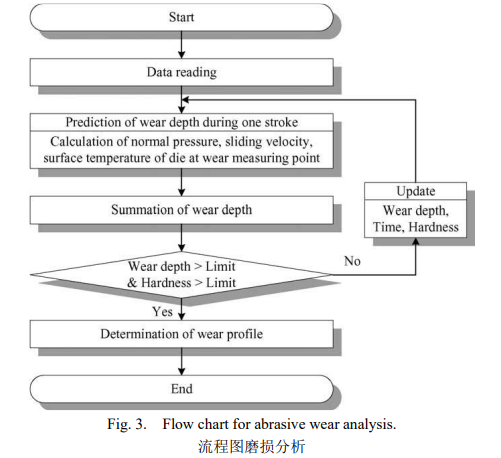
This study developed two methods for estimating the service life of dies in hot forging process. One is a method that can predict the plastic deformation of the die; the other is for calculating abrasive tool wear.
本研究开发的两种方法估算的使用寿命模具在热锻过程。其中一个方法,可以预测的塑性变形的模具;另一种是计算磨具的磨损。
2.1.Die service life based on plastic deformation
2.1模具使用寿命基于塑性变形
During the hot forging process, the temperature of a die increases due to the contact between the dies and the hot deforming material. The rate of temperature rise can be attributed to several factors, such as the initial temperature of dies and billet, the contact time and pressure, the die material and surface treatment conditions. The thermal softening induced by this temperature rise gradually reduces die hardness, and finally leads to the plastic deformation of a die [8].
The longer contact time at the elevated temperature gives rise to a decrease of the surface hardness of a die. In order to consider the thermal softening effect in estimating die service life against plastic deformation, it is required to introduce the tempering parameter, M, as shown in Eq. (1), which represents the effect of die hardness change on the contact temperature and time successive forging cycles [9]:
在热锻过程中,温度的增加而死亡之间的接触死亡和热变形的材料。率的温度上升可以归因于几个因素,如初始温度的模具和坯料,接触时间和压力,模具材料及表面处理条件。热软化诱导这一温度上升逐渐降低模具硬度,并最终导致的塑性变形的死亡[ 8 ] 。
较长的接触时间在高温引起减少了表面硬度的死亡。为了考虑热软化效应估计死亡使用寿命对塑性变形,这是需要引进回火参数,男,所显示的均衡器。 ( 1 ) ,这是影响模具硬度变化对温度和时间接触连续锻造周期[ 9 ] :

where T is the tempering temperature (K), C is the material constant which has about 20 for carbon steel, t is the tempering time. Also, from starting to deform until ejecting the forged part, the temperatures of die surface change during one forging cycle, so the introduction of equivalent temperature is required. The equivalent temperature, , can be approximately expressed as shown in Eq. (2):
其中T是回火温度( K ) , C是材料常数其中大约有20对碳钢, T是锻炼时间。另外,从开始变形,直到弹出伪造的部分模具表面的温度变化1锻造周期,因此采用等效温度是必需的。相当于温度,可近似表示显示均衡器。 ( 2 ) :

Where , and are the highest and lowest temperatures during one forging cycle, respectively. 在那里,并且是最高和最低气温在1锻造周期分别。
To estimate die service life for the plastic deformation of a die induced by thermal softening, the tempering time, t, at Eq. (1) is replaced with hardness holding time th, where th is the time which takes until initial die hardness gradually reduces to reach the critical hardness by thermal softening, as shown in Eq. (3):
估计模具使用寿命的塑性变形的热诱导死亡软化,回火时间,吨,在均衡器。 ( 1 )改为硬度日举行的时间,在那里次的时间,考虑到初始模硬度逐渐降低,达到临界硬度的热软化所示,均衡器。 ( 3 ) :
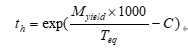
where is the M value when initial die hardness is equals to the corresponding hardness of the yield strength of the die.
哪里是M值时,最初的模具硬度等于相应的硬度屈服强度模具。
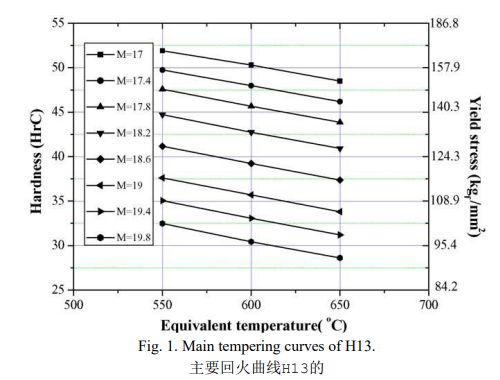
When the material is a perfect plastic, the hardness (HrC) of material is about three times of the yield strength of material [10]. The main tempering curves of this hot work die material, H13, obtained from thermal softening experiments is shown in Fig. 1.An actual working finishing die was quenched at 1030 ◦C, and then it had the first tempering for 3 h at 550 ◦C and the second tempering for 3.5 h at 600 ◦C. Die surface was treated as ion-nitriding process for 14 h at 520 ◦C.
当材料是一个完美的塑料,硬度(硬度)的材料是3倍左右的屈服强度的材料[ 10 ] 。主要回火曲线这个热作模具材料, H13的,从热软化实验显示图。 1.An实际工作完成淬火模具是在1030年◦ C ,然后它的第一个锻炼的3小时在550 ◦ C和第二回火为3.5 h在600 ◦角模具表面被视为离子渗氮过程的14 h在520 ◦角
Therefore, for hardness holding time for estimating the die service life considers the first and second tempering time, which can be derived as follows:
因此,硬度保温时间估计模具使用寿命认为,第一次和第二次锻炼的时间,可以得出如下:

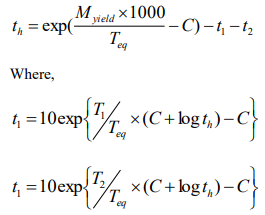
where T1, T2 are the first and second tempering temperatures, t1, t2 are the hardness holding times at the first and the second Myield values for Teq, respectively.
那里的T1 ,时刻是第一次和第二次回火温度, T1讯号,氚的硬度举行次在第一次和第二次Myield价值的毒性当量分别。
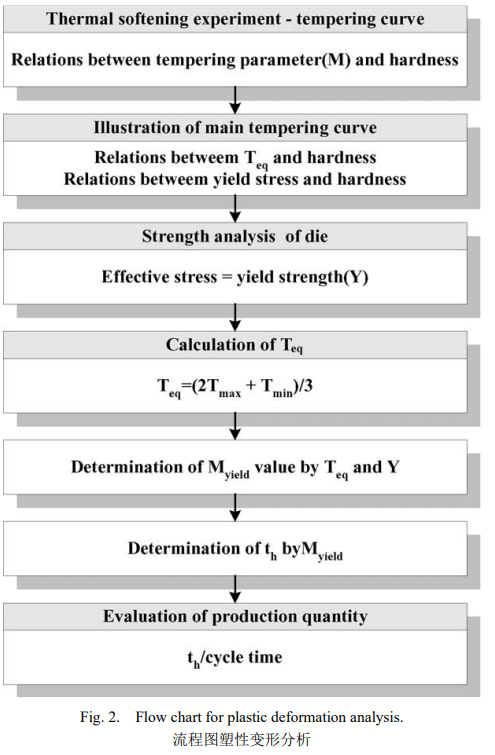
In order to calculate the hardness holding time, effective stresses and equivalent temperatures can be obtained from rigid-plastic finite element an alysis. Myield value can be determined from the main tempering curve. t1 and t2 are substituted into Eq. (4) to obtain the hardness holding time.
Finally, the die service life of the finishing die is calculated by dividing the hardness holding time by one forging cycle time, and the die service life is expressed as the possible maximum production quantity. The outline of a method for estimating die service life affected by plastic deformation is shown in Fig. 2
为了计算硬度持有时间,有效应力和等效温度可从刚塑性有限元分析。 Myield价值来确定的主要回火曲线。 T1和T2是代入方程。 ( 4 ) ,以获取硬度保温时间。
最后,模具使用寿命整理模具除以硬度保温时间由一个锻造循环时间,及模具使用寿命表示可能最高产量。大纲的估算方法模具使用寿命的影响塑性变形图所示。 2
原资料见附件
免责声明:
本页面/内容部分素材来源于互联网公 开 信 息,旨在传递更多信息,不代表本平台立场。
版权归原作者或机构所有,如涉及侵权,请通过平台联系我们,我们将在核实后第一时间处理。
本平台对转载内容的真实性、准确性不作任何保证,用户需自行判断并承担使用风险。