【新文速递】2026年5月29日固体力学SCI期刊最新文章
今日更新:International Journal of Solids and Structures 4 篇,Mechanics of Materials 3 篇,International Journal of Plasticity 1 篇,Thin-Walled Structures 6 篇
International Journal of Solids and Structures
Parameter optimization and topological design of metamaterials with implementation of deep learning
Hongyun Yang, Tao Zeng, Hao Li, Jinchao Wang, Zhaoyu Li, Shijing Wu, Xiaosun Wang
doi:10.1016/j.ijsolstr.2026.114127
基于深度学习的超材料参数优化与拓扑设计
Targeted design of elastic wave metamaterials can avoid complex processes and quickly achieve target performance and structural design, making it a current research hotspot. This paper uses cross-validation based on the plane wave expansion method (PWE) and finite element method (FEM) and utilizes deep learning (DL) to explore bandgap design and topological design of two-dimensional localized resonance-type elastic wave metamaterials. The tasks of DL are systematically divided. First, its prediction of bandgaps and multi-parameter inverse design are a nalyzed, followed by an exploration of multi-topology configuration bandgap and band structure forward prediction based on DL, achieving multi-parameter matching inverse design of topology configurations. A forward and reverse mapping relationship between bandgaps and parameters is established, as well as one-to-many and many-to-one design relationships between bandgaps, topology configurations, and parameters. In the validation phase, FEM calculation results were verified using PWE, and DL design results were validated via FEM; After evaluating model performance using a multi-criteria assessment framework, it was found that CNN achieved the highest accuracy in forward prediction, followed by MLP, with SVM performing the worst. However, all DL models effectively predicted bandgaps and demonstrated excellent performance in multi-parameter and multi-objective topological configuration inverse design. This study provides guidance for targeted intelligent design of metamaterials and holds promise for extension to research on more complex structures.
弹性波超材料的定向设计可以避免复杂的工艺过程,快速实现目标性能和结构设计,是当前的研究热点。本文采用基于平面波展开法(PWE)和有限元法(FEM)的交叉验证,利用深度学习(DL)探索二维局域共振型弹性波超材料的带隙设计和拓扑设计。DL的任务被系统地划分。首先对其带隙预测和多参数逆设计进行了分析,然后探索了基于DL的多拓扑构型带隙和带结构正演预测,实现了拓扑构型的多参数匹配逆设计。建立了带隙与参数之间的正向和反向映射关系,以及带隙、拓扑配置和参数之间的一对多和多对一设计关系。验证阶段,采用PWE对有限元计算结果进行验证,采用FEM对DL设计结果进行验证;在使用多准则评估框架对模型性能进行评估后,发现CNN在前向预测中准确率最高,其次是MLP, SVM表现最差。然而,所有DL模型都能有效地预测带隙,并在多参数、多目标拓扑构型反设计中表现出优异的性能。该研究为超材料的定向智能设计提供了指导,并有望扩展到更复杂结构的研究。
3D printed novel hybrid gradient star re-entrant double-arrowhead structures: An optimization of gradient parameters using statistical and advanced machine learning technique
Hardik D. Sondagar, Shailendra Kumar
doi:10.1016/j.ijsolstr.2026.114126
3D打印新型混合梯度星形可重入双箭头结构:利用统计和先进的机器学习技术优化梯度参数
Hybrid and gradient auxetic metamaterials have shown promising interest in automotive bumpers, protective equipment, aircraft wing morphing, and soft robotics applications, owing to their enhanced strength, stiffness, and energy absorption compared to conventional auxetic structures. This study presents the design and fabrication of a novel hybrid gradient star re-entrant double-arrowhead (GSRDA) auxetic structure using fused filament fabrication (FFF) of 3D printing. The influence of gradient geometric parameters, mainly thickness coefficient and height gradient is systematically investigated on strength, stiffness, and specific energy absorption (SEA) along with deformation mechanisms under compressive loading. Optimization of the gradient parameters is performed using response surface methodology (RSM) and an advanced artificial neural network (ANN) model with three hidden layers, and the accuracy of ANN model is validated through a leave-one-out cross-validation (LOOCV) approach. The results indicate that maximum strength, stiffness, and SEA are achieved at higher thickness coefficients and lower height gradients. Also, energy absorption in the second plateau region is significantly higher than in the first plateau region, attributed to the contribution of inclined walls of the double-arrowhead configuration. Further, the ANN model employing the trainbfg and logsig as training and transfer function demonstrates superior performance (MSE = 0.0304, R = 0.969), highlighting the efficiency of an advanced machine learning approach for predicting the mechanical behavior of auxetic metamaterials.
混合和梯度形变超材料在汽车保险杠、防护设备、飞机机翼变形和软机器人应用中表现出了很大的兴趣,因为与传统的形变结构相比,它们具有更高的强度、刚度和能量吸收。本研究采用3D打印熔丝制造技术(FFF)设计和制造了一种新型的混合梯度星形再入双箭头(GSRDA)辅助结构。系统研究了梯度几何参数(主要是厚度系数和高度梯度)对压缩载荷下强度、刚度和比能吸收(SEA)的影响及其变形机理。采用响应面法(RSM)和先进的三隐层人工神经网络(ANN)模型对梯度参数进行了优化,并通过留一交叉验证(LOOCV)方法验证了ANN模型的准确性。结果表明,在较高的厚度系数和较低的高度梯度下,强度、刚度和SEA均达到最大。第二高原区域的能量吸收明显高于第一高原区域,这是由于双箭头结构的斜壁的贡献。此外,采用trainbfg和logsig作为训练和传递函数的人工神经网络模型表现出优异的性能(MSE = 0.0304, R = 0.969),突出了先进的机器学习方法在预测auxetic超材料力学行为方面的效率。
Physics-informed neural networks for micromechanics in tensile and shear loading with hyperparameter optimization
Shervin Shirmohammadi, Sadegh Mostajeran, Ali Fallah, Mohammad Mohammadi Aghdam
doi:10.1016/j.ijsolstr.2026.114125
具有超参数优化的拉伸和剪切加载微观力学的物理信息神经网络
The mechanical an alysis of heterogeneous materials, such as fiber-reinforced composites, typically relies on computationally intensive numerical techniques like Finite Element An alysis. To address the computational costs and mesh-dependency associated with traditional methods, this study proposes a Physics-Informed Neural Network (PINN) framework for micromechanical modeling. By embedding the governing equations of linear elasticity directly into the network’s loss function, the model is solved for displacement and stress fields within a Representative Volume Element (RVE) without requiring labeled training data. The approach is validated using an aluminum-boron composite system subjected to macroscopic uniaxial tension and pure shear loading. The results demonstrate strong agreement with finite element benchmarks, maintaining average relative errors below eight percent. A systematic hyperparameter an alysis, including the effects of activation functions, network architecture, and training duration, reveals that the Swish activation function consistently outperforms Tanh, Sigmoid, and ReLU in terms of convergence speed and final solution accuracy. Furthermore, sensitivity an alyses indicate that while the model is robust, predictive errors increase with the stiffness contrast ratio between the matrix and inclusion, particularly under shear deformation modes. The study concludes by utilizing the trained network to perform computational homogenization, accurately deriving the effective material properties of the composite. This work confirms the viability of the PINN as a mesh-free and data-efficient alternative for the micromechanical a nalysis of heterogeneous solids.
非均质材料(如纤维增强复合材料)的力学分析通常依赖于计算密集型的数值技术,如有限元分析。为了解决与传统方法相关的计算成本和网格依赖问题,本研究提出了一个物理信息神经网络(PINN)框架用于微力学建模。通过将线性弹性的控制方程直接嵌入到网络的损失函数中,该模型在不需要标记训练数据的情况下求解代表性体元(RVE)内的位移和应力场。用铝硼复合材料体系进行了宏观单轴拉伸和纯剪切载荷的验证。结果显示与有限元基准的强烈一致性,将平均相对误差保持在8%以下。系统的超参数分析,包括激活函数、网络架构和训练时间的影响,表明Swish激活函数在收敛速度和最终解精度方面始终优于Tanh、Sigmoid和ReLU。此外,敏感性分析表明,尽管该模型具有鲁棒性,但预测误差随着基体与夹杂物之间的刚度对比而增加,尤其是在剪切变形模式下。最后,利用训练好的网络进行计算均匀化,准确地推导出复合材料的有效材料性能。这项工作证实了PINN作为非均质固体微力学分析的无网格和数据高效替代方案的可行性。
Determining the couple stress characteristic material length of two-phase composites with square symmetry by homogenization
Moonhong Kim
doi:10.1016/j.ijsolstr.2026.114114
采用均质化法确定方形对称两相复合材料的耦合应力特征材料长度
The characteristic material length of the consistent couple stress theory is determined for two-phase periodic composites through computational homogenization. A quadratic displacement field producing uniform macroscopic curvature is imposed on stacked unit cells modeled with classical Cauchy constitutive laws, and the effective curvature stiffness is extracted by decomposing the strain energy into Cauchy elastic and curvature contributions. A parametric study for circular fiber composites under plane strain reveals that the characteristic material length is governed primarily by the Young’s modulus contrast, with a non-monotonic dependence on the fiber volume fraction. A surface effect is identified, in which unit cells adjacent to a free boundary exhibit a different effective curvature stiffness from the bulk value, and its magnitude is quantified as a function of the material contrast ratios. The effect of fiber cross-sectional shape is also examined by comparing the results for unit cells with a circular fiber and with a square fiber. The computed characteristic material length is validated through cantilever plate deflection and plate buckling problems, showing good agreement between couple stress an alytical solutions and heterogeneous finite element results.
通过计算均质化,确定了两相周期性复合材料的一致耦合应力理论的特征材料长度。在基于经典柯西本构定律的叠加单元格上施加产生均匀宏观曲率的二次位移场,将应变能分解为柯西弹性贡献和曲率贡献,提取有效曲率刚度。平面应变下圆形纤维复合材料的参数化研究表明,材料的特征长度主要由杨氏模量对比决定,与纤维体积分数非单调相关。确定了表面效应,其中靠近自由边界的单元胞表现出不同于体积值的有效曲率刚度,其大小被量化为材料对比度的函数。通过比较圆形纤维和方形纤维的单晶胞的结果,还考察了纤维截面形状的影响。通过悬臂板挠曲和板屈曲问题验证了计算的特征材料长度,表明耦合应力解析解与非均质有限元结果吻合较好。
Mechanics of Materials
Viscous friction - induced ignition mechanism of high-energy propellants under dynamic compressive loading
Liying Dong, Chenyang Fan, Kun Yang, Yanqing Wu
doi:10.1016/j.mechmat.2026.105749
高能推进剂在动态压缩载荷下的粘性摩擦引燃机理
Investigation of the ignition mechanisms of high-energy, low-vulnerability propellants is essential for improving the combat effectiveness and survivability of strategic and tactical missile systems. Dynamic compression experiments were conducted using a drop-weight apparatus to capture the full deformation-damage-ignition process of GRT propellant specimens. A dynamic damage constitutive model, coupled with a macro-micro ignition criterion, was then implemented into an LS-DYNA user subroutine to simulate localized ignition under compressive loading and compare it with other ignition criteria. The results indicate that ignition of the GRT propellant exhibits two key characteristics: (i) extreme thinning of the specimen to approximately 0.1 mm, and (ii) ignition initiation at the specimen edge. Numerical simulations yield a frictional power density of P in=814 w/cm2 and an ignition time of t ig=1.01 ms, which is of the same millisecond order as the experimental value (1.64 ms). This quantitative agreement demonstrates that viscous external friction is the dominant ignition mechanism. The macro–micro ignition criterion based on viscous friction accurately reproduces the ignition behavior of the GRT propellant and shows the closest overall agreement with experimental results among the considered criteria, indicating good generality.
研究高能量、低易损推进剂的点火机理对提高战略战术导弹系统的作战效能和生存能力至关重要。采用落重仪进行了动态压缩实验,捕捉了GRT推进剂试样变形-损伤-点火的全过程。在LS-DYNA用户子程序中实现了基于宏微点火准则的动态损伤本构模型,模拟了压缩载荷下的局部点火,并与其他点火准则进行了比较。结果表明,GRT推进剂的点火表现出两个关键特征:(1)试样极度变薄至约0.1 mm;(2)试样边缘起燃。数值模拟得到的摩擦功率密度P =814 w/cm2,点火时间t =1.01 ms,与实验值(1.64 ms)处于相同的毫秒量级。这一定量一致表明,粘性外摩擦是主要的点火机制。基于粘性摩擦的宏微点火判据准确再现了GRT推进剂的点火行为,总体上与实验结果最吻合,具有较好的通用性。
Monotonic and cyclic behaviour of a unidirectional needle-punched preform: An experimental investigation and multi-scale modelling
Hugo Jamet, Amélie Marduel, Guillaume Helbert, Shanwan Anwar, Anne Buisson, Florent Bouillon, Gilles Hivet, Nahiene Hamila
doi:10.1016/j.mechmat.2026.105732
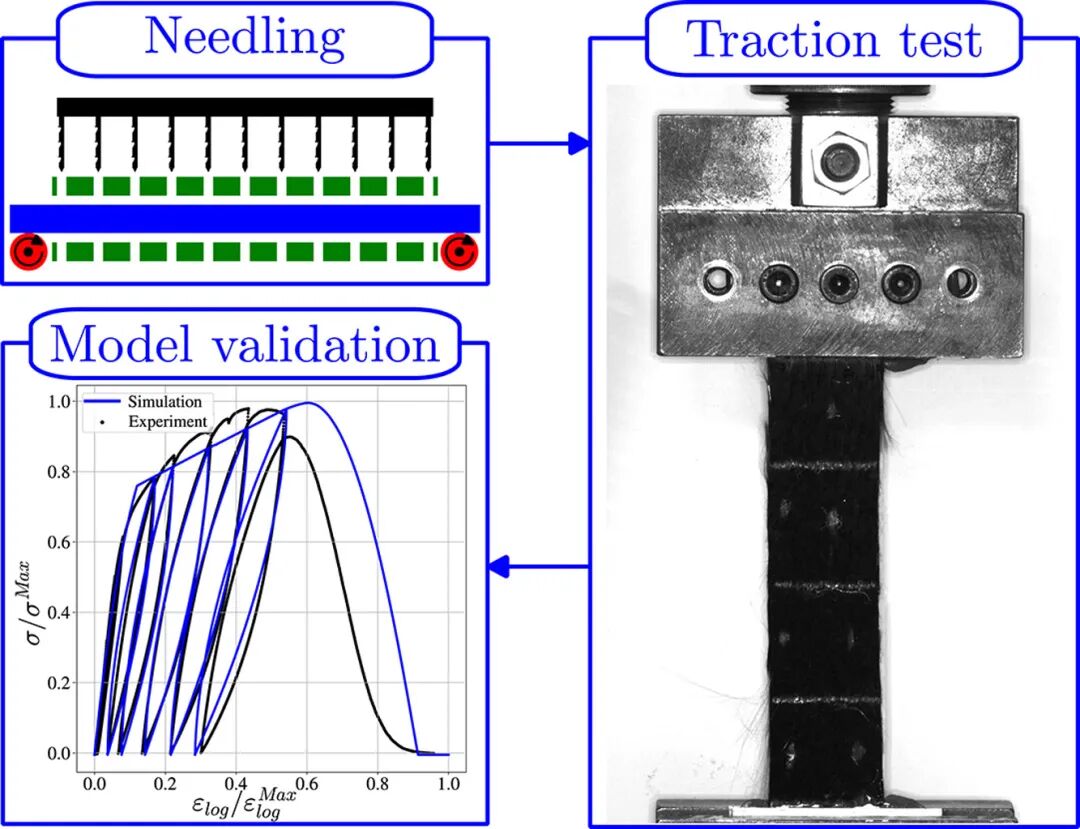
单向针 刺预制体的单调和循环行为:实验研究和多尺度建模
Needle-punched preforms are widely utilised in the production of 2.5D composites for the aerospace sector. However, elucidating and modelling their constitutive behaviour remains challenging due to the multitude of mechanisms activated during loading, including fibre–fibre interactions, fibre reorganisation, and the intrinsic response of individual fibres. To investigate these mechanisms, both monotonic and cyclic tensile tests were conducted. A mesoscopic model was first established to identify the most influential components governing the response. This was followed by the development of a macroscopic monotonic model incorporating these components, thereby reducing computational cost. Finally, the macroscopic model was extended to capture cyclic behaviour. The proposed models address a gap in the literature concerning the mechanical characterisation and constitutive modelling of dry needle-punched preforms. Comparison between numerical predictions and experimental stress–strain data confirmed the validity of all models and enabled the identification of their governing parameters.
针 刺预成形件广泛应用于航空航天领域的2.5D复合材料生产。然而,由于在加载过程中激活的多种机制,包括纤维纤维相互作用、纤维重组和单个纤维的内在响应,阐明和建模它们的本构行为仍然具有挑战性。为了研究这些机制,进行了单调和循环拉伸试验。首先建立了一个介观模型,以确定控制反应的最具影响力的成分。随后发展了包含这些组件的宏观单调模型,从而降低了计算成本。最后,对宏观模型进行了扩展,以捕获循环行为。提出的模型解决了文献中关于干针冲预成形的机械特性和本构建模的空白。数值预测与实验应力应变数据的对比证实了所有模型的有效性,并能够识别其控制参数。
FGM optimization with thermal constraint enabled by deep operator networks and a novel design space
Piyush Agrawal, Ihina Mahajan, Shivam Choubey, Manish Agrawal
doi:10.1016/j.mechmat.2026.105731
基于深度算子网络和新颖设计空间的热约束FGM优化
This manuscript proposes an optimization framework to find the tailor-made functionally graded materials (FGMs) profiles for thermoelastic applications. This optimization framework consists of a random profile generation scheme, deep operator-based surrogate models for the prediction of thermal and structural quantities, and a genetic algorithm (GA). In the proposed random profile generation scheme, we aim for a generic design space that excludes impractical designs, i.e., profiles with sharp gradations. We also show that the power law is a strict subset of the proposed design space. We utilize the deep operator network (DeepONet) for predicting the thermal and stress field as a function of the volume fraction and thermal boundary data. The point-wise effective prediction of the thermal field enables us to implement the constraint that the metallic content of the FGM remains within a specified temperature limit. The integration of the profile generation scheme and DeepONet-based surrogate models with GA provides us an efficient optimization scheme. The efficacy of the proposed framework is demonstrated through various numerical examples.
本文提出了一个优化框架,以找到适合热弹性应用的定制功能梯度材料(fgm)型材。该优化框架由随机剖面生成方案、基于深度算子的热量和结构量预测代理模型以及遗传算法(GA)组成。在提出的随机轮廓生成方案中,我们的目标是建立一个通用的设计空间,排除不切实际的设计,即具有明显渐变的轮廓。我们还表明幂律是所提出的设计空间的严格子集。我们利用深度算子网络(DeepONet)来预测热和应力场作为体积分数和热边界数据的函数。热场的逐点有效预测使我们能够实现FGM金属含量保持在指定温度范围内的约束。将轮廓生成方案和基于deeponet的代理模型与遗传算法相结合,提供了一种高效的优化方案。通过数值算例验证了该框架的有效性。
International Journal of Plasticity
Atomic-resolution observation of dynamic grain boundary evolution under high-temperature loading
Xiaoai Yi, Hui Feng, Bin Liu, Jia Li, Qihong Fang
doi:10.1016/j.ijplas.2026.104734
高温载荷下动态晶界演化的原子分辨观察
The motion of grain boundaries (GBs) at elevated temperatures presents a complex phenomenon that is challenging to observe directly, yet it critically influences the mechanical properties of materials. Here, we investigate a dynamic evolution of GBs and microstructures in complex concentration alloys across a wide range of temperatures — from RT to near-melting point — and under various mechanical loading conditions using a phase field crystal method. The results demonstrate that both concentration and temperature play crucial roles in governing grain growth and GB migration. Grain growth exhibits a clear concentration and orientation dependence: the <100> and <110> orientations show comparable growth rates, both significantly exceeding that of the <111> orientation. In high-concentration alloys, the formation of metastable clusters and their subsequent transformation into precipitates facilitate grain growth, whereas low-concentration alloys exhibit only Cu segregation that migrates concurrently with the GBs. Temperature profoundly influences GB migration mechanisms. At RT, GB evolution is characterized by energy-driven GB migration and subsequent grain coalescence. As the temperature increases to 0.6 Tm and 0.8 Tm, competitive grain growth coupled with enhanced atomic diffusion leads to microstructural coarsening and the development of more uniform grain size distributions. Notably, at ultrahigh temperatures of 0.8 Tm, GBs undergo thermal-induced amorphization, forming metastable disordered regions that act as unique sites for dislocation emission, a mechanism distinct from conventional crystalline boundaries. Near the melting point, preferential premelting initiates at triple junctions while the bulk solid structure remains intact. The interplay of precipitate coarsening, and temperature governs the overall GB migration kinetics in AlCu alloy. Furthermore, the coupling effect of temperature and mechanical loading demonstrates that higher temperatures and lower strain rates promote diffusion-controlled processes, such as dislocation climb and grain rotation, which mitigate strain hardening and facilitate microstructural stabilization. Precipitate evolution ana lysis shows that higher temperatures result in finer precipitates due to reduced coarsening driving forces. These findings provide crucial insights into the interplay among the thermal activation, mechanical stress, and microstructural stability, offering valuable guidance for optimizing the processing and high-temperature application of alloys.
高温下的晶界运动是一种复杂的现象,很难直接观察到,但它对材料的力学性能有重要影响。在这里,我们使用相场晶体法研究了复杂浓度合金在广泛的温度范围内(从RT到近熔点)和各种机械加载条件下的gb和显微组织的动态演变。结果表明,浓度和温度对晶粒生长和GB迁移均起关键作用。晶粒生长表现出明显的浓度依赖性和取向依赖性:<100>和<110>取向的生长速率相当,均显著超过<111>取向。在高浓度合金中,亚稳团簇的形成及其随后向析出相的转变促进了晶粒的生长,而低浓度合金只表现出与GBs同时迁移的Cu偏析。温度对GB迁移机制影响深远。在室温下,GB的演化以能量驱动的GB迁移和随后的晶粒聚结为特征。当温度升高到0.6 Tm和0.8 Tm时,晶粒的竞争生长和原子扩散的增强导致微观组织粗化,晶粒尺寸分布更加均匀。值得注意的是,在0.8 Tm的超高温下,gb发生热诱导非晶化,形成亚稳无序区,作为位错发射的独特位点,这是一种不同于传统晶体边界的机制。在熔点附近,优先预熔在三结处开始,而整体固体结构保持完整。析出相粗化和温度的相互作用决定了AlCu合金中GB的整体迁移动力学。此外,温度和机械载荷的耦合效应表明,较高的温度和较低的应变速率促进了位错爬升和晶粒旋转等扩散控制过程,从而减缓了应变硬化,促进了微观组织的稳定。析出物演化分析表明,温度升高导致粗化驱动力降低,析出物更细。这些发现为热活化、机械应力和显微组织稳定性之间的相互作用提供了重要的见解,为优化合金的加工和高温应用提供了有价值的指导。
Thin-Walled Structures
Post-fire mechanical properties of explosively welded double-sided stainless-clad steel
Peng CHEN, Jiachen GUO, Jun-Zhi LIU, Boshan CHEN, Junbo CHEN, Fei XU
doi:10.1016/j.tws.2026.115178
双面不锈钢爆炸焊接着火后力学性能研究
This study investigates the post-fire mechanical properties of double-sided stainless-clad steel produced via the explosive welding process. The material configuration consists of an 8mm thick Q355 carbon steel substrate sandwiched between two 2mm thick 304 austenitic stainless steel cladding layers. A total of 45 tensile coupons were tested after exposure to temperatures ranging from 300 °C to 900 °C, followed by cooling in air or cooling in water. Experimental results demonstrate that the characteristic wavy metallurgical bonding interface created by explosive welding remains intact without cracking or separation across all tested temperatures. This robust interfacial integrity ensures concurrent necking and simultaneous fracture of the constituent layers, which stands in contrast to the interfacial separation reported in prior studies of hot-rolled stainless-clad steel. The mechanical properties were found to be largely stable for exposure temperatures up to 600 °C. Beyond this threshold, specimens cooled in air exhibited a monotonic decline in strength and an increase in ductility. In contrast, water-cooled specimens subjected to 800 °C and 900 °C showed a significant strengthening effect, reaching an ultimate strength retention factor of 1.23, accompanied by a severe loss of ductility and a transition to brittle fracture. The elastic modulus remained effectively constant regardless of the thermal history. Finally, a set of predictive equations was developed to characterise the retention factors of key mechanical parameters, providing a strong correlation with experimental data. These findings provide an essential technical foundation and material-level input for the future fire-resilient design and post-fire structural assessment of double-sided stainless-clad steel components.
研究了爆炸焊接双面不锈钢复合材料的火灾后力学性能。材料结构包括8mm厚的Q355碳钢衬底夹在两个2mm厚的304奥氏体不锈钢包层之间。在暴露于300°C至900°C的温度下,然后在空气中冷却或在水中冷却,总共测试了45张拉伸板。实验结果表明,爆炸焊接形成的特征波状冶金结合界面在所有测试温度下都保持完整,没有开裂或分离。这种强大的界面完整性确保了组成层的同时颈缩和同时断裂,这与之前热轧不锈钢的界面分离研究形成鲜明对比。在高达600°C的暴露温度下,发现其机械性能基本稳定。超过这个阈值,在空气中冷却的试样表现出强度的单调下降和延性的增加。相比之下,800°C和900°C的水冷试样表现出明显的强化效果,其极限强度保持系数达到1.23,同时塑性损失严重,向脆性断裂过渡。无论热历史如何,弹性模量都有效地保持恒定。最后,建立了一组预测方程来表征关键力学参数的保留系数,提供了与实验数据的强相关性。这些发现为未来双面不锈钢构件的防火设计和火灾后结构评估提供了必要的技术基础和材料水平的输入。
Phase field fracture in elasto-plastic solids: Application to shell fracture of battery casing
Yang Jiang, Cunyi Li, Na Qiu, Jianguang Fang
doi:10.1016/j.tws.2026.115175
弹塑性固体相场断裂:在电池壳壳断裂中的应用
This study employs a shell phase field model to simulate and an alyse the ductile fracture behaviour of a lithium-ion battery casing, supported by experimental validation. Material anisotropy is described using the Hill 48 yield criterion, while the Bao-Wierzbicki (B-W) fracture model captures the stress-state dependence of fracture strain. Model parameters are calibrated through uniaxial tensile tests on specimens with varying stress states and material orientations. The calibrated model accurately reproduces the experimentally observed deformation patterns, fracture progression, and force-displacement responses across three structural tests on the battery casing and cell. In the three-point bending test of the casing alone, plastic strain localises in the front and rear equatorial regions, with initial inward bending inducing outer-surface damage, followed by reversed bending and inner-surface damage initiation under progressive loading. In axial compression, the simulation successfully captures both the diamond-mode deformation and the characteristic force-displacement fluctuations. In the battery cell bending test, a through-thickness crack at the bottom mid-span corresponds to uniform membrane tensile stress across the thickness, whereas the top hinge region exhibits bending-dominated stresses, leading to stress-state variation through the thickness and damage initiation on the outer surface.
本研究采用壳相场模型对锂离子电池壳的韧性断裂行为进行了模拟和分析,并进行了实验验证。材料的各向异性使用Hill 48屈服准则来描述,而Bao-Wierzbicki (B-W)断裂模型捕获了断裂应变的应力状态依赖性。通过不同应力状态和材料取向的单轴拉伸试验,对模型参数进行校准。校准后的模型准确再现了在电池外壳和电池芯的三次结构测试中实验观察到的变形模式、断裂进展和力-位移响应。在套管单独的三点弯曲试验中,塑性应变集中在赤道前后区域,首先向内弯曲引起外表面损伤,然后在渐进加载下发生反向弯曲和内表面损伤。在轴向压缩中,模拟成功地捕获了金刚石模态变形和特征力-位移波动。在电池芯弯曲试验中,底部跨中出现的贯穿厚度的裂纹对应的是跨厚度均匀的薄膜拉伸应力,而顶部铰区则表现出弯曲主导的应力,导致应力状态随厚度的变化和外表面的损伤起裂。
Quasi-static and low-velocity impact responses of bioinspired lattice structure fabricated by multi jet fusion
Zhang Long, Donglin Tang, Jie Hu, Junfang Zhang, Feijuan Wen, Bo Li
doi:10.1016/j.tws.2026.115172
多射流融合制备仿生晶格结构的准静态和低速冲击响应
The design of lattice structures with superior mechanical properties under both quasi-static and dynamic loading remains a critical challenge. Inspired by gyroids in butterfly wings and the multilayer parallel configuration of cuttlebone, this study proposes bio-inspired lattice structures with seamless connections of heterogeneous units. GS lattice structures (gyroid + S units) with varying relative densities were fabricated using multi jet fusion. Compared to uniform gyroid lattice structures, the GS lattice structures exhibit dual elastic stages, dual plateau stresses, and multistage energy absorption under quasi-static compression tests. The elastic modulus during the first elastic stage follows a power-law relation with relative density, while the elastic modulus at the second stage stabilizes near 30MPa. Under impact tests, the GS lattice structures show significant buckling and efficient energy dissipation, with force–displacement curves displaying oscillatory decay and energy–time curves outlining a three–stage absorption process. Notably, increasing the relative density enhances the peak and mean crushing forces but reduces energy absorption efficiency, indicating a trade-off between load-bearing capacity and energy absorption. The GS lattice structures demonstrate excellent load adaptability and impact management capacity, highlighting their potential for protective and vibration-isolation applications.
设计在准静态和动态载荷下均具有优异力学性能的晶格结构仍然是一个关键的挑战。受蝴蝶翅膀上的陀螺仪和海螵蛸的多层平行结构的启发,本研究提出了异质单元无缝连接的仿生晶格结构。采用多射流熔合制备了不同相对密度的GS晶格结构(陀螺+ S单元)。与均匀陀螺晶格结构相比,GS晶格结构在准静态压缩试验中表现出双弹性阶段、双平台应力阶段和多级能量吸收。第一阶段弹性模量与相对密度呈幂律关系,第二阶段弹性模量稳定在30MPa附近。在冲击试验中,GS晶格结构表现出明显的屈曲和有效的能量耗散,力-位移曲线呈现振荡衰减,能量-时间曲线勾勒出一个三阶段的吸收过程。值得注意的是,增加相对密度会提高峰值和平均破碎力,但会降低能量吸收效率,表明承载能力和能量吸收之间存在权衡。GS晶格结构表现出优异的负载适应性和冲击管理能力,突出了它们在保护和隔振应用方面的潜力。
Study on vulnerability of hyperbolic cooling tower based on endurance time a nalysis
Wenwei You, Jianchun Xiao, Cong Liu, Yang Yi
doi:10.1016/j.tws.2026.115164
基于耐久时间分析的双曲型冷却塔脆弱性研究
Hyperbolic cooling towers, characterized by their high-rise thin-walled design, are susceptible to damage during severe earthquakes. This study focuses on a 162m high hyperbolic cooling tower, employing Endurance Time An alysis (ETA) for seismic vulnerability assessment using ANSYS APDL, MATLAB, and other applications, with an emphasis on computing efficiency. Utilizing the nonlinear least squares approach, three Endurance Time An alyze Functions (ETAFs) curve were synthesized based on the response spectrum of the Chinese seismic code. The nonlinear dynamic response of the structure's apex displacement was derived under varying seismic intensity indices with the application of multi-dimensional seismic motion input. The vulnerability curves are developed using the lognormal distribution model and are compared with data from 20 groups of actual seismic waves picked by the incremental dynamic approach. The findings indicate that the displacement errors derived from the ETA method do not exceed 15% when compared to the incremental dynamic method over a 30-second endurance times. This similarity is observed during minor earthquakes and is suggested as a preliminary reference for medium and large earthquakes. The vulnerability curve indicates that at a seismic resistance duration of approximately 30seconds, corresponding to a PGA of 0.6g, the likelihood of structural failure is 33.2%. The vulnerability assessment results from both methods exhibit a similar trend, indicating that the proposed method is highly practical and computationally efficient, serving as a reference for the seismic performance evaluation, design optimization, and seismic risk management of hyperbolic cooling towers.
双曲线冷却塔的特点是其高层薄壁设计,在强烈地震中容易受到破坏。本研究以一座162米高的双曲型冷却塔为研究对象,利用ANSYS APDL、MATLAB等应用软件,采用耐久性时间分析(ETA)进行地震易损性评估,重点关注计算效率。利用非线性最小二乘法,在中国地震规范反应谱的基础上,合成了3条耐久性时间分析函数曲线。应用多维地震运动输入,推导了不同烈度指标下结构顶端位移的非线性动力响应。利用对数正态分布模型建立了脆弱性曲线,并与增量动力法采集的20组实际地震波数据进行了比较。研究结果表明,与增量动态方法相比,ETA方法在30秒耐力时间内的位移误差不超过15%。这种相似性在小地震中观察到,并建议作为中地震和大地震的初步参考。易损性曲线表明,在抗震持续时间约为30秒时,对应的PGA为0.6g,结构破坏的可能性为33.2%。两种方法的易损性评价结果呈现出相似的趋势,表明该方法具有较高的实用性和计算效率,可为双曲型冷却塔的抗震性能评价、设计优化和地震风险管理提供参考。
Time-scale Dependent Transient Impact of Trains on Damaged Railway Tunnel Linings: A Numerical Investigation
Linfeng Li, Weifeng Liu, Lihui Xu, Rongning Cao, Donghai Li, Xiang Yu
doi:10.1016/j.tws.2026.115162
列车对受损铁路隧道衬砌随时间变化的瞬态冲击:数值研究
This study investigates the train-induced transient impact of damaged tunnel linings, revealing a time-scale dependent duality in structural behavior. To clarify this phenomenon, a simplified an alysis framework is developed to numerically decouple the static soil pressures from the dynamic train loads. The results show that the physical mechanism governing the train-induced impact reverses across time scales due to the shifting role of the surrounding soil. At the slow-time scale (multiple train passages), the soil-lining system responds in a quasi-static manner, with the soil acting as a compliant medium; the transient impact is primarily governed by the train’s axle weight and is diminished by structural damage. Conversely, at the fast-time scale (rapid axle pulses), the surrounding soil behaves as an immovable boundary due to its massive inertia, and the static soil pressure further clamps the lining against this boundary. This confinement suppresses the influence of train speed and reverses the governing factor from speed to axle weight compared to the unconfined case. Also, at the fast-time scale, increasing stiffness degradation can dangerously amplify the transient impact on specific internal forces. It is concluded that identifying the time scale is essential for evaluating the train-induced transient impacts, which is crucial for assessing the serviceability and long-term performance of tunnel linings.
本研究探讨了列车对受损隧道衬砌的瞬态冲击,揭示了结构行为的时间尺度依赖性对偶性。为了阐明这一现象,开发了一个简化的分析框架,以数值解耦静态土壤压力和动态列车荷载。结果表明,由于周围土壤的移动作用,控制火车碰撞的物理机制在时间尺度上是相反的。在慢时间尺度下(多列火车通道),衬砌土系统以准静态方式响应,土壤作为顺应介质;瞬态冲击主要由列车的轴重控制,并因结构损坏而减弱。相反,在快时间尺度下(快速轴脉冲),周围的土壤由于其巨大的惯性而表现为一个不可移动的边界,静土压力进一步将衬砌夹紧在这个边界上。与无约束情况相比,这种约束抑制了列车速度的影响,并将控制因素从速度转向轴重。此外,在快时间尺度下,增加刚度退化可能会危险地放大对特定内力的瞬态影响。结果表明,列车瞬态冲击的时间尺度的确定是评价列车瞬态冲击的关键,对评价隧道衬砌的使用性能和长期性能至关重要。
Interfacial Bond Behavior of Grout-Infused Multi-Cell FRP Profiles Integrated with Bolted Hybrid Connections for Tunnel Segment Strengthening
Yuyang Pang, Zhibo Zhang, Qiang Wang, Hu Feng, Chang Su, Qiubo Yu, Yuanchen Lv
doi:10.1016/j.tws.2026.115125
注浆复合纤维型材结合螺栓复合连接加固隧道管片的界面粘结行为
This study proposed a strengthening technique that integrates internally grouted fiber-reinforced polymer (FRP) multi-cell profiles with shield tunnel segments via bolted connections. An experimental program was conducted to investigate the effects of critical design parameters covering bolt diameter (8mm, 12mm, 16mm, 20mm), spacing (100mm, 150mm, 200mm, 250mm), anchor depth (50mm, 100mm, 150mm), and grouting type (high-strength mortar, ultra-high-performance concrete (UHPC), engineered cementitious composites (ECC)) on the behavior of the hybrid FRP profiles-concrete interface. The results indicate that, among the investigated parameters, the type of grouting has the least influence on the interface bearing capacity, followed by the bolt spacing and anchor depth, while the bolt diameter exhibits the most significant effect. The interface bearing capacity generally increases with increasing bolt diameter and anchor depth. However, when the bolt spacing reaches 250mm, a noticeable reduction in bearing capacity is observed, due to the non-uniform distribution of interfacial shear stress between bolts caused by excessive spacing. In general, concrete splitting failure is the primary mode of failure for specimens. However, when the bolt spacing is smaller, shear failure of the bolts may occur. Additionally, when the bolt anchor depth is insufficient, bolt pull-out failure is more likely to take place. A finite element model was subsequently developed and validated to elucidate the load-transfer mechanism and the evolution of interfacial damage. Finally, based on modifications to existing domestic and international formulations, a calculation method for predicting the FRP profiles-concrete interface bearing capacity was proposed by comprehensively considering the effects of multiple influencing parameters and different failure modes. The theoretical predictions obtained from the proposed formula show good agreement with the experimental results and numerical simulation outcomes, and a rational parameter selection range is established.
本研究提出了一种通过螺栓连接将内注浆纤维增强聚合物(FRP)多单元型材与盾构隧道段集成的强化技术。通过试验研究了螺栓直径(8mm、12mm、16mm、20mm)、间距(100mm、150mm、200mm、250mm)、锚固深度(50mm、100mm、150mm)和注浆类型(高强砂浆、超高性能混凝土(UHPC)、工程胶凝复合材料(ECC))等关键设计参数对复合材料界面性能的影响。结果表明:在各参数中,注浆类型对界面承载力的影响最小,其次是锚杆间距和锚杆深度,而锚杆直径对界面承载力的影响最为显著。界面承载力一般随锚杆直径和锚固深度的增大而增大。而当锚杆间距达到250mm时,由于锚杆间距过大导致锚杆间界面剪应力分布不均匀,导致承载力明显降低。一般来说,混凝土劈裂破坏是试件的主要破坏形式。但当锚杆间距较小时,锚杆可能发生剪切破坏。此外,当锚杆锚固深度不足时,更容易发生锚杆拔出破坏。随后建立并验证了有限元模型,以阐明载荷传递机制和界面损伤的演变。最后,在对国内外现有公式进行修正的基础上,提出了综合考虑多种影响参数和不同破坏模式影响的FRP型材-混凝土界面承载力预测计算方法。该公式的理论预测结果与实验结果和数值模拟结果吻合较好,并建立了合理的参数选择范围。