【新文速递】2026年5月11日固体力学SCI期刊最新文章
今日更新:International Journal of Solids and Structures 1 篇,Journal of the Mechanics and Physics of Solids 1 篇,Mechanics of Materials 2 篇,Thin-Walled Structures 9 篇
International Journal of Solids and Structures
Design and an alysis of rigid-flexible coupling joints of shoulder exoskeleton with variable stiffness characteristics
Lianzheng Niu, Sheng Guo, Xinhua Yang, Haibo Qu, Majun Song
doi:10.1016/j.ijsolstr.2026.114070
变刚度肩外骨骼刚柔耦合关节的设计与分析
Achieving compatible and safe physical human-robot interaction is a critical requirement in exoskeleton design. To address the kinematic mis match often found in shoulder exoskeletons while satisfying stiffness requirements, this paper proposes a rigid-flexible coupling joint with variable stiffness based on a winding mechanis m. We designate this device as the shoulder-humeral regulator. By incorporating elastic elements, the regulator provides necessary compliance, while the winding mechanis m allows for rapid and easy stiffness adjustment. These features optimize human-robot coupling during shoulder movement and enhance the overall performance of the exoskeleton. A physical prototype was fabricated to validate its kinematic range and stiffness properties. Furthermore, dynamic musculoskeletal simulations demonstrate that the variable stiffness characteristics of the shoulder-humeral regulator significantly improve human-robot compatibility by effectively absorbing localized parasitic loads and accommodating complex joint misalignments.
实现兼容和安全的物理人机交互是外骨骼设计的关键要求。为解决肩部外骨骼在满足刚度要求的情况下经常出现的运动失配问题,提出了一种基于缠绕机构的变刚度刚柔耦合关节。我们把这个装置称为肩胛骨调节器。通过结合弹性元件,调节器提供必要的顺应性,而缠绕机构允许快速和容易的刚度调整。这些功能优化了肩关节运动过程中的人机耦合,增强了外骨骼的整体性能。制作了物理样机,验证了其运动范围和刚度特性。此外,动态肌肉骨骼模拟表明,肩部-肱骨调节器的可变刚度特性通过有效吸收局部寄生载荷和适应复杂的关节错位,显著提高了人机兼容性。
Journal of the Mechanics and Physics of Solids
Elastocapillary morphing of self-encapsulated droplets floating at the oil-air interface
D. Andrini, D. Riccobelli, L. Gazzera, S. Molteni, P. Metrangolo, P. Ciarletta
doi:10.1016/j.jmps.2026.106677
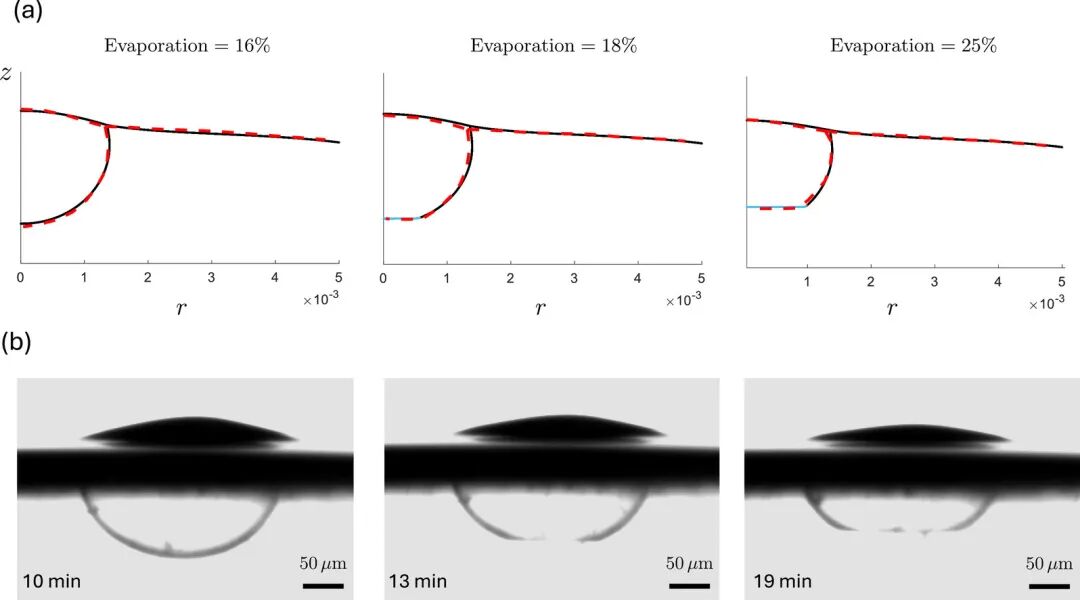
浮在油气界面上的自封装液滴的弹性毛细管变形
Self-encapsulated droplets floating at an oil–air interface undergo striking shape changes during evaporation, including flattening and localized loss of membrane tension leading to crumpling and wrinkling. Here we combine experiments, modeling and simulations to obtain predictive morphological maps. We perform contact-angle and evaporation experiments on water droplets coated by a hydrophobin protein film and floating in a fluorinated oil, providing reference profiles and volume-loss sequences for quantitative validation. We develop an axisymmetric mechanics framework in which equilibria follow from minimization of a total free energy combining surface energies, membrane strain energy and gravitational potential, subject to volume and contact-line constraints. A quasi-convex tension-relaxation rule accounts for compression-free states and enables coexistence of taut, wrinkled (one principal tension vanishes) and crumpled (both vanish) membrane domains. A finite element algorithm computes quasi-static morphing under volume reduction; key parameters are identified by fitting the reference contact-angle profile and then used without further tuning. The model reproduces the experimentally observed shape evolution and resolves the associated stress redistribution. Systematic parameter scans yield morphological phase diagrams governed by the Bond number, the oil–droplet surface-tension ratio and the density ratio. For buoyant droplets, crumpling relocates between exposed and submerged caps as parameters vary; for heavy droplets, a crossover to circumferential wrinkling along the immersed sidewall emerges. Wall-meniscus variations shift phase boundaries and can suppress bottom crumpling, consistent with wall-affected experiments.
漂浮在油气界面上的自封装液滴在蒸发过程中会发生显著的形状变化,包括变平和局部膜张力损失,导致皱缩和起皱。在这里,我们结合实验,建模和模拟来获得预测形态图。我们对被疏水蛋白膜包裹并漂浮在氟化油中的水滴进行了接触角和蒸发实验,为定量验证提供了参考剖面和体积损失序列。我们开发了一个轴对称力学框架,其中平衡遵循最小的总自由能,结合表面能,膜应变能和重力势,受体积和接触线约束。准凸张力松弛规则解释了无压缩状态,并使紧绷、起皱(一个主张力消失)和皱褶(两个主张力都消失)膜域共存。采用有限元法计算体积缩小条件下的准静态变形;通过拟合参考接触角轮廓来确定关键参数,然后无需进一步调整即可使用。该模型再现了实验观察到的形状演变,并解决了相关的应力重分布。系统参数扫描得到由键数、油滴表面张力比和密度比控制的形态相图。对于有浮力的水滴,随着参数的变化,皱褶在暴露的和淹没的盖子之间重新定位;对于重液滴,沿浸没的侧壁出现了向周向褶皱的交叉。壁-半月板变化可以改变相边界,抑制底部皱缩,与壁影响实验一致。
Mechanics of Materials
Coupled effects of inhomogeneity and orthotropy on the dynamic response of an elastic media with a circular cavity under shear horizontal (SH) wave incidence
Ziyang Lin, Zailin Yang, Guanxixi Jiang
doi:10.1016/j.mechmat.2026.105729
非均匀性和正交异性对含圆腔弹性介质在横波入射下动力响应的耦合影响
This study conducts an an alytical investigation of the scattering of shear horizontal wave in an inhomogeneous and orthotropic media by a circular cavity. Through the combination of the auxiliary function method and the complex function method, the governing equations of inhomogeneous orthotropic media are normalized. Subsequently, the wave fields and its corresponding stresses are expressed in terms of complex variables, and the undetermined coefficients are obtained by utilizing the boundary condition. Dynamic stress distribution at the surface of the cavity is calculated and discussed of typically influential parameters. The effect of the wave number, the inhomogeneous parameter, and the orthotropic parameter on dynamic stress concentration is calculated and discussed by an alyzing the typically graphical results.
本文对非均匀正交各向异性介质中横波在圆腔中的散射进行了分析研究。通过辅助函数法和复函数法的结合,对非齐次正交各向异性介质的控制方程进行了归一化。然后,将波场及其相应的应力以复变量形式表示,利用边界条件得到待定系数。计算并讨论了影响腔体表面动应力分布的典型参数。通过对典型图形结果的分析,计算并讨论了波数、非均匀参数和正交各向异性参数对动应力集中的影响。
Development of a Fatigue Law for Asphalt Mixtures Combining Thixotropy and Damage: An alytical and Numerical Exploration with Discrete Elements
Léo Coulon, Georg Koval, Cyrille Chazallon, Jean-Noël Roux
doi:10.1016/j.mechmat.2026.105724
结合触变性和损伤的沥青混合料疲劳规律的发展:离散元的解析和数值探索
Until now, fatigue tests on asphalt mixes have most often been modelled by coupling the effects of damage and self-heating. This study differs from previous works by modelling the interaction between thixotropy and damage. To this end, a new fatigue damage law was developed, based on a coupling between the damage variable and a modified Paris’ law, which governs damage propagation. This damage law was combined with a viscoelastic law obeying the VENoL model, which accounts for nonlinearity and thixotropy. Together, these components form an ana lytical model that has been adapted and implemented as an inter-particle contact law within a two-dimensional numerical model based on the Discrete Element Method. Validation is provided by the ability of both the an alytical and numerical models to reproduce direct tensile–compressive fatigue tests on asphalt concrete from the literature, across a range of strain amplitudes and temperatures. Numerical simulations highlight the model’s complexity and demonstrate several key findings. Among these, the damage variable must be applied to both the real and imaginary parts of the complex modulus, confirmed by accurate phase-angle predictions. Furthermore, increasing the test temperature slows damage progression, allowing thixotropy more time to develop. At 20°C, this results in a shift in the failure mechanis m, with damage occurring primarily through contact “liquefaction” rather than classical rupture-induced cracking. Although improvements are still possible, this work provides a contribution to the development of fatigue models and to a better understanding of the physical mechanis ms in asphalt mixtures.
到目前为止,沥青混合料的疲劳试验通常是通过耦合损伤和自热的影响来模拟的。这项研究不同于以往的工作,通过模拟触变性和损伤之间的相互作用。为此,建立了一种新的疲劳损伤规律,该规律基于损伤变量和修正的巴黎规律之间的耦合,该规律控制损伤的传播。该损伤规律与符合VENoL模型的粘弹性规律相结合,考虑了非线性和触变性。总之,这些组成部分形成了一个解析模型,该模型已被改编并实现为基于离散元法的二维数值模型中的粒子间接触律。验证是通过分析和数值模型的能力,从文献中重现沥青混凝土的直接拉伸-压缩疲劳试验,在应变幅度和温度范围内。数值模拟突出了模型的复杂性,并展示了几个关键发现。其中,损伤变量必须同时应用于复模量的实部和虚部,并通过精确的相角预测来确定。此外,提高测试温度可以减缓损伤的进展,使触变性有更多的时间发展。在20°C时,这导致破坏机制发生转变,破坏主要通过接触“液化”发生,而不是经典的破裂引起的开裂。虽然改进仍然是可能的,但这项工作为疲劳模型的发展和更好地理解沥青混合料的物理机制做出了贡献。
Thin-Walled Structures
From data-driven DMDc modeling to control parameter optimization: a framework for adaptive vibration control of thin-walled composites
Qinshan Ouyang, Longlei Dong, Jian Liu, Jiaming Zhou
doi:10.1016/j.tws.2026.115090
从数据驱动的DMDc建模到控制参数优化:薄壁复合材料自适应振动控制框架
Vibration-induced performance degradation is a critical concern for thin-walled composite structures. While adaptive active control is a promising solution, its effectiveness critically depends on control parameters that typically requires extensive experimental tuning. To address this limitation, we develop an integrated framework combining scaled-derivative based Dynamic Mode Decomposition with control (sd-DMDc) modeling and Filtered-x Least Mean Square (FxLMS) adaptive control for a composite laminated plate instrumented with piezoelectric patches. Our sd-DMDc model, experimentally established using a displacement-strain hybrid measurement vector, accurately captures the system’s electromechanical coupling while retaining modal interpretability. Building on this model, a novel sd-DMDc-FxLMS adaptive control framework is designed and implemented to suppress structural vibrations under both single- and multi-channel configurations. Simulation and experimental results show strong agreement, demonstrating high prediction fidelity and rapid convergence of the proposed framework. Furthermore, the influence of two key adaptive parameters, convergence step size and filter length, is systematically examined through orthogonal simulations and experiments. The sd-DMDc-FxLMS simulation framework reliably captures experimental trends across a broad parameter space and accurately predicts the effective convergence regions, offering valuable guidance for parameter tuning. This work establishes a powerful data-driven platform for modeling, predicting, and optimizing active vibration control in s mart thin-walled composite structures.
振动引起的性能退化是薄壁复合材料结构的一个重要问题。虽然自适应主动控制是一种很有前途的解决方案,但其有效性严重依赖于通常需要大量实验调谐的控制参数。为了解决这一限制,我们开发了一个集成框架,将基于比例导数的动态模态分解与控制(sd-DMDc)建模和滤波-x最小均方(FxLMS)自适应控制相结合,用于带有压电贴片的复合材料层合板。我们的sd-DMDc模型是通过实验建立的,使用位移-应变混合测量向量,在保持模态可解释性的同时准确地捕获了系统的机电耦合。在此模型的基础上,设计并实现了一种新的sd-DMDc-FxLMS自适应控制框架,以抑制单通道和多通道配置下的结构振动。仿真结果与实验结果一致,表明该框架具有较高的预测保真度和较快的收敛速度。此外,通过正交仿真和实验,系统地考察了收敛步长和滤波器长度这两个关键自适应参数的影响。sd-DMDc-FxLMS仿真框架可靠地捕获了广泛参数空间的实验趋势,并准确预测了有效收敛区域,为参数调优提供了有价值的指导。本研究为智能薄壁复合材料结构的振动主动控制建模、预测和优化提供了一个强大的数据驱动平台。
Isotropic Auxetic Trigonal Symmetry Tessellations designed for FDM Printing Infill Patterns
Reza Moghimimonfared, Andrea Spaggiari, Luke Mizzi
doi:10.1016/j.tws.2026.115088
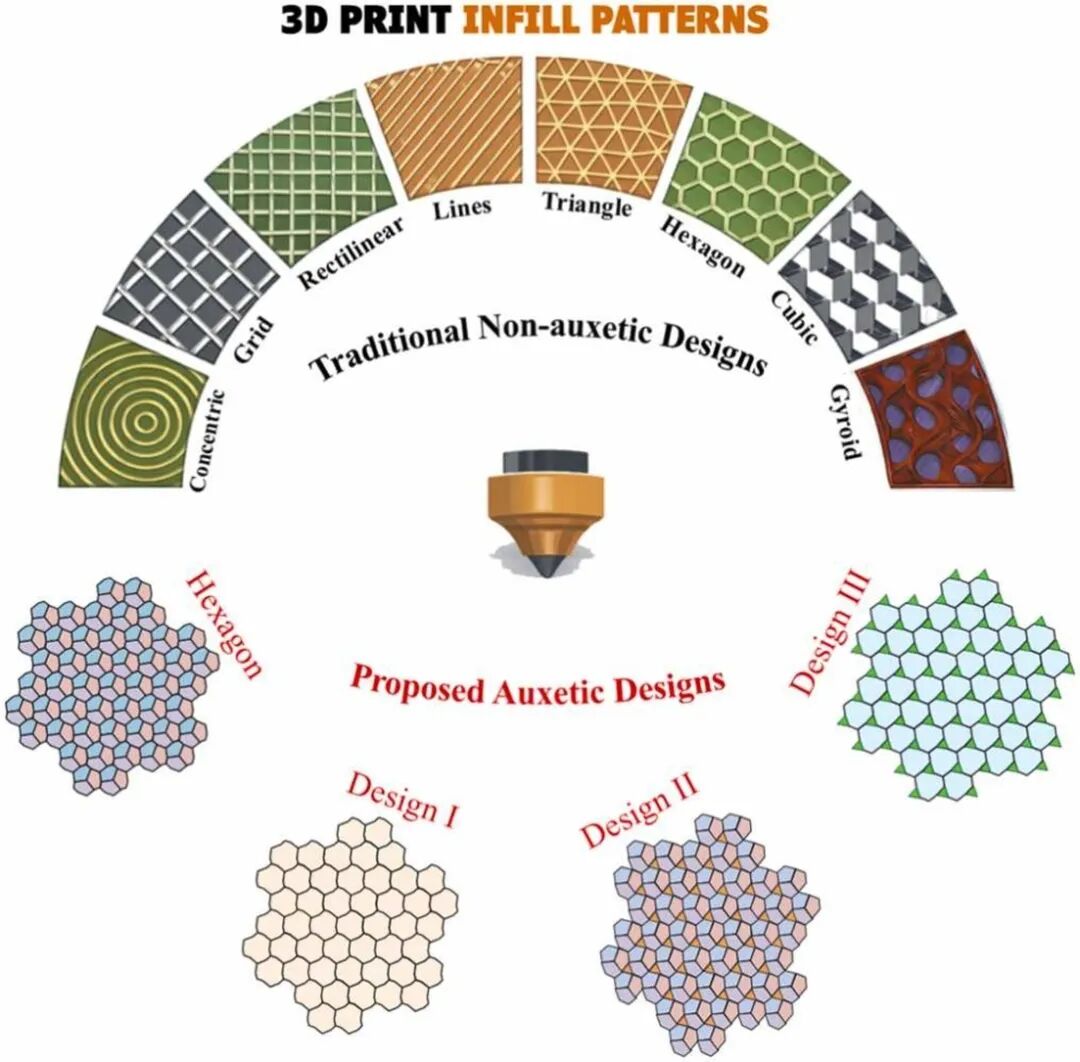
为FDM印刷填充图案设计的各向同性三角形对称镶嵌
Mechanical metamaterials derived from Euclidean polygonal tessellations constitute a novel class of architected materials capable of exhibiting a broad spectrum of mechanical properties, including auxeticity. In this work, new monohedral and dihedral tessellations derived from a Euclidean hexagonal tessellation system possessing trigonal rotational symmetry were designed through targeted structural modifications of the original tessellation. A parametric an alysis was carried out on these tessellations using finite element (FE) simulations in order to evaluate the Poisson’s ratios and effective Young’s modu li, followed by experimental tests on various additively-manufactured prototypes to validate the results predicted by the FE simulations. The results obtained show that these new transversely-isotropic tessellations have the capability of exhibiting the entire spectrum of two-dimensional isotropic Poisson’s ratios (−1 < ν < +1) as well as a wide range of Young’s modu li. The representative unit cells of these tessellations are also relatively s mall (compared to other irregular monohedral and dihedral networks) and highly porous, which coupled with the inherent tuneability in mechanical properties and isotropic behaviour, makes them ideal for implementation as infill patterns for Fused-Deposition Method (FDM) additively-manufactured components with low volume fractions.
源自欧几里得多边形镶嵌的机械超材料构成了一类新型建筑材料,能够表现出广泛的机械性能,包括可塑性。本文从欧几里得三角旋转对称的六边形镶嵌系统出发,通过对原有镶嵌的结构进行针对性的修改,设计了新的一面体镶嵌和二面体镶嵌。利用有限元模拟对这些镶嵌进行了参数化分析,以评估泊松比和有效杨氏模量,然后在各种增材制造原型上进行了实验测试,以验证有限元模拟预测的结果。结果表明,这些新的横向各向同性曲面能够显示二维各向同性泊松比(−1 < ν < +1)的全谱,并具有广泛的杨氏模量。这些镶嵌的代表性单元格也相对较小(与其他不规则的单面体和二面体网络相比),并且具有高度多孔性,再加上机械性能和各向同性行为的固有可调性,使它们非常适合作为低体积分数的熔融沉积法(FDM)增材制造组件的填充模式。
Mechanis ms-Based Dual-Phase Metamaterials: Exploiting Rotational Deformation for Enhanced Energy Absorption
Huitian Wang, Chao Ma, Zihao Zhu, Jiazhen Zhang, Shengcheng Ji, Sha Yin
doi:10.1016/j.tws.2026.115087
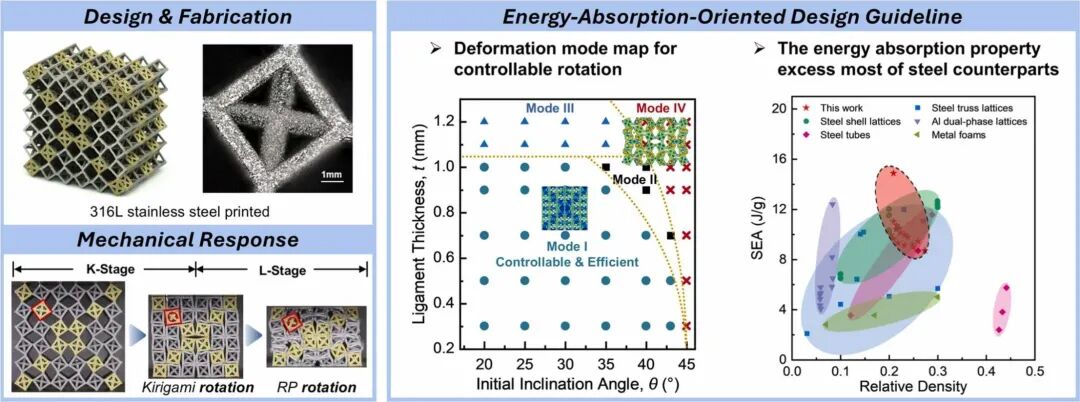
基于机制的双相超材料:利用旋转变形增强能量吸收
Heterogeneous metamaterials inherently introduce deformation discontinuities that can trigger localized rotational motions. However, effectively exploiting such rotation for enhanced energy absorption remains challenging, as it is typically passive and kinematically unconstrained. In this work, a mechanis m-based architecture is proposed by integrating kirigami-inspired features into dual-phase lattice metamaterials to actively guide and amplify rotational deformation. To elucidate the role of three-dimensional phase distribution, two spatial topologies—aligned and staggered—are systematically investigated. Quasi-static compression experiments on additively manufactured aligned stainless-steel specimens reveal a controllable rotational mechanis m, leading to a characteristic two-stage response: a kirigami-dominated stage (K-Stage) followed by a lattice-dominated stage (L-Stage). Parametric finite element an alyses show that the K-Stage kinematics are governed by the interplay between ligament thickness (t) and initial rotation angle (θ), resulting in four distinct deformation modes that critically influence energy absorption performance. A deformation-mode map is established to identify parameter regimes that ensure stable and controllable rotational behavior. Importantly, the K-Stage response is found to be insensitive to the stacking strategy, indicating that the rotation mechanis m operates independently of the global phase arrangement. In contrast, the L-Stage behavior is strongly dependent on spatial topology. The staggered configuration forms a fully interconnected reinforcement network, effectively eliminating the directional anisotropy observed in the aligned structure and maximizing the strengthening potential of the dual-phase system. As a result, the optimized staggered lattice achieves a 60.7% increase in specific energy absorption compared to the baseline dual-phase lattice. These findings demonstrate that explicitly embedding rotational mechanis ms within architecture-dominated systems provides a robust and material-efficient strategy for designing high-performance energy-absorbing structures.
非均质超材料固有地引入了可以引发局部旋转运动的变形不连续性。然而,有效地利用这种旋转来增强能量吸收仍然具有挑战性,因为它通常是被动的,不受运动学约束。在这项工作中,提出了一种基于机制的架构,通过将基里伽米启发的特征集成到双相晶格超材料中来主动引导和放大旋转变形。为了阐明三维相分布的作用,系统地研究了两种空间拓扑-排列和交错。在增材制造的排列不锈钢试样上进行的准静态压缩实验显示了一种可控的旋转机制,导致了一个典型的两阶段响应:基里伽米主导阶段(k阶段)和晶格主导阶段(l阶段)。参数有限元分析表明,K-Stage运动学由韧带厚度(t)和初始旋转角度(θ)之间的相互作用决定,导致四种不同的变形模式,这些模式对能量吸收性能有重要影响。建立了一种变形模态映射来识别保证旋转行为稳定可控的参数体系。重要的是,发现k阶段响应对堆叠策略不敏感,表明旋转机制独立于全局相位排列。相反,l阶段的行为强烈依赖于空间拓扑结构。交错结构形成了一个完全互连的强化网络,有效地消除了排列结构中观察到的方向各向异性,最大限度地提高了双相体系的强化潜力。结果表明,与基线双相晶格相比,优化后的交错晶格比能量吸收提高了60.7%。这些发现表明,在以建筑为主导的系统中明确嵌入旋转机制,为设计高性能吸能结构提供了一种强大且材料高效的策略。
Dynamic mechanical response and deformation mechanis m of multilayer compression-torsion metamaterials
Xiran Chen, Bingcheng Wu, Xinpei Zhang, Yuxuan Zheng, Kebin Li, Yuanyuan Ding
doi:10.1016/j.tws.2026.115080
多层压缩扭转超材料的动态力学响应及变形机理
Compression-torsion metamaterials have been extensively studied due to their distinctive compression-torsion coupling (CTC) effects. However, their dynamic behavior remains insufficiently explored, and the underlying deformation mechanis ms are not yet fully understood. To address this, a multilayer compression-torsion metamaterial was designed, and its mechanical response under high strain rates (450s-1) was investigated using a Split Hopkinson Pressure Bar (SHPB) and strain rosette technology. Finite element simulations were carried out under both quasi-static and dynamic loadings to examine the influence of key structural on the mechanical response and CTC effect, including the number of circumferentially nested and axially stacked layers, the inclination angle of the rods, and the rod thickness. The results indicate that the plateau stress of the compression-torsion metamaterials decreases with increasing numbers of nested layers, but increases with larger rod thickness or s maller inclination angle. In contrast, the CTC effect is found to be more sensitive to the inclination angle than to the rod thickness. Notably, at higher strain rates (4500s-1), the deformation mode of the compression-torsion metamaterial transitions to a layer-wise pattern, leading to pronounced changes in mechanical behavior, including an unexpected reduction in the CTC effect.
压缩-扭转超材料由于其独特的压缩-扭转耦合效应而得到了广泛的研究。然而,它们的动态行为仍然没有得到充分的探索,潜在的变形机制尚未完全了解。为了解决这个问题,设计了一种多层压缩扭转超材料,并使用分离式霍普金森压力杆(SHPB)和应变玫瑰花技术研究了其在高应变速率(450s-1)下的力学响应。在准静态和动态载荷下进行了有限元模拟,考察了关键结构对轴向和周向嵌套层数、杆倾角和杆厚等力学响应和CTC效应的影响。结果表明:压缩扭转超材料的平台应力随嵌套层数的增加而减小,而随杆厚的增大或倾角的减小而增大;相比之下,发现CTC效应对倾角比杆厚更敏感。值得注意的是,在更高的应变速率下(4500s-1),压缩-扭转超材料的变形模式转变为分层模式,导致机械行为的显著变化,包括意想不到的CTC效应的降低。
Interpretable Machine Learning Models for Geometry - Property Correlation of Nested Lattice Structures Fabricated Through Additive Manufacturing Process
Vaishnavi Kirugunda Subramanya, Cho-Pei Jiang, Chinmai Bhat, Dong Ruan, Prateek Saxena
doi:10.1016/j.tws.2026.115079
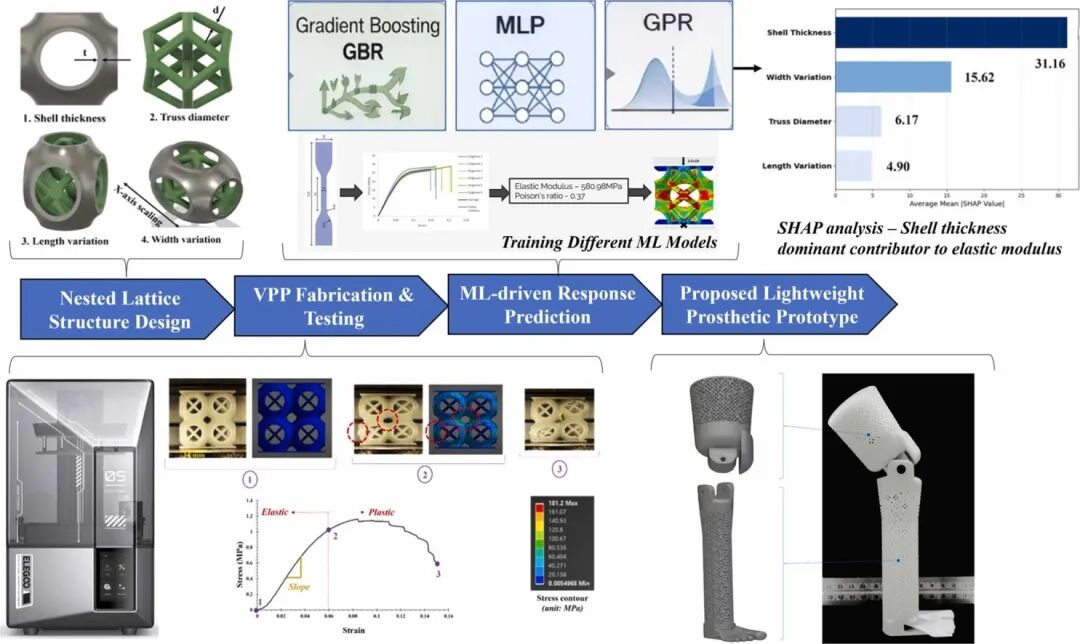
几何的可解释机器学习模型-通过增材制造工艺制造的嵌套晶格结构的属性关联
The design of lattice structures (DoLS) is emerging as a new field of research with a scope of customization and lightweight applications. The precursor for the customization of lattice structures is to correlate the dependency of properties on the design parameters. Thus, in this study, three different machine learning models: multi-layer perceptron (MLP), gradient boosting regression (GBR), and Gaussian process regression (GPR) were employed to predict the elastic modulus of the lattices by considering the input design parameters. The study utilized a nested lattice structure that comprised a surface lattice enclosing a modified Body-Centered Cubic (BCC) truss. This lattice structure blends the bending and stretch-dominated behaviors, thereby providing both load-bearing properties without compromising its stability. The developed models were trained and tested using the data obtained from the finite element an alysis. To validate the FEA results, differently designed lattice structures were fabricated through a digital light processing-based additive manufacturing process using ABS-like material. The study demonstrated the performance of the prediction of MLP, GBR, and GPR with the R² values of 0.95, 0.97, and 0.91, respectively. GBR showed the best overall predictive robustness among all models, whereas GPR provided reasonably-calibrated uncertainty estimation with narrow confidence intervals. Furthermore, the SHapley Additive exPlanations (SHAP) an alysis revealed that shell thickness and truss diameter have the most significant influence on the properties of the lattice structures, while dimensional variations show less sensitivity. The successful reverse prediction algorithm developed using this study would enable the design of lattice-infilled customized components with unit cells of different design parameters without trial-and-error attempts.
晶格结构的设计是一个新兴的研究领域,具有定制化和轻量化的应用范围。栅格结构定制的前提是将属性的依赖关系与设计参数相关联。因此,在本研究中,采用三种不同的机器学习模型:多层感知器(MLP)、梯度增强回归(GBR)和高斯过程回归(GPR),通过考虑输入设计参数来预测网格的弹性模量。该研究利用了一个嵌套的晶格结构,包括一个表面晶格包围一个改进的体心立方(BCC)桁架。这种晶格结构混合了弯曲和拉伸主导的行为,从而在不影响其稳定性的情况下提供了两种承重性能。利用有限元分析得到的数据对所开发的模型进行了训练和测试。为了验证有限元分析结果,采用类似abs的材料,通过基于数字光处理的增材制造工艺制造了不同设计的晶格结构。研究表明,MLP、GBR和GPR的预测效果良好,R²分别为0.95、0.97和0.91。GBR模型的总体预测稳健性最好,而GPR模型提供了合理校准的不确定性估计,置信区间较窄。此外,SHapley加性解释(SHAP)分析表明,壳厚和桁架直径对晶格结构性能的影响最为显著,而尺寸变化对晶格结构的影响较小。利用本研究开发的成功的反向预测算法将能够设计具有不同设计参数的单元格填充的定制组件,而无需反复尝试。
Impact resistance and pedestrian head protection of bioinspired multi-layered composite shell-aluminum foam core sandwich panels
Yi Chang, Le Yang, Liang Gao, Zihang Qiu, Rui Zhang
doi:10.1016/j.tws.2026.115078
仿生多层复合壳-泡沫铝芯夹层板的抗冲击和行人头部保护
Many natural biological materials possess excellent mechanical properties due to hierarchical structure. Foam porous materials are typical biomimetic materials with excellent strength and energy-absorbing characteristics. In this paper, a bioinspired multi-layered shell-foam core hybrid sandwich composite is developed, comprising of hybrid glass fiber reinforced aluminum laminates (GLARE) face-sheets and aluminum foam cores, to meet multi-functional requirements such as lightweight, high strength, and superior energy-absorbing. Correspondingly, a new combined preparation process assisted by dual pre-treatment, is proposed to achieve integrated preparation of GLARE/aluminum foam composite sandwich panels (GAFSs). The quasi-static bending and in-plane compression properties, as well as dynamic impact resistance are comprehensively compared to reveal the variation of failure modes and damage mechanis m of GAFSs, exploring the performance advantages of new hybrid material system and the contribution of each component. The expected energy-absorbing combined effect is fully clarified, and pedestrian head collision protection of GAFSs is studied based on the application of engine hood. Compared with conventional aluminum foam sandwich structures, GAFSs exhibit significant improvements in quasi-static mechanical properties, impact resistance and head collision protection capability. Results indicate that the fabricated GAFSs show an excellent comprehensive performance, achieving a balanced combination of lightweight, high strength, superior impact resistance, and effective pedestrian protection performance. These are attributed to the high-strength brazing interface, the reinforcing effect of GLARE face-sheets, and the synergy between composite face-sheets and foam core. It is expected to become the preferred material for collision protection structure.
许多天然生物材料由于具有层次结构而具有优异的力学性能。泡沫多孔材料是典型的仿生材料,具有优异的强度和吸能性能。为满足轻质、高强、吸能等多功能需求,研制了一种由混合玻璃纤维增强铝层压板(GLARE)面板和泡沫铝芯组成的仿生多层壳-泡沫芯复合夹层材料。相应地,提出了一种新的复合制备工艺,辅助双重预处理,以实现眩光/泡沫铝复合夹层板(gafs)的集成制备。综合比较了gafs的准静态弯曲、面内压缩性能以及动态抗冲击性能,揭示了gafs的失效模式变化和损伤机理,探索了新型混杂材料体系的性能优势以及各部件的贡献。充分阐明了预期的吸能组合效应,并基于发动机罩的应用研究了悬架的行人头部碰撞保护。与传统泡沫铝夹层结构相比,gafs在准静态力学性能、抗冲击性能和头部碰撞防护能力方面均有显著提高。结果表明,制备的gafs具有优异的综合性能,实现了轻量化、高强度、优异的抗冲击性能和有效的行人保护性能的平衡组合。这是由于高强度钎焊界面、眩光面板的增强作用以及复合面板和泡沫芯之间的协同作用。有望成为防撞结构的首选材料。
Design and Parametric Optimization of a Tubular Auxetic Piezoelectric Energy Harvester
Jin-Yang Li, Mingyang Ma, Guoxiong Yang, Zhiyu Xia, Gang Li
doi:10.1016/j.tws.2026.115077
一种管状互补式压电能量采集器的设计与参数优化
This paper presents a novel tubular Auxetic piezoelectric energy harvester designed to enhance the strain-to-electrical energy conversion efficiency of tubular structures subjected to cyclic loading. The key novelty lies in the integration of a three-dimensional tubular Auxetic structure into energy harvesting systems, enabling geometry-induced strain amplification for improved electromechanical conversion. The proposed device consists of annular piezoelectric ceramics (e.g., PZT) bonded to a tubular Auxetic substrate and can be directly integrated into pipelines or other cylindrical structural components. Owing to the negative Poisson's ratio of the Auxetic substrate, pronounced circumferential deformation is induced under axial loading, effectively concentrating stress and strain within the piezoelectric regions and thereby significantly enhancing the electromechanical response. A three-dimensional finite element model is developed to systematically optimize the key geometric parameters of the tubular Auxetic structure and to elucidate the underlying mechanis m responsible for power enhancement. Numerical results demonstrate that, under an excitation frequency of 10Hz and a strain amplitude of 100 με, the proposed harvester achieves a power density of 0.161W/m²·Hz, which is approximately 2.98 times higher than that of a directly bonded piezoelectric energy harvester, and exhibits superior output performance compared with an open Auxetic tubular configuration. Furthermore, for practical engineering scenarios involving multi-directional bending loads, the arrangement of the piezoelectric elements is further optimized to accommodate different bending directions, resulting in improved energy harvesting performance under complex loading conditions.
为了提高管状结构在循环荷载作用下的应变-电能转换效率,提出了一种新型的管状异形压电能量采集器。关键的新颖之处在于将三维管状辅助结构集成到能量收集系统中,从而实现几何诱导的应变放大,从而改进机电转换。该装置由环形压电陶瓷(例如PZT)粘合到管状Auxetic基板上,可以直接集成到管道或其他圆柱形结构部件中。由于缺失基板的负泊松比,在轴向载荷作用下产生明显的周向变形,有效地将应力和应变集中在压电区域内,从而显著增强了机电响应。建立了三维有限元模型,系统地优化了管状增强型结构的关键几何参数,阐明了增强型结构的动力机理。数值结果表明,在激励频率为10Hz、应变幅值为100 με的情况下,该能量采集器的功率密度为0.161W/m²·Hz,是直接粘结式压电能量采集器功率密度的2.98倍左右,输出性能优于开管式压电能量采集器。此外,针对多方向弯曲载荷的实际工程场景,进一步优化了压电元件的排列,以适应不同的弯曲方向,从而提高了复杂载荷条件下的能量收集性能。
Design and mechanical properties of novel combined honeycomb structure with enhanced load-bearing and energy absorption characteristic
Haoran Mei, Junhua Xiao, Tianzeng Tao
doi:10.1016/j.tws.2026.115073
新型组合式蜂窝结构的设计与力学性能
Honeycomb structures are widely used in lightweight protective systems, yet conventional configurations still face persistent trade-offs among load-bearing capacity, crushing stability, and energy-absorption efficiency. To address this issue, this study develops a new family of composite honeycombs by coupling a concave structure (CS) with inscribed regular-polygonal motifs, including the inscribed rhombus composite structure (IRCS), inscribed octagon composite structure (IOCS), and inscribed circle composite structure (ICCS). Their quasi-static and rate-dependent in-plane crushing responses are systematically investigated through experiments and finite element simulations. The numerical predictions agree well with the experimental results, with average relative errors of 3.1% in plateau stress and 0.92% in densification displacement, confirming the reliability of the numerical model. Compared with the conventional CS, the IOCS achieves a 46.5% increase in specific energy absorption under low-velocity impact, whereas the ICCS exhibits improvements of 16.3% and 12.1% under medium- and high-velocity impact conditions, respectively. The results further show that local inner-ring thickness provides an effective geometric parameter for tuning the dynamic crushing response of the ICCS. Furthermore, implementation in a vehicle energy-absorbing box leads to improved crashworthiness. These results establish inscribed regular-polygonal coupling as a transferable design strategy for developing lightweight impact-resistant structures with improved mechanical efficiency and engineering relevance.
蜂窝结构广泛应用于轻型防护系统,但传统结构仍然面临承载能力、破碎稳定性和能量吸收效率之间的长期权衡。为了解决这一问题,本研究将凹形结构(CS)与内嵌正多边形基元耦合,开发了一种新型复合蜂窝,包括内嵌菱形复合结构(IRCS)、内嵌八边形复合结构(IOCS)和内嵌圆形复合结构(ICCS)。通过实验和有限元模拟系统地研究了它们的准静态和速率相关的面内破碎响应。数值预测结果与实验结果吻合较好,高原应力平均相对误差为3.1%,致密化位移平均相对误差为0.92%,证实了数值模型的可靠性。低速冲击下,IOCS比能吸收比能提高46.5%,中、高速冲击下,ICCS比能吸收比能提高16.3%,ICCS比能吸收比能提高12.1%。结果进一步表明,局部内环厚度为调节ICCS的动态破碎响应提供了有效的几何参数。此外,在汽车吸能箱中实施可提高耐撞性。这些结果表明,内嵌正多边形耦合是一种可转移的设计策略,可用于开发具有提高机械效率和工程相关性的轻质抗冲击结构。
An isogeometric solid-shell framework for transient thermal and thermo-mechanical large-deformation an alysis of homogeneous and multilayered shells
Antonella Corrado, Leonardo Leonetti, Domenico Magisano, Giovanni Garcea
doi:10.1016/j.tws.2026.115046
一种等几何实体-壳框架,用于均质和多层壳的瞬态热力学大变形分析
This work presents an isogeometric solid-shell framework for transient thermo-mechanical an alysis of homogeneous and multilayered thin-walled structures under large deformations and thermally induced buckling. The main contribution is a generalized shell model for both heat conduction and thermoelasticity: by introducing a piecewise-linear through-thickness representation within each layer, the governing equations are reformulated in terms of generalized through-thickness quantities that depend only on the in-plane coordinates of a reference surface. As a result, the discrete problem requires a purely two-dimensional spatial discretization, implemented here with bivariate NURBS basis functions, while the effects of three-dimensional temperature gradients and temperature-dependent constitutive behavior are captured through efficient layer-wise thickness pre-integration. Time integration of the thermal problem is performed via a modified Crank–Nicolson scheme. Nonlinear time/temperature–displacement equilibrium paths are computed using a generalized arc-length continuation method capable of traversing limit and turning points in transient simulations. This is a major novelty, as conventional Riks an alyses are restricted to proportional temperature fields and cannot account for the transient thermal history. A staggered strategy is adopted to eliminate the thermal degrees of freedom by explicit condensation, yielding a reduced mechanical system at each iteration, and robustness is enhanced by the mixed integration-point (MIP) technique and deriving algorithmically consistent tangent operators. Benchmark problems on plates and shells subjected to transient thermal loads and fire exposure demonstrate accuracy and efficiency against fully three-dimensional ABAQUS solutions, with a drastic reduction in degrees of freedom and computational time.
本工作提出了一种等几何固体壳框架,用于大变形和热致屈曲下均匀和多层薄壁结构的瞬态热力学分析。主要贡献是热传导和热弹性的广义壳模型:通过在每层中引入分段线性透厚表示,控制方程被重新表述为仅依赖于参考表面的平面内坐标的广义透厚量。因此,离散问题需要一个纯二维空间离散化,在这里用二元NURBS基函数实现,而三维温度梯度和温度相关的本构行为的影响是通过有效的分层厚度预积分来捕获的。通过改进的Crank-Nicolson格式对热问题进行时间积分。采用广义弧长延拓法计算了非线性时间/温度-位移平衡路径,该方法在瞬态模拟中具有遍历极限和拐点的能力。这是一个主要的新奇之处,因为传统的Riks分析仅限于比例温度场,不能解释瞬态热历史。采用交错策略通过显式冷凝消除热自由度,在每次迭代中产生一个简化的机械系统,并通过混合积分点(MIP)技术和推导算法一致的切线算子增强鲁棒性。在经受瞬态热载荷和火灾暴露的板壳上的基准问题表明,与全三维ABAQUS解决方案相比,该方法具有准确性和效率,并且大大降低了自由度和计算时间。