【新文速递】2026年5月25日固体力学SCI期刊最新文章
今日更新:International Journal of Solids and Structures 3 篇,Thin-Walled Structures 4 篇
International Journal of Solids and Structures
A photo-mechanical-nematic order coupling viscoelastic model for photoactive nematic liquid crystal elastomers
X. Zhang, J.Y. Wang, S. Huang, B.L. Wang, K.F. Wang
doi:10.1016/j.ijsolstr.2026.114103
光活性向列液晶弹性体的光-力学-向列序耦合粘弹性模型
Accurate modeling of photo-induced deformation in photoactive liquid crystal elastomers (LCEs) requires capturing both their intrinsic time-dependent viscoelastic properties and the nematic order coupling between the liquid crystal (LC) director and order parameters. To address these requirements, a comprehensive photo-mechanical-nematic order coupling viscoelastic model is established. Within the framework of continuum mechanics, specific forms of the free energy functions that encompass the elastic potential energy of the crosslinked network and the free energy of the nematic mixture were formulated based on the neo-classical model. The validity and predictive accuracy of the model were verified by experiments. Distinct from existing models, which are typically limited to describing either LC mesogens reorientation or photo-isomerization in isolation, our model uniquely enables the simultaneous characterization of these two processes and their intricate coupling interactions, filling a key gap in the current literature. Additionally, by applying external mechanical loads and accounting for LC director rotation, our model successfully reproduces the semisoft elasticity of LCEs observed in tensile experiments. Furthermore, numerical examples are presented to investigate the time-dependent deformation of LCEs with different viscoelastic parameters under varying light intensities, offering a comprehensive understanding of how these factors regulate the time-dependent deformation of LCEs. This work lays a theoretical foundation for the development of novel actuation modes and advanced applications of photoactive LCEs.
光活性液晶弹性体(LCEs)的光致变形精确建模需要捕获其固有的随时间变化的粘弹性特性以及液晶(LC)导向器和序参量之间的向列序耦合。为了满足这些要求,建立了一个综合的光-力学-向列序耦合粘弹性模型。在连续介质力学的框架下,基于新古典模型,给出了包含交联网络弹性势能和向列混合自由能的自由能函数的具体形式。通过实验验证了该模型的有效性和预测精度。与现有模型不同,现有模型通常仅限于描述LC介质重定向或孤立的光异构化,我们的模型独特地能够同时表征这两个过程及其复杂的耦合相互作用,填补了当前文献中的关键空白。此外,通过施加外部机械载荷并考虑LC导向器旋转,我们的模型成功地再现了拉伸实验中观察到的LCEs的半软弹性。此外,通过数值算例研究了不同光强下具有不同粘弹性参数的lce的时效变形,从而全面了解这些因素如何调节lce的时效变形。这项工作为新型驱动模式的发展和光敏lce的先进应用奠定了理论基础。
Symplectic ana lytical solutions for free and forced vibrations of semi-rigidly folded plates with rotational spring boundary conditions
Yueqing Shi, Dongqi An, Zichang Wu, Yewang Su, Rui Li
doi:10.1016/j.ijsolstr.2026.114104
具有旋转弹簧边界条件的半刚性折叠板自由振动和强迫振动的辛解析解
The semi-rigidly folded plates are commonly utilized in engineering fields to meet multiple requirements in structural designs, such as solar panels, folding wings, and origami structures. Nevertheless, the an alytical free and forced vibration solutions of such complex structures are intractable to be obtained due to the lack of the applicability of the classic an alytical methods. In this paper, a novel a nalytical scheme is developed with a combination of the symplectic superposition method and the subdomain partition strategy. The formulation retains both in-plane and out-of-plane displacements, with the in-plane terms playing an essential role in constituting the folding continuity. The vibration problems are solved in the symplectic space by rigorous derivations without assumptions. The study focuses on semi-rigidly folded plates with rotational spring boundary conditions (RSBCs), where folding lines are constituted with the rotational springs. The excellent agreements between the present solutions and their counterparts from existing literature or obtained by the finite element method adequately demonstrate the generality and accuracy of the developed an alytical scheme. Furthermore, the effects of design parameters on the vibration characteristics are systematically explored by leveraging the reliable an alytical solutions, and the revealed folding mechanisms provide insights for the rapid design and an alysis of the folded structures.
半刚性折叠板广泛应用于工程领域,以满足太阳能电池板、折叠机翼、折纸结构等结构设计的多种要求。然而,由于经典解析方法的适用性不足,这种复杂结构的自由振动和强迫振动的解析解很难得到。本文将辛叠加法与子域划分策略相结合,提出了一种新的解析格式。该公式同时保留了面内和面外位移,其中面内项在构成折叠连续性中起着至关重要的作用。在辛空间中,通过不加假设的严格推导,求解了振动问题。研究了具有旋转弹簧边界条件的半刚性折叠板,其中折叠线由旋转弹簧构成。本文的解与现有文献或有限元法得到的解非常吻合,充分证明了所建立的解析格式的通用性和准确性。此外,利用可靠的解析解,系统地探索了设计参数对折叠结构振动特性的影响,揭示了折叠结构的折叠机理,为折叠结构的快速设计和分析提供了见解。
Cross-level buckling mode evolution in aperiodic morphospace for stiffened structures
Xuge Dong, Shengyu Duan, Changmeng Liu, Hongshuai Lei, Daining Fang
doi:10.1016/j.ijsolstr.2026.114098
加劲结构非周期形态空间跨水平屈曲模态演化
This work develops a hierarchical plate-strip theory for aperiodic stiffened plates and interprets buckling as an eigenvalue-evolution process. The plate-strip model is introduced by representing the stiffener topology through Voronoi-type cells and the plate-stiffener interaction through line-concentrated force potentials. The resulting theory resolves global plate buckling, local plate buckling, local stiffener or local-web buckling, and their mixed states within one framework. Starting from the total potential energy, the governing equations are obtained from the first variation for the prebuckling state and from the second variation for the incremental buckling problem about a general non-flat base state. A plate-rod reduction and a further Voronoi-Dirac reduction are then obtained in a controlled manner, which makes the applicability range of each reduction explicit. Numerical simulations and compression experiments confirm four characteristic buckling modes driven by geometric discontinuity, namely global, local-plate, local-stiffener, and coupled buckling. The results further show that non-uniform boundary conditions drive the evolution of optimal aperiodic layouts, while the strong stiffener-plate discontinuity enhances the mode-coupling effect. Under the combined action of these two factors, the evolved aperiodic geometries achieve more than 20% improvement in load capacity relative to periodic reference layouts under non-uniform loading. Modal nudging is finally used to steer the coupled-buckling state toward nearby global, local-plate, and local-stiffener-dominated responses.
这项工作发展了非周期加筋板的分层板带理论,并将屈曲解释为特征值演化过程。通过voronoi型单元表示加劲板拓扑结构,通过线集中力势表示板-加劲板相互作用,引入板-带模型。该理论解决了整体板屈曲、局部板屈曲、局部加强筋或局部腹板屈曲,以及它们在一个框架内的混合状态。从总势能出发,分别对一般非平坦基态的预屈曲状态和增量屈曲问题分别进行了第一次变分和第二次变分。然后以受控的方式获得板杆还原和进一步的Voronoi-Dirac还原,这使得每个还原的适用范围明确。数值模拟和压缩实验证实了几何不连续驱动下的四种典型屈曲模式,即全局屈曲、局部板屈曲、局部加劲屈曲和耦合屈曲。结果进一步表明,非均匀边界条件推动了最优非周期布局的演化,而强加劲板不连续增强了模态耦合效应。在这两个因素的共同作用下,演化的非周期几何结构在非均匀荷载作用下的承载能力比周期参考布局提高了20%以上。最后,利用模态推动将耦合屈曲状态转向局部、局部板和局部加筋主导的响应。
Thin-Walled Structures
Modal Energy Distribution and Vibration Control Mechanisms in Fluid-Filled Thin-Walled Pipes: Ana lytical Modeling and Experimental Validation
Zirong Gao, Qi Li, Dajing Shang, Tang Rui, Ping Li
doi:10.1016/j.tws.2026.115166
充液薄壁管道的模态能量分布与振动控制机制:分析建模与实验验证
The vibration transmission in fluid-filled piping systems poses a critical challenge for the background noise control of hydro-acoustic facilities, particularly in large-scale circulating reverberation tanks. This study presents a comprehensive theoretical and experimental investigation into the fluid-structure interaction (FSI) wave propagation mechanisms and passive vibroacoustic control strategies in thin-walled pipes. An an alytical framework based on elastic thin-shell theory is established, utilizing a spectral method to derive exact power flow expressions for the fully coupled propagating modes. A key contribution of this work is the proposal of the modal energy partition ratio ( γ ) between the fluid and the pipe wall as a rigorous quantitative criterion to pinpoint the dominant transmission pathways. Theoretical an alysis reveals that, while the fundamental (0,1) mode is overwhelmingly fluid-borne, the critical low-frequency modes (specifically (0,2) and (1,1)) and high-order non-axisymmetric modes are predominantly structure-borne. Crucially, a comparative purely elastic FSI an alysis identifies a powerful “subsonic energy trap” mechanism when substituting high-stiffness iron pipes with low-stiffness polyethylene (PE) pipes. The extreme reduction in pipe stiffness fundamentally retards structural wave speeds, drastically lowering acoustic radiation efficiency and forcing the vibratory energy to remain heavily confined within the pipe wall. It is precisely this structurally-dominated energy localization, identified by the theoretical model, that in practice enables the high intrinsic damping of the PE material to effectively dissipate the trapped modal power into heat. Full-scale experimental validations on a circulating reverberation tank, evaluated via cyclostationary signal processing, confirm that this intrinsic strategy effectively suppresses the modulated characteristic pump frequencies, reducing them to the broadband background noise floor. Complementary spectral an alysis further reveals that replacing the iron pipe with the PE pipe significantly reduces both the structural vibration levels of the tank wall and the internal acoustic background noise. Ultimately, this work demonstrates that modal energy distribution is the fundamental prerequisite for leveraging material damping, providing universally applicable guidelines for tailoring passive noise mitigation in complex piping systems using high-damping composites.
充液管道系统的振动传递对水声设施,特别是大型循环混响罐的背景噪声控制提出了严峻的挑战。本文对薄壁管道中流固耦合(FSI)波传播机制和被动振动声控制策略进行了全面的理论和实验研究。建立了基于弹性薄壳理论的解析框架,利用谱法推导了完全耦合传播模式的精确功率流表达式。这项工作的一个关键贡献是提出流体和管壁之间的模态能量分配比(γ)作为精确确定主要传输途径的严格定量标准。理论分析表明,基态(0,1)模态绝大多数是流体传递的,而临界低频模态(特别是(0,2)和(1,1))和高阶非轴对称模态主要是结构传递的。至关重要的是,一项比较纯弹性的FSI分析发现,当用低刚度聚乙烯(PE)管代替高刚度铁管时,存在强大的“亚音速能量陷阱”机制。管道刚度的极大降低从根本上延缓了结构波速,大大降低了声辐射效率,迫使振动能量严重限制在管壁内。正是这种由理论模型确定的结构主导的能量局部化,在实践中使PE材料的高固有阻尼能够有效地将捕获的模态功率消散为热量。在循环混响槽上进行的全尺寸实验验证,通过循环平稳信号处理进行评估,证实了这种内在策略有效地抑制了调制的特征泵频,将其降低到宽带背景噪声底。互补光谱分析进一步表明,用PE管代替铁管显著降低了罐壁结构振动水平和内部背景声噪声。最后,这项工作表明,模态能量分布是利用材料阻尼的基本前提,为使用高阻尼复合材料在复杂管道系统中定制被动降噪提供了普遍适用的指导方针。
Tailored distribution of multiple partial piezoelectric patches for smart frequency control of functionally graded GPL arches using an energy-based Ritz method
Cong Li
doi:10.1016/j.tws.2026.115165
基于能量的里兹方法在功能梯度GPL拱桥智能频率控制中对多个局部压电片的定制分布
This study investigates the active control of natural frequencies in curved arches constructed from composite laminates reinforced with graphene platelets (GPLs). The control system is implemented using multiple partial piezoelectric sensor and actuator patches connected via a proportional feedback mechanism. Such curved nanocomposite structures with tunable dynamic properties have direct applications in adaptive support rings of turbofan engine casings, precision vibration-isolating arches in medical imaging devices such as MRI systems, and deployable curved beams in aerospace structures or flexible robotic shells, where mass efficiency and active vibration control are simultaneously required. The arch core is made of a nanocomposite with graphene platelets (GPLs), whose volume fraction follows a defined functionally graded (FG) linear distribution through the thickness. The effective material properties of this FG-GPLRC are estimated using the Halpin--Tsai micromechanical model. The structural displacement field is described using first shear deformation theory, and strain–displacement relations are formulated based on Donnell’s assumptions, which are suitable for shallow structures. A second-order electric potential distribution is considered across the thickness of these piezoelectric layers. After computing the total potential and kinetic energies of the system, the Ritz method—employing Chebyshev polynomial functions—is applied to derive the governing equations of motion, and the natural frequencies are subsequently obtained by solving a standard eigenvalue problem. The used energy-based modeling framework allows for arbitrary selection of the number, length, and locations of piezoelectric layers, offering substantial flexibility in optimizing the system's fundamental dynamic characteristics. Following the validation of the proposed theoretical model, a comprehensive parametric study is carried out to examine the influences of piezoelectric configuration, nanocomposite reinforcement, and geometric parameters on the free vibration behavior of the structure.
本研究探讨了由石墨烯薄片增强的复合层压板(GPLs)构成的弯曲拱门的固有频率主动控制。该控制系统由多个局部压电传感器和执行器贴片通过比例反馈机构连接实现。这种具有可调动态特性的弯曲纳米复合结构可直接应用于涡扇发动机机壳的自适应支撑环、医学成像设备(如MRI系统)中的精密隔振拱、航空航天结构或柔性机器人壳体中的可展开弯曲梁等需要质量效率和主动振动控制的领域。拱形核心由石墨烯薄片(GPLs)的纳米复合材料制成,其体积分数在厚度上遵循定义的功能梯度(FG)线性分布。利用Halpin- Tsai微力学模型估计了FG-GPLRC的有效材料性能。采用第一剪切变形理论描述结构位移场,并基于Donnell假设建立了适用于浅层结构的应变-位移关系。在这些压电层的厚度上考虑二阶电位分布。在计算出系统的总势能和动能后,采用切比雪夫多项式函数的里兹方法推导出系统的运动控制方程,并通过求解标准特征值问题得到系统的固有频率。所使用的基于能量的建模框架允许任意选择压电层的数量、长度和位置,为优化系统的基本动态特性提供了极大的灵活性。在验证理论模型之后,进行了全面的参数研究,以检查压电构型,纳米复合材料增强和几何参数对结构自由振动行为的影响。
Strain-rate dependent mechanics of metallic kirigami
Amanpreet Singh, Aryan Sinha, Thomas Dunnett, Tanmoy Mukhopadhyay, Martin G. Walker
doi:10.1016/j.tws.2026.115153
金属基利米的应变速率依赖力学
The Japanese art of kirigami has inspired a new class of structures with remarkable properties. Novel applications include: soft robotics, metamaterials, deployable structures, and energy-dissipating devices. Many studies have explored the behaviour of kirigami structures with varying cut patterns. However, these studies have focused on quasi-static deformations and linear elastic materials. In this work, we investigate the dynamic response of metallic kirigami structures. Using static and dynamic experiments, supplemented by numerical simulations and semi-an alytical calculations, we provide a comprehensive understanding of the strain-rate-dependent behaviour of kirigami. More specifically, we compute a critical impact velocity beyond which the response of the kirigami switches from imperfection-dominated to the formation of a tension-induced buckling front. Despite this phenomenological transition, we show that the energy dissipated through plastic deformations is largely unaffected by strain rate. The results of this study will enable the robust design of novel kirigami-based energy dissipating devices for dynamic applications such as blast and impact.
日本的kirigami艺术激发了一种具有非凡性能的新型建筑。新的应用包括:软机器人、超材料、可展开结构和耗能装置。许多研究已经探索了具有不同切割模式的基里伽米结构的行为。然而,这些研究主要集中在准静态变形和线弹性材料上。在这项工作中,我们研究了金属基里米结构的动力响应。通过静态和动态实验,辅以数值模拟和半解析计算,我们对基里基米的应变率依赖行为有了全面的了解。更具体地说,我们计算了一个临界撞击速度,超过这个速度,基里伽米的响应从不完美主导转变为张力诱导屈曲锋的形成。尽管存在这种现象转变,但我们表明,通过塑性变形耗散的能量在很大程度上不受应变速率的影响。这项研究的结果将使新型的基于基里伽米的能量耗散装置能够用于诸如爆炸和冲击等动态应用的稳健设计。
Probability wrinkling an alysis of spatial tubes forming considering mixed uncertainties
Hui Wang, Jianjun Wu, Long Liu, Yvdong Liu, Zekun Yang
doi:10.1016/j.tws.2026.115152
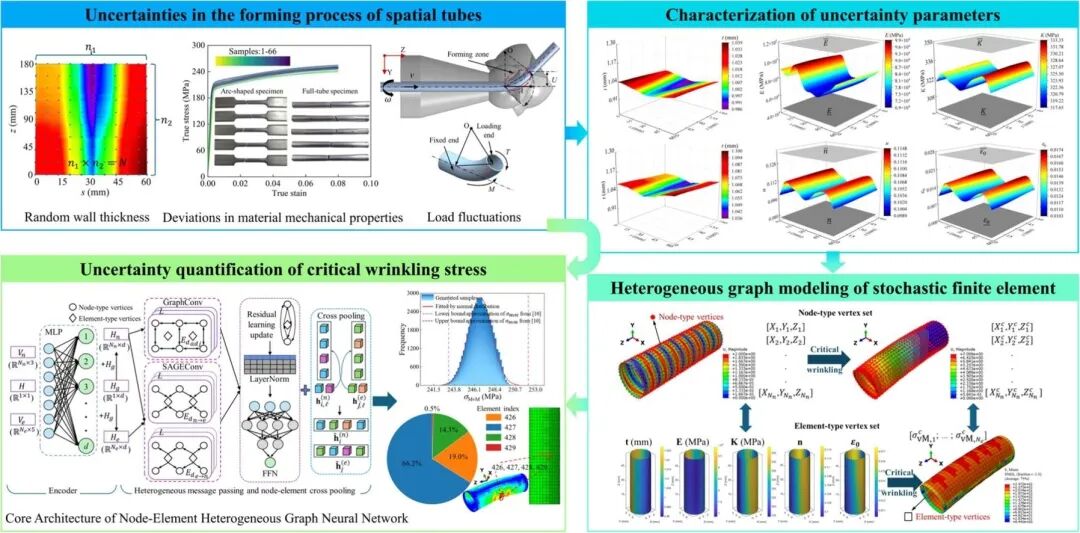
考虑混合不确定性的空间管材成形概率起皱分析
Uncertainty inherently exists in the spatial tube forming process, and uncertainty quantification (UQ) of the critical wrinkling stress is crucial for precise and stable forming as well as structural safety. However, the inherent strong randomness of geometric characteristics and material mechanical properties, together with limited experimental data, increases the difficulty of UQ. Therefore, for the UQ of random wall thickness and material mechanical property deviations, a wall thickness random field, an elastic modulus interval field, and cross-correlated interval fields of plastic mechanical property parameters are constructed, respectively. In addition, geometric deflection imperfections and loads are regarded as one-dimensional random variables. As the first attempt to apply Heterogeneous Graph Neural Network (HGNN) to the spatial tube forming process considering mixed uncertainties of random field, interval fields and random variables, this study adopts a heterogeneous graph data structure to represent finite element node and element information, and constructs a Node-Element Heterogeneous Graph Neural Network (NE-HGNN) surrogate model to predict the critical wrinkling waveform and critical wrinkling stress of spatial tube forming. Mixed uncertainty propagation is realized by replacing large-scale finite element simulations. Through comparative an alysis and ablation studies with a Multi-Head Convolutional Neural Network, it is proved that the physical coupling behavior between deformation state and stress state can be effectively represented by heterogeneous graph topology. Finally, the proposed NE-HGNN is used to realize the uncertainty quantification of critical wrinkling stress, and the final results are verified by the theoretical an alysis. This work effectively integrates the finite element mesh with mixed uncertainty information into the heterogeneous graph structure, providing a general modeling framework for data-driven forming prediction of complex spatial components considering mixed uncertainties.
空间管材成形过程中固有的不确定性,其临界起皱应力的不确定性量化对管材的精确稳定成形和结构安全至关重要。然而,几何特征和材料力学性能固有的强随机性,加上实验数据有限,增加了UQ的难度。因此,针对随机壁厚和材料力学性能偏差的UQ,分别构建壁厚随机场、弹性模量区间场和塑性力学性能参数交叉相关区间场。此外,几何挠度缺陷和载荷被视为一维随机变量。本文首次尝试将异质图神经网络(HGNN)应用于考虑随机场、区间场和随机变量混合不确定性的空间管材成形过程,采用异质图数据结构表示有限元节点和单元信息,构建节点-单元异质图神经网络(NE-HGNN)替代模型,预测空间管材成形的临界起皱波形和临界起皱应力。通过替换大规模有限元模拟,实现了混合不确定性传播。通过多头卷积神经网络的对比分析和烧蚀研究,证明了异质图拓扑可以有效表征变形状态和应力状态之间的物理耦合行为。最后,利用提出的NE-HGNN实现了临界起皱应力的不确定性量化,并通过理论分析对最终结果进行了验证。该工作将混合不确定性信息的有限元网格有效地集成到异构图结构中,为考虑混合不确定性的复杂空间构件的数据驱动成形预测提供了一个通用的建模框架。