甲醇氧化详细动力学机理构建与多工况验证

甲醇氧化详细动力学机理构建与多工况验证(A Comprehensve Mechanis m for Methanol Oxidation)
摘要:
本文构建了覆盖633–2050 K、0.26–20 atm、当量比 0.05–2.6的甲醇氧化详细动力学机理,包含完整 H₂/O₂、CO、CH₂O 与甲醇子机理。通过静态反应器、流动反应器、激波管、层流火焰多工况验证,明确HO₂/H₂O₂体系在低温链分支、高温链终止的关键作用,修正CH₃OH+OH分支比与HCO 分解等核心反应速率。机理精准复现点火延迟、火焰速度与组分分布,阐明甲醇经 CH₂OH/CH₃O→CH₂O→CO→CO₂的反应路径,为宽工况甲醇燃烧模拟提供可靠详细机理。
ABSTRACT: A comprehensive detailed chemical kinetic mechanis m for methanol oxidation has been developed and validated against multiple experimental data sets. The data are from static-reactor, flow-reactor, shock-tube, and laminar-flame experiments, and cover conditions of temperature from 633– 2050 K, pressure from 0.26– 20 atm, and equivalence ratio from 0.05– 2.6. Methanol oxidation is found to be highly sensitive to the kinetics of the hydroperoxyl radical through a chain-branching reaction sequence involving hydrogen peroxide at low tem- peratures, and a chain-terminating path at high temperatures. The sensitivity persists at un- usually high temperatures due to the fast reaction of CH2OH + O2 = CH2O + HO2 compared to CH2OH + M = CH2O + H + M. The branching ratio of CH3OH + OH = CH2OH/CH3O + H2O was found to be a more important parameter under the higher temperature conditions, due to the rate-controlling nature of the branching reaction of the H-atom formed through CH3O thermal decomposition. ◎ 1998 John Wiley & Sons, Inc. Int J Chem Kinet 30: 805– 830, 1998
INTRODUCTION
Detailed chemical kinetic mechanis ms can be useful engineering tools, which permit exploration ofthe mi- croscopic chemical processes that underlie and some- times control the macroscopic physical processes, such as flame speed or autoignition time. The mech- anis ms are systems of many elementary reactions, with rate constants determined, where possible, by funda- mental kinetic experiments or theoretical treatment. The examination of the contribution of the elementary reactions within the context of the larger system aids in identification of rate constants or reaction channels that warrant further investigation by fundamental ki- neticists.
Detailed mechanis ms are often developed in re- sponse to and validated against a single set of exper- imental measurements. As a result, the range of ap- plicability of the mechanis m, as defined primarily by temperature, pressure, and equivalence ratio, is limited to that covered by the data set. The term “comprehen- sive” implies that the range of validity of the mecha- nis m has been extended to the maximum practical ex- tent by comparison to multiple experimental data sets. The creation of such mechanis ms has additional util- ity. Many combustion processes occur over a wide range of conditions (An example is the autoignition process in spark-ignition engines. The fuel/air charge enters the cylinder at near-ambient conditions, and in a transient process, is compressed to 10 – 40 atm, and an unburned gas temperature of 1000 – 1200 K). A comprehensive mechanis m may be used to not only identify important reactions, but also the controlling chemical regimes during the transient process.
In the present work, a detailed kinetic mechanis m, initially developed in comparison to low and inter- mediate temperature (< 1100 K) flow reactor data, is extended by comparison to shock-tube, flame-speed, and static-reactor data. Reaction path and sensitivity a nalysis is used to identify controlling reaction chan- nels and rate constants, and to indicate several reac- tions that require additional study.
PREVIOUS MODELING STUDIES
Westbrook and Dryer
The first comprehensive detailed kinetic model of methanol oxidation was developed by Westbrook and Dryer [ 1]. Inclusion of reaction paths that were im- portant at both high and intermediate temperatures produced successful reproduction of flow-reactor and shock-tube data. Using a simplified diffusion model, the stoichiometric laminar flame speed of a premixed methanol/air mixture was calculated to be 44 ± 2 cm/s at one atmosphere, 298 K initial conditions.
The work was hampered by a lack of elementary rate constant and reaction path information. Many im- portant rate constants, including those for methanol and hydroxymethyl (CH2OH) thermal decomposition, and H and OH abstraction reactions, were estimated in the context of the detailed modeling. The methoxy radical (CH3O) was neglected in the mechanis m. Con- siderable importance was placed upon the dehydration reaction
CH3OH + OH = CH3 + H2O
as a source of methane and C2 hydrocarbons. Later work [2] has indicated that this reaction route is neg- ligible, and other sources are sufficient to account for experimental methane and C2 species measurements. The effects of pressure-dependent reactions were not included in this early modeling effort.
Norton and Dryer
Oxidation Mechanis m: In an effort to resolve several difficulties with the Westbrook/Dryer [ 1] mechanis m, Norton and Dryer updated the model using more cur- rent rate constants and a consistent set of thermochem- ical parameters [3]. In a few instances, different prod- uct paths were proposed based on more recent work. The updated mechanis m was compared to a new set of atmospheric-pressure flow-reactor data [4], encom- passing the temperature range of 1025 – 1090 K and equivalence ratios from 0.6 – 1.6. Improved agreement with the flow-reactor data was attained, and the im-portance of the hydroperoxyl radical (HO2) to meth- anol oxidation kinetics was identified. No attempt was made to recalculate the full experimental basis set from the original reference [ 1].
Comprehensive Pyrolysis Mechanis m: The same au- thors expanded upon their previous work to develop a comprehensive model for methanol pyrolysis [2]. Al- though not an oxidation mechanis m, many ofthe im- portant reaction paths in high-temperature oxidation are identical to those found in pyrolysis studies as well. The mechanis m was compared successfully to static-reactor, flow-reactor, and shock-tube data.
Egolfopoulos, Du, and Law
A more recent attempt [5] at creating a comprehensive methanol oxidation mechanis m was based primarily upon premixed laminar flame-speed measurements over a range of initial temperatures and pressures. Ex- cellent agreement was attained for both the laminar flame speed and atmospheric-pressure flow-reactor data set [4]. The agreement with Bowman’s shock- tube ignition delay measurements [6] was less satis- factory, and only a s mall subset of the data were re- ported. Laminar-flame-species profiles were compared to data ofVandooren and Van Tiggelen [7,8], Pauwels et al. [9], and Bradley [ 10]. Although the calculation technique was not specified, it is apparent that the spe- cies profiles were forced to match the data point clos- est to the burner face. It is therefore difficult to judge the accuracy of the premixed flame profile calcula- tions.
Unfortunately, the products of a CH3 + OH reac- tion were erroneously assigned as CH2OH + H rather than CH3O + H [ 11]. The resulting reverse reaction rate coefficient is higher than collisional, and signifi- cantly affects the calculated results. With the product channel correctly specified, the mechanis m calculates flame speeds in substantial disagreement with the au- thors’ experimental measurements. The error also overemphasizes the relative importance of C2 chem- istry due to the higher CH3 production rate and alters the sensitivity of the calculations to the CH3OH + OH = CH2OH/CH3O + H2O branching ratio, as dis- cussed further below.
Grotheer
Although not described as a comprehensive mecha- nis m, the model of Grotheer et al., [ 12, 13] has been applied to both premixed laminar flame speed calcu- lations and to autoignition in a spark-ignition engine [ 14]. The published comparison of flame speed to ex- perimental data is excellent. Gradient sensitivity co-efficients for flame speed identify a number of impor- tant reactions, including HO2 + H = products and hydroxymethyl decomposition.
The authors also identified the branching ratio be- tween CH3OH + OH = CH2OH/CH3O + H2O (de- fined as kCH2OH/ktotal) as an important parameter in cal- culating flame speeds. The value chosen to give optimal agreement with the measurements is 0.85. Several independent experimental and theoretical studies of the OH abstraction reaction, indicate an in- creasing contribution of the methoxy radical path with increasing temperature, approaching a value of the branching ratio of 0.5 above 865 K. Substitution of the lower branching ratio into the baseline mechanis m would result in a significant increase in the calculated laminar flame speeds.
DETAILED MECHANIS M DEVELOPMENT
Mechanis m Development
The development of a detailed kinetic model is a hi- erarchical procedure. The basis for any hydrocarbon oxidation is the subset of reactions involving hydro- gen, oxygen, and their associated intermediates and products. These include H- and O-atoms, hydroxyl(OH) and hydroperoxyl (HO2) radicals, and hydrogen peroxide (H2O2). and water. This submechanis m de- termines to a large extent the characteristics ofthe rad- ical pool responsible for chain propagation, termina- tion, and branching.
The oxidation of carbon-containing species follows a basic series of steps, beginning with initiation reac- tions, followed by radical attack on the fuel, produc- tion of (generally) s maller intermediates, and finally a chain of aldehyde → CO → CO2 steps [ 15]. Taken in inverse order, these steps form the basic reaction hi- erarchy in a detailed kinetic mechanis m.
This section describes the procedures and sources used in compiling the detailed models of this study. Although attention is preferentially focused upon re- actions of the most significance to the mechanis m, dis- cussion of the relative importance of individual reac- tions appears in the following sections where relevant.
CO/H2/O2
The carbon monoxide/hydrogen/oxygen reaction sys- tem used in this study is taken primarily from the mechanis m of Yetter et al. [ 16], which has been re- cently modified to reflect high-pressure studies of Kim et al. [ 17, 18]. This submechanis m was verified against a series of flow-reactor, static-reactor, and shock-tube
experiments, and is well established as providing an accurate depiction of hydrogen and carbon monoxide oxidation over a wide range of conditions.
CH2O
Formaldehyde oxidation kinetics are of great impor- tance to the oxidation of larger hydrocarbon and ox- ygenated hydrocarbon species. Under most circum- stances, nearly all of the carbon in these species is oxidized through a route involving formaldehyde. Methanol oxidation is not an exception to this gener- alization. Thus, accurate modeling of methanol oxi- dation requires significant attention to the details of the formaldehyde oxidation mechanis m as well.
The difficulties involved in generating formalde- hyde have resulted in a relatively sparse experimental data set for mechanis m validation [ 19]. The compre- hensive modeling effort of Hochgreb and Dryer [20]encompassed the full range of available data, including shock-tube, flow-reactor, and static-reactor data. For the present modeling study, the CH2O submechanis m was modified as described in an earlier article [21]. The rate constants of CH2O + H and CH2O + OH were reduced from their high values in the earlier work. These changes were necessary to reproduce peak formaldehyde yields in the flow reactor experi- ments [22]. The new rate constants for these reactions allowed accurate calculation of the relative formalde- hyde and methanol destruction rates in flow-reactor experiments on the oxidation and pyrolysis of mixtures of these two species. Recalculation of the data set used in the original mechanis m development [20] showed little change in the calculated species pro- files, with the exception of the oxidative pyrolysis flow-reactor experiments. However, the presence of an uncontrolled trace contamination of oxygen in these experiments casts uncertainty upon their accuracy. Considering this uncertainty, the alteration of the cal- culated formaldehyde consumption rate is within the error limit of the experiments.
CH3OH
The methanol submechanis m requires addition of the following species: methanol (CH3OH), hydroxy- methyl (CH2OH), and methoxy (CH3O). The high- pressure flow-reactor experiments indicated the pres- ence of formic acid (HCOOH) and 1,2-ethanediol (ethylene glycol, HOC2H4OH) as minor intermediates. For the present work, tentative formation mechanis ms for these species are described below. The two meth- anol mechanis ms of Norton and Dryer provided the initial basis for the present methanol submechanis m.
A number of rate constants were changed from the original mechanis ms to reflect more recent rate con- stant measurements. The details of the most significant portions of the mechanis m are discussed below.
Initiation/Decomposition: Although the rate constants of initiation reactions are seldom important under flow-reactor, static-reactor, or laminar-flame condi- tions, they may play a more significant role in shock- tube studies. At least four different decomposition re- actions are possible:
CH3OH + M = CH3 + OH ΔHr = 92.2 kcal/mol
= CH2OH + H 98.0 kcal/mol
= CH3O + H 104.1 kcal/mol
= 1CH2 + H2O 91.8 kcal/mol
The first reaction predominates, accounting for 75% to 90% of the total decomposition rate in various stud- ies [23 – 25]. The methoxy radical channel is thermo- dynamically unfavorable. The hydroxymethyl channel is usually assumed to account for the remainder of the initiation rate, although the singlet methylene channel is an interesting alternative proposed by Dombrowsky et al. [23]. As yet there is no direct evidence to support this channel, but it could be considered in future stud- ies.
For the present model, a Troe fit for the CH3 + OH channel was generated based on the falloff param- eters ofTsang [26]. For simplicity, the hydroxymethyl channel is assigned a rate of 10% of the primary chan- nel. A more accurate expression should take into ac- count the higher activation energy expected with the more endothermic reaction path; however, the calcu- lations are insensitive to the rate constant of this re- action.
OH Abstraction: The abstraction reactions of OH are the predominant fuel consumption routes in the meth- anol mechanis m. The abstraction may occur at either the methyl or hydroxyl group, forming CH2OH + H2O (83) or CH3O + H2O (84), respectively. Except at the highest temperatures, the two species react by considerably different mechanis ms
CH2OH + O2 = CH2O + HO2 (70)
CH3O + M = CH2O + H + M (42)
It is therefore important to maintain a distinction be- tween the two CH3O isomers.
Two recent studies reported overall rates for the reaction of methanol with OH. Hess and Tully [27] obtained an expression for k83 + k84 = 3.54 × 10⁴T2.6 exp(883/RT) over the temperature range
293 – 803 K*. Isotopic substitution allowed an esti- mate of the “branching ratio,” defined as k83/(k83 + k84), that increased from a s mall value to 0.5 at their highest temperature. More recently, Bott and Cohen[28] obtained a value for k83 + k84 of 5.2 × 10¹² at 1200 K, in excellent agreement with the value of 5.1 × 10¹² obtained from the previous expression. Their calculated site specific expressions yield a branching ratio that increases from 0.39 at 1000 K to 0.51 at 2000 K. The present mechanis m uses the ex- pression of Bott and Cohen.
Reaction with H: Methanol may react with hydrogen atoms by abstraction from either site, or by dehydra- tion, forming methyl and water. The latter reaction was suggested as a significant source of methyl radicals[ 1], although subsequent studies [2] have failed to de- tect evidence of this channel. The present model does not include this reaction. Its inclusion at the rate con- stant suggested by Norton [3] has no discernible effect on the overall kinetics.
The abstraction reaction consumes a significant fraction of the methanol, particularly under fuel rich
conditions. The product channel yielding hydroxy-methyl is 6. 1 kcal/mol exothermic, while the methoxy channel is almost thermoneutral. Consistent with the pyrolysis study of Norton and Dryer [2], the rate con-stant of Warnatz [29] was applied with a 20% contri-bution by the methoxy radical path.
CH3O/CH2 OH Isomerization: A possible isomeriza- tion reaction between CH3O and CH2OH was first sug- gested as a loss mechanis m for CH3O in a fundamental kinetics experiment [30]. Because thermodynamic equilibrium strongly favors hydroxymethyl, the isom- erization primarily converts methoxy to hydroxy- methyl. Because it eliminates the H-atom produced by methoxy decomposition, the isomerization reaction could be very important if it occurs at a rate compa- rable to the decomposition rate. Theoretical and ther- mochemical estimates of the isomerization rate con- stant [31 – 33] consistently place its value at or below about 10% of that for methoxy decomposition. Ex- perimental work [34] also suggests that the upper limit for the isomerization reaction is 10% of the decom- position rate. At this upper limit, the isomerization re- action does not significantly affect the results of the detailed model. Since no direct evidence exists to sup- port this reaction path, the present mechanis m does not include it.
Minor Species Formation: Infrared spectra collected during the VPFR experiments indicated the presence of detectable amounts of formic acid as an interme- diate species (approximately 50 ppm with 4000 ppm
initial methanol). A postulated formation mechanis m is a combination reaction between hydroxymethyl and hydroperoxyl radicals, followed by decomposition or rearrangement and decomposition:
CH2OH + HO2 = CH2(OOH)OH
CH2(OOH)OH = CH2(O)OH + OH
-or-
CH2(OOH)OH = HCOOH + H2O
CH2(O)OH = HCOOH + H
Spangenberg et al. [35] originally postulated the de- hydration route, which involves a fairly highly strained transition state. The decomposition route seems more likely, but there is no direct evidence to support one path over the other. The present mecha- nis m includes both reactions with estimated rate co- efficients of 3.0 × 1013 cm3/mol-s. The variation of formic acid mole fraction with equivalence ratio is not well reproduced, and thus this mechanis m can only be considered tentative, at best.
In the most fuel-rich high-pressure flow-reactor ex- periments, a spectral feature identified as 1,2-ethane- diol (ethylene glycol) was detected after the oxygen had been completely consumed [21,22]. Clearly, this species is a product of hydroxymethyl (CH2OH) di- merization. Although the quality of the spectrum was insufficient to permit its quantification, the possibility that 1,2-ethanediol formation is an important radical termination path for fuel-rich conditions led to the in- clusion of this reaction in the mechanis m. However, its impact on the overall predictions of the mechanis m is negligible.
C2 Species: Because s mall amounts of methyl radicals are created during the oxidation and pyrolysis of meth- anol, C2 or larger hydrocarbon species may be formed by their recombination. Egolfopoulos et al. [5] re- ported significant effects of the inclusion of a detailed C2 submechanis m on their calculated laminar flame speeds. Because of the incorrectly high-rate constant for CH2OH + H = CH3 + OH used in their mecha- nis m [ 11, 13], it is likely that this conclusion is influ- enced by an erroneously high CH3 production rate. In the present work, a simple C2 mechanis m was assem- bled primarily from the compilation of Tsang and Hampson [36] for purposes of testing the influence of higher carbon number kinetics on methanol oxidation. Under all cases simulated, no influence of C2 chem- istry could be detected in any of the calculated species profiles, overall reaction rates, ignition delays or pre- mixed flame speeds.
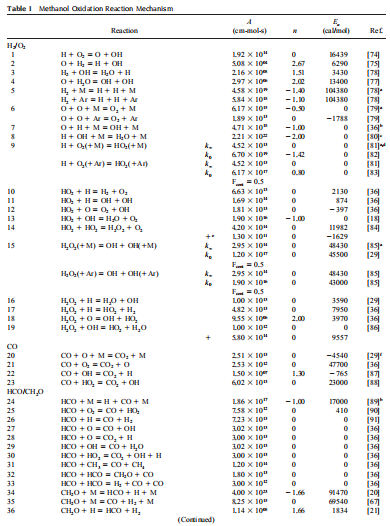
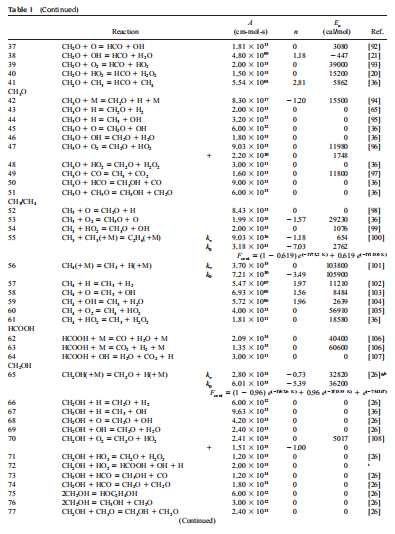
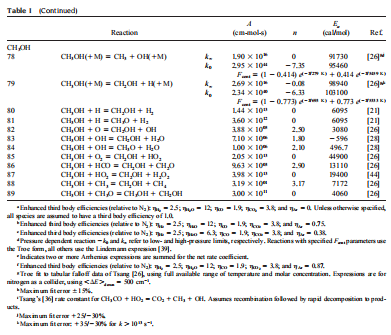
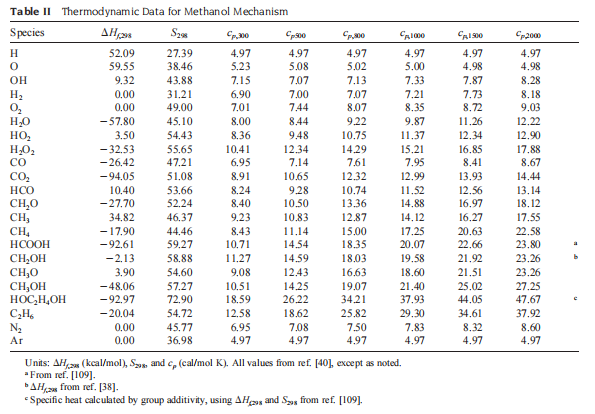
Summary: The cumulative mechanis m used for com- parison to the methanol experiments appears in Table I, with the forward rate coefficients and references. The reverse reaction rates are calculated by detailed balance and thermodynamic parameters, listed in Ta- ble II. Most of these data are from the Sandia ther- modynamic database [37]. The enthalpy of formation for CH2OH has been changed to reflect the recent mea- surements of Seetula and Gutman [38].
Solution Technique
Six different types of experiments were simulated in this study, static reactors, flow reactors, shock tubes, premixed flames extrapolated to the freely-propagat- ing, unstretched condition, and burner-stabilized flat premixed flames. The Chemkin-II package [39] was used for the simulations. The fundamental modeling assumptions are summarized as follows.
Static Reactor: Constant volume, spatially homoge- neous. The assumption of a spatially homogeneous mixture requires that the reaction time is much longer than the characteristic thermal and mass diffusion times to the reactor walls. The implications of these characteristics of static reactor experiments are dis- cussed below.
Flow Reactor: Constant pressure, adiabatic, zero-di- mensional. The constant pressure assumption is essen- tially a low Mach number assumption. Adiabaticity is approximated in the experiments through the use of preheated reactor tube walls and a short length to di- ameter ratio in the reactor tube. Zero-dimensionality is valid in the case of negligible axial and radial dif- fusion. Radial diffusion is held to a minimum, again by limiting the experiment to L/D values such that the flow is essentially an entry-region flow, where the de- veloping boundary layers do not interact strongly with a radially uniform core flow. Finally, axial diffusion is negligible where the characteristic diffusion length is much greater than the convective length. Although this assumption is reasonably valid over much of the reaction zone, it breaks down in regions of high con- centration gradients, such as in the rapid transition in the oxidation rate of CO accompanying the depletion of hydrocarbon species in Figure 12.
The finite-rate mixing of fuel and oxidizer, recir- culation zones near the mixing region, and residual effects of axial diffusion in this region all result in uncertainty in specification of an absolute “zero time” for flow reactor experiments. Modeling simulation of these effects using stirred reactor-plug flow coupled models has shown that they all serve to translate the calculated species and temperature profiles along the time axis toward the origin. Furthermore, the initial perturbations of the system are quickly relaxed and result in no historical effects downstream of this re-gion, other than shifting the entire reaction profiles (without perturbations) with respect to the “zero time.” When the calculated profiles are artificially temporally aligned at an arbitrary reference point within the downstream reaction zone where methanol disappear- ance is observed, the calculations and experimental profiles overlay one another nearly perfectly. Thus, in comparing calculations with experimental data, the time axis of the data is effectively “translated” to achieve a minimum RMS error with the calculated fuel decay profile. The magnitude of the required shift is noted in the figure captions. Time shifting and the re- sults achieved by the above approach are entirely con- sistent with the assumption (noted above) that within the range of extents of reaction to be compared with the calculation, axial diffusion time scales are much longer than kinetic and convective time scales. Math- ematically, the solution of the conservation equations then becomes an initial value problem, and any single matching point between the experiment and compu- tation is equivalent (Computationally, calculations can be marched upstream or downstream of the matching point without concern).
Shock Tubes: The thermal environment in the post- shock region can be safely assumed to be adiabatic. Also, the short reaction time scales relative to diffusive times permits the zero-dimensional approximation. The treatment of the free boundary of the reaction zone is open to some debate. A limiting case, frequently applied, assumes a constant-volume (density) bound- ary, which implies that the bulk expansion of the fluid due to temperature rise and average molecular weight change overwhelms the inertial effects of the sur- rounding fluid. However, the situation is rarely as clear-cut as the simplified model would indicate. Short of solving the one-dimensional momentum equation, the best that can be assumed is that reality lies between the limiting cases of constant density and constant pressure. Both cases were calculated in this work and representative points are indicated on the figures as the average parameter with error bars indicating the lim- iting cases.
The SENKIN program [40] was used to calculate all the preceding three cases, i.e., cases involving static-reactor, flow-reactor, and shock-tube compari- sons.
Premixed Laminar Flame Speeds: The Chemkin pro- gram PREMIX was used to simulate a freely-propa- gating, one-dimensional, constant-pressure adiabatic flame. The multicomponent diffusion model was used, and thermal diffusion of H and H2 was included in the calculations. The windward differencing numerical scheme was used for most of the calculations, due to its superior convergence properties. At the high grid resolution used (approximately 150 nodes within the flame, and 50 in the preheat and post-flame regions), less than 0.5 cm/s difference in calculated flame speed results when using the more accurate but less stable central differencing scheme.
Burner-Stabilized Premixed Flat Flames: Species pro- files through several low-pressure, burner-stabilized flames were calculated using PREMIX. The measured temperature profiles were used as inputs to the model due to the unquantified heat losses to the burner. The same diffusion model and numerical parameters were used as for the freely-propagating flame calculations.
RESULTS AND DISCUSSION
Static Reactors
Static reactors are typically used to study low temper- ature oxidation chemistry, where the reaction time scales are measured in minutes. The principal advan- tages of these experiments are their simplicity, and essentially unlimited time available for observation of slow reactions. However, the influence of surfaces has long remained difficult to handle for numerical mod- elers. The experiments are often difficult to control without treatment of surfaces by rigorous cleaning procedures, coating with various substances, and/or “aging” or “seasoning” of the vessels by numerous repetitions (often hundreds) of experiments.
The surfaces interact with the experiments both thermally and chemically. Thermal interaction in-volves transfer of the reaction enthalpy through the walls of the vessel. For the present work, this effect was treated by assuming a lumped heat capacity model, with an overall characteristic thermal transfer rate. The numerical values used in the calculations were initially estimated based on the thermal diffusiv- ity of the major species and the reported dimensions of the reaction vessels. The details of the chemical/ surface interactions are discussed below.
The five static reactor experiments selected for sim- ulation are summarized in Table III. The temperatures studied range from 633 to 873 K, and the initial pres- sures are atmospheric or below. The reactor surfaces in the experiments were uncoated Pyrex or silica. Fort and Hinshelwood [41] followed the extent of reaction by monitoring the pressure rise due to the decreasing average molecular weight of the reacting mixture. The characteristic thermal time of their reactor vessel was much shorter than the reaction time scale, and nearly isothermal conditions were maintained. This was also the case in the experiments of Bone and Gardner [42], and Bell and Tipper [43]. The primary diagnostic in Bone and Gardner’s experiment was also pressure rise, although limited species an alysis was performed. Car- bon monoxide was the primary product detected, with s maller amounts of formaldehyde, formic acid, carbon dioxide, and an unidentified peroxide. The more de- tailed species measurements of Bell and Tipper [43] were in agreement with Bone and Gardner’s results, although in addition, hydrogen and water were also measured, and the peroxide identified as hydrogen per- oxide. A reaction scheme for low-temperature meth- anol oxidation, involving HO2 as the primary chain carrier, was also proposed. Cathonnet et al. [44] stud- ied methanol oxidation at higher temperatures as a function of equivalence ratio. Temporal species pro- files were measured by gas chromatography, and a de- tailed reaction mechanis m was proposed, which repro- duced their measurements with a reasonable degree of accuracy. Finally, in the continuously-stirred static reactor study of Aniolek and Wilk [45], overall reac- tion rate as a function of temperature, pressure, and equivalence ratio was measured by pressure rise. A single set of species measurements was also re- ported. Ignition events were observed at fuel-rich con- ditions.
Initial modeling attempts using the baseline mech- anis m resulted in poor agreement with all the experi- mental data, with the calculated reaction time scales being much shorter than measured. Because the mech- anis m successfully simulated high-pressure flow-re- actor experiments at temperatures nearing those in the static reactor studies [21], three possibilities were con- sidered. First, the low-pressure conditions of the static- reactor experiments may open new reaction pathways not considered in the mechanis m, or a pressure-depen- dent rate coefficient may not be adequately specified. However, the lower pressures of the static reactor ex- periments do not favor gas-phase chain termination reactions, as required to cause an overall decrease in reaction rate. Also, detailed falloff expressions have been incorporated for all relevant reactions. Second, the overall reaction rate measured in the flow reactor experiments maybe systematically too high. However, flow reactor experiments are generally less affected by surface reactions than are static reactor experiments, particularly if fluid element residence times in the flow reactor are much shorter than diffusion times to/from the reactor walls. Thus, heterogeneous reactions may play an important role in modifying the chemical rate observed in static reactors from that characteristic of homogeneous gas-phase conditions.
The two main reactions generally assumed to be responsible for the chemical effect of surfaces are loss of hydrogen peroxide and hydroperoxyl radical through heterogeneous termination [43,46]. These re- actions were modeled by the overall process:
HO2 (+ wall) 一 H2 + O2
H2O2 (+ wall) 一→ H2O O2
详细内容请见附件
免责声明:
本页面/内容部分素材来源于互联网公 开 信 息,旨在传递更多信息,不代表本平台立场。
版权归原作者或机构所有,如涉及侵权,请通过平台联系我们,我们将在核实后第一时间处理。
本平台对转载内容的真实性、准确性不作任何保证,用户需自行判断并承担使用风险。