【新文速递】2026年5月7日复合材料SCI期刊最新文章
今日更新:Composites Part A: Applied Science and Manufacturing 3 篇,Composites Part B: Engineering 4 篇,Composites Science and Technology 1 篇
Composites Part A: Applied Science and Manufacturing
Porous NC/Co@NC/Mo2C heterostructures with gradient dielectric interfaces for electromagnetic wave absorption
Huizhong Huang, Xiaojun Zeng, Yanfeng Gao
doi:10.1016/j.compositesa.2026.109913
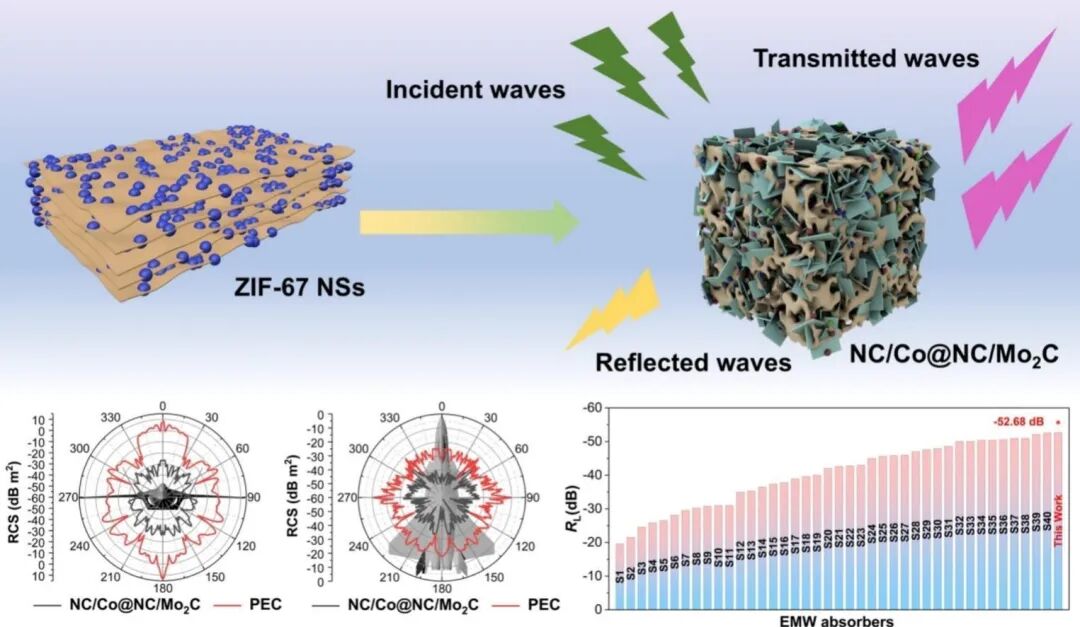
具有梯度介电界面的多孔NC/Co@NC/Mo2C异质结构用于电磁波吸收
The development of high-performance electromagnetic wave (EMW) absorption materials that combine broadband absorption, lightweight properties, strong attenuation, and ultrathin thickness is of paramount importance for mitigating electromagnetic pollution and advancing stealth technologies. In this work, we report a hierarchical Co/Mo-based heterostructure (NC/Co@NC/Mo2C) synthesized via a two-dimensional (2D) metal–organic framework (MOF)-mediated interfacial engineering strategy. By employing ZIF-67 nanosheets as structural templates, a sequential hydrothermal and pyrolysis route was utilized to construct a three-dimensional (3D) heterointerface network characterized by a gradient dielectric distribution. This network features uniformly dispersed Co/Mo2C nanoparticles and a high density of interfaces. By synergistically designing a hierarchical porous architecture and a nitrogen-doped carbon matrix, the material effectively tunes the frequency-dependent dielectric and magnetic parameters, thereby achieving broadband impedance matching. Consequently, the NC/Co@NC/Mo2C composite exhibits an exceptional reflection loss (R L) of −52.68 dB at a thin thickness of 2.145 mm, along with an effective absorption bandwidth (EAB) of 3.5 GHz. The EMW dissipation mechanis ms of this hierarchical porous heterostructure include conduction loss, dipole polarization, interfacial polarization, magnetic loss. These findings underscore the efficacy of gradient heterointerface design and provide a robust strategy for developing high-efficiency EMW absorbers.
开发集宽带吸收、轻量化、强衰减和超薄厚度于一体的高性能电磁波吸收材料对减轻电磁污染和推进隐身技术具有重要意义。在这项工作中,我们报道了通过二维(2D)金属有机框架(MOF)介导的界面工程策略合成的分层Co/ mo基异质结构(NC/Co@NC/Mo2C)。以ZIF-67纳米片为结构模板,采用顺序热液热解路线构建了具有梯度介电分布的三维异质界面网络。该网络具有均匀分散的Co/Mo2C纳米颗粒和高密度的界面。通过协同设计分层多孔结构和氮掺杂碳基体,该材料有效地调节了频率相关的介电和磁参数,从而实现了宽带阻抗匹配。因此,NC/Co@NC/Mo2C复合材料在厚度为2.145 mm时的反射损耗(R L)为- 52.68 dB,有效吸收带宽(EAB)为3.5 GHz。该层次化多孔异质结构的EMW耗散机制包括传导损耗、偶极极化、界面极化和磁损耗。这些发现强调了梯度异质界面设计的有效性,并为开发高效的EMW吸收剂提供了强有力的策略。
Engineering a “Rebar-Brick” ceramic shield in Polyamide 6 fibers: a hyperbranched siloxane-based modifier for integrated flame retardancy, hydrophobicity, and spinnability
Zhengqi Wang, Jia Song, Ai Liu, Yingying Li, Jianyong Yu, Xueli Wang, Ruchao Yuan, Faxue Li
doi:10.1016/j.compositesa.2026.109904
在聚酰胺6纤维中设计“钢筋砖”陶瓷屏蔽:一种基于超支化硅氧烷的综合阻燃、疏水性和可纺性改性剂
Polyamide 6 (PA6) fibers face significant limitations in safety–critical applications due to their inherent flammability and problematic melt-dripping behavior. To address these challenges, we developed a novel organo-inorganic hybrid flame retardant (HPPS) through covalent conjugation of a phenyl phosphonic diamide unit with a hyperbranched siloxane backbone. This innovative design enables direct melt-spinning of PA6 fibers while improving both flame retardancy and hydrophobicity. The modified composites demonstrate notable fire safety performance, achieving a V-0 UL-94 classification and a notably high limiting oxygen index of 28.3 %, coupled with a substantial 42 % decrease in peak heat release rate. Particularly noteworthy is the distinct plateau observed in the heat release rate curve, indicating notable resistance to melt-dripping. This enhanced fire safety stems from an innovative “rebar-brick” protective mechanis m, wherein the silicon-based network acts as structural reinforcement (“rebar”) for the phosphorus-catalyzed highly cross-linked char (“brick”), collectively forming an effective ceramic-like thermal barrier. Furthermore, the material undergoes a fundamental transformation in surface properties, evolving from hydrophilic to hydrophobic characteristics with a composite water contact angle reaching 93.8°. This innovative design establishes a new pathwayfor engineering advanced PA6 fibers with integrated high performance and enhanced safety features.
聚酰胺6 (PA6)纤维由于其固有的易燃性和有问题的熔滴行为,在安全关键应用中面临重大限制。为了解决这些挑战,我们通过苯基膦二胺单元与超支化硅氧烷主链的共价偶联,开发了一种新型有机无机杂化阻燃剂(HPPS)。这种创新的设计使PA6纤维能够直接熔融纺丝,同时提高阻燃性和疏水性。改性后的复合材料具有显著的消防安全性能,达到了V-0 UL-94级,极限氧指数高达28.3%,峰值放热率大幅降低42%。特别值得注意的是,在热释放率曲线中观察到明显的平台,表明对熔滴的显著抵抗。这种增强的防火安全性源于一种创新的“螺纹砖”保护机制,其中硅基网络作为磷催化的高度交联炭(“砖”)的结构加固(“螺纹砖”),共同形成有效的陶瓷样热障。此外,材料的表面性质发生了根本性的转变,从亲水性转变为疏水性,复合水接触角达到93.8°。这种创新的设计为工程先进的PA6纤维建立了新的途径,具有集成的高性能和增强的安全特性。
A parametric method for thickness extraction and process design of complex 3D woven composites
Yinping Ye, Chengchang Ji, Qiyang Li, Suhang Ding, Xinfu Chi, Yize Sun
doi:10.1016/j.compositesa.2026.109902
复杂三维编织复合材料厚度提取与工艺设计的参数化方法
Although 3D woven composites have excellent performance, process design for complex components like aero-engine blades is inefficient and inaccurate due to empirical trial and error. This paper proposes a parametric method for thickness extraction and process design of complex 3D woven composites. First, the upper surface, lower surface and central plane of the composite model are extracted, and a predictive model for the warp and weft yarn trajectories on the upper and lower surfaces is constructed to extract the thickness distribution data of the interlacing point area; then, based on the thickness data, the distribution of warp and weft yarn layers and the position distribution of warp and weft yarn reduction points are extracted; furthermore, a weft yarn quantity matrix (WYQM) for each interlacing point is constructed, and a conversion model between WYQM and the jacquard pattern matrix (JPM) is established; finally, the shedding control matrix is extracted, the serialized arrangement of JPM is completed, and process files that can directly drive 3D weaving looms are generated. Experimental results demonstrate that this method adapts to various process parameters and achieves full-process weaving design, providing reliable digital support for the design and optimization of complex 3D woven composites.
尽管3D编织复合材料具有优异的性能,但由于经验试验和错误,航空发动机叶片等复杂部件的工艺设计效率低下且不准确。提出了一种复杂三维机织复合材料厚度提取和工艺设计的参数化方法。首先提取复合模型的上表面、下表面和中心平面,构建经纬纱在上、下表面的轨迹预测模型,提取交错点区域的厚度分布数据;然后,根据厚度数据提取经纬纱层分布和经纬纱缩点位置分布;在此基础上,构建了每个交织点的纬纱量矩阵,并建立了纬纱量矩阵与提花花纹矩阵的转换模型;最后提取脱落控制矩阵,完成JPM的序列化排列,生成可直接驱动三维织布机的工艺文件。实验结果表明,该方法可适应多种工艺参数,实现了全程编织设计,为复杂三维编织复合材料的设计与优化提供了可靠的数字化支持。
Composites Part B: Engineering
High-Temperature Electromagnetic Wave Absorption of Si3N4 Composite Ceramics Reinforced with Continuous SiC Fibers and SiC Particles
Haoquan Hao, Jingxiang Liu, Yuheng Zhang, Qinghe Jing, Shouqing Yan, Jie Guo, Hairui Zhao, Yong Shuai, Zhijiang Wang
doi:10.1016/j.composites b.2026.113776
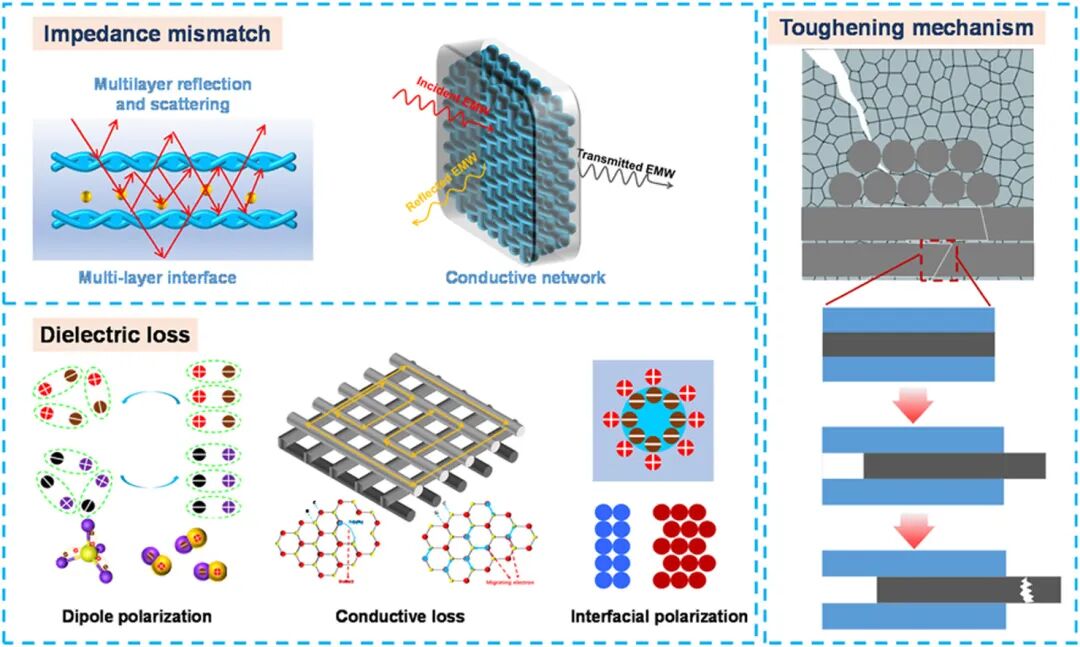
连续SiC纤维和SiC颗粒增强Si3N4复合陶瓷的高温电磁波吸收
High-temperature electromagnetic wave (EMW) absorbing materials are essential for advanced aerospace and stealth applications due to their functional stability and mechanical reliability. In this study, SiC fiber/powder-reinforced Si3N4 ceramic matrix composites were fabricated through spark plas ma sintering, with carefully controlled compositions and microstructures. We systematically evaluated the electromagnetic and mechanical properties of the optimized composite, SCNF20, in the X band. The SCNF20 composite exhibits exceptional EMW absorption performance, achieving an ultra-low minimum reflection loss of −56.2 dB and an effective absorption bandwidth that spans the entire X band. Moreover, the composite retains effective absorption at elevated temperatures up to 600 °C, demonstrating excellent high-temperature stability. CST electromagnetic simulations further indicate a substantial reduction in radar cross-section at various incident angles, confirming the composite’s strong potential for electromagnetic stealth applications. The enhanced absorption performance is primarily attributed to optimal impedance matching and multiple dielectric loss mechanis ms, facilitated by the SiC reinforcements. Additionally, SCNF20 shows reliable mechanical properties, including a flexural strength of 442.6 ± 5.4 MPa and a fracture toughness of 11.47 ± 0.55 MPa·m1/2, attributed to fiber-related toughening mechanis ms such as crack deflection, fiber pull-out, and fiber bridging. These results suggest that SCNF20 is a promising candidate for high-temperature, load-bearing EMW-absorbing ceramic applications.
高温电磁波吸收材料由于其功能稳定性和机械可靠性,在先进的航空航天和隐身应用中是必不可少的。在本研究中,通过火花等离子烧结制备了SiC纤维/粉末增强Si3N4陶瓷基复合材料,并对其成分和微观结构进行了精心控制。我们系统地评估了优化后的复合材料SCNF20在X波段的电磁和力学性能。SCNF20复合材料具有优异的EMW吸收性能,实现了- 56.2 dB的超低反射损耗和跨越整个X波段的有效吸收带宽。此外,复合材料在高达600°C的高温下保持有效吸收,表现出优异的高温稳定性。CST电磁模拟进一步表明,在各种入射角下,雷达横截面大幅减少,证实了该复合材料在电磁隐身应用方面的强大潜力。吸收性能的增强主要归功于SiC增强材料的最佳阻抗匹配和多种介电损耗机制。此外,SCNF20表现出可靠的力学性能,包括442.6±5.4 MPa的抗弯强度和11.47±0.55 MPa·m1/2的断裂韧性,这归因于纤维相关的增韧机制,如裂缝挠曲、纤维拉出和纤维桥接。这些结果表明,SCNF20是高温、承载emw吸收陶瓷应用的有希望的候选者。
A progressive damage model-assisted GW-Gaussian process SHM method for complex composite damage quantification
Hutao Jing, Shenfang Yuan, Yuanqiang Ren, Jian Chen, Ying Wang
doi:10.1016/j.composites b.2026.113770
一种递进损伤模型辅助的gw -高斯过程SHM方法用于复杂复合材料损伤量化
Accurate damage quantification of composites by using structural health monitoring (SHM) is of great significance for the life management of aerospace structures. However, damage mechanis m in composite structures is always complicated and progressive due to their heterogeneity and anisotropy, leading to significant dispersion and multi-stage characteristics in damage evolution. To solve this problem, a new progressive damage quantification SHM method for composite structures by combining Gaussian process (GP)-based probabilistic mode transition and progressive damage model assistance is proposed in this paper. The dominant progressive damage mechanis m transition is identified by evaluating the statistical consistency between damage features and the GP predictive distribution. By combining the assistance of progressive damage modeling in capturing the entire damage evolution process, a mode-dependent GP probabilistic model is established to quantify the progressive damage. Based on active guided wave (GW)-SHM, the proposed method is validated under quasi-static shear loading using a composite orthogrid stiffened panel with a central cutout, which is derived from an important load-carrying component in reusable launch vehicles (RLV). The validation focuses on skin-stiffener debonding and subsequent skin cracking, which are the dominant progressive damage modes in such structures. Validation results demonstrate the effectiveness of the proposed method in accurately identifying the debonding-to-cracking transition at a load level of 200 kN, as well as in quantifying the debonding area with a maximum absolute error of 8.1%. A sensitivity an alysis further confirms the robustness of the method under ±20% variations in key skin–stiffener interface properties.
利用结构健康监测技术对复合材料损伤进行精确量化,对航空航天结构的寿命管理具有重要意义。然而,由于复合材料结构的非均质性和各向异性,其损伤机制往往是复杂渐进的,导致其损伤演化具有明显的分散性和多阶段特征。针对这一问题,提出了一种基于高斯过程(GP)的概率模态转换与渐进损伤模型辅助相结合的复合材料结构渐进损伤量化SHM方法。通过评估损伤特征与GP预测分布之间的统计一致性,确定了主要的渐进损伤机制转变。结合渐进式损伤建模对整个损伤演化过程的辅助捕捉,建立了基于模式依赖的GP概率模型来量化渐进式损伤。基于主动导波(GW)-SHM,采用可重复使用运载火箭(RLV)中重要承载部件的带中心切口的复合材料正网格加筋板,在准静态剪切载荷下对该方法进行了验证。验证的重点是皮肤加劲脱粘和随后的皮肤开裂,这是这种结构中主要的渐进损伤模式。验证结果表明,该方法能够准确识别200 kN荷载水平下的脱粘-开裂过渡,并能定量确定脱粘面积,最大绝对误差为8.1%。灵敏度分析进一步证实了该方法在±20%的关键皮肤强化界面特性变化下的鲁棒性。
Ultralight Continuous Fiber Printed Bioinspired Metamaterials Enabling High-Stress yet Stable Deformation
Rui Xu, Chunqi Liu, Zhikun Yang, Yihao Yuan, Liang He, Peng Wang
doi:10.1016/j.composites b.2026.113767
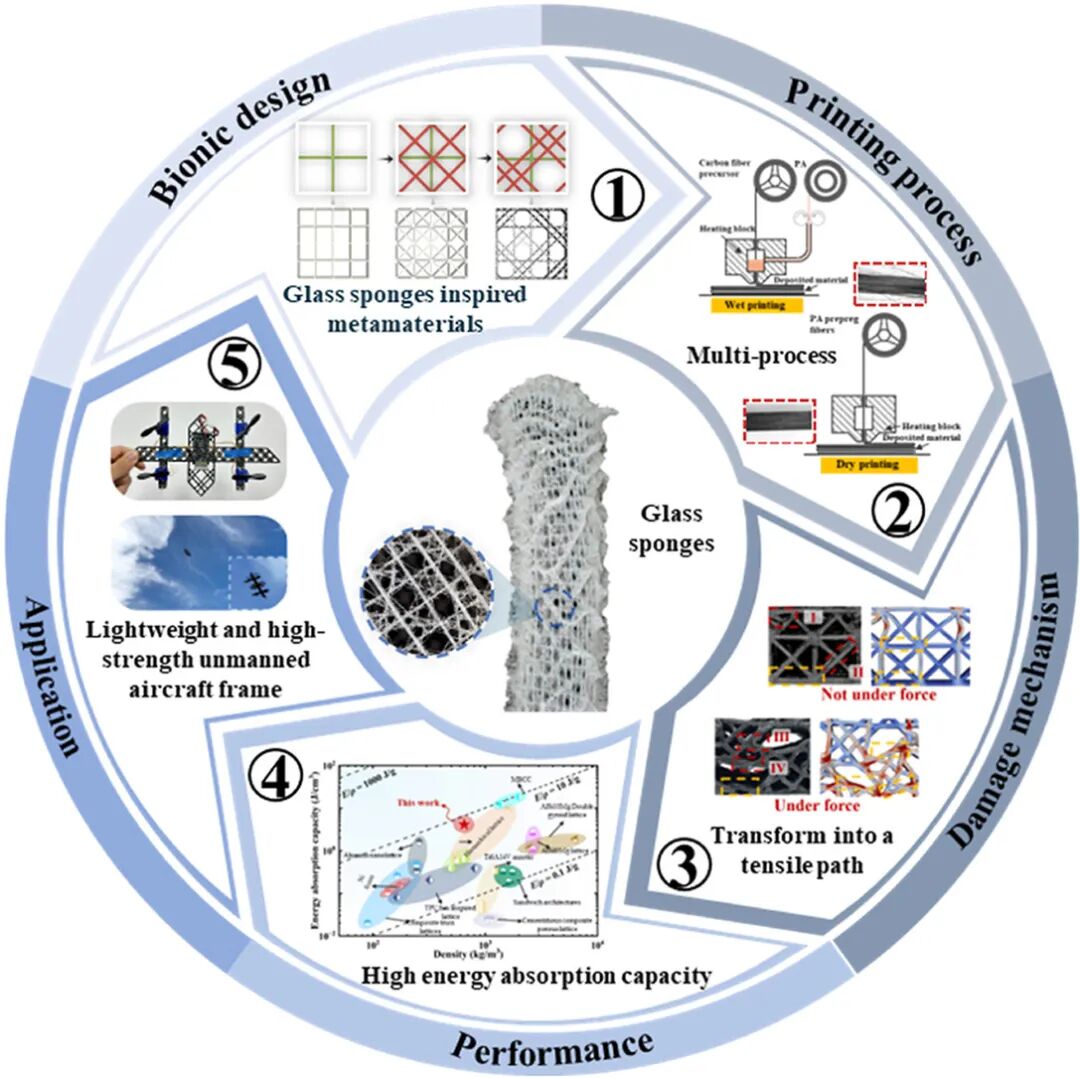
超轻连续纤维打印生物灵感超材料实现高应力但稳定变形
Lattice metamaterials are promising for ultralight load-bearing and impact resistance, yet most additively manufactured lattices are built from materially isotropic constituents, preventing stiffness and strength from being aligned with topology-governed load paths, while nodal and interlayer weaknesses induce localized collapse and unstable crushing plateaus. Here, inspired by the double-diagonal skeletal framework of deep-sea glass sponges, we develop an ultralight continuous-fiber 3D-printed lattice metamaterial coupling architectural load-transfer pathways with fiber anisotropy via a structure–material–process co-design. Three topologies (SC, FCC, and a vertex-offset MFCC) are fabricated through wet and dry impregnation and examined using quasi-static compression and validated finite-element simulations to elucidate their deformation modes, load-transfer mechanis ms, and energy absorption responses. The MFCC lattice establishes multi-channel diagonal load paths that suppress nodal stress concentration, delivering a markedly stabilized plateau with >103.3% higher specific energy absorption than conventional lattices at identical density. Wet and dry routes further enable process-tunable plateaus and deformability by regulating interlayer bonding and resin heterogeneity. At the structural scale, this work fabricates a monolithic continuous-fiber-printed unmanned aerial vehicle frame withstanding loads exceeding 145 times its weight and remaining flight-functional after impact. This work establishes a scalable continuous-fiber architected-material paradigm for integrating geometric complexity, anisotropic reinforcement, and stable energy dissipation in manufacturable lightweight structures for aerospace and impact-critical systems.
晶格超材料有望实现超轻承重和抗冲击,但大多数增材制造的晶格都是由材料各向同性成分构成的,这使得刚度和强度无法与拓扑控制的负载路径一致,而节点和层间的弱点会导致局部坍塌和不稳定的破碎高原。在这里,受深海玻璃海绵的双对角线骨架框架的启发,我们通过结构-材料-工艺协同设计,开发了一种超轻连续纤维3d打印晶格超材料,将建筑荷载传递路径与纤维各向异性耦合在一起。通过湿浸渍和干浸渍制备了三种拓扑结构(SC、FCC和顶点偏移的MFCC),并使用准静态压缩和验证的有限元模拟来研究它们的变形模式、负载传递机制和能量吸收响应。MFCC晶格建立了多通道对角加载路径,抑制了节点应力集中,提供了一个明显稳定的平台,比能量吸收比相同密度下的常规晶格高103.3%。通过调节层间粘合和树脂的非均质性,湿法和干法进一步实现工艺可调平台和可变形性。在结构尺度上,这项工作制造了一个单片连续纤维打印的无人机框架,可以承受超过其重量145倍的载荷,并在撞击后保持飞行功能。这项工作建立了一个可扩展的连续纤维建筑材料范例,用于集成航空航天和冲击关键系统的可制造轻质结构的几何复杂性、各向异性增强和稳定的能量耗散。
Physics-Informed Bayesian Inference for Frequency-domain Nonlinear Multiscale Viscoelasticity in 3D-Printed Composites
Xiang Hong, Peng Wang, Weidong Yang, Junming Zhang, Yong Zhang, Yu Ma, Yan Li
doi:10.1016/j.composites b.2026.113765
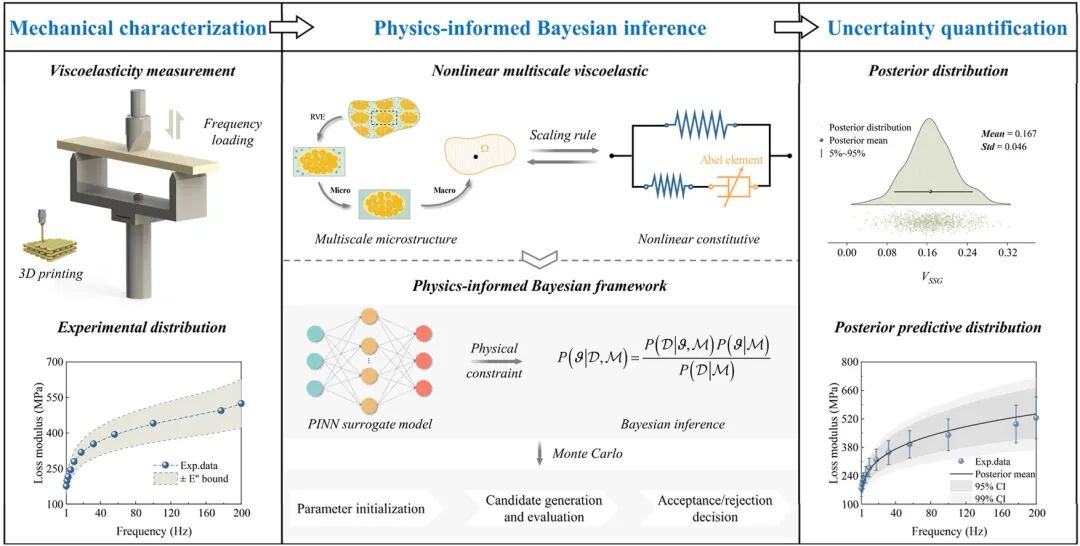
三维打印复合材料频域非线性多尺度粘弹性的物理贝叶斯推断
The nonlinear viscoelasticity of 3D-printed natural-fiber-reinforced composites (NFRCs), coupled with large dispersion in mechanical properties, undermines reliability in safety-critical applications. In this work, we introduce a physics-informed Bayesian framework to calibrate the constitutive parameters of frequency-domain nonlinear multiscale viscoelasticity and quantify their uncertainties. To this end, we develop a multiscale micromechanical model that employs fractional-order differential operators to model the constituents’ nonlinear viscoelasticity and applies two-scale homogenization theory to map constituent mean fields to macroscopic effective properties. We further develop a physics-informed neural network (PINN) surrogate to enable efficient posterior distribution sampling. Integrating this surrogate with Bayesian inference yields a physics-informed Bayesian framework. The Monte Carlo method is then employed to compute the posterior distributions of model parameters and assess their uncertainties, correlations, and calibration errors. Finally, the framework is validated on 3D-printed NFRCs, with posterior predictive distributions of the overall and constitutive responses in agreement with experimental measurements. This physics-informed Bayesian framework enables uncertainty-aware calibration of nonlinear multiscale viscoelasticity in 3D-printed composites, thereby guiding robust manufacturing for consistent mechanical performance.
3d打印天然纤维增强复合材料(NFRCs)的非线性粘弹性,加上机械性能的大分散,破坏了安全关键应用的可靠性。在这项工作中,我们引入了一个物理通知贝叶斯框架来校准频域非线性多尺度粘弹性的本构参数并量化它们的不确定性。为此,我们建立了一个多尺度微观力学模型,该模型采用分数阶微分算子来模拟组分的非线性粘弹性,并应用双尺度均匀化理论将组分的平均场映射到宏观有效性质。我们进一步开发了一个物理信息神经网络(PINN)代理,以实现有效的后验分布抽样。将这个代理与贝叶斯推理相结合,可以得到一个基于物理的贝叶斯框架。然后采用蒙特卡罗方法计算模型参数的后验分布,并评估其不确定性、相关性和校准误差。最后,在3d打印的NFRCs上验证了该框架,总体和本构响应的后验预测分布与实验测量结果一致。这种基于物理的贝叶斯框架能够对3d打印复合材料中的非线性多尺度粘弹性进行不确定性感知校准,从而指导稳定的机械性能制造。
Composites Science and Technology
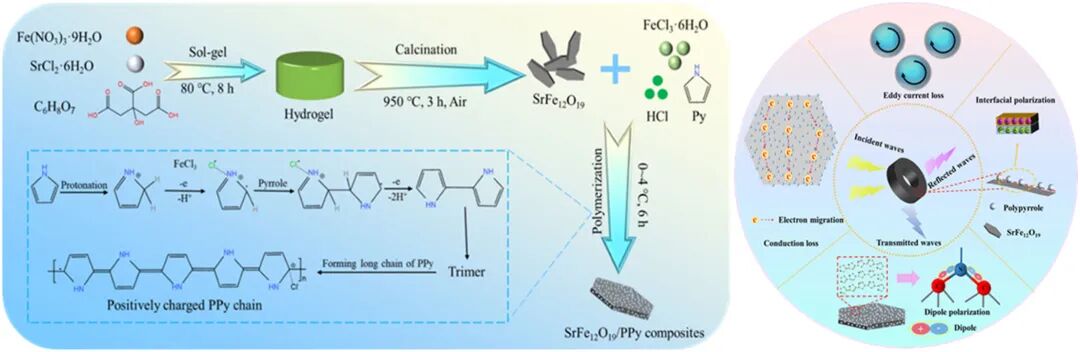
Regulation of conduction loss in strontium ferrite/polypyrrole composites for broadband and high-efficient electromagnetic wave absorption
Dehui Kong, Lijun Liao, Konghu Tian, Ruiwen Shu, Xiangcheng Li
doi:10.1016/j.compscitech.2026.111686
铁氧体锶/聚吡咯复合材料宽带高效电磁波吸收的传导损耗调控
Magnetoelectric synergy and impedance matching are crucial for the development of efficient and wideband electromagnetic wave (EMW) absorbing materials. In this work, strontium ferrite/polypyrrole (SrFe12O19/PPy) composites were successfully prepared by combining the sol-gel and in-situ polymerization method. The relationship between electromagnetic parameters and EMW absorption capacity of SrFe12O19/PPy composites was deeply explored. Introducing PPy into the composite material not only significantly enhanced the dielectric loss capacity, but also achieved ideal impedance matching by optimizing the content of PPy. Significantly, the binary composite with the content of PPy of 41.33 wt.% exhibited the best EMW absorption performance at a low filling ratio of only 16 wt.%. The obtained minimum reflection loss was -49.66 dB with a thickness of 3.5 mm, and the effective absorption bandwidth reached 6.56 GHz at a thickness of 2.37 mm. The a nalysis of the electromagnetic loss mechanis m indicates that their excellent absorption performance was attributed to the synergistic effect of interfacial polarization, conduction loss and magnetic loss. In addition, the results of radar cross section simulation revealed that the SrFe12O19/PPy composite had exceptional radar stealth performance. This work provides a feasible strategy for the development of high-efficiency and wideband EMW absorbing materials.
磁电协同和阻抗匹配是研制高效宽带电磁波吸收材料的关键。本文采用溶胶-凝胶和原位聚合相结合的方法成功制备了铁酸锶/聚吡咯(SrFe12O19/PPy)复合材料。深入探讨了SrFe12O19/PPy复合材料电磁参数与EMW吸收能力的关系。在复合材料中引入聚吡啶,不仅显著提高了材料的介电损耗能力,而且通过优化聚吡啶的含量,实现了理想的阻抗匹配。PPy含量为41.33 wt.%的二元复合材料在填充率仅为16 wt.%时具有最佳的EMW吸收性能。在厚度为3.5 mm时,最小反射损耗为-49.66 dB,在厚度为2.37 mm时,有效吸收带宽达到6.56 GHz。电磁损耗机理分析表明,其优异的吸收性能是界面极化、传导损耗和磁损耗协同作用的结果。雷达截面仿真结果表明,SrFe12O19/PPy复合材料具有优异的雷达隐身性能。本研究为研制高效宽带EMW吸波材料提供了可行的策略。