【新文速递】2026年4月24日复合材料SCI期刊最新文章
今日更新:Composite Structures 1 篇,Composites Part B: Engineering 3 篇,Composites Science and Technology 1 篇
Composite Structures
A comparative study on conventional drilling and ultrasonic vibration-assisted drilling of CF/PEEK
Shiming Liang, Zhenming Zhang, Shunuan Liu, Zhijian Meng, Tiele Tubo, Qi Yang, Bin Luo, Kaifu Zhang
doi:10.1016/j.compstruct.2026.120371
CF/PEEK常规钻井与超声振动辅助钻井的对比研究
While thermoplastic carbon fiber-reinforced polyetheretherketone (CF/PEEK) are gaining prominence in manufacturing high-end aerospace components, their drilling-induced damage remains a challenge. Although ultrasonic vibration-assisted drilling (UVAD) has been explored for thermoplastics, existing studies report conflicting thermal effects and lack comprehensive hole quality assess ment. This paper addresses these gaps by systematically comparing UVAD and conventional drilling (CD) of CF/PEEK. Kinematic an alysis clarifies the fundamental cutting differences between CD and UVAD. Experimental results reveal that the effectiveness of UVAD is highly dependent on spindle speed: at low spindle speeds, the thrust force and drilling temperature in UVAD can be reduced by up to 19.1% and 26.7%, respectively. Crucially, under optimized low-speed parameters, UVAD substantially minimizes hole damage and improves dimensional accuracy compared to CD. This study resolves the apparent contradiction in existing literature by identifying spindle speed as a key determinant of the effect of UVAD. The findings provide direct practical guidance for selecting low-speed UVAD parameters in aerospace manufacturing of CF/PEEK components.
虽然热塑性碳纤维增强聚醚醚酮(CF/PEEK)在制造高端航空航天部件方面越来越突出,但其钻井引起的损伤仍然是一个挑战。虽然超声波振动辅助钻井(UVAD)已经在热塑性塑料中进行了探索,但现有研究报告的热效应相互矛盾,并且缺乏全面的孔质量评估。本文通过系统比较UVAD与CF/PEEK常规钻井(CD)来解决这些差距。运动学分析阐明了CD和UVAD切割的根本区别。实验结果表明,UVAD的有效性与主轴转速密切相关:在主轴转速较低时,UVAD的推力和钻孔温度可分别降低19.1%和26.7%。关键是,在优化的低速参数下,与CD相比,UVAD大大减少了孔损伤,提高了尺寸精度。本研究通过确定主轴转速是UVAD效果的关键决定因素,解决了现有文献中明显的矛盾。研究结果为CF/PEEK部件航空制造中低速UVAD参数的选择提供了直接的实践指导。
Composites Part B: Engineering
Carbon Fiber Thermoset Composites with Architected Thermoplastic Lattice Interlayers: Topology- and Density-Driven Enhancement of Interlaminar and Flexural Properties
Denizhan Yavas, Joanna Feaster, Ethan Javedan, Ricky Miller
doi:10.1016/j.composites b.2026.113717
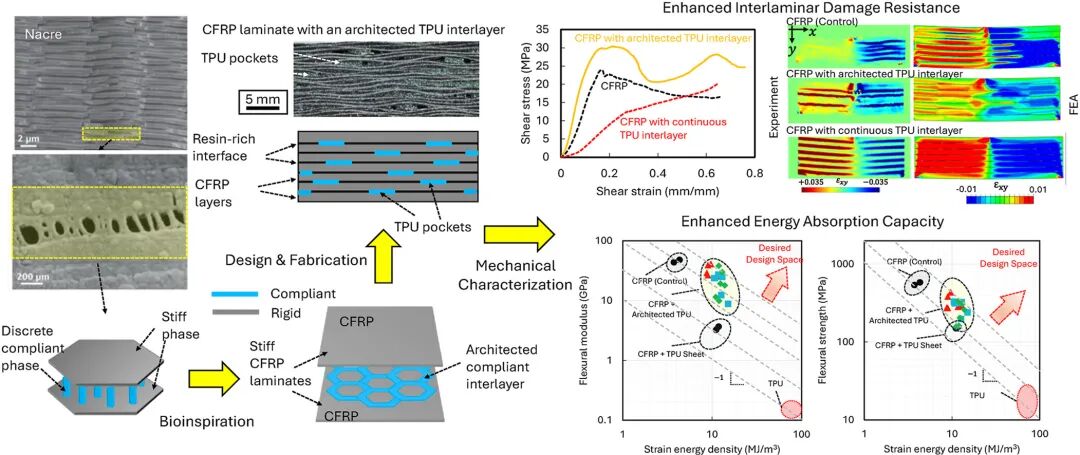
具有结构热塑性晶格层的碳纤维热固性复合材料:层间和弯曲性能的拓扑和密度驱动增强
Introducing compliant interlayers is a widely explored strategy for enhancing the damage tolerance of carbon fiber–reinforced polymer (CFRP) laminates; however, continuous elastomeric layers often severely degrade interlaminar stiffness and strength. Inspired by natural segmented architectures, such as nacre, where discrete compliant domains are embedded within a stiff load-bearing framework, we demonstrate that interlaminar performance is governed not solely by material compliance, but critically by the spatial architecture, topology, and relative density of the interlayer. CFRP laminates incorporating architected thermoplastic polyurethane (TPU) lattice interlayers are fabricated and compared with baseline CFRP and laminates containing continuous TPU sheets. Short-beam shear and flexural tests, complemented by digital image correlation and Ashby-style stiffness–energy design-space mapping, reveal that discretizing the compliant phase into isolated TPU pockets embedded within a predominantly epoxy-controlled interlaminar network preserves nearly the full baseline interlaminar stiffness, while increasing flexural energy absorption by up to fourfold relative to baseline CFRP and twofold relative to continuous TPU interlayers. In contrast to continuous elastomeric layers, architected lattices mitigate the stiffness–toughness trade-off and promote stable, distributed damage mechanis ms. Finite-element simulations employing heterogeneous cohesive interfaces provide mechanistic insight into damage initiation, strain redistribution, and post-initiation stability, reproducing key qualitative experimental trends. These results establish architectural design of the interlaminar region as an effective pathway for enhancing damage tolerance in CFRP laminates without incurring the severe mechanical penalties associated with continuous elastomeric interlayers.
引入柔性夹层是提高碳纤维增强聚合物(CFRP)复合材料损伤容限的一种被广泛探索的策略。然而,连续的弹性体层通常会严重降低层间的刚度和强度。受自然分段结构的启发,如珍珠层,其中离散的柔顺域嵌入在刚性承重框架中,我们证明了层间性能不仅受材料顺应性的支配,而且受空间结构、拓扑结构和层间相对密度的影响。采用结构热塑性聚氨酯(TPU)晶格夹层的CFRP层压板被制造出来,并与基线CFRP和含有连续TPU片的层压板进行比较。短束剪切和弯曲测试,加上数字图像相关和ashby风格的刚度-能量设计-空间映射,表明将柔顺阶段离散到嵌入在主要由环氧树脂控制的层间网络中的孤立TPU袋中,几乎保留了整个基线层间刚度,同时增加了相对于基线CFRP的四倍和相对于连续TPU夹层的两倍的弯曲能量吸收。与连续的弹性体层相比,结构网格减轻了刚度和韧性的权衡,促进了稳定的、分布式的损伤机制。采用异质内聚界面的有限元模拟提供了对损伤起裂、应变再分布和起裂后稳定性的机制洞察,再现了关键的定性实验趋势。这些结果表明,层间区域的建筑设计是提高CFRP层压板损伤容忍度的有效途径,而不会产生与连续弹性体夹层相关的严重机械损伤。
Machining of Continuous Fiber Reinforced Composites: A Comparative Review across Polymer, Ceramic and Metal Matrices
Liyu Wang, Songmei Yuan, Yutao Wang, Sirui Yi, Obaid Muhammad, Qilin Li, Zhen Li
doi:10.1016/j.composites b.2026.113702
连续纤维增强复合材料的加工:聚合物、陶瓷和金属基体的比较综述
Continuous fiber-reinforced composites (CFRCs) have demonstrated significant potential in high-end equipment manufacturing, particularly in aerospace, owing to their superior specific strength and modulus. However, their inherent heterogeneity and strong anisotropy pose severe challenges to precision manufacturing. This paper presents a systematic comparative review of the machinability and material removal mechanis ms of three distinct classes of CFRCs: polymer matrix composites (PMCs), metal matrix composites (MMCs) and ceramic matrix composites (CMCs). The inherent logic and technical advantages underlying the evolution from traditional cutting to non-traditional technologies specifically ultrasonic vibration-assisted machining, laser beam machining and laser-assisted machining are critically an alyzed. Comparative ana lysis reveals that while anisotropy is a universal challenge, the dominant mechanis ms of damage evolution are strictly governed by physical properties of the matrix. PMCs are characterized primarily by interlaminar delamination driven by viscoelastic behavior; CMCs are dominated by brittle fracture of a hard-brittle matrix and MMCs face complex interface failure induced by plastic flow. Traditional machining is constrained by an inherent trade-off between efficiency and quality. In contrast, ultrasonic machining significantly reduces cutting loads via high-frequency intermittent impact; laser beam machining eliminates mechanical contact forces through photothermal ablation, though thermal defects in the heat-affected zone must be managed; and laser-assisted machining leverages thermal softening effects to facilitate material removal. Finally, future perspectives are highlighted, identifying the establishment of cross-scale multi-physics simulation models, the development of novel processes with precise spatiotemporal synergy of multiple energy fields and the construction of digital twin-based adaptive control systems as critical directions for achieving damage-free precision manufacturing.
连续纤维增强复合材料(CFRCs)由于其优越的比强度和模量,在高端设备制造,特别是航空航天领域显示出巨大的潜力。然而,它们固有的非均质性和强各向异性给精密制造带来了严峻的挑战。本文对三种不同类型的碳纤维复合材料:聚合物基复合材料(PMCs)、金属基复合材料(MMCs)和陶瓷基复合材料(CMCs)的可加工性和材料去除机理进行了系统的比较综述。分析了传统加工技术向超声振动辅助加工、激光束加工和激光辅助加工发展的内在逻辑和技术优势。对比分析表明,虽然各向异性是一个普遍的挑战,但损伤演化的主要机制严格受基体物理性质的支配。pmc的主要特征是由粘弹性行为驱动的层间分层;复合材料主要以硬脆基体的脆性断裂为主,并面临塑性流动引起的复杂界面破坏。传统的机械加工受到效率和质量之间内在权衡的限制。相比之下,超声波加工通过高频间歇冲击显著降低了切削载荷;激光束加工通过光热烧蚀消除了机械接触力,但必须控制热影响区的热缺陷;激光辅助加工利用热软化效应来促进材料的去除。最后,展望了未来的发展方向,指出建立跨尺度的多物理场仿真模型、开发具有多能量场精确时空协同作用的新工艺以及构建基于数字孪生的自适应控制系统是实现无损伤精密制造的关键方向。
Exploring Nanoscale organic piezoelectric coatings for in -situ Non Destructive Structural Health Monitoring of carbon fibre reinforced Composites
Clotilde Techoueyres, Valeria Nico, Akshay Hejjaji, Anne Beaucamp, Maurice N. Collins
doi:10.1016/j.composites b.2026.113700
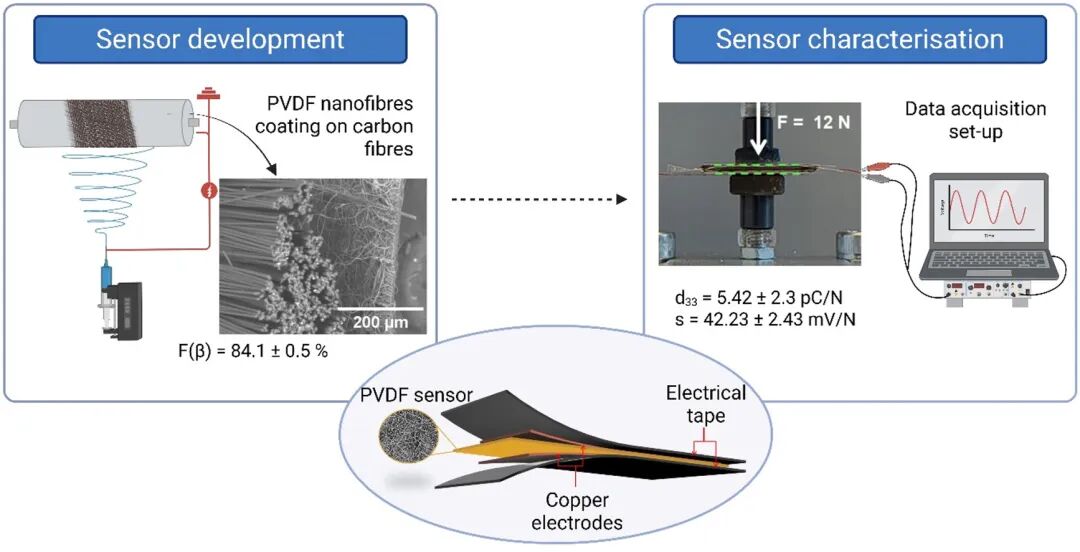
纳米级有机压电涂层用于碳纤维增强复合材料原位无损结构健康监测的研究
This study develops the integration of piezoelectric sensors into carbon fibre reinforced polymers (CFRPs) for non-destructive health monitoring. A uniform, continuous coating of Poly(vinylidene fluoride) (PVDF) nanofibres was applied directly onto the surface of carbon fibres (CF) via electrospinning, creating fully embedded, flexible, and lightweight piezoelectric sensors. Careful optimisation of the crystalline structure of PVDF leads to high piezoelectric performance for sensing with a β-phase content of 84.1 ± 0.5% and a piezoelectric coefficient d33 of 5.42 ± 2.3 pC/N, representing the highest piezoelectric performance for sensing displaying 90 times more sensitivity than the previous state-of-the-art of voltage response for organic sensors. Single-step production via the electrospinning process ensures strong adhesion and conformal coverage of the CF without the need for post-processing allowing direct integration into CF for ease of optimisation of sensor fabrication. While a reliable and repeatable data acquisition system was established to characterise the sensor performance under mechanical loading. The piezoelectric coating studied reacts to dynamic mechanical stimuli, producing pulsed signals. Although this limits direct measurement of static forces, the impulsive responses reliably indicate dynamic mechanical events and relative force magnitudes. Finally, the PVDF-based sensors were successfully embedded within CFRP laminates and subjected to mechanical testing for up to three months. This work introduces an optimised integration strategy for real-time structural health monitoring (SHM) applications. These advances represent a new benchmark for real-time, non-destructive SHM of advanced composites.
本研究将压电传感器集成到碳纤维增强聚合物(CFRPs)中,用于非破坏性健康监测。通过静电纺丝将聚偏氟乙烯(PVDF)纳米纤维的均匀连续涂层直接涂在碳纤维(CF)表面,创造出完全嵌入的、柔性的、轻质的压电传感器。通过对PVDF晶体结构的精心优化,其β相含量为84.1±0.5%,压电系数d33为5.42±2.3 pC/N,具有最高的压电传感性能,灵敏度比以前最先进的有机传感器高90倍。通过静电纺丝工艺的单步生产确保了CF的强附着力和保形覆盖,而不需要后处理,允许直接集成到CF中,以便于优化传感器制造。同时建立了可靠且可重复的数据采集系统来表征传感器在机械载荷下的性能。所研究的压电涂层对动态机械刺 激产生反应,产生脉冲信号。虽然这限制了静力的直接测量,但脉冲响应可靠地表明动态机械事件和相对力的大小。最后,基于pvdf的传感器成功嵌入CFRP层压板中,并进行了长达三个月的机械测试。本工作介绍了一种优化的实时结构健康监测(SHM)应用集成策略。这些进步代表了先进复合材料的实时、非破坏性SHM的新基准。
Composites Science and Technology
Physics-informed active learning for the design of thermally conductive composite microstructures with controlled anisotropy
Massimiliano Zamengo, Stephen Wu, Ryo Yoshida, Junko Morikawa
doi:10.1016/j.compscitech.2026.111668
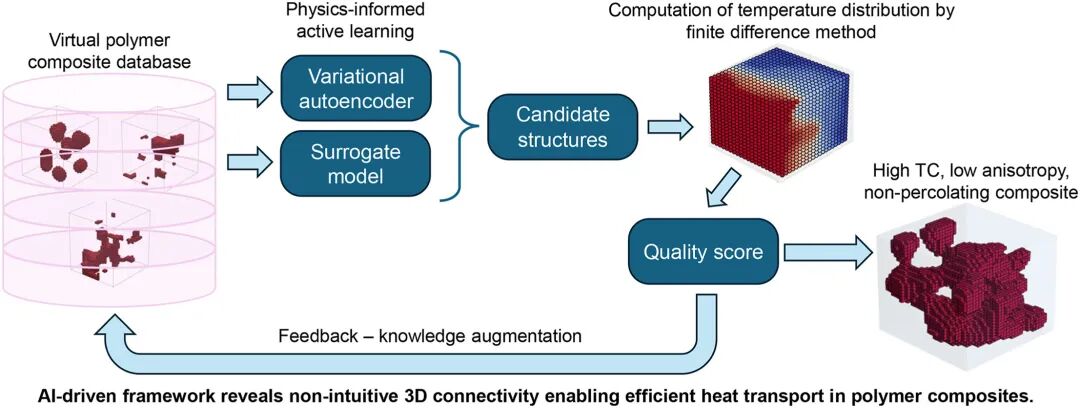
具有控制各向异性的导热复合材料微结构设计的物理信息主动学习
The increasing power density of modern electronic devices demands advanced thermal interface materials (TIMs) with improved heat dissipation. Conventional material discovery approaches, based on extensive experiments or computationally intensive simulations, struggle to efficiently explore the vast design space of polymer-filler composites. This work presents an active learning framework for the accelerated discovery of thermally conductive composites with controlled thermal anisotropy and percolation behavior. The framework integrates a conditional variational autoencoder for generative modeling of 3D voxelized microstructures, a physics-informed finite-difference solver to evaluate anisotropic thermal conductivity along three orthogonal directions, and an ensemble surrogate model for rapid property prediction with uncertainty estimation. An adaptive candidate selection strategy balances exploration and exploitation, guiding the search toward high-performance and previously unexplored regions of the design space while preserving structural diversity. Iterative refinement of the training dataset enables the identification of novel non-percolating microstructures exhibiting enhanced thermal conductivity and low anisotropy, reaching mean conductivities of approximately 1.4 W m-1K-1. The proposed methodology provides a scalable protocol for the data-driven design of composite materials with tailored thermal transport properties and offers a systematic pathway for TIM development.
现代电子器件的功率密度不断增加,需要具有更好散热性能的先进热界面材料(TIMs)。传统的材料发现方法,基于大量的实验或计算密集的模拟,难以有效地探索聚合物填充复合材料的广阔设计空间。这项工作为加速发现具有控制热各向异性和渗透行为的导热复合材料提供了一个主动学习框架。该框架集成了用于三维体素化微结构生成建模的条件变分自编码器,用于沿三个正交方向评估各向异性导热系数的物理信息有限差分求解器,以及用于具有不确定性估计的快速属性预测的集成代理模型。适应性候选选择策略平衡了探索和开发,在保持结构多样性的同时,引导搜索到高性能和以前未探索的设计空间区域。对训练数据集进行迭代细化,可以识别出具有增强导热性和低各向异性的新型非渗透微结构,平均电导率约为1.4 W m-1K-1。所提出的方法为具有定制热输运特性的复合材料的数据驱动设计提供了可扩展的协议,并为TIM的开发提供了系统的途径。