【新文速递】2026年4月23日固体力学SCI期刊最新文章

今日更新:International Journal of Solids and Structures 4 篇,Journal of the Mechanics and Physics of Solids 2 篇,Mechanics of Materials 4 篇,International Journal of Plasticity 2 篇
International Journal of Solids and Structures
Constitutive modeling of rubber-like materials based on insights from molecular dynamics simulations
Zhigang Wei, Hao Wu, Zelin Zhang, Chengxiang Zheng, Danming Zhong, Shaoxing Qu
doi:10.1016/j.ijsolstr.2026.114029
基于分子动力学模拟的橡胶类材料的本构建模
A major challenge in developing accurate and reliable constitutive models for soft materials is understanding and characterizing the relationship between microstructure and macroscopic mechanical behavior. In this work, coarse-grained molecular dynamics simulations of natural rubber are performed to investigate this relationship. The affine model is critically examined, the fluctuation range of molecular chains is quantified using the envelope surface of molecular trajectories, and the shape and characteristics of force trans mission along the primitive paths are an alyzed using the average trajectories of each chain. Three key insights have been obtained: (1) many crosslinking constraints in equilibrium states can be effectively regarded as entanglement constraints; (2) Although individual chain strands deviate significantly from affine deformation, there are longer chain paths under nearly uniform force that are appropriately described by the affine model; and (3) the fluctuation range of molecular chains remains nearly constant during deformation. Based on these findings, a novel curved affine tube model is proposed to describe the mechanical response between two macroscopic points in such materials. The constitutive model in terms of stretch ratios is an alyzed, leading to the formulation of two new elastic models. Validation against experimental data demonstrates that both models exhibit high accuracy and reliability. This study provides a deeper understanding and a corresponding expression of the correlation between elasticity and microstructure in soft materials, offering valuable guidance for the design of high-performance materials.
开发准确可靠的软质材料本构模型的主要挑战是理解和表征微观结构与宏观力学行为之间的关系。在这项工作中,进行了天然橡胶的粗粒度分子动力学模拟来研究这种关系。对仿射模型进行了严格的检验,利用分子轨迹的包络面量化了分子链的波动范围,并利用每条链的平均轨迹分析了沿原始路径的力传递形状和特征。本文获得了三个关键的见解:(1)平衡态的许多交联约束可以有效地视为纠缠约束;(2)尽管单个链链明显偏离仿射变形,但在几乎均匀的力作用下,存在更长的链径,这可以用仿射模型适当地描述;(3)变形过程中分子链的波动范围基本保持恒定。基于这些发现,提出了一种新的弯曲仿射管模型来描述这种材料中两个宏观点之间的力学响应。分析了基于拉伸比的本构模型,建立了两种新的弹性模型。实验数据验证表明,两种模型均具有较高的准确性和可靠性。本研究对软质材料的弹性与微观结构之间的关系有了更深入的理解和相应的表达,对高性能材料的设计具有重要的指导意义。
Intrinsic interfacial shear characterization of tangential cohesive Interface: fully coupled shear-lag modeling and universal PINN inversion strategy
Yafei Yin, Jin Gu, Yuan Lin
doi:10.1016/j.ijsolstr.2026.114028
切向黏结界面的本征界面剪切特性:全耦合剪切滞后建模和通用PINN反演策略
Interfacial shear transfer at the tangential cohesive interfaces between thin films and soft substrates critically determines the mechanical performance of layered systems. Classic cohesive zone models (CZMs)—characterized by parameters such as shear strength, stiffness, and fracture energy—govern critical phenomena including interfacial debonding, fatigue resistance, and strain transfer. Conventional shear-lag-based characterization methods typically assume uniform substrate strain equal to the far-field loading, neglecting bidirectional coupling at the interface that becomes particularly significant in systems involving compliant or finite-thickness substrates. Moreover, most existing studies predefine a specific CZM form—typically bilinear, despite the fact that actual traction–separation behavior is often unknown, highly nonlinear, and varies across material systems. This lack of generality poses a significant challenge for accurate and flexible interfacial characterization. To address these limitations, a fully coupled two-dimensional (2D) shear-lag model is developed by incorporating bidirectional shear transfer across the interface, which improves strain prediction accuracy and enables clear separation of intrinsic interface properties from substrate effects during parameter inversion, outperforming conventional sequential coupling methods. Furthermore, in the absence of closed-form solutions, a physics-informed neural network (PINN) framework is constructed to facilitate robust inversion of intrinsic interfacial shear properties from strain measurements. Additionally, a piecewise-linear strategy is proposed for flexible reconstruction of arbitrary CZM responses without prior specification of their functional forms. This framework integrates physical modeling and data-driven inference into a scalable approach for intrinsic interfacial shear characterization, providing a unified tool for interfacial mechanics an alysis in thin film/substrate systems.
薄膜与软基之间切向黏结界面处的界面剪切传递对层状体系的力学性能起着至关重要的作用。经典的黏结区模型(CZMs)——以剪切强度、刚度和断裂能等参数为特征——控制着界面脱粘、抗疲劳和应变传递等关键现象。传统的基于剪切滞后的表征方法通常假设均匀的衬底应变等于远场载荷,忽略了界面上的双向耦合,这在涉及柔性或有限厚度衬底的系统中尤为重要。此外,大多数现有研究都预先定义了特定的CZM形式——通常是双线性的,尽管实际的牵引-分离行为通常是未知的,高度非线性的,并且在不同的材料系统中是不同的。这种通用性的缺乏对准确和灵活的界面表征提出了重大挑战。为了解决这些限制,研究人员开发了一个完全耦合的二维(2D)剪切滞后模型,该模型通过结合界面上的双向剪切传递,提高了应变预测的准确性,并在参数反演过程中能够将界面固有特性与基质效应清晰分离,优于传统的顺序耦合方法。此外,在没有封闭解的情况下,构建了一个物理信息神经网络(PINN)框架,以促进从应变测量中获得固有界面剪切特性的鲁棒反演。此外,提出了一种分段线性策略,用于任意CZM响应的柔性重建,而无需事先指定其函数形式。该框架将物理建模和数据驱动推理集成到固有界面剪切表征的可扩展方法中,为薄膜/衬底系统中的界面力学分析提供了统一的工具。
Line-based 4D-printed thermoplastics enabled by layerwise printing speed control: Concept, mechanics, and inverse design
Hong-Xin Lu, Jing-Zhong Tong, Jiajia Shen
doi:10.1016/j.ijsolstr.2026.114013
通过分层打印速度控制实现基于线的4d打印热塑性塑料:概念,力学和逆设计
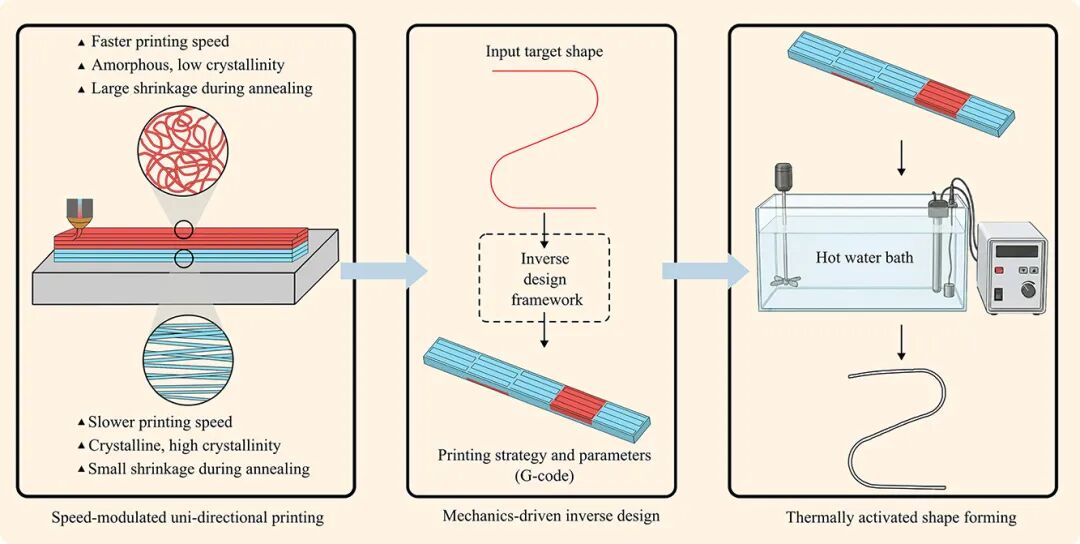
Thermally induced shrinkage in fused deposition modelling (FDM) of semi-crystalline thermoplastics is conventionally regarded as a manufacturing defect that compromises dimensional accuracy. In this work, we demonstrate that printing-induced shrinkage can instead be deliberately harnessed as a programmable design variable for deterministic shape forming. A co-directional, single-material printing strategy is proposed in which layerwise modulation of printing speed is used to control crystallinity development and, consequently, through-thickness shrinkage gradients. Upon thermal activation, these gradients generate predictable bending moments that transform initially straight, planar line elements into prescribed three-dimensional geometries. A systematic experimental programme is conducted to establish quantitative process–structure–property relationships linking printing speed, shrinkage strain, and resulting curvature. Building on this database, a reduced-order an alytical model based on multi-layer beam theory is developed to predict the thermally activated deformation of isolated line elements and is validated through finite element simulations and experiments. Using this forward model, a mechanics-guided inverse design framework is formulated to map target geometries directly to layerwise printing speed distributions, enabling automated generation of manufacturing-ready process parameters. When extending the approach to continuous architectures fabricated via uninterrupted filament deposition, non-local thermal interactions are identified, leading to systematic curvature under-actuation and deviation from isolated-element predictions. To address this limitation, an iterative geometric calibration strategy is introduced and integrated into the inverse design workflow, enabling high-fidelity reconstruction of complex shapes. The framework is validated experimentally through a series of demonstrations, including alphabetical and non-trivial planar geometries. Overall, this study establishes layerwise crystallinity control via printing speed modulation as a manufacturing-compatible route for programmable shape forming in thermoplastic additive manufacturing, offering a scalable alternative to multi-material printing and complex toolpath anisotropy for 4D-printed structures.
在半结晶热塑性塑料的熔融沉积建模(FDM)中,热致收缩通常被认为是一个影响尺寸精度的制造缺陷。在这项工作中,我们证明了印刷引起的收缩可以被故意地利用为确定性形状形成的可编程设计变量。提出了一种共向、单材料印刷策略,其中采用分层调制印刷速度来控制结晶度的发展,从而控制整个厚度的收缩梯度。在热激活后,这些梯度产生可预测的弯矩,将最初的直线平面线元素转变为规定的三维几何形状。进行了系统的实验程序,以建立定量的工艺-结构-性能关系,将印刷速度、收缩应变和产生的曲率联系起来。在此基础上,建立了基于多层梁理论的降阶分析模型,用于预测孤立线元的热激活变形,并通过有限元仿真和实验进行了验证。利用该正向模型,制定了一个力学指导的逆设计框架,将目标几何形状直接映射到分层印刷速度分布,从而实现制造就绪工艺参数的自动生成。当将该方法扩展到通过不间断的长丝沉积制造的连续结构时,发现了非局部热相互作用,导致系统曲率驱动不足和与隔离元件预测的偏差。为了解决这一限制,引入了迭代几何校准策略并将其集成到逆设计工作流中,从而实现了复杂形状的高保真重建。通过一系列的实验验证了该框架,包括字母和非平凡平面几何。总体而言,本研究通过打印速度调节建立了分层结晶度控制,作为热塑性增材制造中可编程形状成形的制造兼容路线,为多材料打印和4d打印结构的复杂刀具轨迹各向异性提供了可扩展的替代方案。
Homogenized anisotropic micromechanical modeling and cyclic mechanical response of fiber network flexible composites
Yifeng Dong, Zhiqiang Meng, Jinliang Du, Chao Yu, Kaijuan Chen, Yingchao Zhang, Junyu Chen, Ying Li
doi:10.1016/j.ijsolstr.2026.114021
纤维网络柔性复合材料均质各向异性细观力学建模及循环力学响应
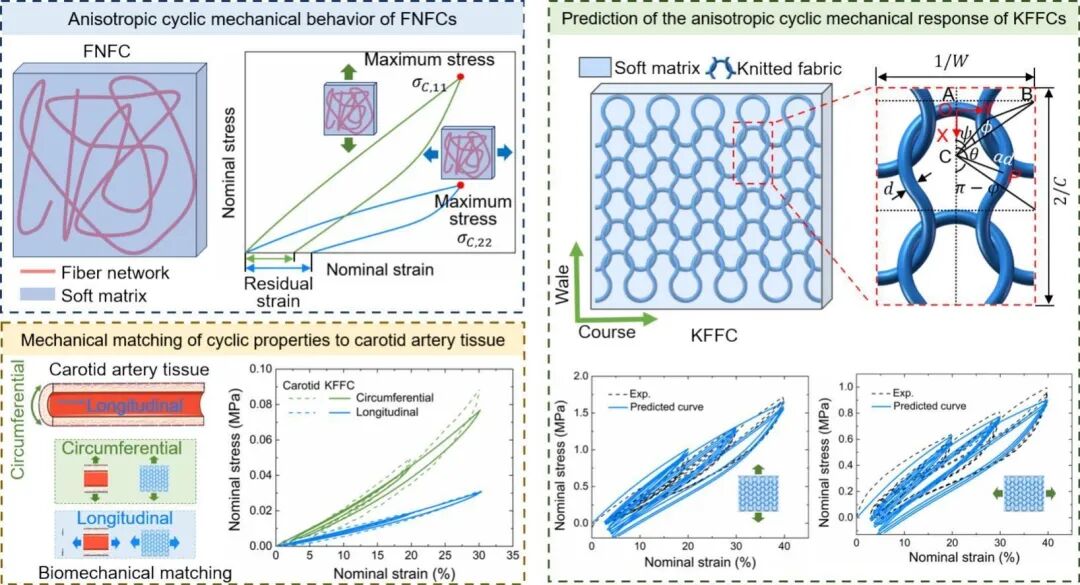
Fiber networks are widely used in soft-tissue repair owing to their excellent flexibility, breathability, moisture permeability, and structural versatility. During wound healing, they integrate with native tissue to form fiber network flexible composites (FNFCs), whose anisotropic cyclic stress softening and residual deformation critically influence therapeutic outcomes. However, previous studies have primarily focused on the theoretical models of flexible composites with simple fiber architectures, which are inadequate for capturing the cyclic mechanical behavior of FNFCs with highly complex mesostructures and hyper-visco-pseudoelastic properties. To address this limitation, we develop a homogenized anisotropic micromechanical model that couples a hyper-visco-pseudoelastic constitutive law for the soft matrix with a micromechanical homogenization framework, and implement it numerically. The model accurately predicts stress softening, residual deformation, and anisotropic responses during cyclic loading–unloading, and its validity is confirmed through cyclic experiments on knitted fabric flexible composites (KFFCs). By optimizing the knitted fabric architecture, we further demonstrate that the cyclic stress–strain responses of KFFCs can be closely matched to those of carotid artery tissue in both longitudinal and circumferential directions. Moreover, the model elucidates the governing role of helical fiber geometry in the cyclic mechanical behavior of FNFCs, identifying fiber crimp as a key parameter that controls reinforcement efficiency, stress softening, and residual deformation. These findings highlight the novelty and effectiveness of the proposed model and demonstrate its potential as a design tool for tailoring the biomechanical properties of fiber networks to improve soft-tissue repair
纤维网络因其优异的柔韧性、透气性、透湿性和结构通用性而广泛应用于软组织修复。在伤口愈合过程中,它们与原生组织结合形成纤维网络柔性复合材料(fnfc),其各向异性循环应力软化和残余变形严重影响治疗效果。然而,以往的研究主要集中在具有简单纤维结构的柔性复合材料的理论模型上,这些模型不足以捕捉具有高度复杂细观结构和超粘伪弹性性能的fnfc的循环力学行为。为了解决这一限制,我们开发了一种均质各向异性微力学模型,该模型将软基体的超粘-伪弹性本构律与微力学均质框架耦合在一起,并在数值上实现了它。该模型准确预测了循环加载-卸载过程中的应力软化、残余变形和各向异性响应,并通过针织物柔性复合材料(KFFCs)的循环试验验证了该模型的有效性。通过优化织物结构,我们进一步证明了KFFCs的循环应力应变响应在纵向和周向上与颈动脉组织的循环应力应变响应非常接近。此外,该模型阐明了螺旋纤维几何形状对fnfc循环力学行为的控制作用,并确定纤维卷曲是控制增强效率、应力软化和残余变形的关键参数。这些发现突出了所提出模型的新颖性和有效性,并展示了其作为定制纤维网络生物力学特性以改善软组织修复的设计工具的潜力
Journal of the Mechanics and Physics of Solids
Normal contact of metainterfaces: the roles of finite size and microcontact interactions
Donald Zeka, Nawfal Blal, Fatima-Ezzahra Fekak, Arnaud Duval, Anthony Gravouil, Julien Scheibert
doi:10.1016/j.jmps.2026.106646
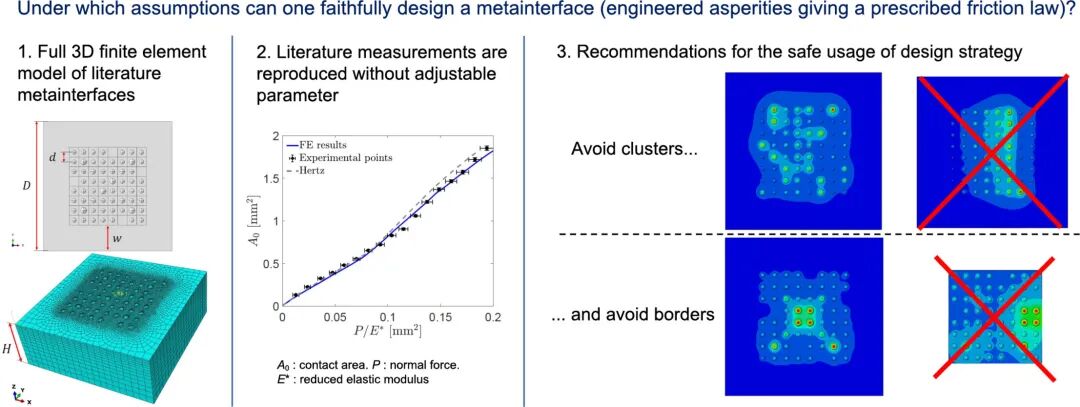
元界面的法向接触:有限尺寸和微接触相互作用的作用
The design of contact interfaces that meet quantitatively a specified friction law (friction force vs normal force) is challenging due to the multi-scale and multi-physics nature of contact interactions. Recently, a concept was proposed to address this question in the case of dry elastic microarchitected contact interfaces, so-called metainterfaces. These take their macroscopic friction properties from an array of discrete asperities whose geometrical descriptors are optimized through an inverse design phase. Such design is based on the experimentally-observed proportionality between friction force and real contact area under pure compression, reducing the friction problem to a simpler contact mechanics problem of designing the contact area. In this context, the design strategy assumes that asperities are placed on a linear elastic half-space and behave independently from each other. Both assumptions are likely to fail in experimental realizations of metainterfaces, potentially inducing discrepancies between the actual and target behaviours. Here, we use full 3D finite element modelling to critically assess the validity of those two assumptions in existing experimental metainterfaces, and their potential impact on the design quality. The results first confirm the validity of the strategy, in the conditions in which it was used in the literature. Then, by systematically varying the spatial arrangement of asperities, their interdistance and the size of their elastic base, we identify conditions under which the literature assumptions fail. Our findings provide critical insights into the robustness and practical limitations of the metainterface design strategy and guidelines for its future improvements.
由于接触相互作用的多尺度和多物理性质,满足定量指定摩擦定律(摩擦力与法向力)的接触界面设计具有挑战性。最近,提出了一个概念来解决干弹性微结构接触接口(所谓的元接口)的这个问题。这些材料的宏观摩擦特性来自一系列离散的凹凸不平,这些凹凸不平的几何描述符通过逆向设计阶段进行了优化。这种设计基于实验观察到的纯压缩条件下摩擦力与实际接触面积的比例关系,将摩擦问题简化为设计接触面积的简单接触力学问题。在这种情况下,设计策略假设凸起放置在线性弹性半空间上,并且相互独立。这两种假设都可能在元接口的实验实现中失败,可能导致实际行为和目标行为之间的差异。在这里,我们使用全三维有限元建模来严格评估这两个假设在现有实验元界面中的有效性,以及它们对设计质量的潜在影响。结果首先证实了该策略在文献中使用的条件下的有效性。然后,通过系统地改变凸起的空间排列,它们的间距和它们的弹性基底的大小,我们确定了文献假设失败的条件。我们的发现对元接口设计策略的健壮性和实际限制提供了重要的见解,并为其未来的改进提供了指导。
Design of a specimen to train path-dependent deep learning material models from a single uniaxial test: eliciting strain diversity via automatically differentiable elastoplastic topology optimization
Shunyu Yin, Bernardo P. Ferreira, Gaweł Kuś, Miguel A. Bessa
doi:10.1016/j.jmps.2026.106631
从单个单轴试验中训练路径相关深度学习材料模型的试样设计:通过自动可微弹塑性拓扑优化引发应变多样性
Artificial neural networks accurately learn nonlinear, path-dependent material behavior. However, training them typically requires large, diverse datasets, often created via synthetic unit cell simulations. This hinders practical adoption because physical experiments on standardized specimens with simple geometries fail to generate sufficiently diverse stress–strain trajectories. Consequently, an unreasonably large number of experiments or complex multi-axial tests would be needed. This work shows that such networks can be trained from a single specimen subjected to simple uniaxial loading, by designing the specimen using a novel automatically differentiable elastoplastic topology optimization method. Our strategy diversifies the stress–strain states observed in a single test involving plastic deformation. We then employ the automatically differentiable model updating (ADiMU) method to train the neural network surrogates. This work demonstrates that topology-optimized specimens under simple loading can train large neural networks, thereby substantially reducing the experimental burden associated with data-driven material modeling.
人工神经网络精确地学习非线性、路径依赖的材料行为。然而,训练它们通常需要大量不同的数据集,这些数据集通常是通过合成单元模拟创建的。这阻碍了实际应用,因为在具有简单几何形状的标准化标本上进行的物理实验无法产生足够多样化的应力-应变轨迹。因此,需要大量的实验或复杂的多轴试验。这项工作表明,通过使用一种新颖的自动可微弹塑性拓扑优化方法设计试件,可以从单个试件进行简单的单轴加载来训练这种网络。我们的策略多样化的应力-应变状态观察在一个单一的测试涉及塑性变形。然后,我们使用自动可微模型更新(ADiMU)方法来训练神经网络代理。这项工作表明,简单加载下的拓扑优化试样可以训练大型神经网络,从而大大减少与数据驱动材料建模相关的实验负担。
Mechanics of Materials
Formulation of a Micromechanical-Based Continuum Damage Model for Viscoelastic Fractured Materials Regarded as Anisotropic Homogenized Media
Cássio Barros de Aguiar, Samir Maghous
doi:10.1016/j.mechmat.2026.105706
各向异性均质介质粘弹性断裂材料的微力学连续损伤模型的建立
This paper presents the formulation of a progressive continuum damage model for microfractured viscoelastic materials based on micromechanical reasoning and macroscopic thermodynamic arguments. Fractures are treated in the modeling as interfaces with specific behavior under normal and shear loading. By making use of the elastic-viscoelastic correspondence principle together with a Mori-Tanka homogenization scheme, the overall viscoelastic properties are first evaluated under non-propagating fracture conditions. In the upscaling process, fracture density is viewed as the damage parameter at the macroscale. The second step of the modeling is the formulation at the macroscopic scale of an energy-based criterion for damage propagation in the homogenized viscoelastic medium. The macroscopic energy release rate stands for the thermodynamic force associated with damage evolution. A simplified framework is then set up to develop a nonlinear model for continuous damage propagation in fractured viscoelastic materials, including the rate-state equation and complementary equations governing the evolution of stresses, strains, and damage parameter in the homogenized medium. The accuracy of the nonlinear viscoelastic damage formulation is assessed through comparison of the model predictions with available experimental data, providing preliminary validation of the modeling in both anisotropic elastic and viscous contexts.
基于微观力学推理和宏观热力学论证,建立了微断裂粘弹性材料的渐进连续损伤模型。在模型中,裂缝被视为在法向和剪切载荷下具有特定行为的界面。利用弹性-粘弹性对应原理和Mori-Tanka均匀化格式,首先对非扩展断裂条件下的整体粘弹性特性进行了评估。在放大过程中,断裂密度被视为宏观尺度上的损伤参数。建模的第二步是在宏观尺度上建立均匀粘弹性介质中损伤传播的能量准则。宏观能量释放率代表与损伤演化相关的热力学力。然后建立了一个简化框架,建立了断裂粘弹性材料中连续损伤传播的非线性模型,包括速率状态方程和控制均匀介质中应力、应变和损伤参数演化的互补方程。通过将模型预测与现有实验数据进行比较,评估了非线性粘弹性损伤公式的准确性,为各向异性弹性和粘性环境下的建模提供了初步验证。
Size dependence of homogenized monotonic and cyclic responses and extreme-value fatigue indicators in polycrystalline microstructures
Anik Das Anto, Stephanie TerMaath, Reza Abedi
doi:10.1016/j.mechmat.2026.105698
多晶组织中均匀单调循环响应和极值疲劳指标的尺寸依赖性
We investigate the size dependence of elastic, monotonic plastic, and cyclic quantities of interest (QoIs) in austenitic stainless steel using a rate-dependent crystal plasticity finite element model. For Low Cycle Fatigue and High Cycle Fatigue, we consider both homogenized and extreme value QoIs. Using a coefficient-of-variation-based convergence criterion for the response of Statistical Volume Elements (SVEs), homogenized QoIs exhibit a clear hierarchy in Representative Volume Element (RVE) size, ranging from 0.08 mm for elastic stiffness to 0.27 - 0.325 mm for monotonic QoIs and up to 0.9 mm for cyclic QoIs. In contrast, extreme-value QoIs based on maximum Fatigue Indicator Parameters (FIPs), including Fatemi–Socie and a plastic energy-based measure, show significantly stronger size dependence, with RVE sizes reaching 10–100 mm due to the dominance of localized hotspots in fatigue crack nucleation. Such extreme RVE sizes necessitate the use of a probabilistic multiscale approach. The maximum FIPs follow a Gumbel extreme-value distribution, with the location parameter scaling linearly with the logarithm of SVE volume. While this trend is consistent with an alytical upscaling approaches, deviations are observed, including over-conservative predictions and nonphysical assumptions of constant variance. To address this, we propose a minimum statistical RVE (MSRVE), defined as the s mallest SVE size whose statistics can be reliably used to upscale the FIP distributions to larger volumes. This provides a computationally efficient and physically meaningful alternative to conventional RVE requirements. Overall, the results establish a unified framework for property-specific RVE identification and more reliable multiscale modeling of fatigue.
我们使用速率相关的晶体塑性有限元模型研究了奥氏体不锈钢中弹性、单调塑性和循环兴趣量(qoi)的尺寸依赖性。对于低周疲劳和高周疲劳,我们同时考虑均匀化和极值qoi。使用基于变异系数的收敛准则对统计体积元(SVEs)的响应进行分析,均质质量指标在代表性体积元(RVE)尺寸上表现出明显的层次结构,范围从弹性刚度的0.08 mm到单调质量指标的0.27 - 0.325 mm,再到循环质量指标的0.9 mm。相比之下,基于最大疲劳指标参数(FIPs)的极值qi(包括Fatemi-Socie和基于塑性能量的测量)显示出更强的尺寸依赖性,由于疲劳裂纹成核的局部热点占主导地位,RVE尺寸达到10-100 mm。如此极端的RVE大小需要使用概率多尺度方法。最大FIPs服从Gumbel极值分布,位置参数与SVE体积的对数呈线性关系。虽然这一趋势与分析升级方法一致,但也观察到偏差,包括过度保守的预测和恒定方差的非物理假设。为了解决这个问题,我们提出了最小统计RVE (MSRVE),定义为最小的SVE大小,其统计信息可以可靠地用于将FIP分布升级到更大的容量。这为传统RVE需求提供了一种计算效率高、物理上有意义的替代方案。总体而言,研究结果为特定性能的RVE识别和更可靠的多尺度疲劳建模建立了统一的框架。
Neural network-assisted sensitivity a nalysis applied to finite-element simulations of plant-fiber microdroplet tests
Valentin Senk, Markus Königs berger, Sebastian Pech, Josef Füssl
doi:10.1016/j.mechmat.2026.105689
神经网络辅助灵敏度分析在植物纤维微滴试验有限元模拟中的应用
Microdroplet tests are widely used for interface characterization in fiber-reinforced composites. However, their interpretation remains challenging due to complex, non-uniform stress states and the interplay of multiple geometric and mechanical factors. These challenges are further amplified in biocomposites, where natural fibers introduce additional variability in shape, orientation, and adhesion quality. This study presents a surrogate-based methodology to systematically quantify these sensitivities. A fully parameterized finite element model captures the geometric and interfacial complexities of natural fiber microdroplet tests. To efficiently explore parameter dependencies, a surrogate model based on artificial neural networks (ANNs) is trained on a comprehensive dataset of finite element simulations. Sensitivity an alyses reveal strong effects of geometrical variability and mixed-mode behavior, questioning the validity of the commonly used scalar strength metric—interfacial shear strength (IFSS). By leveraging first- and second-order sensitivity an alyses, we demonstrate how non-linear parameter interactions shape the macroscopic stress–displacement curves. These findings open up the possibility of using the surrogate model for inverse identification of interfacial parameters for use in composite-scale models, reducing reliance on repeated finite element simulations that often accompany interface characterization experiments.
微滴试验被广泛用于纤维增强复合材料的界面表征。然而,由于复杂、不均匀的应力状态以及多种几何和机械因素的相互作用,它们的解释仍然具有挑战性。这些挑战在生物复合材料中被进一步放大,在生物复合材料中,天然纤维在形状、方向和粘附质量方面引入了额外的可变性。本研究提出了一种基于代理的方法来系统地量化这些敏感性。一个完全参数化的有限元模型捕捉了天然纤维微滴测试的几何和界面复杂性。为了有效地探索参数依赖关系,基于人工神经网络(ann)的代理模型在有限元模拟的综合数据集上进行了训练。敏感性分析揭示了几何变异性和混合模式行为的强烈影响,质疑了常用的标量强度度量-界面剪切强度(IFSS)的有效性。通过利用一阶和二阶敏感性分析,我们展示了非线性参数相互作用如何塑造宏观应力-位移曲线。这些发现开辟了使用替代模型进行界面参数逆识别的可能性,用于复合尺度模型,减少了对界面表征实验中经常伴随的重复有限元模拟的依赖。
Thermo-mechanical effects of binder–crystal interfacial damage on localized heating in polymer-bonded explosives under high velocity impact
Georgios Barkoulis Gavris, WaiChing Sun
doi:10.1016/j.mechmat.2026.105700
高速冲击下粘结剂-晶体界面损伤对聚合物粘结炸药局部加热的热力学影响
The initiation and growth of explosions in Polymer-bonded explosives (PBX) is driven by energy localization, known as hotspots. Understanding the mechanis ms underlying hot-spot formation is crucial to ensuring the safe transportation and deployment of the PBX. The formation of hotspots is triggered by a complex thermo-chemo-mechanical coupling mechanis m, in which microstructural attributes, such as defects and voids in crystals and at the crystal-binder interface, may affect how shock propagates in response to external stimuli, leading to rapid heating in localized regions. In this work, we employ a numerical model to investigate how a damaged interface between the HMX crystal and binder may affect the formation of hotspots during shock loading. As such, we introduce a thermo-mechanical cohesive zone model with frictional contact for the HMX-crystal-Estane binder interface and couple it with an MPM solver specialized for capturing the extremely large deformation that occurred locally near the hotspots. With finite-strain non-Schmidt crystal plasticity for the HMX crystal and a viscoelastic model derived from Ogden elasticity for the polymer, the interactions among different mechanis ms that generate heat are numerically reproduced. Reverse-ballistic simulations at high impact velocities indicate that the frictional heating of the polymer-crystal grain boundary may induce temperature increases that are comparable to those induced by pore collapse in HMX.
聚合物粘结炸药(PBX)中爆炸的发生和发展是由能量局部化驱动的,即热点。了解热点形成的机制对于确保PBX的安全运输和部署至关重要。热点的形成是由复杂的热-化学-机械耦合机制触发的,其中微观结构属性,如晶体中的缺陷和空隙以及晶体-粘合剂界面,可能会影响冲击响应外部刺 激的传播方式,导致局部区域快速加热。在这项工作中,我们采用数值模型来研究HMX晶体和粘合剂之间的界面损坏如何影响冲击加载过程中热点的形成。因此,我们为HMX-crystal-Estane粘结剂界面引入了具有摩擦接触的热机械粘接区模型,并将其与专门用于捕获热点附近局部发生的极大变形的MPM求解器相结合。利用HMX晶体的有限应变非施密特晶体塑性和聚合物的奥格登弹性导出的粘弹性模型,数值再现了不同机制之间产生热量的相互作用。在高冲击速度下的反弹道模拟表明,聚合物晶体晶界的摩擦加热可能导致温度升高,与HMX中孔隙崩塌引起的温度升高相当。
International Journal of Plasticity
Microplasticity and macroplasticity behavior of additively manufactured IN 718: In-situ synchrotron X-ray diffraction and dislocation-based crystal plasticity modeling
Cheng Luo, Huang Yuan, Xianmin Chen, Xingxing Zhang
doi:10.1016/j.ijplas.2026.104703
增材制造IN 718的微塑性和宏观塑性行为:原位同步加速器x射线衍射和基于位错的晶体塑性建模
Understanding the mechanical performance of additively manufactured superalloys requires deciphering their microplasticity-macroplasticity coupling. Multiscale links among microstructure, dislocation dynamics, and macroscopic mechanical behavior in additively manufactured IN 718 are studied using in-situ synchrotron X-ray diffraction, dislocation-density-based crystal plasticity modeling, and multi-scale an alysis of plastic deformation mechanis ms. In-situ characterization reveals that build direction dictates stress partitioning across crystallographic planes, with texture strongly influencing plane-specific elastic modu li and lattice strain evolution during tension. A micromechanical framework that integrates crystal plasticity and representative volume element modeling bridges dislocation dynamics with macroscale behavior. The constitutive model reasonably captures, the microscopic evolutions of lattice strain. Computational an alysis shows material microstructure governs lattice strain and stress–strain partitioning. Mechanical anisotropy is found to be a synergetic result of initial dislocation density, crystallographic textures and grain-scale microstructure. Further parameter study reveals that material texture, rather than grain aspect ratio, dominates lattice strain behavior. Strong 〈 001 〉 material texture enhances { 200 } lattice strain due to single-crystal-like deformation behavior, suppressing grain rotation and altering elastic–plastic transitions. Ultimately, it is revealed that the material texture and grain orientation determine the initial slip activity and lattice rotation pathways. Intergranular interactions dominate load transfer and strain distribution. Precipitates and dislocation evolution govern the extent of strain localization and deformation capacity. This work uncovers multi-scale deformation mechanis ms in AM IN 718, providing insights for additive manufacturing process optimization and microstructure-sensitive design.
要理解增材制造高温合金的力学性能,就必须破译它们的微塑性-宏观塑性耦合关系。利用原位同步x射线衍射、基于位错密度的晶体塑性建模和塑性变形机制的多尺度分析,研究了增材制造in 718的微观结构、位错动力学和宏观力学行为之间的多尺度联系。原位表征表明,构建方向决定了晶体平面上的应力分配,织构强烈影响拉伸过程中平面特定弹性模量和晶格应变演化。集成晶体塑性和代表性体积元建模的微力学框架将位错动力学与宏观尺度行为相结合。本构模型合理地描述了晶格应变的微观演化过程。计算分析表明,材料微观结构控制晶格应变和应力-应变分配。力学各向异性是初始位错密度、晶体织构和晶粒微观结构共同作用的结果。进一步的参数研究表明,材料织构,而不是晶粒长径比,主导晶格应变行为。强< 001 >的材料织构由于单晶样变形行为而增强了{200}晶格应变,抑制了晶粒旋转并改变了弹塑性转变。最后,揭示了材料织构和晶粒取向决定了初始滑移活动和晶格旋转路径。晶间相互作用主导着载荷传递和应变分布。析出相和位错演化决定了应变局部化程度和变形能力。这项工作揭示了AM in 718中的多尺度变形机制,为增材制造工艺优化和微结构敏感设计提供了见解。
Modulating Strength and Ductility Trade-off through Grain Boundary Carbon Segregation to Carbide Precipitation in Refractory High-Entropy Alloys
Guangxiong Luo, Xiaoli Chen, Yang Liu, Yunzhu Ma, Wensheng Liu, Chaoping Liang
doi:10.1016/j.ijplas.2026.104704
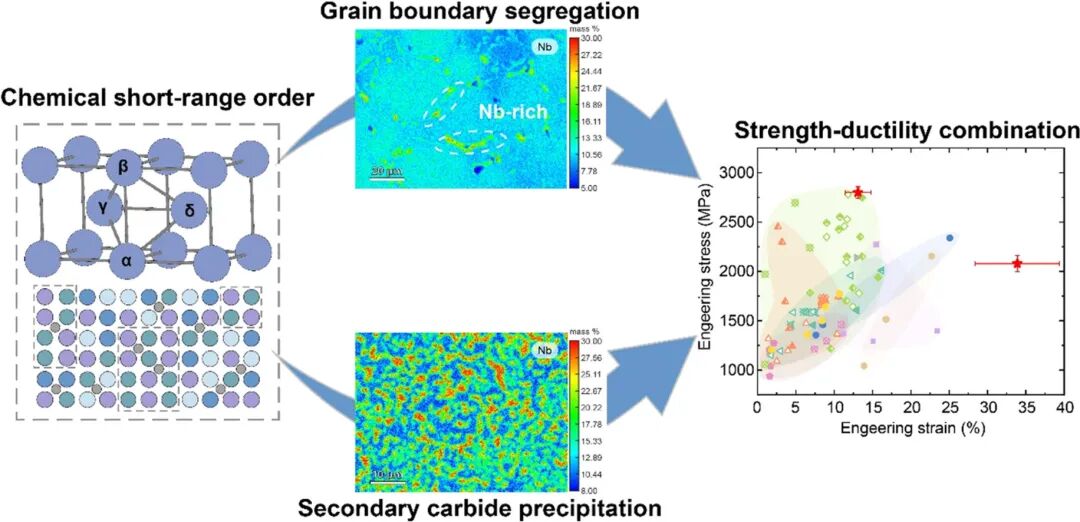
通过晶界碳偏析和碳化物析出调节高熵合金的强度和延性权衡
Refractory high-entropy alloys (HEAs), especially NbMoTaW, suffer from low fracture strain at room temperature due to their weak grain boundary cohesion. Unlike substitutional alloying strategies, interstitial nonmetallic elements, like C, are prone to segregate at the grain boundaries or even form carbide phases, altering the plastic deformation route of HEAs. In this work, we introduce an interstitial C alloying strategy that synergistically enhances the strength and fracture strain of NbMoTaW-based HEAs through grain boundary segregation to carbide precipitation. Preferential segregation of the Nb-Ta pair near C-rich grain boundaries is predicted by first-principles calculations combined with the cluster variation method. Chemical short-range order (CSRO) shows that Nb-Ta-C clustering leads to higher grain boundary strength with higher antiphase boundary energy, but also presents a propensity toward second-phase formation. Accordingly, C-doped HEAs fabricated by spark plas ma sintering validate the enrichment of Nb-Ta-C at grain boundaries in C1 alloy (1 at.% C), and turn into carbides in C20 alloy (20 at.% C). They demonstrate an exceptional combination of high strength and fracture strain: 2085 ± 80 MPa strength and 33.8 ± 5.4% strain for C1, and a higher 2802 ± 57 MPa strength with 13.1 ± 1.6% strain for C20. Deformation an alysis implies that Nb/Ta-rich grain boundaries mediate dislocation glide in C1, while nanotwins and stacking faults in carbides accommodate strain concentration in C20. Interestingly, a Nb-rich amorphous domain-like complexion at triple junctions provides buffering between matrix/carbide interfaces, enabling good strength and high fracture strain of C20. The interstitial C-induced CSRO, segregation, and ordering introduce additional deformation mechanis ms and alter the pathways of plastic flow, presenting a new avenue for designing advanced HEAs that module the strength-ductility trade-off.
高温难熔高熵合金(HEAs),尤其是NbMoTaW,由于其晶界黏聚力弱,在室温下具有较低的断裂应变。与替代合金化策略不同,间隙非金属元素,如C,容易在晶界处偏析甚至形成碳化物相,改变了HEAs的塑性变形路径。在这项工作中,我们引入了一种间隙C合金化策略,该策略通过晶界偏析到碳化物析出来协同提高nbmotaw基HEAs的强度和断裂应变。利用第一性原理计算结合簇变分法预测了Nb-Ta对在富c晶界附近的优先偏析。化学短程有序(CSRO)表明,Nb-Ta-C聚类导致晶界强度和反相边界能提高,但也有形成第二相的倾向。因此,火花等离子烧结制备的c掺杂HEAs验证了C1合金(1 at)晶界处Nb-Ta-C的富集。% C),并在C20合金(20at)中转化为碳化物。% C)。C1的强度为2085±80 MPa,应变为33.8±5.4%;C20的强度为2802±57 MPa,应变为13.1±1.6%。变形分析表明,富含Nb/ ta的晶界介导了C1中的位错滑动,而碳化物中的纳米孪晶和层错则调节了C20中的应变集中。有趣的是,在三结处富含nb的非晶态畴提供了基体/碳化物界面之间的缓冲,使C20具有良好的强度和高断裂应变。间隙c诱导的CSRO、偏析和有序引入了额外的变形机制,改变了塑性流动的路径,为设计先进的HEAs提供了一条新的途径,该途径可以实现强度-塑性平衡。