【新文速递】2026年4月16日固体力学SCI期刊最新文章
今日更新:International Journal of Solids and Structures 2 篇,Journal of the Mechanics and Physics of Solids 1 篇,Mechanics of Materials 2 篇,International Journal of Plasticity 2 篇
International Journal of Solids and Structures
Surface topology-based wear evolution model integrated with multiscale frictional contact in finite element an alysis
Jung Yun Won, Hoejeong Jeong, Joonseok Kyeong, Woojeong Oh, Myoung-Gyu Lee
doi:10.1016/j.ijsolstr.2026.114012
基于表面拓扑的多尺度摩擦接触有限元磨损演化模型
This work develops a wear evolution model formulated from surface topology and integrates it into a finite element (FE) framework for multiscale frictional contact. The wear equation is constructed by modifying Archard’s formulation so that the wear rate depends on key statistical descriptors of the pad surface, allowing the model to represent both running-in and steady-state regimes through consistent evolution of surface height distributions. To incorporate the effect of surface evolution on frictional response, the wear formulation is coupled with a multiscale friction model in which the interface traction depends on pressure, temperature, and the evolving topography parameters. A reduced-order surrogate representation of the multiscale friction model is obtained using a neural network trained on physics-based solutions, enabling efficient evaluation of the friction law during large-scale FE simulations. The full formulation is implemented into an iterative nonlinear FE scheme through user-defined contact subroutines, allowing direct integration of surface evolution into the contact algorithm. Application to a brake dynamometer loading sequence demonstrates that the framework captures the transition from running-in to stabilized wear, the evolution of interface tractions, and the spatial distribution of wear. The proposed formulation provides a mechanics-based approach for modeling wear evolution in frictional contact systems.
本研究开发了一个基于表面拓扑的磨损演化模型,并将其集成到多尺度摩擦接触的有限元框架中。磨损方程是通过修改Archard的公式来构建的,因此磨损率取决于垫面关键的统计描述符,允许模型通过表面高度分布的一致演变来表示磨合和稳态状态。为了考虑表面演变对摩擦响应的影响,将磨损公式与多尺度摩擦模型相结合,其中界面牵引力取决于压力、温度和不断变化的地形参数。利用基于物理解训练的神经网络获得了多尺度摩擦模型的降阶代理表示,从而能够在大规模有限元模拟中有效评估摩擦规律。完整的公式通过用户定义的接触子程序实现为迭代非线性有限元方案,允许将表面演化直接集成到接触算法中。对制动测力仪加载序列的应用表明,该框架捕获了从磨合到稳定磨损的转变,界面牵引力的演变以及磨损的空间分布。提出的公式提供了一种基于力学的方法来模拟摩擦接触系统的磨损演变。
Nonlinear complementarity framework for sliding cable an alysis with elastic catenary equation considering frictional nons moothness
Ziyun Kan, Hongyuan Zhang, Wenzhe Zhao, Xinxian Yang, Xueguan Song
doi:10.1016/j.ijsolstr.2026.114010
考虑摩擦非光滑的弹性悬链线方程滑索分析的非线性互补框架
Sliding cable structures are widely present in many engineering applications, and their complex motion states and diverse mechanical behaviors make their an alysis particularly challenging, especially when large sag effects and frictional interactions at cable–pulley interfaces are involved. In this paper, an efficient and robust numerical method is proposed within the nonlinear complementarity function (NCP) framework to address these challenges. The core idea is to construct an implicit cable model based on elastic catenary equations, while the frictional sliding conditions are reformulated into a set of complementarity equations using a modified Fischer–Burmeister function. The sliding length is introduced as an additional degree of freedom in the finite element formulation, enabling a consistent resolution of the strong coupling between sliding motion and frictional effects. The resulting nonlinear system is solved using the classical Newton–Raphson algorithm with a closed-form tangent matrix, ensuring computational efficiency and robustness. The proposed approach accurately captures both the nons mooth and nonlinear characteristics of large-sag sliding cables under friction, without resorting to trial-and-error procedures for determining sliding states. Several numerical examples are presented to demonstrate the effectiveness and general applicability of the method in modeling complex sliding cable systems.
滑动索结构广泛存在于许多工程应用中,其复杂的运动状态和多样的力学行为使其分析变得特别具有挑战性,特别是当涉及到大的凹陷效应和索-滑轮界面的摩擦相互作用时。本文在非线性互补函数(NCP)框架下提出了一种有效且鲁棒的数值方法来解决这些问题。该方法的核心思想是基于弹性悬链线方程构建隐式索模型,并利用修正的fisher - burmeister函数将摩擦滑动条件重新表述为一组互补方程。在有限元公式中引入滑动长度作为附加自由度,使滑动运动和摩擦效应之间的强耦合得到一致的解决。所得到的非线性系统采用经典的Newton-Raphson算法求解,具有封闭形式的切矩阵,保证了计算效率和鲁棒性。该方法可以准确地捕捉摩擦作用下大垂度滑动索的非光滑和非线性特性,而无需采用反复试验的方法来确定滑动状态。算例验证了该方法在复杂滑索系统建模中的有效性和普遍适用性。
Journal of the Mechanics and Physics of Solids
Learning constitutive relations from experiments: II. Dynamic indentation
Andrew Akerson, Aakila Rajan, Daniel Casem, Kaushik Bhattacharya
doi:10.1016/j.jmps.2026.106629
从实验中学习本构关系:动态压痕
We continue the development of a method to accurately and efficiently identify the constitutive behavior of complex materials through experimental observations that we started in Akerson et al. (2025). We formulate the problem of inferring constitutive relations from experiments as an indirect inverse problem that is constrained by the balance laws. Specifically, we seek to find a constitutive behavior that minimizes the difference between the experimental observation and the corresponding quantities computed with the model, while enforcing the balance laws. We formulate the forward problem as a boundary value problem corresponding to the experiment, and compute the sensitivity of the objective with respect to the model using the adjoint method. In this paper, we extend the approach to include contact and study dynamic indentation. Contact is a nonholonomic constraint, and we introduce a Lagrange multiplier and a slack variable to address it. We demonstrate the method on synthetic data before applying it to experimental observations on rolled homogeneous armor steel and a polycrystalline aluminum alloy.
我们继续开发一种方法,通过我们在Akerson等人(2025)开始的实验观察,准确有效地识别复杂材料的本构行为。我们把从实验中推断本构关系的问题表述为一个受平衡律约束的间接逆问题。具体来说,我们试图找到一种本构行为,使实验观察和模型计算的相应数量之间的差异最小化,同时执行平衡定律。我们将正演问题表述为与实验相对应的边值问题,并利用伴随法计算目标相对于模型的灵敏度。在本文中,我们将该方法扩展到包括接触和研究动态压痕。接触是一个非完整约束,我们引入拉格朗日乘子和松弛变量来解决它。在将该方法应用于轧制均质装甲钢和多晶铝合金的实验观察之前,我们对合成数据进行了验证。
Mechanics of Materials
Fibre orientation–dependent damage modelling and experimental identification for 3D-printed continuous carbon fibre reinforced nylon composites
João V.B. Netto, Ênio H.P. Silva, Bruno G. Christoff, Marcelo L. Ribeiro, José Humberto S. Almeida
doi:10.1016/j.mechmat.2026.105697
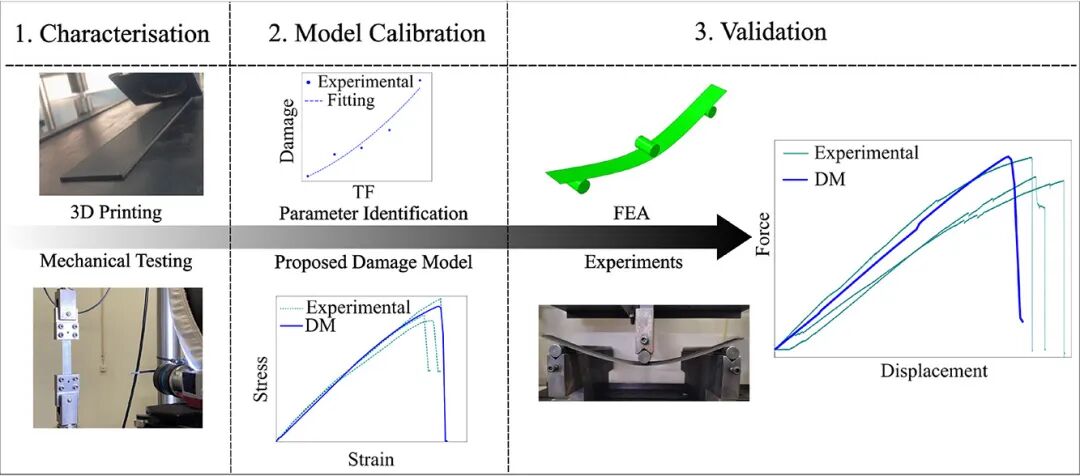
3d打印连续碳纤维增强尼龙复合材料的纤维定向损伤建模与实验识别
The complex failure mechanis ms induced by the layer-by-layer deposition in additive manufacturing require advanced modelling strategies to ensure reliable structural an alysis; however, existing approaches rarely incorporate explicit orientation-dependent damage laws to capture anisotropic degradation. This study presents an effective intralaminar constitutive damage model for 3D-printed continuous carbon fibre-reinforced nylon (Onyx) composites manufactured by fused filament fabrication (FFF), calibrated for a specific specimen architecture and print configuration. An experimental campaign comprising quasi-static tensile, compression, and in-plane shear tests at multiple fibre orientations was conducted to calibrate a thermodynamically consistent continuum damage mechanics (CDM) model, with key parameters identified from cyclic tests to characterise stiffness degradation and define damage evolution as a function of the local fibre angle ( θ ) . The proposed model accurately reproduces the mechanical response across the investigated loading cases and is further validated under three-point bending, demonstrating its predictive capability for orientation-dependent failure in FFF composites.
在增材制造中,由逐层沉积引起的复杂破坏机制需要先进的建模策略来保证可靠的结构分析;然而,现有的方法很少包含明确的与取向相关的损伤规律来捕获各向异性退化。本研究提出了一种有效的层内本构损伤模型,用于通过熔融长丝制造(FFF)制造的3d打印连续碳纤维增强尼龙(Onyx)复合材料,并针对特定的样品结构和打印配置进行了校准。在多个纤维方向上进行了准静态拉伸、压缩和面内剪切试验,以校准热力学一致连续损伤力学(CDM)模型,并从循环试验中确定了关键参数,以表征刚度退化并将损伤演变定义为局部纤维角度(θ)的函数。该模型准确地再现了所研究载荷情况下的力学响应,并在三点弯曲下进一步验证,证明了其对FFF复合材料定向相关失效的预测能力。
A machine-learning-based model for accurately predicting the bending behavior of sandwich beams
Yu Yan, Yu Duan, Zhilong Peng, Bo Zhang, Yin Yao, Shaohua Chen
doi:10.1016/j.mechmat.2026.105701
基于机器学习的夹层梁弯曲行为准确预测模型
Sandwich beams always exhibit a shear-bending-coupling mechanical behavior, which is difficult to be accurately predicted by existing bending theories due to the prior assumptions, such as an overlook of the interlayer shear stress and a zigzag displacement distribution on the beam’s cross-section. In this work, based on the large dataset provided by finite element simulation, an alternative model of sandwich beams is generated using machine learning (ML) methods without any assumptions, and applied to an alyze the influence of modulus ratio and thickness ratio between the surface and core layers on the stress and deformation fields of sandwich beams under four point bending. It is found that an increase in modulus ratio not only causes significant shear stress in the core layer, but also results in a mixed tensile and compressive stress state in the surface layer, causing the neutral plane to shift from the core layer to the surface layers. In contrast, the thickness ratio only affects the magnitude of stress and deformation in the beam, and has little effect on the position of the neutral plane. All the predicted results are consistent with existing experimental and numerical ones, indicating that the modulus difference between the surface and core layers dominates the shear-bending-coupling behavior of sandwich beams and determines the applicability of existing bending theories. The present ML-based model should be of guiding value for the design of sandwich structures with desirable mechanical properties.
夹层梁总是表现出剪切-弯曲-耦合的力学行为,现有的弯曲理论由于先前的假设而难以准确预测,例如忽略了层间剪切应力和梁截面上的锯齿形位移分布。本文基于有限元模拟提供的大型数据集,采用机器学习(ML)方法,在不做任何假设的情况下,建立了夹层梁的替代模型,并应用该模型分析了四点弯曲条件下,面芯层的模量比和厚度比对夹层梁应力场和变形场的影响。研究发现,模量比的增大不仅会在芯层产生显著的剪切应力,还会导致表层出现拉压混合应力状态,导致中性面从芯层向表层偏移。相比之下,厚度比仅影响梁内应力和变形的大小,对中性面位置影响不大。所有的预测结果与已有的实验和数值结果一致,表明表面和芯层之间的模量差异主导了夹层梁的剪切-弯曲耦合行为,决定了现有弯曲理论的适用性。该模型对具有理想力学性能的夹层结构的设计具有一定的指导价值。
International Journal of Plasticity
Origin of enhanced <c+a> slip in Mg-Gd alloys
Dongfang Shi, Xinwei Zhong, Jie Wang, Tao Song, Yuchi Cui, Changhui Liu, Gaoming Zhu, Ziliang Lu, Huamiao Wang, Xiaoqin Zeng, Zhefeng Zhang, Leyun Wang
doi:10.1016/j.ijplas.2026.104702
Mg-Gd合金中<c+a>滑移增强的成因
The influence of gadolinium (Gd) on the deformation mechanis ms of magnesium (Mg) alloys was investigated by comparing extruded Mg-1Al, Mg-1Zn, and Mg-1Gd alloys (at.%) with similar grain sizes. This “grain-size matching” isolates the role of solute chemistry from the Hall-Petch effect. At similar grain sizes (∼14 μm), Mg-1Gd exhibits significantly higher strain hardening than Mg-1Al and Mg-1Zn. Electron microscopy and dislocation-density-based elastic-viscoplastic self-consistent (EVPSC) simulations reveal that <c+a> slip is substantially more active in Mg-1Gd than in Mg-1Al or Mg-1Zn. The critical resolved shear stresses (CRSS) for basal slip, pyramidal <c+a> slip, and twinning were estimated using the EVPSC model and compared with single-crystal micropillar compression results. In the Mg-1Gd alloy, both the CRSS<c+a>/CRSSbasal and CRSS<c+a>/CRSStwin ratios derived from the EVPSC model are substantially lower than those measured in single-crystal compression. This discrepancy is attributed to grain boundary effects in the polycrystal—specifically, the segregation of Gd solutes to grain boundaries, which may facilitate the nucleation of <c+a> dislocations. This grain-boundary-mediated mechanis m is key to the enhanced <c+a> slip in Mg-Gd alloys and reconciles the divergent observations between single-crystal and polycrystal studies in the literature.
通过比较晶粒尺寸相近的Mg- 1al、Mg- 1zn和Mg- 1gd合金(at.%)的挤压变形,研究了钆(Gd)对镁(Mg)合金变形机制的影响。这种“粒度匹配”将溶质化学的作用从霍尔-佩奇效应中分离出来。在相似晶粒尺寸(~ 14 μm)下,Mg-1Gd表现出明显高于Mg-1Al和Mg-1Zn的应变硬化。电子显微镜和基于位错密度的弹粘塑性自一致(EVPSC)模拟显示,Mg-1Gd中的<c+a>滑移比Mg-1Al或Mg-1Zn中的更活跃。利用EVPSC模型估计了基底滑移、锥体<c+a>滑移和孪晶的临界分解剪应力(CRSS),并与单晶微柱压缩结果进行了比较。在Mg-1Gd合金中,由EVPSC模型得出的CRSS<c+a>/CRSSbasal和CRSS<c+a>/CRSStwin比均显著低于单晶压缩时的测量值。这种差异归因于多晶中的晶界效应,特别是Gd溶质向晶界的偏析,这可能促进<c+a>位错的成核。这种晶界介导的机制是Mg-Gd合金中<c+a>滑移增强的关键,并且调和了文献中单晶和多晶研究之间的不同观察结果。
Multiphase structure enables strength-ductility-hardening synergy in additively-manufactured Fe-Mn-Cu Alloys
Peifeng Liu, Hao Fu, Tiansheng Li, Ziyang Ji, Zengbao Jiao, Quan Shan, Cuie Wen, Hong Wu
doi:10.1016/j.ijplas.2026.104701
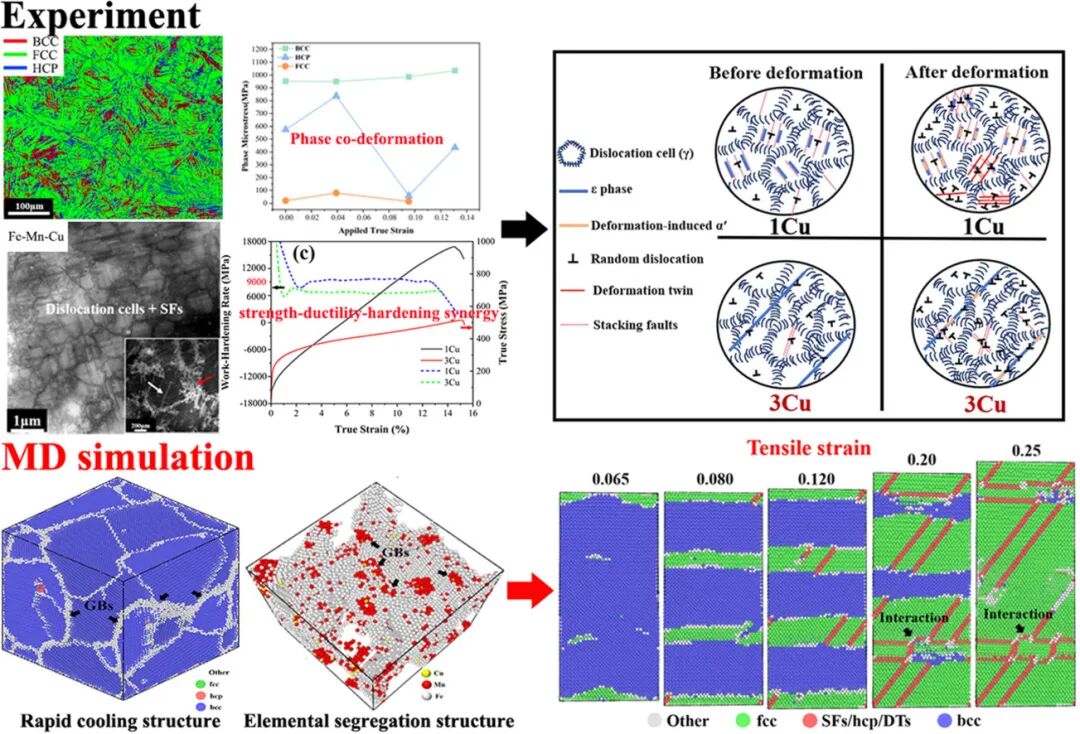
多相结构使增材制造的Fe-Mn-Cu合金具有强度-延展性-硬化协同作用
Additively manufactured Fe-Mn alloys hold promise for biodegradable orthopedic load-bearing applications, yet their strength-ductility-strain hardening synergy is constrained by the formation of excessive ε-martensite under rapid cooling. In this study, a copper (Cu)-alloying strategy combined with laser powder bed fusion (LPBF) to construct a multiphase structure comprising γ-austenite (71.9–98.8 vol. %), ε-martensite, α-ferrite, and Cu-rich nano-precipitates. With the increase of Cu content, the texture was gradually weakened, and the greater heat accumulation led to more widely distributed dislocation cells, captured by the low angle grain boundaries. Mn and Cu segregation occurred in the dislocation cell walls, and the SFE (∼ 25.4 mJ/m2) of the Fe-18Mn-1Cu alloy was close to that of Fe-18Mn, resulting in a synergistic effect of TRIP and TWIP during deformation. Molecular dynamics (MD) indicated that, the combined TRIP/TWIP effects persistently form hard martensite and deformation twins, with interphase stress/strain-partitioning induced strengthening, enhancing the dislocation formation kinetics and improving the strength and hardening. In contrast, Fe-18Mn-3Cu primarily undergoes dislocation slip, depleting ε-martensite and diminishing strain hardening and relying on dislocation cells and minimal α′-martensite for strain accommodation. The Fe-18Mn-1Cu alloy shows higher ultimate tensile strength of 837 MPa, improved ductility of 16%, and a superior strain hardening rate of ∼9000 MPa. This work refined the theoretical foundations for the multiphase structures design of Fe-Mn-Cu alloys through multi-scale experiments and simulations, and quantified the contribution of the strengthening mechanis m, finally demonstrated the feasibility of their development in orthopedic load-bearing applications.
增材制造的Fe-Mn合金有望用于生物可降解的骨科承载应用,但其强度-塑性-应变硬化协同作用受到快速冷却下过量ε-马氏体形成的限制。在本研究中,采用铜合金化策略结合激光粉末床熔合(LPBF),构建了由γ-奥氏体(71.9 ~ 98.8 vol. %)、ε-马氏体、α-铁素体和富Cu纳米沉淀组成的多相结构。随着Cu含量的增加,织构逐渐减弱,较大的热积累导致更广泛分布的位错胞被低角度晶界捕获。位错细胞壁发生了Mn和Cu偏析,Fe-18Mn- 1cu合金的SFE (~ 25.4 mJ/m2)接近Fe-18Mn,变形过程中TRIP和TWIP协同作用。分子动力学(MD)表明,TRIP/TWIP复合作用持续形成硬马氏体和变形孪晶,相间应力/应变分配诱导强化,强化了位错形成动力学,提高了强度和硬化。Fe-18Mn-3Cu主要发生位错滑移,损耗ε-马氏体,减小应变硬化,依靠位错胞和最小α′-马氏体进行应变调节。Fe-18Mn-1Cu合金的抗拉强度达到837 MPa,塑性提高16%,应变硬化率达到~ 9000 MPa。本工作通过多尺度实验和模拟,为Fe-Mn-Cu合金多相结构设计提供了理论基础,量化了强化机制的贡献,最终证明了其在骨科承载应用中的可行性。