主应力旋转对粒状材料导热系数的影响

论文题目
Effect of Principal Stress Rotation on the Thermal Conductivity of Granular Materials
研究内容
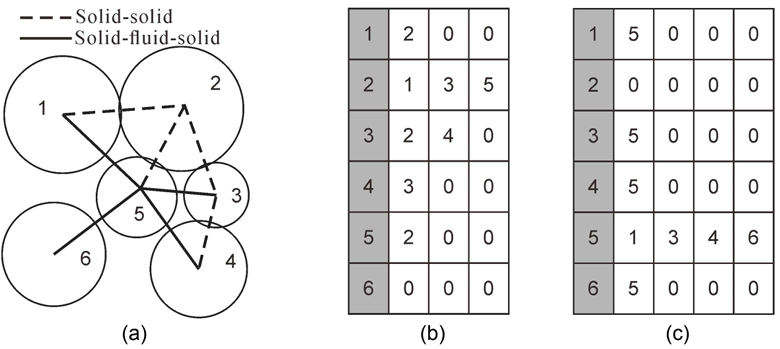
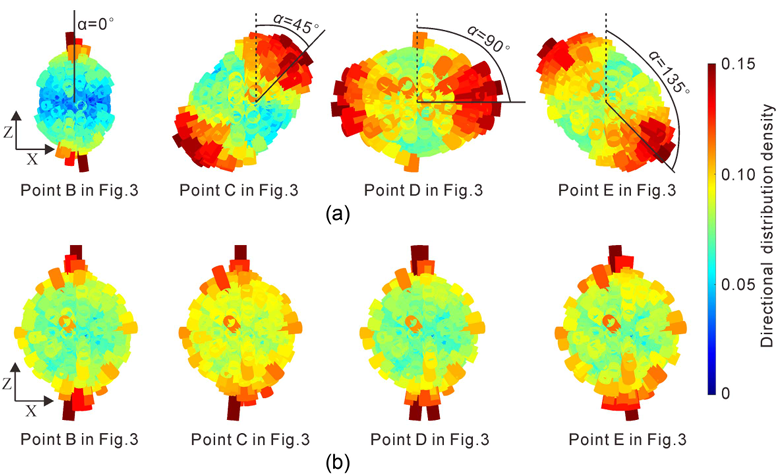
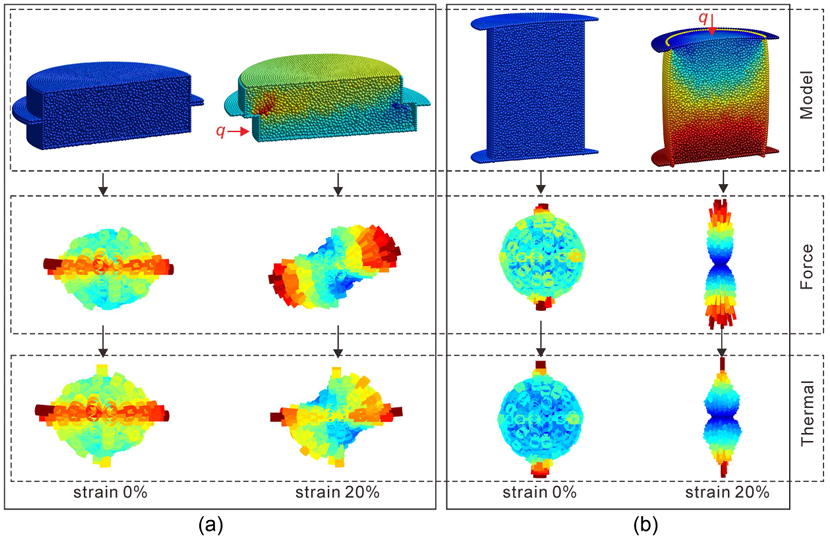
Abstract: Principal stress rotation accompanying heat transfer is largely involved in the processes of screw energy pile installation, traffic loading on frozen soil subgrades, and air compression energy storage in underground cavities. Numerous studies have demonstrated that the volumetric strain induced by principal stress rotation is of the same order of magnitude caused by fixed-axis shear, potentially affecting the thermal conductivity of the surrounding soil. However, there has been limited research on the thermal conductivity of particulate materials under conditions involving principal stress rotation. This study pioneers the coupling between principal stress rotation and heat transfer in granular materials, which investigated the influence of stress conditions (e.g., intermediate principal stress coefficient, mean stress) and structural characteristics (e.g., porosity, particle size distribution) on the thermal conductivity of glass bead assemblies using discrete element simulations coupled with a thermal conductance network model. Results indicate that shear shrinkage dominates in the horizontal (X and Y) directions, while vertical (Z) dilation leads to net volumetric contraction, enhancing the effective thermal conductivity (keff) during rotation. Increasing intermediate principal stress reduces keff vertically but elevates it horizontally, whereas higher confining stress, lower porosity, and broader particle size distributions generally improve keff across all directions. Microscopic an alysis further reveals that principal stress rotation induces anisotropy in particle-to-particle contact forces only, while leaving the anisotropy of all thermal conductance paths unaf fected. As the principal stress rotates, solid–fluid–solid thermal conductance paths gradually transition to solid–solid paths, thereby enhanc ing the overall thermal conductivity. This study provides valuable theoretical insights into the thermal conductivity behavior of particulate materials under dynamic stress conditions and offers practical guidance for engineering applications involving granular material heat transfer.
Keywords: Principal stress rotation; Discrete element method (DEM); Thermal conductance network model (TCNM); MatDEM
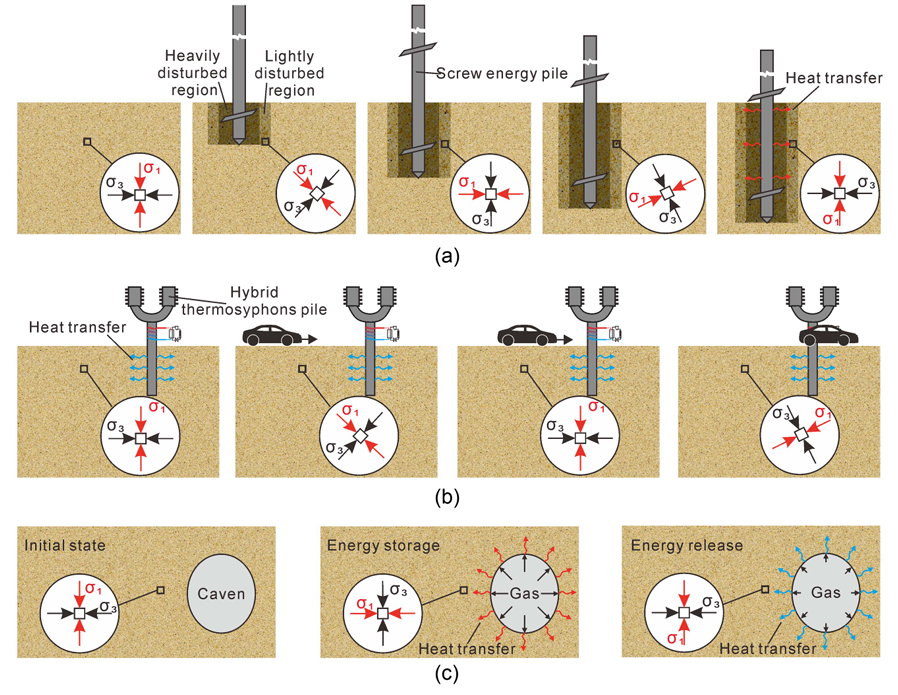
Fig.1 Three scenarios involving principal stress rotation and thermal conductivity: principal stress rotation induced by (a) screw energy pile drilling process; (b) traffic load; and (c) energy storage and release.
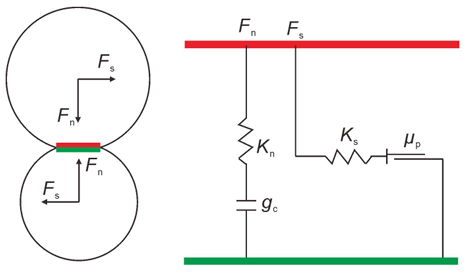
Fig.2 Hertz contact model.
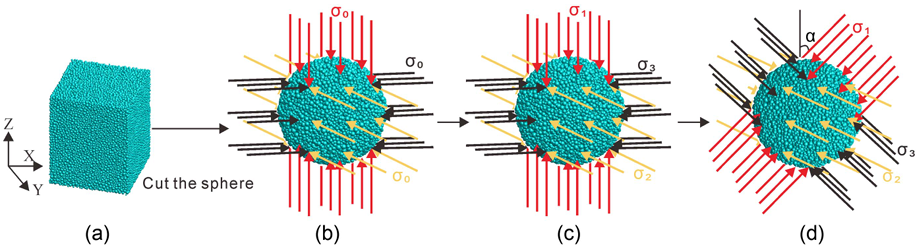
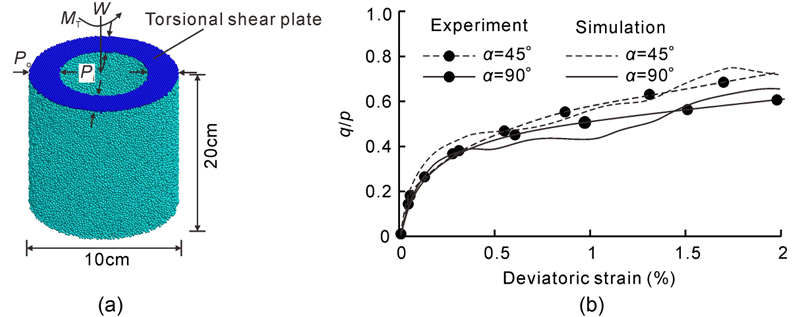
Fig.4 Simulationprocessofprincipalstressrotationsimulation:(a)gravityaccumulation;(b)isotropicconsolidation;(c)partialconsolidation;and (d)principal stress rotation.
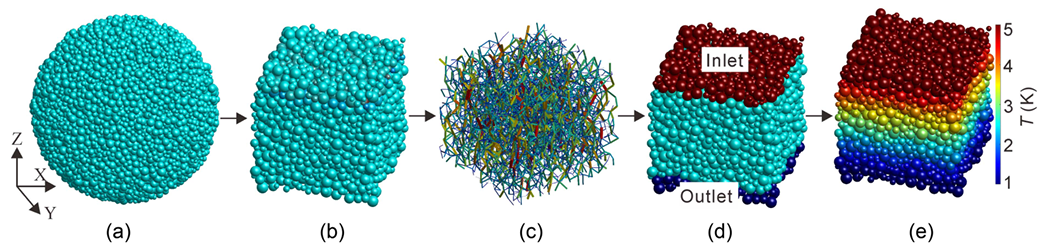
Fig.5 Simulation process of thermal conductance: (a) after principal stress rotation; (b) cropped cube; (c) thermal conductance network; (d) set heat inlet and outlet; and (e) heat transfer.
了解详情
Wang F, Fei W, Li H, et al. Effect of Principal Stress Rotation on the Thermal Conductivity of Granular Materials[J]. Journal of Engineering Mechanics, 2026, 152(4): 04026008.