考虑膨胀效应的锚杆注浆体与围岩界面剪切滑移计算:理论模型与数值模拟

论文题目
Shear-slip calculation for the interface between anchor bolt grouting body and surrounding rock considering the expansion effect: theoretical model and numerical simulation
研究内容
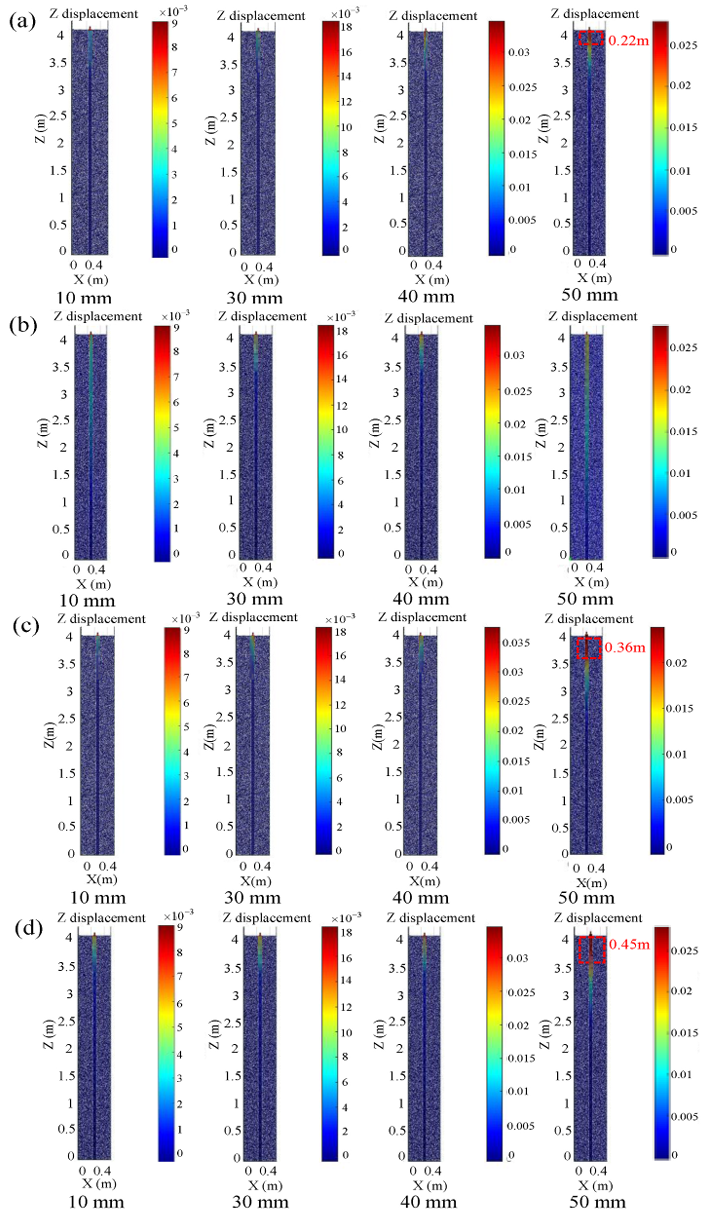
Abstract: In ocean engineering and coastal infrastructure, weak and fractured surrounding rock is commonly encountered in field engineering projects. Under such circumstances, the interface between the grouting body and the sur rounding rock is prone to slipping and debonding when subjected to applied shear stress. However, the dynamic mechanical process has not been well understood. In this study, the mechanical response of the interface between the grouting body and the surrounding rock during the loading process was investigated. An improved shear-slip model was developed by incorporating borehole expansion effects, in-situ rock stress, and interfacial radial stress, aiming to accurately reflect the interfacial stress characteristics under the condition of weak surrounding rock. Subsequently, the discrete element method (MatDEM) was employed to simulate the pull-out process of anchor bolts, and the influence of key factors were systematically ana lyzed, including the anchorage length, grout thickness, surrounding rock type and in-situ stress on the interfacial stress distribution and deformation mechanis ms. The results show that an increase in the anchorage length, surrounding rock strength and in-situ stress significantly enhances the system’s load-bearing capacity and delays the interface’s debonding stage. With the anchorage length of 4 m, the optimal grouting thickness is 10 mm. The anchorage performance markedly declines and even accelerates the propagation of interfacial failure when the grouting thickness ex ceeds 10 mm. The numerical simulations and theoretical an alysis show good consistency in both trend and magnitude, indicating that the proposed model can provide a valuable reference for optimizing anchor design and improving the evaluation of anchor system stability.
Keywords: Anchor bolt; Surrounding rock; Shear-slip model; Expansion effect; Distinct element method
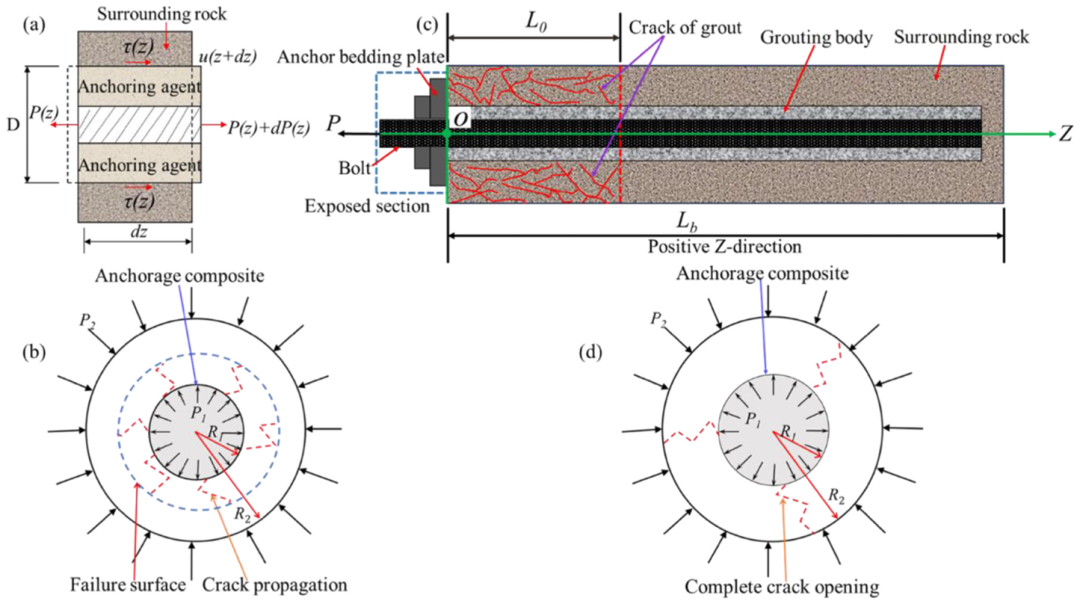
Fig.2 Diagram of static equilibrium ana lysis for the micro-element of the anchor composite segment. (a) Micro-element of the anchor composite segment; (b) Plastic deformation zone in the anchorage section; (c) Schematic diagram of crack propagation; (d) Schematic diagram of complete crack propagation
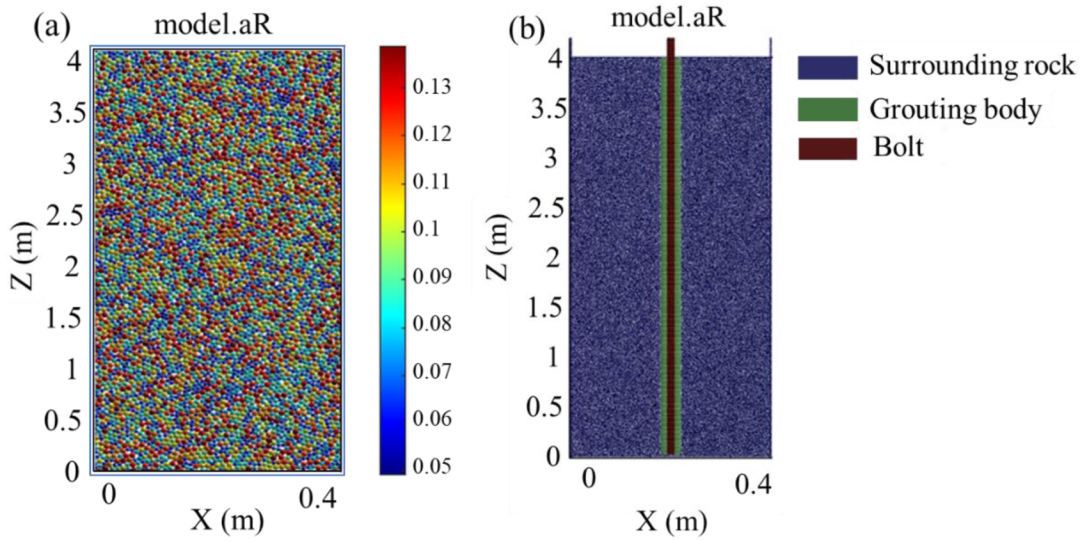
Fig.4 Numerical simulation model. (a) MatDEM-based particle packing model; (b) Anchor bolts pullout model
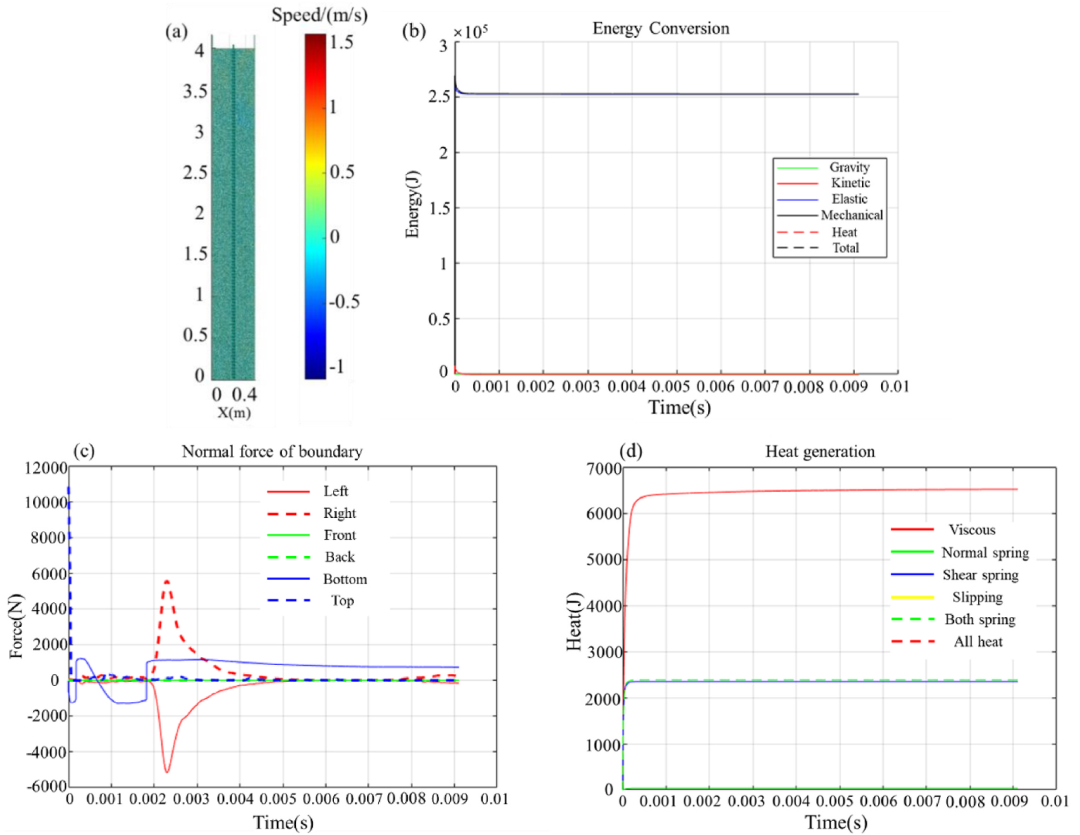
Fig.6 Coupled mechanical-thermal response Characteristics. (a) Vertical velocity distribution; (b) Energy conversion; (c) Normal force of boundary; (d) Heat generation
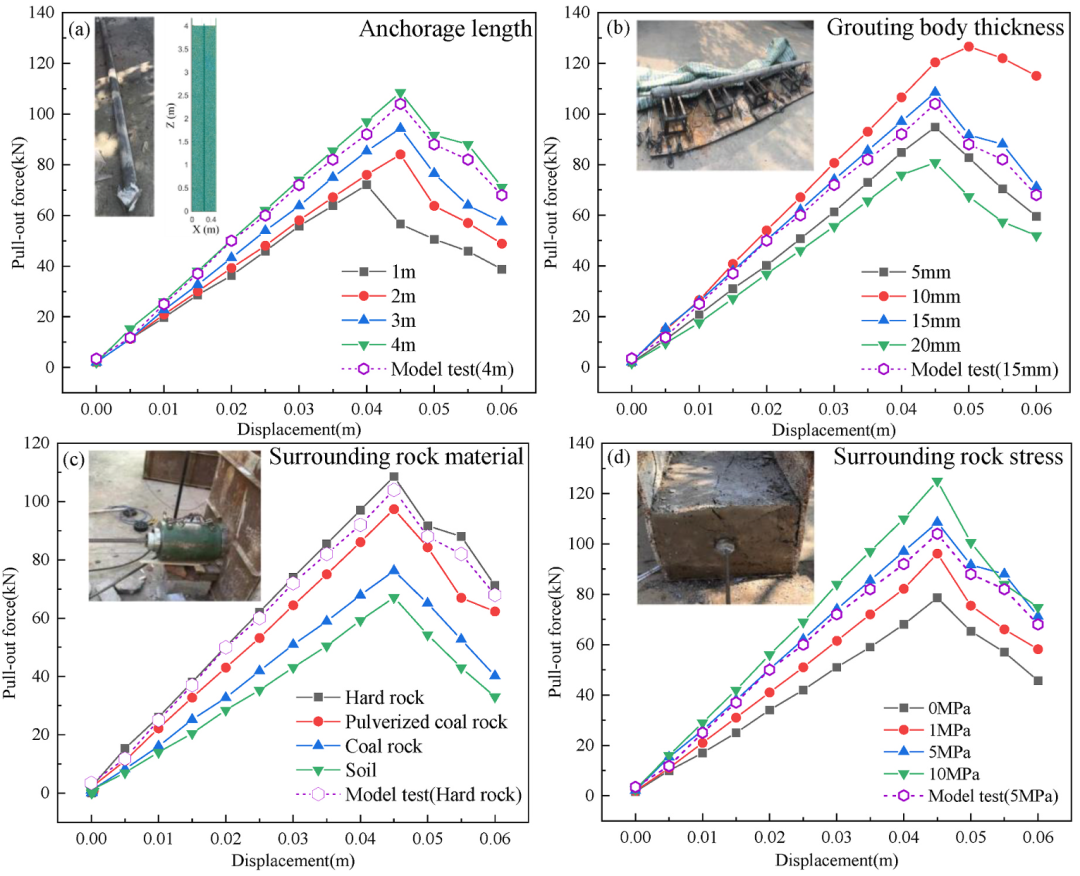
Fig.7 Comparison of pull-out force-displacement responses between numerical simulation and physical model test results. (a) Anchorage length; (b) Grouting body thickness; (c) Surrounding rock material; (d) Surrounding rock stress
了解详情
Shu W, Zhu B, Wu H, et al. Shear-slip calculation for the interface between anchor bolt grouting body and surrounding rock considering the expansion effect: theoretical model and numerical simulation[J]. Ocean Engineering, 2026, 346: 123991.