
地形对岩石滑坡侵蚀机制与滑移效应的约束作用

论文题目
Topographic constraints on the rock avalanche erosion mechanis ms and sliding effects
Qiyi Laia,Jianjun Zhaoa,*,Mengming Lina,b,Rui Zhanga,c,Chang Yanga,d,Qingmiao Lia,Jianxian Hea
研究内容
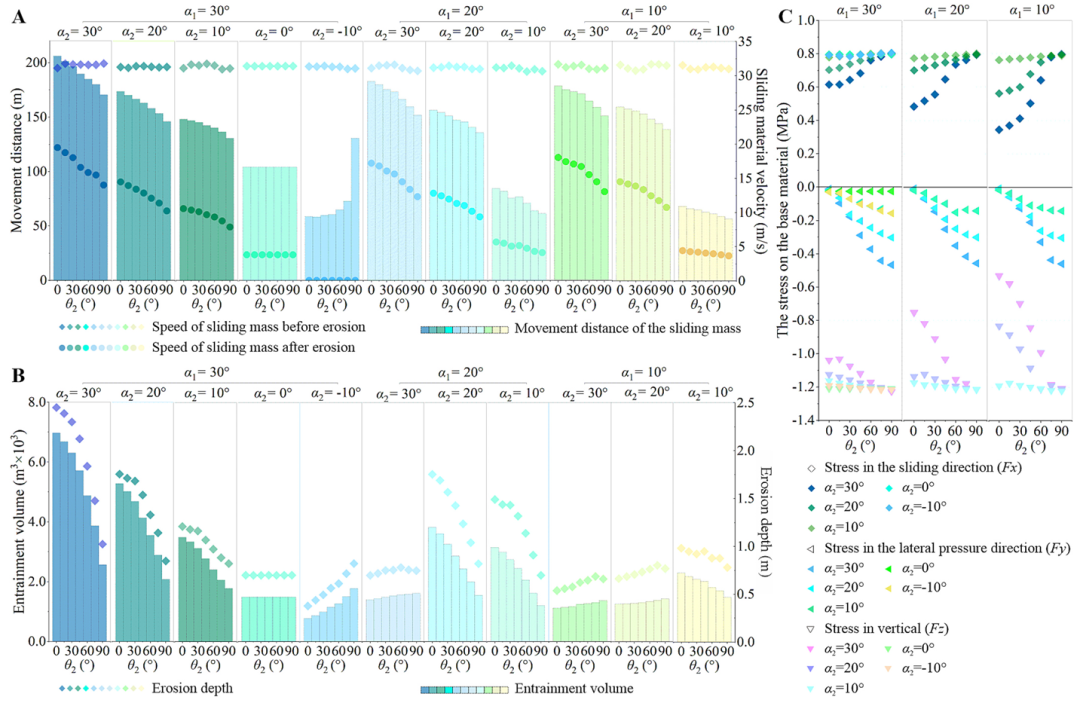
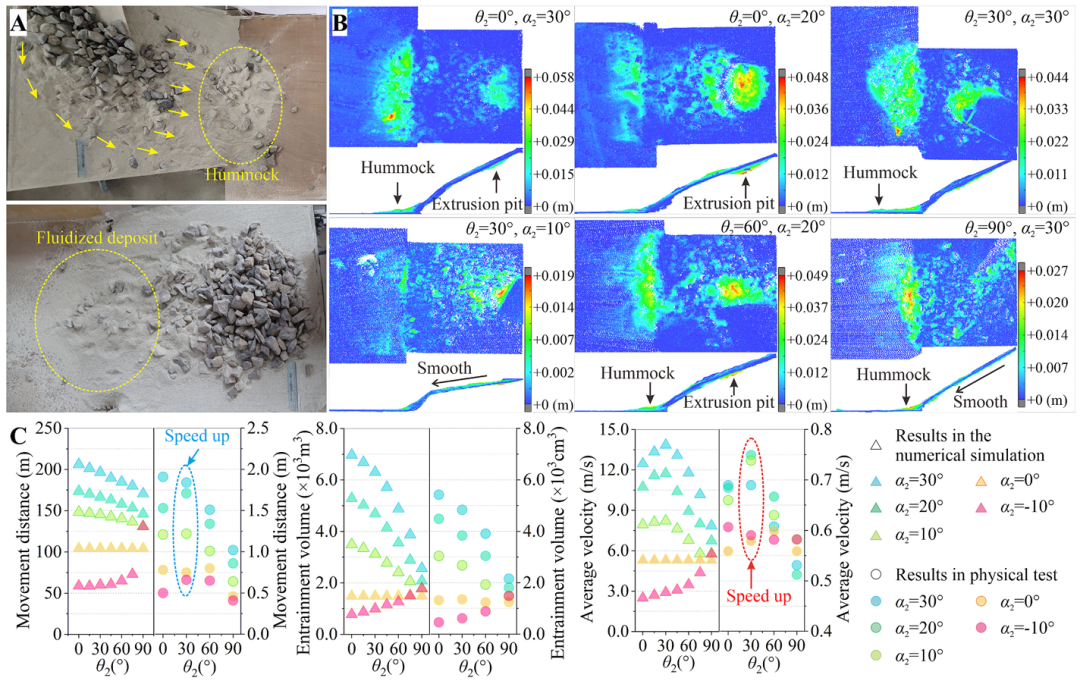
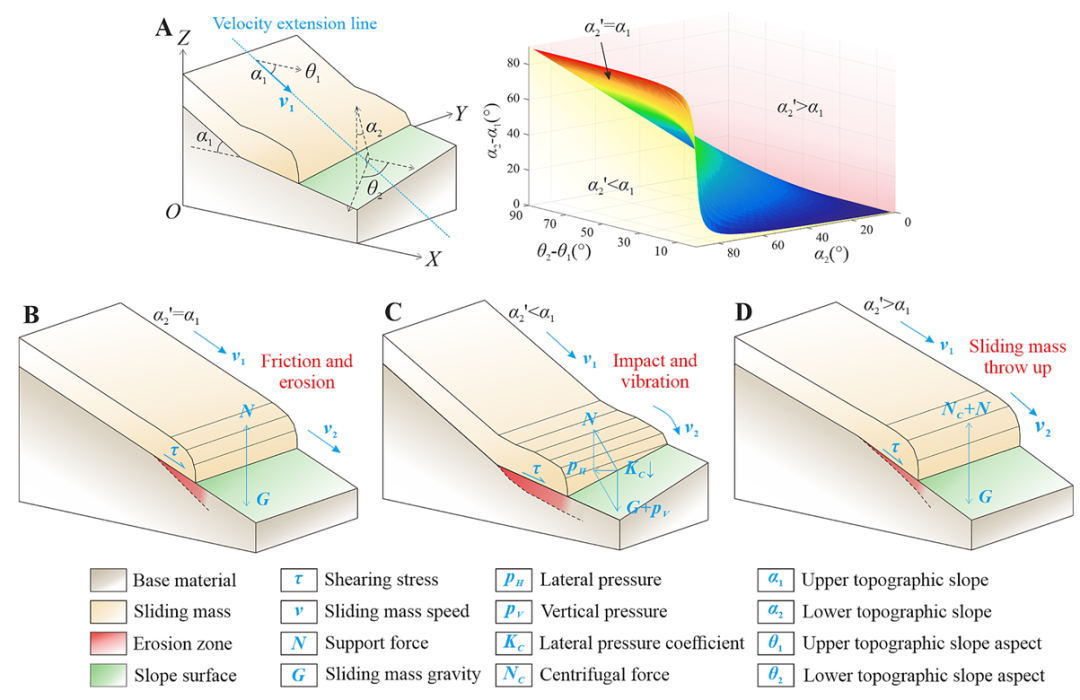
Abstract: Rock avalanches frequently exhibit accelerated movement, increased volume, and heightened hazards due to erosion at their base. Our understanding of topography controls of the erosion mechanis m and promotive sliding effect in rock avalanches remains limited due to the presence of an extremely long flow zone and complex scraping process in landslides, as well as the difficulty of observing them in actual landslides. Based on a compilation of 50 rock avalanche cases inventories, physical tests and discrete element numerical simulations, this study investigates the effects of topography on erosion mechanis ms and promotive sliding. The findings indicate that topography in the erosion zone significantly influences the spatial distribution of deposits, including compression, tension, and arcuate uplift. Impact erosion of the sliding body significantly influences the topo graphic relief. Deflected terrain can induce fluid-like behavior in the sliding mass, characterized by brief intensification followed by rapid attenuation, thereby enhancing both acceleration and dispersal. Erosion mechanis ms vary based on the contact angle between the sliding body and the underlying topography, with erosion-related physical quantities revealing the dominant influence of terrain features. Notably, intersections with side boundaries generate substantial lateral pressure, intensifying basal scraping and promoting movement, especially on slopes with aspects between 15 ◦ to 30 ◦ . Sliding masses exhibit greater mobility within gullies than s mooth slopes, although excessive curvature may inhibit erosion. These findings deepen our understanding of topographic control over erosion and sliding effects in rock avalanches, offering a theoretical basis for disaster prevention and mitigation strategies.
Keywords: Rock avalanche; Erosion mechanis m; Sliding effect; Topography; Physical test
; MatDEM
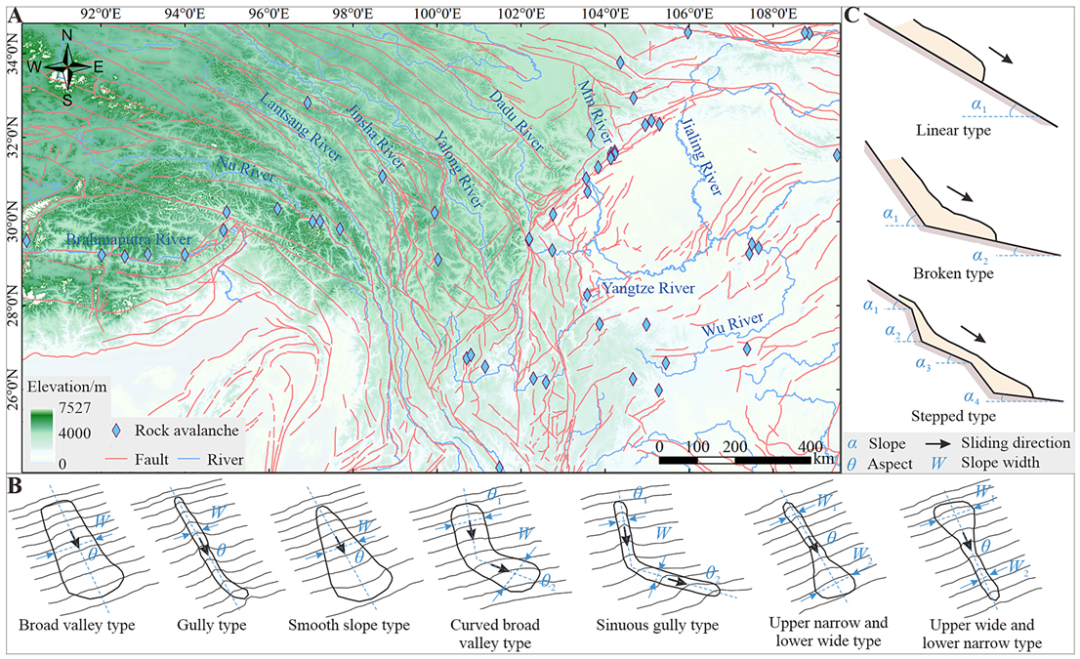
Fig.1 Rock avalanche erosion cases in southwestern mountainous regions of China: (A) distribution map showing the locations of documented rock avalanche events; (B) planform view of the topography; (C) profile view of the topography
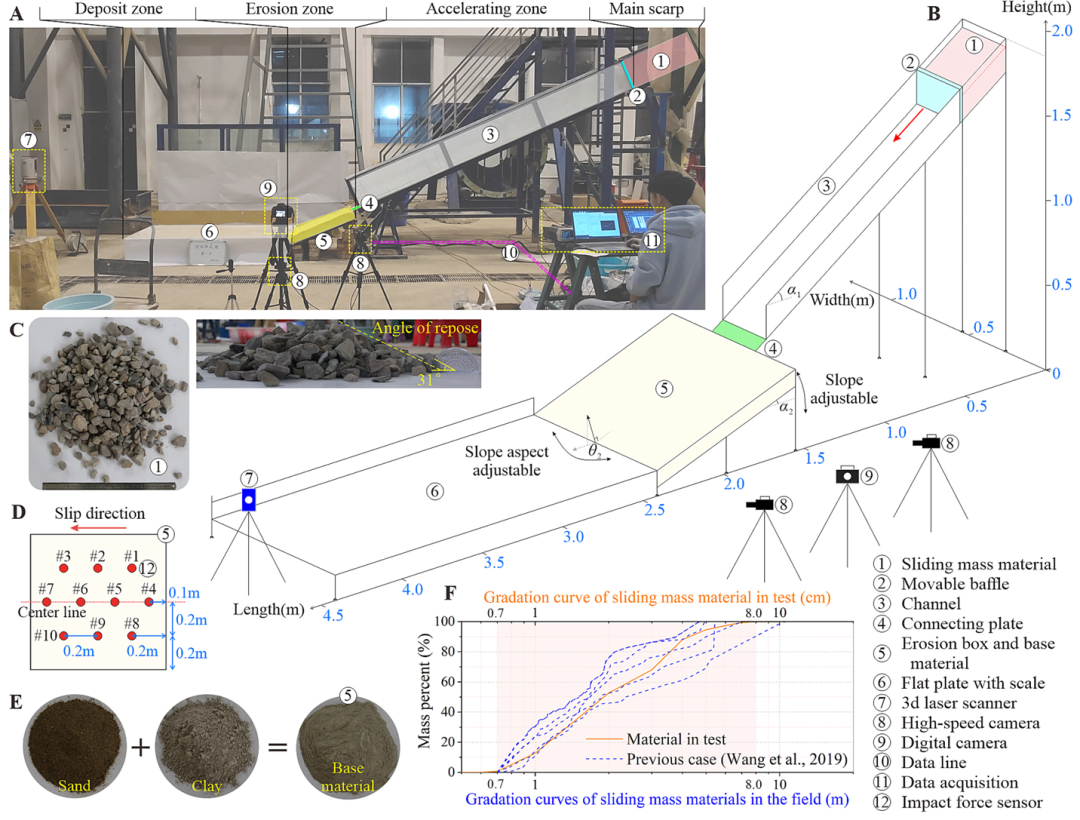
Fig.3 Physical test design: (A) framework and zone partitions; (B) schematic diagram of the experimental setup; (C) sliding mass material (gravel); (D) schematic of sensor arrangement; (E) standardized base material; (F) particle size distribution curve of the sliding mass material
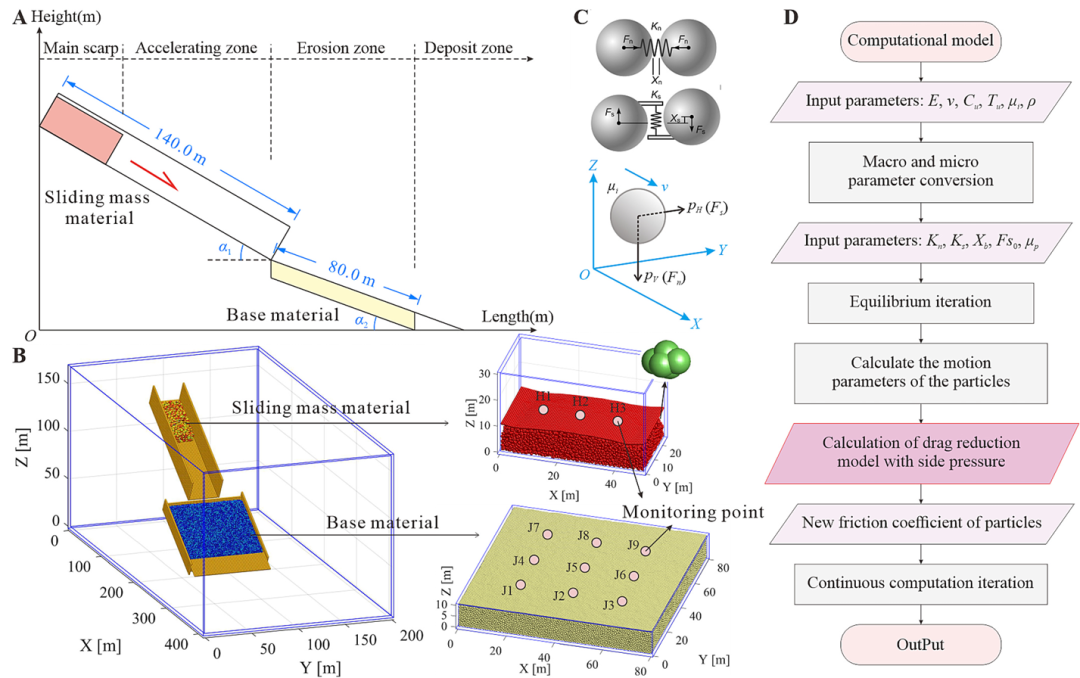
Fig.4 Numeric simulation design: (A) framework and partitions; (B) model, materials and monitoring points; (C) contact relationships between particles; (D) calculation process of simulation
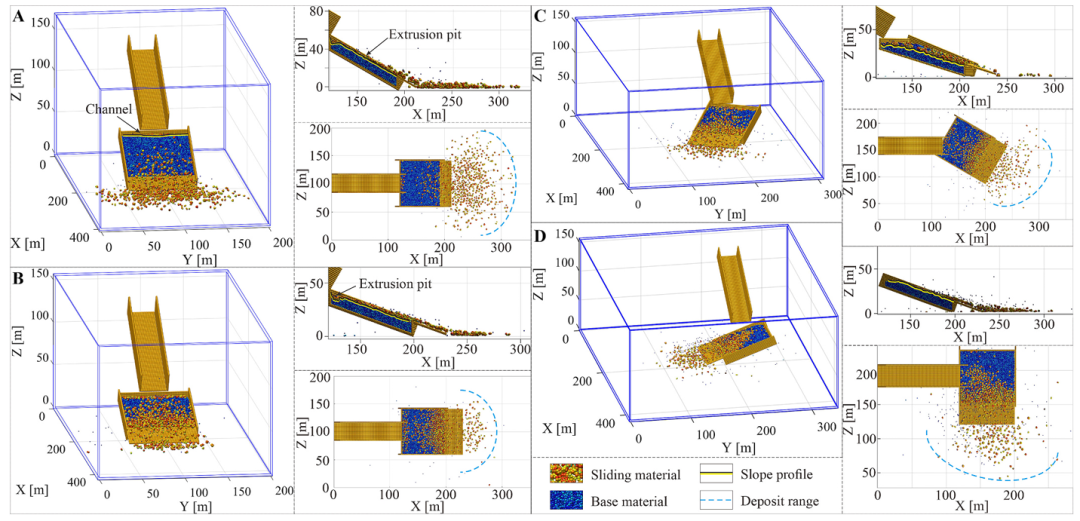
Fig.9 Full view, cross-section, and top view of the representative erosion simulation: (A) α1 =30◦, α2 =30◦, and θ2 =0◦; (B) α1 =30◦, α2 =20◦, and θ2 =0◦; (C) α1 =30◦, α2 =20◦, and θ2 =30◦; (D) α1 =30◦, α2 =20◦, and θ2 =90◦
了解详情
Lai Q, Zhao J, Lin M, et al. Topographic constraints on the rock avalanche erosion mechanis ms and sliding effects[J]. Geomorphology, 2025: 110078.