
多目标粒子群优化,MATLAB代码直接复制

该算法简单易懂,很适合刚入门多目标算法的。且想改进其他单目标优化算法为多目标的,完全可以在此算法框架上直接修改!今天重新推出一下。
多目标粒子群算法是应用最广泛,也是最经典的多目标寻优算法。各种硕士博士文章,都将其应用在各种各样的领域。今天就为大家带来一期多目标粒子群算法。
与网上大多数多目标粒子群代码不同,本期给出的多目标粒子群优化算法,只有一个脚本和一个函数,很适合新手学习,而且出图精美!
在经典的多目标测试函数“ZDT1”,“ZDT2”,“ZDT3”,“ZDT6”,“Kursawe”,“Schaffer”,“Poloni”,“Viennet2”,“Viennet3”中对多目标粒子群进行测试,结果如下:
其中绿色的线代表真实的Pareto前沿面,黑色的圆圈表示寻优得到的Pareto值,红色的圈表示其他粒子。
ZDT1

ZDT2
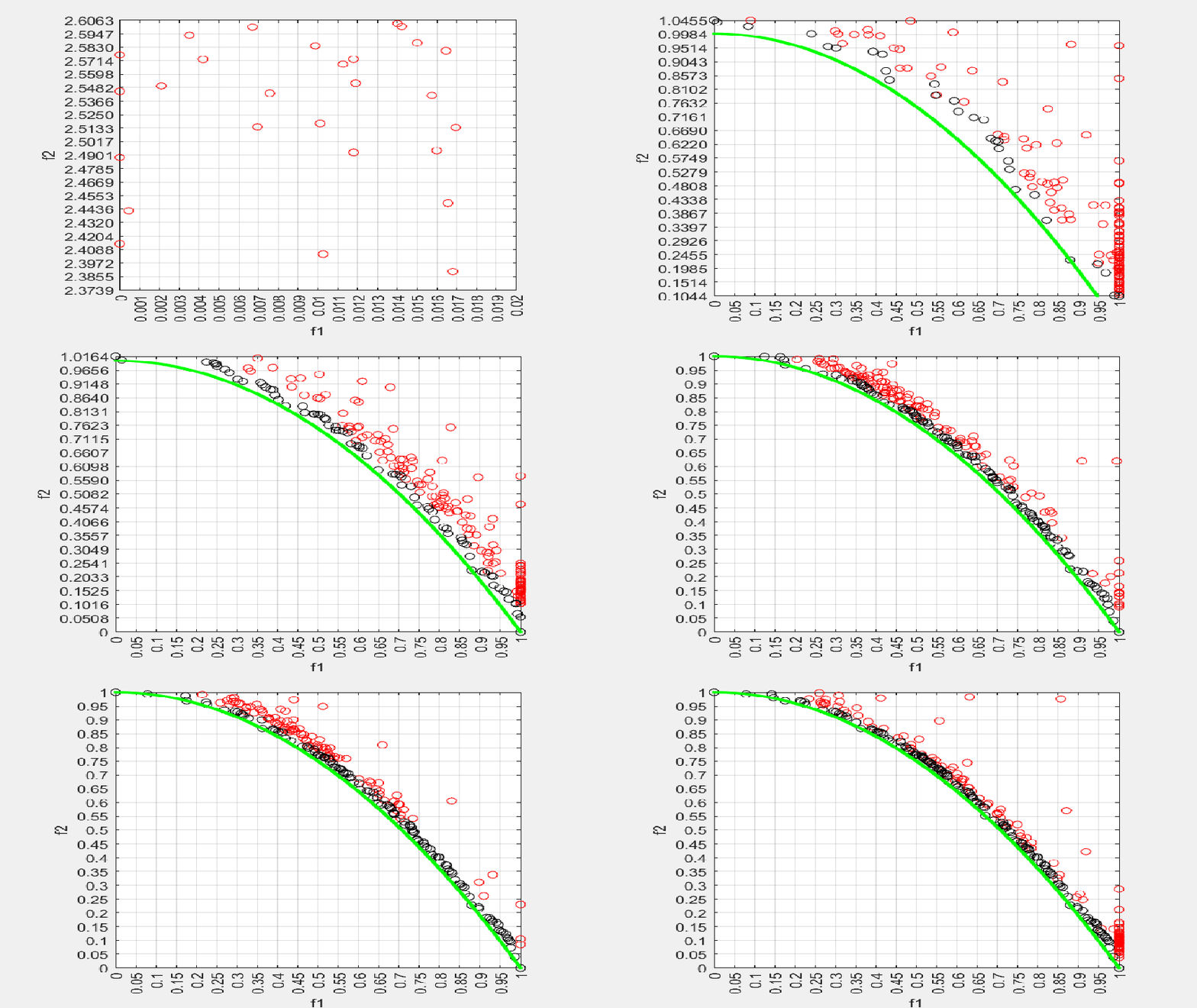
ZDT3

ZDT6
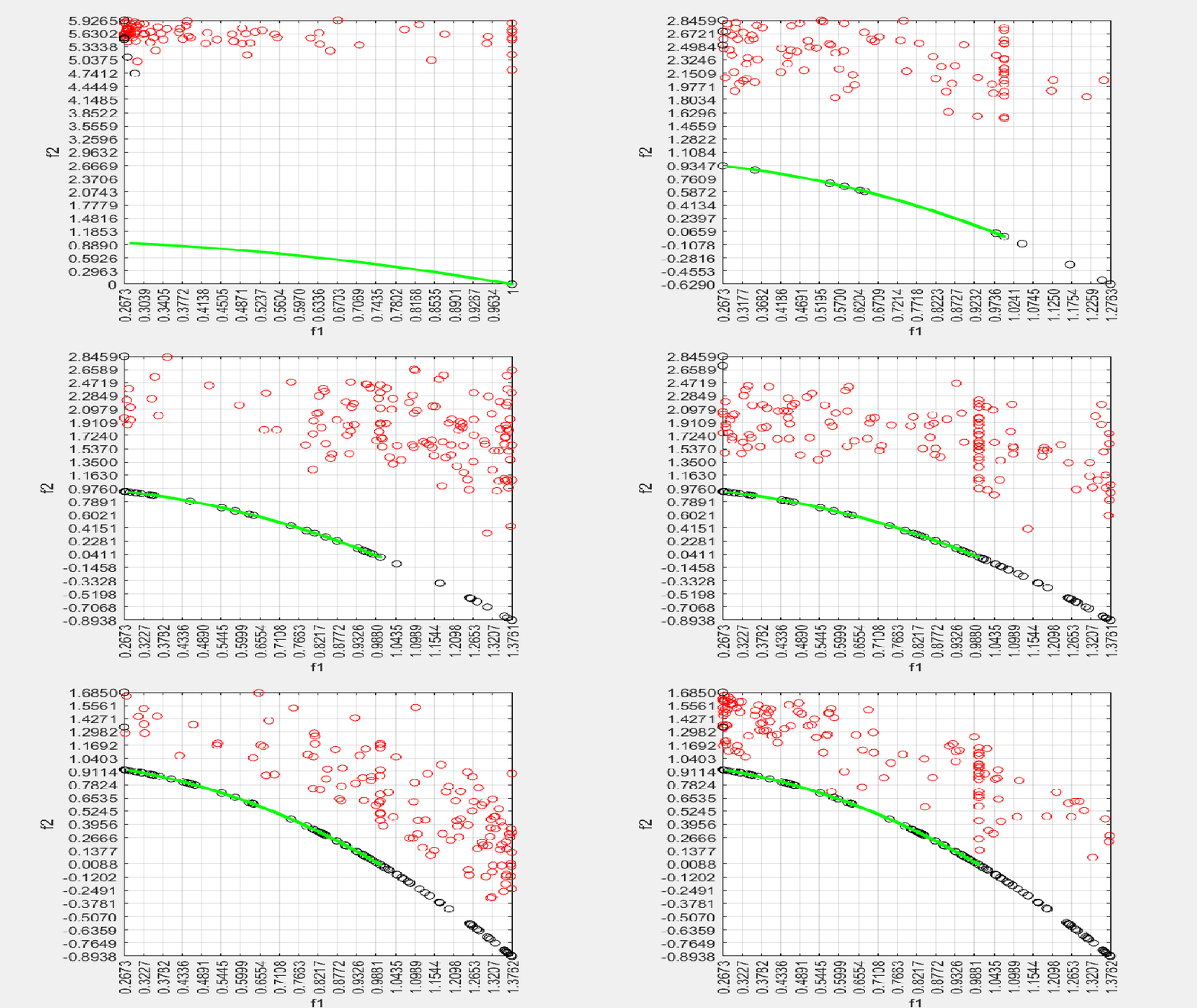
Kursawe
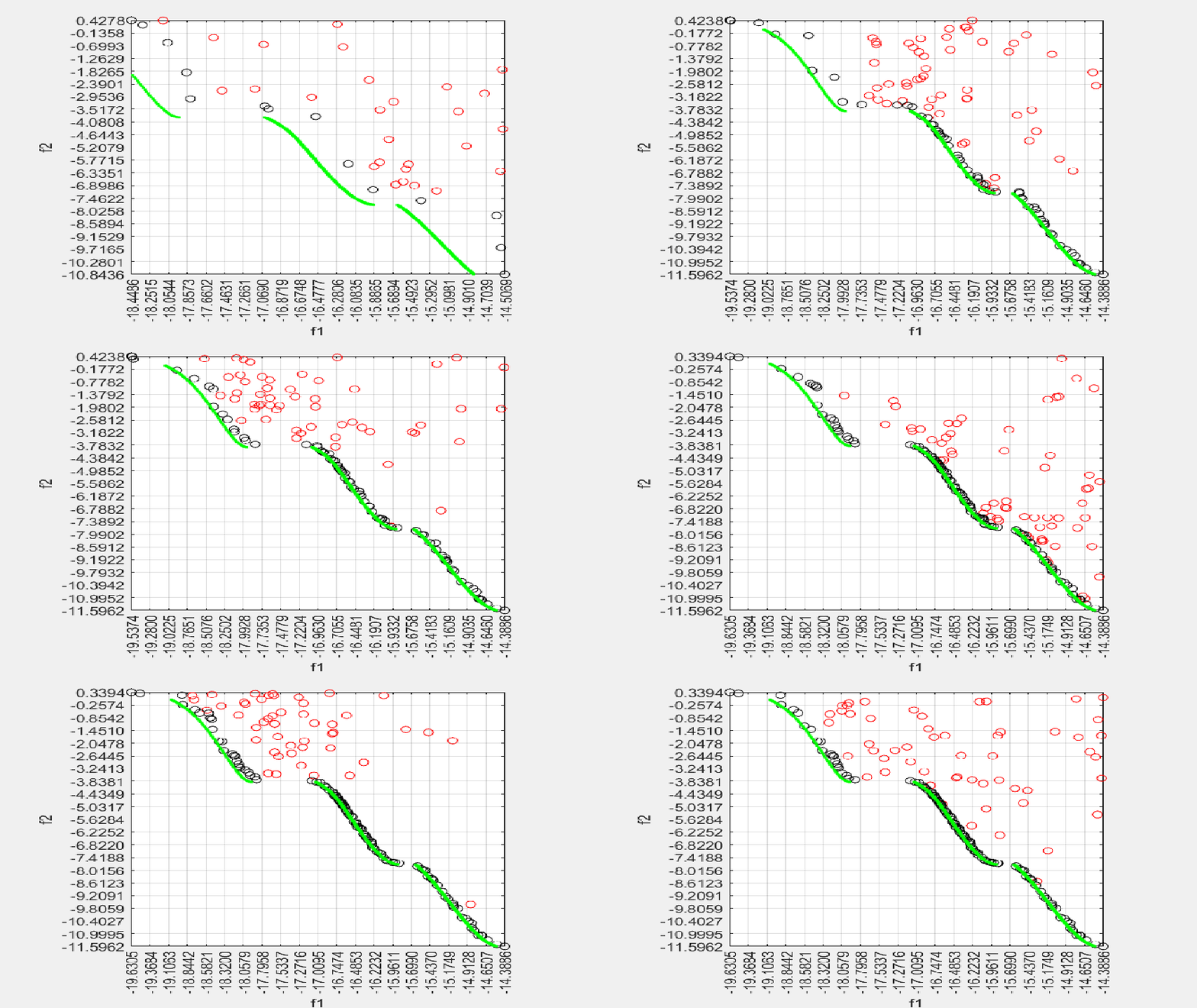
Schaffer
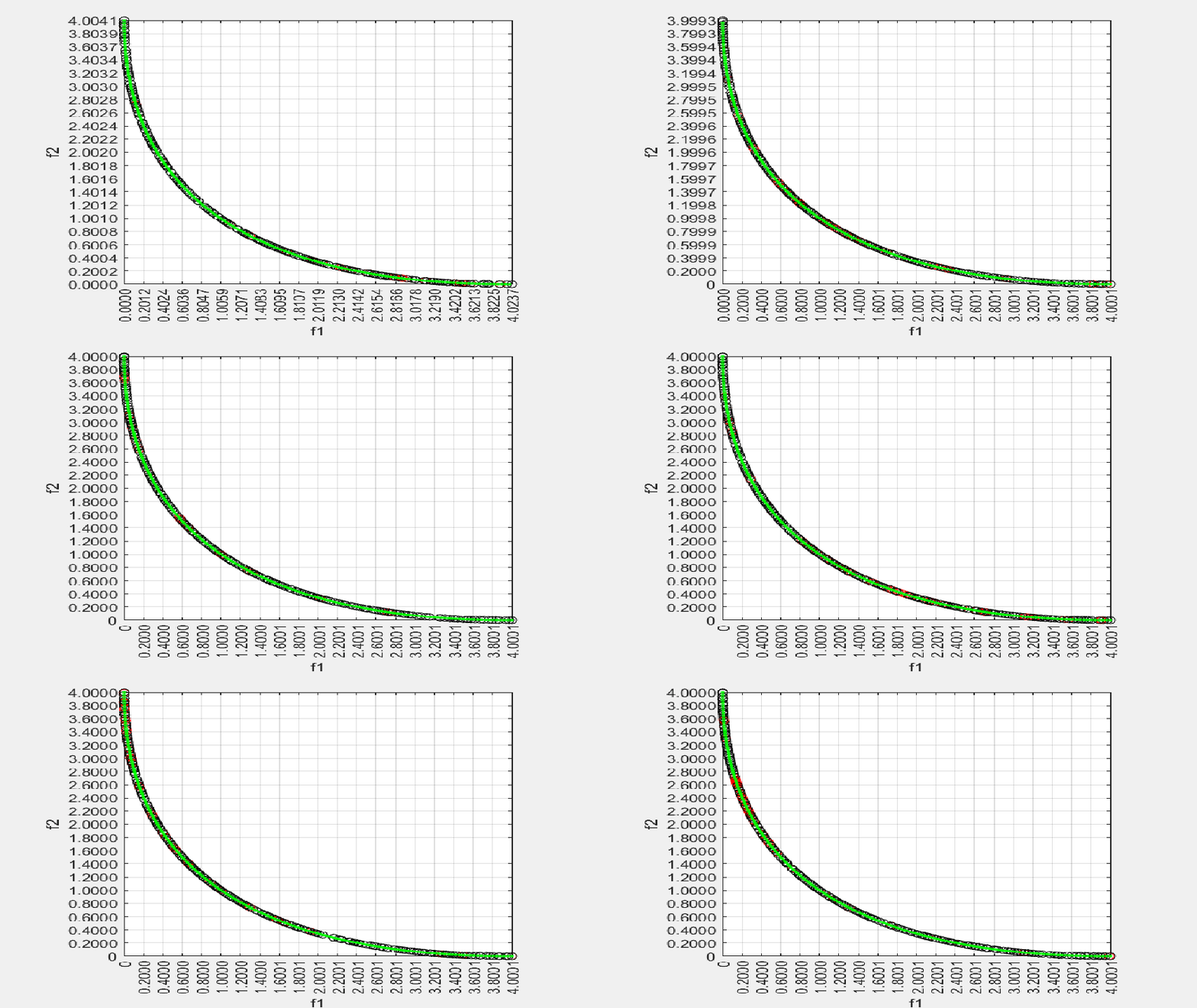
Viennet2

Viennet3
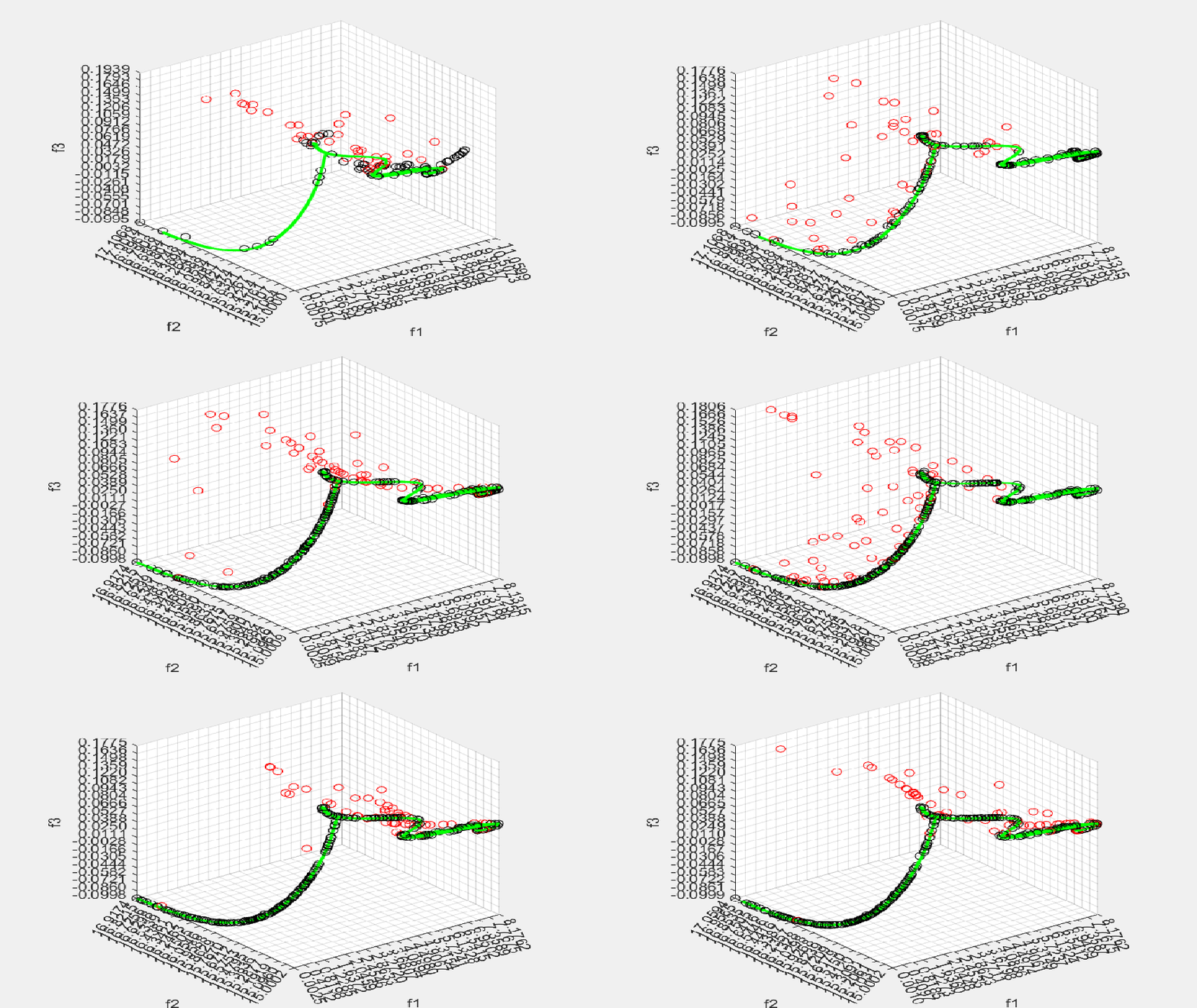
可以看到,在这几个经典函数中的测试,多目标粒子群的效果还是非常不错的,但也有可改进的空间。
接下来直接上代码!
首先是主函数:
clear all; clc;% Multi-objective function% MultiObjFnc = 'Schaffer';% MultiObjFnc = 'Kursawe';% MultiObjFnc = 'Poloni';% MultiObjFnc = 'Viennet2';% MultiObjFnc = 'Viennet3';% MultiObjFnc = 'ZDT1';% MultiObjFnc = 'ZDT2';% MultiObjFnc = 'ZDT3';% MultiObjFnc = 'ZDT6';switch MultiObjFnccase 'Schaffer' % SchafferMultiObj.fun = @(x) [x(:).^2, (x(:)-2).^2];MultiObj.nVar = 1;MultiObj.var_min = -5;MultiObj.var_max = 5;load('Schaffer.mat');MultiObj.truePF = PF;case 'Kursawe' % KursaweMultiObj.fun = @(x) [-10.*(exp(-0.2.*sqrt(x(:,1).^2+x(:,2).^2)) + exp(-0.2.*sqrt(x(:,2).^2+x(:,3).^2))), ...sum(abs(x).^0.8 + 5.*sin(x.^3),2)];MultiObj.nVar = 3;MultiObj.var_min = -5.*ones(1,MultiObj.nVar);MultiObj.var_max = 5.*ones(1,MultiObj.nVar);load('Kursawe.mat');MultiObj.truePF = PF;case 'Poloni' % Poloni's two-objectiveA1 = 0.5*sin(1)-2*cos(1)+sin(2)-1.5*cos(2);A2 = 1.5*sin(1)-cos(1)+2*sin(2)-0.5*cos(2);B1 = @(x,y) 0.5.*sin(x)-2.*cos(x)+sin(y)-1.5.*cos(y);B2 = @(x,y) 1.5.*sin(x)-cos(x)+2.*sin(y)-0.5.*cos(y);f1 = @(x,y) 1+(A1-B1(x,y)).^2+(A2-B2(x,y)).^2;f2 = @(x,y) (x+3).^2+(y+1).^2;MultiObj.fun = @(x) [f1(x(:,1),x(:,2)), f2(x(:,1),x(:,2))];MultiObj.nVar = 2;MultiObj.var_min = -pi.*ones(1,MultiObj.nVar);MultiObj.var_max = pi.*ones(1,MultiObj.nVar);case 'Viennet2' % Viennet2f1 = @(x,y) 0.5.*(x-2).^2+(1/13).*(y+1).^2+3;f2 = @(x,y) (1/36).*(x+y-3).^2+(1/8).*(-x+y+2).^2-17;f3 = @(x,y) (1/175).*(x+2.*y-1).^2+(1/17).*(2.*y-x).^2-13;MultiObj.fun = @(x) [f1(x(:,1),x(:,2)), f2(x(:,1),x(:,2)), f3(x(:,1),x(:,2))];MultiObj.nVar = 2;MultiObj.var_min = [-4, -4];MultiObj.var_max = [4, 4];load('Viennet2.mat');MultiObj.truePF = PF;case 'Viennet3' % Viennet3f1 = @(x,y) 0.5.*(x.^2+y.^2)+sin(x.^2+y.^2);f2 = @(x,y) (1/8).*(3.*x-2.*y+4).^2 + (1/27).*(x-y+1).^2 +15;f3 = @(x,y) (1./(x.^2+y.^2+1))-1.1.*exp(-(x.^2+y.^2));MultiObj.fun = @(x) [f1(x(:,1),x(:,2)), f2(x(:,1),x(:,2)), f3(x(:,1),x(:,2))];MultiObj.nVar = 2;MultiObj.var_min = [-3, -10];MultiObj.var_max = [10, 3];load('Viennet3.mat');MultiObj.truePF = PF;case 'ZDT1' % ZDT1 (convex)g = @(x) 1+9.*sum(x(:,2:end),2)./(size(x,2)-1);MultiObj.fun = @(x) [x(:,1), g(x).*(1-sqrt(x(:,1)./g(x)))];MultiObj.nVar = 30;MultiObj.var_min = zeros(1,MultiObj.nVar);MultiObj.var_max = ones(1,MultiObj.nVar);load('ZDT1.mat');MultiObj.truePF = PF;case 'ZDT2' % ZDT2 (non-convex)f = @(x) x(:,1);g = @(x) 1+9.*sum(x(:,2:end),2)./(size(x,2)-1);h = @(x) 1-(f(x)./g(x)).^2;MultiObj.fun = @(x) [f(x), g(x).*h(x)];MultiObj.nVar = 30;MultiObj.var_min = zeros(1,MultiObj.nVar);MultiObj.var_max = ones(1,MultiObj.nVar);load('ZDT2.mat');MultiObj.truePF = PF;case 'ZDT3' % ZDT3 (discrete)f = @(x) x(:,1);g = @(x) 1+(9/size(x,2)-1).*sum(x(:,2:end),2);h = @(x) 1 - sqrt(f(x)./g(x)) - (f(x)./g(x)).*sin(10.*pi.*f(x));MultiObj.fun = @(x) [f(x), g(x).*h(x)];MultiObj.nVar = 5;MultiObj.var_min = 0.*ones(1,MultiObj.nVar);MultiObj.var_max = 1.*ones(1,MultiObj.nVar);load('ZDT3.mat');MultiObj.truePF = PF;case 'ZDT6' % ZDT6 (non-uniform)f = @(x) 1 - exp(-4.*x(:,1)).*sin(6.*pi.*x(:,1));g = @(x) 1 + 9.*(sum(x(:,2:end),2)./(size(x,2)-1)).^0.25;h = @(x) 1 - (f(x)./g(x)).^2;MultiObj.fun = @(x) [f(x), g(x).*h(x)];MultiObj.nVar = 10;MultiObj.var_min = 0.*ones(1,MultiObj.nVar);MultiObj.var_max = 1.*ones(1,MultiObj.nVar);load('ZDT6.mat');MultiObj.truePF = PF;end% Parametersparams.Np = 200; % Population sizeparams.Nr = 200; % Repository sizeparams.maxgen = 100; % Maximum number of generationsparams.W = 0.4; % Inertia weightparams.C1 = 2; % Individual confidence factorparams.C2 = 2; % Swarm confidence factorparams.ngrid = 20; % Number of grids in each dimensionparams.maxvel = 5; % Maxmium vel in percentageparams.u_mut = 0.5; % Uniform mutation percentage% MOPSOREP = MOPSO(params,MultiObj);% Display infodisplay('Repository fitness values are stored in REP.pos_fit');display('Repository particles positions are store in REP.pos');
然后是多目标粒子群函数代码:
function REP = MOPSO(params,MultiObj)% ParametersNp = params.Np;Nr = params.Nr;maxgen = params.maxgen;W = params.W;C1 = params.C1;C2 = params.C2;ngrid = params.ngrid;maxvel = params.maxvel;u_mut = params.u_mut;fun = MultiObj.fun;nVar = MultiObj.nVar;var_min = MultiObj.var_min(:);var_max = MultiObj.var_max(:);% InitializationPOS = repmat((var_max-var_min)',Np,1).*rand(Np,nVar) + repmat(var_min',Np,1);VEL = zeros(Np,nVar);POS_fit = fun(POS);if size(POS,1) ~= size(POS_fit,1)warning(['The objective function is badly programmed. It is not returning' ...'a value for each particle, please check it.']);endPBEST = POS;PBEST_fit= POS_fit;DOMINATED= checkDomination(POS_fit);REP.pos = POS(~DOMINATED,:);REP.pos_fit = POS_fit(~DOMINATED,:);REP = updateGrid(REP,ngrid);maxvel = (var_max-var_min).*maxvel./100;gen = 1;% Plotting and verboseif(size(POS_fit,2)==2)h_fig = figure(1);h_par = plot(POS_fit(:,1),POS_fit(:,2),'or'); hold on;h_rep = plot(REP.pos_fit(:,1),REP.pos_fit(:,2),'ok'); hold on;tryset(gca,'xtick',REP.hypercube_limits(:,1)','ytick',REP.hypercube_limits(:,2)');axis([min(REP.hypercube_limits(:,1)) max(REP.hypercube_limits(:,1)) ...min(REP.hypercube_limits(:,2)) max(REP.hypercube_limits(:,2))]);grid on; xlabel('f1'); ylabel('f2');enddrawnow;endif(size(POS_fit,2)==3)h_fig = figure(1);h_par = plot3(POS_fit(:,1),POS_fit(:,2),POS_fit(:,3),'or'); hold on;h_rep = plot3(REP.pos_fit(:,1),REP.pos_fit(:,2),REP.pos_fit(:,3),'ok'); hold on;tryset(gca,'xtick',REP.hypercube_limits(:,1)','ytick',REP.hypercube_limits(:,2)','ztick',REP.hypercube_limits(:,3)');axis([min(REP.hypercube_limits(:,1)) max(REP.hypercube_limits(:,1)) ...min(REP.hypercube_limits(:,2)) max(REP.hypercube_limits(:,2))]);endgrid on; xlabel('f1'); ylabel('f2'); zlabel('f3');drawnow;axis square;enddisplay(['Generation #0 - Repository size: ' num2str(size(REP.pos,1))]);% Main MPSO loopstopCondition = false;while ~stopCondition% Select leaderh = selectLeader(REP);% Update speeds and positionsVEL = W.*VEL + C1*rand(Np,nVar).*(PBEST-POS) ...+ C2*rand(Np,nVar).*(repmat(REP.pos(h,:),Np,1)-POS);POS = POS + VEL;% Perform mutationPOS = mutation(POS,gen,maxgen,Np,var_max,var_min,nVar,u_mut);% Check boundaries[POS,VEL] = checkBoundaries(POS,VEL,maxvel,var_max,var_min);% Evaluate the populationPOS_fit = fun(POS);% Update the repositoryREP = updateRepository(REP,POS,POS_fit,ngrid);if(size(REP.pos,1)>Nr)REP = deleteFromRepository(REP,size(REP.pos,1)-Nr,ngrid);end% Update the best positions found so far for each particlepos_best = dominates(POS_fit, PBEST_fit);best_pos = ~dominates(PBEST_fit, POS_fit);best_pos(rand(Np,1)>=0.5) = 0;if(sum(pos_best)>1)PBEST_fit(pos_best,:) = POS_fit(pos_best,:);PBEST(pos_best,:) = POS(pos_best,:);endif(sum(best_pos)>1)PBEST_fit(best_pos,:) = POS_fit(best_pos,:);PBEST(best_pos,:) = POS(best_pos,:);end% Plotting and verboseif(size(POS_fit,2)==2)figure(h_fig); delete(h_par); delete(h_rep);h_par = plot(POS_fit(:,1),POS_fit(:,2),'or'); hold on;h_rep = plot(REP.pos_fit(:,1),REP.pos_fit(:,2),'ok'); hold on;tryset(gca,'xtick',REP.hypercube_limits(:,1)','ytick',REP.hypercube_limits(:,2)');axis([min(REP.hypercube_limits(:,1)) max(REP.hypercube_limits(:,1)) ...min(REP.hypercube_limits(:,2)) max(REP.hypercube_limits(:,2))]);endif(isfield(MultiObj,'truePF'))try delete(h_pf); endh_pf = plot(MultiObj.truePF(:,1),MultiObj.truePF(:,2),'.','color','g'); hold on;endgrid on; xlabel('f1'); ylabel('f2');drawnow;axis square;endif(size(POS_fit,2)==3)figure(h_fig); delete(h_par); delete(h_rep);h_par = plot3(POS_fit(:,1),POS_fit(:,2),POS_fit(:,3),'or'); hold on;h_rep = plot3(REP.pos_fit(:,1),REP.pos_fit(:,2),REP.pos_fit(:,3),'ok'); hold on;tryset(gca,'xtick',REP.hypercube_limits(:,1)','ytick',REP.hypercube_limits(:,2)','ztick',REP.hypercube_limits(:,3)');axis([min(REP.hypercube_limits(:,1)) max(REP.hypercube_limits(:,1)) ...min(REP.hypercube_limits(:,2)) max(REP.hypercube_limits(:,2)) ...min(REP.hypercube_limits(:,3)) max(REP.hypercube_limits(:,3))]);endif(isfield(MultiObj,'truePF'))try delete(h_pf); endh_pf = plot3(MultiObj.truePF(:,1),MultiObj.truePF(:,2),MultiObj.truePF(:,3),'.','color','g'); hold on;endgrid on; xlabel('f1'); ylabel('f2'); zlabel('f3');drawnow;axis square;enddisplay(['Generation #' num2str(gen) ' - Repository size: ' num2str(size(REP.pos,1))]);% Update generation and check for terminationgen = gen + 1;if(gen>maxgen), stopCondition = true; endendhold off;end% Function that updates the repository given a new population and its% fitnessfunction REP = updateRepository(REP,POS,POS_fit,ngrid)% Domination between particlesDOMINATED = checkDomination(POS_fit);REP.pos = [REP.pos; POS(~DOMINATED,:)];REP.pos_fit= [REP.pos_fit; POS_fit(~DOMINATED,:)];% Domination between nondominated particles and the last repositoryDOMINATED = checkDomination(REP.pos_fit);REP.pos_fit= REP.pos_fit(~DOMINATED,:);REP.pos = REP.pos(~DOMINATED,:);% Updating the gridREP = updateGrid(REP,ngrid);end% Function that corrects the positions and velocities of the particles that% exceed the boundariesfunction [POS,VEL] = checkBoundaries(POS,VEL,maxvel,var_max,var_min)% Useful matricesNp = size(POS,1);MAXLIM = repmat(var_max(:)',Np,1);MINLIM = repmat(var_min(:)',Np,1);MAXVEL = repmat(maxvel(:)',Np,1);MINVEL = repmat(-maxvel(:)',Np,1);% Correct positions and velocitiesVEL(VEL>MAXVEL) = MAXVEL(VEL>MAXVEL);VEL(VEL<MINVEL) = MINVEL(VEL<MINVEL);VEL(POS>MAXLIM) = (-1).*VEL(POS>MAXLIM);POS(POS>MAXLIM) = MAXLIM(POS>MAXLIM);VEL(POS<MINLIM) = (-1).*VEL(POS<MINLIM);POS(POS<MINLIM) = MINLIM(POS<MINLIM);end% Function for checking the domination between the population. It% returns a vector that indicates if each particle is dominated (1) or notfunction dom_vector = checkDomination(fitness)Np = size(fitness,1);dom_vector = zeros(Np,1);all_perm = nchoosek(1:Np,2); % Possible permutationsall_perm = [all_perm; [all_perm(:,2) all_perm(:,1)]];d = dominates(fitness(all_perm(:,1),:),fitness(all_perm(:,2),:));dominated_particles = unique(all_perm(d==1,2));dom_vector(dominated_particles) = 1;end% Function that returns 1 if x dominates y and 0 otherwisefunction d = dominates(x,y)d = all(x<=y,2) & any(x<y,2);end% Function that updates the hypercube grid, the hypercube where belongs% each particle and its quality based on the number of particles inside itfunction REP = updateGrid(REP,ngrid)% Computing the limits of each hypercubendim = size(REP.pos_fit,2);REP.hypercube_limits = zeros(ngrid+1,ndim);for dim = 1:1:ndimREP.hypercube_limits(:,dim) = linspace(min(REP.pos_fit(:,dim)),max(REP.pos_fit(:,dim)),ngrid+1)';end% Computing where belongs each particlenpar = size(REP.pos_fit,1);REP.grid_idx = zeros(npar,1);REP.grid_subidx = zeros(npar,ndim);for n = 1:1:nparidnames = [];for d = 1:1:ndimREP.grid_subidx(n,d) = find(REP.pos_fit(n,d)<=REP.hypercube_limits(:,d)',1,'first')-1;if(REP.grid_subidx(n,d)==0), REP.grid_subidx(n,d) = 1; endidnames = [idnames ',' num2str(REP.grid_subidx(n,d))];endREP.grid_idx(n) = eval(['sub2ind(ngrid.*ones(1,ndim)' idnames ');']);end% Quality based on the number of particles in each hypercubeREP.quality = zeros(ngrid,2);ids = unique(REP.grid_idx);for i = 1:length(ids)REP.quality(i,1) = ids(i); % First, the hypercube's identifierREP.quality(i,2) = 10/sum(REP.grid_idx==ids(i)); % Next, its qualityendend% Function that selects the leader performing a roulette wheel selection% based on the quality of each hypercubefunction selected = selectLeader(REP)% Roulette wheelprob = cumsum(REP.quality(:,2)); % Cumulated probssel_hyp = REP.quality(find(rand(1,1)*max(prob)<=prob,1,'first'),1); % Selected hypercube% Select the index leader as a random selection inside that hypercubeidx = 1:1:length(REP.grid_idx);selected = idx(REP.grid_idx==sel_hyp);selected = selected(randi(length(selected)));end% Function that deletes an excess of particles inside the repository using% crowding distancesfunction REP = deleteFromRepository(REP,n_extra,ngrid)% Compute the crowding distancescrowding = zeros(size(REP.pos,1),1);for m = 1:1:size(REP.pos_fit,2)[m_fit,idx] = sort(REP.pos_fit(:,m),'ascend');m_up = [m_fit(2:end); Inf];m_down = [Inf; m_fit(1:end-1)];distance = (m_up-m_down)./(max(m_fit)-min(m_fit));[~,idx] = sort(idx,'ascend');crowding = crowding + distance(idx);endcrowding(isnan(crowding)) = Inf;% Delete the extra particles with the smallest crowding distances[~,del_idx] = sort(crowding,'ascend');del_idx = del_idx(1:n_extra);REP.pos(del_idx,:) = [];REP.pos_fit(del_idx,:) = [];REP = updateGrid(REP,ngrid);end% Function that performs the mutation of the particles depending on the% current generationfunction POS = mutation(POS,gen,maxgen,Np,var_max,var_min,nVar,u_mut)% Sub-divide the swarm in three parts [2]fract = Np/3 - floor(Np/3);if(fract<0.5), sub_sizes =[ceil(Np/3) round(Np/3) round(Np/3)];else sub_sizes =[round(Np/3) round(Np/3) floor(Np/3)];endcum_sizes = cumsum(sub_sizes);% First part: no mutation% Second part: uniform mutationnmut = round(u_mut*sub_sizes(2));if(nmut>0)idx = cum_sizes(1) + randperm(sub_sizes(2),nmut);POS(idx,:) = repmat((var_max-var_min)',nmut,1).*rand(nmut,nVar) + repmat(var_min',nmut,1);end% Third part: non-uniform mutationper_mut = (1-gen/maxgen)^(5*nVar); % Percentage of mutationnmut = round(per_mut*sub_sizes(3));if(nmut>0)idx = cum_sizes(2) + randperm(sub_sizes(3),nmut);POS(idx,:) = repmat((var_max-var_min)',nmut,1).*rand(nmut,nVar) + repmat(var_min',nmut,1);endend
登录后免费查看全文
著作权归作者所有,欢迎分享,未经许可,不得转载
首次发布时间:2024-06-01
最近编辑:2年前

博士
签名征集中

相关推荐
最新文章
热门文章
