首页/文章/ 详情

大家一起学标准之IEC61400-1(9)
21天前浏览376

  点击听全文,今天大家继续一起学IEC61400-1。  

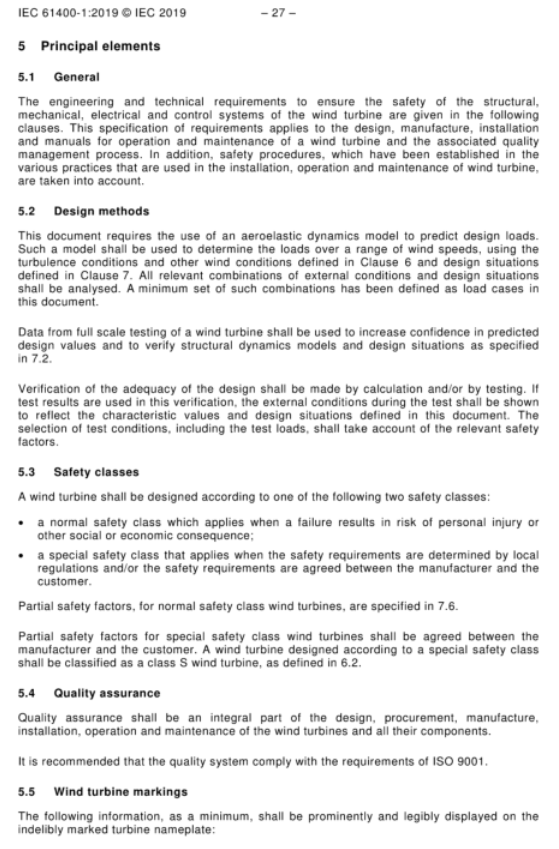
5 Principal elements

5.1 General

The engineering and technical requirements to ensure the safety of the structural, mechanical, electrical and control systems of the wind turbine are given in the following clauses. This specification of requirements applies to the design, manufacture, installation and manuals for operation and maintenance of a wind turbine and the associated quality management process. In addition, safety procedures, which have been established in the various practices that are used in the installation, operation and maintenance of wind turbine, are taken into account.

5.2 Design methods

This document requires the use of an aeroelastic dynamics model to predict design loads. Such a model shall be used to determine the loads over a range of wind speeds, using the turbulence conditions and other wind conditions defined in Clause 6 and design situations defined in Clause 7. All relevant combinations of external conditions and design situations shall be an alysed. A minimum set of such combinations has been defined as load cases in this document.

Data from full scale testing of a wind turbine shall be used to increase confidence in predicted design values and to verify structural dynamics models and design situations as specified in 7.2.

Verification of the adequacy of the design shall be made by calculation and/or by testing. If test results are used in this verification, the external conditions during the test shall be shown to reflect the characteristic values and design situations defined in this document. The selection of test conditions, including the test loads, shall take account of the relevant safety factors.

5.3 Safety classes

A wind turbine shall be designed according to one of the following two safety classes:

·a normal safety class which applies when a failure results in risk of personal injury or other social or economic consequence;

·a special safety class that applies when the safety requirements are determined by local regulations and/or the safety requirements are agreed between the manufacturer and the customer.

Partial safety factors, for normal safety class wind turbines, are specified in 7.6.

Partial safety factors for special safety class wind turbines shall be agreed between the manufacturer and the customer. A wind turbine designed according to a special safety class shall be classified as a class S wind turbine, as defined in 6.2.

5.4 Quality assurance

Quality assurance shall be an integral part of the design, procurement, manufacture, installation, operation and maintenance of the wind turbines and all their components.

It is recommended that the quality system comply with the requirements of ISO 9001.

5.5 Wind turbine markings

The following information, as a minimum, shall be prominently and legibly displayed on the indelibly marked turbine nameplate:

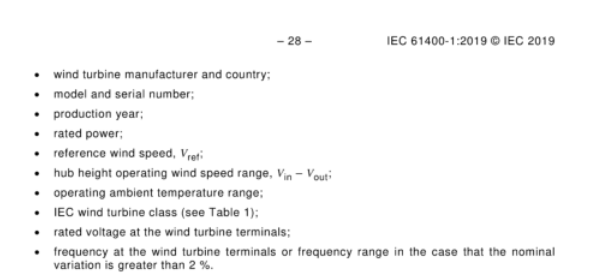
wind turbine manufacturer and country;

model and serial number;

production year;

rated power;

reference wind speed,Vref;

hub height operating wind speed range,Vin−Vout;

operating ambient temperature range;

IEC wind turbine class (see Table 1);

rated voltage at the wind turbine terminals;

frequency at the wind turbine terminals or frequency range in the case that the nominal variation is greater than 2 %.

5 核心基础要素

5.1 总则

后续条款规定了保障风机结构、机械、电气及控制系统安全的工程技术要求。本规范适用于风力发电机组的设计、制造、安装、运维手册编制及配套全流程质量管理工作;同时纳入风机安装、运行、维护各环节通用规范中已确立的安全作业流程。

5.2 设计方法

本标准要求采用气动弹性动力学模型计算设计载荷。该模型需结合第 6 章规定的湍流、各类风况条件与第 7 章规定的设计工况,计算全风速区间下机组承受荷载;需分析所有外部环境与设计工况的有效组合,本标准已划定最低限度组合作为标准载荷工况。

需采用整机全尺寸试验数据验证设计计算结果的可靠性,同时校验 7.2 条款规定的结构动力学模型与设计工况。

设计合理性需通过计算、试验或二者结合完成验证。若采用试验数据验证,试验外部环境必须匹配本标准规定的特征参数与设计工况;试验条件(含试验加载荷载)选取过程需充分考虑对应分项安全系数。

5.3 安全等级

风机设计需选用以下两类安全等级之一:

常规安全等级:机组失效会造成人员伤亡、其他社会或经济损失时适用;

特殊安全等级:安全要求由当地法规规定,或由设备制造商与客户协商确定时适用。

常规安全等级风机对应的分项安全系数见 7.6 条款。

特殊安全等级风机的分项安全系数由供需双方协商确定;按特殊安全等级设计的风机归类为 6.2 条款定义的 S 级风机。

5.4 质量保证

质量保证体系需贯穿风机及其全部零部件的设计、采购、制造、安装、运行、维护全生命周期。

推荐质量管理体系符合 ISO 9001 标准要求。

5.5 风机标识铭牌

风机永久性铭牌上,至少需清晰醒目标注以下全部信息:

·风机制造厂商及所属国家;

·机型型号与设备序列号;

·生产年份;

·额定功率;

·参考风速Vref;

·轮毂高度运行风速区间,切入风速Vin至切出风速Vout;

·运行环境温度范围;

·IEC 风机等级(见表 1);

·风机接线端子额定电压;

·风机接线端子额定频率;若标称频率波动幅度大于 2%,则标注频率区间。

简单总结

本章为标准核心基础章节,明确风机全流程适用范围、气动弹性模型载荷计算设计方法、两类安全分级规则、全生命周期质量管控要求,同时规定风机铭牌必须标注的最低技术信息清单,是风机设计、制造、验收、运维的通用基础准则。

今天就学到这里,明天我们继续学习,每天十分钟大家一起学标准。

来源:智慧强学斋
ACTMechanicalSystem湍流通用ADSUM电机控制试验电气
著作权归作者所有,欢迎分享,未经许可,不得转载
首次发布时间:2026-08-04
最近编辑:21天前
强学斋
硕士 签名征集中
获赞 19粉丝 66文章 161课程 0
点赞
收藏
作者推荐

大家一起学标准之IEC61400-1(1)

对于上班族,上下班的路上都会耗费大量的时间,很多人为了高效的利用时间,都会抓紧利用通勤时间进行学习。上下班的路上不管是坐公交地铁还是自己开车或骑自行车,都很难利用纸质的书籍或电子书进行学习,一般都是听音频的学习资料。标准对于风电行业是十分重要的,一些重要的标准我一般都会放到手边随时翻阅。而音频的规范资料是很少的,一般都是纸质或者电子版的,就算上下班的路上坐公交地铁,一只手扶着栏杆,另一只手拿着纸质规范或电子书也是非常困难的。我也尝试过把电子版的规范转成音频,但效果都不太好,免费软件朗读的声音非常生硬。直到我发现用公众 号的听全文朗读效果是最好的,利用这个功能上下班的路上就可以听规范了。从今天开始,每个工作日的早上,我都会截取一段英文规范并翻译成中文,用十分钟的时间大家一起学标准。今天就从EIC61400-1开始。 INTERNATIONAL ELECTROTECHNICAL COMMISSIONWIND ENERGY GENERATION SYSTEMS -Part 1: Design requirementsFOREWORDThe International Electrotechnical Commission (IEC) is a worldwide organization for standardization comprising all national electrotechnical committees (IEC National Committees). The object of IEC is to promote international co-operation on all questions concerning standardization in the electrical and electronic fields. To this end and in addition to other activities, IEC publishes International Standards, Technical Specifications, Technical Reports, Publicly Available Specifications (PAS) and Guides (hereafter referred to as ‘IEC Publication(s)’). Their preparation is entrusted to technical committees; any IEC National Committee interested in the subject dealt with may participate in this preparatory work. International, governmental and non-governmental organizations liaising with the IEC also participate in this preparation. IEC collaborates closely with the International Organization for Standardization (ISO) in accordance with conditions determined by agreement between the two organizationsThe formal decisions or agreements of IEC on technical matters express, as nearly as possible, an international consensus of opinion on the relevant subjects since each technical committee has representation from interested IEC National CommitteesIEC Publications have the form of recommendations for international use and are accepted by IEC National Committees in that sense. While all reasonable efforts are made to ensure that the technical content of IEC Publications is accurate, IEC cannot be held responsible for the way in which they are used or for any misinterpretation by any end userIn order to promote international uniformity. IEC National Committees undertake to apply IEC Publications transparently to the maximum extent possible in their national and regional publications. Any divergence between any IEC Publication and the corresponding national or regional publication shall be clearly indicated in the latter.IEC itself does not provide any attestation of conformity. Independent certification bodies provide conformity assessment services and, in some areas, access to IEC marks of conformity. IEC is not responsible for any services carried out by independent certification bodies.All users should ensure that they have the latest edition of this publicationNo liability shall attach to IEC or its directors, employees, servants or agents including individual experts and members of its technical committees and IEC National Committees for any personal injury, property damage or other damage of any nature whatsoever, whether direct or indirect, or tor costs (including legal tees) and expenses arising out of the publication, use of, or reliance upon, this IEC Publication or any other IEC Publications.Attention is drawn to the Normative references cited in this publication. Use of the referenced publications is indispensable for the correct application of this publication.Attention is drawn to the possibility that some of the elements of this IEC Publication may be the subject of patent rights. IEC shall not be held responsible for identifying any or all such patent rights.International Standard IEC 61400-1 has been prepared by IEC technical committee 88: Wind energy generation systems.This fourth edition cancels and replaces the third edition published in 2005 and Amendment 1:2010. This edition constitutes a technical revisionThis edition includes the following significant technical changes with respect to the previous edition:a) general update and clarification of references and requirements;b) extension of wind turbine classes to allow for tropical cyclones and high turbulence;c)Weibull distribution of turbulence standard deviation for normal turbulence model (NTM);d)updated design load cases (DLCs), in particular DLC 2.1 and 2.2;e) revision of partial safety factor specifications;f) major revision of Clauses 8, 10 and 11;g) introduction of cold climate requirements, Clause 14;h)new Annex B on design load cases for site-specific or special class S wind turbine design or site suitability assessment;i)new Annex J on prediction of the extreme wind speed of tropical cyclones by using Monte Carlo simulation method;j)new Annex K on calibration of structural material safety factors and structural design assisted by testing;k)new Annex L on assessment and effects of icing climate;l)new Annex M on medium wind turbines.The text of this International Standard is based on the following documents:Full information on the voting for the approval of this International Standard can be found in the report on voting indicated in the above table.This document has been drafted in accordance with the ISO/IEC Directives, Part 2.A list of all parts of the IEC 61400 series, published under the general title Wind energy generation systems, can be found on the IEC website.Future standards in this series will carry the new general title as cited above. Titles of existing standards in this series will be updated at the time of the next edition.The committee has decided that the contents of this document will remain unchanged until the stability date indicated on the IEC website under "http://webstore.iec.ch" in the data related to the specific document. At this date, the document will bereconfirmed,withdrawn,replaced by a revised edition, oramended.A bilingual version of this publication may be issued at a later date.IMPORTANT - The 'colour inside' logo on the cover page of this publication indicates that it contains colours which are considered to be useful for the correct understanding of its contents. Users should therefore print this document using a colour printer.国际电工委员会风能发电系统第 1 部分:设计要求前言国际电工委员会(IEC)是由各国家电工委员会(IEC 国家委员会)组成的全球性标准化组织。IEC 的宗旨是就电气与电子领域标准化相关各项事务开展国际合作。为此,IEC 除编制其他文件外,还发布国际标准、技术规范、技术报告、可公开提供规范(PAS)以及指南(下文统称 “IEC 出版物”)。IEC 出版物的编制工作委托各技术委员会负责;任何对该技术委员会所辖主题感兴趣的 IEC 国家委员会均可参与此项编制工作。与 IEC 建立联络关系的国际组织、政府及非政府机构也会参与编制。IEC 与国际标准化组织(ISO)依据双方商定的条件开展紧密合作。IEC 就技术事项做出的正式决议或协议,尽可能代表所有相关主题的国际共识;各技术委员会均有全部感兴趣的 IEC 国家委员会派代表参与。IEC 出版物作为国际推荐文件,由各 IEC 国家委员会采纳执行。尽管 IEC 已尽合理努力确保出版物技术内容准确无误,但 IEC 不对出版物的使用方式或任何使用者的误读承担任何责任。为推动国际层面规范统一,各 IEC 国家委员会承诺在本国及地区性出版物中最大限度透明采用 IEC 出版物。若本国 / 地区出版物与对应 IEC 出版物存在差异,必须在后者中清晰标注。IEC 本身不提供符合性认证;独立认证机构开展符合性评定业务,部分场景下可使用 IEC 符合性标识。IEC 不对独立认证机构开展的相关服务承担责任。本出版物所有使用者应确保自身持有最新版本。IEC 及其董事、雇员、工作人员、代理人(包括特邀专家、技术委员会成员与 IEC 国家委员会成员),不对因本出版物、其他 IEC 出版物的编制、使用或引用而产生的任何人身伤害、财产损毁,或是各类直接、间接损失、费用(含诉讼费与各项开支)承担任何法律责任。请注意本文件中引用的规范性参考文献,引用文件是本标准正确应用不可或缺的依据。提请注意:本 IEC 出版物部分条款可能涉及专利权,IEC 不承担识别任一或全部此类专利权的义务。本国际标准 IEC 61400-1 由 IEC 第 88 技术委员会(风能发电系统)编制。本第四版替代 2005 年发布的第三版及其 1 号修改单(2010 版),属于技术性修订版本。相较于上一版,本版主要技术修订内容如下:a)全面更新并厘清参考文献与各项要求;b)拓展风电机组等级划分,新增适用于台风、高湍流环境的机组类别;c)正常湍流模型(NTM)采用威布尔分布定义湍流标准差;d)更新设计载荷工况(DLC),重点修订 DLC 2.1、DLC 2.2;e)修订分项安全系数相关规定;f)对第 8、10、11 章进行大幅改版;g)新增第 14 章,补充寒冷气候环境设计要求;h)新增附录 B,针对定制化机型、S 类特殊机组设计或场址适配性评估给出设计载荷工况;i)新增附录 J,采用蒙特卡洛模拟法预测台风极端风速;j)新增附录 K,明确结构材料安全系数校准方法与试验辅助结构设计规则;k)新增附录 L,给出寒冷气候环境影响评估方法;l)新增附录 M,针对中型风电机组提出设计规范。本国际标准文本编制依托下列文件:本标准审批投票完整信息可查阅上表所列投票报告。本文件按照 ISO/IEC 导则第 2 部分起草编制。IEC 官网可查阅以《风能发电系统》作为总标题发布的全部 IEC 61400 系列标准清单。该系列后续新标准将统一使用上述总标题;本系列现有标准将在下次改版时同步更新标题。IEC 技术委员会规定:在 IEC 官网网页商店(http://webstore.iec.ch)对应本条文档的稳定性标注日期前,本文件内容保持不变;到期后本文件将执行以下任一处置:·复审确认继续有效·撤销废止·发布修订版替代·发布修改单修订本出版物后续可能发布双语版本。⚠️ 重要提示:本出版物封面的 “彩印标识” 说明文件内含彩色图示,对准确理解条文内容具备关键作用,建议使用者采用彩色打印机打印本文件。今天这段规范是IEC 61400-1:2019《风力发电机组 第 1 部分:设计要求》的前言部分,介绍了 IEC 标准化组织的职能、该标准的版权责任与引用规范,并列出了第四版替代第三版标准的修改单,整体完成技术修订。新版标准更新了引用文件、风机风况等级、湍流模型、设计载荷工况与分项安全系数,大幅修订核心章节,并新增低温、覆冰、台风、中型风机等多项附录与专项条款,同时标注了标准编制依据、后续版本维护规则与印刷使用注意事项。今天就学到这里,明天我们再继续学习,每天十分钟大家一起学标准。来源:智慧强学斋

未登录
还没有评论
课程
培训
服务
行家
VIP会员 学习计划 福利任务
下载APP
联系我们
帮助与反馈