首页/文章/ 详情

大家一起学标准之IEC61400-1(3)
1月前浏览534
点击听全文,大家继续一起学IEC61400-1。

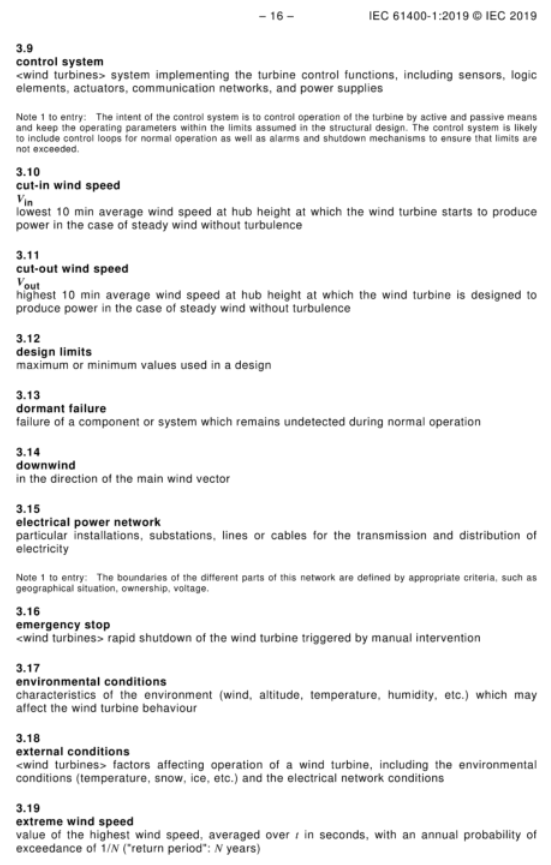
3 Terms and definitions

3 术语和定义

For the purposes of this document, the following terms and definitions apply.
ISO and IEC maintain terminological databases for use in standardization at the following addresses:
·IEC Electropedia: available at
http://www.electropedia.org/http://www.electropedia.org/
·ISO Online browsing platform: available at
http://www.iso.org/obphttp://www.iso.org/obp
本标准适用以下术语及定义。
ISO 与 IEC 在以下平台维护标准化专用术语数据库:
IEC Electropedia 百科平台:网址 http://www.electropedia.org/
ISO 在线浏览平台:网址 http://www.iso.org/obp

3.1 annual average

3.1 年平均值

mean value of a set of measured data of sufficient size and duration to serve as an estimate of the expected value of the quantity.
具备足够样本量与观测时长的一组测量数据的平均值,用于估算该物理量的期望值。
Note 1 to entry: The averaging time interval should be a whole number of years (e.g. 10) to average out non-stationary effects such as seasonality.
本条注释 1:平均时长需取整数年(例如 10 年),以抹平季节变化等非稳态影响。

3.2 annual average wind speed

3.2 年平均风速

Vave
wind speed averaged according to the definition of annual average.
按照年平均值定义计算得到的平均风速。

3.3 auto-reclosing cycle

3.3 自动重合闸周期

event with a time period, varying from approximately 0,01 s to a few seconds, during which a breaker released after a grid fault is automatically reclosed and the line is reconnected to the network.
电网故障跳闸后的断路器,在约 0.01 秒至数秒时长内自动合闸,使线路重新接入电网的过程。

3.4 blocking

3.4 锁止装置

use of a mechanical pin or other device (other than the ordinary mechanical brake) that cannot be released accidentally to prevent movement, for instance of the rotor shaft or yaw mechanism.
< 风电机组专用 > 采用机械插销或其他不会意外解锁的装置(区别于常规机械制动器),用于限制风轮主轴、偏航机构等部件发生位移或转动。

3.5 brake

3.5 制动器

device capable of reducing the rotor speed or stopping rotation.
能够降低风轮转速或完全锁止风轮转动的装置。
Note 1 to entry: The brake may operate on, for example, aerodynamic, mechanical or electrical principles.
本条注释  1:制动器可依据气动、机械、电气原理实现制动功能。

3.6 characteristic value

3.6 特征值

value having a prescribed probability of not being attained (i.e. an exceedance probability of less than or equal to a prescribed amount).
规定了不被超越概率的取值(即该数值被超越的概率小于等于给定限值)。

3.7 complex terrain

3.7 复杂地形

surrounding terrain that features significant variations in topography and terrain obstacles that may cause flow distortion.
周边地形地势起伏剧烈,且存在易造成气流畸变的地形障碍物的地貌区域。

3.8 control functions

3.8 控制功能

functions of the control system that, based on information about the condition of the wind turbine and/or its environment, adjust the turbine in order to maintain it within its operating limits.
控制系统依据机组自身状态、外部环境信息对机组进行调节,使其运行参数始终处于设计运行限值内的各项功能。

3.9 control system

3.9 控制系统

system implementing the turbine control functions, including sensors, logic elements, actuators, communication networks, and power supplies.
实现机组全部控制功能的整套系统,包含传感器、逻辑运算单元、执行机构、通信网络与供电电源。
Note 1 to entry: The intent of the control system is to control operation of the turbine by active and passive means and keep the operating parameters within the limits assumed in the structural design. The control system is likely to include control loops for normal operation as well as alarms and shutdown mechanisms to ensure that limits are not exceeded.
本条注释  1:控制系统通过主动、被动方式管控机组运行,保证运行参数不超出结构设计预设限值;系统包含常规运行控制回路,同时配备报警与停机机构,确保运行限值不会被突破。

3.10 cut-in wind speed

3.10 切入风速

Vin
lowest 10 min average wind speed at hub height at which the wind turbine starts to produce power in the case of steady wind without turbulence.
无湍流稳态风工况下,轮毂高度处风机开始并网发电的最低 10 分钟平均风速。

3.11 cut-out wind speed

3.11 切出风速

Vout
highest 10 min average wind speed at hub height at which the wind turbine is designed to produce power in the case of steady wind without turbulence.
无湍流稳态风工况下,轮毂高度处风机设计允许持续发电的最高 10 分钟平均风速。

3.12 design limits

3.12 设计限值

maximum or minimum values used in a design.
设计工作中采用的上限值或下限值。

3.13 dormant failure

3.13 隐性故障

failure of a component or system which remains undetected during normal operation.
部件或系统发生失效,但在常规运行过程中无法被检测发现的故障类型。

3.14 downwind

3.14 下风侧

in the direction of the main wind vector.
顺着主导风向的方位。

3.15 electrical power network

3.15 电力电网

particular installations, substations, lines or cables for the transmission and distribution of electricity.
用于电能输送、分配的专用设施、变电站、输电线路及电缆的整体。
Note 1 to entry: The boundaries of the different parts of this network are defined by appropriate criteria, such as geographical situation, ownership, voltage.
本条注释  1:电网各组成部分的划分边界依据地理位置、资产权属、电压等级等规范条件界定。

3.16 emergency stop

3.16 紧急停机

rapid shutdown of the wind turbine triggered by manual intervention.
由人工手动操作触发的机组快速停机动作。

3.17 environmental conditions

3.17 环境条件

characteristics of the environment (wind, altitude, temperature, humidity, etc.) which may affect the wind turbine behaviour.
能够影响风机运行状态的环境要素,包括风况、海拔、温度、湿度等。

3.18 external conditions

3.18 外部条件

factors affecting operation of a wind turbine, including the environmental conditions (temperature, snow, ice, etc.) and the electrical network conditions.
< 风电机组专用 > 所有会影响风机运行的外界因素,包含温湿度、积雪覆冰等环境条件,以及电网工况条件。

3.19 extreme wind speed

3.19 极端风速

value of the highest wind speed, averaged over t in seconds, with an annual probability of exceedance of 1/N ("return period": N years).
取t秒时长进行平均计算得到的最大风速值,该风速年超越概率为1/N,N即为以年为单位的重现期。
Note 1 to entry: In this document, return periods of N = 50 years and N = 1 year and averaging time intervals of t = 3 s and t = 10 min are used. In popular language, the less precise term, survival wind speed, is often used. In this document, however, the turbine is designed using extreme wind speeds for design load cases.
本条注释 1:本标准采用50 年、1 年两类重现期,以及3 秒、10 分钟两种平均时距。行业内常使用严谨性不足的俗称 “生存风速”,但本标准所有设计载荷工况均统一采用 “极端风速” 作为规范术语开展机组设计。

简单总结

本章是 IEC 61400-1:2019 第 3 章基础术语定义,统一规范了风机风速指标、启停边界、制动锁止结构、控制系统、故障类型、地形电网环境、极端风重现期等核心专业名词,为后续载荷工况、风况设计提供统一释义基准。

今天就学到这里,明天我们继续学习,每天十分钟大家一起学标准。

来源:智慧强学斋
ACTMechanicalSystem湍流电源电力通信UM电机Electric控制电气
著作权归作者所有,欢迎分享,未经许可,不得转载
首次发布时间:2026-07-20
最近编辑:1月前
强学斋
硕士 签名征集中
获赞 19粉丝 66文章 161课程 0
点赞
收藏
作者推荐

IEC61400-1风力发电机组第1部分:设计要求解析(8)结构设计

IEC 61400-1:2019第7章Structural Design是风电机组设计的核心核心章节,覆盖载荷定义、全系列设计载荷工况(DLC)、载荷计算、极限疲劳稳定挠度四大类极限状态与分项安全系数体系,是风电整机、叶片、塔筒、基础设计与仿真的强制依据。风力发电机组完要通过整性验证,所有承载部件必须通过计算、试验或两者结合,验证其极限强度和疲劳强度,确保达到可接受的安全水平。载荷分类重力与惯性载荷重力与惯性载荷源于重力、振动、旋转及地震活动,设计文档需明确塔架垂直度公差,并在结构分析中单独考虑其对重力载荷的作用。气动载荷气动载荷由气流与机组部件的相互作用产生,受风速、湍流、转速、空气密度及气动外形等影响。 作动载荷作动载荷来自机组运行与控制,计算时需考虑作动力范围,机械制动还需计入温度与老化对摩擦、弹簧力或压力的影响。 其他载荷还需适当考虑尾流、冲击、冰载荷及涡激振动引起的塔架载荷等。设计工况风况与机组状态的组合本章按照风力发电机组全生命周期内的运行状态与设计情况,将载荷工况系统性地划分为8大类:正常发电(DLC1)、故障状态(DLC2)、启动(DLC3)、正常停机(DLC4)、紧急停机(DLC5)、停机/空转(DLC6)、停机后待维修(DLC7)以及运输/维护(DLC8)。通过匹配不同的风况模型(如NTM、ETM、ECD、EWS、EOG、EWM、NWP等)与各类环境或故障条件,明确了每种工况下应采用的分析类型(U-极限分析或F-疲劳分析)及对应的部分安全系数(N-正常、A-非正常)。其核心设计原则是:对多年一遇的极端事件进行极限强度分析,对频繁发生的常规工况进行疲劳分析,从而确保机组在全寿命周期内各类状态下均具备足够的结构安全裕度。以后我会单独用整篇文章来对每个工况的详细解读,这篇只做简略的描述。安全系数载荷分项系数 γf用于将特征载荷转化为设计载荷,以考虑载荷的不确定性及不利偏差。抗力分项系数 γM替代旧版材料系数,用于将特征抗力(或材料强度)转化为设计抗力,以考虑材料性能、抗力模型及几何参数的不确定性。考虑材料强度相对于特征值的不利偏差与不确定性;截面抗力或结构承载能力评估的不准确性;几何参数的不确定性;结构材料性能与控制试样测试值之间关系的不确定性;换算系数的不确定性。失效后果系数 γn用于区分不同部件失效后对整机的影响程度,以反映失效后果的严重性。在极限状态校核中,上述三类系数通过极限状态函数组合使用:γn⋅S(Fd)≤Rd即:γn⋅γf⋅Fk≤γMRk。三者共同确保设计载荷不超过设计抗力,且不同失效后果等级的部件获得与其重要性相匹配的安全裕度。 极限状态校核ULS 极限强度验证结构构件在极端载荷作用下,其材料强度是否足以抵抗破坏。该分析针对的是材料强度破坏、截面断裂、连接失效等承载能力丧失的失效模式。FLS 疲劳验证结构在循环载荷长期作用下,不会因累积损伤而导致疲劳破坏。疲劳强度定义为与给定循环次数相关联的应力幅值。SLS 稳定塔筒屈曲校核以 DLC6 极端风为主控,规范隐含:薄壁塔筒初始制造椭圆度缺陷折算进γM,不用额外人为附加缺陷系数;基础倾覆验算采用特征荷载乘γf,抗倾覆抗力用地基特征承载力除以γM。DLS 挠度验证在设计载荷条件下,不会发生影响结构完整性的过大变形,最典型的校核是叶片与塔筒之间的机械干涉(扫塔)。总结本章是风机结构设计核心,采用极限状态加分项安全系数体系,明确强度、疲劳、稳定、挠度四类校核要求。以标准化DLC 载荷工况为设计主线,覆盖运行、故障、启停、紧急停机、吊装运维全场景,各工况绑定专属风模型。第四版标准重构抗力分项系数体系,统一全工况安全裕度,划定叶片扫塔挠度等刚性底线,同时允许依托试验数据合理优化系数。规定以气动弹性时程仿真为核心载荷计算手段,搭配极值外推、疲劳损伤累积方法,作为结构校核的统一依据。用一句话总结:本章用统一的分项系数体系,通过覆盖全场景的 DLC 载荷工况,以气动弹性仿真为手段,完成强度、疲劳、稳定、挠度四大极限状态校核,并允许用试验数据校准安全系数,确保风电机组全寿命周期的结构完整性。来源:智慧强学斋

未登录
还没有评论
课程
培训
服务
行家
VIP会员 学习计划 福利任务
下载APP
联系我们
帮助与反馈