【新文速递】2026年6月3日复合材料SCI期刊最新文章
今日更新:Composite Structures 3 篇,Composites Part A: Applied Science and Manufacturing 8 篇,Composites Part B: Engineering 4 篇,Composites Science and Technology 1 篇
Composite Structures
Behavior and modeling of novel FRP-UHPC hybrid reinforcing bars with a strain-hardening behavior
Yu-Yi Ye, Jun-Jie Zeng, Wai-Meng Quach, Jie-Kai Zhou, Wan-Yang Gao, Cheng Jiang
doi:10.1016/j.compstruct.2026.120522
具有应变硬化性能的新型FRP-UHPC复合钢筋的性能与建模
Recently, hybrid bars comprising an external fiber-reinforced polymer (FRP) tube, a center FRP bar and sandwiched ultra-high-performance concrete (UHPC) (referred to as FRP-UHPC hybrid bars or simply hybrid bars) have been proposed to mitigate the premature buckling failure of FRP bars under compression. Previous studies have shown that the central FRP bar in hybrid bars exhibits significantly better compressive behavior than a bare FRP bar under compression. However, its response is influenced by the surrounding UHPC layer and FRP confinement effects, which has not been explicitly accounted for in existing models. Consequently, a unified predictive framework capable of capturing the full compressive response of hybrid bars is still lacking. This paper develops, for the first time, a unified system-level an alytical model for hybrid bars under axial compression. The proposed model incorporates the responses of the FRP tube, UHPC layer, and central FRP bar, and effectively captures the strain-hardening compressive behavior of hybrid bars, with the key interactions and influences among components reflected through the adopted formulations. This is achieved by combining a modified three-segment model for FRP-confined UHPC, a simplified biaxial representation of the FRP tube, and a stress–strain polyline representation for the central FRP bar. The model predicts the average stress–strain response of hybrid bars with good agreement with experimental results, providing a reliable an alytical tool for design applications.
最近,为了减轻FRP筋在压缩作用下的过早屈曲破坏,提出了由外部纤维增强聚合物(FRP)管、中心FRP筋和夹层超高性能混凝土(UHPC)组成的混合筋(简称FRP-UHPC混合筋或简称混合筋)。先前的研究表明,混合筋的中心FRP筋在压缩下表现出明显优于裸FRP筋的抗压性能。然而,其响应受到周围UHPC层和FRP约束效应的影响,而现有模型尚未明确考虑这些影响。因此,一个统一的预测框架,能够捕捉混合杆的全部压缩响应仍然缺乏。本文首次建立了轴压作用下混合动力杆的统一系统级分析模型。该模型综合了FRP管、UHPC层和中央FRP筋的响应,有效地捕捉了混合筋的应变硬化压缩行为,并通过所采用的公式反映了构件之间的关键相互作用和影响。这是通过结合改进的FRP约束UHPC的三段模型,FRP管的简化双轴表示和中央FRP筋的应力-应变折线表示来实现的。该模型预测的混合杆的平均应力应变响应与试验结果吻合较好,为设计应用提供了可靠的分析工具。
Anisotropic thermomechanically coupled and neural-network accelerated micromechanical an alysis of temperature-dependent storage and loss modul i in highly aligned aramid nanocomposites
Xiaodong Xia, Jianchen Tang, Ruiyang Li, Jirong Fan, George J. Weng
doi:10.1016/j.compstruct.2026.120520
高排列芳纶纳米复合材料中温度依赖的存储和损耗模量的各向异性热力学耦合和神经网络加速微力学分析
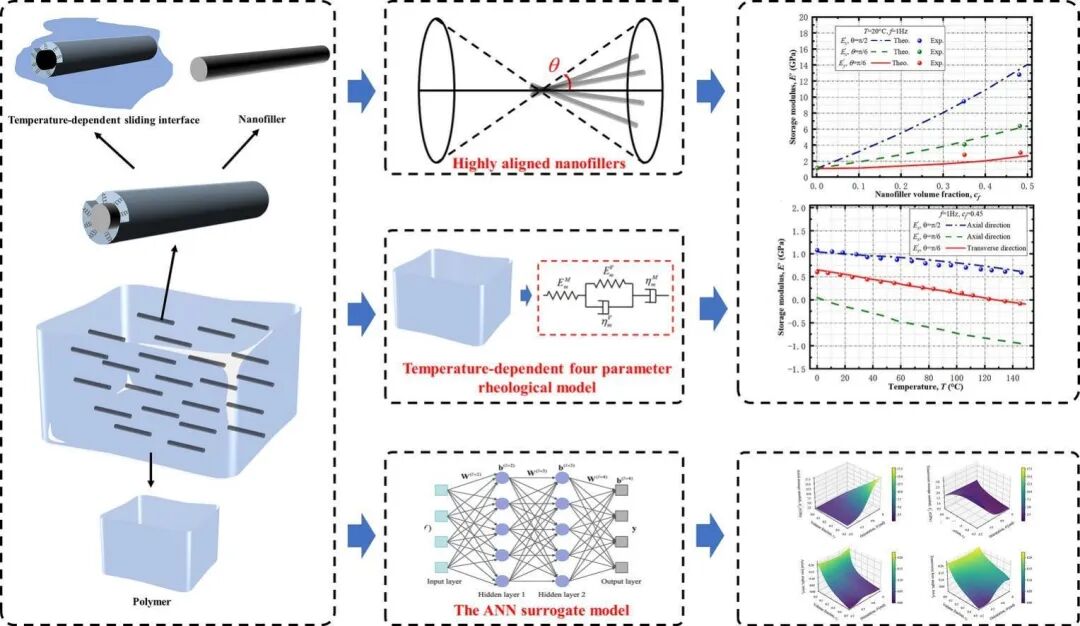
In contrast to isotropic nanocomposites containing randomly distributed nanofillers, highly aligned nanocomposites have garnered significant attention due to the extraordinary mechanical behaviors along the alignment direction. In this study, an anisotropic thermomechanically coupled and neural-network accelerated micromechanical theory is established for the temperature-dependent storage and loss modu li of highly aligned aramid nanocomposites. Firstly, the time–temperature superposition principle is adopted to characterize the temperature-dependent Laplacian transformed constitutive relation of constituents. Then, a temperature-dependent sliding interface effect is introduced between the nanofiller and matrix with the interfacial thermal degradation. Subsequently, the thermomechanically coupled homogenization scheme is developed to determine the temperature and orientation dependent anisotropic viscoelastic behavior of highly aligned aramid nanocomposites. Finally, an artificial neural network (ANN) is developed as a surrogate for rapid evaluation of anisotropic temperature-dependent storage and loss mod uli. The predicted temperature-dependent anisotropic complex modu li are calibrated with the experiment of highly aligned aramid nanofiller/poly(vinyl alcohol) nanocomposites. The synergistic influences of nanofiller orientation and temperature on the viscoelastic characteristics of highly aligned aramid nanocomposites are discussed in detail. This research provides valuable guidance for the microstructural design of highly aligned aramid nanocomposites.
与含有随机分布的纳米填料的各向同性纳米复合材料相比,高度排列的纳米复合材料由于在排列方向上具有非凡的力学行为而引起了人们的广泛关注。在这项研究中,建立了一个各向异性热力学耦合和神经网络加速的微力学理论,用于研究高度排列的芳纶纳米复合材料的温度依赖性存储和损耗模量。首先,采用时间-温度叠加原理对成分的温度相关拉普拉斯变换本构关系进行表征;然后,在纳米填料与基体之间引入了温度相关的滑动界面效应,并伴有界面热降解。随后,建立了热-机械耦合均质方案,以确定高度排列的芳纶纳米复合材料的温度和取向相关的各向异性粘弹性行为。最后,提出了一种人工神经网络(ANN)作为快速评估各向异性温度相关存储和损耗模量的替代方法。通过高度排列的芳纶纳米填料/聚乙烯醇纳米复合材料实验,对预测的温度相关各向异性复合模量进行了校正。详细讨论了纳米填充剂取向和温度对高排列芳纶纳米复合材料粘弹性特性的协同影响。该研究为高排列芳纶纳米复合材料的微结构设计提供了有价值的指导。
Steel reinforcement effects on early-age damage evolution of mass concrete: A fully coupled chemo–thermo–mechanical–damage phase-field approach
Jian Ding, Xin Wang, Haim Waisman, Lining Ding, Shui Liu, Zhishen Wu
doi:10.1016/j.compstruct.2026.120497
钢筋对大体积混凝土早期损伤演化的影响:一种完全耦合的化学-热-机械-损伤相场方法
Early-age cracking is common in mass reinforced concrete (RC) due to the coupled effects of cement hydration heat, temperature gradients, shrinkage, and mechanical restraint, leading to reduced durability and accelerated steel corrosion. The influence of steel reinforcement is not limited to macroscopic crack patterns, but fundamentally lies in its regulation of early-age damage initiation and evolution. However, existing experimental methods and conventional numerical models have difficulty capturing the continuous transition from damage to cracking, which hinders a mechanistic understanding of reinforcement effects. To address this limitation, a fully coupled chemo–thermo–mechanical–damage model based on a phase-field approach is developed. The model is derived from a unified free-energy functional and satisfies the second law of thermodynamics, enabling a continuous description of damage initiation, evolution, and crack formation within a single framework. The model is implemented in ABAQUS using UMAT and UMATHT subroutines and validated against a mass concrete wall experiment, demonstrating good internal consistency. Further a nalyses reveal that steel reinforcement primarily regulates damage evolution by modifying internal restraint and stress redistribution, rather than merely delaying damage initiation. In contrast, expansive agents mainly postpone damage onset through stress adjustment, while their influence on subsequent damage evolution remains limited. The proposed framework provides a mechanistic basis for understanding and quantitatively a nalyzing reinforcement-controlled early-age damage and cracking, and offers theoretical support for early-age damage regulation toward long-term durability.
由于水泥水化热、温度梯度、收缩和机械约束的耦合作用,早期开裂在大体积钢筋混凝土(RC)中很常见,导致耐久性降低和钢腐蚀加速。钢筋的影响不仅限于宏观裂纹形态,其根本在于钢筋对早期损伤的起裂和演化的调控作用。然而,现有的实验方法和传统的数值模型很难捕捉到从损伤到开裂的连续转变,这阻碍了对钢筋效应的机理理解。为了解决这一限制,基于相场方法建立了一个完全耦合的化学-热-机械-损伤模型。该模型来源于统一的自由能泛函,满足热力学第二定律,能够在单一框架内连续描述损伤的发生、演化和裂纹的形成。利用UMAT和UMATHT子程序在ABAQUS中实现了该模型,并通过大体积混凝土墙体试验进行了验证,结果表明该模型具有良好的内部一致性。进一步的分析表明,钢筋主要通过改变内部约束和应力重分布来调节损伤演变,而不仅仅是延迟损伤的发生。膨胀剂主要通过应力调节延缓损伤发生,对后续损伤演化的影响有限。该框架为理解和定量分析钢筋控制的早期损伤和开裂提供了机制基础,并为早期损伤调控长期耐久性提供了理论支持。
Composites Part A: Applied Science and Manufacturing
Monolayer and multilayer biodegradable biocomposite blown films: Effect of poly (3-hydroxybutyrate-co-3-hydroxyvalerate) and talc on mechanical and barrier properties
Ehsan Pesaranhajiabbas, Amar K. Mohanty, Manjusri Misra
doi:10.1016/j.compositesa.2026.109990
单层和多层可生物降解生物复合吹膜:聚(3-羟基丁酸酯-co-3-羟基戊酸酯)和滑石对机械和屏障性能的影响
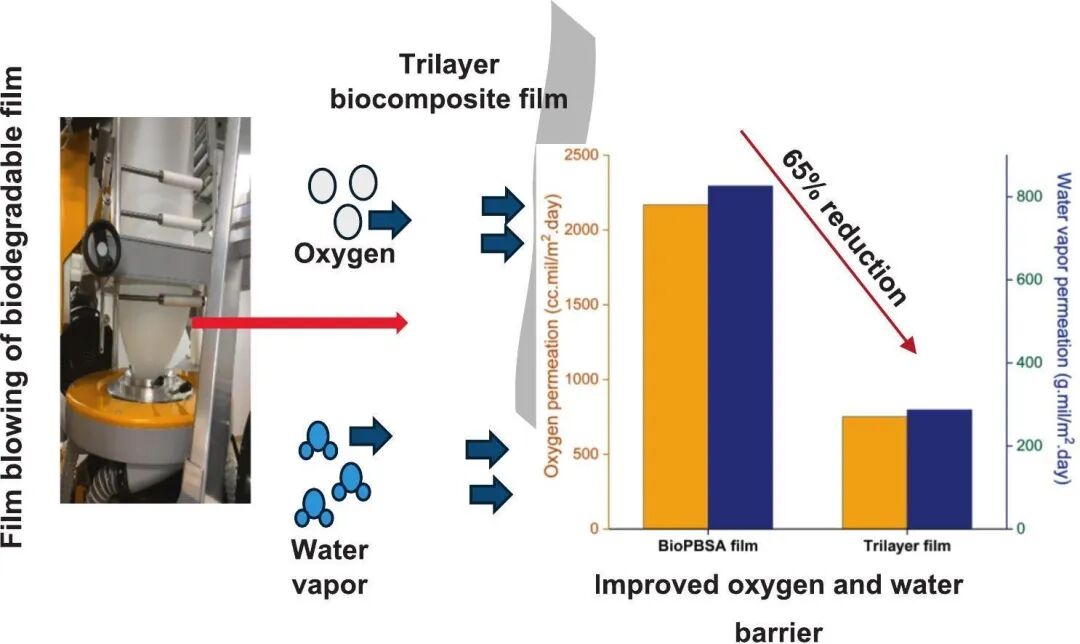
This study explores the blending of poly(butylene succinate-co-adipate) (PBSA) with poly(3-hydroxybutyrate-co-3-hydroxyvalerate) (PHBV) and talc to assess their effects on film processability, mechanical properties, and gas barrier performance in blown films. PHBV was incorporated into the PBSA matrix to boost stiffness and reduce oxygen and water vapor transmission rate. Extensional viscosity measurements were used to correlate rheological behavior with processability. Incorporation of 15 wt% PHBV notably improved the modulus and barrier performance of PBSA films without significantly compromising their deformability, although strain hardening behavior decreased, leading to processing instability. Incorporation of reactive peroxide developed a strain hardening behavior in biocomposites based on ternary biopolymer blends, as confirmed by extensional viscosity data. The addition of talc further enhanced stiffness and barrier properties but resulted in a decreased elongation at break. Trilayer films demonstrated improved processability compared to monolayer films, evidenced by increased film width during production. Notably, trilayer films containing talc in both the core and outer layers achieved an optimal balance of mechanical strength, gas barrier performance, and flexibility.
本研究探讨了聚(3-羟基丁酸酯-co-3-羟基戊酸酯)(PHBV)和滑石的共混,以评估它们对吹膜的薄膜加工性能、机械性能和气体阻隔性能的影响。PHBV被掺入PBSA基体中,以提高刚度,降低氧气和水蒸气的透射率。拉伸粘度测量用于将流变行为与可加工性联系起来。掺入15wt %的PHBV显著提高了PBSA薄膜的模量和屏障性能,但没有显著影响其变形能力,尽管应变硬化行为降低,导致加工不稳定。拉伸粘度数据证实,活性过氧化物的加入使三元生物聚合物共混物的生物复合材料具有应变硬化行为。滑石的加入进一步提高了硬度和阻隔性能,但导致断裂伸长率下降。与单层薄膜相比,三层薄膜表现出更好的可加工性,在生产过程中增加了薄膜宽度。值得注意的是,在芯层和外层都含有滑石粉的三层薄膜在机械强度、气体阻隔性能和柔韧性方面达到了最佳平衡。
Comparative an alysis on the adhesion of carbon-fiber-reinforced thermoplastic composite/aluminum joints after dielectric barrier discharge and localized low-pressure plasma discharge treatments
Jihyeon Lim, Unseok Jung, Jaewoo Kim, Ji Young Jo, Hunsu Lee
doi:10.1016/j.compositesa.2026.109989
介质阻挡放电和局部低压等离子体放电处理后碳纤维增强热塑性复合材料/铝接头附着力的对比分析
Joining dissimilar materials has become increasingly important as lightweight and recyclable materials like carbon fiber reinforced thermoplastic polymer (CFRTP) are being applied in the aerospace and automotive industries. Although adhesion with plasma treatment is highly effective, conventional plasma systems have key limitations, such as modest adhesion improvements, long process durations, and limited applicability to large-scale components. A novel plasma device, the localized low-pressure plasma discharge (LLPD), was designed to overcome these issues. The LLPD enables faster plasma treatment than atmospheric-pressure plasma and significantly reduces overall process duration, including evacuation time, while still achieving adhesion strength comparable to the highest value reported. This notable advancement is driven by the rapid and predominant formation of C–O functional groups over other oxygen functional groups, which directly promote epoxy ring-opening reactions and are crucial for substantial adhesion enhancement. The superior formation of C–O groups in LLPD, compared with other plasma devices, was clearly demonstrated through optical an alysis of the plasmas. Building on these findings, LLPD is a promising candidate for the aerospace and automotive industries, as it offers greater industrial compatibility and higher throughput than other existing plasma treatments, providing a solution for large-scale structures that remain unattainable with conventional plasma devices.
随着碳纤维增强热塑性聚合物(CFRTP)等轻质可回收材料在航空航天和汽车工业中的应用,连接不同材料变得越来越重要。尽管等离子体处理的粘附效果非常好,但传统的等离子体系统存在关键的局限性,例如粘附性能的改善幅度不大,工艺持续时间长,对大型部件的适用性有限。为了克服这些问题,设计了一种新型等离子体装置——局部低压等离子体放电(LLPD)。与常压等离子体相比,LLPD可以实现更快的等离子体处理,并显着缩短了整个过程的持续时间,包括疏散时间,同时仍然具有可与报道的最高值相媲美的粘附强度。这一显著的进步是由于C-O官能团比其他氧官能团快速形成,直接促进环氧环开环反应,对显著增强附着力至关重要。通过对等离子体的光学分析,可以清楚地证明LLPD中C-O基团的形成优于其他等离子体器件。基于这些发现,LLPD是航空航天和汽车工业的一个很有前途的候选者,因为它比其他现有的等离子体处理具有更大的工业兼容性和更高的吞吐量,为传统等离子体设备无法实现的大规模结构提供了解决方案。
Flexural performance of all-composite sandwich beams with modular continuous-fiber lattice cores
Jun Young Choi, Seonghun Hyeon, Sung-Hoon Ahn
doi:10.1016/j.compositesa.2026.109988
模块化连续纤维格芯全复合夹层梁的抗弯性能
Ultra-lightweight sandwich structures are essential for aerospace and mobility systems, yet conventional foam and honeycomb cores limit internal accessibility, recyclability, and geometric adaptability. This study presents a modular, winding-based all-composite sandwich architecture in which independently fabricated continuous-fiber lattice modules are assembled into highly open lattice-core beams. Discrete lattice modules are fabricated via robotic dry winding of carbon fibers on sacrificial 3D-printed scaffolds, achieving precise geometries at low relative densities (∼0.18–0.19). Three lattice topologies—simple cubic (SC), rectangular prism (RP), and hexagonal prism (HP)—are evaluated under three-point bending at span lengths of 120 mm and 180 mm. All configurations exhibit progressive, non-brittle deformation with significant displacement capacity. Among the tested topologies, RP and HP both improved flexural performance relative to SC. At the 120 mm span, HP reached the highest mean peak load of 741 ± 107 N and peak-load-to-mass ratio of 16.7 ± 2.3 N g⁻1, while RP showed comparable improvement with lower scatter. Comparison with literature shows that the proposed structures achieve competitive load-bearing performance within the low-mass region of the selected literature comparison. The results demonstrate that modular continuous-fiber lattice units can function as efficient open-cell cores for ultra-lightweight all-composite sandwich beams, offering a manufacturable route toward topology-tunable composite structures.
超轻的夹层结构对于航空航天和移动系统至关重要,然而传统的泡沫和蜂窝芯限制了内部的可达性、可回收性和几何适应性。本研究提出了一种模块化的、基于卷绕的全复合夹层结构,在这种结构中,独立制造的连续纤维晶格模块被组装成高度开放的晶格核心梁。离散晶格模块是通过机器人将碳纤维干缠绕在牺牲的3d打印支架上制造的,在低相对密度(~ 0.18-0.19)下实现精确的几何形状。三种晶格拓扑-简单立方(SC),矩形棱镜(RP)和六边形棱镜(HP) -在跨度为120毫米和180毫米的三点弯曲下进行了评估。所有构型均表现出渐进的非脆性变形,具有显著的位移能力。在测试的拓扑结构中,RP和HP相对于SC都提高了抗弯性能。在120 mm跨度时,HP达到了最高的平均峰值载荷741±107 N,峰值载荷-质量比为16.7±2.3 N g - 1,而RP在较低的散射下也有类似的改善。与文献比较表明,所提出的结构在所选文献比较的低质量区域内具有竞争性的承载性能。结果表明,模块化连续纤维晶格单元可以作为超轻型全复合材料夹层梁的高效开孔芯,为拓扑可调复合材料结构的制造提供了一条可行途径。
Design of latent-curing system to decouple sintering and curing reactions for dense Ag necking formation in Ag/epoxy composite die attach
Je-Yong Jeong, Jun-Hyeong Yoon, So-Jeong Lee, Jun-Ki Kim, Soo-Jin Lee, Min-Su Kim
doi:10.1016/j.compositesa.2026.109987
银/环氧复合材料模具粘结层中致密银颈形成的潜在固化体系设计
Ag sintering is recognized as a next-generation die-attach technology for wide-bandgap power semiconductor due to its high melting point and excellent thermal/electrical conductivities. The process temperature is restricted to below 300 °C to avoid thermal stress from coefficient of thermal expansion (CTE) mismatch or direct thermal damage on packaging materials or semiconductor, which often results in residual porosity and limited densification within the sintered layer. While epoxy is added for mechanical reinforcement, conventional systems suffer from premature curing, where a rapid increase in viscosity hinders Ag particle rearrangement and neck formation. To address this, we developed a latent-curing epoxy system that maintains low viscosity during the initial Ag sintering stage, allowing for sufficient particle contact and densification before gelation. The correlation between latent curing and thermal conduction pathway development was quantitatively ana lyzed using scanning electron microscopy (SEM) image-based 2D finite element method (FEM) for heat transfer simulations. The proposed Ag/epoxy composite die attach material exhibited a thermal conductivity exceeding 170 W/m·K and a shear strength of 56.1 MPa, significantly outperforming conventional premature-gelation systems. This finding demonstrates that the synergistically designing hybrid Ag powders and latent curing kinetics is a critical factor for optimizing the microstructure-property relationship in sintered joints.
银烧结由于其高熔点和优异的导热/导电性,被公认为下一代宽带隙功率半导体的贴装技术。工艺温度限制在300°C以下,以避免热膨胀系数(CTE)失配或封装材料或半导体的直接热损伤引起的热应力,这通常会导致烧结层内的残余孔隙和有限的致密化。虽然加入环氧树脂是为了增强机械强度,但传统的体系存在过早固化的问题,其中粘度的快速增加阻碍了银颗粒的重排和颈状的形成。为了解决这个问题,我们开发了一种潜伏固化环氧树脂体系,该体系在银烧结初期保持低粘度,允许在凝胶化之前充分接触颗粒和致密化。采用基于扫描电镜(SEM)图像的二维有限元法(FEM)进行传热模拟,定量分析了潜热固化与导热路径发展的相关性。该材料导热系数超过170 W/m·K,抗剪强度达到56.1 MPa,明显优于传统的早凝胶体系。这一发现表明,混合银粉和潜在固化动力学的协同设计是优化烧结接头组织性能关系的关键因素。
Life cycle assessment research and industrial reality in the composites sector: A systematic review
Ulrike Kirschnick, Nilmini Dissanayake, Vanessa Zeller, Myriam Saadé
doi:10.1016/j.compositesa.2026.109985
复合材料行业生命周期评价研究与工业现实:系统综述
Fiber-reinforced polymer composites are high-performance materials increasingly used in multiple fields of application, offering advantages while also facing challenges regarding environmental sustainability. Despite an increasing number of Life Cycle Assessments (LCA), existing reviews on composites remain limited in scope and critical stance. This paper presents a systematic review of 130 original articles on LCA of composites examining technical aspects of composite products, and LCA methodological choices. They were compared to industrial data considering material types, manufacturing, field of application and waste treatment. The review stresses discrepancies between assessed issues in LCA and their importance in industrial context. Particularly, bio-based composites and recycling receive high attention in LCA research compared to their market shares, while some industrially-relevant materials and applications are underrepresented in LCA. It also underlines frequent differences in technological maturity in LCA studies, which influences results especially for emerging materials and processes. Four methodological choices were selected for in-depth ana lysis: system model and database selection, functional unit description, system boundary definition, and modelling of composite life cycle stages. Intransparency and inconsistency on these choices in multiple studies highlight the discrepancy between LCA theory and its application to composites. Recommendations address the inclusion of composite level of quality, lifetime, and system boundaries reflecting specific applications of composites. They also tackle multifunctionality and biogenic carbon accounting, pleading for methodologically consistent and technically realistic approaches. Despite limitations, the joint approach adopted in this review can help other sectors in enhancing the usefulness of LCA to guide industrial developments towards reduced environmental impacts. While they offer major advantages, they also face challenges regarding environmental sustainability. Despite the growing number of Life Cycle Assessments (LCA) an alyzing the environmental impacts of these materials, existing reviews on composites remain limited in scope and critical perspective. This paper presents a systematic review cross-examining technical aspects of composite products, LCA methodological choices, and industrial context. A total of 130 original articles on LCA of composites were identified and compared with industrial data considering fiber and polymer type, manufacturing process, field of application, and waste treatment pathway. The review highlights discrepancies between the issues assessed in LCA studies and their relevance in industrial practice. In particular, bio-based composites and recycling receive disproportionate attention in LCA research compared to their current market shares, whereas some industrially relevant materials and applications remain underrepresented. The review also underlines frequent differences in technological maturity among LCA studies, which strongly influence results, especially for emerging materials and processes. Four methodological choices were selected for in-depth an alysis: system model and database selection, functional unit description, system boundary definition, and modelling of composite life cycle stages. Intransparency and inconsistency in these choices across multiple studies highlight the gap between LCA theory and its application to composites. Recommendations address the inclusion of composite quality, lifetime, and application-specific system boundaries, while also discussing multifunctionality and biogenic carbon accounting. Despite limitations, the joint approach adopted in this review may support other sectors in improving the usefulness of LCA for guiding industrial developments toward reduced environmental impacts.
纤维增强聚合物复合材料是一种高性能材料,越来越多地应用于多个领域,在提供优势的同时也面临着环境可持续性的挑战。尽管生命周期评估(LCA)越来越多,但现有的复合材料评估在范围和关键立场上仍然有限。本文系统回顾了130篇关于复合材料LCA的原创文章,研究了复合材料产品的技术方面,以及LCA方法的选择。将它们与工业数据进行比较,考虑材料类型、制造、应用领域和废物处理。审查强调了LCA中评估的问题与其在工业背景下的重要性之间的差异。特别是,与市场份额相比,生物基复合材料和回收利用在LCA研究中受到高度关注,而一些工业相关材料和应用在LCA中代表性不足。它还强调了LCA研究中技术成熟度的频繁差异,这尤其影响了新兴材料和工艺的结果。选择了四种方法进行深入分析:系统模型和数据库选择、功能单元描述、系统边界定义和复合生命周期阶段建模。多项研究对这些选择的不透明和不一致突出了LCA理论与其在复合材料中的应用之间的差异。建议包括复合材料的质量水平、生命周期和反映复合材料特定应用的系统边界。他们还讨论了多功能和生物碳核算,呼吁采用方法上一致和技术上现实的方法。尽管有种种限制,但本检讨所采用的联合方法,可协助其他界别提高生命周期分析的效用,以指引工业发展减少对环境的影响。虽然它们具有很大的优势,但它们也面临着环境可持续性方面的挑战。尽管越来越多的生命周期评估(LCA)分析了这些材料对环境的影响,但现有的对复合材料的评论在范围和关键角度上仍然有限。本文提出了一个系统的审查交叉审查复合产品的技术方面,LCA方法的选择,和工业背景。从纤维和聚合物类型、制造工艺、应用领域、废弃物处理途径等方面,对130篇关于复合材料LCA的原创文章进行了识别,并与工业数据进行了比较。这篇综述强调了LCA研究中评估的问题与其在工业实践中的相关性之间的差异。特别是,与目前的市场份额相比,生物基复合材料和回收利用在生命周期分析研究中受到了不成比例的关注,而一些工业相关材料和应用仍然代表性不足。该综述还强调了LCA研究之间技术成熟度的经常差异,这强烈影响了结果,特别是对于新兴材料和工艺。选择了四种方法进行深入分析:系统模型和数据库选择、功能单元描述、系统边界定义和复合生命周期阶段建模。这些选择在多个研究中的不透明性和不一致性突出了LCA理论及其在复合材料中的应用之间的差距。建议包括复合材料质量、寿命和特定应用的系统边界,同时也讨论了多功能和生物碳核算。尽管存在局限性,但本审查中采用的联合方法可能会支持其他部门提高LCA在指导工业发展减少环境影响方面的作用。
Defects-induced strength reduction: from lap-shear joint to semi-structural bell-spigot pipe joint
H. Ejaz, A. Wagih, X. Li, R. Hajri, A. Asiri, A. Al-Jarro, Y. Alsubhi, H. Saiari, G. Lubineau
doi:10.1016/j.compositesa.2026.109983
缺陷引起的强度降低:从搭剪接头到半结构钟形接头
Fabrication defects can severely compromise the integrity of adhesively bonded joints. Such defects can be geometric (air pockets, and kissing bonds) or non-geometric (improper resin/hardener ratios and varying cure levels). The present study established a comparative defect sensitivity framework associated with these defects at the coupon level (lap-shear joints), with further validation using bell-spigot GFRP pipe adhesive joints, which is one of the most common joining methods for oil and water pipelines. The results showed that the critical defect type strongly depends on the defect fraction (DF). In the low to intermediate DF regimes, air pockets were identified as the most critical defect, where even a ≈ 4% air pocket caused approximately 20% strength reduction (globally a maximum of 52%). In the high DF regime, the degree of cure initially showed the largest degradation; however, partial residual curing and strength recovery reduced its long-term severity. Consequently, improper resin/hardener mixing ratio emerged as the overall most critical defect, producing up to 69% strength reduction under hardener-deficient conditions. Kissing bonds were overall the least detrimental, caused only a moderate reduction in strength of 26%. The strength degradation percentage in the bell-spigot joints was comparable to lap-shear joints containing the same defect ratio.
制造缺陷会严重损害粘接接头的完整性。这些缺陷可以是几何缺陷(气穴和亲和键)或非几何缺陷(树脂/硬化剂比例不当和固化水平不同)。本研究建立了一个与这些缺陷相关的相对缺陷敏感性框架,在接头水平(搭接-剪切接头),并进一步使用钟形接头GFRP管道粘接接头进行验证,这是石油和水管道中最常见的连接方法之一。结果表明,临界缺陷类型与缺陷分数(DF)密切相关。在低至中等自由度的情况下,气穴被认为是最关键的缺陷,即使是≈4%的气穴也会导致大约20%的强度降低(全球最大降低52%)。在高DF状态下,固化程度最初表现出最大的退化;然而,部分残余固化和强度恢复降低了其长期严重程度。因此,不适当的树脂/硬化剂混合比例成为整体上最关键的缺陷,在缺乏硬化剂的条件下,强度降低高达69%。总的来说,接吻是最无害的,只会适度降低26%的强度。在相同缺陷率的情况下,钟形接头的强度退化率与搭剪接头相当。
Thermomechanical and microstructural response of hybrid fiber-reinforced reactive powder concrete to water quenching after high-temperature exposure
Muhammad Abid, Shayan Zeb, Muhammad Sheraz, Ali Qabur, Abdulrahman Abbadi
doi:10.1016/j.compositesa.2026.109982
混杂纤维增强活性粉末混凝土高温水淬后的热力学和微观结构响应
Reactive powder concrete (RPC) is widely used in fire-critical infrastructure due to its high strength and dense microstructure; however, its post-fire behavior under realistic firefighting conditions remains underexplored. Specifically, the combined effects of hybrid fiber reinforcement and water quenching (thermal shock) during fire suppression are not well understood. This study investigates the residual mechanical properties and microstructural degradation of hybrid steel–polypropylene fiber reinforced RPC exposed to temperatures of 200, 400, 600, and 800 °C, followed by either natural air cooling or water quenching. Residual compressive, splitting tensile, and flexural strengths were measured, and damage mechanisms a nalyzed using SEM and XRD. Predictive models were developed for the degradation of mechanical properties under thermal shock. Results showed compressive strength increased by up to 19% at 200–400 °C due to enhanced hydration, with severe degradation above 600 °C. Water quenching caused greater strength loss than air cooling, particularly at 600 °C, due to thermal shock-induced microcracking. Hybrid fiber reinforcement with optimal steel fiber content (2%) improved post-fire performance. Microstructural a nalysis indicated that strength loss during water quenching was driven more by microstructural disruption than phase transformation. The proposed models and insights aid in post-fire assessments and fire design of RPC structures.
活性粉末混凝土(RPC)因其高强度和致密的微观结构而广泛应用于防火基础设施;然而,其在现实消防条件下的火灾后行为仍未得到充分研究。具体来说,混杂纤维增强和水淬(热冲击)在灭火过程中的联合作用尚未得到很好的理解。本研究考察了混杂钢-聚丙烯纤维增强RPC在200、400、600和800℃温度下的残余力学性能和微观组织退化,然后进行自然空气冷却或水淬。测试了残余抗压、劈裂拉伸和弯曲强度,并利用SEM和XRD分析了损伤机理。建立了热冲击下力学性能退化的预测模型。结果表明,在200-400°C时,由于水化作用增强,抗压强度增加了19%,而在600°C以上则严重降解。由于热冲击引起的微裂纹,水淬火比空气冷却造成更大的强度损失,特别是在600°C时。混合纤维增强的最佳钢纤维含量(2%)提高了火灾后的性能。显微组织分析表明,水淬过程中的强度损失主要是由显微组织破坏而非相变引起的。提出的模型和见解有助于火灾后评估和RPC结构的防火设计。
Inverse process-window identification of key parameters for burst-pressure consistency in type IV cylinders
Jiaqi WANG, Aixu Wang, Yuze Han, Chenxu Zhao, Mingfa Ren
doi:10.1016/j.compositesa.2026.109981
IV型汽缸爆压一致性关键参数的反过程窗口辨识
Achieving burst-pressure consistency in the batch manufacturing of Type IV filament-wound cylinders is challenging due to inevitable fluctuations in geometry, material properties, and winding-related process parameters. This study proposes a hierarchical FE–ML framework that links a prescribed consistency target ( C V P ) to actionable process windows of key parameters. A high-fidelity progressive-failure FE database (775 valid samples) is built via Latin hypercube sampling, and a LightGBM surrogate achieves R2 = 0.855 with MAE = 3.54 MPa and RMSE = 4.81 MPa on an independent grouped test set. Gain/Permutation/SHAP and end-to-end permutation identify four dominant drivers: overwrap single-ply thickness ( T F ), fiber-direction tensile strength ( X T ), cylinder radius ( R 0 ), and fiber-direction compressive strength ( X C ); remaining inputs are capped at CV = 5%. A two-stage statistical surrogate predicts the burst-pressure mean ( P μ ) and second-order raw moment ( P m 2 ) from grouped input statistics, reaching relative errors of 0.85% for P μ and 2.22% for P m 2 . A hybrid DE + L-BFGS-B solver then inverts admissible CVs of key parameters under a prescribed C V P , and a distribution-agnostic mapping based on Popoviciu’s inequality converts the inverted CV limits into implementable control intervals. For C V P = 3%, the resulting windows are [0.273, 0.287] mm ( T F ), [2.29, 2.45] GPa ( X T ), [154.2, 165.8] mm ( R 0 ), and [1.43, 1.53] GPa ( X C ). For the investigated nominal Type IV cylinder configuration, the workflow provides quantitative decision support for consistency-oriented process-window identification, while the proposed FE–ML framework can be extended to other cylinder families by updating the FE database or constructing family-level surrogate models.
由于几何形状、材料特性和缠绕相关工艺参数的不可避免的波动,在批量制造IV型长丝缠绕钢瓶时,实现爆裂压力一致性是具有挑战性的。本研究提出了一个分层的FE-ML框架,将规定的一致性目标(C V P)与关键参数的可操作过程窗口联系起来。通过拉丁超立方体采样建立了高保真的累进故障有限元数据库(775个有效样本),在独立分组测试集上,LightGBM代理在MAE = 3.54 MPa和RMSE = 4.81 MPa下达到R2 = 0.855。增益/排列/形状和端到端排列 确定了四个主要驱动因素:包覆单层厚度(T F)、纤维方向抗拉强度(X T)、圆柱体半径(R 0)和纤维方向抗压强度(X C);剩余的输入限制在CV = 5%。两阶段统计代理从分组输入统计量中预测爆发压力平均值(P μ)和二阶原始矩(p2), P μ和p2的相对误差分别为0.85%和2.22%。然后利用混合DE + L-BFGS-B求解器在给定的C - V - P下反演关键参数的可容许CV,并利用基于Popoviciu不等式的分布不可知映射将反演CV极限转化为可实现的控制区间。当C V P = 3%时,得到的窗口为[0.273,0.287]mm (T F), [2.29, 2.45] GPa (X T), [154.2, 165.8] mm (R 0)和[1.43,1.53]GPa (X C)。对于所研究的名义IV型气缸配置,工作流为面向一致性的过程窗口识别提供了定量决策支持,而所提出的FE - ml框架可以通过更新FE数据库或构建家族级代理模型扩展到其他气缸系列。
Composites Part B: Engineering
Architecture-dependent failure mechanisms in woven L-shaped SiCf/SiC composites revealed by high-fidelity multi-scale modelling
Penghui Ma, Xin Li, Dianyin Hu, Jinchao Pan, Xi Liu, Jier Wang, Guican Wang, Jinquan Deng, Yan Yan, Rongqiao Wang
doi:10.1016/j.composites b.2026.113871
高保真多尺度模型揭示了编织l型SiCf/SiC复合材料的结构依赖破坏机制
As a typical geometric feature in aero-engine hot-section structures, the out-of-plane mechanical strength of L-shaped SiCf/SiC composites is a critical indicator for evaluating the in-service performance of turbine components. In this study, experimental investigations and finite element ana lyses were conducted to examine the interaction between woven fibre architectures and pore defects, as well as their effects on the bending behaviour of L-shaped composites. Two types of L-shaped composites with distinct woven architectures, 2D- and 2.5D-woven, were fabricated and mechanically tested under four-point bending. To accurately characterise internal fibre architectures and pore distributions, a high-fidelity multi-scale modelling strategy was developed. A comprehensive comparison between numerical simulations and experimental results demonstrates the high predictive accuracy of the proposed model. Progressive failure a nalysis shows that pore-induced stress concentration is the primary factor triggering damage initiation in both woven L-shaped composites. However, differences in fibre architecture lead to distinct damage propagation paths and failure modes. The 2D-woven L-shaped composites exhibit interlaminar matrix cracking and delamination due to the lack of through-thickness constraint. In contrast, the 2.5D-woven architecture suppresses interlaminar damage propagation and promotes damage growth along the thickness direction in pore-rich regions, resulting in a yarn fracture-dominated failure mode.
作为航空发动机热截面结构的典型几何特征,l型SiCf/SiC复合材料的面外机械强度是评价涡轮部件使用性能的重要指标。在这项研究中,通过实验研究和有限元分析来研究编织纤维结构和孔隙缺陷之间的相互作用,以及它们对l型复合材料弯曲行为的影响。制作了两种具有不同编织结构的l型复合材料,2D和2.5 d编织,并在四点弯曲下进行了力学测试。为了准确表征内部纤维结构和孔隙分布,开发了高保真的多尺度建模策略。数值模拟与实验结果的综合比较表明,该模型具有较高的预测精度。渐进式破坏分析表明,孔隙应力集中是引发两种编织型复合材料损伤的主要因素。然而,不同的纤维结构导致不同的损伤传播路径和破坏模式。由于缺乏厚度约束,二维编织的l型复合材料表现出层间基体开裂和分层现象。相反,2.5 d编织结构抑制了层间损伤扩展,促进了富孔区域沿厚度方向的损伤扩展,导致纱线断裂为主的破坏模式。
Mechanisms of Fibre Orientation and Breakage in Short Fibre Reinforced Composites by Fused Filament Fabrication
Erlei Li, Hou Yi Chia, Yingying Ma, Wentao Yan
doi:10.1016/j.composites b.2026.113860
熔融长丝制备短纤维增强复合材料中纤维取向和断裂机理
Short fibre-reinforced thermoplastic composites are increasingly used in Fused Filament Fabrication (FFF) to enhance the mechanical properties of printed components. However, fibre orientation, distribution, and breakage during the process remain poorly understood, primarily due to the complex interactions involved, which are challenging to capture through experiments alone. In this study, an unresolved Computational Fluid Dynamics-Discrete Element Method coupling model is developed to simulate the flow behaviour of polymer-fibre suspensions in FFF. The simulation results reveal that fibres align along the nozzle centreline during extrusion, become disordered near the outlet, and reorient along the printing direction upon deposition. Fibre volume fraction is highest near the nozzle edge driven by flow-induced migration. Fibre breakage is most pronounced in the converging zone, at the nozzle exit, and at the substrate interface, where increased contact and drag forces promote fibre fragmentation. This work provides critical insights into the process-structure relationship in fibre-filled FFF and establishes a predictive framework for guiding composite filament design and process optimisation.
短纤维增强热塑性复合材料越来越多地用于熔丝制造(FFF),以提高印刷部件的机械性能。然而,在这个过程中,纤维的取向、分布和断裂仍然知之甚少,这主要是由于所涉及的复杂相互作用,仅通过实验就很难捕捉到。在这项研究中,建立了一个未解析的计算流体动力学-离散元法耦合模型来模拟聚合物纤维悬浮液在FFF中的流动行为。模拟结果表明,在挤压过程中,纤维沿喷嘴中心线排列,在出口附近变得混乱,在沉积时沿打印方向重新定向。纤维体积分数在喷嘴边缘附近由于流动引起的迁移而最高。纤维断裂在会聚区、喷嘴出口处和基材界面处最为明显,在那里增加的接触和阻力促进了纤维的断裂。这项工作为纤维填充FFF的工艺结构关系提供了重要见解,并为指导复合材料长丝设计和工艺优化建立了预测框架。
A switchable Janus composite metafabric integrating passive radiative cooling and photothermal heating for personal thermal management
Ziheng Zhuang, Tong Xue, Xuejingwen Zhang, Yan Yu, Chaoxia Wang, Yunjie Yin
doi:10.1016/j.composites b.2026.113858
一种可切换的Janus复合超织物,集成了被动辐射冷却和光热加热,用于个人热管理
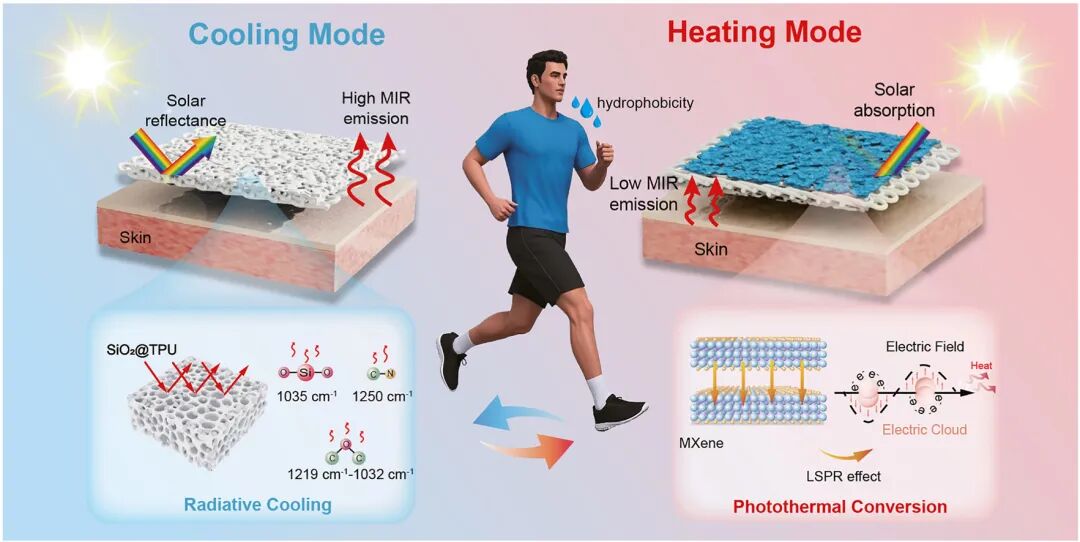
The increasing frequency of extreme weather events and the high energy demand associated with ambient temperature regulation have stimulated growing interest in energy-efficient personal thermal management (PTM) textiles. Herein, a switchable dual-mode Janus thermoregulatory cotton fabric (DJTC) was fabricated through a facile blade-coating and spray-coating process for adaptive regulation of the human-body microenvironment. The DJTC has an asymmetric optical structure, with a porous SiO2@TPU coating on the cooling side for passive radiative cooling and an MXene@PDMS layer on the heating side for photothermal heating. Benefiting from the combined effect of SiO2 microspheres and the porous TPU matrix formed by non-solvent-induced phase separation, the cooling side exhibited a high solar reflectance of 93.2% and a mid-infrared emissivity of 91.3%, resulting in a temperature reduction of 5 °C relative to raw cotton fabric under 1-sun irradiation. In contrast, the heating side utilized the strong solar absorption, efficient photothermal conversion, and low infrared emissivity of MXene, giving rise to a temperature increase of 15.21 °C relative to raw cotton fabric under simulated 1-sun irradiation. The incorporation of PDMS further endowed the textile with hydrophobic self-cleaning capability, washing durability, and mechanical stability. This work presents a simple and effective strategy for developing switchable PTM textiles for microenvironment thermal regulation under dynamic outdoor conditions.
极端天气事件的日益频繁和与环境温度调节相关的高能量需求刺 激了对节能个人热管理(PTM)纺织品的日益增长的兴趣。本文采用简易的叶片涂层和喷涂工艺制备了可切换双模Janus热调节棉织物(DJTC),用于自适应调节人体微环境。DJTC具有非对称光学结构,在冷却侧有多孔SiO2@TPU涂层用于被动辐射冷却,在加热侧有MXene@PDMS层用于光热加热。得益于SiO2微球与非溶剂诱导相分离形成的多孔TPU基体的共同作用,冷却侧的太阳反射率高达93.2%,中红外发射率高达91.3%,在1次太阳照射下,冷却侧的温度相对于原棉织物降低了5℃。加热侧利用MXene的强太阳吸收、高效光热转换和低红外发射率,在模拟1次太阳照射下,相对于原棉织物温度升高15.21℃。PDMS的加入进一步赋予了纺织品疏水自洁能力、洗涤耐久性和机械稳定性。这项工作提出了一种简单有效的策略来开发可切换的PTM纺织品,用于动态室外条件下的微环境热调节。
Nondestructive identification of cure state in composites using noncontact ultrasonic guided wave testing
Chengyang Huang, Saeed Khaleghi, Bradley Yuhasz, Mehran Tehrani, Francesco Lanza di Scalea
doi:10.1016/j.composites b.2026.113857
非接触式超声导波检测在复合材料固化状态无损识别中的应用
This paper presents a nondestructive, noncontact monitoring system for estimating the degree of cure in thermosetting composites. The Green's function of the composite laminate is extracted through ultrasonic guided wave excitation using a pulsed laser, followed by deconvolution of signals received by a pair of ultrasonic transducers (dual-output scheme). The monitoring hardware is completely noncontact and allows ultrasonic measurements to be completed within sub-millisecond acquisition windows, with potential use for real-time control during advanced manufacturing processes. A segmental-averaged Normalized Cross Power Spectrum (NCPS) operation is utilized to recover both phase and magnitude of the Green's function while suppressing incoherent noise at the receivers. The viscoelastic constants of the carbon fiber reinforced polymer composite are then identified by an inverse algorithm that uses Semi-An alytical Finite Element (SAFE) as the forward model and simulated annealing as the optimization tool. The viscoelastic constants obtained from the ultrasonic inversion are benchmarked against independent measurements from quasi-static tensile tests, Dynamic Mechanical Ana lysis (DMA) and Differential Scanning Calorimetry (DSC). Validation on unidirectional laminates fabricated at three different cure states demonstrates that the matrix-dominated viscoelastic constants in the ultrasonic regime—particularly the transverse normal and transverse shear components—exhibit strong sensitivity to the level of cure, while differences from DMA values reflect the distinct strain-rate regimes and loading modes probed by the two methods. These results show promise for a potential future use of this technique for real-time, noncontact cure state monitoring for in-process control and post-cure quality control, potentially reducing variability, cycle time, and scrap.
本文介绍了一种用于热固性复合材料固化程度评估的无损、非接触监测系统。复合层压板的格林函数是通过脉冲激光超声导波激发提取的,然后对一对超声换能器接收的信号进行反卷积(双输出方案)。监测硬件是完全非接触式的,可以在亚毫秒的采集窗口内完成超声波测量,在先进的制造过程中具有潜在的实时控制用途。利用分段平均归一化交叉功率谱(nps)操作来恢复格林函数的相位和幅度,同时抑制接收器处的非相干噪声。采用半解析有限元法(SAFE)作为正演模型,模拟退火法作为优化工具,对碳纤维增强聚合物复合材料的粘弹性常数进行了反演。超声反演得到的粘弹性常数与准静态拉伸试验、动态力学分析(DMA)和差示扫描量热法(DSC)的独立测量结果相比较。在三种不同固化状态下制作的单向层合板的验证表明,超声状态下基质主导的粘弹性常数-特别是横向法向和横向剪切分量-对固化水平表现出很强的敏感性,而与DMA值的差异反映了两种方法所探测的不同应变率制度和加载模式。这些结果显示了该技术在实时、非接触式固化状态监测、过程控制和固化后质量控制方面的潜在未来应用前景,有可能减少可变性、周期时间和报废。
Composites Science and Technology
Unveiling the interplay between filler size and interface effects on the long-term durability of highly filled flexible elastomer composites
Jingyuan Fang, Yongdong Wu, Xiaoliang Zeng, Linlin Ren, Rong Sun
doi:10.1016/j.compscitech.2026.111716
揭示了填料尺寸和界面效应对高填充柔性弹性体复合材料长期耐久性的影响
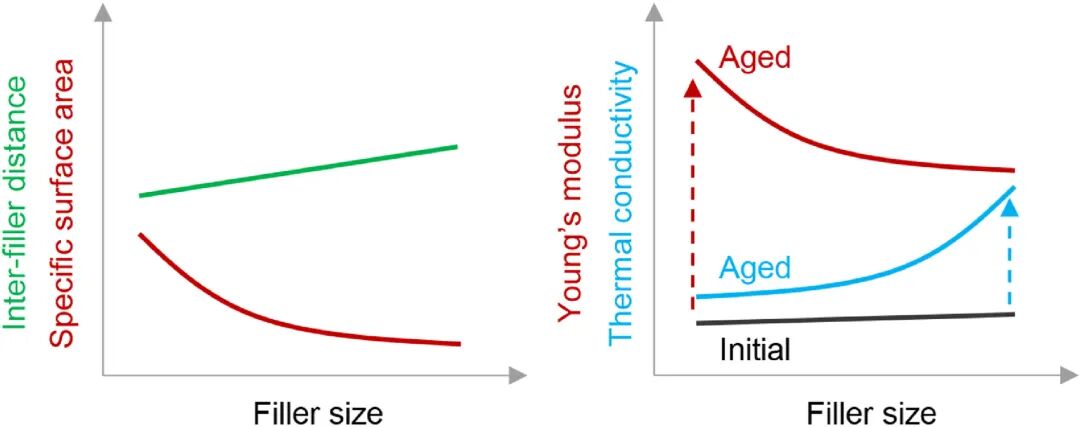
Highly filled elastomer composites are widely used in electronic packaging, where the high-volume fraction filler endows the material with special functions. However, the durability of those materials is becoming an important issue owing to the increasing power density of microelectronic. Due to its high filler content and heterogeneity, the long-term performance of highly filled elastomer composites has become a complex scientific problem involving the synergistic effects of the filler size and filler-polymer interface. In this study, we investigate the long-term durability (24h to 1000h) of highly filled elastomer composites under accelerated aging condition of 150 °C with varied interface proportion and the same volume percentage of 60 by the incorporation of three different-sized aluminum (Al) powders into polydimethylsiloxane (PDMS) matrix. Smaller filler spacing and the thickening of the interfacial thickness contribute to the more pronounced increase of Young’s modulus (from 0.13 MPa to 16.98 MPa), yield stress (from 0.055 MPa to 0.87 MPa) in aged PDMS/Al elastomers with smaller filler size. Conversely, the aged PDMS/Al elastomer with large particle size shows a higher increase of thermal conductivity (from 2.0 W/(m•K) to 3.1 W/(m•K)) due to the increased interfacial thickness and lower interfacial phonon scattering. This work provides a valuable insight of the relationship among the filler size effect, interface effect and long-term performance of highly filled elastomer composites.
高填充弹性体复合材料广泛应用于电子封装,高体积分数填料赋予材料特殊的功能。然而,由于微电子的功率密度不断增加,这些材料的耐用性成为一个重要问题。高填充弹性体复合材料由于其高填料含量和非均质性,其长期性能已成为一个复杂的科学问题,涉及填料尺寸和填料-聚合物界面的协同效应。在本研究中,我们通过在聚二甲基硅氧烷(PDMS)基体中掺入三种不同尺寸的铝(Al)粉末,研究了高填充弹性体复合材料在150°C加速老化条件下的长期耐久性(24h至1000h)。填料间距越小,界面厚度越厚,老化PDMS/Al弹性体的杨氏模量(从0.13 MPa增加到16.98 MPa)和屈服应力(从0.055 MPa增加到0.87 MPa)的增加越明显。相反,大粒径的老化PDMS/Al弹性体由于界面厚度的增加和界面声子散射的降低,其导热系数的增加幅度较大(从2.0 W/(m•K)增加到3.1 W/(m•K))。本研究对填料尺寸效应、界面效应与高填充弹性体复合材料长期性能之间的关系提供了有价值的见解。