【新文速递】2026年6月1日复合材料SCI期刊最新文章
今日更新:Composite Structures 3 篇,Composites Part A: Applied Science and Manufacturing 3 篇,Composites Part B: Engineering 1 篇
Composite Structures
Sound transmission loss of bonded multilayer composite doubly curved shells with viscoelastic epoxy interlayers: a 3D layerwise state-space transfer-matrix formulation
Y. Senkoua, F.P. Ewolo Ngak, M. Hamdaoui, G.E. Ntamack, L. Azrar
doi:10.1016/j.compstruct.2026.120519
粘弹性环氧夹层粘接多层复合材料双弯曲壳的声传输损失:三维分层状态空间传递矩阵公式
Bonded multilayer composite shells are increasingly used as lightweight load-bearing barriers that must also provide acoustic insulation. In such structures, thin epoxy films joining adjacent plies may behave viscoelastically, modifying interlaminar load transfer and introducing frequency-dependent damping that affects sound transmission loss (STL). This paper presents a semi-an alytical three-dimensional framework for predicting STL of doubly curved multilayer composite shells with viscoelastic adhesive interlayers. A layerwise state-space formulation is integrated through the thickness by a fourth-order Runge–Kutta scheme and assembled across layers using a transfer-matrix procedure. The adhesive is modeled by a Standard Linear Solid (Zener) law; a Laplace-domain treatment provides a shear relaxation function used to construct a frequency-dependent interface matrix between adjacent laminates. Structural–acoustic coupling is imposed for oblique plane-wave incidence, and the incident wavenumber is modified to include external mean flow. The formulation is verified in perfectly and imperfectly bonded limits by recovering published STL benchmarks for doubly curved shells and viscoelastic three-layer plates. The model is then applied to assess adhesive thickness, curvature, incidence angle, and mean-flow effects. Results show that thin viscoelastic interlayers can significantly improve mid-to-high-frequency STL while preserving the laminate layup, offering practical guidance for vibroacoustic design and optimization of bonded composite shell structures.
粘结多层复合壳越来越多地被用作轻质承重屏障,同时还必须提供隔音。在这种结构中,连接相邻层的环氧薄膜可能表现出粘弹性,改变了层间载荷传递,并引入了影响声传输损失(STL)的频率相关阻尼。本文提出了一种预测粘弹性夹层双层弯曲多层复合材料壳STL的半解析三维框架。分层状态空间公式通过四阶龙格-库塔格式通过厚度进行积分,并使用传递矩阵过程跨层组装。胶粘剂采用标准线性固体(齐纳)定律建模;拉普拉斯域处理提供了剪切松弛函数,用于构建相邻层板之间的频率相关界面矩阵。对斜平面波入射施加结构声耦合,并对入射波数进行修正,使其包含外部平均流。通过恢复已公布的双弯曲壳和粘弹性三层板的STL基准,在完美和不完美粘结极限下验证了该公式。然后应用该模型来评估胶粘剂厚度、曲率、入射角和平均流动效应。结果表明,薄粘弹性夹层能在保留层合层的同时显著改善中高频STL,为粘结复合材料壳结构的振声设计和优化提供了实践指导。
Comparative assessment of an alytical and numerical frameworks for shear-dominant interlaminar delamination in pultruded CFRP spar caps
Geunsu Joo, Young Cheol Kim, Si-Hyeon Kim, Mungyu Jeong, Ji-Hoon Kim, Jisang Park
doi:10.1016/j.compstruct.2026.120517
拉挤CFRP梁帽剪切主导层间分层的分析框架和数值框架的比较评估
Pultruded carbon-fiber-reinforced polymer (CFRP) laminates are increasingly used as spar caps in wind turbine blades, where shear-dominant interlaminar delamination is a critical factor that can undermine structural reliability. This study provides a comprehensive assessment of an alytical and numerical frameworks for predicting Mode II delamination in pultruded spar-cap structures. End-Notched Flexure (ENF) tests were conducted on representative specimens replicating industrial configurations, providing Mode II fracture toughness data. Four numerical methodologies—Virtual Crack Closure Technique (VCCT), Cohesive Zone Model (CZM), eXtended Finite Element Method with VCCT (XFEM–VCCT), and XFEM with CZM (XFEM–CZM)—were systematically evaluated under consistent numerical configurations. Results demonstrate that while VCCT-based approaches align closely with linear elastic fracture mechanics (LEFM) benchmarks, they tend to predict delayed crack initiation and fail to capture the gradual softening observed experimentally. In contrast, CZM and XFEM–CZM demonstrate superior fidelity to the experimental data by incorporating progressive interfacial degradation, thereby accurately reproducing the smooth transition from initiation to stable propagation. Furthermore, mesh-sensitivity and computational efficiency ana lyses reveal that the surface-based CZM offers the most favorable balance between numerical stability and cost, whereas XFEM-based models exhibit significant dependency on crack-region discretization. These findings provide practical guidance for selecting appropriate delamination an alysis methodologies for pultruded CFRP spar caps.
拉挤碳纤维增强聚合物(CFRP)层压板越来越多地用于风力涡轮机叶片的梁帽,在风力涡轮机叶片中,剪切主导的层间分层是可能破坏结构可靠性的关键因素。本研究提供了预测拉挤梁盖结构II型分层的分析和数值框架的综合评估。末端缺口弯曲(ENF)测试在复 制工业配置的代表性样品上进行,提供II型断裂韧性数据。在一致的数值配置下,对虚拟裂纹闭合技术(VCCT)、内聚区模型(CZM)、VCCT扩展有限元法(XFEM - VCCT)和XFEM - CZM (XFEM - CZM) 4种数值方法进行了系统评价。结果表明,尽管基于vcct的方法与线弹性断裂力学(LEFM)基准非常接近,但它们倾向于预测延迟裂纹起裂,并且无法捕获实验观察到的逐渐软化。相比之下,CZM和XFEM-CZM结合了渐进的界面退化,从而准确地再现了从起始到稳定传播的平滑过渡,从而表现出对实验数据的优越保真度。此外,网格敏感性和计算效率分析表明,基于表面的CZM模型在数值稳定性和成本之间取得了最有利的平衡,而基于xfem的模型则明显依赖于裂纹区域离散化。这些发现为选择合适的CFRP梁帽分层分析方法提供了实用指导。
Mitigating lightning strike damage in unidirectional carbon fiber-reinforced plastic laminates using electrically conductive resin
Takao Okada, Yu Zhou, Keito Hosoe, Shintaro Kamiyama, Hiromitsu Miyaki, Tomohiro Asada, Tomohiro Yokozeki, Tatsuhiro Takahashi
doi:10.1016/j.compstruct.2026.120513
利用导电树脂减轻单向碳纤维增强塑料层压板的雷击损伤
In order to eliminate the effect of contact between fibers through thickness direction, unidirectional fibers were used to manufacture carbon fiber-reinforced plastics (CFRP) laminates with electrically conductive resin. The resin mixed with the conductive component and the process of micronizing the conductive component were changed from the previous study to pulverize the conductive components using general-purpose equipment. The electrical conductivities and lightning strike resistances of the specimens were evaluated. The through-thickness electrical conductivity of the CFRP with electrically conductive resin was approximately 0.02 S/cm, which is two orders of magnitude higher than that of epoxy resin. A lightning strike test revealed that, in the specimen using electrically conductive resin, partial surface resin loss due to thermal decomposition and some fiber breakage occurred. For specimens with added textile material on the surface, the surface resin experienced less thermal decomposition than in the cross-ply laminate made with electrically conductive resin; however, delamination occurred between the first and second layers. Thermographic measurements of the specimen surface showed that, for the epoxy-impregnated specimen, flames generated by the lightning strike persisted for 1 s after impact, whereas no flames were observed in the specimen impregnated with electrically conductive resin. Thermography measurement showed that the surface temperature of the CFRP with conductive resin decreased to the ambient temperature more quickly after the lightning strike than that of the epoxy resin. The electrically conductive resin allows lightning current to flow through thickness direction, thereby reducing lightning-induced damage compared with epoxy resin.
为了消除纤维间通过厚度方向接触的影响,采用单向纤维制备导电树脂碳纤维增强塑料(CFRP)层压板。将导电组分的混合树脂和导电组分的微粉化工艺由以往的研究改为使用通用设备将导电组分粉碎。测定了试样的电导率和雷击电阻。添加导电树脂的CFRP的通厚电导率约为0.02 S/cm,比环氧树脂高出两个数量级。雷击试验表明,在导电树脂试样中,由于热分解导致部分表面树脂损失和部分纤维断裂。对于表面添加纺织材料的试样,其表面树脂的热分解程度小于导电树脂的交叉层合层合;然而,在第一层和第二层之间发生分层。对样品表面的热像测量表明,对于环氧树脂浸渍的样品,雷击后产生的火焰持续了1 s,而在导电树脂浸渍的样品中没有观察到火焰。热像仪测量结果表明,与环氧树脂相比,导电树脂的CFRP在雷击后表面温度下降到环境温度的速度更快。与环氧树脂相比,导电树脂允许雷击电流沿厚度方向流动,从而减少雷击损伤。
Composites Part A: Applied Science and Manufacturing
Synergistic enhancement of breakdown and dielectric properties in ceramic dielectrics via in-situ carbon nanoparticle incorporation
Yuanyuan Zhao, Shuimiao Xia, Qingyang Tang, Peng Yin, Hongqiang Wang, Runhua Fan, Zhicheng Shi
doi:10.1016/j.compositesa.2026.109980
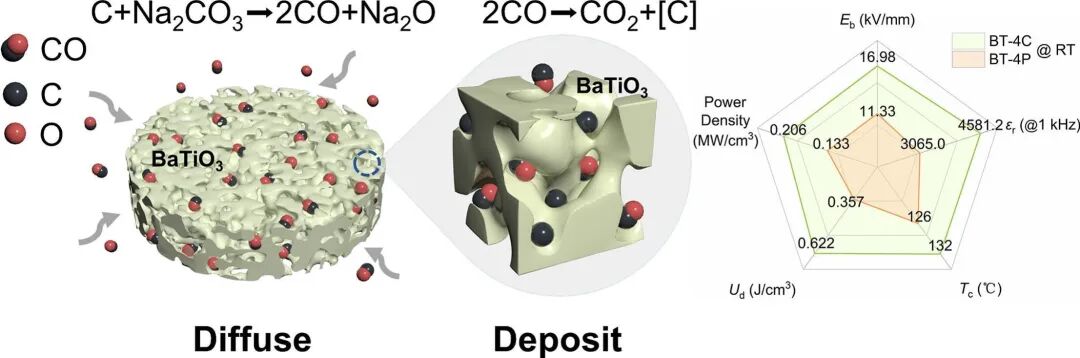
原位碳纳米颗粒掺入对陶瓷介质击穿和介电性能的协同增强
Ceramic dielectrics play a vital role in advanced electronic systems. However, the relatively low breakdown strength restricts the further application of ceramic dielectrics. To address this challenge, a novel vapor-phase in-situ deposition strategy is proposed in this study to enhance the breakdown strength of ceramic dielectrics. Specifically, carbon nanoparticles are uniformly introduced into the barium titanate (BT) ceramic matrix via the co-sintering of carbon black and pre-calcined ceramics. In this design, the Coulomb blockade effect of carbon nanoparticles suppresses charge transport to improve breakdown strength, while the micro-capacitor effect simultaneously enhances the dielectric constant. Experimental results show that the breakdown strength and dielectric constant (at 1 kHz) of the BT-4C ceramics reach 16.98 kV/mm and 4581, respectively, marking substantial increases of 49.9% and 49.5% relative to the pure BT counterpart. Further experiments demonstrate that when this strategy is applied to the linear strontium titanate (ST) ceramic system, the breakdown strength of ST-4C ceramics increases from 23.04 kV/mm (for pure ST) to 33.67 kV/mm, while the dielectric constant (at 1 kHz) simultaneously grows from 410.4 to 528.5. In this work, an efficient and practical strategy is proposed for the synergistic enhancement of the dielectric constant and breakdown strength of ceramic dielectrics.
陶瓷介质在先进的电子系统中起着至关重要的作用。然而,相对较低的击穿强度限制了陶瓷电介质的进一步应用。为了解决这一挑战,本研究提出了一种新的气相原位沉积策略来提高陶瓷介电体的击穿强度。具体来说,碳纳米颗粒通过炭黑和预煅烧陶瓷的共烧结被均匀地引入钛酸钡(BT)陶瓷基体中。在本设计中,碳纳米颗粒的库仑阻断效应抑制电荷输运以提高击穿强度,而微电容效应同时提高介电常数。实验结果表明,BT- 4c陶瓷的击穿强度和介电常数(1khz)分别达到16.98 kV/mm和4581 kV/mm,较纯BT陶瓷大幅提高了49.9%和49.5%。进一步的实验表明,当该策略应用于线性钛酸锶(ST)陶瓷体系时,ST- 4c陶瓷的击穿强度从23.04 kV/mm(纯ST)增加到33.67 kV/mm,而介电常数(1 kHz)同时从410.4增加到528.5。本文提出了一种有效而实用的提高陶瓷介质介电常数和击穿强度的协同策略。
Characterization of thermal and crystallization shrinkage in LM-PAEK composites
Kwanchai Chinwicharnam, Justin Hicks, R. Byron Pipes
doi:10.1016/j.compositesa.2026.109974
LM-PAEK复合材料的热收缩和结晶收缩特性
Cooling-induced shrinkage distortions in continuous fiber–reinforced thermoplastic composites (CFRTPs) remain a major challenge for dimensional control and distortion-aware tooling design, as the laminate’s coefficient of overall expansion (COE) is strongly temperature dependent and influenced by polymer phase transitions. This work presents an experimentally grounded methodology to quantify anisotropic thermal strain and crystallization shrinkage in a unidirectional carbon fiber/LM-PAEK laminate (Toray Cetex® TC1225). Full-field digital image correlation (DIC) was combined with a strain-transformation approach using a directional cosine matrix to resolve principal thermal strains in the fiber (ε11) and transverse (ε22) directions. The rotated-specimen configuration and transformation framework enable reliable extraction of the small fiber-direction strain, which is typically difficult to measure directly. This measurement capability provides experimentally resolved input for subsequent modeling and an alysis of thermomechanical behavior in composite forming processes.
在连续纤维增强热塑性复合材料(CFRTPs)中,冷却引起的收缩变形仍然是尺寸控制和变形感知工具设计的主要挑战,因为层压板的整体膨胀系数(COE)强烈依赖于温度并受聚合物相变的影响。本研究提出了一种基于实验的方法来量化单向碳纤维/LM-PAEK层叠板(Toray Cetex®TC1225)的各向异性热应变和结晶收缩率。将全场数字图像相关(DIC)与应变变换相结合,利用方向余弦矩阵解析纤维(ε11)方向和横向(ε22)方向的主热应变。旋转试样结构和转换框架能够可靠地提取小的纤维方向应变,这通常是难以直接测量的。这种测量能力为复合材料成形过程中的后续建模和热力学行为分析提供了实验解决的输入。
Integrating deep learning and geometry-based microstructural an alysis of bamboo technical fibres for bio-composite engineering
Lina Garcia-Palacio, Carlos I. Cardona, Jesús Alejandro Alzate, Reiner Dieden, Doriane Delfrari, Oscar Cardona-Morales, Mario Bravo-Ortiz, C.A. Fuentes
doi:10.1016/j.compositesa.2026.109949
结合深度学习和基于几何的竹技术纤维微观结构分析,用于生物复合材料工程
Hierarchical microstructural ana lysis of plant extracted technical fibres, such as bamboo, is critical for advancing sustainable composite development in what concerns to geometric modelling, properties prediction, and manufacturing optimization. Precise segmentation of anatomical phases such as elementary fibres, middle lamella, and lumen is essential for quantifying morphological gradients and structural heterogeneity. These aspects directly influence interfacial stress transfer mechanisms and the mechanical performance in natural fibre composites. Yet conventional threshold-based methods struggle with the overlapping boundaries, anisotropic growth patterns, and high variability inherent to natural fibres. This study systematically evaluates five deep learning segmentation models: RootPainter, U-Net, SwinUNETR, SegFormer, and the Segment Anything Model (SAM) using high-resolution optical micrographs of bamboo fibre cross-sections. RootPainter achieved the highest performance (Dice: 0.9096; IoU: 0.8341), producing spatially coherent segmentation masks that preserved fine structural details, followed by U-Net (Dice: 0.8707; IoU: 0.7758). The best performing model was subsequently applied to automated morphometric a nalysis, enabling anatomical classification, structural area quantification, and interactive visualization through a web-based interface. Critically, this approach enables quantification of the middle lamella sub-micron inter cellular bonding layer which is unresolvable by conventional µCT imaging. Middle lamella area fractions alongside elementary fibre wall and lumen areas provide essential input parameters for micromechanical stress transfer and stiffness prediction models. The framework reveals systematic morphological gradients across fibre cross sections, reflecting the functionally graded microstructure optimized for bending loading. By minimizing dependence on manual thresholding and improving reproducibility, this framework advances precise morphological characterization, supports accurate micromechanical modelling through phase-resolved geometric data.
植物提取技术纤维(如竹子)的分层微观结构分析对于推进可持续复合材料的发展至关重要,因为它涉及几何建模、性能预测和制造优化。解剖阶段的精确分割,如初级纤维,中间薄片,和管腔是必要的定量形态梯度和结构异质性。这些方面直接影响着天然纤维复合材料的界面应力传递机制和力学性能。然而,传统的基于阈值的方法与重叠边界、各向异性生长模式和天然纤维固有的高可变性作斗争。本研究系统地评估了五种深度学习分割模型:RootPainter, U-Net, SwinUNETR, SegFormer和分割任何模型(SAM),使用竹纤维横截面的高分辨率光学显微照片。RootPainter获得了最高的性能(Dice: 0.9096; IoU: 0.8341),产生了空间连贯的分割掩模,保留了精细的结构细节,其次是U-Net (Dice: 0.8707; IoU: 0.7758)。表现最好的模型随后应用于自动形态计量分析,通过基于web的界面实现解剖分类、结构面积量化和交互式可视化。关键的是,这种方法可以量化中间薄片亚微米细胞间键合层,这是传统微CT成像无法分辨的。中间片层面积分数以及基本纤维壁和管腔区域为微机械应力传递和刚度预测模型提供了必要的输入参数。该框架揭示了纤维截面上系统的形态梯度,反映了针对弯曲载荷优化的功能梯度微观结构。通过最大限度地减少对手动阈值的依赖和提高再现性,该框架推进了精确的形态表征,通过相位分辨几何数据支持精确的微力学建模。
Composites Part B: Engineering
Molecularly Engineered Sliding-Ring Interphases for Basalt/Epoxy Composites: Achieving Simultaneous Toughening and Robust Corrosion Protection via Interfacial Buffering
Li Chen, Fandi Meng, Pan Xie, Fuhui Wang, Li Liu
doi:10.1016/j.composites b.2026.113859
玄武岩/环氧复合材料的分子工程滑环界面:通过界面缓冲实现同时增韧和强大的腐蚀保护
Dynamic loading accelerates interfacial damage and electrolyte ingress in composite coatings for metal protection, leading to deterioration of their long-term barrier performance under extreme service conditions. Here, a molecularly engineered sliding-ring interphase is introduced into a basalt/epoxy composite coating through a polyrotaxane-modified system (EP–PEB) to simultaneously improve mechanical robustness and corrosion resistance via interfacial buffering. Specifically, polyrotaxane chains are covalently grafted onto etched basalt, which markedly improves filler dispersion in epoxy and enables the formation of a continuous polymeric interphase in the cured coating. Unlike conventional rigid interphases that rely mainly on static interfacial bonding, the sliding-ring interphase features mechanically interlocked but mobile junctions, allowing stress redistribution and stepwise energy dissipation while preserving interfacial integrity. The experimental results demonstrate the improved mechanical performance of EP-PEB with other basalt-epoxy composites reported in the literature. EP-PEB exhibits a 24% increase in tensile strength and a 48% increase in fracture toughness, compared with the etched basalt-epoxy system (EP-EB). Dynamic mechanical an alysis further reveals a load-bearing yet more energy-dissipative network, consistent with a sliding-ring-mediated molecular buffering mechanism. Under simulated deep-sea conditions (6 MPa + 3 m/s), EP–PEB delivers markedly improved barrier performance, maintaining a low-frequency impedance about one order of magnitude higher than that of the control after 240 h, along with better-retained coating resistance and interfacial stability. Molecular dynamics simulations further confirm that the strengthened interfacial interactions and thickened interphase promote more efficient stress transfer and delayed damage evolution. This work provides a practical molecular-engineering strategy for developing durable, high-performance corrosion-protective composite coatings for harsh marine environments.
动态载荷加速了用于金属保护的复合涂层的界面损伤和电解质的进入,导致其在极端使用条件下的长期屏障性能恶化。通过聚轮烷改性体系(EP-PEB),将分子工程滑环界面相引入玄武岩/环氧复合涂层中,同时通过界面缓冲提高机械坚固性和耐腐蚀性。具体来说,聚轮烷链被共价接枝到蚀刻玄武岩上,这显著改善了填料在环氧树脂中的分散,并使固化涂层中形成连续的聚合物界面相。与主要依赖静态界面结合的传统刚性界面不同,滑动环界面具有机械互锁但可移动的结,允许应力重新分布和逐步能量耗散,同时保持界面完整性。实验结果表明,EP-PEB与文献报道的其他玄武岩-环氧复合材料的力学性能有所改善。与蚀刻玄武岩-环氧体系(EP-EB)相比,EP-PEB的抗拉强度提高了24%,断裂韧性提高了48%。动态力学分析进一步揭示了一个承载更多能量耗散的网络,与滑动环介导的分子缓冲机制一致。在模拟深海条件下(6 MPa + 3 m/s), EP-PEB的阻隔性能显著提高,在240 h后保持的低频阻抗比对照组高一个数量级,同时保留了更好的涂层阻力和界面稳定性。分子动力学模拟进一步证实,界面相互作用的增强和界面相的增厚促进了更有效的应力传递和延迟损伤演化。这项工作为开发适用于恶劣海洋环境的耐用、高性能防腐复合涂层提供了实用的分子工程策略。