
首页/文章/ 详情

【新文速递】2026年5月26日固体力学SCI期刊最新文章

2月前浏览924

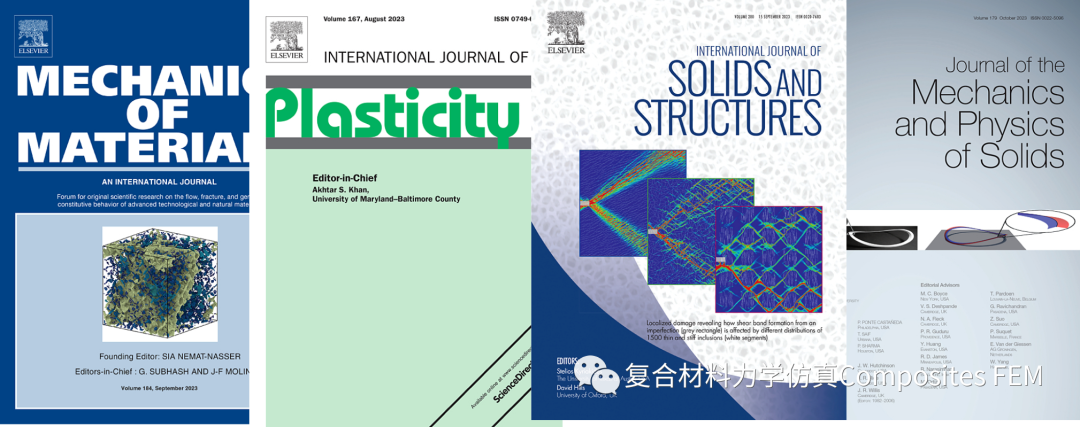
今日更新:International Journal of Solids and Structures 1 篇,Journal of the Mechanics and Physics of Solids 2 篇,International Journal of Plasticity 1 篇,Thin-Walled Structures 1 篇

International Journal of Solids and Structures

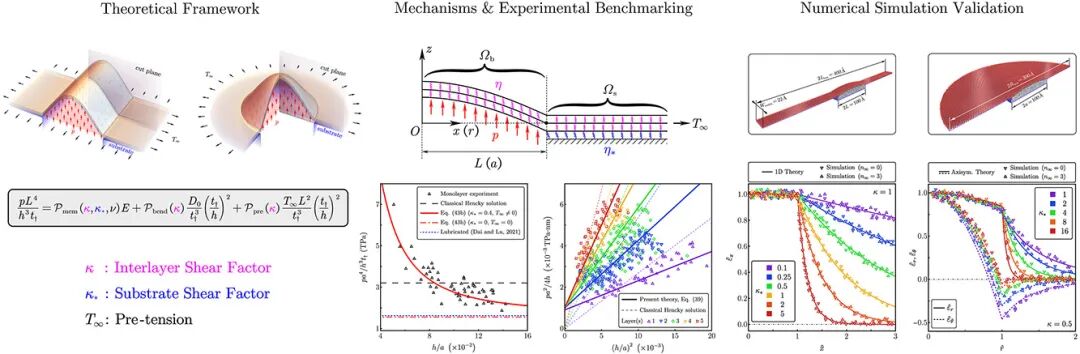
Bulge mechanics of pre-tensioned multilayer 2D structures with interlayer and substrate slip

Xiangtian Shen, Yueguang Wei

doi:10.1016/j.ijsolstr.2026.114102
层间和衬底滑移的预张拉多层二维结构的膨胀力学

The bulge test is a cornerstone technique for characterizing the mechanical properties of two-dimensional (2D) materials, yet classical models fall short in describing multilayer systems by neglecting the coupled effects of interlayer slip, substrate slip, and pre-tension. Here, a comprehensive characterization study is presented, combining a nalytical modeling, molecular dynamics (MD) simulations, and experimental benchmarking. Explicit full-field theoretical solutions are derived for both rectangular strip (one-dimensional) and circular (axisymmetric) bulge configurations, incorporating linear elastic interfacial slips and pre-tension. These solutions explicitly decouple the contributions of membrane stretching, plate bending, and pre-tension, while elucidating the regulating roles of interfacial slips. The accuracy and robustness of the theoretical model are systematically validated against extensive MD simulations and literature experimental data on few-layer graphene. The framework developed herein provides a robust toolkit for the quantitative interpretation of bulge-test responses, enabling the identification of interfacial properties and pre-tension in complex 2D multilayer systems.

膨胀试验是表征二维(2D)材料力学性能的基础技术,但经典模型由于忽略了层间滑移、衬底滑移和预张力的耦合效应,在描述多层系统时存在不足。在这里,一个全面的表征研究提出,结合分析建模,分子动力学(MD)模拟,和实验基准。导出了包含线弹性界面滑移和预张力的矩形条形(一维)和圆形(轴对称)凸起结构的显式全场理论解。这些解决方案明确地解耦了膜拉伸、板弯曲和预张力的贡献,同时阐明了界面滑移的调节作用。理论模型的准确性和鲁棒性通过广泛的MD模拟和文献实验数据在几层石墨烯上进行了系统验证。本文开发的框架为膨胀试验响应的定量解释提供了一个强大的工具包,能够识别复杂的二维多层系统中的界面特性和预张力。


Journal of the Mechanics and Physics of Solids

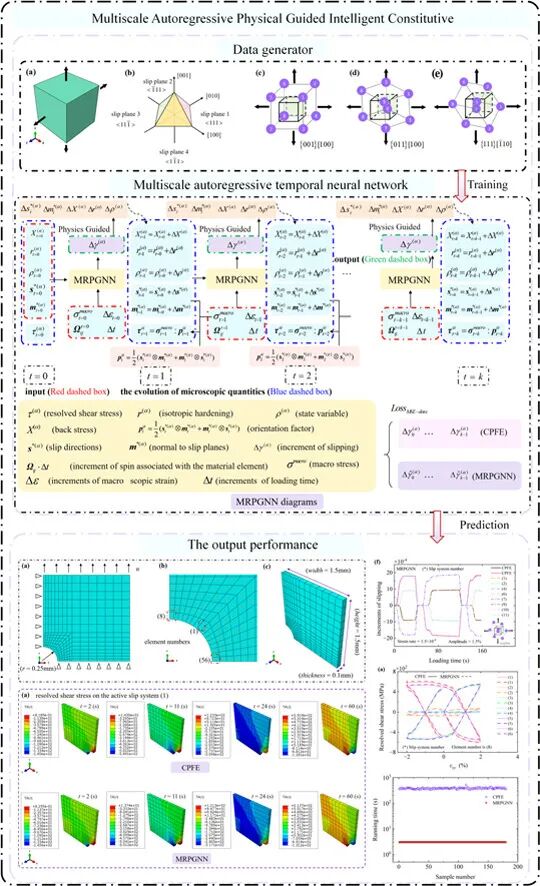
A Multiscale Physics Guided Deep Learning Framework for Predicting Microscopic Evolution of Crystal Plasticity Considering Finite Deformations

Wei Liu, Huanbo Weng, Yinan Cui, Yinghua Liu

doi:10.1016/j.jmps.2026.106694
考虑有限变形的晶体塑性微观演化预测的多尺度物理引导深度学习框架

Understanding constitutive relationships is essential for the modeling, design, and practical application of advanced metals and alloys under extreme conditions. Currently, most constitutive models are phenomenological. While crystal plasticity finite element (CPFE) modeling can incorporate physical equations at the microscale, its high computational cost makes it difficult to apply in engineering problems. There is an urgent need to develop a multiscale neural network constitutive surrogate model to improve efficiency and address the issue of historical dependence. To address the limitations above, a multiscale autoregressive physics-guided neural network (MRPGNN) model is developed to obtain the evolution of the slip system rotation, resolved shear stress, back stress, isotropic hardening term, and state variables describing dislocation hardening through physics-based propagation via update equations, considering finite deformations. It is developed using initial state and macroscopic loading history as input, evolution of all physical quantities on the slip system with loading history serve as the outputs. The proposed MRPGNN model achieves two orders of magnitude higher efficiency than CPFE modeling while also effectively addressing cumulative errors. A film cooling hole (FCH) structural component is used to validate the robustness of the MRPGNN model and assess its potential for practical applications. Research shows that the MRPGNN model demonstrates high prediction accuracy and robustness. The MRPGNN model has the potential to be integrated with advanced technologies in the future, allowing for a deeper exploration of multiscale constitutive relationships by incorporating more complex deformation mechanisms (such as climb and diffusional creep and so on) through modifications to the update equations in the deep learning framework.

理解本构关系对于在极端条件下的高级金属和合金的建模、设计和实际应用至关重要。目前,大多数本构模型都是现象学的。晶体塑性有限元(CPFE)建模虽然可以在微观尺度上包含物理方程,但其计算成本高,难以应用于工程问题。迫切需要开发一种多尺度神经网络本构代理模型来提高效率并解决历史依赖问题。为了解决上述局限性,开发了一个多尺度自回归物理引导神经网络(MRPGNN)模型,通过更新方程,考虑有限变形,通过基于物理的传播,获得滑移系统旋转、分解剪切应力、背应力、各向同性硬化项和描述位错硬化的状态变量的演变。该模型以初始状态和宏观加载历史为输入,滑移系统上各物理量随加载历史的演化为输出。所提出的MRPGNN模型比CPFE模型的效率提高了两个数量级,同时也有效地解决了累积误差。利用膜冷却孔(FCH)结构部件验证了MRPGNN模型的鲁棒性,并评估了其实际应用潜力。研究表明,MRPGNN模型具有较高的预测精度和鲁棒性。MRPGNN模型在未来有可能与先进技术相结合,通过修改深度学习框架中的更新方程,通过合并更复杂的变形机制(如爬升和扩散蠕变等),允许对多尺度本构关系进行更深入的探索。


ChebyKAN-Enhanced Deep Energy Method for Phase Field Fracture: From Homogeneous to Heterogeneous Materials

Peng Zhang, Keke Tang, Baixiang Xu

doi:10.1016/j.jmps.2026.106693

相场断裂的chebykan增强深能法:从均匀材料到非均匀材料

Physics-Informed Neural Networks (PINNs) have emerged as a promising approach for solving phase field fracture problems, with the Deep Energy Method (DEM)—an energy-driven branch of PINNs—being particularly suitable due to its alignment with the variational nature of fracture mechanics. DEM typically employs Multi-Layer Perceptrons (MLPs) as function approximators; however, MLPs rely on fixed activation functions, and successful crack path prediction demands meticulous selection tailored to each specific problem. To address the limitation of fixed activation functions in capturing problem-specific nonlinearities, a ChebyKAN-enhanced DEM is developed where learnable activation functions are parameterized by Chebyshev polynomial expansions through Kolmogorov-Arnold Networks (KANs), enabling the network to adaptively discover the optimal activation function form without manually specifying the activation function type. A diffuse interface formulation is introduced to handle heterogeneous materials such as matrix-inclusion composites by smoothly transitioning material properties across boundaries, demonstrating that neural network-based phase field methods can effectively address fracture in multi-phase systems without explicit domain partitioning. Numerical examples involving crack propagation, coalescence, and branching in both homogeneous and heterogeneous materials demonstrate excellent agreement with finite element solutions. To improve computational efficiency, transfer learning strategies are systematically investigated, including step-transfer learning that exploits temporal continuity between load increments and cross-task transfer learning that reuses trained networks across different configurations. Compared with the baseline without transfer learning, these strategies substantially reduce the training epochs required at each load step. Regarding computational efficiency, the total wall-clock time of the proposed framework and FEM falls within the same order of magnitude across all benchmark cases; relative to earlier DEM implementations that are typically about one order of magnitude slower than FEM, this gap has been substantially narrowed.

物理信息神经网络(pinn)已经成为解决相场断裂问题的一种很有前途的方法,其中深能量法(DEM)是pinn的一个能量驱动分支,由于其与断裂力学的变分特性相一致,因此特别适用。DEM通常使用多层感知器(mlp)作为函数逼近器;然而,mlp依赖于固定的激活函数,成功的裂纹路径预测需要针对每个特定问题进行细致的选择。为了解决固定激活函数在捕获特定问题非线性方面的局限性,开发了一个chebykan增强的DEM,其中可学习的激活函数通过Kolmogorov-Arnold网络(KANs)通过Chebyshev多项式展开进行参数化,使网络能够自适应地发现最优激活函数形式,而无需手动指定激活函数类型。引入了一种扩散界面公式来处理非均相材料,如基体-夹杂复合材料,通过平滑地跨边界过渡材料的性能,证明基于神经网络的相场方法可以有效地处理多相系统中的断裂,而无需显式的域划分。在均质和非均质材料中涉及裂纹扩展、合并和分支的数值例子与有限元解非常吻合。为了提高计算效率,系统地研究了迁移学习策略,包括利用负载增量之间的时间连续性的步进迁移学习和跨不同配置重用训练网络的跨任务迁移学习。与没有迁移学习的基线相比,这些策略大大减少了每个负载步骤所需的训练次数。在计算效率方面,所提出的框架和FEM的总挂钟时间在所有基准情况下都处于同一数量级;相对于早期的DEM实现(通常比FEM慢一个数量级),这一差距已经大大缩小。


International Journal of Plasticity

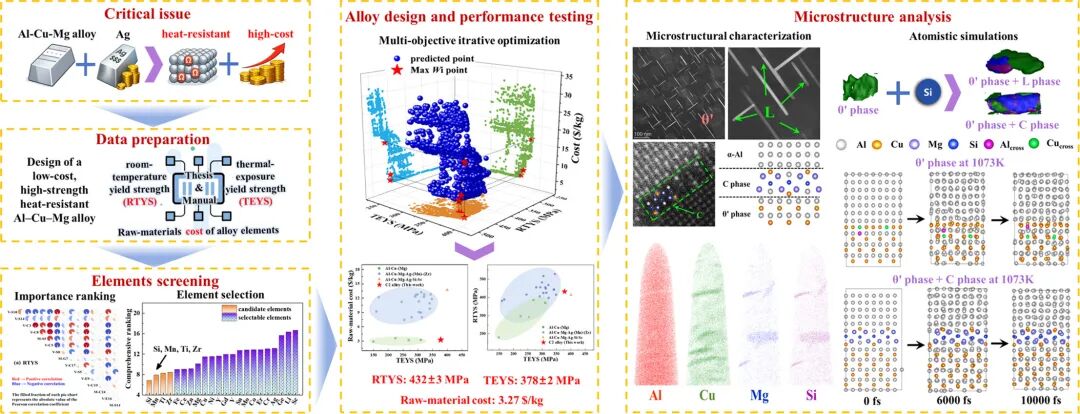
Machine learning guided element substitution strategy for improving strength and heat resistance in cost-effective aluminum alloys

Ziyao Zhao, Kaikai Qiu, Haochen Xu, Lei Jiang, Zhihao Zhang, Jianxin Xie

doi:10.1016/j.ijplas.2026.104732
机器学习指导的元素替代策略,以提高经济高效的铝合金的强度和耐热性

Heat resistance in Al-Cu-Mg alloys is commonly achieved through Ag-promoted Ω phase strengthening, yet this approach is intrinsically limited by the high cost of Ag and the rapid coarsening of the Ω phase at service temperatures near 200 °C. To overcome these limitations, a machine learning–guided element substitution strategy was investigated. This approach integrates key alloy factor screening, Shapley Additive Explanations (SHAP) an alysis and multi-objective active learning to identify the alloy factors governing room-temperature yield strength (RTYS) and thermal-exposure yield strength (TEYS). Low-cost elements, including Si, Mn, Ti, and Zr, were identified to enable simultaneous enhancement of RTYS and TEYS. Guided by these insights, a low-cost, high-strength, heat-resistant alloy featuring core–shell θ′ phases (Al-5.18Cu-0.28Mg-0.32Mn-0.18Si-0.12Zr-0.08Ti, wt.%) was designed. After T6 treatment, the alloy achieves a RTYS of 432 ± 3 MPa and retains 87% of its yield strength after thermal exposure at 200 °C for 100 h. Compared with the commercial 2040 alloy, the present alloy exhibits increases of 6.6% and 29.4% in RTYS and TEYS, respectively, while raw-material cost is reduced by over 70%. These performance enhancements arise from a synergistic optimization of composition and microstructure. In particular, Si promotes the formation of thermally stable C/L interfacial phases at the θ′/α-Al interface, imparting higher stability than the conventional Mg-Ag core-shell Ω phases strengthening. The reduced Mg content raises the solution-treatment temperature window, enabling more complete Cu dissolution and increasing the number density of θ′ phases, whereas Al6Mn and Al3(Zr, Ti) dispersoids further enhance the thermal stability of the microstructure.

Al-Cu-Mg合金的耐热性通常是通过Ag促进Ω相强化来实现的,但这种方法本质上受到Ag的高成本和Ω相在200°C附近使用温度下快速粗化的限制。为了克服这些限制,研究了一种机器学习引导的元素替换策略。该方法集成了关键合金因素筛选、Shapley加性解释(SHAP)分析和多目标主动学习,以确定控制室温屈服强度(RTYS)和热暴露屈服强度(TEYS)的合金因素。低成本元素,包括Si, Mn, Ti和Zr,被确定为能够同时增强RTYS和TEYS。在这些见解的指导下,设计了一种低成本,高强度,具有核壳θ′相的耐热合金(Al-5.18Cu-0.28Mg-0.32Mn-0.18Si-0.12Zr-0.08Ti, wt.%)。经T6处理后,合金的RTYS为432±3 MPa,在200℃下热暴露100 h后,合金的屈服强度保持了87%。与2040合金相比,该合金的RTYS和TEYS分别提高了6.6%和29.4%,而原材料成本降低了70%以上。这些性能增强来自于成分和微观结构的协同优化。特别是在θ′/α-Al界面处,Si促进了热稳定的C/L界面相的形成,比传统的Mg-Ag核-壳Ω相强化具有更高的稳定性。Mg含量的降低提高了固溶处理温度窗,使Cu溶解更完全,θ′相的数量密度增加,而Al6Mn和Al3(Zr, Ti)弥散体进一步增强了显微组织的热稳定性。


Thin-Walled Structures

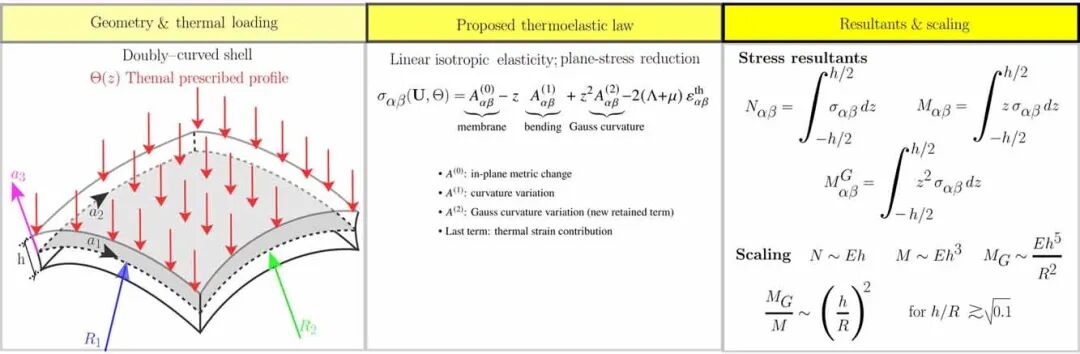
A linear isotropic thermoelastic shell model including Gauss curvature effects: A theoretical derivation and a nalytical solutions

Eric Sinclair Fongho, Platon Dongmo Nizegha, Arno Roland Ngatcha Ndengna, Joseph Nkongho Anyi, Jean Chills Amba, Robert Nzengwa

doi:10.1016/j.tws.2026.115151
含高斯曲率效应的线性各向同性热弹性壳模型:理论推导和解析解

This paper presents a thermoelastic extension of the Nzengwa–Tagne (N–T) kinematic framework. The objective is to derive a reduced two-dimensional shell model that explicitly retains the contribution of the Gauss curvature through the third fundamental form, which is rare in most shell equations. The main contributions include the derivation of a linear thermoelastic shell model retaining the third fundamental form, the identification of Gauss-related stress resultants, and the formulation of an exact reduced two-dimensional model based on Hamilton’s principle and Navier’s approach, together with closed-form an alytical benchmarks for representative shell configurations. Several first-order shear deformation theories are revisited in this approach. In the present work, the Gauss-related contribution is introduced at the level of the strain–displacement relation and consistently propagated to the thermoelastic constitutive equations. The formulation assumes small displacements, prescribed temperature, and a reduction of the three-dimensional (3D) stress state to a two-dimensional (2D) plane stress framework. Material properties are assumed temperature-independent, which is consistent with a linear thermoelastic framework and appropriate for moderate thermal variations. This choice allows the derivation of closed-form an alytical solutions while preserving thermoelastic coupling. The strain field includes a quadratic term associated with the variation of the third fundamental form, leading to additional curvature–rotation coupling effects (Gauss-related moments) arising from the intrinsic geometry of the shell. It is shown that these contributions remain negligible in the classical thin-shell regime, but become significant for moderately thick and doubly curved shells. The proposed model therefore provides a consistent framework to isolate and quantify Gauss curvature effects within a reduced shell theory. An alytical solutions are derived for various shell configurations and boundary conditions. For dynamic problems, Navier-type solutions are obtained using Hamilton’s principle for simply supported shells. The results show good agreement with available solutions in the literature. Comparisons with LD2/LD4, CST and FSDT models are presented through displacement fields and stress resultants. The present formulation is intended as a theoretical benchmark model and remains fully compatible with finite element implementation. Extensions including transverse shear and thickness stretching effects are discussed as perspectives for thicker shell regimes.

本文提出了Nzengwa-Tagne (N-T)运动框架的热弹性扩展。目标是推导出一个简化的二维壳模型,通过第三种基本形式明确地保留高斯曲率的贡献,这在大多数壳方程中是罕见的。主要贡献包括推导了保留第三种基本形式的线性热弹性壳模型,确定了高斯相关应力结果,基于Hamilton原理和Navier方法的精确简化二维模型的公式,以及代表性壳构型的封闭形式分析基准。几种一阶剪切变形理论在这种方法中被重新审视。在本工作中,高斯相关贡献被引入到应变-位移关系水平,并一致地传播到热弹性本构方程中。该配方假定小位移,规定温度,并将三维(3D)应力状态减小到二维(2D)平面应力框架。假设材料性能与温度无关,这与线性热弹性框架一致,适合于适度的热变化。这种选择允许推导封闭形式的解析解,同时保持热弹性耦合。应变场包括与第三种基本形式的变化相关的二次项,导致壳的固有几何形状产生额外的曲率-旋转耦合效应(高斯相关矩)。结果表明,这些贡献在经典薄壳状态下仍然可以忽略不计,但在中等厚度和双弯曲壳状态下变得显著。因此,提出的模型提供了一个一致的框架来隔离和量化高斯曲率效应在一个简化壳理论。导出了各种壳体构型和边界条件下的解析解。对于动力问题,利用Hamilton原理得到了简支壳的navier型解。所得结果与文献中已有的解相吻合。通过位移场和应力结果与LD2/LD4、CST和FSDT模型进行了比较。本公式旨在作为一个理论基准模型,并保持与有限元实现完全兼容。包括横向剪切和厚度拉伸效应在内的扩展作为厚壳结构的观点进行了讨论。


来源:复合材料力学仿真Composites FEM
ACTMechanicalAdditiveSystemDeform断裂复合材料非线性裂纹理论材料分子动力学多尺度控制
著作权归作者所有,欢迎分享,未经许可,不得转载
首次发布时间:2026-06-02
最近编辑:2月前
Tansu
签名征集中
获赞 22粉丝 6文章 1031课程 0
点赞
收藏
作者推荐

【新文速递】2026年5月20日固体力学SCI期刊最新文章

今日更新:International Journal of Solids and Structures 4 篇,Thin-Walled Structures 4 篇International Journal of Solids and StructuresComputational an alysis of fracture and fatigue in overmolded thermoplastic composites: Time-homogenized viscoplasticity, cohesive fracture and processing effectsP. Hofman, F.P. van der Meer, L.J. Sluysdoi:10.1016/j.ijsolstr.2026.114092复模热塑性复合材料断裂和疲劳计算分析:时间均质粘塑性、内聚断裂和加工效应A numerical framework is presented for simulating fracture and fatigue in a T-section, cut from an overmolded thermoplastic composite panel made of CF/PEEK. The framework combines a cohesive zone model for the overmolded interface with an anisotropic viscoplasticity model for the laminate and accounts for processing effects. For high-cycle fatigue an alyses, a two-scale time-homogenized version of the viscoplasticity model is derived. The numerical framework is applied to the an alysis of a rib pull-off test and is used to gain insights into the influence on the short- and long-term response of two typical processing effects: out-of-plane deformations of the laminate that occur during thermoforming and non-uniform healing profiles resulting from spatially varying thermal histories. Furthermore, the effects of various modeling assumptions are studied, such as modeling the local fiber orientations of each ply in the laminate with a mesoscopic ply-by-ply approach, the effect of viscoplastic deformations in the laminate, the influence of non-uniform local stress ratios, and the effect of the boundary conditions. The an alyses demonstrate that the framework is capable of efficiently simulating a large number of cycles. The simulation results show that the local wrinkles in the laminate as a result of thermoforming have a significant effect on the mechanical response, especially under cyclic loading. Moreover, accounting for viscoplastic deformations appears more important when high degrees of bonding of the overmolded interface are achieved. Finally, it is shown that changes to the boundary conditions have a significant effect on the short and long-term response of the T-section, challenging the validity of the test for characterizing fracture and fatigue properties of the overmolded interface.提出了一种用于模拟CF/PEEK复合材料t形截面断裂和疲劳的数值框架。该框架结合了覆盖界面的内聚区模型和层压材料的各向异性粘塑性模型,并考虑了加工效应。对于高周疲劳分析,导出了粘塑性模型的双尺度时间均匀化版本。数值框架应用于肋条拉断试验的分析,并用于深入了解两种典型加工效应对短期和长期响应的影响:热成型过程中层压板的面外变形和由空间变化的热历史引起的不均匀愈合剖面。此外,还研究了各种建模假设的影响,例如用细观一层一层的方法模拟层合板中每层的局部纤维取向,层合板中粘塑性变形的影响,非均匀局部应力比的影响以及边界条件的影响。分析表明,该框架能够有效地模拟大量的循环。仿真结果表明,热成形过程中产生的局部起皱对复合材料的力学响应有显著影响,尤其是在循环载荷作用下。此外,考虑粘塑性变形显得更加重要,当覆盖界面的高度结合实现。最后,研究表明,边界条件的变化对t形截面的短期和长期响应都有显著影响,这对表征覆压界面断裂和疲劳特性的试验有效性提出了挑战。Numerical modeling of the nonlinear structural response of helically structured strands using a microscale informed Bouc–Wen model applied to helicoidal strands and submarine power cablesLara Zeidan, Patrice Cartraud, Gilles Marckmann, Laurent Stainierdoi:10.1016/j.ijsolstr.2026.114089基于微尺度信息Bouc-Wen模型的螺旋链非线性结构响应数值模拟,应用于螺旋链和海底电力电缆Helical beam-like structures subjected to combined axial tension and bending may exhibit a nonlinear response due to interlayer contact and friction between their components. A sequential multiscale strategy is proposed to represent this path-dependent behavior with reduced computational cost. Homogenized moment–curvature responses are obtained from a representative volume element under bending at different axial extension levels, revealing tension-dependent hysteresis and threshold bending moments. These results are used to calibrate a uniaxial Bouc–Wen law, which is implemented within a Bernoulli beam finite element formulation to simulate the global structural response. The methodology is first described for helicoidal strands and validated through comparison with detailed finite element simulations. It is then applied to a full-scale dynamic submarine power cable and compared with experimental measurements. The numerical and experimental results demonstrate that the proposed Bouc–Wen beam formulation provides an accurate and computationally efficient approach for nonlinear structural a nalysis.螺旋梁状结构在轴向拉伸和弯曲的联合作用下,由于层间接触和构件之间的摩擦,可能表现出非线性响应。提出了一种序列多尺度策略来表示这种路径依赖行为,减少了计算成本。在不同的轴向拉伸水平下,获得了具有代表性的体积单元在弯曲作用下的均匀弯矩-曲率响应,揭示了张力相关的滞后和阈值弯矩。这些结果用于校准单轴Bouc-Wen定律,该定律在伯努利梁有限元公式中实现,以模拟整体结构响应。该方法首先描述了螺旋链,并通过详细的有限元模拟比较验证。然后将其应用于全尺寸海底动力电缆,并与实验测量结果进行了比较。数值和实验结果表明,所提出的Bouc-Wen梁公式为非线性结构分析提供了一种精确且计算效率高的方法。Multiscale modelling of non-centrosymmetric nested lattice-like materials via high-frequency continualizationDeison Preve, Vito Diana, Andrea Bacigalupodoi:10.1016/j.ijsolstr.2026.114083基于高频连续化的非中心对称嵌套晶格类材料多尺度建模This study proposes an enhanced continualization framework through which non-centrosymmetric generalized micropolar continua are systematically identified from the underlying discrete microstructure, enabling an accurate description of periodic architected materials beyond standard elasticity. Within this setting, a hierarchical non-centrosymmetric lattice is mapped onto integral-type micropolar continuum models whose dispersion-band structure coincides with that of the underlying discrete Lagrangian system, and which are asymptotically approximated by non-local, gradient-type generalized micropolar continua of increasing order endowed with non-local inertia terms. Focusing in particular on first-order micropolar continua (i.e., Cosserat-type solids), the overall constitutive tensors are identified through a variational projection-based procedure that maps discrete kinematic descriptors onto continuum kinematic fields, ensuring full energetic equivalence between the discrete and continuum counterparts. The framework is applied to two prototypical non-centrosymmetric lattice-like microstructures: a square lattice with non-uniform ligament cross-sections, and a nested block lattice material with architected interfaces. In both cases, the reference models are formulated within a discrete Lagrangian setting and exhibit non-vanishing stress–curvature (or equivalently, couple-stress–strain) coupling terms as a direct consequence of non-centrosymmetry. Bloch–Floquet dispersion an alyses are employed to assess the ability of the derived micropolar generalized continua to reproduce the spectral properties of the original discrete systems. The results highlight the role of non-centrosymmetry and shear–bending interactions in generating anisotropic and non-reciprocal wave propagation phenomena, and demonstrate that the proposed framework accurately captures the dispersion behaviour of non-centrosymmetric lattices. More generally, the approach provides a systematic pathway for the construction of higher-order, hierarchical, and non-local generalized continuum models with controlled spectral fidelity.本研究提出了一个增强的连续化框架,通过该框架,非中心对称的广义微极连续体可以从潜在的离散微观结构中系统地识别出来,从而能够准确描述超出标准弹性的周期性结构材料。在这种情况下,一个分层的非中心对称晶格被映射到积分型微极连续体模型上,该模型的色散带结构与底层的离散拉格朗日系统的色散带结构一致,并被赋予非局部惯性项的非局部梯度型广义微极连续体渐进逼近。特别关注一阶微极连续体(即cosserat型固体),通过基于变分投影的程序识别总体本构张量,该程序将离散运动学描述符映射到连续体运动学场,确保离散和连续体对应体之间的完全能量等效。该框架应用于两种典型的非中心对称晶格状微结构:具有非均匀韧带横截面的方形晶格,以及具有架构界面的嵌套块晶格材料。在这两种情况下,参考模型都是在离散拉格朗日环境中制定的,并且作为非中心对称的直接结果,表现出非消失的应力-曲率(或等效的,耦合应力-应变)耦合项。采用Bloch-Floquet色散分析来评估导出的微极广义连续体再现原始离散系统的光谱特性的能力。结果强调了非中心对称和剪切弯曲相互作用在产生各向异性和非互反波传播现象中的作用,并证明了所提出的框架准确地捕获了非中心对称晶格的色散行为。更一般地说,该方法为构建具有可控谱保真度的高阶、分层和非局部广义连续体模型提供了系统的途径。On the influence of thickness, stiffness, and soft interfaces in heterogeneous multilayered structuresY. Xiao, N. Fani, F. Tavangarian, C. Pecodoi:10.1016/j.ijsolstr.2026.114090厚度、刚度和软界面对非均质多层结构的影响This study examines the mechanical performance of spicule-inspired structures (SISs) modeled after the multilayered architecture of Euplectella aspergillum sponge spicules. Using finite element simulations validated by experiments on 3D-printed prototypes, we explore how variations in thickness distribution, modulus contrast, and the introduction of soft interfacial layers affect stress distribution, deformation, and energy absorption. Our results show that SISs with thinner outer layers and strategic modulus gradients—particularly those with stiff cores and soft outer layers—demonstrate enhanced flexibility, improved load transfer, and greater energy absorption compared to uniformly layered designs. The addition of soft, thin interfaces between layers further reduces stress concentrations, especially when interface modulus is tuned appropriately. These findings establish design principles that emphasize functional gradients and targeted material placement over simple layering, offering a framework for engineering lightweight, resilient structures for applications in aerospace, civil infrastructure, and bioinspired systems.本研究考察了以曲霉Euplectella aspergillum海绵针状体的多层结构为模型的针状启发结构(SISs)的力学性能。通过3d打印原型实验验证的有限元模拟,我们探索了厚度分布、模量对比和软界面层的引入如何影响应力分布、变形和能量吸收。我们的研究结果表明,与均匀分层设计相比,具有更薄外层和战略模量梯度的SISs,特别是具有硬芯和软外层的SISs,具有更高的灵活性,改善的负载传递和更大的能量吸收。在层间添加柔软、薄的界面进一步降低了应力集中,特别是当界面模量适当调整时。这些发现建立了强调功能梯度和有针对性的材料放置而不是简单分层的设计原则,为应用于航空航天、民用基础设施和生物启发系统的工程轻量化、弹性结构提供了框架。Thin-Walled StructuresHigh-Support Auxetic Magnesium Alloy Vascular Stents: Design and Femtosecond Laser Precision FabricationSen Zhang, Lingfei Ji, Huaqing Zhangdoi:10.1016/j.tws.2026.115156高支撑辅助镁合金血管支架:设计与飞秒激光精密制造Magnesium (Mg) alloy stents, as biodegradable vascular implants, provide temporary mechanical support while avoiding long-term complications associated with permanent devices. Their clinical application, however, is constrained by material and structural instability and the challenge of producing complex thin-walled structures with high fidelity. This study presents a femtosecond (fs) laser-based fabrication strategy integrating auxetic structural design with a geometric projection compensation algorithm to realize high-precision manufacturing of thin-walled Mg alloy stents. The fabricated stents exhibit negative Poisson’s ratio (NPR) deformation, effectively eliminating the typical dogboning effect and achieving highly uniform radial expansion. Compared with stents made from the same Mg alloy, the auxetic stents achieve an approximately 43% increase in radial strength and markedly reduced radial recoil, despite a ~20% reduction in wall thickness. Furthermore, a local moment conversion mechanism is revealed, optimizing the balance among lightweight design, radial support, and compliance. This work clarifies the processing-structure-performance relationship and provides guidance for the structural design and engineering of next-generation high-performance biodegradable vascular implants.镁(Mg)合金支架作为一种可生物降解的血管植入物,提供暂时的机械支持,同时避免了永久性支架相关的长期并发症。然而,它们的临床应用受到材料和结构不稳定性以及制作高保真复杂薄壁结构的挑战的限制。为实现薄壁镁合金支架的高精度制造,提出了一种飞秒激光制造策略,并结合几何投影补偿算法实现了辅助结构设计。制备的支架呈现负泊松比(NPR)变形,有效消除了典型的狗骨效应,实现了高度均匀的径向膨胀。与由相同镁合金制成的支架相比,尽管壁厚减少了约20%,但辅助支架的径向强度提高了约43%,径向后坐力显著降低。此外,揭示了一种局部力矩转换机制,优化了轻量化设计、径向支撑和顺应性之间的平衡。本研究阐明了加工-结构-性能的关系,为下一代高性能可生物降解血管植入物的结构设计和工程提供指导。Dynamic response and fire resistance of steel beam-column substructures with rib-stiffened top-and-seat double web angle connectionsZhi Li, Qing-long Mo, Quan Luo, Xi Landoi:10.1016/j.tws.2026.115155肋加筋顶座双腹板角连接钢梁柱下部结构的动力响应及耐火性能To evaluate the influence of rib stiffening on the progressive collapse resistance of beam-column substructures with top-and-seat double web angle (TSDWA) connections under fire, combined experimental and numerical studies were conducted. Sudden column removal tests first characterized the dynamic response, followed by fire tests under sustained gravity loads to evaluate structural performance at elevated temperatures. Based on validated finite element models, parametric an alyses investigated the effects of rib thickness and layout. The sudden column removal tests demonstrated that rib stiffening effectively mitigated dynamic amplification, reducing peak and residual mid-column displacements by 25.9% and 28.4%, respectively. Under heating, the stiffeners shifted the structural failure mode from tensile yielding of the angles and bolts to combined tension and shear failure of the bolts, which increased the temperature associated with rapid mid-column displacement by 132 °C and the fire resistance limit defined by Chinese standards by 50 °C. Furthermore, the enhanced rotational restraint provided by the stiffeners increased the maximum bending moment by 11.2%, thereby delaying the critical temperature by 82 °C. Parametric results indicated that increasing rib thickness enhanced the initial stiffness and delayed the development of large deformation, thereby reducing the peak mid-column displacement and increasing the critical and fire resistance temperatures. However, these improvements exhibited diminishing returns, and in this study, a thickness of 12mm was identified as the optimal threshold. Regarding layout, the symmetric arrangement provided superior fire resistance, whereas the bottom-only configuration was most effective in promoting catenary action.为评估肋层加劲对顶座双腹板角连接梁柱子结构在火灾作用下的抗连续倒塌能力的影响,进行了试验与数值相结合的研究。突然移柱试验首先表征了动态响应,然后是持续重力载荷下的火灾试验,以评估高温下的结构性能。在验证的有限元模型基础上,进行参数化分析,考察肋板厚度和布置的影响。突然移柱试验表明,肋层加劲有效地缓解了动力放大,峰值位移和残余中柱位移分别降低了25.9%和28.4%。在加热作用下,加强筋将结构破坏模式从角和螺栓的受拉屈服转变为螺栓的受拉和剪切联合破坏,使柱中快速位移相关温度升高132℃,使中国标准规定的耐火极限升高50℃。此外,加强筋提供的增强旋转约束使最大弯矩提高了11.2%,从而将临界温度推迟了82°C。参数化结果表明,肋厚的增加提高了初始刚度,延缓了大变形的发展,从而降低了柱中位移峰值,提高了临界温度和耐火温度。然而,这些改进表现出递减的回报,在本研究中,12mm的厚度被确定为最佳阈值。在布局上,对称布局具有较好的防火性能,而底部布局在促进接触网作用方面最为有效。Advanced finite element model for nonlinear response of thin perovskite solar cell plates under thermal conditionsHuy-Cuong Vu-Do, Duy-Khuong Ly, T. Nguyen-Thoi, Sy-Ngoc Nguyen, Nam-Vu Hodoi:10.1016/j.tws.2026.115129热条件下钙钛矿薄太阳能电池板非线性响应的先进有限元模型Perovskite solar cells (PSCs) offer exceptional photovoltaic efficiency but face significant mechanical durability challenges due to the stark stiffness mismatch between their constitutive layers. Accurate prediction of stress distributions under operating conditions is critical to mitigating failure modes such as cracking and delamination. This study establishes a numerical framework for the nonlinear an alysis of thin-film PSC structures subjected to dynamic pressure and thermal gradients. To address the limitations of conventional theories in modeling heterogeneous laminates, the present formulation couples the Refined Zigzag Theory (RZT) with the Cell-Based Smoothed Discrete Shear Gap method (CS-DSG3). Uniquely, the RZT kinematics capture the zigzag deformation of the through-thickness displacement field—a capability essential for reliably assessing the structural integrity of multilayered Perovskite assemblies. The integration of the CS-DSG3 technique further enhances the model by eliminating shear-locking phenomena and ensuring superior convergence rates. The framework accounts for geometric nonlinearities to simulate the large-deflection response under realistic environmental loading. Comprehensive benchmark studies demonstrate that the proposed framework offers a balance of computational efficiency and accuracy. Subsequently, extensive parametric investigations are conducted to elucidate the sensitivity of the PSC’s nonlinear response to key design variables, including layer thickness ratios, aspect ratios, and boundary conditions.钙钛矿太阳能电池(PSCs)提供了卓越的光伏效率,但由于其本构层之间的刚度不匹配,面临着重大的机械耐久性挑战。准确预测运行条件下的应力分布对于减轻开裂和分层等失效模式至关重要。本研究建立了动态压力和热梯度作用下薄膜PSC结构非线性分析的数值框架。为了解决传统理论在非均质层合板建模中的局限性,本文将精细化之字形理论(RZT)与基于单元的平滑离散剪切间隙方法(CS-DSG3)相结合。独特的是,RZT运动学捕获了贯穿厚度位移场的之字形变形,这是可靠评估多层钙钛矿组件结构完整性所必需的能力。CS-DSG3技术的集成通过消除剪切锁定现象和确保优越的收敛速度进一步增强了模型。该框架考虑几何非线性,以模拟实际环境荷载下的大挠度响应。综合基准研究表明,该框架在计算效率和精度上取得了平衡。随后,进行了广泛的参数研究,以阐明PSC非线性响应对关键设计变量的敏感性,包括层厚度比、纵横比和边界条件。Geometric Modulation and Dynamic Stability of Nonlinear Waves in Fluid-Filled Hyperelastic TubesYi Fei Zhang, Wei Zhang, Yu Fei Zhangdoi:10.1016/j.tws.2026.115051充液超弹性管内非线性波的几何调制与动力稳定性This paper investigates the evolution of solitons and periodic waves in fluid-filled geometrically non-uniform hyperelastic tubes. Based on the governing equations of fluid-structure interaction under initial pre-stress, a variable-coefficient Korteweg-de Vries (KdV) equation is derived and an alytically solved using the Jacobi elliptic function method. Theoretical an alysis establishes that the nonlinear characteristics of the hyperelastic material influence the wave velocity. Furthermore, numerical simulations of a water-filled rubber tube demonstrate that axial geometric non-uniformity induces wave deceleration and phase retardation relative to the linear wavefront. As the wave propagates, this modulation manifests as an apparent trajectory reversal, in contrast to the steady propagation of uniform tubes. Dynamic stability tests confirm that the exact solutions preserve their localized form and energy conservation under 15% Gaussian colored noise and time-varying geometric modulations. Parametric studies further indicate that wave velocity decreases with stretch ratio, initial radius, and fluid density, while increasing with wall thickness and tube material density. These results provide a theoretical basis for wave an alysis and vibration control in flexible pipeline systems.本文研究了几何非均匀充液超弹性管内孤子和周期波的演化。基于初始预应力作用下的流固耦合控制方程,推导了变系数Korteweg-de Vries (KdV)方程,并用Jacobi椭圆函数法对其进行了解析求解。理论分析证实了超弹性材料的非线性特性对波速的影响。此外,对充水橡胶管的数值模拟表明,轴向几何不均匀性会导致相对于线性波前的波减速和相位延迟。当波传播时,这种调制表现为明显的轨迹反转,与均匀管的稳定传播相反。动态稳定性试验证实,精确解在15%高斯彩色噪声和时变几何调制下保持了局部形式和能量守恒。参数化研究进一步表明,波速随拉伸比、初始半径和流体密度而减小,随管壁厚度和管材密度而增大。研究结果为柔性管道系统的波动分析和振动控制提供了理论依据。来源:复合材料力学仿真Composites FEM

未登录
还没有评论
课程
培训
服务
行家
VIP会员 学习计划 福利任务
下载APP
联系我们
帮助与反馈