【新文速递】2026年5月22日复合材料SCI期刊最新文章
今日更新:Composite Structures 3 篇,Composites Part B: Engineering 5 篇,Composites Science and Technology 3 篇
Composite Structures
Design, fabrication and vibration damping characteristics of composite acoustic black hole metastructures
Shi-Jun Chen, Jin-Shui Yang, Kai-Di Zhang, Xu-Chang Liu
doi:10.1016/j.compstruct.2026.120479
复合声学黑洞元结构的设计、制造及减振特性研究
To address the issues of low local stiffness, insufficient vibration suppression in specific frequency bands, and high self-weight inherent in traditional metallic acoustic black hole structures, this paper proposes composite acoustic black hole metastructures (CABHM). Firstly, based on Euler-Bernoulli beam theory, a theoretical model for a composite acoustic black hole (CABH) beam is established, which is accurately validated using the finite element method. Subsequently, three types of CABH plate structures are designed. Results demonstrate that all three CABH structures exhibit remarkable vibration suppression performance within the 10–5000 Hz frequency band. Their average vibration level difference is reduced by over 2.8 dB compared to a uniform aluminum plate, and they outperform metallic ABH structures. After introducing local resonance units, the average vibration level difference of the CABHM structure can be further reduced by up to −11 dB, demonstrating significant broadband vibration suppression capability. Vibration experiment results show good agreement with simulation results, validating the accuracy of the numerical model. The study indicates that the CABHM structure combines the characteristics of light weight, high stiffness, and high damping. These features provide a valuable reference for the application of novel acoustic metamaterials in the field of vibration suppression.
针对传统金属声黑洞结构存在的局部刚度低、特定频段振动抑制不足、自重过高等问题,提出了复合声黑洞元结构(CABHM)。首先,基于欧拉-伯努利光束理论,建立了复合声黑洞(CABH)光束的理论模型,并用有限元方法对模型进行了精确验证。随后,设计了三种类型的CABH板结构。结果表明,在10 ~ 5000 Hz频段内,三种结构均表现出显著的抑制振动性能。与均匀铝板相比,它们的平均振动水平差减少了2.8 dB以上,并且优于金属ABH结构。在引入局部共振单元后,CABHM结构的平均振动级差可进一步降低- 11 dB,显示出显著的宽带振动抑制能力。振动实验结果与仿真结果吻合较好,验证了数值模型的准确性。研究表明,CABHM结构具有轻量化、高刚度和高阻尼的特点。这些特性为新型声学超材料在振动抑制领域的应用提供了有价值的参考。
Compressive behaviors of composite cement reinforced with low-stress-concentration polymer auxetic lattice
Zihao Li, Hui Wang
doi:10.1016/j.compstruct.2026.120474
低应力浓度聚合物外加晶格增强复合水泥的抗压性能
Although adding fibers into cementitious materials exhibits potential for ductility enhancement, independent fibers cannot form a continuous network to provide sufficient confinement to the matrix. To address this, a composite strategy is explored in this study by integrating a polymer auxetic framework into cement mortar (CM) to provide continuous loading channel and effective confinements against cement expansion and crack propagation. The auxetic framework featuring low-stress-concentration peanut-shaped pores (HAF-P) is fabricated via 3D printing. The experimental and numerical results reveal that the composite’s enhanced mechanical performance arises from three mechanisms characterized by auxetic confinement, microcrack initiation and synergistic interaction. To assess the influence of pore configuration, three distinct composite designs with peanut-shaped pores (ARC-P), re-entrant cells (ARC-R), and elliptical pores (ARC-E) are compared. Notably, ARC-P design demonstrates more superior performance in peak stress, plateau stress, energy absorption and stability than ARC-R and ARC-E. Furthermore, reducing porosity of ARC-P from 70% to 30% results in a 20% increase in peak stress and a 13% improvement in energy absorption capacity. These findings highlight the significant potential of architectured cementitious composites, particularly those integrating optimal auxetic framework with peanut-shaped pores, for practical construction applications where enhanced toughness, damage tolerance and structural stability are essential.
虽然在胶凝材料中加入纤维具有增强延性的潜力,但独立的纤维不能形成连续的网络来对基体提供足够的约束。为了解决这个问题,本研究探索了一种复合策略,将聚合物增减框架集成到水泥砂浆(CM)中,以提供连续的加载通道和有效的水泥膨胀和裂缝扩展限制。采用3D打印技术制备了具有低应力集中花生状孔隙(HAF-P)的辅助骨架。实验和数值结果表明,复合材料力学性能的增强主要是由塑性约束、微裂纹萌生和协同作用三种机制引起的。为了评估孔隙结构的影响,我们比较了花生形孔隙(ARC-P)、重入孔(ARC-R)和椭圆孔(ARC-E)三种不同的复合材料设计。值得注意的是,ARC-P设计在峰值应力、平台应力、能量吸收和稳定性方面都优于ARC-R和ARC-E。此外,将ARC-P孔隙度从70%降低到30%,峰值应力增加20%,能量吸收能力提高13%。这些发现突出了建筑胶凝复合材料的巨大潜力,特别是那些将最佳的auxetic框架与花生状孔隙结合在一起的材料,在实际建筑应用中,增强韧性、损伤容忍度和结构稳定性是必不可少的。
A multi-objective mixed-variable co-evolutionary genetic programming approach for stiffened composite panel design
Hossein Yousefimiab, Peiman Khandar Shahabad, M. Erden Yildizdag, Bekir Bediz, Haris Moazam Sheikh
doi:10.1016/j.compstruct.2026.120470
加筋复合材料板设计的多目标混合变量协同进化遗传规划方法
Stiffened composite panels are widely used due to their high strength-to-weight ratio and design flexibility. Their optimization often relies on computationally expensive heuristic methods, which can significantly constrain the scale of composite structures that can be feasibly optimized. To address this limitation, we introduce a novel multi-objective framework, the Multi-Objective Mixed-variable Co-evolutionary Genetic Programming (MOMCGP) approach, to optimize the stacking sequence of stiffened composite panels. Compared to conventional GA variants, MOMCGP adopts a cooperative co-evolution strategy with species-specific sub-populations representing the base plate and individual stiffeners, combined with Pareto-based ranking, elitism, and rank-weighted mating to efficiently explore mixed discrete–categorical design spaces. Benchmark studies show that MOMCGP achieves faster convergence, maintains solution diversity, and scales more favorably with increasing design dimensionality than GA and NSGA-II. The framework is coupled with a spectral element method based on Chebyshev polynomials and a NURBS-based coarse quadrilateral meshing technique, enabling high-accuracy structural an alysis with reduced computational cost. Validation against numerical and experimental benchmarks confirms the robustness of the approach. Comprehensive single- and multi-objective case studies across varied geometries, stiffener configurations, and boundary conditions further demonstrate MOMCGP’s effectiveness in maximizing fundamental frequency while minimizing weight, establishing it as a promising tool for scalable lightweight structure design.
加筋复合板因其高强度重量比和设计灵活性而得到广泛应用。它们的优化通常依赖于计算代价高昂的启发式方法,这可能会极大地限制可可行优化的复合结构的规模。为了解决这一限制,我们引入了一种新的多目标框架,即多目标混合变量协同进化遗传规划(MOMCGP)方法,来优化加筋复合材料板的堆叠顺序。与传统遗传变异相比,MOMCGP采用了一种协同进化策略,以物种特异性亚种群代表基板和个体加强板,结合基于帕累托的排序、精英主义和排名加权交配,有效地探索混合离散分类设计空间。基准研究表明,与GA和NSGA-II相比,MOMCGP收敛速度更快,保持了解的多样性,并且随着设计维数的增加,其可扩展性更好。该框架与基于Chebyshev多项式的谱元方法和基于nurbs的粗四边形网格技术相结合,可以在降低计算成本的同时实现高精度的结构分析。数值和实验基准验证证实了该方法的鲁棒性。针对不同几何形状、加强筋配置和边界条件的综合单目标和多目标案例研究进一步证明了MOMCGP在最大化基频和最小化重量方面的有效性,使其成为可扩展轻量化结构设计的有前途的工具。
Composites Part B: Engineering
In Situ Crosslinked SiO2/BC Ceramic Nanofibrous Aerogel with Dual Network Structure for Thermal Insulation and Sound Absorption
Mengmeng Yang, Qiong Wu, Wei Hu, Cao Wu, Hailiang Deng, Min Li, Mingling Li, Zhaofeng Chen
doi:10.1016/j.composites b.2026.113834
原位交联SiO2/BC陶瓷纳米纤维气凝胶的隔热吸声双重网络结构
The rapid development of modern transportation and industrialization has caused serious traffic noise pollution and energy consumption, posing a huge burden on the global economy, ecological environment, and human health. However, the narrow absorbing band, high density and poor mechanical durability of the sound-absorber and thermal insulation materials significant obstacles to its practical application. Herein, environment-friendly bacterial cellulose (BC) as the dispersant and binder to in-situ crosslinked SiO2 nanofibers, resulting in SiO2/BC nanofibrous aerogel with dual-network via freeze drying. The hydrogen bonding within the BC allows SiO2 nanofibers to hinge effectively, establishing a stable primary framework integrated with an in-situ secondary network. Benefit from synergistic effect of dual structure, the prepared aerogel exhibits 80% excellent compression recovery performance, with excellent fatigue resistance. Owing to their unique hierarchical, aerogel display superior low-frequency sound-absorbing capabilities and a high noise-reduction coefficient of 0.511. In addition, the dual network cell wall of aerogel provides large number of additional tortuous solid conduction paths for heat transfer, which showing ultralow thermal conductivities 28.14 mW/(m·K). Combined with the excellent mechanical performance, low thermal conductivity and excellent sound-absorption ability make it a promising material for heat insulation and acoustic absorption.
现代交通和工业化的快速发展造成了严重的交通噪声污染和能源消耗,给全球经济、生态环境和人类健康带来了巨大的负担。但吸声隔热材料吸声带窄、密度大、机械耐久性差等缺点阻碍了其实际应用。本文以环境友好型细菌纤维素(BC)作为分散剂和粘合剂,原位交联SiO2纳米纤维,通过冷冻干燥得到具有双网状结构的SiO2/BC纳米纤维气凝胶。BC内的氢键使SiO2纳米纤维能够有效地连接,建立一个稳定的初级框架,并与原位次级网络相结合。得益于双结构的协同作用,制备的气凝胶具有80%优良的压缩恢复性能和优异的抗疲劳性能。由于其独特的层次性,气凝胶表现出优异的低频吸声能力和0.511的高降噪系数。此外,气凝胶的双网状细胞壁为传热提供了大量额外的弯曲固体传导路径,其导热系数为28.14 mW/(m·K)。优异的机械性能、低导热系数和优异的吸声能力使其成为一种很有前途的隔热吸声材料。
In-space welding without melting: Amorphous bonding of coilable thermoplastic composite shells
Cesar E. Moriel, Joseph G. Kirchhoff, Miguel Mireles, Tyler B. Hudson, Mehran Tehrani, Armanj D. Hasanyan
doi:10.1016/j.composites b.2026.113813
无熔化空间焊接:可卷曲热塑性复合材料外壳的无定形焊接
A readily weldable hybrid thermoplastic laminate for in-space welding of thin-shell composite space structures is introduced. The architecture consists of a semi-crystalline Polyetheretherketone (PEEK) composite fusion bonded with an amorphous polyetherimide (PEI) thin-film at the surfaces, enabling solid-state bonding without melting the internal PEEK polymer. The PEI both reduces welding temperature and reduces power demand in resource-constrained space environments and avoids issues associated with melting and potential off-gassing. Taking advantage of these benefits, welding a longeron shell structure, typically used for structural support of a spacecraft, is demonstrated by bonding two deployable tape-spring shell sub-elements. Large-curvature column bending test (CBT), representative of coilability of the deployable sub-segments prior to welding, indicates increased bending stiffness and higher failure curvature in hybrid laminates. Optical micrography confirms effective PEI–PEI consolidation in the longeron cross-section and peel test shows higher interface strength compared to PEEK–PEEK bonds. These results demonstrate the combined manufacturing and mechanical advantages of the proposed thermoplastic shells and their potential for in-space assembly and manufacturing (ISAM).
介绍了一种适用于薄壳复合材料空间结构空间焊接的易焊杂化热塑性层压板。该结构由半结晶聚醚醚酮(PEEK)复合材料与表面非晶聚醚酰亚胺(PEI)薄膜结合而成,在不熔化内部PEEK聚合物的情况下实现固态结合。在资源有限的空间环境中,PEI既降低了焊接温度,又降低了电力需求,还避免了熔化和潜在的废气排放问题。利用这些优势,焊接一个较长的外壳结构,通常用于航天器的结构支撑,通过粘合两个可展开的磁带弹簧外壳子元件来演示。大曲率柱弯曲试验(CBT)代表了焊接前可展开子段的可卷曲性,表明混合层压板的弯曲刚度增加,破坏曲率更高。光学显微摄影证实PEI-PEI在较长截面上有效固结,剥离试验显示与PEEK-PEEK键相比界面强度更高。这些结果证明了所提出的热塑性外壳的综合制造和机械优势,以及它们在空间组装和制造(ISAM)方面的潜力。
HOF Interphase Regulates Interfacial Water Activity and Zn2+ Transport for Stable Aqueous Zinc Metal Batteries
Le Li, Yue Shi, Chao Tan, Yuanyuan Yang, Hengbo Jia, Ziyi Cheng, Yaning Zhou, Zhixi Kang, Hairan Zhang, Qian Li, Dan Zhang
doi:10.1016/j.composites b.2026.113792
HOF界面相调节稳定水锌金属电池的界面水活度和Zn2+运输
Aqueous zinc-ion batteries often suffer from interfacial instability at the Zn anode/electrolyte interface, leading to dendrite growth, parasitic reactions, and limited cycling performance. Here, we construct a melamine-cyanuric acid (MCA)-based hydrogen-bonded organic framework (HOF) that forms a continuous and uniform interphase (HOF@Zn) on the zinc surface. The HOF@Zn layer, enriched with N/O polar sites, facilitates Zn2+ desolvation, promotes selective ion transport, and blocks water-mediated side reactions. This synergistic interface converts uncontrolled three-dimensional zinc deposition into confined two-dimensional lateral growth, effectively suppressing dendrites and improving reversibility. As a result, the HOF@Zn symmetric cell operates stably for approximately 3750 h at 1 mA cm−2/1 mAh cm−2 and around 2200 h at 4 mA cm−2/1 mAh cm−2, with an average Coulombic efficiency of about 98.6%. Furthermore, full-cell tests demonstrate enhanced rate capability and long-term cycling across multiple cathode chemistries, including ZnI2, MnO2, and AlVO, highlighting the broad applicability and engineering potential of this interfacial strategy.
水溶液锌离子电池通常在锌阳极/电解质界面处存在界面不稳定,导致枝晶生长、寄生反应和有限的循环性能。在这里,我们构建了一个基于三聚氰胺-三聚氰尿酸(MCA)的氢键有机框架(HOF),它在锌表面形成一个连续均匀的间相(HOF@Zn)。HOF@Zn层富含N/O极性位点,有利于Zn2+的脱溶,促进选择性离子传输,并阻断水介导的副反应。这种协同界面将不受控制的三维锌沉积转化为受限的二维横向生长,有效地抑制了枝晶并提高了可逆性。结果表明,HOF@Zn对称电池在1ma cm - 2/ 1mah cm - 2下稳定工作约3750 h,在4ma cm - 2/ 1mah cm - 2下稳定工作约2200 h,平均库仑效率约为98.6%。此外,全电池测试表明,在多种阴极化学物质(包括ZnI2、MnO2和AlVO)上,该界面策略具有增强的速率能力和长期循环能力,突出了该界面策略的广泛适用性和工程潜力。
Structure-property relationships in mycelium biocomposites: Particle size and orientation as design parameters for hygrothermal and mechanical performance
Brahim Mazian, Pedro E.D. Augusto, Aya Zoghlami, Patrick Perré
doi:10.1016/j.composites b.2026.113787
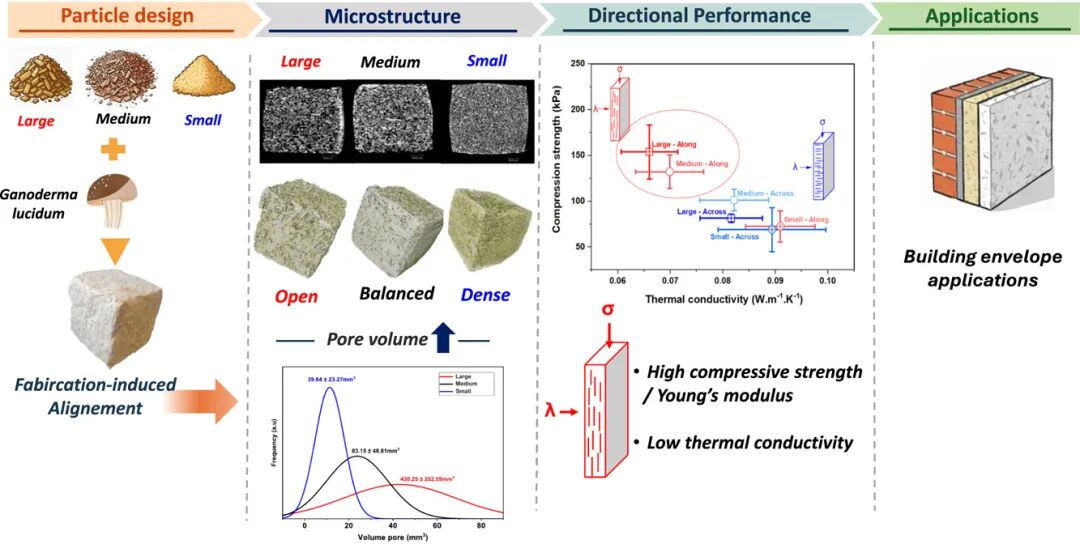
菌丝生物复合材料的结构-性能关系:颗粒大小和取向作为湿热和机械性能的设计参数
Mycelium-based biocomposites are emerging as sustainable alternatives for non-structural building due to their low environmental impact and multifunctional potential. This study investigates the coupled effects of particle size and particle orientation on the morphological, thermal, and mechanical performance of hemp shives mycelium biocomposites. The biocomposites were produced using Ganoderma lucidum and hemp shives of three particle sizes (large, medium, and small), with a preferential particle alignment induced during fabrication. Experimental characterization was complemented by microstructural an alysis and modeling to establish structure–property relationships. X-ray nano-tomography revealed that increasing particle size leads to higher macroporosity and structural anisotropy, driven by particle alignment along the mold-filling direction, whereas smaller particles produce homogeneous microstructures. These morphological features govern biocomposite behavior. Thermal conductivity exhibited clear directional dependence, ranging from 0.066 to 0.091 W m − 1 K − 1 with the lowest values obtained for large-particle biocomposites tested perpendicular to the particle alignment. Mechanical performances are also anisotropic: compressive strength and stiffness were maximized when loading was applied parallel to the particle orientation, reaching up to 183 kPa for biocomposites manufactured with large and medium particles. Simplified upscaling models captured the influence of particle orientation on both heat transfer and mechanical strength, highlighting the contribution of the mycelial network and particle elongation. These findings demonstrate that systematic particle alignment during fabrication can be used as a controllable design parameter to tailor material anisotropy and optimize functional performance: to optimize the mechanical resistance while reducing thermal losses, the panel should be manufactured horizontally with elongated particles and then raised against the wall.
菌丝体基生物复合材料因其低环境影响和多功能潜力而成为非结构建筑的可持续替代品。本研究考察了颗粒大小和颗粒取向对麻屑菌丝生物复合材料形态、热、力学性能的耦合影响。生物复合材料是用三种粒径(大、中、小)的灵芝和大 麻片制成的,在制造过程中产生了优先的颗粒排列。实验表征辅以微观结构分析和建模,以建立结构-性能关系。x射线纳米层析成像显示,颗粒尺寸增大导致宏观孔隙率和结构各向异性增大,这主要受颗粒沿充型方向排列的驱动,而较小的颗粒则产生均匀的微观结构。这些形态特征支配着生物复合材料的行为。热导率表现出明显的方向依赖性,范围从0.066到0.091 W m−1 K−1,在垂直于颗粒排列的大颗粒生物复合材料中获得的最低值。力学性能也是各向异性的:当加载平行于颗粒方向时,抗压强度和刚度最大,对于由大颗粒和中等颗粒制造的生物复合材料,其抗压强度和刚度最高可达183 kPa。简化的升级模型捕获了颗粒取向对传热和机械强度的影响,突出了菌丝网络和颗粒伸长的贡献。这些发现表明,在制造过程中,系统的颗粒排列可以作为一个可控的设计参数来调整材料的各向异性和优化功能性能:为了优化机械阻力,同时减少热损失,面板应该用细长的颗粒水平制造,然后紧贴墙壁。
Vision-Inspired Cone-Ring Architectures Enable Broadband and Low-Frequency Electromagnetic Absorption
Dongxu Zhao, Lu Feng, Wanchong Li, Zaiqing Yang, Shicheng Jin, Zhe Wang, Xiaoyong Wu, Haozhen Yan, Yan Wang, Yu Mao, Jinsong Zhang
doi:10.1016/j.composites b.2026.113780
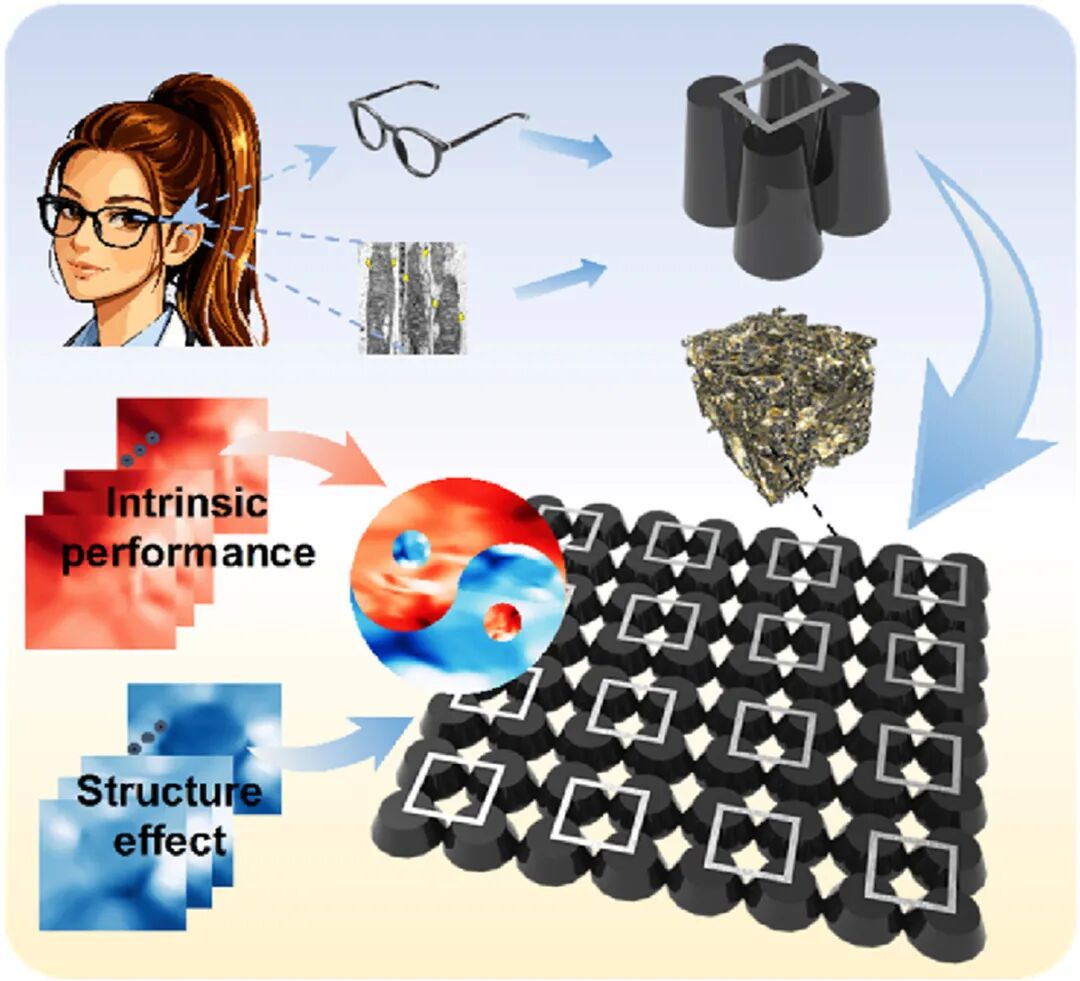
视觉启发锥环架构实现宽带和低频电磁吸收
Most existing structural designs mainly focus on geometric optimization while neglecting the interaction between intrinsic electromagnetic (EM) properties and structural effects, making it difficult to achieve low-frequency and broadband absorption. Here, a biomimetic design strategy that integrates intrinsic material properties with structural effects is proposed. Biomass-derived porous carbon, obtained from fermented steamed buns and doped with Co-based nanoparticles via pyrolysis, hydrothermal synthesis, and Joule heating, serves as the intrinsic absorption unit with tunable dielectric–magnetic coupling. Structurally, a cone-ring synergistic EM absorber (EMAMs) materials (CPC-G) is designed, inspired by the photosensitive response of cone cells and the optical correction principle of glasses. By incorporating both intrinsic EM parameters and geometric variables into a machine-learning optimization framework, the structure–property relationship was effectively established and optimized, achieving precise impedance matching and efficient energy dissipation. The optimized CPC-G exhibits an effective absorption bandwidth of 1.2-50 GHz at 18.6 mm with a low areal density of 0.16 g cm-2. Field simulations reveal that the hierarchical porous cone-ring architecture enhances multi-scattering, localized resonance, and conductive loss through magneto-dielectric synergy. This biomimetic, machine learning-assisted strategy provides a universal pathway for designing lightweight, broadband, and low-frequency EMAMs for advanced stealth and protection applications.
现有的结构设计大多侧重于几何优化,忽略了固有电磁特性与结构效应之间的相互作用,难以实现低频和宽带吸收。本文提出了一种将材料固有特性与结构效应相结合的仿生设计策略。以发酵馒头为原料,经热解、水热合成、焦耳加热等工艺制备掺杂钴基纳米颗粒的生物质衍生多孔碳,作为具有可调谐介电-磁耦合特性的本征吸收单元。在结构上,受锥细胞光敏响应和眼镜光学校正原理的启发,设计了一种锥-环协同电磁吸收材料(CPC-G)。通过将固有电磁参数和几何变量结合到机器学习优化框架中,有效地建立和优化了结构-性能关系,实现了精确的阻抗匹配和高效的能量耗散。优化后的CPC-G在18.6 mm处的有效吸收带宽为1.2 ~ 50 GHz,面密度为0.16 g cm-2。现场模拟结果表明,分层多孔锥环结构通过磁介电协同作用增强了多散射、局部共振和导电损耗。这种仿生、机器学习辅助策略为设计轻型、宽带和低频emam提供了一种通用途径,用于先进的隐身和保护应用。
Composites Science and Technology
Defect and heterointerface engineering in ramie-leaf-derived carbon nanofiber (CNF)/M (M=Co, Fe/Fe3O4, or Ni) magnetic composites for boosted microwave absorptive and heat dissipative capabilities
Kang Fu, Lingling Xu, Guiyue Zhou, Xiaojuan Wang, Liyan Xie, Guoxiu Tong, Wenhua Wu
doi:10.1016/j.compscitech.2026.111701
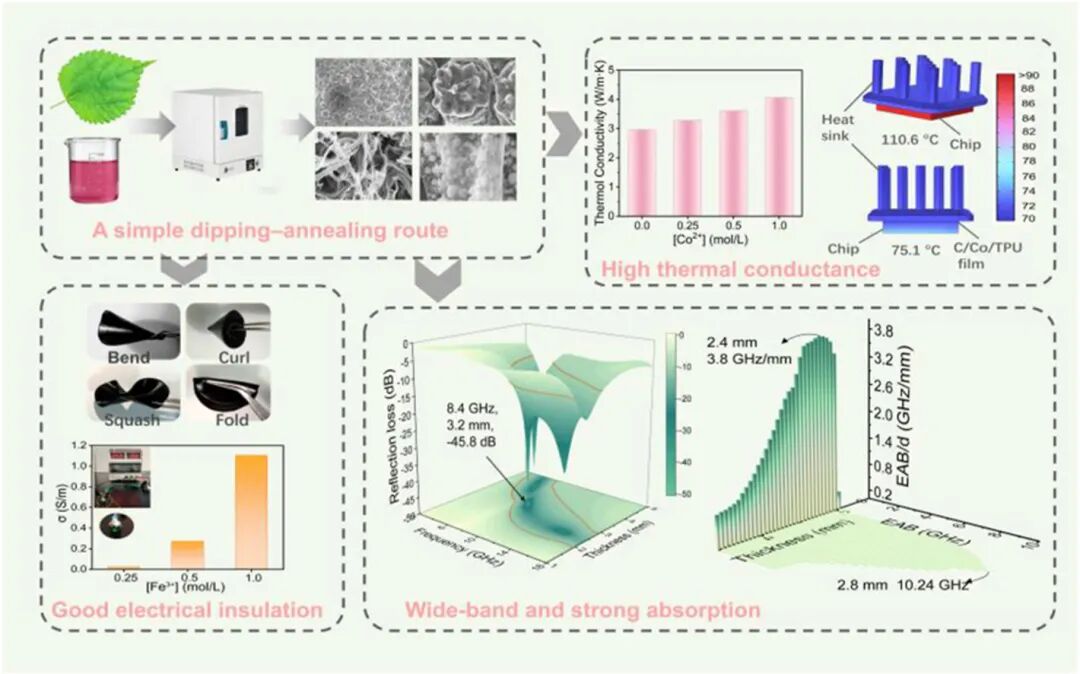
苎麻叶衍生碳纳米纤维(CNF)/M (M=Co, Fe/Fe3O4或Ni)磁性复合材料的缺陷和异质界面工程,以提高微波吸收和散热能力
With the growing concerns over electromagnetic (EM) radiation and thermal accumulation issues in electronic devices, developing green, high-yield, and low-cost materials that offer both EM protection and heat dissipation is critical to ensuring device reliability and human safety. In this study, ramie-leaf-derived carbon nanofiber (CNF)/M (M = Co, Fe/Fe3O4, or Ni) magnetic composites were prepared using a simple dipping–annealing method, which possessed significant potential for EM protection and thermal management applications. Initially, CNFs exhibited an absorption-frequency band of 6.56 GHz and a heat conduction of 2.963 W/(m K) thanks to their rich defects and phase interfaces among carbon, silicates, and carbonates. The CNFs were further combined with magnetic nanoparticles (Co, Fe/Fe3O4, or Ni) and their defects and heterointerfaces were optimized via the modulations of sintering temperature, metal ion concentration, and metal ion type. Results showed that the CNF/M composites exhibited a simultaneous improvement in microwave absorption and heat conductance. The optimal overall properties were attained under T s=800 °C and [Ni2+]=0.50 mol/L, with an efficacious absorption-band of 10.24 GHz (3.66 GHz/mm) and a thermal conductivity of 3.50 W/(m·K) at a small load of 30 wt.%, which were superior to those of already-reported carbon-based composites. The simultaneous improvement was due to multiple magnetic/dielectric losses, electron/phonon co-transmission, interlinked networks, and a trade-off between defects and heterointerfaces. Overall, this study proposes an effective strategy to achieve scalable synthesis, structure optimization, and multifunctional integration in composites, contributing greatly to the development of electronic packaging materials with superior microwave absorption and thermal dissipation capabilities.
随着人们对电子设备中的电磁辐射和热积累问题的日益关注,开发既能提供电磁保护又能散热的绿色、高产、低成本材料对于确保设备可靠性和人身安全至关重要。本研究采用简单的浸退火方法制备了苎麻叶衍生的碳纳米纤维(CNF)/M (M = Co, Fe/Fe3O4或Ni)磁性复合材料,该复合材料在电磁保护和热管理方面具有重要的应用潜力。由于碳、硅酸盐和碳酸盐之间存在丰富的缺陷和相界面,CNFs的吸收频带为6.56 GHz,热传导系数为2.963 W/(m K)。进一步将CNFs与磁性纳米颗粒(Co、Fe/Fe3O4或Ni)结合,并通过烧结温度、金属离子浓度和金属离子类型对其缺陷和异质界面进行优化。结果表明,CNF/M复合材料的微波吸收性能和导热性能均有显著提高。在温度为800℃,[Ni2+]为0.50 mol/L的条件下,复合材料的综合性能达到最佳,有效吸收波段为10.24 GHz (3.66 GHz/mm),热导率为3.50 W/(m·K),负载为30 wt.%,优于已有报道的碳基复合材料。同时的改进是由于多重磁/介电损耗、电子/声子共传输、互连网络以及缺陷和异质界面之间的权衡。总体而言,本研究提出了一种有效的策略来实现复合材料的可扩展合成、结构优化和多功能集成,为开发具有优异微波吸收和散热能力的电子封装材料做出了重要贡献。
Synergistic pore-structure tuning and multifunctional integration in polyimide aerogels via interfacial engineered nanofillers
Xinshuo Mu, Tiantian Xue, Xi Shen, Chao Zhang, Wei Fan, Tianxi Liu
doi:10.1016/j.compscitech.2026.111702
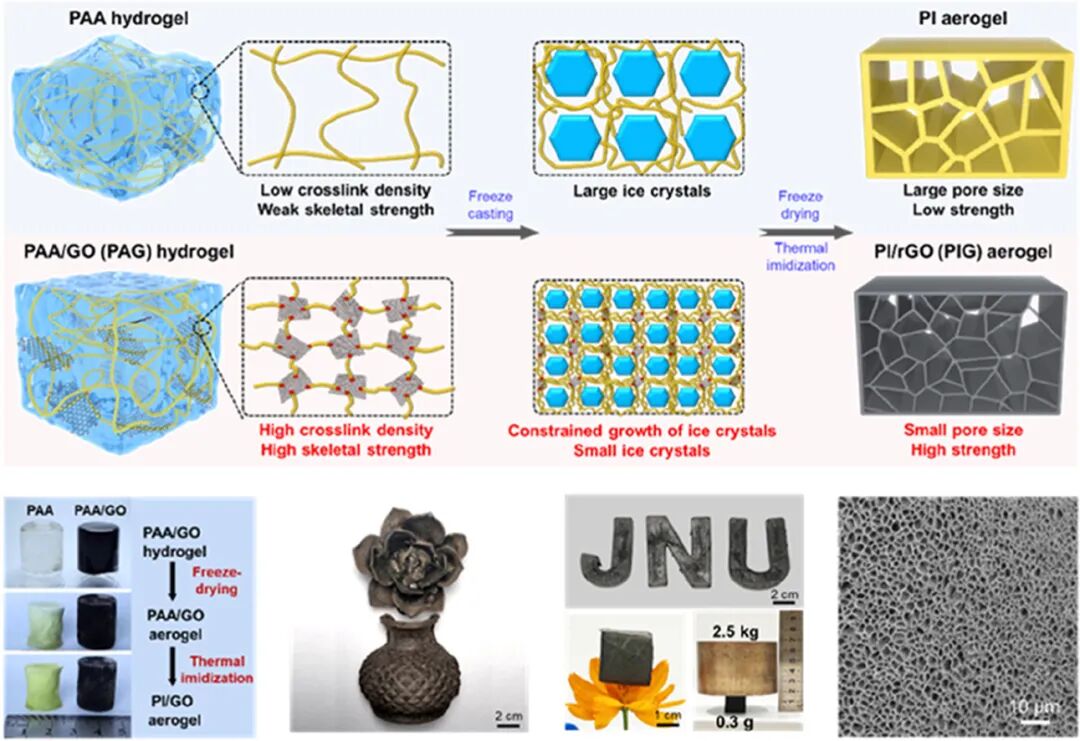
界面工程纳米填料在聚酰亚胺气凝胶中的协同孔隙结构调整和多功能集成
Despite their exceptional thermal insulation, the widespread application of polymer aerogels is fundamentally limited by the inherent trade-off between mechanical strength and thermal performance. This work presents a universal strategy to decouple this conflict by leveraging the interfacial interactions between graphene oxide (GO) nanosheets and a polyimide (PI) matrix. Through in-situ rheology, variable-temperature Nuclear Magnetic Resonance, and 2D correlation spectroscopy, we elucidate how GO directs the sol-gel transition, accelerates network formation, and refines the pore architecture via hydrogen-bonding interactions. The resulting composite aerogel achieves an ultralow density (0.1 g cm-3), high compressive modulus (27.3 MPa), and low thermal conductivity (43.0-60.8 mW m-1 K-1 from 25-200 °C). Simultaneously, the aerogel exhibits excellent high-temperature stability (>500 °C) and flame retardancy (UL-94 V-0). This work elucidates a versatile nanofiller-enabled reinforcement mechanism, offering a promising strategy for the designed fabrication of multifunctional aerogels for advanced thermal management.
尽管聚合物气凝胶具有出色的隔热性能,但其广泛应用从根本上受到机械强度和热性能之间固有权衡的限制。这项工作提出了一种通用策略,通过利用氧化石墨烯(GO)纳米片和聚酰亚胺(PI)矩阵之间的界面相互作用来解耦这种冲突。通过原位流变学、变温核磁共振和二维相关波谱,我们阐明了氧化石墨烯如何通过氢键相互作用指导溶胶-凝胶转变,加速网络形成,并改善孔隙结构。所得的复合气凝胶具有超低密度(0.1 g cm-3)、高压缩模量(27.3 MPa)和低导热系数(25-200℃范围内40.3 -60.8 mW m-1 K-1)。同时,该气凝胶具有优异的高温稳定性(500℃)和阻燃性(UL-94 V-0)。这项工作阐明了一种通用的纳米填料增强机制,为设计制造用于高级热管理的多功能气凝胶提供了一种有前途的策略。
Prediction of stiffness degradation induced by off-axis cracks in non-crimp fabric composites for wind turbines under cyclic loadings
Federico Lamon, Lucio Maragoni, Paolo Andrea Carraro, Ashish K. Bangaru, Bent F. Sørensen, Lars P. Mikkelsen, Marino Quaresimin
doi:10.1016/j.compscitech.2026.111694
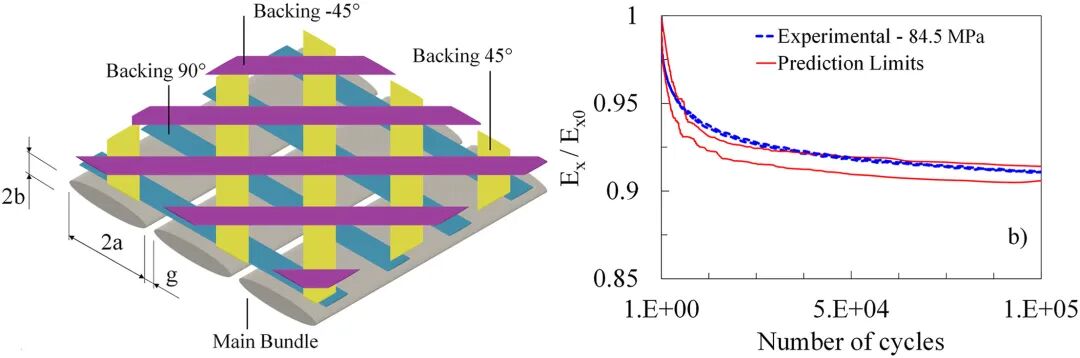
循环荷载下风力发电机用无卷曲织物复合材料离轴裂纹刚度退化预测
Wind turbine design requires robust models to evaluate the fatigue damage evolution of composite materials for rotor blades. Crucial areas such as spar caps are mostly made of quasi-unidirectional non-crimp fabric composites, that include thin layers of backing bundles. Despite some similarities with laminates made of unidirectional plies, the morphology of non-crimp fabrics affects the fatigue-induced damage mechanisms and the stiffness properties. Consequently, dedicated models must be developed to accurately describe the fatigue behaviour. In this paper, we propose a novel strategy to predict the stiffness degradation in composites for wind turbine rotor blades, based on the prediction of the damage evolution, consisting of tunnel-cracking in the off-axis bundles of the NCF. The model predictions were found be in satisfactory agreement with experimental results.
风力机设计需要鲁棒模型来评估复合材料转子叶片的疲劳损伤演变。诸如梁顶之类的关键区域大多由准单向无卷曲织物复合材料制成,其中包括薄层的背束。尽管与单向层合板有一些相似之处,但无卷曲织物的形态影响疲劳损伤机制和刚度性能。因此,必须开发专用模型来准确描述疲劳行为。在本文中,我们提出了一种新的预测风力发电机转子叶片复合材料刚度退化的策略,该策略基于对NCF离轴束中包含隧道裂纹的损伤演变的预测。模型预测结果与实验结果吻合较好。