
首页/文章/ 详情

【新文速递】2026年5月19日复合材料SCI期刊最新文章
3月前浏览456

今日更新:Composites Part B: Engineering 2 篇

Composites Part B: Engineering

A multi-level interfacial structure between 304 SSM heating elements and GF-PA66 for synergistic strengthening in resistance welding

Jiayi Chen, Jianhui Su, Xueyan Zhang, Fuyun Liu, Caiwang Tan, Xiaohui Han, Gengxiang Yang, Bo Chen, Xiaoguo Song, Swee Leong Sing

doi:10.1016/j.composites b.2026.113818

304 SSM加热元件与GF-PA66之间的多层界面结构在电阻焊中的协同强化

Interfacial bonding reliability remains a critical challenge in resistance welding of fiber-reinforced thermoplastic composites (FRTP) for lightweight applications. In this study, to transform the SSM from a passive heating element into an active load-bearing component, a multi-level interfacial structure featuring a roughness-induced discontinuous silane layer was constructed on 304 stainless steel mesh (SSM) via sequential hydrochloric acid (HCl) etching and γ-aminopropyltriethoxysilane (APTES) coupling. The underlying strengthening mechanism was systematically investigated. Results showed that etching created a three-dimensional micro-nano structure on the SSM, enhancing the interfacial bonding strength via anchoring. Simultaneously, the enlarged surface area and the increase in surface hydroxyl (-OH) density facilitated the adsorption of APTES. Critically, the self-condensation of APTES was suppressed on the rough surface, yielding a discontinuous silane layer rich in both amino (-NH2) and silanol (-Si-OH) groups, which promoted the formation of a dense hydrogen-bonding network with GF-PA66. Consequently, the synergistic reinforcement from micro-mechanical interlocking and molecular-level hydrogen bonding increased the joint strength by 54.16% to 44.43 MPa. The corresponding failure mode shifted to a mixture of cohesive resin tearing and cooperative SSM deformation, confirming the functional transformation of the SSM. This work provides new insights into silane-based interfacial design for high-performance FRTP resistance welding and deepens the understanding of multi-level interfacial interactions in metal-polymer composite systems.

界面粘接的可靠性仍然是纤维增强热塑性复合材料(FRTP)轻量化应用中电阻焊的关键挑战。为了将SSM从被动加热元件转变为主动承载元件,在304不锈钢网(SSM)上通过盐酸(HCl)蚀刻和γ-氨基丙基三乙氧基硅烷(APTES)偶联构建了具有粗糙诱导不连续硅烷层的多级界面结构。系统地研究了潜在的强化机制。结果表明,蚀刻在SSM上形成了三维微纳结构,通过锚定增强了界面结合强度。同时,表面积的增大和表面羟基(-OH)密度的增加有利于APTES的吸附。重要的是,APTES在粗糙表面的自缩合被抑制,生成了一个不连续的硅烷层,富含氨基(-NH2)和硅醇(-Si-OH)基团,这促进了与GF-PA66形成致密的氢键网络。结果表明,微力学联锁和分子级氢键的协同强化使接头强度提高了54.16%,达到44.43 MPa。相应的破坏模式转变为树脂黏性撕裂和SSM协同变形的混合,证实了SSM的功能转变。这项工作为高性能FRTP电阻焊的硅烷界面设计提供了新的见解,并加深了对金属-聚合物复合体系中多层次界面相互作用的理解。


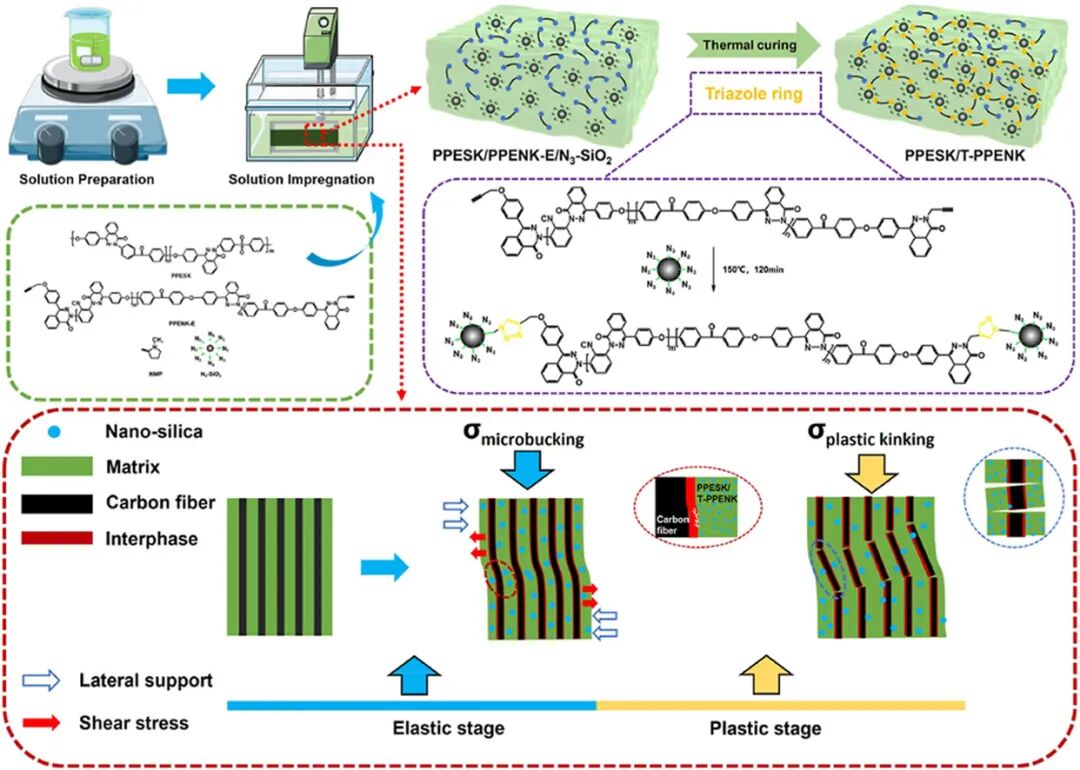
Enhancing longitudinal compressive strength of carbon fiber reinforced thermoplastic composites via organic–inorganic synergistic crosslinking: interphase strengthening and microbuckling suppression

Qiming Wang, Minghang Yang, Yining Wang, Lei Lu, Yulong Meng, Zhimin Wang, Xigao Jian, Yousi Chen

doi:10.1016/j.composites b.2026.113811
通过有机-无机协同交联提高碳纤维增强热塑性复合材料的纵向抗压强度:界面强化和微屈曲抑制

To overcome the intrinsic limitation of carbon fiber reinforced Polyphthalazine ether sulfone ketone (CF/PPESK) in longitudinal compression, an organic–inorganic synergistic crosslinking strategy is proposed to construct a mechanically graded interphase around carbon fibers. A crosslinkable high-modulus thermoplastic resin was engineered by co-designing an alkynyl-terminated heterocyclic Polyphthalazinone ether nitrile ketone (PPENK-E) and azide-functionalized silica (N3–SiO2), targeting interphase stiffening and shear-load transfer. The role of matrix/interphase modulus in governing longitudinal compressive strength and failure evolution was systematically investigated. Increasing the hybrid crosslinking density together with nanosilica reinforcement significantly enhanced the elastic and shear mod uli of the matrix, thereby forming a robust intermediate-modulus interphase and improving lateral constraint against fiber microbuckling. Consequently, the optimized composite achieves a longitudinal compressive strength of 936 MPa at 25 °C and retains 81% of its compressive strength at 200 °C, demonstrating excellent elevated-temperature compressive stability. Force-modulation AFM reveals a “high-modulus fiber–intermediate-modulus interphase–matrix” architecture with an enlarged modulus-gradient zone, which is consistent with improved interphase reinforcement and reduced stiffness mismatch. These observations are consistent with microscopy and a coupled elastic-buckling/plastic-kinking simulation, revealing delayed kink-band initiation and constrained damage localization. This work establishes a modulus-centered, scalable route for compression-critical thermoplastic composites with high load-bearing capability and robust thermomechanical stability for elevated-temperature structural applications.

为了克服碳纤维增强聚酞嗪醚砜酮(CF/PPESK)纵向压缩的固有局限性,提出了一种有机-无机协同交联策略,在碳纤维周围构建机械梯度界面相。通过设计端烷基杂环聚酞嗪酮醚腈酮(PPENK-E)和叠氮化二氧化硅(N3-SiO2),设计了一种可交联的高模量热塑性树脂,以增强相间刚度和剪切载荷传递。系统研究了基体/相间模量对纵向抗压强度和破坏演化的控制作用。增加杂化交联密度和纳米二氧化硅增强显著提高了基体的弹性模量和剪切模量,从而形成了稳健的中间模量界面,提高了对纤维微屈曲的侧向约束。因此,优化后的复合材料在25℃时的纵向抗压强度为936 MPa,在200℃时仍能保持81%的抗压强度,表现出优异的高温抗压稳定性。力调制AFM显示出“高模量纤维-中间模量相间矩阵”结构,具有较大的模梯度区,这与增强的相间增强和减少的刚度失配相一致。这些观察结果与显微镜和耦合弹性-屈曲/塑性-扭结模拟相一致,揭示了延迟扭结带起始和约束损伤定位。这项工作为压缩临界热塑性复合材料建立了以模量为中心、可扩展的路线,具有高承载能力和强大的高温结构应用的热机械稳定性。

来源:复合材料力学仿真Composites FEM
ACTMechanicalSystemDeform复合材料ADS化机材料控制
著作权归作者所有,欢迎分享,未经许可,不得转载
首次发布时间:2026-05-27
最近编辑:3月前
Tansu
签名征集中
获赞 22粉丝 6文章 1031课程 0
点赞
收藏
作者推荐

【新文速递】2026年5月12日固体力学SCI期刊最新文章

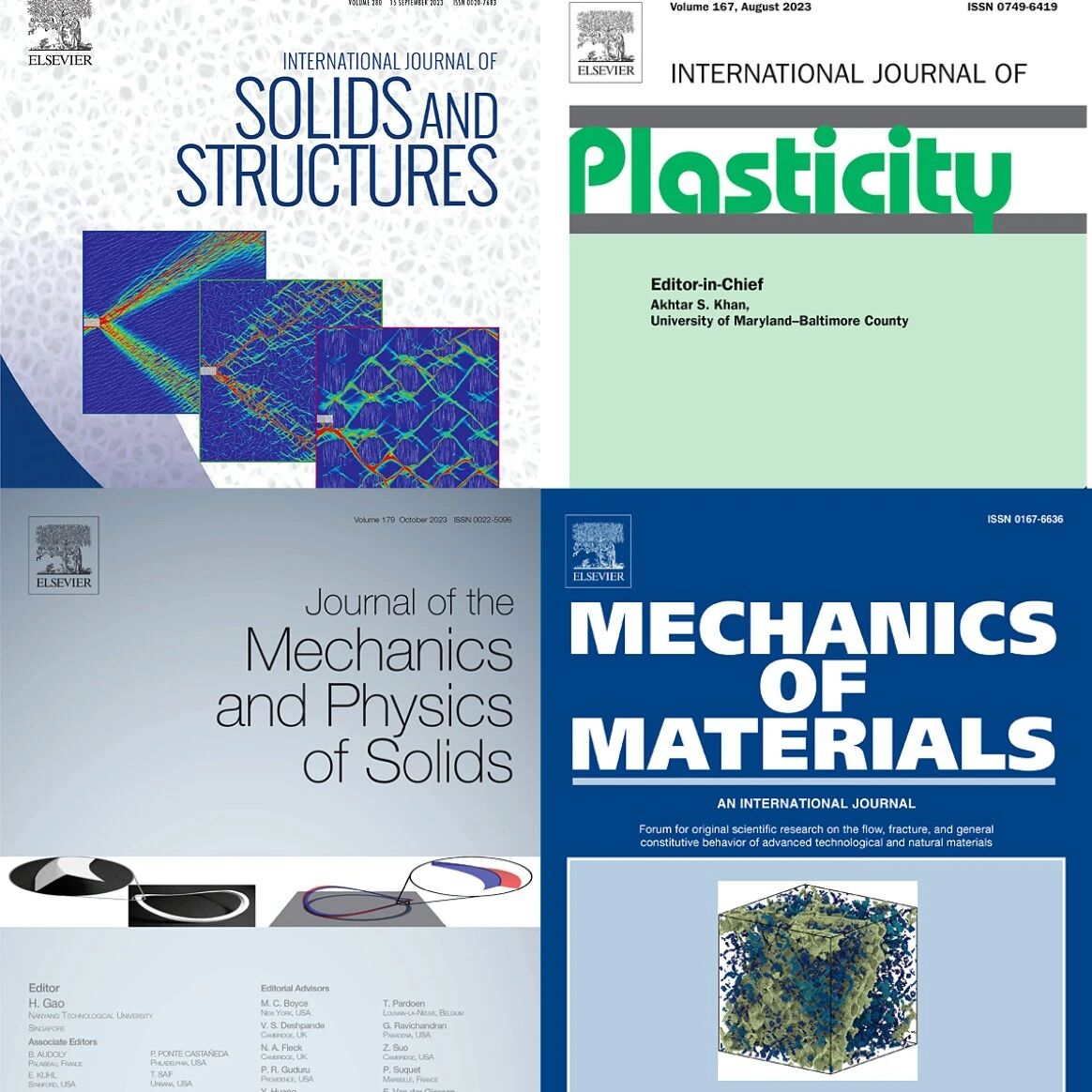
今日更新:International Journal of Solids and Structures 1 篇,Journal of the Mechanics and Physics of Solids 1 篇,Thin-Walled Structures 1 篇International Journal of Solids and StructuresEnhancement of strength and durability in single-lap joints using thin double-sided tapeAshwani Kumar Devisharan, Ho Xuan Ngoc Chau, Kounosuke Shimamura, Kosuke Takahashidoi:10.1016/j.ijsolstr.2026.114082 使用薄双面胶带增强单搭接接头的强度和耐久性Adhesive bonding has emerged as a viable and efficient alternative to conventional joining techniques offering the key advantages of reduced structural weight and lower manufacturing costs. It is the preferred method when joining dissimilar materials. Single-lap joints (SLJs) bonded using adhesives are widely used due to their simple design and ease of fabrication. However, these joints exhibit stress concentrations at the bondline ends which lead to sudden premature failure. The concept of variable modulus bondline has been suggested in the past studies as a solution. However, the practical implementation of this method remains challenging. This is due to factors such as the need for precise adhesive placement in a defined area, and ensuring a uniform bondline thickness. This paper presents a novel and practical method to improve the performance of single lap adhesive joints using thin double-sided tapes at bondline ends. Double-sided tape relieves the stress concentration, offers the advantage of easy manufacturability and ensures uniform adhesive thickness without use of complicated mechanis ms. Joints fabricated with aluminum and acrylic adherends were bonded with a structural epoxy adhesive in combination with the tape. The proposed technique was found to enhance the performance both under static and cyclic loading conditions revealing a delayed onset of interfacial debonding in specimens with the proposed tape arrangement. Finite element a nalysis not only confirmed the reduction in stress concentrations but also validated the experimental observations, demonstrating the effectiveness of the proposed technique.粘合剂连接已成为传统连接技术的一种可行和有效的替代方案,具有减轻结构重量和降低 制造成本的关键优势。它是连接不同材料时的首选方法。用胶粘剂粘合的单搭接由于其设计简单、易于制造而被广泛应用。然而,这些接头在结合线末端表现出应力集中,从而导致突然的过早失效。在过去的研究中提出了变模结合线的概念作为解决方案。然而,这种方法的实际实施仍然具有挑战性。这是由于需要在规定的区域内精确地放置粘合剂,并确保粘合线厚度均匀等因素造成的。本文提出了一种新颖实用的方法来提高单搭接接头的性能。双面胶带消除了应力集中,具有易于制造的优点,无需使用复杂的机构即可确保均匀的粘接厚度。用铝和丙烯酸粘合剂制成的接头用结构环氧粘合剂结合胶带粘合。所提出的技术被发现提高了静态和循环加载条件下的性能,揭示了具有所提出的胶带布置的试样的界面剥离延迟发作。有限元分析不仅证实了应力集中的降低,而且验证了实验观察结果,证明了所提出技术的有效性。Journal of the Mechanics and Physics of SolidsTwist-angle dependence of the out-of-plane elasticity in bilayer MoS2Qianglong Wu, Jun Pei, Erteng Chen, Xiaoyi Yuan, Yonghuang Wu, Run Shi, Yukai Li, Tianyi Zhang, Wenjian Su, Jinkai Li, Xinyu Sun, Huan Hu, Yanhao Tang, Zhaohe Dai, Kai Liu, Shuze Zhu, Yang Gaodoi:10.1016/j.jmps.2026.106680二硫化钼双层结构面外弹性的扭角依赖性The interlayer van der Waals (vdW) coupling is pivotal in determining the physical properties of vdW homo- and heterostructures. Out-of-plane elasticity is a quantitative measure of the vdW coupling strength between 2D layers. Here, we report on the direct mechanical measurement of the out-of-plane elastic modulus of twisted bilayer MoS2 with an advanced angstrom-indentation technique combined with theoretical modeling. We demonstrate that the out-of-plane elastic response of bilayer MoS2 is extremely sensitive to the twist angle. The out-of-plane elasticity is maximized when the twist angle < 2° and weakest with the twist angle exceeding 20°. In a s mall range of twist angle (2° ∼ 7°), the out-of-plane elasticity is notably softened. Large-scale molecular dynamics (MD) simulations, which quantitative agree with experimental measurement, suggest that the twist-angle dependence of the out-of-plane elasticity arises from the evolution of stacking patterns due to atomic relaxations. Our work offers new perspectives on elucidating the interplay between the interlayer rotation and the interfacial physics of vdW materials.层间范德华(vdW)耦合是决定vdW同质结构和异质结构物理性质的关键。面外弹性是二维层间vdW耦合强度的定量度量。本文报道了一种先进的埃压痕技术结合理论建模对扭曲双层二硫化钼的面外弹性模量的直接机械测量。我们证明了双层二硫化钼的面外弹性响应对扭转角极为敏感。当扭转角度< 2°时,面外弹性最大,扭转角度超过20°时,面外弹性最弱。在较小的扭转角范围内(2°~ 7°),面外弹性明显软化。大尺度分子动力学(MD)模拟结果与实验结果一致,表明面外弹性的扭转角依赖源于原子弛豫引起的堆叠模式的演化。我们的工作为阐明vdW材料的层间旋转与界面物理之间的相互作用提供了新的视角。Thin-Walled StructuresNon-linear harmonic vibrations of laminate plates with viscoelastic layers described by extended fractional modelsPrzemysław Litewka, Roman Lewandowskidoi:10.1016/j.tws.2026.115091用扩展分数阶模型描述粘弹性层合板的非线性谐波振动Laminate plates are frequently used structural elements in many branches of engineering. The understanding of their dynamic behaviour under various service conditions is of great importance. This paper is devoted to the non-linear harmonic vibration a nalysis of such plates containing viscoelastic layers, which are useful in reducing excessive vibrations. The viscoelasticity is modelled using a generalised scheme valid for four different material descriptions based on the fractional derivatives and including the separation of volumetric and deviatoric parts of deformation. The time-temperature superposition and three methods of thermal shift computation are considered to include the effect of the ambient temperature. The plate kinematics is described with the refined zig-zag theory including the von Kàrmàn geometric non-linearity. The harmonic vibration problem of layered plates is formulated using the harmonic balance method with the exponential complex-conjugate representation of the displacement and stress functions, the time-averaged principle of virtual work and the finite element discretisation. The paper presents the results and discussion of several numerical examples solved using the proposed approach. They include comparison of the damping performance of six different viscoelastic materials described by four models of viscoelasticity for various sandwich plates in various thermal ambient conditions.层压板是许多工程领域中常用的结构元件。了解它们在各种使用条件下的动态行为是非常重要的。本文对含粘弹性层板的非线性简谐振动进行了分析,这对减小超振动有重要意义。粘弹性的建模采用一种广义方案,该方案适用于基于分数阶导数的四种不同的材料描述,并包括体积和变形偏差部分的分离。时间-温度叠加和三种热移计算方法考虑了环境温度的影响。用包含von Kàrmàn几何非线性的精细化之字形理论描述板的运动学。采用位移和应力函数的指数复共轭表示、虚功时均原理和有限元离散化的谐波平衡法,建立了层状板的谐波振动问题。文中给出了用该方法求解的几个数值算例的结果和讨论。其中包括用四种粘弹性模型描述的六种不同粘弹性材料在不同热环境条件下的阻尼性能的比较。来源:复合材料力学仿真Composites FEM

未登录
还没有评论
课程
培训
服务
行家
VIP会员 学习计划 福利任务
下载APP
联系我们
帮助与反馈