【新文速递】2026年4月30日固体力学SCI期刊最新文章

今日更新:International Journal of Solids and Structures 6 篇,Journal of the Mechanics and Physics of Solids 2 篇,Mechanics of Materials 2 篇,International Journal of Plasticity 1 篇
International Journal of Solids and Structures
Physics-informed neural networks for local and nonlocal modeling in continuum damage mechanics
Mohammad Sadegh Mirzaei, Mohammad Mashayekhi, Mohsen Mirkhalaf
doi:10.1016/j.ijsolstr.2026.114052
连续介质损伤力学中局部和非局部建模的物理信息神经网络
In Continuum Damage Mechanics (CDM), numerical algorithms are widely used to predict material degradation in engineering applications. However, these methods typically require iterative computations at each time step, which creates significant challenges for complex geometries. This study presents a Physics-Informed Neural Network (PINN) model based on the Lemaitre damage model, a well-established framework in CDM, for predicting damage evolution in ductile materials. Training data for the PINN were generated from 2,000 random strain paths, with stress and damage values computed using a numerical Lemaitre model implemented in an Abaqus UMAT. The numerical model was validated with benchmark tests to ensure accuracy. The PINN architecture integrates Gated Recurrent Units (GRUs), enabling it to capture strain path dependency and history effects. Results show that the PINN closely matches the numerical solution in benchmark evaluations. Furthermore, incorporating damage growth equations into the loss function significantly improves predictions, especially for data outside the training region, and enhances physical consistency compared to standard neural networks. The application of PINNs in nonlocal damage mechanics was also investigated. A key challenge in local damage mechanics is the mesh dependency of numerical solutions, which can lead to unrealistic localization effects. While nonlocal damage models mitigate this issue by introducing a characteristic length to s mooth damage field, this study demonstrates that the trained PINN, despite being trained on local data, successfully predicts nonlocal damage behavior, highlighting its potential as a data-driven tool for both local and nonlocal damage modeling.
在连续损伤力学(CDM)中,数值算法被广泛用于工程应用中预测材料的退化。然而,这些方法通常需要在每个时间步进行迭代计算,这对复杂的几何形状造成了巨大的挑战。本研究提出了一种基于Lemaitre损伤模型的物理信息神经网络(PINN)模型,用于预测延性材料的损伤演变。Lemaitre损伤模型是CDM中一个成熟的框架。PINN的训练数据由2000个随机应变路径生成,应力和损伤值使用在Abaqus UMAT中实现的数值Lemaitre模型计算。通过基准试验验证了数值模型的正确性。PINN架构集成了门控循环单元(gru),使其能够捕获应变路径依赖和历史效应。结果表明,在基准评估中,PINN与数值解非常接近。此外,与标准神经网络相比,将损伤增长方程纳入损失函数显著改善了预测,特别是对训练区域以外的数据,并增强了物理一致性。研究了pin - n在非局部损伤力学中的应用。局部损伤力学的一个关键挑战是数值解的网格依赖性,这可能导致不现实的局部化效果。虽然非局部损伤模型通过在光滑损伤场中引入特征长度来缓解这一问题,但该研究表明,尽管训练后的PINN是在局部数据上训练的,但它成功地预测了非局部损伤行为,突出了其作为局部和非局部损伤建模数据驱动工具的潜力。
Optimization of sandwich tensile test to extract the true constitutive curve by suppressing Lüders instability
Heng Zhu, Guisen Liu, Ran Chen, Yao Shen
doi:10.1016/j.ijsolstr.2026.114054
通过抑制<s:1> ders失稳,优化夹芯拉伸试验提取真实本构曲线
Extraction of the true tensile curves for materials exhibiting Lüders instability is challenging, due to the macroscopic nonuniformity manifested as Lüders banding in the gauge section. A promising solution to suppress Lüders instability is using sandwiched specimens, where the two outer layers constrain the local necking of core layer by higher strength and/or higher hardening rate. However, previous efforts to achieve complete instability suppression were hindered by some limitations: (1) reliance on indirect indicators of instability suppression such as the absence of stress serrations/plateaus in the sandwich tensile curve or uniformity of deformation in the outer layers, and (2) insufficient investigation into the effects of adhesive and outer layers’ properties on the suppression capability. In this study, we confirm that direct inspection is necessary for robust instability assess ment, such as in-situ DIC strain measurement on the lateral surface or post-test morphological examination on the front surface of the core layer after removal of the outer layers. The instability suppression can be seen from the macroscopic strain uniformity and a self-similar evolution of the normalized axial strain deviation, or the absence of surface undulations in the core layer; the first two indicators are proposed in view of the generally unavoidable DIC measurement artifacts. Additionally, we propose optimal design strategies for the adhesive and outer layers based on systematic experiments and simulations: (1) unexpectedly, for the adhesive layer, lower thickness and/or higher Poisson’s ratio are recommended for higher suppression capability, on the premise of ensuring effective adhesion between core and outer layers; and (2) for the outer layer, although increasing thickness, yield strength or work hardening rate all enhance the suppression, more considerations are needed to balance the suppression efficiency and the precision of the extracted constitutive curve, additionally, more than suppressing the instability, achieving uniform strain beyond that of the bare specimen is expectable in a sandwich design. These requirements for the outer layers necessitate that (i) the thickness and yield strength should moderately exceed those of the core layer, and (ii) the work hardening rate needs to maintain elevated levels throughout the Lüders strain window—defined as the finite strain interval between the yield strain ( ε y c o r ) and the Lüders strain ( ε l v c o r ) of the core-layer material—and to remain sufficient to delay necking through subsequent deformation. To explain these effects, we developed a local necking concave-convex model that elucidates the influence of the adhesive-layer thickness and Poisson’s ratio on suppression, and we propose an evaluation framework based on the average work hardening capability within the Lüders strain window to assess the suppression efficiency of the outer-layer yield strength and work hardening rate. Collectively, to achieve complete instability suppression and enable reliable extraction of constitutive curves with enhanced precision, the optimized sandwich tensile testing requires: (1) direct assess ment of core-layer instability, and (2) specimen design developed on the synergistic optimization of adhesive and outer-layer properties. These findings provide a foundation for quantitatively assessing Lüders instability and further its relationship to various microstructural features
由于宏观上的不均匀性表现为规范截面上的l<s:2> ders带,因此对表现出lders不稳定性的材料的真实拉伸曲线的提取是具有挑战性的。一种很有前途的解决方案是使用夹在中间的试样,其中两个外层通过更高的强度和/或更高的硬化速率约束核心层的局部颈缩。然而,之前实现完全抑制不稳定的努力受到一些限制的阻碍:(1)依赖于抑制不稳定的间接指标,如夹层拉伸曲线中没有应力锯齿/高原或外层变形均匀性;(2)对粘合剂和外层性能对抑制能力的影响的研究不足。在本研究中,我们证实了直接检测对于鲁棒不稳定性评估是必要的,例如在去除外层后对核心层的侧面进行原位DIC应变测量或在核心层的前表面进行测试后形态学检查。失稳抑制表现为宏观应变均匀性和归一化轴向应变偏差的自相似演化,或核心层无表面波动;前两个指标是考虑到通常不可避免的DIC测量伪影而提出的。通过系统的实验和仿真,提出了胶粘剂和外层的优化设计策略:(1)胶粘剂层在保证芯层与外层有效粘接的前提下,为了获得更好的抑制能力,建议采用更低的胶粘剂厚度和更高的泊松比;(2)对于外层,虽然增加厚度、屈服强度或加工硬化率都可以增强抑制作用,但需要更多地考虑抑制效率和提取本构曲线的精度,此外,在夹层设计中,除了抑制失稳外,还可以实现超过裸试件的均匀应变。对外层的这些要求要求:(i)厚度和屈服强度应适度超过芯层的厚度和屈服强度,以及(ii)加工硬化率需要在整个l<s:1> ders应变窗口(定义为芯层材料的屈服应变(ε 1 v cor)和l<s:1> ders应变(ε 1 v cor)之间的有限应变间隔)保持较高水平,并保持足以通过后续变形延迟颈缩。为了解释这些影响,我们建立了一个局部颈缩凹凸模型,阐明了胶粘剂层厚度和泊松比对抑制的影响,并提出了一个基于l<s:1> ders应变窗口内平均加工硬化能力的评估框架,以评估外层屈服强度和加工硬化率的抑制效率。总的来说,为了实现完全的失稳抑制和提高本构曲线的可靠提取精度,优化的夹层拉伸试验需要:(1)直接评估核心层的失稳,(2)在粘结性能和外层性能协同优化的基础上进行试件设计。这些发现为定量评估l<s:1> ders不稳定性及其与各种微观结构特征的关系提供了基础
Asymmetric and multi-step switching ejection strategy for ultrathin chip-peeling process
Siyu Chen, Ziwen Kong, Hanbin Yin, Yonglin Chen, Weijian Jiao, Feng Zhu, Yinji Ma
doi:10.1016/j.ijsolstr.2026.114051
超薄切屑剥离过程的非对称多步切换顶出策略
Flexible ultrathin chips are fundamental to the advancement of flexible electronics, necessitating precise fabrication processes to ensure damage-free peel-off and high throughput. Prior studies have predominantly focused on the peeling process of the chip–adhesive–substrate structure under symmetrical fixed loading, which often leads to excessive chip fracture or incomplete delamination. This study investigated a switching-position needle ejection strategy by introducing asymmetric ejection loading. A theoretical framework for the chip–adhesive–substrate structure under asymmetric loading was established, and its accuracy was validated through finite element a nalysis. Numerical ana lysis focusing on the dimensionless peeling-health index was conducted to evaluate the health status of the chip, facilitating the formulation of different peeling strategies, including reverse-side ejection, optimal-needle-position ejection, and multi-step switching ejection. The results indicated that the optimal needle position varies with adhesive crack propagation, and the frequency and position of needle switching are significantly influenced by the ratio of the substrate length to chip length. A multi-step switch ejection strategy was determined as the optimal strategy, demonstrating significant superiority over symmetric ejection. To verify the proposed strategy, a wafer-disk moving platform was designed for experimental validation. The results demonstrate that dynamic adjustments of the ejection position effectively promote the delamination of the adhesive layer while mitigating chip fracture, thus providing a novel method to enhance the reliability and efficiency of the chip-peeling process.
柔性超薄芯片是柔性电子技术进步的基础,需要精确的制造工艺来确保无损伤剥离和高吞吐量。以往的研究主要集中在对称固定载荷下芯片-黏合剂-衬底结构的剥离过程,这种剥离过程往往导致芯片过度断裂或分层不完全。本文研究了一种引入非对称弹射载荷的切换位置针弹射策略。建立了非对称载荷下贴片-黏合剂-衬底结构的理论框架,并通过有限元分析验证了其准确性。针对无量纲脱皮健康指数进行数值分析,评价切屑的健康状况,制定不同的脱皮策略,包括反向脱皮、最优针位脱皮和多步切换脱皮。结果表明,最佳针位随粘接裂纹扩展而变化,且针位切换频率和位置受衬底长度与芯片长度之比的显著影响。确定了多步开关弹射策略为最优弹射策略,证明了该策略优于对称弹射策略。为了验证所提出的策略,设计了一个晶圆片移动平台进行实验验证。结果表明,动态调整弹射位置可有效促进粘接层的分层,同时减轻切屑断裂,为提高切屑剥离工艺的可靠性和效率提供了一种新方法。
Probabilistic prediction model for multiaxial fatigue life of notched components integrating dynamic critical point and local stress–strain method
Wenbin Lu, Wen Liu, Yaobing Wei, Rui Liu, Huifeng Ning, Xuemei Pan, Yong Yang, Jianhui Liu
doi:10.1016/j.ijsolstr.2026.114050
基于动态临界点和局部应力-应变法的缺口构件多轴疲劳寿命概率预测模型
Accurate fatigue life prediction models are essential for the reliable safety design and life evaluation of engineering structures. However, existing methods mostly rely on empirical assumptions and case-specific corrections, resulting in insufficient accuracy and stability of the predictions. To solve this problem, a new probabilistic prediction model integrating dynamic critical point with local stress–strain method was proposed. The key innovation lies in the construction of an effective damage parameter which incorporates two elements: a synergistic “promotion-inhibition” mechanis m established by coupling the dangerous point with the dynamic critical point, and an equivalent stress gradient factor introduced to quantify stress gradient effects. The parameter is subsequently integrated with a Weibull distribution to form an adaptive closed-loop iterative framework for simultaneous critical-point updating and accurate probabilistic life prediction. Multiaxial fatigue tests were conducted on Q355D steel to characterize its fatigue behavior. The test data obtained, combined with the existing fatigue test data of Q345, were employed to validate the proposed model. The results show that all predictions fall within the ±2 life scatter band, with superior logarithmic error statistics (μ = −0.04, δ = 0.12). In contrast, predictions from the LSS M, TCD, and two-point methods some data points that fall outside the ±3 life scatter band, with mean errors of 0.25, 0.17, and 0.06 and standard deviations of 0.79, 0.55, and 0.53, respectively. Thereby demonstrating the high accuracy, robustness, and strong potential for engineering application of the proposed model.
准确的疲劳寿命预测模型是工程结构可靠的安全设计和寿命评估的基础。然而,现有方法大多依赖于经验假设和个案修正,导致预测的准确性和稳定性不足。针对这一问题,提出了一种将动态临界点与局部应力应变法相结合的概率预测模型。关键创新在于构建了有效损伤参数,该参数包含两个要素:一是通过将危险点与动态临界点耦合建立协同“促进-抑制”机制;二是引入等效应力梯度因子,量化应力梯度效应。将该参数与威布尔分布相结合,形成自适应闭环迭代框架,实现临界点同步更新和精确概率寿命预测。对Q355D钢进行了多轴疲劳试验,对其疲劳性能进行了表征。将获得的试验数据与Q345现有的疲劳试验数据相结合,对所提出的模型进行验证。结果表明,所有预测结果均在±2寿命散射范围内,具有较好的对数误差统计性(μ =−0.04,δ = 0.12)。相比之下,LSS M、TCD和两点方法的预测数据点落在±3寿命散射带之外,平均误差分别为0.25、0.17和0.06,标准差分别为0.79、0.55和0.53。从而证明了该模型具有较高的精度、鲁棒性和较强的工程应用潜力。
A reconfigurable auxetic lattice with dual-stress plateaus for spacecraft soft-landing energy absorption
Yangzuo Liu, Jie Ren, Changfang Zhao, Zhitan Zhou, Hao Liu, Xingkui Guo
doi:10.1016/j.ijsolstr.2026.114048
航天器软着陆能量吸收的可重构双应力平台辅助晶格
Reusable landing systems are critical for sustainable space exploration, yet existing energy-absorbing materials often suffer from single-impact limitations and lack of adaptive mechanical response. Here, we present a three-dimensional auxetic metamaterial (3D-AMM) lattice based on strut integration and fabricated from hyperelastic thermoplastic polyurethane (TPU). This architected metamaterial combines geometric reconfiguration, persistent global auxetic effect, and repeatable energy absorption—enabling tailored cushioning for spacecraft soft landing. Through selective laser sintering and mechanical training via quasi-static cyclic loading, we stabilize their properties and test their dynamic impact performance using a drop-hammer system. Our findings reveal that individual 3D-AMM units exhibit a well-defined dual-stress plateau response, while lattices maintain auxetic behavior throughout compression. Remarkably, cyclic tests demonstrate specific energy storage retention rates of 87.7–94.7%, exceeding conventional honeycomb and auxetic structures. Under successive low-velocity impacts, the metamaterial shows reproducible energy absorption with minimal degradation, with orthogonal configurations further enhancing stress plateau stability across loading events. These results establish a framework for designing lightweight, reusable, and intelligently reconfigurable cushioning systems, offering a promising avenue for next-generation extraterrestrial landing technologies.
可重复使用的着陆系统对于可持续的空间探索至关重要,但现有的吸能材料往往受到单次撞击的限制,并且缺乏自适应的机械响应。在这里,我们提出了一种基于支撑集成和由超弹性热塑性聚氨酯(TPU)制造的三维auxetic超材料(3D-AMM)晶格。这种结构上的超材料结合了几何重构、持续的全局auxetic效应和可重复的能量吸收,为航天器软着陆提供了量身定制的缓冲。通过选择性激光烧结和准静态循环加载的机械训练,稳定了材料的性能,并利用落锤系统测试了材料的动态冲击性能。我们的研究结果表明,单个3D-AMM单元表现出明确的双应力平台响应,而晶格在整个压缩过程中保持缺乏行为。值得注意的是,循环试验表明,比储能保持率为87.7-94.7%,超过了传统的蜂窝结构和消气结构。在连续的低速冲击下,超材料表现出可重复的能量吸收和最小的退化,正交构型进一步增强了应力平台的稳定性。这些结果为设计轻量化、可重复使用和智能可重构的缓冲系统建立了框架,为下一代地外着陆技术提供了一条有前途的途径。
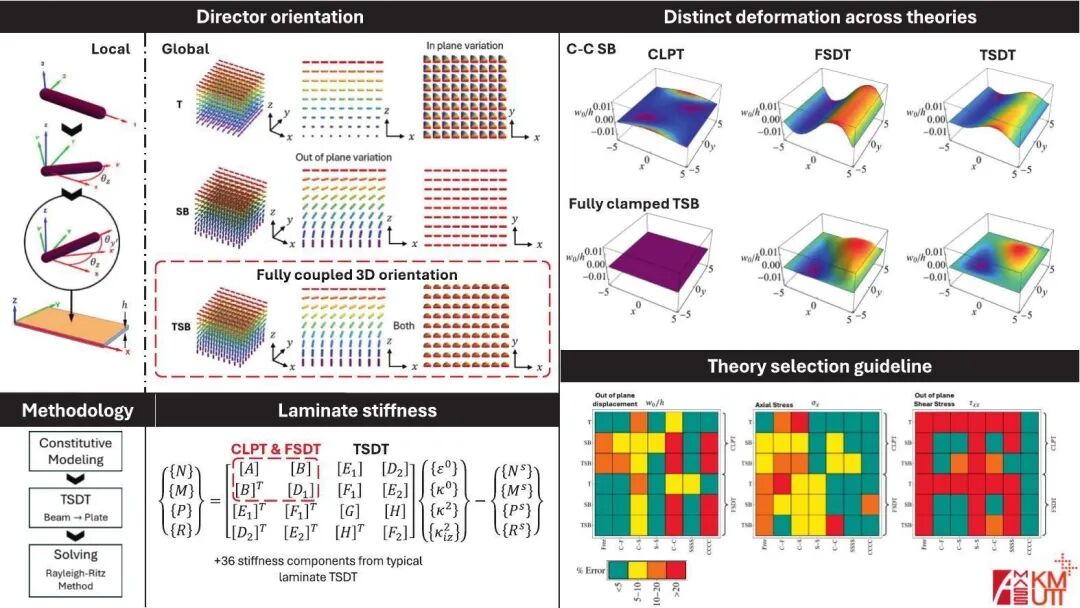
Generalized plate theory for programmable liquid crystal networks with three-dimensional director fields
Vacharat Thongsumrit, Sontipee Aimmanee
doi:10.1016/j.ijsolstr.2026.114047
三维定向场可编程液晶网络的广义平板理论
This study presents a generalized plate theory for predicting the deformation of nematic liquid crystal network (LCN) plates subjected to light and thermal stimuli with varying three-dimensional director orientations. Existing models commonly assume in-plane or uniform director fields and rely on lower-order formulations such as classical laminated plate theory (CLPT) and first-order shear deformation theory (FSDT), thereby limiting their ability to fully capture anisotropic, shear-coupled responses. To address these limitations, a higher-order shear deformation theory (HSDT), in conjunction with a three-dimensional transformed constitutive framework, is employed to couple local nematic spontaneous strain with global plate mechanics. Stimulus-induced spontaneous strains are incorporated directly into the governing equations, enabling accurate representation of complex director-dependent morphing behavior. The Ritz method, employing Legendre polynomial trial functions, is implemented for efficient numerical evaluation under diverse boundary conditions. Parametric an alyses examine the effects of director orientation, plate geometry, and mechanical constraints, with results validated against finite element simulations. The present study demonstrates its performance using a set of representative through-thickness director configurations, including twist, splay–bend, and twist–splay–bend cases. Comparative assess ments reveal that third-order shear deformation theory (TSDT) accurately captures transverse shear effects and asymmetric deformations associated with SB and TSB configurations. In contrast, FSDT provides reasonable predictions of out-of-plane displacement and axial stress but lacks higher-order shear accuracy, whereas CLPT is largely restricted to axial stress estimation. The proposed formulation provides a solid foundation for an alyzing anisotropic, stimuli-responsive materials for the mechanics-based design of programmable morphing structures.
本文提出了一种广义的平板理论,用于预测向列型液晶网络(LCN)平板在不同三维定向方向的光和热刺 激下的变形。现有模型通常假设平面内或均匀方向场,并依赖于低阶公式,如经典层合板理论(CLPT)和一阶剪切变形理论(FSDT),从而限制了它们完全捕捉各向异性、剪切耦合响应的能力。为了解决这些限制,采用高阶剪切变形理论(HSDT)结合三维转换本构框架,将局部向列自发应变与整体板力学耦合起来。刺 激诱导的自发应变被直接纳入控制方程,从而能够准确地表示复杂的依赖于方向的变形行为。采用勒让德多项式试函数的Ritz方法,实现了在不同边界条件下的有效数值计算。参数分析考察了定向器方向、板的几何形状和机械约束的影响,并通过有限元模拟验证了结果。本研究通过一组具有代表性的全厚度定向器配置,包括扭转、斜向弯曲和扭转-斜向弯曲情况,展示了其性能。对比评估表明,三阶剪切变形理论(TSDT)准确地捕获了与SB和TSB构型相关的横向剪切效应和不对称变形。相比之下,FSDT提供了合理的面外位移和轴向应力预测,但缺乏高阶剪切精度,而CLPT在很大程度上仅限于轴向应力估计。该公式为基于力学的可编程变形结构设计分析各向异性、刺 激响应材料提供了坚实的基础。
Journal of the Mechanics and Physics of Solids
On the Yielding of Brittle Granular Materials at Elevated Temperatures
Yazeed Kokash, Richard Regueiro, Yida Zhang
doi:10.1016/j.jmps.2026.106660
高温脆性颗粒材料的屈服研究
Environmental conditions such as temperature and humidity majorly affect the mechanical properties of geomaterials such as stiffness, strength and time-dependent behavior (e.g., creep, relaxation, time-to-failure). Modeling the thermomechanical responses of geomaterials is becoming increasingly important, driven by the rising demand for environmentally-secure nuclear-waste repositories, efficient deep-geothermal energy extraction, and climate-resilient geostructures. In this study, we seek to mechanistically link temperature-dependent macroscopic yielding in brittle granular materials to the temperature dependence of the surface energy of their constituent solids. We begin by modeling the surface energy γ of minerals such as quartz by examining the intermolecular potential and its variability with respect to temperature. We then upscale this property to the continuum description of brittle granular assemblies through a novel surface-based breakage mechanics theory (SBM), in which the specific surface area As is the sole internal state variable tracking the degree of crushing in the granular matrix. An advantage of this choice is that As and γ naturally form a thermodynamically conjugated pair, allowing γ and its temperature dependency to explicitly appear in the yield function of the granular material. The surface-area growth law is obtained from a grain size distribution (GSD) with an evolving fractal dimension, supported by X-ray tomography data on crushable granular materials. The derived model successfully predicts the temperature-dependent yielding and stress-strain behavior of both consolidated and unconsolidated sands over temperatures from 20°C to 150°C, relying solely on the knowledge of surface energy variations at the mineral scale. These results support the hypothesis that, within the tested temperature range, thermal weakening is governed predominantly by reductions in solid surface energy, while changes in the elastic and hardening properties of the granular materials play at most a secondary role.
环境条件(如温度和湿度)主要影响岩土材料的力学性能,如刚度、强度和时间相关行为(如蠕变、松弛、失效时间)。由于对环境安全的核废料储存库、高效的深层地热能提取和气候适应性土工结构的需求不断增长,对地质材料的热力学响应建模变得越来越重要。在这项研究中,我们试图将脆性颗粒材料的温度依赖宏观屈服与其组成固体的表面能的温度依赖机制联系起来。我们首先通过检查分子间电位及其随温度的变化来模拟矿物(如石英)的表面能γ。然后,我们通过一种新的基于表面的破碎力学理论(SBM)将这一特性升级为脆性颗粒组合的连续体描述,其中比表面积As是跟踪颗粒基质破碎程度的唯一内部状态变量。这种选择的一个优点是,As和γ自然形成一个热力学共轭对,允许γ及其温度依赖性明确地出现在颗粒材料的屈服函数中。根据可破碎颗粒材料的x射线层析成像数据,得到了具有不断变化的分维的晶粒尺寸分布(GSD)的表面积增长规律。该模型成功地预测了固结砂和松散砂在20 ~ 150℃温度下的屈服和应力-应变行为,仅依赖于矿物尺度上的表面能变化。这些结果支持了一个假设,即在测试温度范围内,热弱化主要由固体表面能的降低控制,而颗粒材料的弹性和硬化性能的变化最多起次要作用。
The out-of-plane bifurcation and narrow stability interval of planar solutions in the Euler–Plateau problem
Sankalp Tiwari, Eliot Fried
doi:10.1016/j.jmps.2026.106657
欧拉高原问题平面解的面外分岔和窄稳定区间
The Euler–Plateau problem concerns the equilibrium of a system consisting of an inextensible elastic loop spanned by a minimal surface. The equilibrium configurations are governed jointly by the bending elasticity of the loop and the surface tension of the film. For a loop of length 2πR, stability is controlled by the dimensionless parameter ν = R 3 σ / a , where a denotes the bending rigidity and σ the surface tension. It is known that the circular planar state loses stability at ν = 3 , giving rise to a branch of noncircular planar equilibria. The value of ν at which these planar configurations lose stability has not been studied a nalytically and has been estimated through numerical simulations performed by Majid. In this work, we determine an alytically the critical value ν crit for this out-of-plane bifurcation. The an alysis is based on the second-variation condition obtained previously for the coupled surface-elastica system. By minimizing the associated stability functional, subject to an appropriate normalization constraint, the problem reduces to a nonlinear eigenvalue equation whose s mallest root yields ν crit ≈ 3.7402, a value substantially s maller than the value 4.3790 computed by Majid. The corresponding instability mode is obtained and the structure of the solution landscape in the vicinity of the bifurcation is characterized. A principal consequence is that the branch of noncircular planar configurations persists only over the narrow interval 3 < ν < ν crit. In experimental protocols in which ν is increased by increasing the loop radius while holding the material parameters fixed, the radii at the planar and non-planar bifurcations differ by only about 7.6%. Resolving this interval would therefore require sufficiently fine control of the loop length along with precise determination of the loop contour.
欧拉高原问题研究的是由最小曲面跨出的不可扩展弹性环组成的系统的平衡问题。平衡构型由线圈的弯曲弹性和薄膜的表面张力共同决定。对于长度为2πR的环,稳定性由无量纲参数ν = R 3 σ / a控制,其中a表示弯曲刚度,σ表示表面张力。已知圆形平面态在ν = 3时失去稳定性,产生非圆形平面平衡的一个分支。这些平面构型失去稳定性的ν at值还没有被解析研究过,已经由Majid通过数值模拟估计过。在这项工作中,我们解析地确定了这种面外分岔的临界值。该分析基于先前得到的表面-弹性耦合系统的二次变分条件。通过最小化相关的稳定性泛函,在适当的归一化约束下,问题简化为一个非线性特征值方程,其最小根产生ν crit≈3.7402,这个值比Majid计算的值4.3790小得多。得到了相应的失稳模式,并对分岔附近的解景观结构进行了表征。一个主要的结果是,非圆平面构型的分支只在3 < ν < ν临界区间内存在。在保持材料参数不变的情况下,通过增加环半径来增加ν的实验方案中,平面和非平面分叉处的半径仅相差约7.6%。因此,要解决这个区间,就需要对回路长度进行足够精细的控制,并精确确定回路轮廓。
Mechanics of Materials
Mechanistic Modeling of Asphalt Binder Deformation: A Viscoelastic-Viscoplastic Damage Approach Anchored by Creep-Recovery and Long-Term Creep Tests
Lin Wang, Yankai Wen
doi:10.1016/j.mechmat.2026.105711
沥青粘结剂变形的力学建模:基于蠕变-恢复和长期蠕变试验的粘弹-粘塑性损伤方法
The long-term performance of asphalt pavements is largely governed by the time- and temperature-dependent deformation of binders, yet current evaluation methods remain largely empirical and fail to mechanistically represent the progression of creep deformation until final failure. This study proposes a unified viscoelastic-viscoplastic damage (VEVPD) model that integrates a generalized Kelvin viscoelastic formulation, a Perzyna-type viscoplastic theory with a Drucker-Prager yield criterion, and a Kachanov-Rabotnov damage law. Two performance-graded binders (PG58-28 and PG64-22) were investigated using creep-recovery tests to quantify viscoelastic creep compliance and long-term creep tests to characterize viscoplastic flow and damage evolution. A consistently identifiable damage initiation point (D s) was introduced to determine the onset of tertiary creep in asphalt deformation. Results revealed that viscoelastic strain contributed less than 3% across 20-45°C and 2,000-20,000 Pa, demonstrating that the long-term creep response of asphalt binders is dominated by viscoplastic flow and progressive damage. Model parameters demonstrated stress independence but were sensitive to temperature, as reflected by the Arrhenius-type dependence of viscosity (Γ) and activation energy (Q). The proposed VEVPD framework accurately reproduced the total strain-time response of both binders, with coefficients of determination (R 2) exceeding 0.98. Validation at 35°C and 45°C confirmed predictive robustness across stress levels, while PG64-22 binder consistently showed higher D s values and greater resistance to damage initiation than PG58-28 binder. These findings demonstrate that the VEVPD framework provides a mechanistically interpretable and experimentally grounded tool for predicting asphalt performance under long-term creep loading, thereby enhancing reliability in physics-based life prediction and performance-driven pavement design.
沥青路面的长期性能在很大程度上取决于粘合剂的随时间和温度的变形,但目前的评估方法在很大程度上仍然是经验的,不能机械地代表蠕变变形的进展,直到最终破坏。本研究提出了一个统一的粘弹-粘塑性损伤(VEVPD)模型,该模型集成了广义Kelvin粘弹性公式、带有Drucker-Prager屈服准则的perzyna型粘塑性理论和Kachanov-Rabotnov损伤定律。两种性能分级的粘合剂(PG58-28和PG64-22)通过蠕变恢复试验来量化粘弹性蠕变顺应性,并通过长期蠕变试验来表征粘塑性流动和损伤演变。引入了一个一致可识别的损伤起始点(D s)来确定沥青变形中三级蠕变的开始。结果表明,在20-45°C和2000 -20,000 Pa范围内,粘弹性应变对沥青粘结剂的蠕变响应贡献小于3%,表明沥青粘结剂的长期蠕变响应以粘塑性流动和渐进损伤为主。模型参数表现出应力无关性,但对温度敏感,这反映在粘度(Γ)和活化能(Q)的arrhenius型依赖关系上。所提出的VEVPD框架准确再现了两种粘合剂的总应变时间响应,决定系数(r2)超过0.98。在35°C和45°C下的验证证实了不同应力水平下PG64-22粘结剂的预测稳稳性,与PG58-28粘结剂相比,PG64-22粘结剂始终表现出更高的D值和更强的抗损伤启动能力。这些发现表明,VEVPD框架为预测沥青在长期蠕变载荷下的性能提供了一种机制上可解释的实验基础工具,从而提高了基于物理的寿命预测和性能驱动的路面设计的可靠性。
Study on Energy Evolution and Dynamic Damage Constitutive Model of Rocks under Medium to High Strain Rates
Wangqin Wu, Yuan Gu, Xiaoli Xu
doi:10.1016/j.mechmat.2026.105710
中高应变率下岩石能量演化及动态损伤本构模型研究
In mining, tunneling, and hydraulic engineering, rock masses frequently experience dynamic loads such as rock bursts, impacts, and seis mic events, with their failure essentially representing a dynamic process of energy accumulation and release. An energy-based dynamic damage constitutive model is essential to ensure the stability and safety of rock engineering. Split Hopkinson pressure bar (SHPB) tests on coal rock and red sandstone show that when the strain rate exceeds 116.55s−1 for coal rock and 81.97s−1 for red sandstone, the elastic strain energy back-calculated from SHPB dissipated energy via the energy balance theory becomes negative, contradicting the physical reality. This indicates that it is necessary to consider energy dissipation in non-crack propagation forms such as kinetic and thermal energy of rock fragments. Consequently, dynamic elastic strain energy should be calculated directly from the stress–strain curve, and the fragmented dissipated energy can be obtained by subtracting the elastic strain energy from the total strain energy. An alysis of the energy evolution in typical engineering rocks such as granite, marble, sandstone, shale, and coal rock reveals the energy evolution mechanis m of rocks under medium to high strain rates. Experimental data indicate that the ratio of dissipated to critical dissipated energy follows an S-shaped curve, consistent with the variation of classical damage variables with strain. Accordingly, a rock damage evolution equation based on dissipated energy evolution is proposed. By introducing a parallel structure of damaged elements, the classical Zhu-Wang-Tang (ZWT) nonlinear viscoelastic model is modified to establish a dynamic damage constitutive model incorporating energy dissipation. Under varying strain rates, the model accurately captures the stress–strain response of different rocks, reflecting both viscoelastic and damage characteristics, and demonstrates good applicability under medium-high strain rate conditions.
在采矿、隧道和水利工程中,岩体经常受到冲击、冲击、地震等动荷载的作用,其破坏本质上是一个能量积累和释放的动态过程。基于能量的动力损伤本构模型对保证岩石工程的稳定与安全至关重要。煤岩和红砂岩劈裂霍普金森压杆(SHPB)试验表明,当煤岩应变速率超过116.55s−1,红砂岩应变速率超过81.97s−1时,根据能量平衡理论反算SHPB耗散能的弹性应变能变为负值,与物理实际相矛盾。这表明有必要考虑岩石破片的动能和热能等非裂纹扩展形式的能量耗散。因此,动态弹性应变能应直接由应力-应变曲线计算,总应变能减去弹性应变能得到破碎耗散能。通过对花岗岩、大理石、砂岩、页岩、煤岩等典型工程岩石的能量演化分析,揭示了岩石在中高应变速率下的能量演化机制。实验数据表明,耗散能与临界耗散能之比呈s型曲线,与经典损伤变量随应变的变化规律一致。据此,提出了基于耗散能演化的岩石损伤演化方程。通过引入损伤单元的平行结构,对经典的朱旺塘(ZWT)非线性粘弹性模型进行修正,建立了考虑能量耗散的损伤动态本构模型。在变应变速率下,该模型准确地捕捉了不同岩石的应力-应变响应,反映了粘弹性和损伤特征,在中高应变速率条件下具有良好的适用性。
International Journal of Plasticity
Prospect of quantum computing on Enhanced Strain Gradient Crystal Plasticity theory
Amirhossein Lame Jouybari, Leon Cizelj
doi:10.1016/j.ijplas.2026.104711
增强应变梯度晶体塑性理论的量子计算展望
A new branch of the Enhanced Strain Gradient Crystal Plasticity (ESGCP) theory is introduced, based on a quadratic energetic contribution associated with the gradient of the cumulative shear strain on each slip system, within a thermodynamically consistent framework for the formation of slip and kink bands in crystalline microstructures. Together with the recently proposed Nye-tensor-based ESGCP formulation, a new differential operator is developed for the solution of the corresponding nonlocal field equation (or higher-order balance equation). In both branches of the ESGCP theory, the higher-order modulus is intrinsically coupled to the evolving microstructural state of irradiated crystalline lattices during deformation. The ESGCP framework is employed to investigate the Hall–Petch (mean grain size) effect and is systematically compared with classical Strain Gradient Crystal Plasticity (CSGCP) models. The results reveal that, in contrast to CSGCP formulations where the grain-size effect continuously intensifies by the loading, the ESGCP models predict an enhanced grain-size sensitivity at low strain levels followed by a progressive attenuation at higher levels of loading. In addition, a novel quantum computing algorithm based on the quantum Fourier transform (QFT) is developed to solve the classical linear momentum balance equation within a fixed-point iteration scheme, while nonlocal field equations associated with the ESGCP and CSGCP models are addressed using a quantum finite difference approach. It is demonstrated that the proposed QFT-method achieves a poly-logarithmic computational speedup, offering significant advantages for high-resolution simulations of irradiated materials, where both numerical accuracy and computational efficiency are critical for reliable structural integrity assess ments in nuclear power plant applications.
本文介绍了增强应变梯度晶体塑性(ESGCP)理论的一个新分支,该理论基于与每个滑移系统上累积剪切应变梯度相关的二次能量贡献,在晶体微观结构中形成滑移和扭结带的热力学一致框架内。结合最近提出的基于nye张量的ESGCP公式,提出了一种新的微分算子,用于求解相应的非局部场方程(或高阶平衡方程)。在ESGCP理论的两个分支中,高阶模量与辐照晶格在变形过程中不断演变的微观结构状态是内在耦合的。采用ESGCP框架研究了Hall-Petch(平均晶粒尺寸)效应,并与经典的应变梯度晶体塑性(CSGCP)模型进行了系统比较。结果表明,与CSGCP模型中晶粒尺寸效应随加载而不断增强不同,ESGCP模型预测在低应变水平下晶粒尺寸敏感性增强,然后在高加载水平上逐渐衰减。此外,提出了一种基于量子傅立叶变换(QFT)的量子计算算法,在不动点迭代格式下求解经典线性动量平衡方程,并利用量子有限差分方法求解ESGCP和CSGCP模型的非局部场方程。结果表明,所提出的qft方法实现了多对数计算加速,为辐照材料的高分辨率模拟提供了显著优势,其中数值精度和计算效率对于核电厂应用中可靠的结构完整性评估至关重要。