【新文速递】2026年4月30日复合材料SCI期刊最新文章
今日更新:Composite Structures 4 篇,Composites Part B: Engineering 3 篇,Composites Science and Technology 3 篇
Composite Structures
Dynamic shear resistance of UHPC-strengthened RC columns under near-support impacts: Tests, strengthening efficiency and theoretical modeling
Wei Fan, Wenbiao Sun, Huaxiang Su, Zhengwu Zhong, Jiatong Liu
doi:10.1016/j.compstruct.2026.120396
近支承冲击下uhpc加固RC柱的动力抗剪性能:试验、加固效率及理论建模
Ultra-high-performance concrete (UHPC) has excellent impact resistance and durability, making it promising for strengthening reinforced concrete (RC) columns with insufficient anti-collision capacity. However, few studies have clarified the dynamic shear behavior and strengthening efficiency of UHPC-RC composite columns, especially for near-base impacts. To this end, drop-weight impact tests were conducted in this study to investigate the shear enhancement mechanis m of UHPC-RC composite columns. The effects of strengthening configuration, impact velocity, and location were examined during the tests. The results show that the strengthening configuration strongly influences the failure: as the strengthening transitions from “bottom-only” and “two-sided” to “U-shaped” and finally to “casing”, the dominant failure shifts from flexural to shear. Based on the punching shear mechanis m observed from the impact tests, a theoretical model was proposed to predict the dynamic punching shear capacity of UHPC-strengthened RC columns., and a Dynamic Strut-and-Tie Model (DSTM) was developed to estimate diagonal shear resistance under near-support impact. Both models show good agreement with experimental results, elucidating the strengthening mechanis m of UHPC layers and offering a reliable theoretical basis for impact-resistant retrofitting design. The UHPC strengthening efficiency of different configurations was quantified, with two-sided strengthening configuration achieving the highest efficiency.
超高性能混凝土(UHPC)具有优异的抗冲击性能和耐久性,在加固抗碰撞能力不足的钢筋混凝土柱方面具有广阔的应用前景。然而,很少有研究明确UHPC-RC复合柱的动力剪切性能和加固效率,特别是近基冲击。为此,本研究通过落锤冲击试验对UHPC-RC复合柱的抗剪增强机理进行了研究。在试验中考察了强化形态、冲击速度和位置的影响。结果表明:加固形式对破坏的影响较大,随着加固形式从“单底”、“双面”到“u形”再到“套管”的转变,主要破坏形式由弯曲向剪切转变;基于冲击试验中观察到的冲剪机理,提出了预测uhpc加固RC柱动态冲剪承载力的理论模型。,并建立了动态拉杆模型(DSTM)来估计近支撑冲击下的斜向剪切阻力。两种模型与试验结果吻合较好,阐明了超高性能混凝土层的加固机理,为抗冲击加固设计提供了可靠的理论依据。量化了不同配置的UHPC强化效率,双面强化效率最高。
Multi-strategy integrated general toolpath planning framework for continuous fiber-reinforced polymer additive manufacturing
Huichun Tian, Zhen Wang, Jiahao Zhou, Feng Xiao, Longqiu Li, Jing Qiao
doi:10.1016/j.compstruct.2026.120395
连续纤维增强聚合物增材制造的多策略集成通用刀具轨迹规划框架
This study presents a general toolpath planning framework integrated with multiple path generation strategies for continuous fiber-reinforced polymer additive manufacturing (CFRP-AM). Built upon the concept of offset weighting, the proposed method achieves strong adaptability to complex geometries and enables flexible fiber placement while providing tunable mechanical performance with excellent properties. To further enhance manufacturability and quality, a path filtering process and a novel optimization approach are introduced to mitigate potential fiber damage during deposition. Finite element ana lysis and mechanical testing of specimens fabricated with different strategies reveal that structural stiffness increases with the offset weight of the shape contour, while a balanced distribution of offset weights between shape and hole contours yields a higher load-bearing capacity. Moreover, varying offset weighting strategies cause migration of resin-rich regions, influencing local stress distributions and failure modes. A hybridization of different offset weighting strategies can further improve mechanical strength. Specifically, the hybrid-strategy specimen demonstrates a 22.26% increase compared with the strongest single-strategy specimen. This work establishes a novel toolpath planning framework for CFRP-AM, providing a solid foundation for future hybrid strategies while enabling enhanced control over fiber layout and improved structural performance in complex composite parts.
本研究提出了一种通用的刀具轨迹规划框架,该框架集成了连续纤维增强聚合物增材制造(CFRP-AM)的多路径生成策略。基于偏移加权的概念,提出的方法实现了对复杂几何形状的强适应性,并实现了灵活的纤维放置,同时提供了具有优异性能的可调机械性能。为了进一步提高可制造性和质量,引入了一种路径滤波工艺和一种新的优化方法来减轻沉积过程中潜在的纤维损伤。有限元分析和力学试验表明,结构刚度随形状轮廓偏置重量的增加而增加,而形状轮廓和孔轮廓之间偏置重量的均匀分布可以获得更高的承载能力。此外,不同的偏移加权策略会导致富树脂区域的偏移,从而影响局部应力分布和破坏模式。不同偏置加权策略的杂交可以进一步提高机械强度。其中,混合策略比最强单策略提高了22.26%。这项工作为CFRP-AM建立了一个新的刀具路径规划框架,为未来的混合策略提供了坚实的基础,同时增强了对纤维布局的控制,改善了复杂复合材料零件的结构性能。
Novel application of the modal strain energy technique for state-of-the-art damping predictions
Justin H. Porter, Tom Mace, Pietro Bortolotti, Evan M. Anderson, David Barnes, Mayank Chetan, Ryan Beach, Scott Hughes, Connor G. Davis, Benjamin J. Moldenhauer, Erik G. Rognerud, Kimberley A. Mac Donald, Christoph W. Schwingshackl
doi:10.1016/j.compstruct.2026.120394
模态应变能技术在最新阻尼预测中的新应用
Structural damping, which measures the energy dissipation of a vibrating structure, is a key modeling input for lightweight structures but is notoriously hard to predict. This work utilizes vibration-based measurements of centimeter-scale coupons and the modal strain energy approach to predict structural damping of a lightly damped structure. The approach was originally validated with panels shorter than a meter in length. This work extends the validation to a 2.75 m beam made of unidirectional and biaxial glass fiber laminates bonded by adhesive. The comparison between three-dimensional finite element model predictions and full-scale experimental measurements of damping show an average error of 5.2% for the first five modes. Additionally, the modal strain energy approach is newly applied with a one-dimensional geometrically exact beam theory model and a two-dimensional sectional an alysis solver. This beam approach accurately predicts the damping behavior of the first bending modes but loses accuracy for higher order modes that are dominated by three-dimensional effects. This novel approach provides faster simulations while allowing arbitrary beam cross sections. The paper also investigates traditional and high-force dynamic mechanical an alysis to measure structural damping of coupons. Both alternatives show significant errors in attempted validation against the theoretical thermoelastic damping of aluminum coupons.
结构阻尼测量振动结构的能量耗散,是轻量级结构建模的一个关键输入,但众所周知,它很难预测。这项工作利用基于振动的厘米尺度的测量和模态应变能方法来预测轻阻尼结构的结构阻尼。这种方法最初是用长度小于一米的面板进行验证的。这项工作将验证扩展到由单向和双轴玻璃纤维层压板通过粘合剂粘合制成的2.75 m梁。三维有限元模型预测与全尺寸阻尼实验测量结果的比较表明,前五种模态的平均误差为5.2%。此外,采用一维几何精确梁理论模型和二维截面分析求解器对模态应变能法进行了新的应用。这种方法可以准确地预测第一阶弯曲模态的阻尼行为,但对于由三维效应主导的高阶模态,这种方法 会失去精度。这种新颖的方法提供了更快的模拟,同时允许任意光束截面。本文还研究了传统的动力力学分析和大力动力力学分析来测量板板的结构阻尼。这两种方法在试图验证铝板的理论热弹性阻尼时都显示出明显的错误。
Interfacial tensile strength of carbon fiber/epoxy matrix based on in-situ observation with micro-DIC and 3D-FE an alysis
Keita Goto, Keigo Sasaki, Masahiro Arai, Akinori Yoshimura, Toshihira Irisawa
doi:10.1016/j.compstruct.2026.120360
基于微dic和3D-FE原位观察的碳纤维/环氧基界面拉伸强度
This paper proposes a novel evaluation method for the interfacial tensile strength between a carbon fiber and an epoxy matrix in carbon fiber-reinforced plastic (CFRP) based on in-situ observation using the micro-digital image correlation (DIC) method and three-dimensional finite element (FE) a nalysis. An epoxy specimen with one carbon fiber embedded along the width direction was prepared, and alumina particles were sprayed in a random speckle pattern. In-situ observation was carried out using a digital microscope during the tensile test to investigate the propagation of interfacial debonding. The micro-DIC method was used to calculate the local strain history at the carbon fiber/epoxy matrix interface and to quantitatively identify the occurrence of interfacial debonding. Subsequently, the microscopic stress distribution at the edge of the carbon fiber/epoxy matrix interface when interfacial debonding occurred was calculated via three-dimensional FE an alysis to consider the free-edge effect. The FE a nalysis results showed that interfacial normal and shear stresses occurred at the edge of the carbon fiber/epoxy matrix interface. An ellipse-shape criterion was employed to account for the combined stress state. A single-fiber pull-out test was performed to measure the interfacial shear strength. The interfacial tensile strength was calculated by substituting the interfacial normal and shear stresses and interfacial shear strength into the ellipse-shape criterion.
本文提出了一种基于原位观测的基于微数字图像相关(DIC)方法和三维有限元(FE)分析的碳纤维增强塑料(CFRP)中碳纤维与环氧基之间界面抗拉强度评价方法。制备了沿宽方向嵌入一根碳纤维的环氧树脂试样,并以随机斑点状喷射氧化铝颗粒。在拉伸试验过程中,利用数码显微镜进行了现场观察,以研究界面脱粘的扩展情况。采用微dic方法计算碳纤维/环氧基界面局部应变历史,定量识别界面脱粘的发生。随后,考虑自由边效应,通过三维有限元分析计算界面脱粘时碳纤维/环氧基界面边缘的细观应力分布。有限元分析结果表明,碳纤维/环氧基界面边缘存在法向应力和剪应力。采用椭圆形状准则来解释复合应力状态。采用单纤维拉拔试验测量界面抗剪强度。将界面法向应力、剪应力和界面抗剪强度代入椭圆准则,计算界面抗拉强度。
Composites Part B: Engineering
Hierarchical structural engineering of PEEK composites for compatible electromagnetic wave absorption and infrared stealth
Yashu He, Fengyu Wen, Yifan Wang, Jierun Ma, Haoyuan Tan, Yuxuan Gu, Pengbo Lian, Lei Li, Hailiang Yang, Jianxin Mu
doi:10.1016/j.composites b.2026.113722
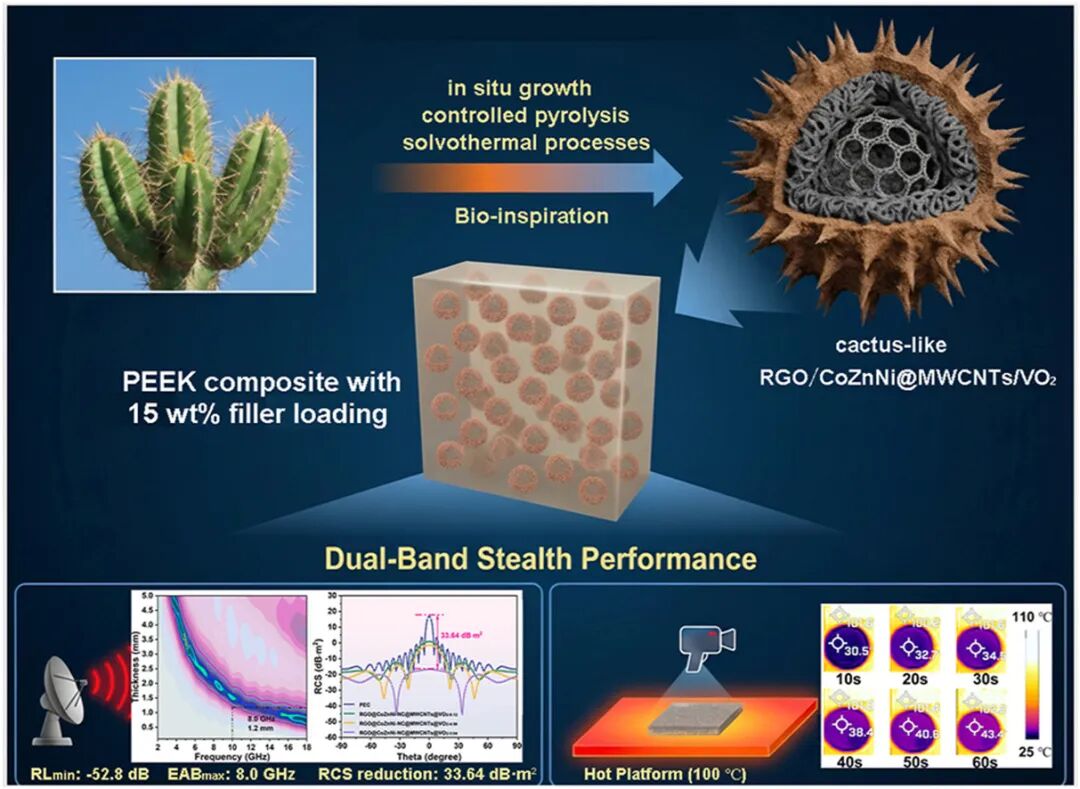
兼容电磁波吸收与红外隐身的PEEK复合材料分层结构工程
The development of multifunctional materials integrating efficient electromagnetic wave attenuation with infrared signature management has become essential for next-generation defense platforms. Here, a cactus-like multifunctional stealth filler, RGO/CoZnNi@MWCNTs/VO2, was rationally designed and synthesized via in situ growth, controlled pyrolysis, and solvothermal processes, and subsequently incorporated into a PEEK matrix to fabricate radar–infrared compatible stealth composites. Through structural and compositional optimization, the intrinsic conflict between electromagnetic wave absorption and infrared signature suppression was effectively resolved. At a filler loading of 15 wt%, the composite delivers a minimum reflection loss of −52.80 dB with a maximum effective absorption bandwidth of 8.0 GHz. CST simulations reveal a pronounced RCS reduction of 33.64 dB·m2 when coated on a PEC substrate, corresponding to an ∼80% reduction in radar detection distance. The composite exhibits excellent infrared thermal camouflage performance, benefiting from the suppressed heat transfer from the heat source to the outer surface enabled by the low through-plane thermal conductivity (0.161 W·m-1·K-1) and the reduced surface infrared radiation output arising from the relatively low infrared emissivity (0.60–0.63). This work provides a promising material platform for integrated radar–infrared stealth and multispectral camouflage applications.
集成高效电磁波衰减和红外特征管理的多功能材料的发展已成为下一代防御平台的必要条件。本研究通过原位生长、受控热解和溶剂热工艺,合理设计并合成了仙人掌状多功能隐身填料RGO/CoZnNi@MWCNTs/VO2,并将其加入PEEK基体中制备雷达-红外兼容隐身复合材料。通过结构和成分优化,有效地解决了电磁波吸收与红外特征抑制之间的内在矛盾。当填充量为15wt %时,该复合材料的最小反射损耗为- 52.80 dB,最大有效吸收带宽为8.0 GHz。CST模拟显示,当涂层在PEC衬底上时,RCS显著降低了33.64 dB·m2,相当于雷达探测距离减少了约80%。该复合材料表现出优异的红外热伪装性能,得益于其低通面导热系数(0.161 W·m-1·K-1)和较低红外发射率(0.60-0.63)降低了表面红外辐射输出,从而抑制了热源向外表面的热量传递。该工作为雷达-红外综合隐身和多光谱伪装应用提供了一个有前景的材料平台。
A Function-Driven Design Mapping Strategy for Additive Manufacturing Structured Diamond Wheels for grinding 2D-Cf/C-SiC composites
Mengjie Hong, Guoqin Huang, Yangli Xu, Longbin Xu, Wenhan Zeng, Chunjin Wang, Xipeng Xu
doi:10.1016/j.composites b.2026.113726
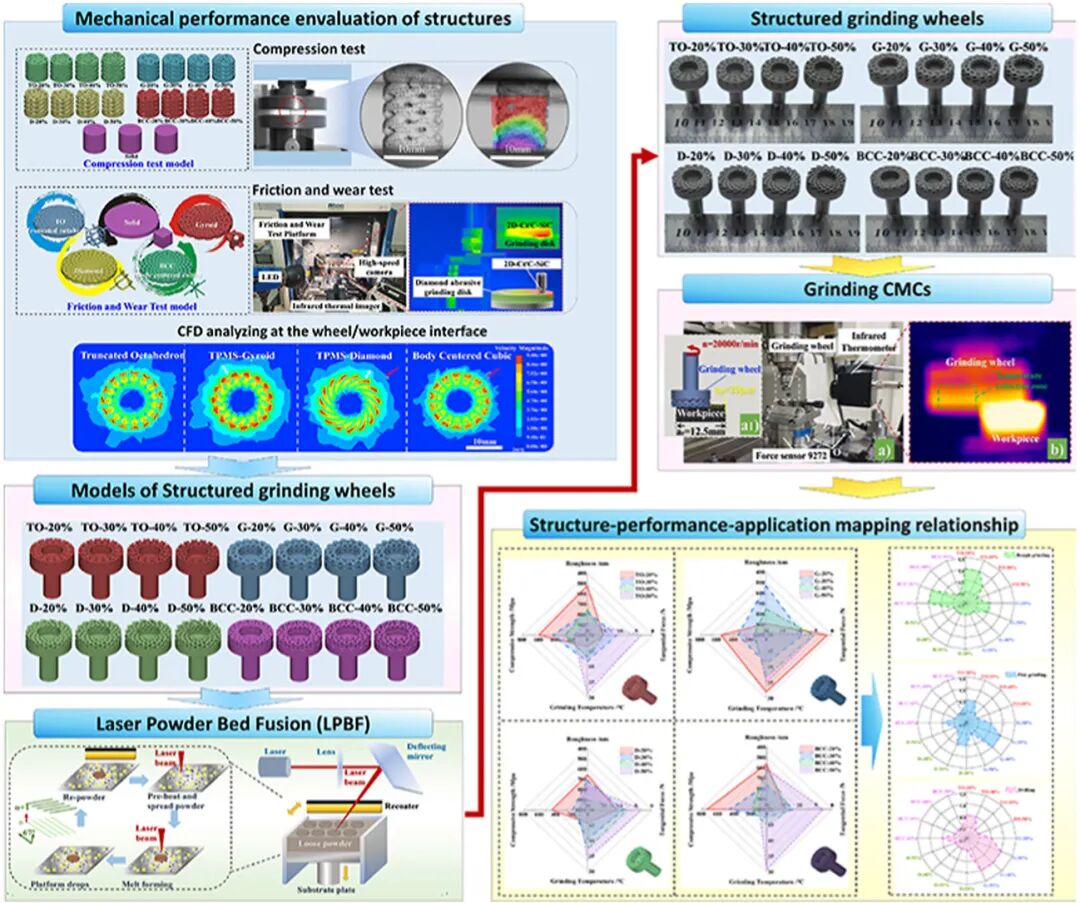
2D-Cf/C-SiC复合材料增材制造结构金刚石砂轮 功能驱动设计映射策略
The rapid wear of grinding tools and severe workpiece damage during machining of 2D-Cf/C-SiC ceramic matrix composites (CMCs) remain critical challenges. Additive manufacturing of Laser Powder Bed Fusion (LPBF) offers a transformative opportunity to address this issue by producing grinding tools with precisely controlled complex internal structures, yet there is still a lack of design basis. To address these issues, this study proposes a function-driven design mapping strategy and investigates the structure-performance relationship of porous structured diamond wheels fabricated by Laser Powder Bed Fusion (LPBF). Solid and four typical lattice structures (TPMS-Gyroid, TPMS-Diamond, BCC, TO) with porosities of 20%-50% were manufactured and evaluated via grinding experiments, mechanical experiments, and CFD simulations. Results show that grinding performance is dominated by the synergistic effect of porosity and topology. The Gyroid-30 structure achieves the lowest surface roughness (Ra≈530 nm) owing to excellent damping and heat dissipation. Triply Periodic Minimal Surface (TPMS) topologies exhibit superior cooling performance, and the deformation mechanis m varies with porosity. Application-oriented guidelines are established: Gyroid (30-40%) for fine grinding, BCC/TO (20-30%) for rough grinding, and Gyroid (30-50%) for drilling. This work provides a theoretical and practical basis for the performance-driven design of next-generation additive manufacturing grinding tools for CMCs.
在2D-Cf/C-SiC陶瓷基复合材料(cmc)的加工过程中,磨具的快速磨损和工件的严重损伤仍然是关键的挑战。激光粉末床融合(LPBF)的增材制造为解决这一问题提供了一个变革性的机会,通过生产具有精确控制复杂内部结构的磨削工具,但仍然缺乏设计基础。为了解决这些问题,本研究提出了一种功能驱动的设计映射策略,并研究了激光粉末床熔合(LPBF)多孔结构金刚石车轮的结构-性能关系。制备了孔隙率为20% ~ 50%的固体和四种典型晶格结构(TPMS-Gyroid、TPMS-Diamond、BCC、TO),并通过磨削实验、力学实验和CFD模拟对其进行了评价。结果表明,孔隙率和拓扑结构的协同作用主导了磨矿性能。由于具有良好的阻尼和散热性能,Gyroid-30结构具有最低的表面粗糙度(Ra≈530 nm)。三周期最小表面(TPMS)拓扑结构具有优异的冷却性能,且变形机制随孔隙率的变化而变化。建立了面向应用的指导方针:Gyroid(30-40%)用于细磨,BCC/TO(20-30%)用于粗磨,Gyroid(30-50%)用于钻孔。该工作为下一代cmc增材制造磨削工具的性能驱动设计提供了理论和实践依据。
Decoupling-based predictive force model for high-speed grinding of anisotropic continuous fibre-reinforced titanium matrix composites
Biao Zhao, Shandong Feng, Yumin Wang, Qi Liu, Tao Chen, Wenfeng Ding
doi:10.1016/j.composites b.2026.113724
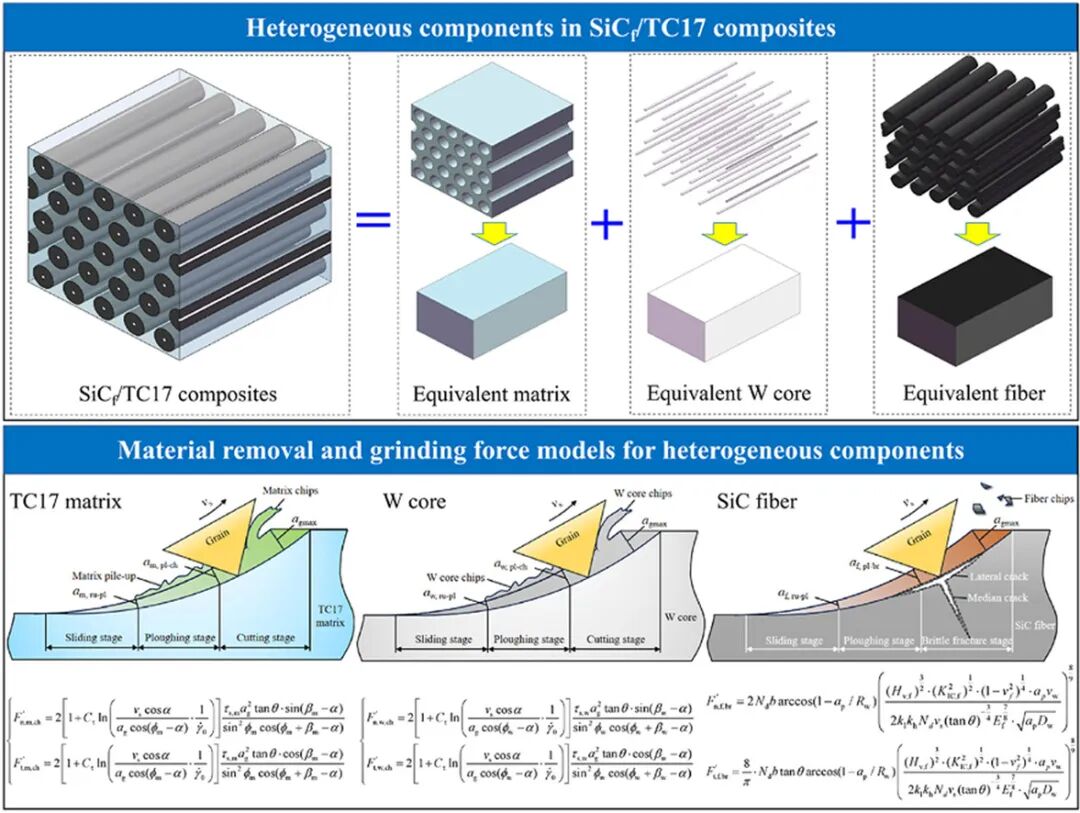
基于解耦的各向异性连续纤维增强钛基复合材料高速磨削预测力模型
Continuous fibre-reinforced titanium matrix composites (CFTMCs) have high specific strength, stiffness, and pronounced anisotropy, making them suitable for critical rotating parts in aerospace engines. Grinding is essential for precision machining these difficult-to-cut materials. Grinding force governs the material removal mechanis m and subsurface damage progression, affecting energy consumption, wheel wear, machining efficiency and surface integrity. This study develops a high-speed grinding force model that incorporates the heterogeneous multiphase microstructure and fibre orientation of CFTMCs. The model is based on three physical principles: phase decoupling to isolate mechanical contributions, superposition of fibre–matrix interaction forces, and a strain-rate-dependent constitutive relation calibrated for high-speed grinding. Grinding force coefficients are further integrated to account for directional anisotropy under different fibre grinding angles. The model quantifies how grinding velocity and fibre orientation affect grinding forces, improving prediction accuracy. Results show prediction errors below 11% for the normal force and 9% for the tangential force, confirming the model’s accuracy under high-speed grinding across varied fibre orientations. As grinding speed increases from 30 m/s to 120 m/s, the normal force decreases by 52.66%–59.71% and the tangential force decreases by 48.52%–58.2% across all fibre grinding angles, mainly due to the reduced grain’s undeformed chip thickness. Increasing the fibre grinding angle from 0° to 90° causes an average 19.05% increase in the normal force, while the tangential force decreases by approximately 14.16%. These trends reflect a transition in dominant failure mechanis ms: fibre fracture changes from longitudinal splitting to transverse fracture, and interfacial failure shifts from shear-dominated to tension-dominated behaviour.
连续纤维增强钛基复合材料(CFTMCs)具有高比强度、刚度和显著的各向异性,适用于航空发动机的关键旋转部件。磨削对于这些难切削材料的精密加工是必不可少的。磨削力决定了材料的去除机制和亚表面损伤的进展,影响能量消耗、砂轮磨损、加工效率和表面完整性。本研究建立了一种考虑cftmc非均相多相微观结构和纤维取向的高速磨削力模型。该模型基于三个物理原理:相解耦以隔离机械贡献,纤维基质相互作用力的叠加,以及针对高速磨削校准的应变率相关本构关系。进一步整合磨削力系数,以反映纤维在不同磨削角度下的方向各向异性。该模型量化了磨削速度和纤维取向对磨削力的影响,提高了预测精度。结果表明,法向力的预测误差低于11%,切向力的预测误差低于9%,证实了该模型在不同纤维取向下高速磨削的准确性。当磨削速度从30 m/s增加到120 m/s时,纤维各磨削角度的法向力减小了52.66% ~ 59.71%,切向力减小了48.52% ~ 58.2%,主要原因是晶粒未变形切屑厚度减小。将纤维磨削角度从0°增加到90°,法向力平均增加19.05%,切向力平均减少约14.16%。这些趋势反映了主导破坏机制的转变:纤维断裂从纵向劈裂转变为横向断裂,界面破坏从剪切为主转变为拉伸为主。
Composites Science and Technology
A Transformer-based method integrated with principal component an alysis for predicting stress-strain curves of CFRP laminates with random gaps
Chenxi Wu, Mengze Li, Fang Li, Weiwei Qu, Weidong Zhu, Yinglin Ke
doi:10.1016/j.compscitech.2026.111673
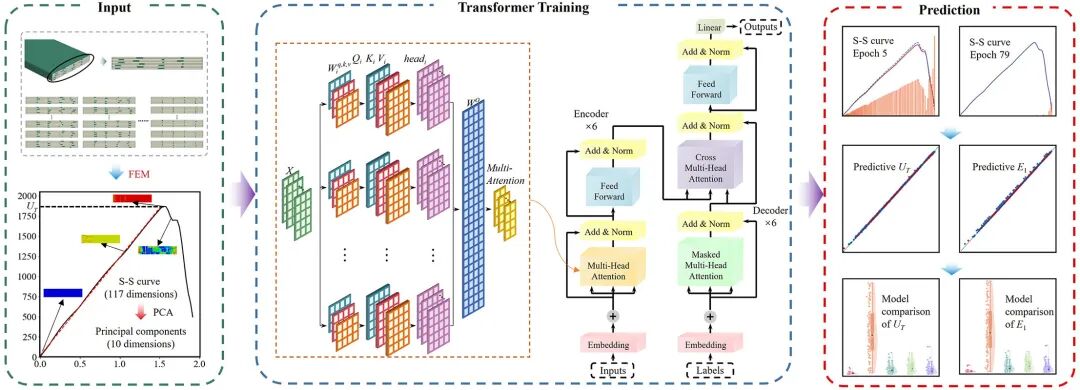
基于变压器与主成分分析相结合的CFRP随机间隙层合板应力应变曲线预测方法
Mechanical property an alysis in defect-containing composites is essential to composite design, yet existing methods suffer from an inability to simulate randomness, limitations in scale, or high computational resource consumption. Therefore, a Transformer model integrated with principal component an alysis (PCA) is proposed for the first time to accurately predict stress-strain (S-S) curves in mesoscale carbon fiber reinforced polymer (CFRP) laminates with random gaps. Based on automated fiber placement (AFP), a laminate with random gaps finite element model is created. The model's reliability is verified experimentally, and a Python script for parameterized modeling is developed to build the dataset. Subsequently, PCA is applied to reduce the dimensionality of the S-S curves, lowering model complexity and computational demands. A Transformer model is then constructed, with its sample size sensitivity and stability a nalyzed through different dataset sizes and 5-fold cross-validation. The model's performance is comprehensively evaluated by comparing it with four other deep learning models designed to predict S-S curves. The results indicate that S-S curves predicted by the Transformer model correlate well with results from finite element simulations, with a correlation coefficient above 0.9999. The relative percentage errors in tensile strength and elastic modulus derived from the predicted curves remain within 0.28%, and the Transformer model demonstrates significant advantages in both accuracy and computational resource consumption. The proposed model combines high accuracy with computational cost-effectiveness, which characterizes mesoscale defects and predicts their impact on mechanical properties, promising a new and highly potential tool for composite material design optimization and uncertainty quantification.
含缺陷复合材料的力学性能分析对复合材料设计至关重要,但现有方法存在无法模拟随机性、规模限制或计算资源消耗高的问题。为此,首次提出了结合主成分分析(PCA)的Transformer模型,以准确预测随机间隙中尺度碳纤维增强聚合物(CFRP)层合板的应力-应变(S-S)曲线。基于自动铺放纤维(AFP),建立了随机间隙层合板的有限元模型。通过实验验证了模型的可靠性,并开发了Python参数化建模脚本来构建数据集。然后,利用主成分分析法降低S-S曲线的维数,降低模型复杂度和计算量。然后构建Transformer模型,通过不同数据集大小和5倍交叉验证分析其样本量的敏感性和稳定性。通过将该模型与其他四种用于预测S-S曲线的深度学习模型进行比较,对该模型的性能进行了综合评估。结果表明,变压器模型预测的S-S曲线与有限元模拟结果具有较好的相关性,相关系数在0.9999以上。从预测曲线得出的抗拉强度和弹性模量的相对百分比误差保持在0.28%以内,变压器模型在精度和计算资源消耗方面都具有显著优势。该模型结合了高精度和计算成本效益,能够表征中尺度缺陷并预测其对力学性能的影响,有望成为复合材料设计优化和不确定性量化的新工具。
A simple off-axis tension method for shear characterization of woven composites derived from material symmetry an alysis
Xianze Meng, Peng Zhuo, Shuguang Li, Ying Yan, Shibo Yan
doi:10.1016/j.compscitech.2026.111672
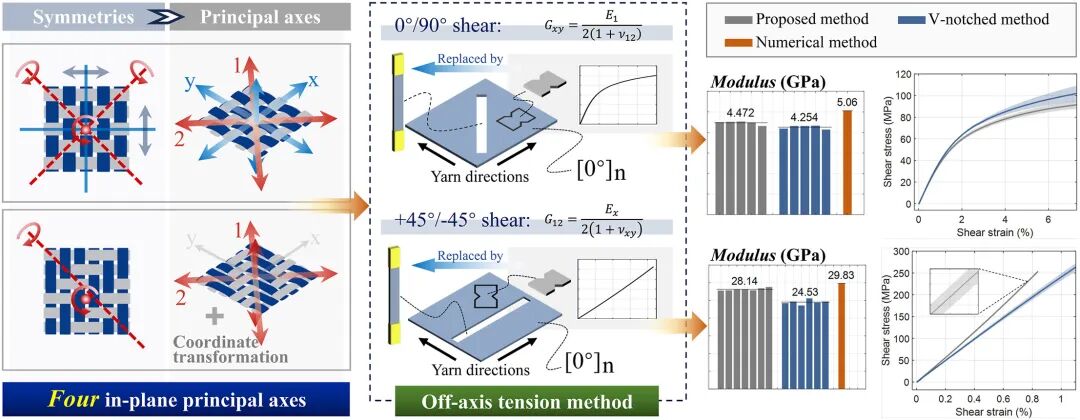
基于材料对称性分析,提出了一种简单的离轴拉伸法来表征机织复合材料的剪切特性
The interlaced architecture of 2D woven composites is commonly regarded as a source of increased anisotropic complexity in mechanical characterization compared with tape laminates, whereas it in fact offers an opportunity for simplification that has not been recognized in existing studies. In this work, a material symmetry an alysis, explicitly accounting for the rotational symmetries of the weave architecture, is performed to identify the principal axes of woven laminae. The an alysis reveals that a 2D woven lamina exhibits orthotropic behavior along both the warp/weft (0°/90°) and the +45°/−45° directions, thus establishing the theoretical foundation for direct tensile characterization of the in-plane shear response of woven composite laminae. Leveraging this insight, a simple off-axis tension method is proposed for characterizing the in-plane shear behavior of woven composites using unidirectionally oriented woven plies, without the need for specially laminated ±45° layups required by ASTM D3518, which is derived from classical laminate theory, or complex V-notched fixtures such as ASTM D7078. When the loading direction is oriented at 45° with respect to the principal axes to be characterized, the proposed approach enables the determination of both the shear modulus and the full in-plane shear stress-strain response from a tension test. Experimental results obtained from twill woven composites, which possess a more complex interlaced architecture than plain weaves, demonstrate that the off-axis tension method reliably captures shear behavior, showing good agreement with V-notched shear tests. These results highlight the proposed method as a rigorous and efficient alternative for in-plane shear characterization of woven laminae.
与带状层压板相比,二维编织复合材料的交错结构通常被认为是力学表征中各向异性复杂性增加的一个来源,而事实上,它提供了一个在现有研究中尚未认识到的简化机会。在这项工作中,进行了材料对称性分析,明确地考虑了编织结构的旋转对称性,以确定编织层的主轴。分析结果表明,二维编织复合材料在经纬方向(0°/90°)和+45°/−45°方向均表现出正交各向异性,为直接表征复合材料编织复合材料的面内剪切响应奠定了理论基础。利用这一见解,提出了一种简单的离轴张力方法,用于使用单向编织层来表征编织复合材料的面内剪切行为,而不需要ASTM D3518(源自经典层压理论)或ASTM D7078(复杂的v形切口夹具)要求的特殊层压±45°层压。当加载方向相对于待表征的主轴方向为45°时,所提出的方法能够确定剪切模量和完整的平面内剪切应力-应变响应。斜纹织物复合材料具有比平纹织物更复杂的交错结构,实验结果表明,离轴拉伸法可靠地捕获了剪切行为,与v形切口剪切试验结果吻合良好。这些结果表明,所提出的方法是一种严格而有效的替代方法,可用于编织层的面内剪切表征。
Effect of fiber surface modification on mechanical and thermal properties of milled carbon fiber reinforced PEEK composite filaments and their FDM-3D Printed Composites
Quan Zhang, Jing Qiao, Jianfeng Lin
doi:10.1016/j.compscitech.2026.111670
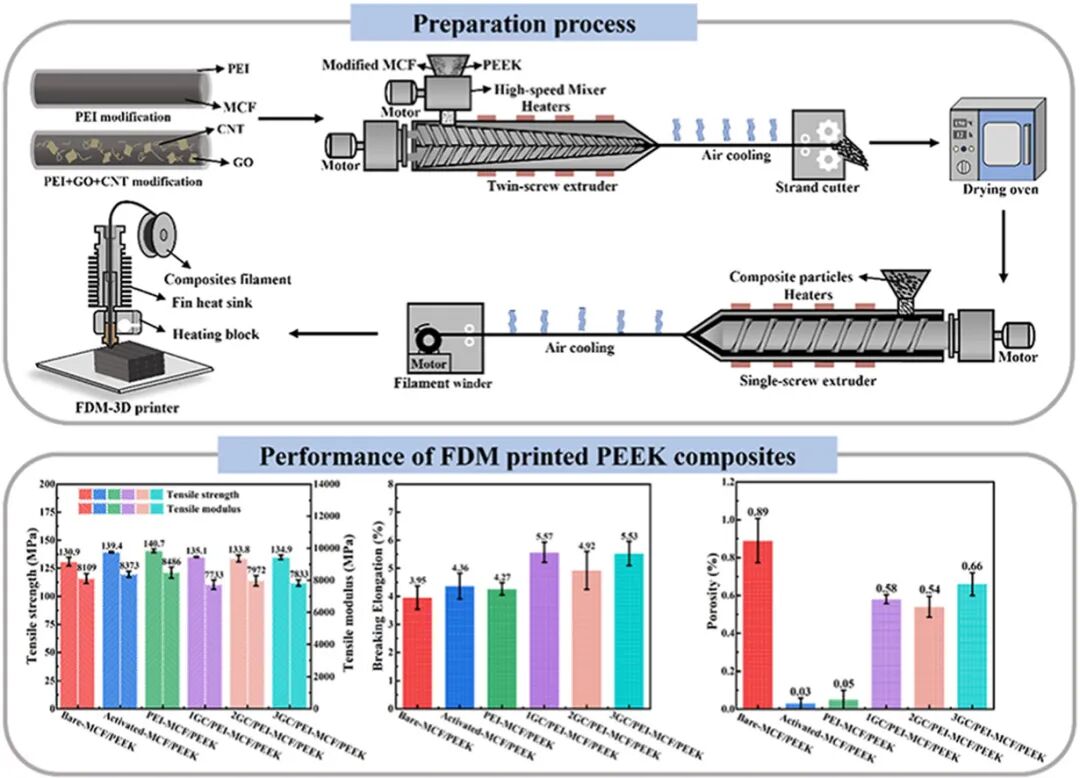
纤维表面改性对铣削碳纤维增强PEEK复合长丝及其FDM-3D打印复合材料力学和热性能的影响
Fused deposition modeling (FDM) additively manufactured milled carbon fiber reinforced polyether ether ketone (MCF/PEEK) composites have received widespread attention in aerospace and other high-performance fields. However, the prevalent problems of poor adhesion and wettability between the fibers and the matrix have resulted in insufficient interfacial bonding, which severely limits the further improvement of composite properties. Therefore, this study systematically investigated the effects of two fiber surface modification strategies, polyetherimide (PEI) sizing and PEI combined with nanofillers sizing, on the physical and chemical structure of fiber surfaces and the properties of composites. The results identify MCF, PEI sizing resin, and hybrid fillers are tightly bonded through electrostatic and hydrogen bonding interactions, forming a strong interface. Surface modification reduces crystallization performance of composites to varying degrees, but significantly enhances filament mechanical properties. The PEI modified composites achieved the highest tensile strength (170.8 MPa), which was 16.3 % higher than the unmodified composites. Although the introduction of hybrid fillers for synergistic modification slightly reduced the tensile strength due to the enrichment of thicker interfacial transition layers, it resulted in a higher elongation at break (4.94 %), which was 41.5 % higher than the unmodified composites. The effects of surface modification on FDM-3D printed composites are similar to those of filaments, and its density and elongation at break are further improved compared to filament. The FDM-3D printed composites modified by PEI showed the highest tensile and bending strengths, at 140.7 MPa and 273.3 MPa, respectively, which were 7.49 % and 17.20 % higher than the unmodified composites.
熔融沉积建模(FDM)增材制造的铣削碳纤维增强聚醚醚酮(MCF/PEEK)复合材料在航空航天等高性能领域受到广泛关注。然而,纤维与基体之间普遍存在的粘附性和润湿性差的问题导致界面结合不足,严重限制了复合材料性能的进一步提高。因此,本研究系统地研究了聚醚酰亚胺(PEI)上浆和PEI复合纳米填料上浆两种纤维表面改性策略对纤维表面物理化学结构和复合材料性能的影响。结果表明,MCF、PEI施胶树脂和杂化填料通过静电和氢键相互作用紧密结合,形成强界面。表面改性不同程度地降低了复合材料的结晶性能,但显著提高了长丝的力学性能。经PEI改性的复合材料抗拉强度最高(170.8 MPa),比未改性的复合材料提高了16.3%。引入杂化填料进行协同改性后,由于界面过渡层较厚,拉伸强度略有降低,但断裂伸长率较高(4.94%),比未改性的复合材料高41.5%。表面改性对FDM-3D打印复合材料的影响与长丝相似,其密度和断裂伸长率比长丝进一步提高。经PEI改性的FDM-3D打印复合材料的拉伸强度和弯曲强度最高,分别为140.7 MPa和273.3 MPa,分别比未改性的复合材料提高7.49%和17.20%。