可编程数字信号处理器在移动通信中的应用-电子书-391页

可编程数字信号处理器在移动通信中的应用(The Application of Programmable DSPs in Mobile Communication)
摘要:
本书聚焦可编程 DSP 在移动通信中的工程应用,系统阐述 2G/3G 移动终端与基站的 DSP 实现方案。全书围绕 DSP 架构演进、低功耗设计、指令集优化及电源管理展开,详解双模终端架构、软硬件划分、协处理器设计与接触定义。同时覆盖天线阵列处理、MIMO 信号提取、软件无线电挑战、多媒体应用、Java 虚拟机适配、生物识别与安全机制等关键技术,结合 OMAP 平台、C55x 系列处理器与典型案例,提供从算法、架构到工程实现的完整方法,为移动通信终端的低功耗、高性能 DSP 开发提供权威参考。
The Application of Programmable DSPs in Mobile Communications
Edited by
Alan Gatherer and Edgar Auslander Both of
Texas Instruments Inc., USA
Copyright q 2002 by John Wiley & Sons, Ltd Baffins Lane, Chichester,
West Sussex, PO19 1UD, England
National 01243 779777
International (+44) 1243 779777
e-mail (for orders and customer service enquiries): cs-books@wiley.co.uk
Visit our Home Page on http://www.wiley.co.uk or http://www.wiley.com
All Rights Reserved. No part of this publication may be reproduced, stored in a retrieval system, or trans mitted, in any form or by any means, electronic, mechanical, photocopying, recording, scanning or otherwise, except under the terms of the Copyright Designs and Patents Act 1988 or under the terms of a licence issued by the Copyright Licensing Agency, 90 Tottenham Court Road, London, W1P 9HE, UK, without the permission in writing of the Publisher, with the exception of any material supplied speci- fically for the purpose of being entered and executed on a computer system, for exclusive use by the purchaser of the publication.
Neither the author(s) nor John Wiley & Sons Ltd accept any responsibility or liability for loss or damage occasioned to any person or property through using the material, instructions, methods or ideas contained herein, or acting or refraining from acting as a result of such use. The author(s) and Publisher expressly disclaim all implied warranties, including merchantability of fitness for any particular purpose.
Designations used by companies to distinguish their products are often claimed as trademarks. In all instances where John Wiley & Sons is aware of a claim, the product names appear in initial capital or capital letters. Readers, however, should contact the appropriate companies for more complete informa- tion regarding trademarks and registration.
Other Wiley Editorial Offices
John Wiley & Sons, Inc., 605 Third Avenue, New York, NY 10158-0012, USA
WILEY-VCH Verlag GmbH
Pappelallee 3, D-69469 Weinheim, Germany
John Wiley & Sons Australia Ltd, 33 Park Road, Milton, Queensland 4064, Australia
John Wiley & Sons (Canada) Ltd, 22 Worcester Road Rexdale, Ontario, M9W 1L1, Canada
John Wiley & Sons (Asia) Pte Ltd, 2 Clementi Loop #02-01, Jin Xing Distripark, Singapore 129809
British Library Cataloguing in Publication Data
A catalogue record for this book is available from the British Library ISBN 0471 48643 4
Typeset in Times by Deerpark Publishing Services Ltd, Shannon, Ireland.
Printed and bound in Great Britain by T. J. International Ltd, Padstow, Cornwall.
This book is printed on acid-free paper responsibly manufactured from sustainable forestry, in which at least two trees are planted for each one used for paper production.
Biographies
Alan Gatherer received his BEng degree in Electronic and Microprocessor Engineering from Strathclyde University (Scotland) in 1988. He then moved to Stanford University and obtained MS and PhD degrees, both in Electrical Engineering in 1989 and 1993. He joined Texas Instruments in 1993. Since 1993, Dr. Gatherer has worked on digital communications research and development in the areas of digital subscriber line, cable modem and wireless. Presently he is a distinguished member of technical staff and manager of systems develop- ment within Wireless Infrastructure at Texas Instruments where he leads a team involved in the development of technology for third generation cellular telephony. He presently holds 11 patents in the field of digital communications.
Edgar Auslander is the Worldwide Strategic Marketing Director at Texas Instruments Wireless Communications Business Unit, Dallas, Texas, working for the general manager of the business unit and Texas Instruments’ senior vice-president. Some of the strategic plans he has written have resulted in Texas Instruments acquiring or investing in companies. He first worked at Texas Instruments in Nice, France, as European product marketing manager for the TMS320 digital signal processors product line in 1990. Mr. Auslander became Texas Instruments’ Worldwide GS M marketing manager in 1993 prior to his current position. He obtained his MEEng and MBA degrees from Cornell University and Columbia Business School in 1988 and 1990, respectively. While at Cornell, he held several teaching assistant positions in signal processing and digital communications courses. While at Columbia Busi- ness School, he was a teaching assistant in statistics and worked at the Office of Science and Technology Development, selling Columbia Telecommunications Research Center’s patents rights.
1 Introduction
Edgar Auslander and Alan Gatherer
This book is about two technologies that have had, and will increasingly have, a significant impact on the way we all live, learn and play: personal wireless communications and signal processing. When it comes to both markets, history has shown that reality has often surprised the most optimistic forecasters.
We draw on the experience of experts from MIT, Berkeley, UCLA, Worcester Polytechnic Institute, INRIA, Authentec, Radioscape, Geovector and Texas Instruments, to give a description of some of the important building blocks and implementation choices that combine both technologies, in the past and in the future. We highlight different perspectives, especially regarding implementation issues, in the processing of speech, audio, video, future multimedia and location-based services as well as mobile commerce and security aspects.
The book is roughly divided into three sections:
† Chapters describing applications and their implementations on what might be described as ‘‘today’s’’ technology. By this, we mean the use of programmable Digital Signal Proces- sors (DSPs) and ASICs in the manner in which they are being used for today’s designs. In these chapters, we highlight the applications and the role of programmable DSPs in the implementation.
† Chapters that present challenges to the current design flow, describing new ways of achieving the desired degree of flexibility in a design by means other than programmable DSPs. Whether these new approaches will unseat the programmable DSP from its perch remains to be seen, as the commercial value of these approaches is less certain. But they give a detailed overview of the directions researchers are taking to leap beyond the performance curve of the programmable DSP approach.
† We conclude with a practical yet innovative application example, a possible flavor of the
exciting new personal communications services enabled by digital signal processing.
In this introduction, we overview the aspects of mobile communications that make it a unique technology. We describe how the applications associated with mobile communica- tions have evolved from the simple phone call into a slew of personal technologies. These technologies, and their implementation, are described in more detail in the subsequent chap- ters.
1.1 It’s a Personal Matter
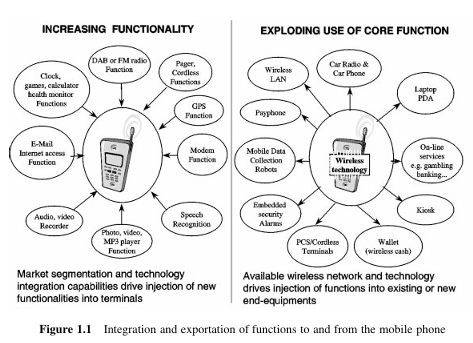
The social impacts and benefits of personal wireless communications are already visible. When phones were not portable and used to only sit on a desk at home or at work, people would call places: work or home; but when phones became portable and accessible anywhere, people began to call people rather than places: today, when we call people we even often start by asking ‘‘Hello, where are you?’’. The mobile phone has become a safety tool: ‘‘I will bring the phone with me in case I need to call for an emergency, if anxious family members want to reach me, or if I am lost’’. The mobile phone has become a social tool, enabling more fiexible personal life planning: ‘‘I do not know where I will be at 2 p.m. and where you will be, but I will call you on your mobile and we will sync’’. A recent survey has shown that when people forget their mobile phone at home, a vast majority is willing to go back home to get it, even when it implies a 30-minute drive. The mobile phone has become a personal item you carry with you like your wallet, your drivers ’ license, your keys, or even wear, like a watch, a pen, or glasses: it made it to the list of the few items that you carry with you. If you are a teenager, a gaming device or an MP3 player also made their room in your pocket, and if you are a busy executive a personal organizer is maybe more likely to have this privilege. Figure 1.1 illustrates the integration of new features trend; conversely, the wireless communication technology will be pervasive in different end-equipments and create new markets for wireless modules embedded in cars for example.
To some, the use of a mobile phone in public places is an annoyance. Peer pressure ‘‘dictates’’ you have a mobile phone tobe reachable ‘‘anywhere anytime’’; not having a mobile phone becomes anti-social in Scandinavian countries for example, where penetration is higher than 70% of the whole population. Like for every disruptive technology widely used, a new etiquette has to be understood and agreed upon, e.g. phones have to be turned off or put in silent mode at concerts or in restaurants. Phones are now programmed with different ringing profiles that are ‘‘environment friendly’’ (e.g. meeting mode rings only once and makes the phone vibrate). In the future, we might see phones that are environment aware, with sensors that detect if the phone is ina bag and needstoring louder for example. In the past, Matra-AEG, now Nokia Mobile Phones, introduced a GS M phone that had an infra-red sensor that served as a proximity detector so as to put the phone automatically on or off hands-free mode. Ringing profiles have also other nice applications: paired with CallerID, they enable users to have different ringing tones for different callers (friends, family, business partners, unknown …).
1.2 The Super Phone?
To the vast majority, the mobile phone is the ultimate telecommunication tool, via voice or short messages, soon to become multimedia messages or multimedia communications.
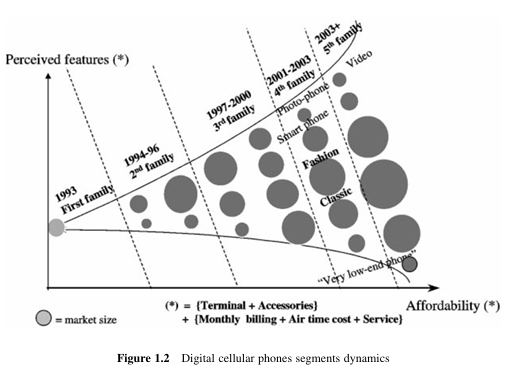
For some, it is a foregone conclusion that wireless terminals will continue their mutation from fairly simple, voice-oriented devices to s marter and s marter systems capable of increasingly more complex voice and data applications. The argument goes that wireless phones will take on the capabilities of Personal Digital Assistants (PDAs) and PDAs will subsume many of the voice communications capabilities of mobile phones. This line of reasoning proclaims that the handsets of the future eventually will become some sort of super-phone/handheld computer/PDA. But in the end, the marketplace is never nearly as neat and tidy as one might imagine. Rather than an inexorable quest for a one-size-fits-all super-phone, the fractious forces of the market, based as they are on completely illogical human emotions, no doubt will lead handset manufacturers down a number of avenues in support of 2.5G and 3G applications (2.5 and 3G refer to coming phone standard genera- tions to be described later in this book). Many mobile handsets will be capable of converged voice/data applications, but many will not. Instead, they will fulfill a perceived consumer need or perform a certain specialized function very well. Rather than a homogenous market of converged super-phones, the terminal devices for next generation applications will be as diverse as they are today, if not more so. And they will be as diverse as the applications that will make up the 2.5G and 3G marketplace. Mobile device OEMs must be prepared to meet the challenge of a diverse and segmented market. Figure 1.2 illustrates how wireless phone service started to be affordable to a few privileged business professionals and how it diversified in time to become a consumer item. The high-end phone of today is the classic phone of tomorrow as fashion and technology evolve and as people become used to inno- vations brought to them.
We believe that the increasing need for function diversification will drive the program- mable DSP into an even more integrated role within the mobile devices of tomorrow. Non- programmable DSP architectures will have to take on many traits of the programmable DSP in order to compete with it. The later chapters of this book highlight that the future of programmable DSPs in mobile applications hinges on their ability to bring the right level of flexibility, along with low power performance.
Over the last several years, the market for terminals first became polarized and then stratified. The market first polarized at the high and low ends of the spectrum. As more features and functions could be added to handsets, they were and this made up the high end. But to attract new subscribers, wireless carriers still wanted low-end, low-cost yet robust
mobile phones. In fact, for the service provider offering free handsets to each new subscriber, the lower the cost of the handset, the better off the service provider would be.
In the last few years though, the market has shown that it will splinter and stratify with several different layers or market segments between the poles. Some of the distinct segments that are emerging can be defined as:
† Data-centric devices: evolving from the PDA, these advanced palmtop computers will be integrated with cellular voice and retain or even expand upon their computing capabilities. Data-centric devices can also be modem cards (no keyboard, no display!) that can be plugged into laptops.
† S mart-phones: migrating from the cellular telephone segment of today’s market, s mart- phones will perform their voice communications functions quite effectively, but they also will be equipped with larger display screens so they can begin to perform new applications like e-mail access, Internet browsing and others.
† Fashion phones: these devices will use fashion techniques to appeal to several segments of consumers. The businessperson, for example, will be attracted to a certain look and feel to make a fashion statement. Younger consumers will have quite different tastes. Although they will cross several demographic market segments, these types of phones will appeal to buyers who are fashion-conscious and who will use fashion to make a statement about their lifestyles.
† Classic mobile phones: for users who are looking for a workhorse mobile phone, the classic handset will be s mall and easy-to-handle, and it will perform effectively the most frequently used communications features.
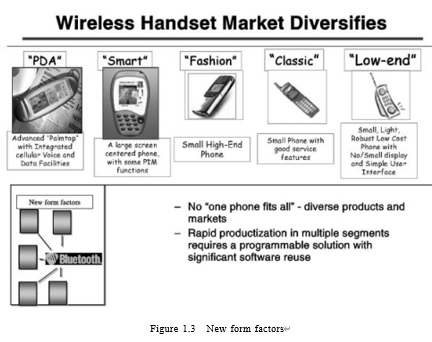
† Low-end phones: service providers will continue to offer free phones with service contracts. These s mall, light and robust phones will remain a mainstay in the market because they perform a very valuable function. They often come with a pre-paid calling plan bundle. They attract first-time users. In the future, we might see such phones without a keyboard or a display (to save cost): phone calls would be made via an operator sitting in a call center or a voice dialing/recognition system, most likely in the network.
† Bluetooth-enabled phones: Bluetooth is a short range, low-cost, low power wireless tech- nology operating in the 2.4 GHz unlicensed band. Bluetooth-enabled phones can be any of the above categories, but the form factors may change dramatically as the phone will now be distributed around your body.
The types of handsets that can be identified are illustrated in Figure 1.3 (concept phones courtesy of Nokia). What is not known is what tomorrow may hold and the effects new applications will have on the size, shape and function of future terminal devices.
One thing is for certain: new technologies will be developed that will alter the form factors in use today. For example, a Bluetooth-enabled phone maybe a belt-attached controller/ gateway device linked to an ear piece that communicates audio information. A display unit of some sort could be connected to the user’s eye glasses for communicating visual data. And beyond these fairly new applications, medical sensors could be deployed to moni- tor the person’s heartbeat or other vital functions.
A s mall box, comparable to a fiat pager in size, will incorporate cellular and Bluetooth (or another technology such as IEEE802.11B or IEEE802.15) functionalities combined, to communicate with a collection of fashionable accessories; the accessories, of the size and
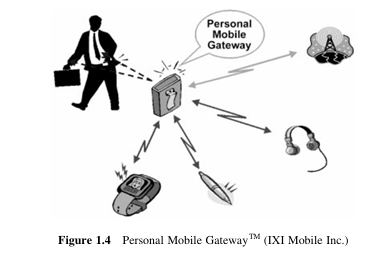
weight of a pen, or a fiat screen for example, will form a personal area network of thin clients communicating via Bluetooth with the s mall box, the Personal Mobile Gateway (Figure 1.4, courtesy of IXI Mobile Inc.). That way the ‘‘all-in-one’’ terminal, often too big to be a phone and too s mall to be a PDA, will become a collection of s mart yet thin, fashionable and low cost devices. The concept would appeal to both mobile professionals and teenagers, the primary target for the ever increasing replacement market.
1.3 New Services
We have discussed wireless devices, but what users really care about are the services those devices will bring to them, and industry players care about how money will be made. Before describing the new services that are likely to be offered thanks to personal mobile terminals, a little history lesson will be useful and remind us to be humble, especially when it comes to predicting the future! When the telephone was invented, it was originally to improve the telegraph system. The fundamental idea of the electrical trans mitting of sound was published by Charles Bourseul first in 1854 in the magazine L’Illustration de Paris. Alexander Graham Bell patented his telephone on the 14 February 1876, just 3 hours before Elisha Gray. Nobody was interested in his invention first. When he asked the Western Telegraph Company in 1877 to buy his patent for $100,000, the response was ‘‘What shall we do with a toy like that?’’. There was some doubt as to the use to which telephones might actually be put in practice. Demonstrations often included speech, song and music, and it was not uncommon for the musical demonstrations to be technically the most successful. ‘‘The musical telephone’’ was a major attraction at the International Electrical Exhibition in Paris in 1881, where the French
engineer Clement Ader demonstrated stereophonic trans mission by telephone direct from the stages of the Paris Opera House and the Come,die Fran aise. It was believed to be the major application of telephony. In 1890, a commercial company, Compagnie du Theatro- phone (Figure 1.5), was established in Paris, distributing music by telephone from various theatres to special coin-operated telephones installed in hotels, cafes, etc. and to domestic
subscribers. The service continued until 1932, when it was made obsolete by radio broad-
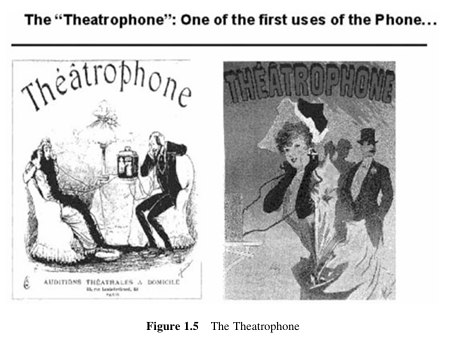
casting. The phone has come a long way since then, and the first mass market application is simply … talking with other people.
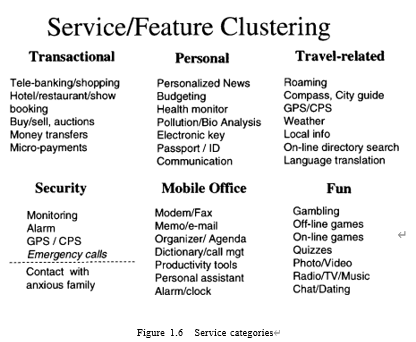
With the advent of the Internet and wireless data services, a new realm of possibilities are already offered, that go far beyond ‘‘just talking with other people’’, as witnessed by the recent success of NTT DoCoMo’s I-mode service in Japan. Service categories of the near future will encompass personalized information delivery for news, location-dependant services, travel, banking and personal hobbies; it will also include productivity-related services such as Virtual Private Network (VPN) with the office or the family, personal assistant, agendas, and address books; extended communication, including e-mail, postcard trans mission, and of course entertainment. Nokia has already introduced phones with games such as ‘‘the snake’’, but the future will bring much more exciting games (on-line as well as off-line, puzzles, gambling) and new forms of entertainment: music (ringtones, clips and songs), TV (schedules, clips), chat groups, astrology, dating services and what is sometimes called ’’adu lt entertainment’’. Figure 1.6 shows some of the service categories.
The successful deployment of the services will depend on ease of use, convenience, pertinence, and clear affordable billing. The pertinence of the service will require persona- lization; profiling technology can be used to match content to the needs of the users. Loca- tion-based services will enable or facilitate such profiling. Of course localization will have to be volunteered and ‘‘legally-correct’’ information. Most mobile location-based services today use positioning based on Cell of Origin (COO), but the precision is often mediocre, linked to cell size; in some cases, this is acceptable enough. Another method, known as Enhanced Observed Time of Difference (EOTD) is used in some GS M networks. Time of arrival signals from base stations are measured by the phone and what is called a Location-Measurement Unit (LMU). In future UMTS systems, a similar technique will be used that is known as
Observed Time Difference of Arrival (OTDOA). The location methods we just talked about only use the network and LMUs as a means to get location information; the use of Global Positioning System (GPS) gives better results, but the cost of a GPS receiver has to be added to the phone. An illustration of an innovative way to exploit and present location-based services is given in the last chapter of the book.
1.4 The Curse and Opportunity of Moore’s Law
Moore’s law predicted the rapid increase in transistor density on silicon chips. Along with this increase in transistor density, came an increase in clock speed, chip size, and component density on boards. All this has given the system designer an exponentially increasing amount of processing power to play with in his or her quest for more and more sophisticated systems. The design community has reacted to this explosion by making less and less efficient use of the transistors offered to it. This has been true since we first moved from hand laid out transistors to logic gates. The latter is less efficient in terms of silicon area and speed optimization, but is much more efficient in terms of a more precious resource: human intel- lect. From logic to RTL to microprocessors, the designer has moved to an increasingly high level of abstraction in order to design more and more complex devices in reasonable time- frames. Despite this, designers continue to lag behind process engineers in their ability to consume the transistors being made available to them. This can be clearly seen in Figure 1.7 which plots the ability of a designer to use transistors against the availability of transistors that can be used. This trend makes the use of programmable devices within mobile commu- nications systems inevitable for the foreseeable future. The only question is, what will these
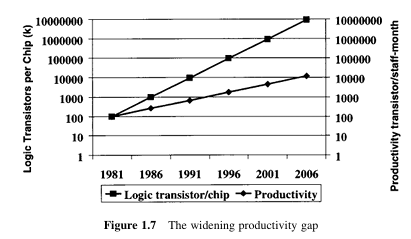
programmable devices look like? Programmable DSPs are programmable devices that include features that enable efficient implementation of systems within the special class of signal processing problems. By focusing on signal processing DSP designers have put programmable DSPs at the heart of many consumer devices, including mobile communica tion systems. Recently DSPs have been specialized to perform specifically in the domain of signal processing for mobile communications (more details are given in Chapter 2). The balance between specialization and flexibility is important for any DSP to succeed.
As DSPs are programmable, they are not ‘‘just pieces of silicon,’’ they come with a development environment. In the early 1980s, DSP was considered black magic, used by gurus who wrote all applications in assembly language. Now, powerful development tools including application boards, emulators, simulators, debuggers, optimizing High Level Language (HLL) compilers, assemblers, linkers, block diagram environments, code genera tors, real-time operating systems (enabling easier multitasking, preemptive schedul ing, high speed context switching, low interrupt latency, and fast, flexible intertask communication) as well as many DSP-related books and application notes and innovative visual tools have made DSP technology a tool for rapid design of increasingly complex systems.
In competition to DSPs, ‘‘silicon compilers’’ have arisen. These compilers promise to take high level descriptions of a system, and output a design ready for synthesis, usually with a certain amount of user feedback along the way. Though such tools have shown some success and are no doubt a useful tool in a designers arsenal, they do not provide a way to modify a system once it has been fabricated. This is becoming an increasingly important requirement because systems evolve quickly and are increasingly difficult to specify at design time. For instance, a mobile handset may not be fully tested until it has been used in the field. The increasing cost of mask sets for the fabrication of chips means any change that cannot be doneby reprogramming may cost millions of dollars and months of time. This is unacceptable in today’s marketplace.
更多内容见附件
免责声明:
本页面/内容部分素材来源于互联网公 开 信 息,旨在传递更多信息,不代表本平台立场。
版权归原作者或机构所有,如涉及侵权,请通过平台联系我们,我们将在核实后第一时间处理。
本平台对转载内容的真实性、准确性不作任何保证,用户需自行判断并承担使用风险。