橡胶疲劳 ≠ 金属疲劳 第3部分:热效应

All materials are temperature dependent, but some more than others: metals tend to be crystalline solids and will melt at sufficiently high temperatures; in contrast, crosslinked elastomers are always solids. They can be glassy or rubbery, crystalline or amorphous. When heated to extreme temperatures, they burn rather than melt, producing new substances, usually low molecular weight hydrocarbons (i.e. tarry substances and s moke). | 所有材料都受温度影响,但影响程度各异:金属通常是结晶固体,在足够高的温度下会熔化;相比之下,交联弹性体始终是固体。它们可以是玻璃态或橡胶态,结晶态或无定形态。当加热到极高温度时,它们会燃烧而不是熔化,产生新物质,通常是低分子量碳氢化合物(即焦油状物质和烟雾)。 |
Of course, you do not have to melt or burn a material to see the effects of temperature. In fatigue an alysis, we are concerned with stress-strain and crack growth behaviour. These can be temperature dependent for both metals and rubbers. However, while metals have a very high thermal conductivity, rubbers have almost the lowest. Therefore, fatigue an alyses involving large temperature gradients are much more common in rubber than in metal. | 当然,无需熔化或燃烧材料就能观察到温度对材料的影响。在疲劳分析中,我们关注的是应力-应变行为和裂纹扩展行为。金属和橡胶的这两种性能,都具有温度依赖性。然而,金属具有极高的热导率,而橡胶的热导率几乎是最低的。因此,涉及大温度梯度的疲劳分析在橡胶中比在金属中更为常见。 |
As shown in Fig.1, while a 100°C temperature gradient in a metal can affect the fatigue tensile strength or the fatigue limit by 10% [1], the same 100°C temperature gradient in rubber can reduce the fatigue life by four orders of magnitude [2]! | 如图1所示,金属中100°C的温度梯度可能使疲劳拉伸强度或疲劳极限降低10% [1]。而橡胶中相同的100°C温度梯度却能使疲劳寿命降低四个数量级[2]! |
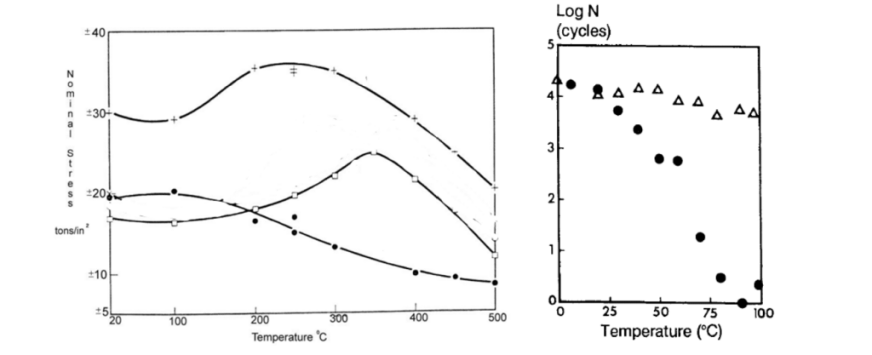 图1. 左图——温度对碳钢的影响,显示拉伸强度(+)、屈服应力(●)和疲劳极限(○)[1];右图 ——温度对天然橡胶(Δ)和丁苯橡胶(●)的影响[2]。 Fig. 1. Left – Effects of temperature on carbon steel showing tensile strength (+), yield stress (●), and fatigue limit (○), [1]; Right – Effects of temperature on natural rubber (Δ) and styrene butadiene rubber (●) [2]. | |
温度与链段迁移率Temperature and Segmental Mobility | |
The mechanis ms underlying the elasticity of metals and rubbers could hardly be more different. Under stress, atoms in a metal’s crystal lattice are displaced from their equilibrium positions, and potential energy is stored in strained interatomic bonds. In rubber, however, the strain energy is not predominantly stored in strained atomic bonds. Rather, elasticity arises because the constituent long-chain molecules are much more likely to be randomly coiled than to be fully extended. | 金属和橡胶弹性背后的机理截然不同。在应力作用下,金属晶格中的原子从其平衡位置发生位移,势能储存在受拉伸的原子间键中。然而,在橡胶中,应变能并非主要储存在受拉伸的原子键内。橡胶的弹性源于组成材料的长链分子更倾向于随机卷曲,而非完全伸展的状态。 |
Thus, provided that the molecules are sufficiently agitated by random thermal fluctuations, an entropic spring effect is created, meaning that potential energy can be stored by working to reduce the entropy of the polymer chain network by increasing the end-to-end distance of individual polymer chains [3]. | 因此,只要分子受到足够剧烈的随机热波动扰动,就会产生”熵弹性“效应。这意味着,通过外力作用增加单个聚合物链的末端距,从而降低聚合物链网络的熵,即可储存势能[3]。 |
Polymers in general can exhibit both glassy and rubbery behavior, depending on the temperature. The rubbery state – in which entropic elasticity dominates – exists above the glass transition temperature Tg, if the molecular motion rate is sufficiently high. In the rubbery state, very large strains are possible and the rubbery elastic storage modulus E’r determines the stress-strain curve. | 聚合物通常可呈现玻璃态和橡胶态行为,具体取决于温度。橡胶态——以熵弹性为主导——存在于玻璃化转变温度 Tg 之上(如果分子运动速率足够高)。在橡胶态下,可实现非常大的应变,且橡胶态弹性储能模量 E'r 决定了应力-应变曲线。 |
Below Tg, however, the lack of thermal molecular mobility prevents molecular reconfiguration, resultng in a glassy stiffness E’g that is several orders of magnitude higher than E’r. Polymers operating below Tg are thus not capable of large elastic strains and instead exhibit inelastic behavior when strains exceed a few percent. | 然而,在 Tg 以下,由于缺乏热分子迁移,分子无法重新构型,导致产生玻璃态刚度 E'g,其值比 E'r 高出几个数量级。因此,在 Tg 以下工作的聚合物无法承受大的弹性应变,当应变超过几个百分点时,会表现出非弹性行为。 |
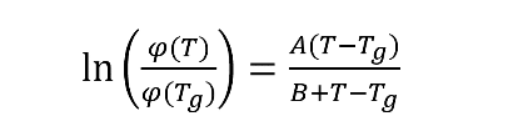
Figure 2 shows how the storage and loss modu li vary through the glass transition (left), and how the rate of molecular motion rate depends on temperature (right). The relative rate φ(T)/φ(Tg) of molecular motion as a function of temperature T is described by the WLF equation [4], which has material constants A and B. | 图2展示了储能模量和损耗模量在玻璃化转变过程中的变化(左图),以及分子运动速率如何依赖于温度(右图)。分子运动的相对速率 φ(T)/φ(Tg) 作为温度 T 的函数,由 WLF 方程[4]描述,该方程包含材料常数 A 和 B。 |
Since the fracture mechanical properties of rubber depend on the viscoelastic dissipation in the crack tip process zone, with higher dissipation associated with lower crack growth rates, frequency and temperature effects can be inferred accordingly. Viscoelastic master curves, such as those shown in Fig. 2, can be used as part of the material property rate dependence specification in the Endurica solver. | 由于橡胶的断裂力学性能依赖于裂纹尖端区内的粘弹性耗散,且通常粘弹耗散越高,橡胶的裂纹扩展速率越低,因此可以相应地推断频率和温度效应。如图2所示的粘弹性主曲线,可作为材料属性速率相关性定义的一部分,在Endurica软件中支持使用该模型来定义材料的粘弹性能。 |
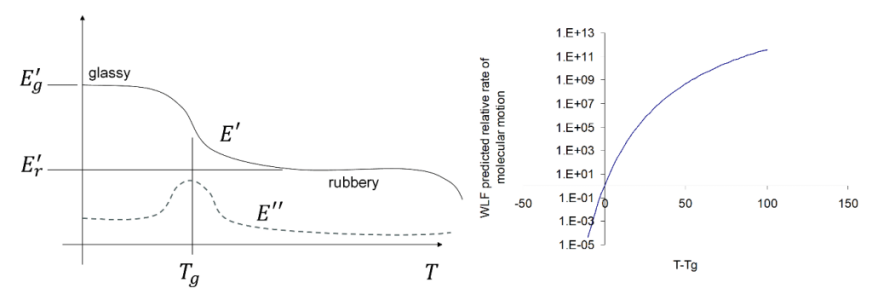
图2,左图 -- 橡胶的弹性和粘性响应取决于相对于玻璃化转变温度 Tg 的温度;右图:分子运动速率取决于相对于玻璃化转变温度 Tg 的温度。
Fig. 2, Left – Rubber’s elastic and viscous responses depend on temperature relative to the glass transition temperature Tg; Right: The rate of molecular motion depends on temperature relative to the glass transition temperature Tg.
自热与热失控
Self-Heating and Thermal Runaway
During a charge cycle, work WL is done on the charge stroke, some of which WU is recovered on the discharge stroke, as shown in Fig. 3. The unrecovered part of the work H remains in the material as heat energy, increasing the temperature. | 在一个加载循环中,加载行程做功 WL,其中一部分功 WU 在卸载行程中恢复,如图3所示。未被恢复的那部分功 H 作为热能留在材料内部,导致温度升高。 |
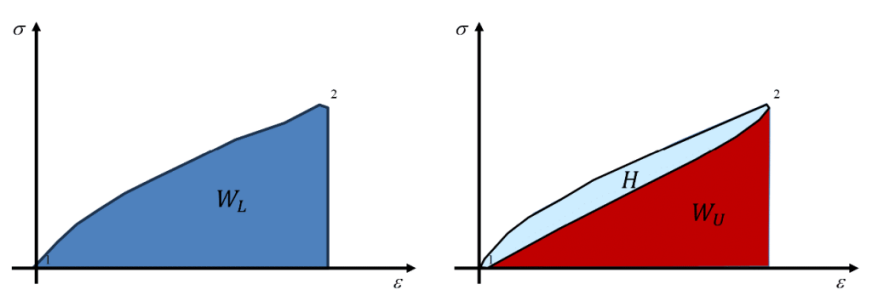
图3. 加载行程输入的功 WL 在卸载行程中部分恢复为 WU。一部分能量 H 以热的形式留在材料中。
Fig. 3. Work input WL on the loading stroke is partially recovered as WU on the unloading stroke. A portion H of the energy remains in the material as heat.
The rate of viscoelastic heating of rubber depends on strain amplitude, cycle rate (i.e. frequency) and temperature. The strain amplitude dependence of the viscoelastic storage and loss modu lii, G’ and G” respectively, can be specified using the Kraus model [5,6]: | 橡胶的粘弹性生热速率取决于应变幅值、循环速率(即频率)和温度。粘弹性储能模量 G' 和损耗模量 G" 对应变幅值的依赖性,可使用 Kraus 模型 来表征[5,6]: |
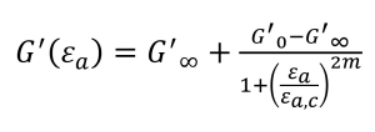
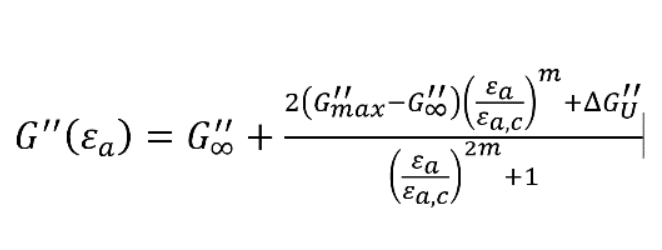
where εa is the strain amplitude, and where G’∞, G’0, εa,c, m, G”∞, G”max, and ΔG”U are material parameters. The viscoelastic heat rate per unit volume can be calculated from: | 其中 εa 是应变幅值,G'∞, G'0, εa,c, m, G"∞, G"max, 和 ΔG"U 是材料参数。单位体积的粘弹性生热速率可计算如下: |

Due to the low thermal conductivity of rubber, s mall amounts of viscoelastic self-heating can produce large temperature gradients. Accurately accounting for thermal effects on rubber durability generally requires both structural finite element an alysis to calculate stress and strain fields, and a thermal finite element an alysis to calculate the temperature field. Endurica fatigue solvers can provide heat rate calculations in a coupled finite element simulation for both transient and steady state thermal an alyses. | 由于橡胶的低热导率,微量的粘弹性自热即可产生大的温度梯度。要精确考虑热效应对橡胶耐久性的影响,通常需要结合结构有限元分析(计算应力和应变场)和热有限元分析(计算温度场)。Endurica疲劳求解器能够在耦合有限元仿真中提供生热速率计算,适用于瞬态和稳态热分析。 |
In cases where the temperature in the rubber exceeds a critical value Tx, an additional heat rate contribution q ̇x occurs due to exothermic chemical reactions. The effect is illustrated in Fig. 4, for a rubber cylinder subjected to a rotating bending load [7]. The thermal runaway starts after about 250 seconds. Both experimental (dashed line) and Endurica-calculated (solid line) simulation results are plotted for the cylinder centreline (blue) and for the cylinder outer surface (green). The thermal runaway event typically results in rapid decomposition of the rubber into hydrocarbon gases (i.e. s moke/burning rubber) and low-molecular weight substances (tar). | 当橡胶内部温度超过临界值 Tx 时,由于放热化学反应会产生额外的生热率 q x 。图4展示了一个承受旋转弯曲载荷的橡胶圆柱体的这种效应[7]。热失控大约在250秒后开始。图中绘制了圆柱体中心线(蓝色)和外表面(绿色)的实验结果(虚线)和Endurica计算结果(实线)。热失控事件通常导致橡胶快速分解为碳氢化合物气体(即烟雾/燃烧橡胶)和低分子量物质(焦油)。 |
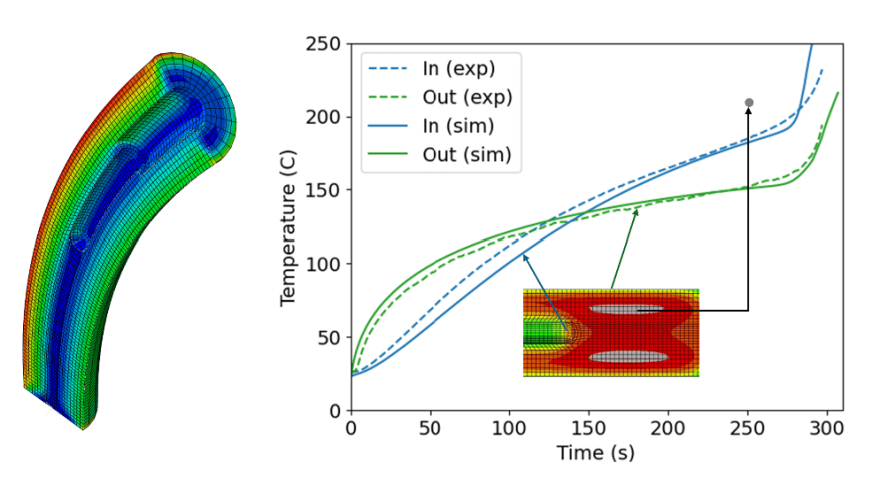
图4. 当温度超过临界值 Tx 时,放热化学反应可导致热失控失效。右图显示了Endurica计算的旋转弯曲圆柱体(左图显示其结构有限元模型)的瞬态温度历程(实线)。作为比较,实验测量的温度历程也一并显示(虚线)。
Fig. 4. When temperature exceeds a critical value Tx, exothermic chemical reactions can produce a thermal runaway failure. Plot (right) shows Endurica calculated transient temperature history (solid lines) for a rotating bending cylinder (structural finite element model shown on left). For comparison, experimentally measured temperature histories are also shown (dashed lines).
可逆温度效应
Reversible Temperature Effects
The crack growth properties of rubber reversibly depend on temperature. Higher temperatures tend to reduce the tear strength Tc of rubber and increase the crack growth rate, as shown in Fig. 5 [8]. At lower temperatures, the tear strength is increased and crack growth is retarded. Endurica’s crack growth models can be specified with a temperature dependence via the temperature sensitivity coefficient (see Table 1) or via a table look-up function. | 橡胶的裂纹扩展性能可逆地依赖于温度。如图5所示,较高的温度往往会降低橡胶的撕裂强度 Tc 并增加裂纹扩展速率[8]。在较低温度下,撕裂强度增加,裂纹扩展减慢。Endurica的裂纹扩展模型可通过温度敏感系数(见表1)或表格查找函数来指定其温度依赖性。 |
Fig. 6 shows the fatigue life as a function of temperature calculated from the parameters in Table 1 [2]. Over a range of 100°C, natural rubber loses approximately a factor of two in fatigue life, and styrene butadiene rubbers loses four orders of magnitude! | 图6显示了根据表1 中参数计算出的疲劳寿命随温度变化的函数关系[2]。在100°C的温度范围内,天然橡胶的疲劳寿命损失约两倍,而丁苯橡胶的疲劳寿命损失高达四个数量级! |
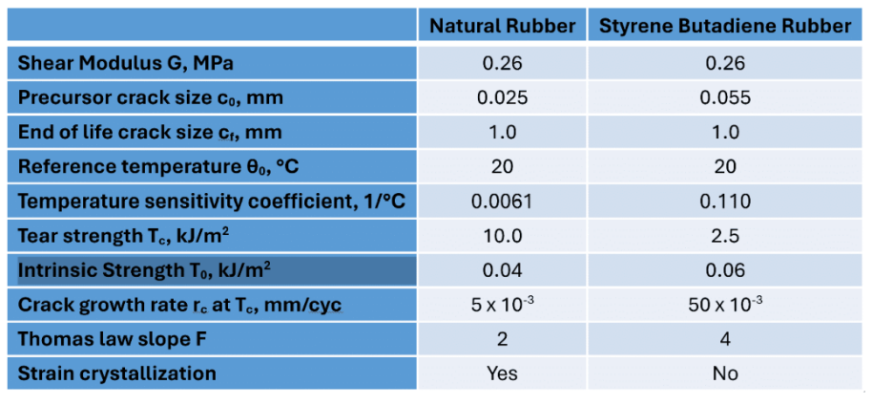
表1. 天然橡胶 (NR) 和丁苯橡胶 (SBR) 的裂纹扩展性能及温度敏感性,根据文献[2]报道的测量结果估算。
Table 1. Crack growth properties and temperature sensitivity for natural rubber (NR) and styrene butadiene rubber (SBR), estimated from measurements reported in [2].
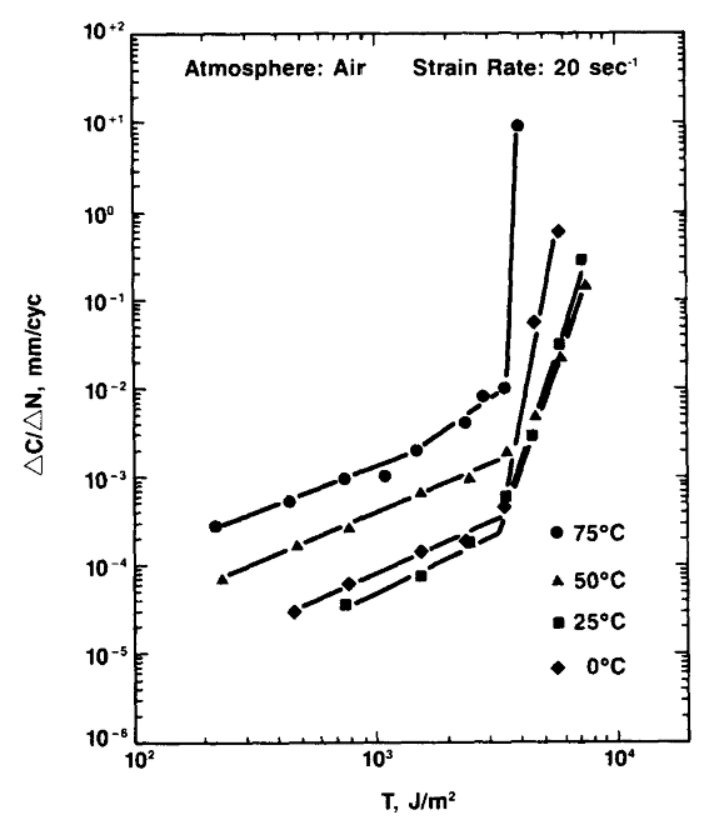
图5 -- 温度升高导致裂纹扩展速率增加。结果针对天然橡胶[8]。
Fig. 5 – Increasing temperature causes the crack growth rate to increase. Results are shown for natural rubber [8].
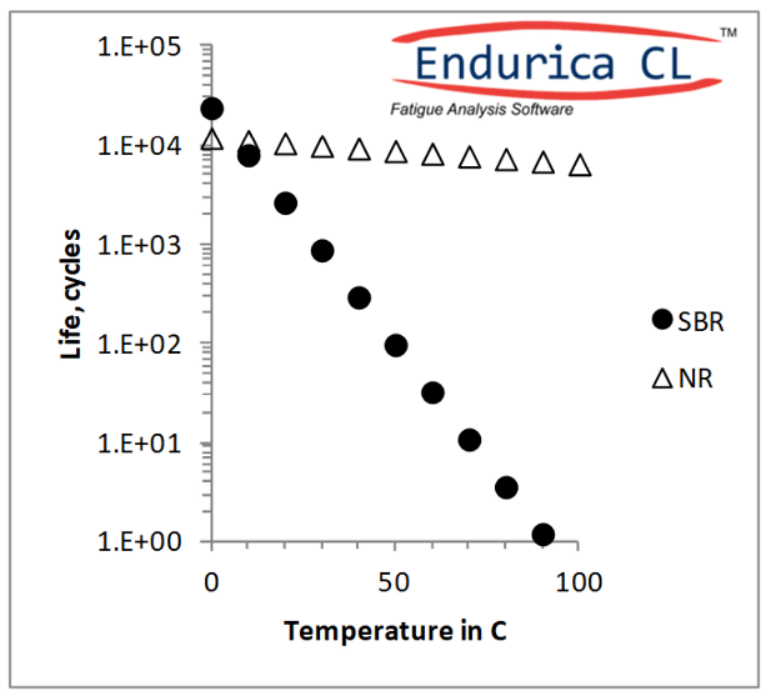
图6. Endurica计算的天然橡胶 (Δ) 和丁苯橡胶 (●) 疲劳寿命对温度的依赖性[2]。请与图1比较。
Fig. 6. Endurica calculated dependence of fatigue life on temperature for natural rubber (Δ) and for styrene butadiene rubber (●) [2]. Compare to Fig. 1.
Some rubbers undergo strain crystallization, which is beneficial when operating under non-relaxing conditions. The crystallization effect is strongly temperature dependent and decreases with increasing temperature. | 一些橡胶会发生应变诱导结晶,在非松弛工况下,应变诱导结晶对于提高材料的抗疲劳性能是有益的。应变诱导结晶强烈依赖于温度,并随温度升高而减弱。 |
Fig. 7 shows the Haigh diagram calculated by Endurica for three different temperatures: 23, 90 and 110°C. For example, at a mean strain of 100% and a strain amplitude of 20%, the fatigue life at 23°C exceeds 106 cycles, but at 110°C the fatigue life is approximately 103 cycles. This effect has been confirmed experimentally in recent work by [9]. | 图7显示了Endurica在三个不同温度(23°C, 90°C 和 110°C)下计算的Haigh图。例如,在100%的平均应变和20%的应变幅值下,23°C时的疲劳寿命超过106次循环,但在110°C时疲劳寿命约为103次循环。文献 [9]最近的实验工作已证实了这一效应。 |
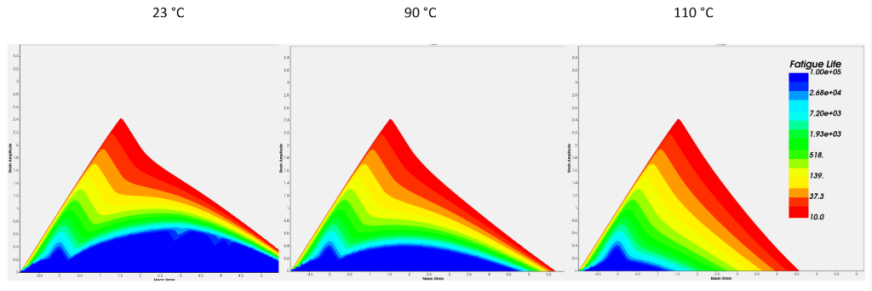
图7. Endurica计算的天然橡胶在23°C, 90°C 和 110°C下的Haigh图。温度升高会减弱应变诱导结晶,其结果是,与应变结晶相关的平均应变效应在高温下会减弱甚至消失。
Fig. 7. Endurica calculated Haigh diagrams for natural rubber at 23, 90 and 110°C . Increasing temperature tends to reduce strain crystallization, with the result that the mean strain benefit associated with strain crystallization is reduced or even eliminated at high temperatures.
不可逆温度效应 / 老化
Irreversible Temperature Effects / Ageing
Prolonged exposure to high temperatures can cause permanent changes in the cross link density and mechanical properties of rubber, including stiffness and crack growth properties. The effect depends on the availability of oxygen [10], as shown in Fig. 8. | 长时间暴露于高温会导致橡胶的交联密度和机械性能(包括刚度和裂纹扩展性能)发生永久性变化。这种效应取决于氧气的含量[10],如图8所示。 |
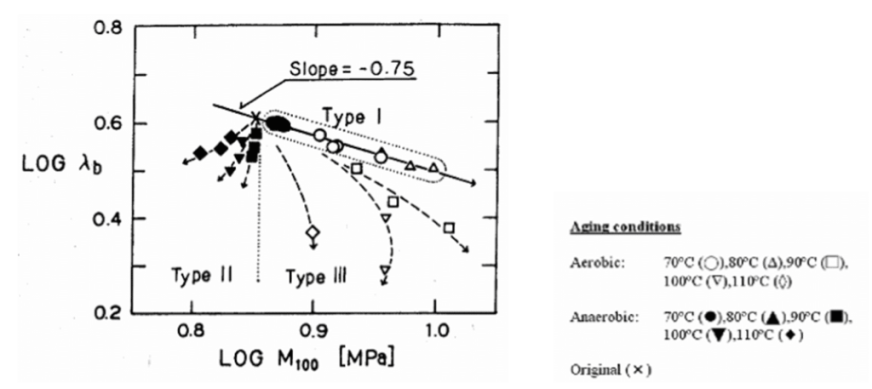
图8 -- 橡胶性能在老化过程中的演变取决于氧气的含量和温度[10]。在有氧条件下,老化倾向于增加刚度,同时断裂伸长率降低。在无氧条件下,老化倾向于降低刚度,同时断裂伸长率也降低。
Fig. 8 – The evolution of rubber’s properties during ageing depends on the availability of oxygen, and on the temperature [10]. Under aerobic conditions, ageing tends to increase stiffness while strain at break decreases. Under anaerobic conditions, ageing tends to decrease stiffness while strain at break decreases.
When aged under Type I aerobic conditions, rubber becomes brittle as its strain at break λb decreases while its stiffness M100 increases. When aged under Type II anaerobic conditions, rubber tends to soften while its strain at break decreases. | 在I型(有氧)条件下老化时,橡胶变脆,其断裂伸长率 λb 降低而刚度 M100 增加。在II型(无氧)条件下老化时,橡胶倾向于软化,同时其断裂伸长率降低。 |
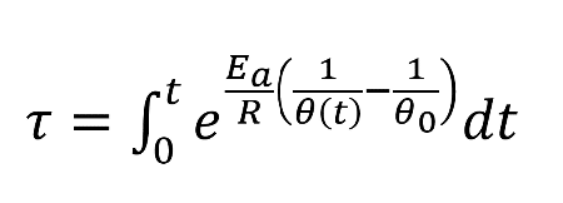
The rate at which thermochemical ageing of rubber progresses can be specified in Endurica using the Arrhenius law [11] and its activation energy parameter Ea. When following a temperature history θ(t), Endurica integrates the Arrhenius law to determine an equivalent exposure time τ at the reference temperature θ0. R is the real gas constant. | 橡胶热化学老化的速率可在Endurica中使用阿伦尼乌斯定律及其活化能参数 Ea 来表征。当给定一个温度历程 θ(t) 时,Endurica 对阿伦尼乌斯定律进行积分,以确定在参考温度 θ0 下的等效暴露时间 τ。R 是真实气体常数。 |
The equivalent exposure time controls the evolution of the stiffness and crack growth properties with thermal history. As shown in Fig. 9, the evolution of the crack growth rate law is specified by a tabular function that gives the stiffness E(τ), tensile strength Tc(τ) and the fatigue limit T0(τ). The material properties are then updated iteratively according to the co-simulation workflow shown in Fig. 10. This allows the effects of thermal history and ageing on fatigue performance to be considered. | 等效暴露时间控制着刚度和裂纹扩展性能随热历程的演变。如图9所示,裂纹扩展速率定律的演变由一个表格函数指定,该函数给出刚度 E(τ)、撕裂强度 Tc(τ) 和疲劳极限 T0(τ)。然后,材料属性根据图10所示的协同仿真工作流程进行迭代更新。这使得可以考虑热历史和老化的效应对疲劳性能的影响。 |
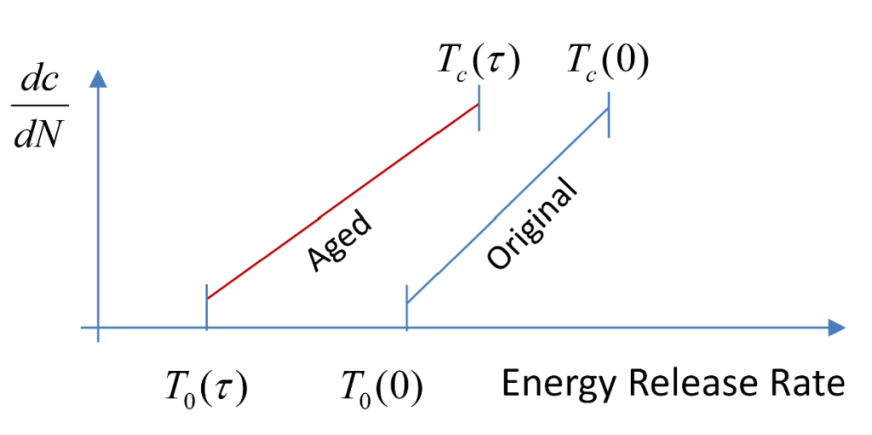
图9. 裂纹扩展速率定律随等效暴露时间 τ 演变。在Endurica中,裂纹扩展性能的演变通过定义橡胶的撕裂强度 Tc(τ) 和其疲劳极限 T0(τ) 对暴露时间的相关性来指定。
Fig. 9. The crack growth rate law evolves as a function of the equivalent exposure time τ. Crack growth property evolution is specified in Endurica by the dependence of the rubber’s tear strength Tc(τ) and its fatigue limit T0(τ) on exposure time.
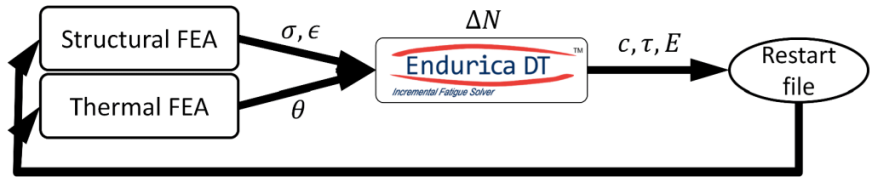
图10. Endurica DT 的协同仿真工作流程,通过更新裂纹长度 c、暴露时间 τ 和刚度 E,支持在计算过程中更新随时间变化的应力、应变和温度场。
Fig. 10. Endurica DT’s co-simulation workflow updates the crack length c, exposure time τ, and stiffness E so that stress, strain and temperature fields can be updated during solution.
结论
Conclusion
There are many ways in which metals and rubbers differ in their behaviour, and thermal behaviour is one of the most important. | 金属和橡胶在行为上存在诸多差异,而热行为是其中最重要的差异之一。 |
Rubber more often requires careful attention to thermal effects due to its exceptionally low thermal conductivity, its entropy-elasticity, its visco-elastic properties and tendency to self-heat under cyclic loading, the sensitivity of crack growth properties and strain crystallization to temperature, oxidation, and ageing. | 由于橡胶极低的热导率、熵弹性、粘弹性特性以及在循环载荷下的自生热倾向、裂纹扩展性能和应变诱导结晶对温度、氧化和老化的敏感性,它通常比金属材料更需要仔细分析热效应对疲劳的影响。 |
Endurica’s fatigue solvers provide material models and workflows that capture these thermal effects, enabling accurate an alysis and “right the first time” engineering. | Endurica的疲劳求解器提供了能够捕捉这些热效应的材料模型和工作流程,从而实现精确的分析和“一次成功”的工程设计。 |
END
参考文献:
[1] P.G. Forrest, Fatigue of Metals, Pergamon Press: Oxford, New York, 1962.
[2] G.J. Lake and P.B. Lindley, “Cut growth and fatigue of rubbers. II. Experiments on a noncrystallizing rubber”, Journal of Applied Polymer Science, vol. 8(2), pp. 707-721, 1964.
[3] W. V. Mars and T. G. Ebbott, “A Review of Thermal Effects on Elastomer Durability” in Advances in Understanding Thermal Effects in Rubber: Experiments, Modelling, and Practical Relevance, G. Heinrich, R. Kipscholl, J. B.
Le Cam and R. Stoček (eds.), pp. 251–324, Springer Nature: Switzerland, 2024.
[4] M. L. Williams, R. F. Landel and J. D. Ferry, “The Temperature Dependence of Relaxation Mechanis ms in Amorphous Polymers and Other Glass-forming Liquids”, Journal of the American Chemical Society, vol. 77 (14), pp. 3701–3707,
1955.
[5] G. Kraus, “Mechanical Losses in Carbon Black Filled Rubbers”, in: Journal of Applied Polymer Science: Applied Polymer Symposium, vol. 39, pp. 75–92, 1984.
[6] J. D. Ulmer, “Strain Dependence of Dynamic Mechanical Properties of Carbon Black-Filled Rubber Compounds”, Rubber Chemistry and Technology, vol. 69, pp. 15–47, 1996.
[7] J. Vaněk, O. Peter et al, “2D Transient Thermal Ana lytical Solution of the Heat Build-Up in Cyclically Loaded Rubber Cylinder” in Advances in Understanding Thermal Effects in Rubber: Experiments, Modelling, and Practical Relevance,
G. Heinrich, R. Kipscholl, J. B. Le Cam and R. Stoček (eds.), pp. 31–52, Springer Nature: Switzerland, 2023.
[8] D. G. Young, “Fatigue Crack Propagation in Elastomer Compounds: Effects of Strain Rate, Temperature, Strain Level, and Oxidation”, Rubber Chemistry and Technology, vol. 59 (5), pp. 809–825, 1986.
[9] B. Ruellan, J. B. Le Cam et al, “Fatigue of natural rubber under different temperatures”, International Journal of Fatigue, vol. 124, pp. 544–557, 2019.is ms in amorphous polymers and other glass-forming liquids. Journal of the American Chemical society, 77(14), 3701-3707.
[10] A. Ahagon, M. Kida and H. Kaidou, “Aging of Tire Parts during Service. I. Types of Aging in Heavy-Duty Tires”, Rubber Chemistry and Technology, vol. 63 (5), pp. 683–697, 1990. [11] S. Arrhenius, “Über die Reaktionsgeschwindigkeit bei der Inversion von Rohrzucker durch Säuren”, Zeitschrift für Physikalische Chemie, vol. 4 (1), pp. 226–248, 1889.