【新文速递】2026年4月16日复合材料SCI期刊最新文章
今日更新:Composite Structures 4 篇,Composites Part A: Applied Science and Manufacturing 6 篇,Composites Science and Technology 2 篇
Composite Structures
From material design to performance evaluation: Reviewing blast-resistant composites for personal safety
Jiangrui Qian, Yun Su, Jun Li
doi:10.1016/j.compstruct.2026.120351
从材料设计到性能评价:人身安全防爆复合材料综述
Personal blast-resistant composites and associated protective equipment have attracted increasing attention due to their potential to mitigate blast loads, reduce fatalities, and minimize injury risks, particularly in industrial and civilian applications. While extensive research has focused on enhancing protective performance through various material strategies, existing studies are often fragmented, typically emphasizing individual materials, isolated performance metrics, or specific loading scenarios. Critically, few studies systematically integrate material design, protective mechanis ms, human adaptability, and performance evaluation into a unified framework, limiting the translation of research insights into practical, wearable protective systems. In this review, we address these gaps by providing an integrated an alytical framework to systematically compare material design objectives and performance enhancement strategies, to highlight how different approaches address trade-offs between protection and human adaptability, and to identify critical limitations in current evaluation approaches. Based on this an alysis, key challenges and knowledge gaps are identified, and future research directions are outlined to guide the development of next-generation protective materials aiming to balance high blast resistance with lightweight, flexible, and wearable characteristics.
个人防爆复合材料和相关防护设备因其减轻爆炸载荷、减少死亡和最大限度地减少伤害风险的潜力而越来越受到关注,特别是在工业和民用应用中。虽然广泛的研究侧重于通过各种材料策略来提高防护性能,但现有的研究往往是碎片化的,通常强调单个材料、孤立的性能指标或特定的加载场景。关键是,很少有研究将材料设计、保护机制、人类适应性和性能评估系统地整合到一个统一的框架中,这限制了将研究见解转化为实用的可穿戴防护系统。在这篇综述中,我们通过提供一个综合的分析框架来解决这些差距,系统地比较材料设计目标和性能增强策略,突出不同的方法如何解决保护和人类适应性之间的权衡,并确定当前评估方法的关键局限性。基于此分析,确定了关键挑战和知识差距,并概述了未来的研究方向,以指导下一代防护材料的开发,旨在平衡高抗爆炸性能与轻质、柔性和可穿戴特性。
Gyroid-based interpenetrating lattice dental implants toward low stress shielding and high load-bearing capacity
Shaoying Yang, Renkai Huang, Linqing Huang, Chunrong Pan, Yuchun Sun, Xu Zhang, Sukun Tian, Youwen Yang
doi:10.1016/j.compstruct.2026.120349
基于陀螺仪的互穿晶格牙种植体低应力屏蔽和高承载能力
Interpenetrating lattice structures offer superior tailorability in physical and mechanical properties compared to single-phase structures. To achieve high strength and moderate elastic modulus, herein, gyroid-based interpenetrating lattice scaffolds for dental implants with different interpenetrating parameter (ω) were designed. The finite element simulation results showed that the interpenetrating lattice scaffold (volume fraction ρ* = 40%, ω = 0.3) achieved the comparable elastic modulus as the single-phase structure (ρ* = 30%), while improving yield strength by 10.11%. This is due to the mutual constraint and support between the inner and outer lattices of the interpenetrating structure, resulting in superior mechanical properties compared to the single-phase lattice structure. The maximum stress and strain values of the bone around lattice scaffolds with interpenetrating parameters of 0.3–0.8 (ρ* = 40%) fell within the range of 2–60 MPa and 1000–3000 με, respectively, both of which are favorable for bone regeneration. The permeability of the interpenetrating lattice scaffolds all remained within the permeability limits of human bone. In addition, lattice scaffolds with interpenetrating parameters of 0.3–0.8 did not exhibit toxic effects on HBMSCs cultured in vitro. This work offers a feasible design method for regulating the mechanical compatibility and biocompatibility of oral implants
与单相结构相比,互穿晶格结构在物理和机械性能方面具有优越的可定制性。为了获得高强度和中等弹性模量,设计了具有不同互穿参数(ω)的陀螺仪基互穿晶格支架。有限元模拟结果表明,互穿晶格支架(体积分数ρ* = 40%, ω = 0.3)的弹性模量与单相结构(ρ* = 30%)相当,屈服强度提高10.11%。这是由于互穿结构的内外晶格之间的相互约束和支撑,导致与单相晶格结构相比具有优越的力学性能。当互穿参数为0.3 ~ 0.8 (ρ* = 40%)时,晶格支架周围骨的最大应力和应变值分别在2 ~ 60 MPa和1000 ~ 3000 με范围内,均有利于骨再生。互穿晶格支架的渗透性均保持在人骨的渗透性极限内。此外,互穿参数为0.3 ~ 0.8的晶格支架对体外培养的HBMSCs没有毒性作用。本研究为调节口腔种植体的机械相容性和生物相容性提供了一种可行的设计方法
Impact force identification on wind turbine blades using the ADMM-Net deep unfolding network guided by structural response priors
Botao Ning, Liang Zeng, Xiaobo Wang
doi:10.1016/j.compstruct.2026.120348
基于结构响应先验的ADMM-Net深度展开网络风力机叶片冲击力辨识
During the long-term service of wind turbine blades, external impacts are unavoidable. Identifying impact forces is therefore essential for the safe and stable operation of wind turbines. At present, both model-based and deep learning methods have been widely used for this task. Model-based methods are interpretable but sensitive to model mis match, computationally demanding, and difficult to optimize. Deep learning methods have strong fitting capability but lack physical interpretability due to their “black-box” nature. To address these limitations, this paper proposes a structure-response prior-driven deep unfolding network, termed ADMM-Net, for impact force identification. The method applies algorithm unfolding to transform the iterative steps of the alternating direction method of multipliers (ADMM) into a deep network, and introduces structural response priors obtained from experiments for physics-based initialization. In this way, the framework achieves both interpretability and adaptiveness in an end-to-end manner. Experimental results from impacts experiments on a section of a wind turbine blade show that ADMM-Net not only enables accurate localization and reconstruction of impact forces, but also demonstrates strong noise resistance under complex noisy conditions.
在风机叶片的长期使用过程中,外界的冲击是不可避免的。因此,确定冲击力对于风力涡轮机的安全稳定运行至关重要。目前,基于模型的学习方法和深度学习方法都被广泛应用于该任务。基于模型的方法具有可解释性,但对模型不匹配敏感,计算量大,难以优化。深度学习方法具有较强的拟合能力,但由于其“黑箱”性质,缺乏物理可解释性。为了解决这些局限性,本文提出了一种结构响应先验驱动的深度展开网络,称为ADMM-Net,用于冲击力识别。该方法采用算法展开将乘法器交替方向法(ADMM)的迭代步骤转化为深度网络,并引入实验得到的结构响应先验,进行基于物理的初始化。通过这种方式,框架以端到端的方式实现了可解释性和适应性。风力机叶片截面冲击实验结果表明,ADMM-Net不仅能够准确定位和重建冲击力,而且在复杂噪声条件下具有较强的抗噪声能力。
Calibrated finite element and reduced-order models for efficient simulation of bolted composite–aluminium structures
Hannes Wemming, Stefan B. Lindström, Lars Johansson, Zlatan Kapidžić
doi:10.1016/j.compstruct.2026.120347
用于螺栓复合铝结构有效模拟的标定有限元和降阶模型
Experimental characterisation of bolted joints is costly, time-consuming and difficult to scale across multiple joint configurations. Accurate modelling of joints in large composite–aluminium structures provides an alternative, but detailed finite element (FE) an alysis of each fastener is computationally demanding and impractical. Reduced-order models, based on the Iwan formulation, offer an efficient approach that can mitigate these challenges. In this work, each bolt installation in a composite-aluminium joint with two fasteners is represented by a structural element incorporating an Iwan-type model. The corresponding model parameters are identified from force–displacement responses predicted by a detailed solid FE model, calibrated against experimental measurements. A large set of FE simulations, covering a range of joint geometries, is then used to construct a meta-model that estimates the relevant Iwan parameters. The resulting model provides a computationally efficient fastener representation suitable for both structural ana lysis and design optimisation in assemblies containing multiple bolted joints. The proposed modelling technique reduces reliance on extensive physical testing and detailed FE simulations.
螺栓连接的实验表征成本高,耗时长,且难以跨多个连接配置进行规模化。对大型复合铝结构中的接头进行精确建模提供了另一种选择,但对每个紧固件进行详细的有限元分析在计算上要求很高,而且不切实际。基于Iwan公式的降阶模型提供了一种有效的方法,可以缓解这些挑战。在这项工作中,每个螺栓安装在一个复合铝连接与两个紧固件是由一个结构元素,结合伊万型模型表示。相应的模型参数由详细的实体有限元模型预测的力-位移响应确定,并根据实验测量进行校准。大量的有限元模拟,涵盖了一系列的关节几何形状,然后用来构建一个元模型来估计相关的Iwan参数。所得到的模型提供了一个计算效率高的紧固件表示,适用于包含多个螺栓连接的组件的结构分析和设计优化。提出的建模技术减少了对广泛的物理测试和详细的有限元模拟的依赖。
Composites Part A: Applied Science and Manufacturing
Lightweight, elastic, and thermally insulative aluminum silicate ceramic felt/polysiloxane@resorcinol-furfural aerogel composite for repeatable high-temperature protection
Haiming Cheng, Yidan Jin, Rongying Yin, Yebo Du
doi:10.1016/j.compositesa.2026.109850
轻质,弹性,隔热硅酸铝陶瓷毡/polysiloxane@resorcinol-furfural气凝胶复合材料,可重复高温保护
Lightweight and flexible ablative thermal protection materials (TPMs) are critically needed for aerospace vehicles that endure complex dynamic stresses in high-temperature environments. This work presents a lightweight, elastic aluminum silicate fiber/polysiloxane aerogel coated with resorcinol–furfural aerogel (ASF/Si@RFA) composite, fabricated via a facile process involving vacuum impregnation, sol–gel reaction, and atmospheric pressure drying. The composite features a unique multiscale architecture that integrates a macroscopic ceramic ASF felt, a micron-scale flexible and ceramizable SiA, and a nanoporous carbonizable RFA into a highly porous, three-dimensionally interconnected network. This multiscale design yields a low density (∼0.165 g·cm−3), superior compressive resilience with full recovery from 60% strain, and excellent thermal insulation (∼34 mW·m−1·K−1) across both high and cryogenic temperatures, alongside notable hydrophobicity (a water contact angle of 130°). More importantly, exceptional repeatable high-temperature protection performance under a 1300 °C butane flame. A synergistic protective mechanis m, arising from the in-situ formation of a silicon oxycarbide barrier, the release of pyrolysis gases for transpiration cooling, the high emissivity of the carbon aerogel, and transverse heat dissipation, results in near-zero surface recession(0.17 μm·s−1) and backside temperature below 100 °C throughout 15 heating cycles. This strategy provides a promising pathway for developing advanced lightweight, flexible ablative TPMs.
对于在高温环境中承受复杂动态应力的航空航天飞行器来说,轻质柔性烧蚀热防护材料(TPMs)是非常需要的。本研究提出了一种轻质、弹性的硅酸铝纤维/聚硅氧烷气凝胶包覆间苯二酚-糠醛气凝胶(ASF/Si@RFA)复合材料,通过真空浸渍、溶胶-凝胶反应和常压干燥等简单工艺制备而成。该复合材料具有独特的多尺度结构,将宏观陶瓷ASF毡、微米级柔性可陶化SiA和纳米多孔可碳化RFA集成到一个高度多孔的三维互联网络中。这种多尺度设计产生低密度(~ 0.165 g·cm−3),优异的压缩弹性,从60%的应变中完全恢复,在高温和低温下都具有优异的绝热性(~ 34 mW·m−1·K−1),以及显著的疏水性(水接触角为130°)。更重要的是,在1300°C的丁烷火焰下,具有卓越的可重复高温保护性能。在15个加热循环中,碳化硅氧屏障的原位形成、热解气体蒸腾冷却的释放、碳气凝胶的高发射率和横向散热产生了协同保护机制,导致表面退缩接近于零(0.17 μm·s−1),背面温度低于100°C。该策略为开发先进的轻量化、柔性烧蚀TPMs提供了一条有前途的途径。
Mechanically reconfigurable terahertz modulation material via graphene aerogel microspheres/liquid metal composites
Qilin Zhu, Xiaoxing Chen, Jie Liu, Dawei Luo, Hesheng Xia, Marino Lavorgna, Zhenhua Wu, Yijun Li
doi:10.1016/j.compositesa.2026.109849
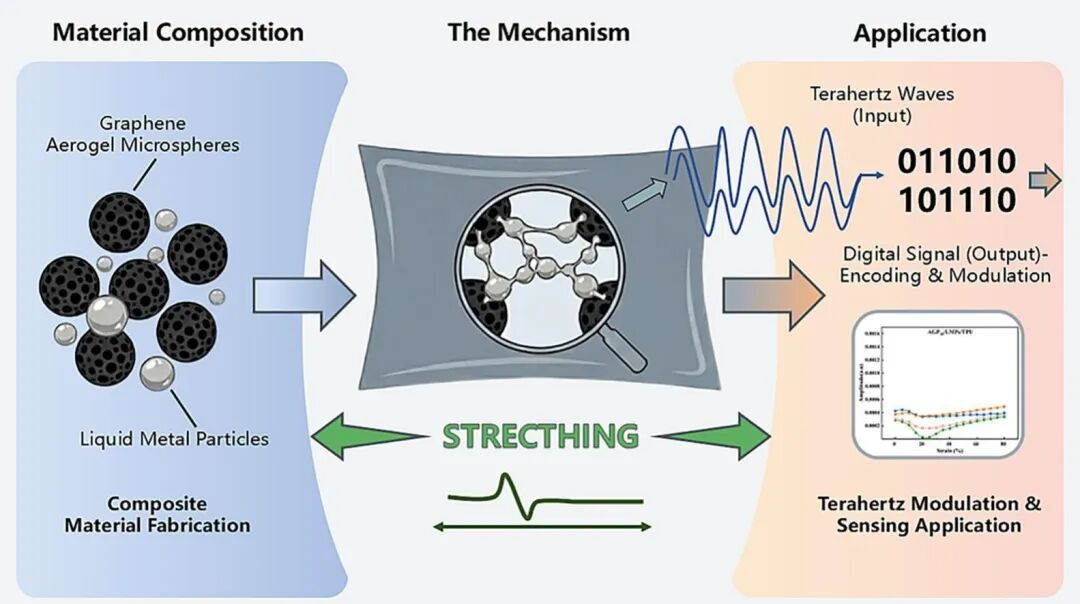
通过石墨烯气凝胶微球/液态金属复合材料机械可重构的太赫兹调制材料
The practical deployment of terahertz (THz) technology is hampered by a critical bottleneck: the scarcity of materials capable of dynamic and efficient wave manipulation. Herein, we overcome this limitation by introducing a mechanically reconfigurable graphene aerogel microsphere/liquid metal composite film, engineered via reactive wetting, that functions as an on-demand THz modulator. The core of our design lies in the marriage of graphene aerogel microspheres with eutectic gallium–indium liquid metal, creating a highly stretchable architecture within a thermoplastic polyurethane matrix. This unique structure endows the material with exceptional fracture strain exceeding 600% and strain-tunable electrical conductivity, achieving a low resistivity of 0.12 Ω·cm at 100% strain. Crucially, terahertz time-domain spectroscopy uncovers a striking, previously unreported phenomenon—reversible “V”-shaped inversion of trans mission at 0.46 and 0.53 THz in response to mechanical strain. These binary, strain-switchable trans mission states establish the foundation for a novel physical encoding mechanis m. Our work not only presents a versatile material platform for high-performance, stretchable THz devices but also unveils a direct pathway towards mechanically programmable metamaterials and THz-encoded communication systems.
太赫兹(THz)技术的实际部署受到一个关键瓶颈的阻碍:能够动态和有效地操纵波的材料的稀缺。在这里,我们通过引入一种机械可重构的石墨烯气凝胶微球/液态金属复合膜来克服这一限制,该膜通过反应性润湿设计,可作为按需太赫兹调制器。我们设计的核心在于石墨烯气凝胶微球与共晶镓铟液态金属的结合,在热塑性聚氨酯基体中创造出高度可拉伸的结构。这种独特的结构使材料具有超过600%的断裂应变和应变可调的导电性,在100%应变下实现0.12 Ω·cm的低电阻率。至关重要的是,太赫兹时域光谱揭示了一个惊人的、以前未报道过的现象——在0.46和0.53太赫兹时,响应于机械应变的可逆“V”形透射反转。这些二进制、应变可切换的传输状态为一种新的物理编码机制奠定了基础。我们的工作不仅为高性能、可拉伸的太赫兹器件提供了一个通用的材料平台,而且还揭示了通往机械可编程超材料和太赫兹编码通信系统的直接途径。
Strain rate and loading mode effects on impact response and damage evolution of pierced C/C composites: experiment and numerical simulation
Tianlei Yao, Diansen Li, Chen Li, Lei Jiang, Stepan V. Lomov, Frederik Desplentere
doi:10.1016/j.compositesa.2026.109848
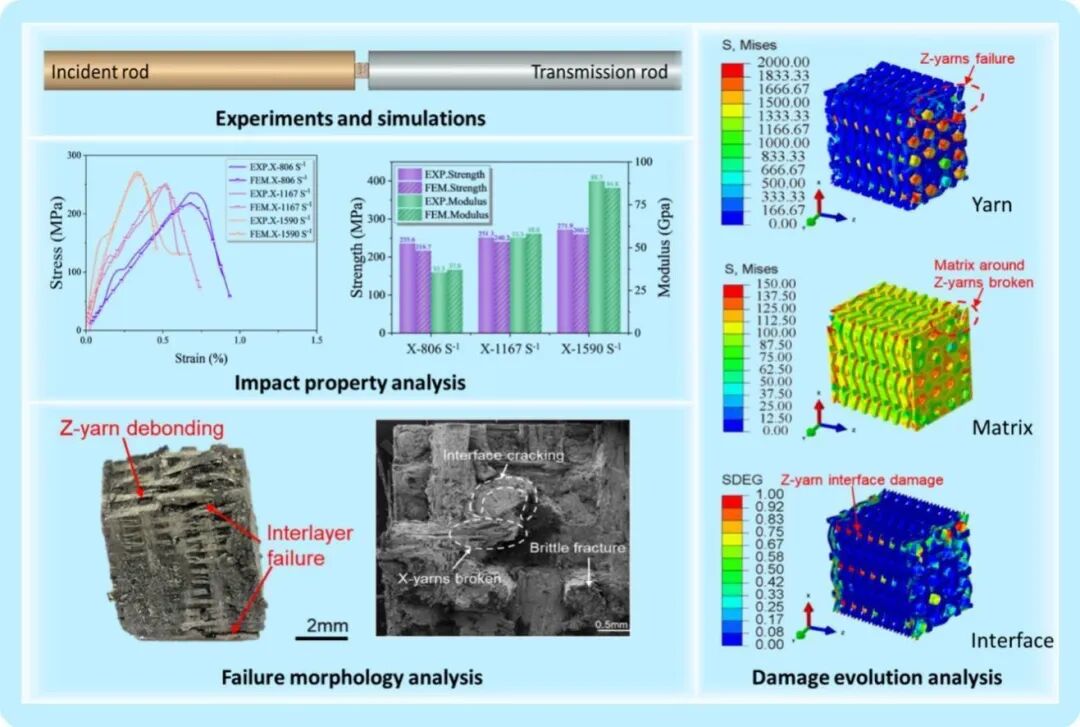
应变速率和加载方式对刺穿C/C复合材料冲击响应和损伤演化的影响:实验与数值模拟
Fine-woven needled C/C composites typically served in thermal structural components under high-load impact, where their service environment involved complex dynamic loads. In this study, the effects of strain rate and loading mode on impact performance and damage evolution mechanis ms were investigated by combining experimental and finite element methods. Results showed that the impact performance of the composites demonstrated significant strain rate dependence and anisotropy. The X-impact strength and modulus increased moderately with strain rate, which was attributed to the dense in-plane yarn. In contrast, the Z-impact exhibited a more prominent strain rate strengthening effect: at low strain rates, its performance was limited by interfacial microcracks; while at high strain rates, the straight Z-yarns enabled rapid stress trans mission, leading to Z-impact performance surpassing that of the X-impact. Strain rate and loading direction jointly influenced the damage evolution. For X-impact, damage initiated at in-plane yarn intersections and accelerated with increasing strain rate. For Z-impact, interfacial microcracks were dominant at low strain rates, whereas Z-yarn failure and shear damage became the main modes at high strain rates. The revealed strain rate dependence and anisotropy of impact performance, and the proposed finite element method provided theoretical guidance for the service application of C/C composites.
细织针状C/C复合材料通常作为高载荷冲击下的热结构部件,其使用环境涉及复杂的动态载荷。本研究采用实验与有限元相结合的方法,研究了应变速率和加载方式对冲击性能的影响以及损伤演化机制。结果表明,复合材料的冲击性能表现出明显的应变速率依赖性和各向异性。x -冲击强度和模量随着应变速率的增加而适度增加,这主要是由于面内纱的致密所致。相反,z形冲击表现出更为突出的应变速率强化效应:在低应变速率下,其性能受到界面微裂纹的限制;而在高应变率下,直z纱的应力传递速度较快,z冲击性能优于x冲击。应变速率和加载方向共同影响损伤演化。对于x向冲击,损伤始于面内纱线相交处,并随着应变速率的增加而加速。在低应变速率下,界面微裂纹是主要的破坏模式,而在高应变速率下,界面微裂纹是主要的破坏模式。揭示了C/C复合材料的应变速率依赖性和冲击性能的各向异性,提出的有限元方法为C/C复合材料的服役应用提供了理论指导。
Tribological properties of short carbon fiber reinforced porous oil-containing polyetherimide composites
Shi-Wei Liang, Yuan-Yuan Zhang, Fang-Liang Guo, Zhe-Ling Li, Yuan-Qing Li, Shao-Yun Fu
doi:10.1016/j.compositesa.2026.109847
短碳纤维增强多孔含油聚醚酰亚胺复合材料的摩擦学性能
Specialty engineering resin-based porous oil-containing materials are promising for self-lubricating components but are often hindered by inefficient preparation and poor mechanical properties. This study developed an efficient, low-cost method combining hot-pressing with a pore-forming agent to fabricate short carbon fiber (SCF)-reinforced porous polyetherimide (PEI) composites. Orthogonal experiments were conducted to systematically optimize key parameters—pore-forming agent mass fraction, size, and sintering time—for tribological performance. The optimal parameters yielded porous PEI with an oil content of 27.8–88.3 wt% and a minimum friction coefficient of approximately 0.15. To enhance mechanical properties, SCFs were then incorporated. The composite with 1 wt% SCFs demonstrated optimal mechanical performance and the s mallest wear scar width. Microstructural an alysis revealed that a low SCF content strengthened the bonding between semi-molten PEI particles, improving properties and reducing wear. However, higher SCF contents (3 or 5 wt%) caused fiber aggregation and large voids, weakening particle bonding and degrading performance. Consequently, this combined hot-pressing and pore-forming agent method presents a promising approach for manufacturing high-performance, self-lubricating porous composites from specialty engineering resins.
特种工程树脂基多孔含油材料是一种很有前途的自润滑材料,但制备效率低、力学性能差等问题阻碍了其发展。本研究开发了一种高效、低成本的方法,结合热压和成孔剂来制备短碳纤维(SCF)增强多孔聚醚酰亚胺(PEI)复合材料。通过正交试验系统优化成孔剂质量分数、粒径、烧结时间等摩擦学性能的关键参数。最佳参数得到的多孔PEI含油量为27.8 - 88.3%,最小摩擦系数约为0.15。为了提高机械性能,加入了SCFs。添加1 wt% SCFs的复合材料具有最佳的力学性能和最小的磨损疤痕宽度。微观组织分析表明,低SCF含量增强了半熔融PEI颗粒之间的结合,改善了性能,减少了磨损。然而,较高的SCF含量(3或5 wt%)会导致纤维聚集和大空隙,削弱颗粒结合和降解性能。因此,这种结合热压和成孔剂的方法为制造高性能、自润滑的特种工程树脂多孔复合材料提供了一种很有前途的方法。
MoS2 and PTFE, two competitive high performance dry lubricants for carbon fiber reinforced PPS in hydrogen compression applications
Alexander Pöllinger, Julia Thalhammer, Sarah Heupl, Fabian Wilde, Gábor Szakács, Stefan Krenn, Klaus Gebhardt, Eleni Siakkou, Thomas Koch, Vasiliki-Maria Archodoulaki, Michael Schöbel
doi:10.1016/j.compositesa.2026.109829
MoS2和PTFE,两种具有竞争力的高性能干润滑剂,用于氢气压缩应用中的碳纤维增强PPS
Efficient hydrogen compression is a critical component for the transition to renewable energy systems. High-pressure reciprocating piston compressors require advanced tribological solutions to ensure durability, reliability, and gas purity under dry-running conditions. Polyphenylene sulfide (PPS) polymer matrix composites, known for their excellent mechanical and thermal stability, are currently of high interest in research. This study compares the performance of molybdenum disulfide (MoS2) and polytetrafluoroethylene (PTFE) as dry lubricants for PPS-based piston ring materials in high-pressure hydrogen environments. This work utilizes tribological and thermo-mechanical testing, along with microstructural a nalysis, to systematically evaluate the effects of these lubricants on friction, wear, and load-bearing capacity. Advanced imaging techniques, including synchrotron tomography, reveal the role of lubricant dispersion and interaction with PPS. The findings highlight key differences in the tribological performance of MoS2 and PTFE, offering insights into their suitability for high-pressure hydrogen compressor applications. This research identifies promising material combinations that will significantly improve the reliability and efficiency of hydrogen compression.
高效的氢气压缩是向可再生能源系统过渡的关键组成部分。高压往复式活塞压缩机需要先进的摩擦学解决方案,以确保干运行条件下的耐用性、可靠性和气体纯度。聚苯硫醚(PPS)聚合物基复合材料以其优异的机械稳定性和热稳定性而备受关注。本研究比较了二硫化钼(MoS2)和聚四氟乙烯(PTFE)作为高压氢环境下pps基活塞环材料干润滑剂的性能。这项工作利用摩擦学和热机械测试,以及微观结构分析,系统地评估了这些润滑剂对摩擦、磨损和承载能力的影响。先进的成像技术,包括同步加速器断层扫描,揭示了润滑剂的分散作用和与PPS的相互作用。研究结果突出了MoS2和PTFE摩擦学性能的关键差异,为它们在高压氢气压缩机应用中的适用性提供了见解。这项研究确定了有前途的材料组合,将显著提高氢压缩的可靠性和效率。
Rapid dual-cure frontal polymerization of composites: Role of fibers and dual-initiator interactions
Sakshar Chowdhury, Martin Mangwiro, ABM Tahidul Haque, Easir Arafat Papon
doi:10.1016/j.compositesa.2026.109821
复合材料的快速双固化正面聚合:纤维的作用和双引发剂相互作用
This study introduces a novel dual-cure approach for thermoset composites, combining low-intensity UV-driven radical-induced cationic photopolymerization for partial bulk-polymerization with high-intensity UV-driven frontal polymerization for rapid curing. Front propagation dynamics and curing behavior were systematically examined as functions of initiator composition, stimulus intensity, fiber orientation, and fiber volume fraction. Experiments reveal that controlled activation of thermal initiators results in a lower thermal gradient and rapid, stable front propagation. It is also found that by regulating photo/thermal initiator activation, about 40%–50% degree of cure can be achieved during the partial-cure phase, which gradually increases the resin viscosity through the thickness and ultimately helps achieve void-free frontal polymerization independent of initiator composition. Results show that the front velocity and flexural properties are affected by initiator composition, UV intensity, and fiber volume fraction. Increasing the thermal initiator concentration and UV intensity slightly increases front velocity and flexural properties up to a certain extent, beyond which further increases have little to no effect. Fiber orientation is found to significantly affect front velocity and flexural properties. 0° fiber orientation exhibited higher front velocities, flexural strength, and modulus than those with 90° orientation. Increasing fiber volume fraction further enhanced velocity and flexural properties for 0°, while front velocity decreased for 90° with only minor changes in flexural performance. Our findings contribute to a broader understanding of dual-cure frontal polymerization of composites, with implications for energy-efficient, rapid manufacturing and on-demand composite repair applications in resource-constrained environments.
本研究介绍了一种热固性复合材料的新型双固化方法,结合了低强度紫外线驱动的自由基诱导阳离子光聚合进行部分本体聚合和高强度紫外线驱动的正面聚合进行快速固化。系统地研究了引发剂组成、刺 激强度、纤维取向和纤维体积分数对前传播动力学和固化行为的影响。实验结果表明,热引发剂的可控活化可以降低热梯度,使锋面传播迅速、稳定。还发现,通过调节光/热引发剂活化,在部分固化阶段可以达到约40%-50%的固化度,通过厚度逐渐提高树脂粘度,最终实现与引发剂成分无关的无空隙正面聚合。结果表明,引发剂组成、UV强度、纤维体积分数等因素均影响着前速度和弯曲性能。热引发剂浓度的增加和UV强度的增加在一定程度上对材料的前速度和弯曲性能有轻微的提高,超过一定程度后,进一步的增加对材料的前速度和弯曲性能几乎没有影响。发现纤维取向对前速度和弯曲性能有显著影响。0°取向的纤维比90°取向的纤维具有更高的前速度、抗弯强度和模量。增加纤维体积分数进一步提高了0°的速度和弯曲性能,而90°的前速度下降,弯曲性能变化不大。我们的研究结果有助于更广泛地理解复合材料的双固化正面聚合,对资源受限环境下的节能、快速制造和按需复合材料修复应用具有重要意义。
Composites Science and Technology
Mechanical response mechanis ms of carbon fiber reinforced poly(phthalazine ether sulfone ketone) composites based on damage mapping: From impregnation process to multiscale structural characteristics
Wenhui Zhang, Tianqi Zhu, Gang Zhao, Zhenyu Qian, Zhiyuan Ning, Xigao Jian, Liangliang Shen, Jian Xu
doi:10.1016/j.compscitech.2026.111660
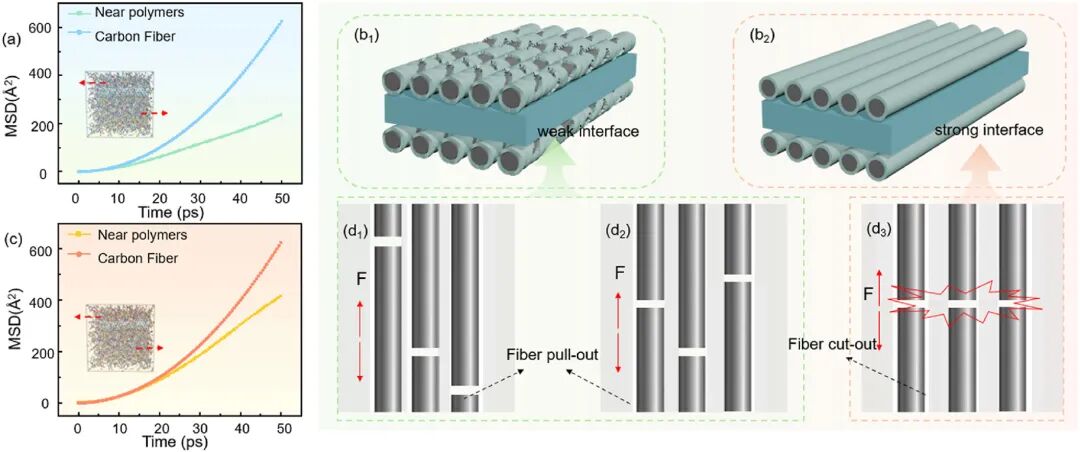
基于损伤映射的碳纤维增强聚酞嗪醚砜酮复合材料力学响应机制:从浸渍过程到多尺度结构特征
This study systematically investigates the mechanical behavior and damage evolution mechanis ms of continuous carbon fiber reinforced poly (phthalazinone ether sulfone ketone) thermoplastic composites under different impregnation concentrations and impregnation times. Static tensile and flexural experiments were conducted in combination with scanning electron microscopy characterization, macro-mesoscopic finite element an alysis, and molecular dynamics simulations, forming a comprehensive multiscale research framework. The results reveal that impregnation concentration and impregnation time jointly regulate the resin infiltration capability and interfacial continuity, thereby influencing the distribution of fiber volume fraction and the load transfer efficiency at the fiber-matrix interface. It is shown that as the impregnation concentration increases from 10% to 15% and 20%, the fiber volume fraction decreases from 70% to 60% and 50%, respectively. At a low impregnation concentration of 10%, excessive fiber volume fraction leads to insufficient resin encapsulation, whereas a moderate increase in impregnation concentration significantly improves interfacial impregnation quality, resulting in tensile strength enhancements of 38.9% and 18.2% at impregnation concentrations of 15% and 20%, respectively, compared with that at 10%. On this basis, a “chain-segment locking effect” is proposed, whereby the impregnation concentration regulates the fiber volume fraction, thereby altering the spatial confinement and mobility of resin chain segments at the interface, enhancing the effective fiber-matrix interfacial bonding and load transfer, and consequently affecting the macroscopic mechanical performance and damage characteristics of the composites.
系统研究了不同浸渍浓度和浸渍时间下连续碳纤维增强聚酞嗪醚砜酮热塑性复合材料的力学行为和损伤演化机制。静态拉伸和弯曲实验结合扫描电镜表征、宏观细观有限元分析和分子动力学模拟,形成了一个全面的多尺度研究框架。结果表明,浸渍浓度和浸渍时间共同调节树脂的渗透能力和界面连续性,从而影响纤维体积分数的分布和纤维-基体界面的载荷传递效率。结果表明,随着浸渍浓度从10%增加到15%和20%,纤维体积分数分别从70%降低到60%和50%。在低浸渍浓度为10%时,纤维体积分数过高导致树脂包封不足,而适度提高浸渍浓度可显著改善界面浸渍质量,浸渍浓度为15%和20%时,界面抗拉强度较浸渍浓度为10%时分别提高38.9%和18.2%。在此基础上,提出了“链段锁紧效应”,即浸渍浓度调节纤维体积分数,从而改变树脂链段在界面处的空间约束和迁移率,增强纤维-基体界面的有效结合和载荷传递,从而影响复合材料的宏观力学性能和损伤特征。
Constructing a Robust Triple-Interaction Network for High-Performance Bio-based Epoxidized Natural Rubber/Silica Nanocomposites via Synergistic Two-step Silica Modification
Zixuan Wang, Ruoyu Wang, Weixiao Song, Xiaohui Wu, Guo-Hua Hu, Liqun Zhang
doi:10.1016/j.compscitech.2026.111659
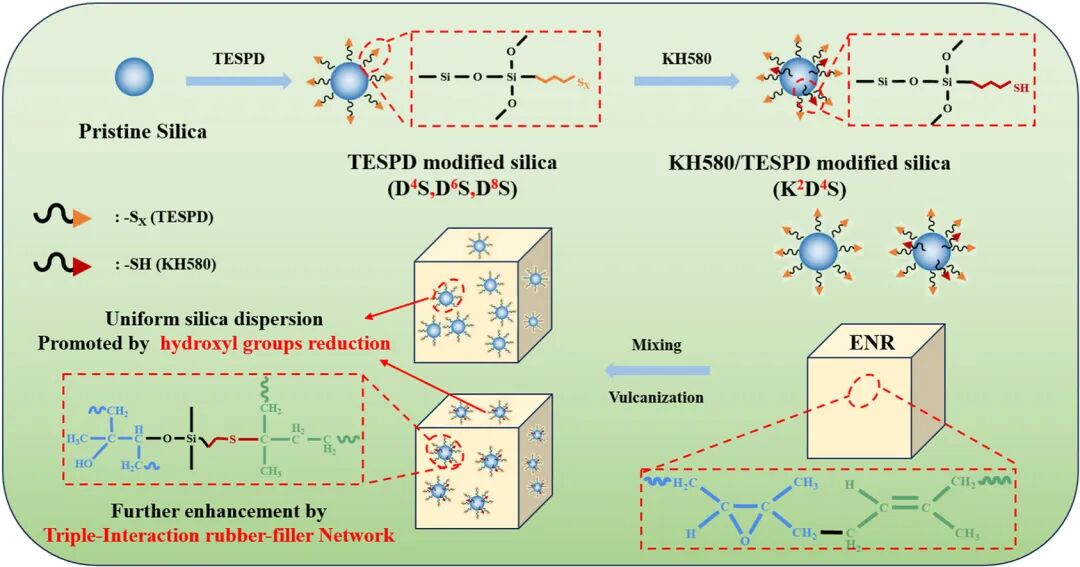
通过两步二氧化硅协同改性构建高性能生物基环氧化天然橡胶/二氧化硅纳米复合材料的鲁棒三相互作用网络
The dispersion of fillers is crucial for the mechanical performance of rubber products. Typically, Silane Coupling Agents (SCAs) are added to the rubber matrix together with silica, relying on high temperature and mechanical shearing for simultaneous surface modification and dispersion. However, this in-situ method often yields uncontrollable modification degrees and poor dispersion efficiency. To address this issue, a two-step silica surface-modification strategy using SCAs was developed, and the modification mechanis m was systematically investigated. First, Bis-(γ-triethoxysilylpropyl)-disulfide (TESPD) was grafted on the silica surface via a condensation reaction between hydrolyzed TESPD and surface hydroxyl groups to prepare TESPD-silica. Subsequently, the TESPD-silica was further modified with γ-Mercaptopropyltrimethoxysilane (KH580) to obtain TESPD-silica-KH580. The successful grafting of the coupling agents was confirmed by FTIR, TGA, and surface hydroxyl group an alysis. Compared with TESPD-silica, TESPD-silica-KH580 exhibited the lowest surface hydroxyl content and the most improved dispersion behavior. On this basis, Epoxidized Natural Rubber (ENR) nanocomposites were prepared with different types and loadings of modified silica, demonstrating improved filler dispersion and static/dynamic mechanical properties. Among them, TESPD-silica-KH580 showed the best comprehensive performance. This is attributed to its ability to act as a coupling bridge between double bonds and epoxy groups via its surface thiol and silanol groups, forming a triple-interaction rubber-filler network. This structure promotes the formation of a robust triple-interaction rubber-filler network, thereby significantly enhancing the overall performance of the nanocomposites.
填料的分散性对橡胶制品的机械性能起着至关重要的作用。通常,硅烷偶联剂(SCAs)与二氧化硅一起添加到橡胶基体中,依靠高温和机械剪切同时进行表面改性和分散。但这种原位方法的改性程度往往不可控,分散效率较差。为解决这一问题,提出了一种两步改性硅石表面的策略,并对改性机理进行了系统的研究。首先,将水解后的双-(γ-三乙氧基硅丙基)二硫化物(TESPD)与表面羟基缩合反应接枝到二氧化硅表面,制备TESPD-二氧化硅。随后,用γ-巯基丙基三甲氧基硅烷(KH580)对TESPD-silica进行进一步改性,得到TESPD-silica-KH580。通过红外光谱(FTIR)、热重分析仪(TGA)和表面羟基分析证实了偶联剂的接枝成功。与tespd -二氧化硅相比,tespd -二氧化硅- kh580的表面羟基含量最低,分散性改善最大。在此基础上,制备了不同类型和负载的改性二氧化硅的环氧化天然橡胶(ENR)纳米复合材料,证明了填料分散性和静动态力学性能的改善。其中,TESPD-silica-KH580综合性能最好。这是由于它能够通过其表面的硫醇和硅醇基团作为双键和环氧基之间的偶联桥梁,形成三重相互作用的橡胶填充网络。这种结构促进了坚固的三相互作用橡胶填料网络的形成,从而显著提高了纳米复合材料的整体性能。