【新文速递】2025年11月25日复合材料SCI期刊最新文章
今日更新:Composite Structures 2 篇,Composites Part A: Applied Science and Manufacturing 2 篇,Composites Part B: Engineering 2 篇,Composites Science and Technology 1 篇
Composite Structures
Carbon nanotube/thick-walled polymethacrylimide foam core with enhanced mechanical and electromagnetic properties for radar absorbing sandwich structures
Yeon Hwa Jeong, Seung Woo Kang, Seung Cheol Shin, Jae Wook Kim, Sang Eui Lee
doi:10.1016/j.compstruct.2025.119879
具有增强机械和电磁性能的碳纳米管/厚壁聚甲基丙烯酰亚胺泡沫芯,用于雷达吸收夹层结构
Carbon nanotube (CNT)/polymethacrylimide foam core with thick cell walls (TWPMI) was proposed as radar absorbing core material. The relationship between the cellular structure, and the mechanical and electromagnetic performance of CNT/TWPMI foam core was investigated by controlling polymerization temperature and CNT loading. Higher polymerization temperatures led to larger cell size with thicker cell walls. The specific compressive modulus was 1.15 times higher, and the specific compressive strength was 1.75 times higher than that of low polymerization temperature. In addition, CNTs enhanced the compressive modulus to 55.6 MPa and the compressive strength to 3.28 MPa in 2 wt% CNT/TWPMI. Due to the synergistic effect of the TWPMI structure and CNTs, the electromagnetic properties were significantly improved, achieving a real part of permittivity of 4.37 and a loss tangent of 0.89 at 2 wt% CNT/TWPMI. As a result, the rigid CNT/TWPMI foam core with excellent radar absorbing performance was developed. The optimized radar-absorbing structure, designed using a genetic algorithm, exhibited a thickness of 6.2 mm and a density of 0.32 g/cm3 without a carbon fiber reinforced polymer (CFRP) back plate, and 0.43 g/cm3 with the back plate, achieving over 90 % absorption in the X-band.
提出了厚壁碳纳米管(CNT)/聚甲基丙烯酰亚胺泡沫芯作为雷达吸波芯材料。通过控制聚合温度和碳纳米管负载,研究了碳纳米管/TWPMI泡沫芯的细胞结构与力学性能和电磁性能的关系。较高的聚合温度导致细胞尺寸更大,细胞壁更厚。比压缩模量比聚合温度低时提高1.15倍,比压缩强度比聚合温度低时提高1.75倍。此外,在2 wt% CNT/TWPMI中,CNTs将抗压模量提高到55.6 MPa,抗压强度提高到3.28 MPa。由于TWPMI结构和CNTs的协同作用,电磁性能得到了显著改善,在2 wt% CNT/TWPMI时,其介电常数实部为4.37,损耗正切为0.89。研制出了具有优异吸波性能的硬质CNT/TWPMI泡沫芯材。优化后的吸波结构采用遗传算法设计,无碳纤维增强聚合物(CFRP)背板时的吸波结构厚度为6.2 mm,密度为0.32 g/cm3,有碳纤维增强聚合物(CFRP)背板时的吸波结构密度为0.43 g/cm3, x波段吸波率达90% %以上。
Damage modeling of high-crimp carbon/phenolic woven composites incorporating weft yarn straightening-induced matrix cracking
Sang Kyu Seo, Dae-Han Cheon, Kwangbok Shin, Jin-Sung Kim, Seong Su Kim
doi:10.1016/j.compstruct.2025.119888
含纬纱矫直诱导基体开裂的高卷曲碳/酚醛机织复合材料损伤建模
Carbon/phenolic (CP) composites, particularly rayon-based CP woven composites, are widely utilized in aircraft and rocket engine nozzles due to their excellent thermal resistance. However, existing progressive damage models cannot adequately capture the unique failure mechanis ms in high-crimp rayon-based fabrics. This study introduces a novel weft yarn straightening matrix cracking failure mode, motivated by experimental observations, to capture matrix cracking and modulus transformation induced by high crimp (crimp angle 40°, crimp ratio 9.1 %). Unlike existing models, this mode distinctly explains the coupled mechanis m of weft-direction modulus transformation and through-thickness degradation. The proposed model incorporates plasticity theory and continuum damage mechanics to capture the gradual load transfer mechanis m during fiber straightening. Material properties were determined through comprehensive mechanical testing, and three-point bending validation was performed on both on-axis and 45° off-axis specimens. For on-axis tests, predicted values were 616.2 N and 1,429mJ versus experimental 608.3 N and 1,510mJ. For 45° off-axis tests, predicted values were 299.1 N and 1,365mJ versus experimental 300.7 N and 1,311mJ. The proposed model exhibits accuracy and superior performance compared to existing approaches, particularly for composites with high fiber crimp.
碳/酚醛(CP)复合材料,特别是人造丝基CP机织复合材料,由于其优异的耐热性,在飞机和火箭发动机喷管中得到了广泛的应用。然而,现有的渐进式损伤模型不能充分捕捉高卷曲人造丝织物的独特破坏机制。本文根据实验观察,提出了一种新的纬纱矫直矩阵开裂失效模式,以捕捉高卷曲(卷曲角40°,卷曲比9.1 %)引起的矩阵开裂和模量变化。与现有模型不同的是,该模型清晰地解释了纬向模量变换和透厚退化的耦合机理。该模型结合了塑性理论和连续损伤力学,捕捉了纤维矫直过程中载荷的逐渐传递机制。通过综合力学测试确定材料性能,并对轴向和45°离轴试样进行三点弯曲验证。轴上试验的预测值为616.2 N和1,429mJ,而实验值为608.3 N和1,510mJ。对于45°离轴试验,预测值为299.1 N和1365 mj,而实验值为300.7 N和1311 mj。与现有方法相比,所提出的模型具有准确性和优越的性能,特别是对于具有高纤维卷曲的复合材料。
Composites Part A: Applied Science and Manufacturing
Achieving exceptional strength-ductility synergy in titanium matrix composites via controllable bimodal grain structure and configuration of nano-reinforcements
Shaopeng Li, Fu Chen, Zhipeng Li, Shan Xiao, Meiqi Wang, Zichao Wei, Jianwen Le, Xiangming Wang, Di Zhang, Weijie Lu, Yuanfei Han
doi:10.1016/j.compositesa.2025.109454
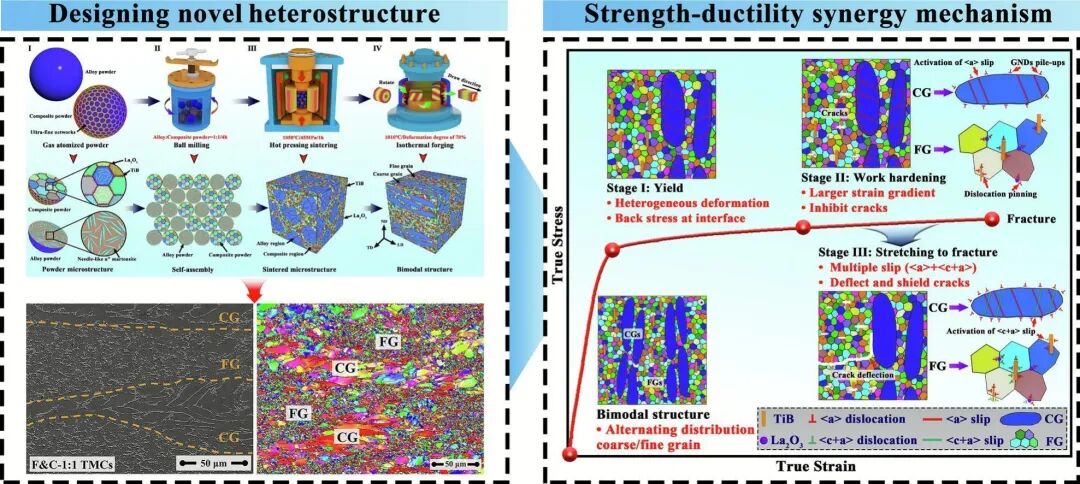
通过可控的双峰晶粒结构和纳米增强材料的配置,在钛基复合材料中实现卓越的强度-延性协同作用
Combining nano-reinforcements with heterogeneous grain structure is a promising strategy for overcoming the strength-ductility trade-off in titanium matrix composites (TMCs). In this study, we developed a unique heterostructure with alternating alloy and composite bands, containing equiaxed fine grains (FGs) embedded with nano-(TiB + La2O3) particles and lamellar coarse grains (CGs), using an innovative powder-assembly and thermal-deformation strategy. The hetero-structured (TiB + La2O3)/IMI834 composite achieved remarkable mechanical properties, exhibiting an ultimate tensile strength (UTS) of 1292 MPa and a fracture elongation of 9.8 % at room temperature, and a UTS of 860 MPa at 600℃. The strength enhancement was attributed to the hetero-deformation induced (HDI) strengthening caused by geometrically necessary dislocations density gradients near the CGs/FGs interfaces and the obstruction of dislocation motion by nano-reinforcements. Meanwhile, multiple slip in CGs, arising from the interaction between basal/pris matic < a > slip and HDI stress-induced pyramidal < c + a > slip, together with the activation of extra < c + a > dislocations in FGs, effectively coordinated deformation and generated extra strain hardening. Additionally, CGs with high deformability deflected and shielded cracks, and absorbed more strain, enhancing crack resistance and maintaining good ductility. This work provides a feasible strategy for designing and fabricating novel hetero-structured TMC with superior strength-ductility synergy.
结合非均相晶粒结构的纳米增强材料是克服钛基复合材料强度-延性平衡的一种很有前途的方法。在这项研究中,我们开发了一种独特的异质结构,具有交替的合金和复合带,包含嵌入纳米(TiB + La2O3)颗粒的等轴细晶粒(fg)和层状粗晶粒(CGs),使用创新的粉末组装和热变形策略。异质结构(TiB + La2O3)/IMI834复合材料具有优异的力学性能,室温下的极限抗拉强度(UTS)为1292 MPa,断裂伸长率为9.8 %,600℃下的UTS为860 MPa。强度增强是由于几何上必需的位错密度梯度和纳米增强剂对位错运动的阻碍引起的异质变形诱导(HDI)强化。同时,多个滑CGs因基底之间的交互/移动 < > 滑动和人类发展指数应激锥体 < c + > 滑,加上额外的激活 < c + > 混乱在投篮,有效地协调变形和产生额外的应变硬化。此外,具有高变形能力的碳纤维对裂纹进行了偏转和屏蔽,吸收了更多的应变,增强了抗裂性,保持了良好的延性。本研究为设计和制造具有良好强度-延性协同作用的新型异质结构TMC提供了可行的策略。
Enhancing accuracy in CFRP forming simulations: investigating the impact of variable friction coefficients using finite element method
Manseok Yoon
doi:10.1016/j.compositesa.2025.109457
提高CFRP成形模拟的精度:利用有限元方法研究可变摩擦系数的影响
In the industrial field, preform forming simulations for Carbon Fiber Reinforced Plastic (CFRP) manufacturing generally assume that friction coefficients do not significantly affect simulation results and therefore use constant approximate values. However, there is no evidence to support this assumption. To verify its validity, a preliminary study was conducted. Previous research has reported that the difference between dynamic and static friction coefficients can influence simulations. However, when friction coefficients are assumed to be constant, this difference remains around 0.02–0.03 for any type of fabric, suggesting that the assumption made in the industry may be reasonable. In actual forming processes, however, variations in load during draping and forming alter the actual contact area between fabric layers or between the fabric and the mold, leading to changes in friction coefficients. Consequently, the difference between static and dynamic friction coefficients can also vary and may become significant enough to affect simulation results. Therefore, verification of this effect was necessary. This study investigates the influence of friction coefficient variability on the difference between static and dynamic friction coefficients and its impact on forming simulations. When variable friction coefficients were applied, the difference between static and dynamic friction coefficients increased, leading to a threefold increase in fabric deflection during draping, from 2.57 mm to 9.30 mm. Additionally, the maximum shear angle increased by approximately 24.5 % in 1st ply, while the changes were relatively s maller at 6.5 % in 6th ply and 4.1 % in 4th ply. Comparisons with actual forming results confirmed that incorporating variable friction coefficients improved prediction accuracy, particularly by 67.3 % in deflection and 50.0 % in shear angle.
在工业领域,碳纤维增强塑料(CFRP)制造的预成形模拟通常假设摩擦系数对模拟结果没有显著影响,因此使用恒定的近似值。然而,没有证据支持这一假设。为了验证其有效性,进行了初步研究。先前的研究已经报道了动静摩擦系数之间的差异会影响模拟。然而,当摩擦系数被假设为恒定时,这种差异对于任何类型的织物都保持在0.02-0.03左右,这表明行业中的假设可能是合理的。 然而,在实际成型过程中,悬垂和成型过程中载荷的变化会改变织物层之间或织物与模具之间的实际接触面积,从而导致摩擦系数的变化。因此,静摩擦系数和动摩擦系数之间的差异也可以变化,并且可能变得足够显著,从而影响模拟结果。因此,有必要核实这种影响。本文研究了摩擦系数变化对静、动摩擦系数差异的影响及其对成形模拟的影响。 当使用可变摩擦系数时,静摩擦系数和动摩擦系数之间的差异增大,导致悬垂时织物挠度增加三倍,从2.57 mm增加到9.30 mm。最大剪切角在第1层增加了约24.5% %,第6层和第4层的变化相对较小,分别为6.5 %和4.1 %。与实际成形结果的比较证实,加入可变摩擦系数提高了预测精度,特别是挠度提高了67.3% %,剪切角提高了50.0% %。
Composites Part B: Engineering
Boosting Magnesium Sulfide Reaction Through Organosulfide Redox Mediator for High Performance Mg–S Batteries
Yingying Yao, Yang Zhan, Xinlong Xie, Yingyan Zhao, Yinghui Li, Richard M. Laine, Jianxin Zou
doi:10.1016/j.composites b.2025.113214
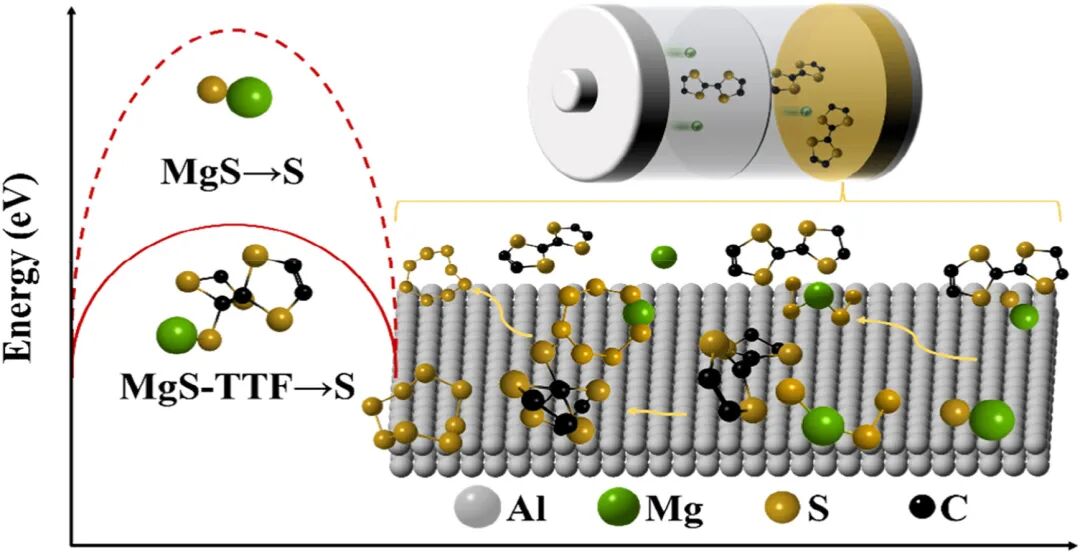
有机硫化物氧化还原介质促进高性能镁硫电池的硫化镁反应
Mg-S batteries are promising next-generation energy storage systems owing to their high energy density and low cost, while facing challenges from irreversible inert product formation and poor electrode/electrolyte compatibility. To address these issues, tetrathiafulvalene (TTF) was chosen as a multifunctional electrolyte additive to optimize Mg–S batteries synergistically. At the anode, TTF helps construct an organic-inorganic composite interphase layer during cycling, which mitigates effectively the continuous accumulation of MgF2 and promotes uniform nanoscale Mg deposition. Consequently, Mg||Mg symmetric cells demonstrated 1000 h long-term cycling stability with TTF-containing electrolyte. At the cathode, the TTF additive enhances sulfur redox kinetics. An alysis confirms that during discharge, S8 combines with Mg2+ to form long-chain magnesium polysulfides (MgPS), which subsequently reduce to short-chain MgPS (S42− and S3−) and stabilize through compound formation with TTF. During charging, TTF acts as an electron bridge to facilitate MgS oxidation, increasing sulfur’s reversible oxidation efficiency from ∼13 to ∼90%. Mg–S batteries using 0.1 M TTF-containing electrolyte maintain reversible capacities of ∼400 mAh·g−1 after 200 cycles at 335 mAh·g−1, whereas those with TTF free electrolyte exhibit rapid capacity decay to ∼160 mAh·g-1 after 100 cycles. Such interface modulation provides a novel paradigm for developing high-performance Mg–S batteries.
由于具有高能量密度和低成本的优势,镁硫电池有望成为下一代储能系统,但其面临着不可逆惰性产物形成以及电极/电解质兼容性差的挑战。为解决这些问题,四硫富瓦烯(TTF)被选作多功能电解质添加剂,以协同优化镁硫电池性能。在阳极,TTF 在循环过程中有助于构建有机-无机复合界面层,有效抑制了 MgF2 的持续积累,并促进纳米级镁的均匀沉积。因此,使用含 TTF 电解质的镁-镁对称电池表现出 1000 小时的长期循环稳定性。在阴极,TTF 添加剂增强了硫的氧化还原动力学。分析表明,在放电过程中,S8 与 Mg2+ 结合形成长链镁多硫化物(MgPS),随后还原为短链 MgPS(S42− 和 S3−),并通过与 TTF 形成化合物而稳定。在充电过程中,TTF 作为电子桥促进 MgS 氧化,使硫的可逆氧化效率从约 13% 提高到约 90%。使用含 0.1 摩尔每升 TTF 电解液的镁硫电池在 335 毫安时每克的电流密度下循环 200 次后仍能保持约 400 毫安时每克的可逆容量,而使用不含 TTF 电解液的电池在循环 100 次后容量迅速衰减至约 160 毫安时每克。这种界面调节为开发高性能镁硫电池提供了一种新的范例。
A Comprehensive Review on Energy-Absorbing Mechanical Metamaterials: From Mechanis ms to Applications
Shu Li, Weijia Zhang, Siqi Ding, Jiahao Lu, Yi-Qing Ni
doi:10.1016/j.composites b.2025.113222
吸能机械超材料研究综述:从机理到应用
Energy absorption (EA) is critical for enhancing the safety and resilience of modern structural systems, particularly under impact and dynamic loading conditions. Mechanical metamaterials (MMs), which derive their exceptional mechanical responses from their architected topology rather than their constituent materials, offer a transformative paradigm for energy dissipation. Focusing on energy-absorbing mechanical metamaterials (EA-MMs), this review covers four key aspects: fundamental mechanis ms, advanced manufacturing, structural design, and engineering applications. The fundamental principles and evaluation metrics of energy dissipation are first discussed, followed by advanced manufacturing techniques enabling the realization of EA-MMs. At the core of this review is a systematic a nalysis of EA-MM configurations, including cellular, pentamode, origami/kirigami, and fractal architectures, which highlights their structural innovations, deformation modes, and EA performance. Furthermore, recent advances in AI-enabled design and optimization of EA-MMs are summarized. In addition, emerging applications of EA-MMs in civil infrastructure, transportation, aerospace, and protective systems are highlighted. Finally, a critical discussion of current challenges is provided, such as design complexity, scalable fabrication, and multifunctional integration as well as promising directions for next-generation EA-MMs. By integrating theory, fabrication, and application-driven design, this review aims to provide a comprehensive roadmap and accelerate the implementation of robust, high-performance EA-MMs in impact-critical and EA-demanding engineering systems.
能量吸收(EA)对于提升现代结构系统的安全性和韧性至关重要,尤其是在冲击和动态载荷条件下。机械超材料(MMs)因其独特的拓扑结构而非组成材料而展现出卓越的机械响应,为能量耗散提供了一种变革性的范例。本文聚焦于能量吸收机械超材料(EA-MMs),涵盖了四个关键方面:基本机制、先进制造、结构设计和工程应用。首先讨论了能量耗散的基本原理和评估指标,接着介绍了实现 EA-MMs 的先进制造技术。本文的核心是对 EA-MM 配置的系统分析,包括蜂窝、五模、折纸/剪纸和分形架构,突出了它们的结构创新、变形模式和 EA 性能。此外,还总结了 EA-MMs 在人工智能辅助设计和优化方面的最新进展。此外,还重点介绍了电活性材料在土木基础设施、交通运输、航空航天和防护系统中的新兴应用。最后,对当前面临的挑战进行了批判性讨论,例如设计复杂性、可扩展制造以及多功能集成等,同时也指出了下一代电活性材料的有前景的发展方向。通过将理论、制造和应用驱动的设计相结合,本综述旨在提供一份全面的路线图,并加速在冲击关键和电活性需求工程系统中实施稳健、高性能的电活性材料。
Composites Science and Technology
Designed core@double-shell KTN@Ag@cPS nanoparticles for regulation of dielectric properties and energy storage enhancement of PVDF-based composites
Gaoru Chen, Chuanjie Lin, Wanbo Liu, Bo Chen, Xiaogan Zheng, Shilei Wang, Haowei Lu, Xuan Wang
doi:10.1016/j.compscitech.2025.111461
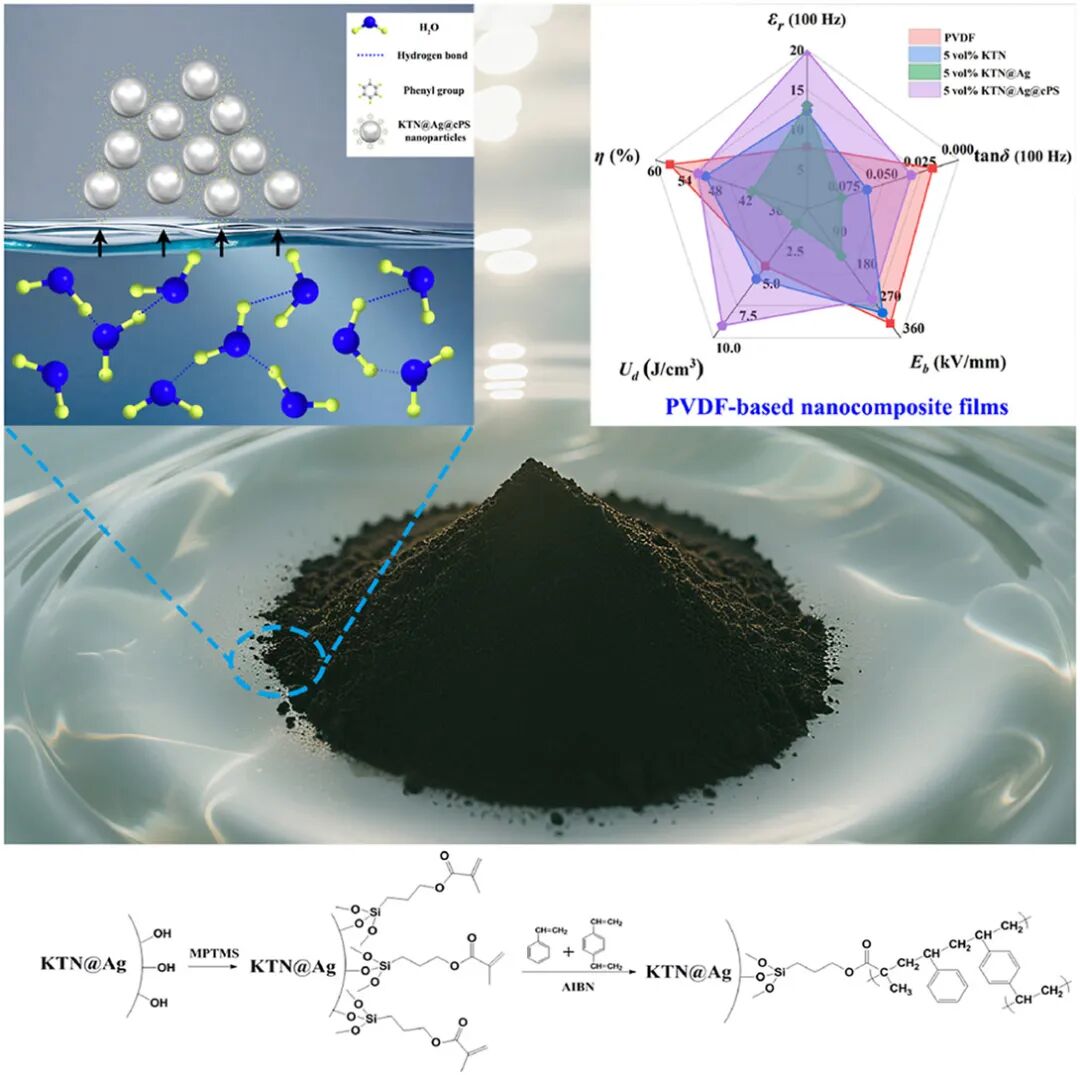
设计core@double-shell KTN@Ag@cPS纳米颗粒用于调节pvdf基复合材料的介电性能和增强储能
To address the trade-off among dielectric constant, dielectric loss, and breakdown strength in polymer-based composites and to achieve nanocomposite films with both high discharged energy density and high energy storage efficiency, core@double-shell structured KTN@Ag@cPS nanoparticles were designed and incorporated into a PVDF matrix. The KTN core imparts excellent frequency stability to the dielectric constant of nanocomposite films. The Ag shell can generates abundant interfacial polarization, thereby effectively enhancing the overall polarization intensity. The insulating cross-linked polystyrene (cPS) outer shell suppresses charge carriers migration, which reduces dielectric loss and improves breakdown strength. At a filler loading of 5 vol%, the KTN@Ag@cPS/PVDF nanocomposite film exhibits a high relative dielectric constant of 19.85 and a low loss tangent of 3.1×10⁻² at 100 Hz. Under an electric field of 250 kV/mm, the discharged energy density reaches 9.05 J/cm3. The overall performance surpasses that of both KTN/PVDF and KTN@Ag/PVDF nanocomposite films. This core@double-shell nanoparticle design provides an effective strategy for the development of composite films for high-energy-density capacitors.
为了解决聚合物基复合材料中介电常数、介电损耗和击穿强度之间的平衡问题,并实现具有高放电能量密度和高储能效率的纳米复合膜,我们设计了core@double-shell结构KTN@Ag@cPS纳米颗粒,并将其纳入PVDF基质中。KTN芯对纳米复合薄膜的介电常数具有良好的频率稳定性。Ag壳层可以产生丰富的界面极化,从而有效地提高了整体极化强度。绝缘性 交联聚苯乙烯(cPS)外壳抑制载流子迁移,降低介电损耗,提高击穿强度。当填充量为5 vol%时,KTN@Ag@cPS/PVDF纳米复合膜在100 Hz时具有19.85的高相对介电常数和3.1×10⁻²的低损耗正切。在250kv /mm电场下,放电能量密度达到9.05 J/cm3。整体性能优于KTN/PVDF和KTN@Ag/PVDF纳米复合膜。这种core@double-shell纳米颗粒设计为高能量密度电容器复合薄膜的开发提供了一种有效的策略。