
Deal.ii到底能不能使用四面体网格?

for (const unsigned int i : fe_values.dof_indices()){const unsigned int component_i =fe.system_to_component_index(i).first;for (const unsigned int j : fe_values.dof_indices()){const unsigned int component_j =fe.system_to_component_index(j).first;for (const unsigned int q_point :fe_values.quadrature_point_indices()){cell_matrix(i, j) +=((fe_values.shape_grad(i, q_point)[component_i] *fe_values.shape_grad(j, q_point)[component_j] *lambda_values[q_point])+(fe_values.shape_grad(i, q_point)[component_j] * //fe_values.shape_grad(j, q_point)[component_i] * //mu_values[q_point])+((component_i == component_j) ?(fe_values.shape_grad(i, q_point) *fe_values.shape_grad(j, q_point) *mu_values[q_point]) :0)) *fe_values.JxW(q_point);}}}
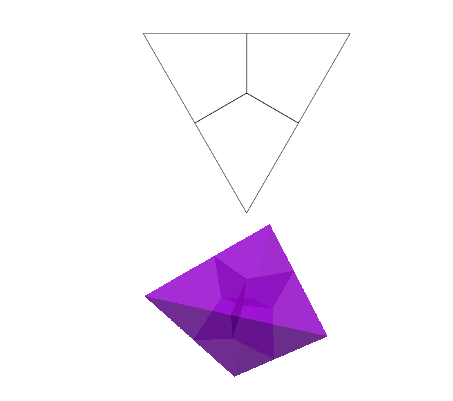
template<int dim>void GridGenerator::simplex(Triangulation< dim, dim > &tria,const std::vector< Point< dim > > &vertices )
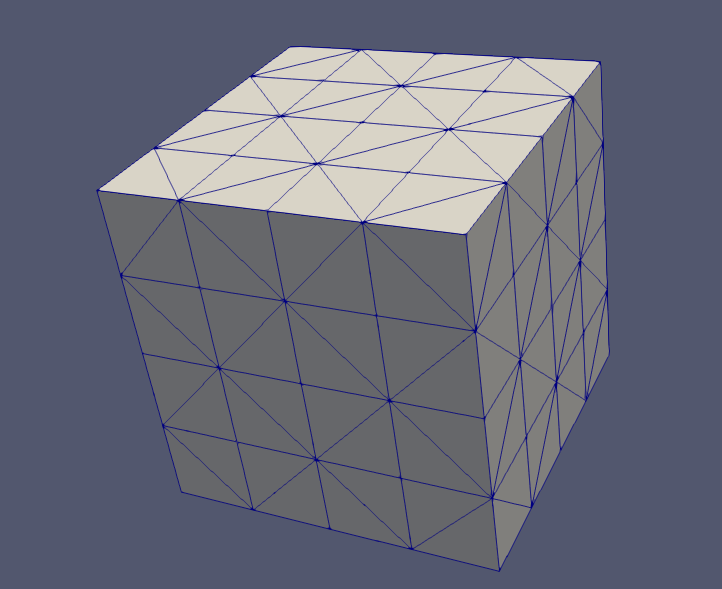
using namespace dealii;int main(){Triangulation<3> tria;GridGenerator::subdivided_hyper_cube_with_simplices(tria, 4,0.0,1.0);GridOut grid_out;std::ofstream out(“simplex.vtk”);grid_out.write_vtk(tria, out);return 0;}
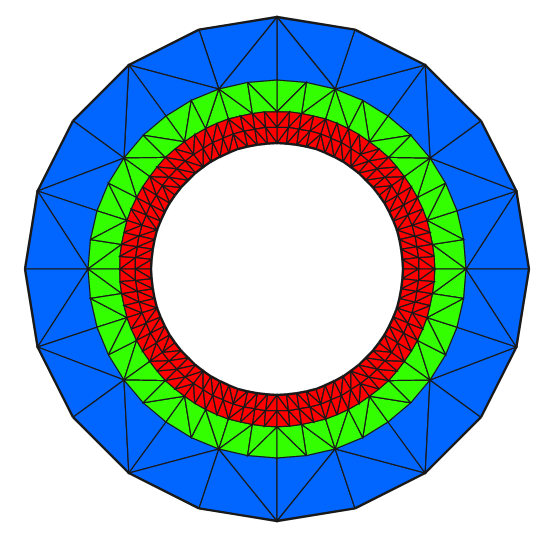
/* ------------------------------------------------------------------------** SPDX-License-Identifier: LGPL-2.1-or-later* Copyright (C) 2021 - 2024 by the deal.II authors** This file is part of the deal.II library.** Part of the source code is dual licensed under Apache-2.0 WITH* LLVM-exception OR LGPL-2.1-or-later. Detailed license information* governing the source code and code contributions can be found in* LICENSE.md and CONTRIBUTING.md at the top level directory of deal.II.** ------------------------------------------------------------------------** <br>** <i>* This program was contributed by Peter Munch. This work and the required* generalizations of the internal data structures of deal.II form part of the* project "Virtual Materials Design" funded by the Helmholtz Association of* German Research Centres.* </i>*** <a name="Intro"></a>* <h1>Introduction</h1>** <h3>Motivation</h3>** Many freely available mesh-generation tools produce meshes that consist of* simplices (triangles in 2d; tetrahedra in 3d). The reason for this is that* generating such kind of meshes for complex geometries is simpler than the* generation of hex-only meshes. This tutorial shows how to work on such kind* of meshes with the experimental simplex features in deal.II. For this* purpose, we solve the Poisson problem from @ref step_3 "step-3" in 2d with a mesh only* consisting of triangles.*** <h3>Working on simplex meshes</h3>** To be able to work on simplex meshes, one has to select appropriate finite* elements, quadrature rules, and mapping objects. In @ref step_3 "step-3", we used FE_Q,* QGauss, and (implicitly by not specifying a mapping) MappingQ1. The* equivalent classes for the first two classes in the context of simplices are* FE_SimplexP and QGaussSimplex, which we will utilize here. For mapping* purposes, we use the class MappingFE, which implements an isoparametric* mapping. We initialize it with an FE_SimplexP object so that it can be* applied on simplex meshes.*** <h3>Mesh generation</h3>** In contrast to @ref step_3 "step-3", we do not use a function from the GridGenerator* namespace, but rather read an externally generated mesh. For this tutorial,* we have created the mesh (square with width and height of one) with Gmsh with* the following journal file "box_2D_tri.geo":** @code* Rectangle(1) = {0, 0, 0, 1, 1, 0};* Mesh 2;* Save "box_2D_tri.msh";* @endcode** The journal file can be processed by Gmsh generating the actual mesh with the* ending ".geo":** @code* gmsh box_2D_tri.geo* @endcode** We have included in the tutorial folder both the journal file and the mesh* file in the event that one does not have access to Gmsh.** The mesh can be simply read by deal.II with methods provided by the GridIn* class, as shown below.**/// @sect3{Include files}// Include files, as used in @ref step_3 "step-3":<deal.II/base/function.h><deal.II/dofs/dof_handler.h><deal.II/dofs/dof_tools.h><deal.II/fe/fe_values.h><deal.II/grid/tria.h><deal.II/lac/dynamic_sparsity_pattern.h><deal.II/lac/full_matrix.h><deal.II/lac/precondition.h><deal.II/lac/solver_cg.h><deal.II/lac/sparse_matrix.h><deal.II/lac/vector.h><deal.II/numerics/data_out.h><deal.II/numerics/matrix_tools.h><deal.II/numerics/vector_tools.h><fstream><iostream>// Include files that contain appropriate quadrature rules, finite elements,// and mapping objects for simplex meshes.<deal.II/base/quadrature_lib.h><deal.II/fe/fe_simplex_p.h><deal.II/fe/mapping_fe.h>// The following file contains the class GridIn, which allows us to read// external meshes.<deal.II/grid/grid_in.h>using namespace dealii;// @sect3{The <code>Step3</code> class}//// This is the main class of the tutorial. Since it is very similar to the// version from @ref step_3 "step-3", we will only point out and explain the relevant// differences that allow to perform simulations on simplex meshes.class Step3{public:Step3();void run();private:void make_grid();void setup_system();void assemble_system();void solve();void output_results() const;Triangulation<2> triangulation;// Here, we select a mapping object, a finite element, and a quadrature rule// that are compatible with simplex meshes.const MappingFE<2> mapping;const FE_SimplexP<2> fe;const QGaussSimplex<2> quadrature_formula;DoFHandler<2> dof_handler;SparsityPattern sparsity_pattern;SparseMatrix<double> system_matrix;Vector<double> solution;Vector<double> system_rhs;};// @sect4{Step3::Step3}//// In the constructor, we set the polynomial degree of the finite element and// the number of quadrature points. Furthermore, we initialize the MappingFE// object with a (linear) FE_SimplexP object so that it can work on simplex// meshes.Step3::Step3(): mapping(FE_SimplexP<2>(1)), fe(2), quadrature_formula(3), dof_handler(triangulation){}// @sect4{Step3::make_grid}//// Read the external mesh file "box_2D_tri.msh" as in @ref step_3 "step-3".void Step3::make_grid(){GridIn<2>(triangulation).read("box_2D_tri.msh");std::cout << "Number of active cells: " << triangulation.n_active_cells()<< std::endl;}// @sect4{Step3::setup_system}//// From here on, nothing has changed. Not even, the// cell integrals have been changed depending on whether one operates on// hypercube or simplex meshes. This is astonishing and is possible due to the// design of the following two classes:// - DoFHandler: this class stores degrees of freedom in a flexible way and// allows simple access to them depending on the element type independent of// the cell type.// - FEValues: this class hides the details of finite element, quadrature rule,// and mapping (even if the implementations are inherently different)// behind a unified interface.void Step3::setup_system(){dof_handler.distribute_dofs(fe);std::cout << "Number of degrees of freedom: " << dof_handler.n_dofs()<< std::endl;DynamicSparsityPattern dsp(dof_handler.n_dofs());DoFTools::make_sparsity_pattern(dof_handler, dsp);sparsity_pattern.copy_from(dsp);system_matrix.reinit(sparsity_pattern);solution.reinit(dof_handler.n_dofs());system_rhs.reinit(dof_handler.n_dofs());}// @sect4{Step3::assemble_system}//// Nothing has changed here.void Step3::assemble_system(){FEValues<2> fe_values(mapping,fe,quadrature_formula,update_values | update_gradients | update_JxW_values);const unsigned int dofs_per_cell = fe.n_dofs_per_cell();FullMatrix<double> cell_matrix(dofs_per_cell, dofs_per_cell);Vector<double> cell_rhs(dofs_per_cell);std::vector<types::global_dof_index> local_dof_indices(dofs_per_cell);for (const auto &cell : dof_handler.active_cell_iterators()){fe_values.reinit(cell);cell_matrix = 0;cell_rhs = 0;for (const unsigned int q_index : fe_values.quadrature_point_indices()){for (const unsigned int i : fe_values.dof_indices())for (const unsigned int j : fe_values.dof_indices())cell_matrix(i, j) +=(fe_values.shape_grad(i, q_index) * // grad phi_i(x_q)fe_values.shape_grad(j, q_index) * // grad phi_j(x_q)fe_values.JxW(q_index)); // dxfor (const unsigned int i : fe_values.dof_indices())cell_rhs(i) += (fe_values.shape_value(i, q_index) * // phi_i(x_q)1. * // f(x_q)fe_values.JxW(q_index)); // dx}cell->get_dof_indices(local_dof_indices);for (const unsigned int i : fe_values.dof_indices())for (const unsigned int j : fe_values.dof_indices())system_matrix.add(local_dof_indices[i],local_dof_indices[j],cell_matrix(i, j));for (const unsigned int i : fe_values.dof_indices())system_rhs(local_dof_indices[i]) += cell_rhs(i);}std::map<types::global_dof_index, double> boundary_values;VectorTools::interpolate_boundary_values(mapping, dof_handler, 0, Functions::ZeroFunction<2>(), boundary_values);MatrixTools::apply_boundary_values(boundary_values,system_matrix,solution,system_rhs);}// @sect4{Step3::solve}//// Nothing has changed here.void Step3::solve(){SolverControl solver_control(1000, 1e-12);SolverCG<Vector<double>> solver(solver_control);solver.solve(system_matrix, solution, system_rhs, PreconditionIdentity());std::cout << solver_control.last_step()<< " CG iterations needed to obtain convergence." << std::endl;}// @sect4{Step3::output_results}//// Nothing has changed here.void Step3::output_results() const{DataOut<2> data_out;DataOutBase::VtkFlags flags;flags.write_higher_order_cells = true;data_out.set_flags(flags);data_out.attach_dof_handler(dof_handler);data_out.add_data_vector(solution, "solution");data_out.build_patches(mapping, 2);std::ofstream output("solution.vtk");data_out.write_vtk(output);}// @sect4{Step3::run}//// Nothing has changed here.void Step3::run(){make_grid();setup_system();assemble_system();solve();output_results();}// @sect3{The <code>main</code> function}//// Nothing has changed here.int main(){Step3 laplace_problem;laplace_problem.run();return 0;}
登录后免费查看全文
著作权归作者所有,欢迎分享,未经许可,不得转载
首次发布时间:2025-10-01
最近编辑:1年前

硕士
|
cae工程师
签名征集中

相关推荐
最新文章
热门文章
