【新文速递】2025年6月18日复合材料SCI期刊最新文章
今日更新:Composite Structures 1 篇,Composites Part A: Applied Science and Manufacturing 6 篇,Composites Part B: Engineering 6 篇
Composite Structures
A flutter reliability optimization approach for aerospace composite structures based on adaptive ensemble model
Huagang Lin, Hui Feng, Haizheng Song, Zhufeng Yue, Zhichun Yang
doi:10.1016/j.compstruct.2025.119402
基于自适应系综模型的航空复合材料颤振可靠性优化方法
Uncertain factors generally exist in aeroelasticity systems, and ignoring their impacts can potentially result in unexpected flutter failures. Additionally, the computational cost of integrating flutter reliability with optimization is significant, as it requires a large number of expensive model evaluations to estimate the failure probability for each distribution parameter. In this paper, a new decoupled flutter reliability optimization method based on adaptive ensemble model is proposed, which fully leverages the advantages of each surrogate model and no additional original model evaluation is required. Firstly, flutter modelling is presented for supersonic composite plate embedded in Shape Memory Alloys (SMA). Secondly, an ensemble model is proposed to estimate the Failure Probability Function (FPF) with enhancing accuracy and efficiency by assigning specific weights to each individual model. The flutter reliability optimization is then decoupled using the FPF. Finally, a highly nonlinear function is employed to demonstrate the validity and computational efficiency of the proposed method compared to DLMCRO, DROAK and DROAPCK method. Two numerical applications including composite plate with SMA and wing model with engine considering the reliability and deterministic optimization are discussed.
气动弹性系统中普遍存在不确定因素,忽视不确定因素的影响可能会导致系统颤振失效。此外,将颤振可靠性与优化相结合的计算成本很高,因为它需要大量昂贵的模型评估来估计每个分布参数的失效概率。本文提出了一种基于自适应集成模型的颤振可靠性解耦优化方法,该方法充分利用了各个代理模型的优点,无需对原始模型进行评估。首先建立了嵌入形状记忆合金(SMA)的超声速复合材料板的颤振模型。其次,提出了一种集成模型,通过对单个模型赋予特定的权重,提高了失效概率函数估计的准确性和效率。然后使用FPF解耦颤振可靠性优化。最后,通过一个高度非线性函数与DLMCRO、DROAK和DROAPCK方法进行比较,验证了该方法的有效性和计算效率。讨论了考虑可靠性和确定性优化的复合材料板和带发动机的机翼模型两种数值应用。
Composites Part A: Applied Science and Manufacturing
Mechanical characterisation of GF-PET composite manufactured via in-situ Solid-State Polymerisation route
O. Vetterli, R. Krüger, S. Hentzen, G.A. Pappas, P. Ermanni
doi:10.1016/j.compositesa.2025.109073
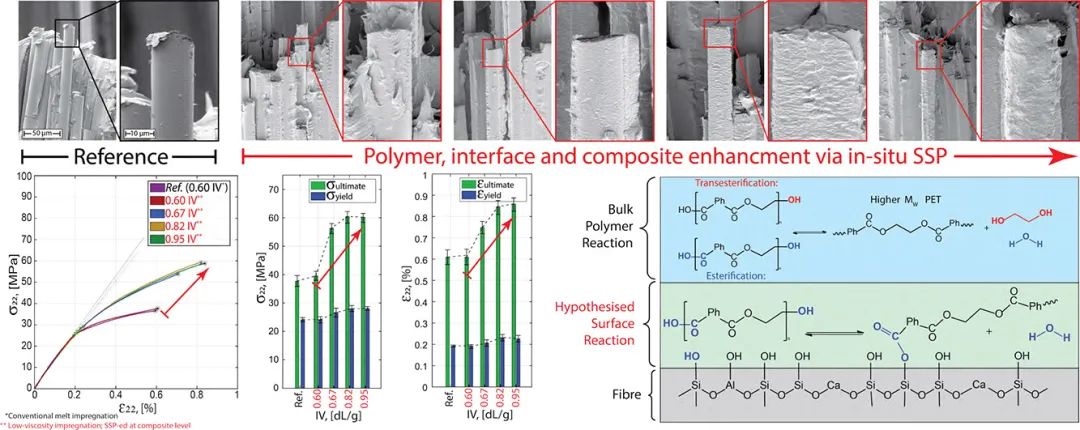
原位固态聚合制备GF-PET复合材料的力学特性
The work reported in this short communication focusses on the impact of solid-state polymerisation (SSP) of glass fibre-poly(ethylene terephthalate) (GF-PET) composites, on polymer’s, interface’s, and eventually composite’s performance characterized through transverse tensile testing. Comparison with a state-of-the-art film stacking process revealed that similar, but also improved mechanical performance can be achieved by composites produced via the in-situ (i.e., at composite lamina level) SSP method. When the polymer is reacted at long intervals to achieve high molecular weights in-situ, a robust matrix-fibre interface is apparently formed, yielding fully cohesive failure of the composite (on fully desized fibres), while the improved polymer’s ductility enhances further the transverse performance. Composite’s ultimate transverse tensile strength saturation was found at a PET intrinsic viscosity of 0.82 dL/g, with values of ∼ 60 MPa, and ultimate strain of ∼ 0 . 82 % , with the latter to show a slight increase when the intrinsic viscosity reached 0.95 dL/g, through even longer SSP times. Thus, the prevalent challenges in thermoplastic reinforced composites, namely high processing viscosity and a weak matrix-fibre interface, are effectively addressed by the developed in-situ SSP route.
在这篇简短的文章中报道的工作重点是玻璃纤维-聚对苯二甲酸乙二醇酯(GF-PET)复合材料的固态聚合(SSP)对聚合物、界面以及最终复合材料性能的影响,这些性能通过横向拉伸测试来表征。与最先进的薄膜堆积工艺相比,通过原位(即复合材料层)SSP方法生产的复合材料可以获得类似的力学性能,但力学性能也有所提高。当聚合物经过长时间的原位反应以获得高分子量时,显然会形成坚固的基质-纤维界面,导致复合材料(在完全粒径化的纤维上)完全内聚失效,而改进的聚合物的延展性进一步增强了横向性能。在PET特性粘度为0.82 dL/g时,复合材料的极限横向抗拉强度饱和值为~ 60 MPa,极限应变为~ 0。82%,当特性粘度达到0.95 dL/g时,后者通过更长的SSP时间略有增加。因此,热塑性增强复合材料的普遍挑战,即高加工粘度和弱基质-纤维界面,通过开发的原位SSP路线有效地解决了。
A synergetic approach to enhancing mechanical properties of trace TiB2 particles reinforced AZ91D composites through α-Mg grain refinement and β-Mg17Al12 manipulation
Zelong Du, Xueqiang Yang, Qing Wang, Hangze Wu, Kai Zhao, Lei Liu, Zongning Chen, Zhirou Zhang, Enyu Guo, Huijun Kang, Tongmin Wang
doi:10.1016/j.compositesa.2025.109114
α-Mg晶粒细化和β-Mg17Al12处理协同提高微量TiB2颗粒增强AZ91D复合材料力学性能
Cast AZ91D magnesium alloys are plagued by coarse α-Mg grains and continuous β-Mg17Al12 phases that compromise mechanical performance. This work proposes a TiB2 particle-reinforced AZ91D composite strategy that simultaneously addresses both challenges through interfacial engineering. Introducing trace 0.3 wt.% TiB2 particles into the AZ91D alloy enables refinement via coupled heterogeneous nucleation and growth restriction effects. The identified crystallographic orientation relationship ([112¯0]Mg//[112¯0]TiB2, and (011¯0)Mg//(0001)TiB2) confirms effective α-Mg nucleation on TiB2 interfaces, reducing grain size by 64.4% to 68.2 μm. Concurrently, the β-Mg17Al12 phase morphology transitions from a typical continuous network to a dispersed small block or spherical structure through grain boundary pinning effects enabled by the refined microstructure. The yield strength, ultimate tensile strength, and elongation of AZ91D with 0.3 wt.% TiB2 particles are 129.2 MPa, 247.0 MPa, and 8.5%, respectively, which are increased by 9.1%, 26.3%, and 63.4% compared to the particle-free AZ91D alloy. This interfacial design strategy not only deciphers the particle–matrix interaction mechanisms in Mg-based composites but also provides insight into the development of refiners for cast Mg alloys.
AZ91D 镁合金存在粗大的α-Mg 晶粒和连续的β-Mg17Al12 相,这严重影响了其机械性能。本研究提出了一种通过界面工程引入 0.3 重量%的 TiB2 颗粒增强 AZ91D 复合材料的策略,以同时解决这两个问题。微量的 0.3 重量% TiB2 颗粒的引入通过异质形核和生长限制的耦合作用实现了细化。所确定的晶体学取向关系([112¯0]Mg//[112¯0]TiB2,以及 (011¯0)Mg//(0001)TiB2)证实了α-Mg 在 TiB2 界面的有效形核,使晶粒尺寸减小了 64.4%至 68.2 微米。同时,由于细化后的微观结构产生的晶界钉扎效应,β-Mg17Al12 相的形态从典型的连续网络转变为分散的小块状或球状结构。添加 0.3 重量% TiB2 颗粒的 AZ91D 合金的屈服强度、抗拉强度和伸长率分别为 129.2 MPa、247.0 MPa 和 8.5%,分别比不含颗粒的 AZ91D 合金提高了 9.1%、26.3%和 63.4%。这种界面设计策略不仅揭示了镁基复合材料中颗粒与基体的相互作用机制,还为铸造镁合金细化剂的开发提供了思路。
In-situ tailored repair of thermoplastic composites by overprinting of continuous carbon fibre reinforced polymer filaments
Yahui Lyu, Aonan Li, Jiang Wu, Haoqi Zhang, Dongmin Yang
doi:10.1016/j.compositesa.2025.109117
连续碳纤维增强聚合物长丝叠印热塑性复合材料的原位定制修复
This study proposes an efficient and convenient in-situ repair approach for damaged thermoplastic composites by 3D overprinting. Continuous carbon fibre reinforced polyphenylene sulphide (CCF/PPS) filament was employed to overprint repair patches onto conventionally manufactured woven polyamide 6 (PA6) laminates. The process window was optimised through thermal analysis of the target polymers, with a temperature range spanning from the melting point of PA6 (216.8°C) to the crystallisation point of PPS (227.6°C). A nominated interface temperature of 220 °C was evidenced as the most effective, raising the tensile strength of repaired specimens to 205.9 MPa, an improvement of 35 % compared to open-hole laminates and a recovery of nearly 50 % of the strength lost relative to undamaged specimens. Additionally, bio-inspired spider web printing paths were tailored for static indention loading, restoring 94 % of the original laminate strength while reducing material usage by 67 % compared to conventional unidirectional patches. This novel overprinting approach offers a highly efficient and flexible solution for repairing damaged thermoplastic structures.
本研究提出了一种高效、便捷的热塑性复合材料三维叠印原位修复方法。采用连续碳纤维增强聚苯硫醚(CCF/PPS)长丝将修复贴片套印到传统制造的编织聚酰胺6 (PA6)层压板上。通过对目标聚合物的热分析,优化了工艺窗口,温度范围从PA6的熔点(216.8°C)到PPS的结晶点(227.6°C)。220 °C的指定界面温度被证明是最有效的,将修复后的试样的抗拉强度提高到205.9 MPa,与裸眼层合板相比提高了35% %,相对于未损伤的试样,恢复了近50% %的强度损失。此外,仿生蜘蛛网打印路径是为静态压痕负载量身定制的,与传统的单向贴片相比,恢复了94 %的原始层压板强度,同时减少了67 %的材料使用量。这种新颖的叠印方法为修复受损热塑性塑料结构提供了高效、灵活的解决方案。
DLfd-based inverse identification for heterogeneous composite properties under large-scale missing measurements with uncertainty quantification
Yizhe Liu, Kuijian Yang, Yue Mei, Yuli Chen, Bin Ding
doi:10.1016/j.compositesa.2025.109123
基于dlfd的不确定度定量非均质复合材料性能反演
The inverse identification methods of heterogeneous mechanical properties from measured displacements/strains play a critical role in various engineering fields, ranging from aerospace to medical diagnostics. However, the commonly presence of large-scale measurement missingness significantly exacerbates the ill-posedness of the inverse problem. This dual challenge not only imposes critical limitations on the solution accuracy of conventional methods, but also creates growing requirements of effective uncertainty quantifications for the identification results. In this paper, a novel deep learning in frequency domain (DLfd)-based inverse identification framework is proposed to resolve large-scale and arbitrary distributed measurement missing scenarios. The framework transforms the inferred variables from high-dimensional discretized elastic properties to reduced missing displacement/strain components. This dimensionality reduction process effectively mitigates the challenges in solving the inverse problem and, most importantly, enables uncertainty quantification through the Bayesian inference method. Results demonstrate that even with more than 15% missing data, the L 1-error remains as low as 3.846%, and two standard deviation confidence intervals effectively encompass the ground truth, ensuring a reliable evaluation. Furthermore, the identification method is validated on phantom experiment data, successfully reconstructing both the position and shape of the inclusion, confirming the applicability of our framework in practical circumstances.
从测量位移/应变反演非均质力学性能的方法在从航空航天到医学诊断等各个工程领域发挥着关键作用。然而,普遍存在的大规模测量缺失极大地加剧了逆问题的不适定性。这一双重挑战不仅严重限制了传统方法的求解精度,而且对鉴定结果的有效不确定度量化提出了越来越高的要求。本文提出了一种新的基于频域深度学习(DLfd)的反辨识框架,以解决大规模、任意分布的测量缺失场景。该框架将推断变量从高维离散弹性属性转换为减少缺失的位移/应变分量。这种降维过程有效地缓解了求解逆问题的挑战,最重要的是,可以通过贝叶斯推理方法对不确定性进行量化。结果表明,即使有超过15%的数据缺失,L 1-error保持在3.846%的低水平,两个标准差置信区间有效地包含了地面真实值,确保了可靠的评估。此外,在模拟实验数据上验证了识别方法,成功地重建了包裹体的位置和形状,验证了我们的框架在实际情况下的适用性。
Decoding of contact number among carbon nanofibers in polymer composites: A new insight to govern electron transfer through tunneling zones
Yasser Zare, Muhammad Naqvi, Kyong Yop Rhee
doi:10.1016/j.compositesa.2025.109124
聚合物复合材料中碳纳米纤维的接触数解码:通过隧道区控制电子转移的新见解
The contact number between carbon nanofibers (CNFs) predominantly dictates the conductivity of composites; however, the specific parameters influencing the contact number remain unclear. In this paper, an equation is introduced to estimate the average contact number in CNF-filled samples (PCNFs), incorporating novel factors such as CNF concentration, percolation onset, CNF dimensions, curliness, interphase depth, network fraction, and tunneling characteristics (both distance and width). The contact number is computed and analyzed across various real-world samples. Furthermore, the proposed equation is validated by examining the effects of all relevant factors on the contact number. Notably, the contact number approaches zero when the tunneling diameter (d) is less than 7.5 nm or the tunneling distance (λ) exceeds 5.6 nm, but reaches a maximum of 250 at d = 40 nm and λ = 1 nm. This indicates that shorter tunneling distance and bigger contact diameter enhance the contact number. Additionally, the highest contact number of 76 occurs by a CNF radius (R) of 40 nm, while R = 100 nm combined with a CNF length of 30 μm drastically reduce the contact number to zero. Consequently, thinner and longer CNFs provide a higher contact number. Moreover, a lower percolation onset, thicker interphase, reduced CNF waviness, and greater network fraction further contribute to an increase in the contact number improving the PCNF conductivity.
碳纳米纤维(CNFs)之间的接触数主要决定了复合材料的导电性;但是,影响联系号码的具体参数仍不清楚。在本文中,引入了一个方程来估计CNF填充样品(pcnf)的平均接触数,该方程结合了诸如CNF浓度、渗透开始、CNF尺寸、卷曲度、界面深度、网络分数和隧道特征(包括距离和宽度)等新因素。通过各种真实世界的样本计算和分析联系号码。此外,通过检查所有相关因素对联系号码的影响,验证了所提出的方程。值得注意的是,当隧穿直径(d)小于7.5 nm或隧穿距离(λ)大于5.6 nm时,接触数趋于零,而当d = 40 nm和λ = 1 nm时,接触数达到最大值250。这说明越短的隧道距离和越大的接触直径会增加接触数。此外,当CNF半径(R)为40 nm时,接触数最高为76,而R = 100 nm加上CNF长度为30 μm时,接触数大幅减少至零。因此,更薄和更长的cnf提供更高的接触数。此外,较低的渗透起始时间、较厚的界面相、较低的CNF波纹度和较大的网络分数进一步有助于增加接触数,从而提高PCNF的电导率。
Composites Part B: Engineering
Elastomer-modified perfluorocyclobutyl polymer/SiO2 composites for corrosion-resistant coatings
Mark Rigel R. Ali, Reymark D. Maalihan, Eugene B. Caldona
doi:10.1016/j.compositesb.2025.112727
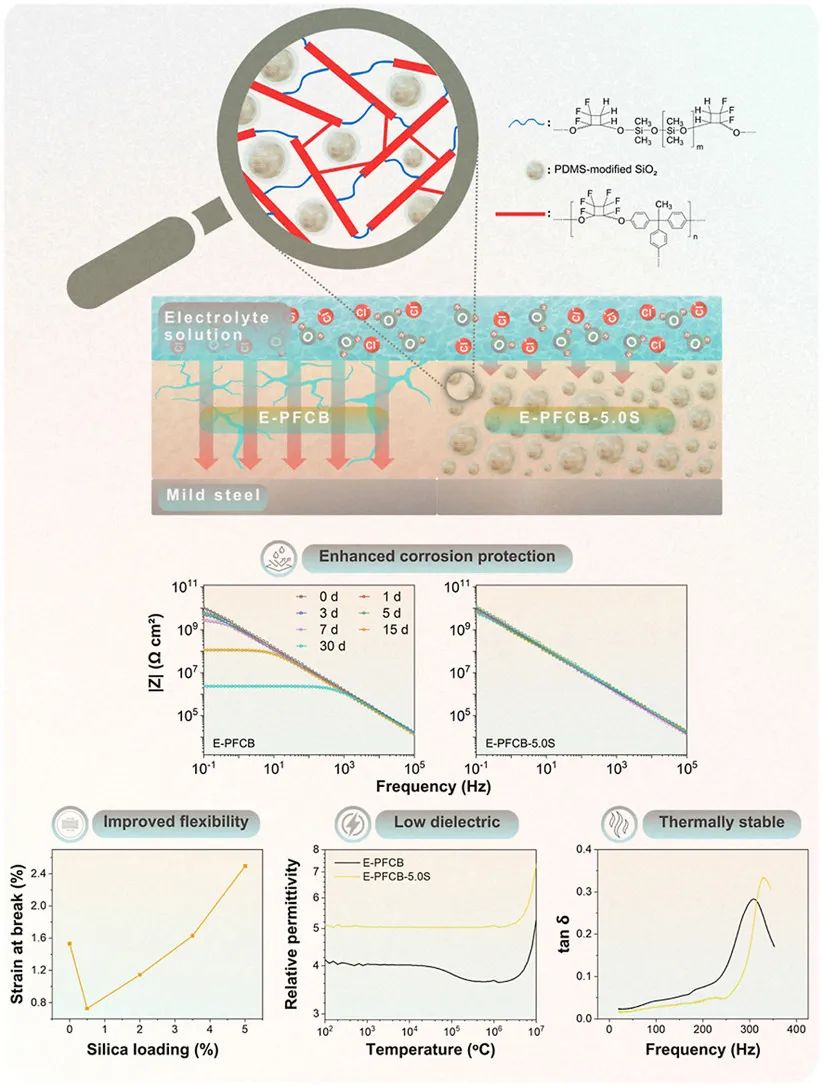
弹性体改性全氟环丁基聚合物/SiO2复合材料耐腐蚀涂层
This study investigates the development of elastomer-modified perfluorocyclobutyl (E-PFCB) thermosetting composites containing polydimethylsiloxane (PDMS)-modified silica as nanofiller and exhibiting enhanced corrosion protection. Electrochemical impedance spectroscopy (EIS) results revealed that the incorporation of silica significantly improved the composite's corrosion resistance, with an impedance modulus (|Z|0.1 Hz) for the PFCB/silica composite containing 5% silica remaining above 106 Ω cm2 even over 30 d of immersion in a 3.5 wt% NaCl solution. This demonstrates the composite's superior ability to resist water uptake and electrolyte penetration. Potentiodynamic polarization scans showed a notable shift in corrosion potential (ECORR) from -700.2 mV for the unfilled E-PFCB to -101.1 mV for the 5% silica composite, indicating lowered tendency for corrosion. Mechanical testing further confirmed the improvements in the composite's properties, with hardness values increasing as silica loading increased. The 5% silica composite showed the highest hardness, reflecting the enhanced durability imparted by the silica particles. Thermomechanical analysis revealed a shift in the glass transition temperature (Tg) from 308 °C for the unfilled E-PFCB to 330 °C upon the addition of 5% silica. In addition, water contact angle measurements confirmed the hydrophobic nature of the composites, with contact angles consistently above 90°, further limiting water interaction and corrosion risk. Hence, the use of PDMS-modified silica as a nanofiller in crosslinked E-PFCB composites significantly enhances both corrosion resistance and thermomechanical properties, making these composites suitable for applications in harsh environments. These findings open up an opportunity for the development of new and advanced protective coatings for many practical applications.
本研究研究了弹性体改性全氟环丁基(E-PFCB)热固性复合材料的发展,该复合材料含有聚二甲基硅氧烷(PDMS)改性二氧化硅作为纳米填料,并具有增强的防腐性能。电化学阻抗谱(EIS)结果表明,二氧化硅的掺入显著提高了复合材料的耐腐蚀性,含有5%二氧化硅的PFCB/二氧化硅复合材料在3.5 wt% NaCl溶液中浸泡30 d后,阻抗模量(|Z|0.1 Hz)仍高于106 Ω cm2。这表明复合材料具有优异的抗吸水和抗电解质渗透能力。动电位极化扫描显示,腐蚀电位(ECORR)从未填充的E-PFCB的- 7002 mV显著变化到5%二氧化硅复合材料的-101.1 mV,表明腐蚀倾向降低。力学测试进一步证实了复合材料性能的改善,硬度值随着二氧化硅载荷的增加而增加。5%二氧化硅复合材料的硬度最高,反映了二氧化硅颗粒增强的耐久性。热力学分析表明,加入5%二氧化硅后,未填充的E-PFCB的玻璃化转变温度(Tg)从308°C转变为330°C。此外,水接触角测量证实了复合材料的疏水性,接触角始终大于90°,进一步限制了水的相互作用和腐蚀风险。因此,在交联E-PFCB复合材料中使用pdms改性二氧化硅作为纳米填料,可显著提高其耐腐蚀性和热机械性能,使这些复合材料适用于恶劣环境。这些发现为许多实际应用开发新的和先进的保护涂层开辟了一个机会。
Impact Efficacy of Sandwich Structures with Additively Manufactured Skins and Elastomeric Foam Cores
Sean Eckstein, George Youssef
doi:10.1016/j.compositesb.2025.112728
增材制造外皮和弹性泡沫芯夹层结构的冲击性能
Sandwich structures are ubiquitous in various applications due to their superior specific properties, attracting assiduous research under a broad range of loading conditions. Introducing additive manufacturing (3D printing) of composite skins and considering novel elastomeric core materials necessitate exploring the process-property interrelationship with emphasis on impact loading. Therefore, this research study aims to elucidate the impact efficacy of additively manufactured sandwich structures, hinging on 3D-printed skins using continuous carbon fiber polymer matrix composites. The 3D-printed skins are adhered to polyurea foam cores with superior impact efficacy and remarkable recoverability. One sample set was subjected to low-velocity impacts using an instrumented drop tower at 4.43 m/s, and another separate set was submitted to moderate-velocity impacts using a small-scale shock tube at 15 m/s. All mechanical testing was accompanied by high-speed digital image correlation (DIC) to elucidate the whole field kinematic variables. The specimens were impacted under various testing parameters, including the size of the hemispherical impactor, sample configuration, mounting plate configuration, and impact velocity, to probe their dynamic behavior. The impact and deformation characteristics, including force-time, axial strain-time, and dynamic and permanent back-surface displacement signatures, were deduced from a high-fidelity force sensor, high-speed and high-resolution DIC, and a laser displacement sensor, and thoroughly analyzed to understand the efficacy of the newly designed sandwich structures. Reconstructive optical microscopy revealed the damage and failure that the structures endured. Across all sample configurations and testing parameters, the structures yielded an energy absorption of ∼91% of the input impact energy, exemplifying impact mitigation capabilities ideal for protective sports gear and structural components in aerospace, automotive, and defense applications.
夹层结构由于其优越的特殊性能在各种应用中无处不在,在广泛的载荷条件下引起了人们的不懈研究。引入增材制造(3D打印)复合材料蒙皮,并考虑新型弹性体芯材,需要探索工艺性能之间的相互关系,重点是冲击载荷。因此,本研究旨在阐明增材制造的三明治结构,铰接在3d打印皮肤上使用连续碳纤维聚合物基复合材料的冲击效果。3d打印皮肤粘附在聚脲泡沫芯上,具有优异的冲击效能和显著的可恢复性。其中一组样本以4.43米/秒的速度使用仪器降落塔进行低速冲击,另一组样本则以15米/秒的速度使用小型激波管进行中速冲击。所有力学测试都伴随着高速数字图像相关(DIC)来阐明整个场的运动学变量。在半球形冲击器的尺寸、试样结构、安装板结构和冲击速度等参数下对试样进行冲击,探讨其动力学行为。利用高保真力传感器、高速高分辨率DIC和激光位移传感器,分析了夹层结构的冲击和变形特性,包括力时间、轴向应变时间、动态和永久后表面位移特征,并对其进行了深入分析,以了解新设计的夹层结构的有效性。重建光学显微镜显示了结构所承受的损伤和破坏。在所有样品配置和测试参数中,结构产生的能量吸收为输入冲击能量的91%,证明了冲击缓解能力是航空航天,汽车和国防应用中防护运动装备和结构部件的理想选择。
Effects of Axial Load on Torsional Fatigue of 3D Braided Carbon Fiber Composites: Mechanisms and Life Prediction
Jikang Li, Zheng Liu, Yuanwen Liu, Zhe Zhang, Xu Chen
doi:10.1016/j.compositesb.2025.112732
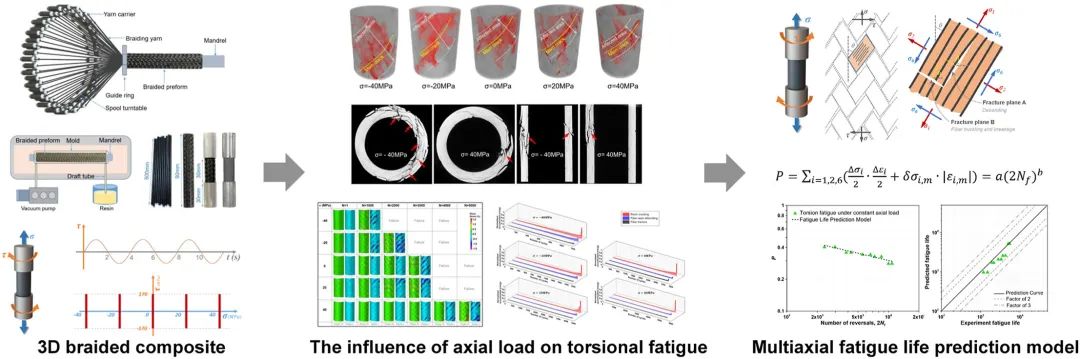
轴向载荷对三维编织碳纤维复合材料扭转疲劳的影响:机理与寿命预测
Three dimensional braided carbon fiber reinforced epoxy composites are gradually replacing traditional materials in transmission components. This study experimentally investigates the influence of axial loads on torsional fatigue damage evolution and lifetime by integrating three dimensional digital image correlation, acoustic emission monitoring, and micro-computed tomography analysis. A fatigue life prediction model incorporating axial load effects is subsequently established. Results indicate that axial loads significantly modify the torsional fatigue behavior of 3D braided composites by redistributing local strain and altering damage progression. Under 0 MPa axial load, the material exhibited a fatigue life of 2787 cycles. Compressive axial loading (-40 MPa) reduced torsional fatigue life by 47% compared to the no-axial-load condition, accelerating stiffness deterioration. In contrast, tensile axial loading (40 MPa) extended the fatigue life to 5007 cycles by suppressing interface debonding propagation. DIC analysis revealed that compressive loading induced a three-stage strain accumulation in resin-rich regions. Tensile loading maintained strain field stability through stress redistribution. Combined AE and Micro-CT analysis demonstrated that compressive loading increased the matrix cracking proportion to 84%, expanded post-failure crack volume by 38%, and formed spiral divergent damage zones. Tensile loading constrained the damage zone width to 7.6 mm and reduced the interface debonding energy proportion. Finally, a multiaxial fatigue life prediction model accounting for mean stress effects induced by axial loads was developed based on microscopic damage mechanisms. The model successfully addresses combined axial-torsional loading effects in 3D braided composites. Experimental validation confirmed that all predicted results fell within the two-fold scatter band.
三维编织碳纤维增强环氧复合材料正在逐步取代传统的传动部件材料。通过三维数字图像相关、声发射监测和微计算机断层扫描分析,研究轴向载荷对扭转疲劳损伤演化和寿命的影响。建立了考虑轴向载荷影响的疲劳寿命预测模型。结果表明,轴向载荷通过重新分配局部应变和改变损伤进程,显著改变了三维编织复合材料的扭转疲劳行为。在0 MPa轴向载荷下,材料的疲劳寿命达到2787次。与无轴向载荷相比,轴向压缩载荷(-40 MPa)使扭转疲劳寿命降低了47%,加速了刚度的退化。相反,拉伸轴向加载(40 MPa)通过抑制界面脱粘扩展,使疲劳寿命延长至5007次。DIC分析显示,压缩加载在富树脂区诱发了三阶段应变积累。拉伸载荷通过应力重分布维持应变场稳定。AE和Micro-CT联合分析表明,压缩载荷使基体开裂比例增加到84%,破坏后裂纹体积扩大了38%,并形成螺旋形发散损伤区。拉伸载荷使损伤区宽度限制在7.6 mm,降低了界面脱粘能比例。最后,基于细观损伤机理,建立了考虑轴向载荷平均应力效应的多轴疲劳寿命预测模型。该模型成功地解决了三维编织复合材料的轴扭复合载荷效应。实验验证证实,所有预测结果都落在两倍散射带内。
A new equivalent crack length technique for mode I fracture of adhesively bonded joints
Ali Shivaie Kojouri, Javane Karami, Jialiang Fan, Akash Sharma, Anastasios P. Vassilopoulos, Veronique Michaud, Wim Van Paepegem, Danny Van Hemelrijck, Kalliopi-Artemi Kalteremidou
doi:10.1016/j.compositesb.2025.112733
黏合接头I型断裂的等效裂纹长度新技术
The current investigation introduces the concepts of the equivalent crack length approach for thin and thick adhesive joints. Its applicability is assessed for adhesively bonded composite and steel joints with a bondline thickness ranging from 0.4mm to 10 mm. To achieve this objective, the equivalent crack length method is formulated utilizing a beam on elastic foundation model. A series of experiments were performed utilizing various loading rates and geometries, and the energy release rate of the thick adhesive joints was determined through beam on elastic foundation model using the crack length values obtained both experimentally and through the equivalent crack length technique. In general, the energy release rate calculated using the equivalent crack length approach and crack length measured experimentally yield comparable results for all tested specimens. For side-grooved specimens with steady crack propagation, the average calculation error of the energy release rate obtained from the experimentally measured crack length experimentally and the equivalent crack length approach is less than seven and six percent for low and high loading rates, respectively. The proposed equivalent crack length method facilitates the experimental fracture characterization of adhesive joints since it eliminates the need for tedious crack length measurements during the test.
本研究引入了薄厚粘接等效裂缝长度法的概念。评估其适用于粘合线厚度为0.4mm ~ 10 mm的复合材料和钢连接。为实现这一目标,采用弹性地基梁模型,建立了等效裂缝长度法。在不同加载速率和几何形状下进行了一系列试验,利用实验和等效裂缝长度技术得到的裂缝长度值,确定了弹性基础模型上的厚粘接节点的能量释放率。一般来说,用等效裂纹长度法计算的能量释放率和实验测量的裂纹长度对所有试件的结果都是相当的。对于裂纹扩展稳定的边槽试件,在低加载率和高加载率条件下,采用实验测量裂纹长度法和等效裂纹长度法计算能量释放率的平均误差分别小于7%和6%。所提出的等效裂缝长度方法消除了测试过程中繁琐的裂缝长度测量,有助于粘结接头断裂的实验表征。
Enhanced aramid fiber epoxy resin composites insulation properties via π-π stacking driven ZnONW heterojunction growth to reconstruct aramid fiber surface
Guowei Xia, Jun Xie, Bobin Xu, Xiaoyu Shi, Ping Huang, Yan Li, Qing Xie
doi:10.1016/j.compositesb.2025.112729
通过π-π堆叠驱动ZnONW异质结生长重建芳纶纤维表面,增强芳纶纤维环氧树脂复合材料的绝缘性能
The Gas-insulated switchgear (GIS) is the core component in the development of China’s new ultra-high voltage power system. Its key part, the insulation pull rod, needs to withstand substantial mechanical loads and impact voltages. The poor compatibility between aramid fiber and epoxy resin is the key problem that affects the insulation performance of pull rods. This paper proposes a method to reconstruct the surface of aramid fibers by utilizing the π-π stacking of iron phthalocyanine (FePc) and the heterojunction growth of zinc oxide nanowires (ZnONW). This approach roughens the fiber surface and improves compatibility, effectively enhancing the insulation performance of aramid fiber-epoxy resin composites. The characterization techniques such as ultraviolet photoelectron spectroscopy (UPS) confirm the π-π stacking effect of FePc and its formation of a heterojunction with ZnO. The insulation performance tests indicate that with a growth concentration of 100 mM and a growth time of 2 h, the aramid fiber-epoxy resin composite exhibits optimal insulation properties. Under these conditions, the breakdown voltage increased by 73.02%, and the breakdown electric field strength improved by 72.13%. Molecular dynamics (MD) simulations and density functional theory (DFT) analyses reveal the π-π stacking process and the mechanisms behind the enhanced insulation properties.
气体绝缘开关柜(GIS)是中国新型超高压电力系统发展的核心部件。它的关键部分,绝缘拉杆,需要承受大量的机械负荷和冲击电压。芳纶纤维与环氧树脂相容性差是影响拉杆绝缘性能的关键问题。本文提出了一种利用酞菁铁(FePc)的π-π堆叠和氧化锌纳米线(ZnONW)的异质结生长来重建芳纶纤维表面的方法。这种方法使纤维表面变得粗糙,提高了相容性,有效地提高了芳纶纤维-环氧树脂复合材料的绝缘性能。紫外光电子能谱(UPS)等表征技术证实了FePc的π-π堆积效应及其与ZnO形成异质结。绝缘性能试验表明,当生长浓度为100 mM,生长时间为2 h时,芳纶纤维-环氧树脂复合材料的绝缘性能最佳。在此条件下,击穿电压提高了73.02%,击穿电场强度提高了72.13%。分子动力学(MD)模拟和密度泛函理论(DFT)分析揭示了π-π堆积过程和增强绝缘性能背后的机制。