
MatDEM应用论文|多孔砂岩中曲折压密带的形成机理:2.离散元法数值模拟

论文题目
Mechanism of formation of wiggly compaction bands in porous sandstone: 2. Numerical simulation using discrete element method
Liu et al., 2015, JGR-Solid Earth
研究内容
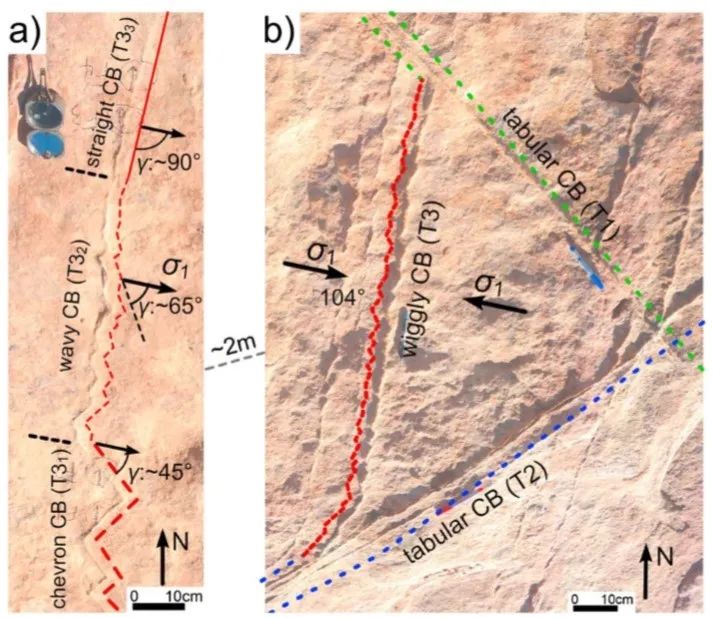
Fig 1. Outcrop photographs taken in the area studied by Hill [1989]. The azimuth of the estimated maximum compressive stress (σ1)is approximately 104°. (a) Transition of band type from chevron to wavy to straight CBs, as failure angle (γ) increases from approximately 45° to 65° to 90°. (b) Wiggly CBs merged into tabular shear-enhanced CBs. Figure 1b was taken about 2 m from Figure 1a.
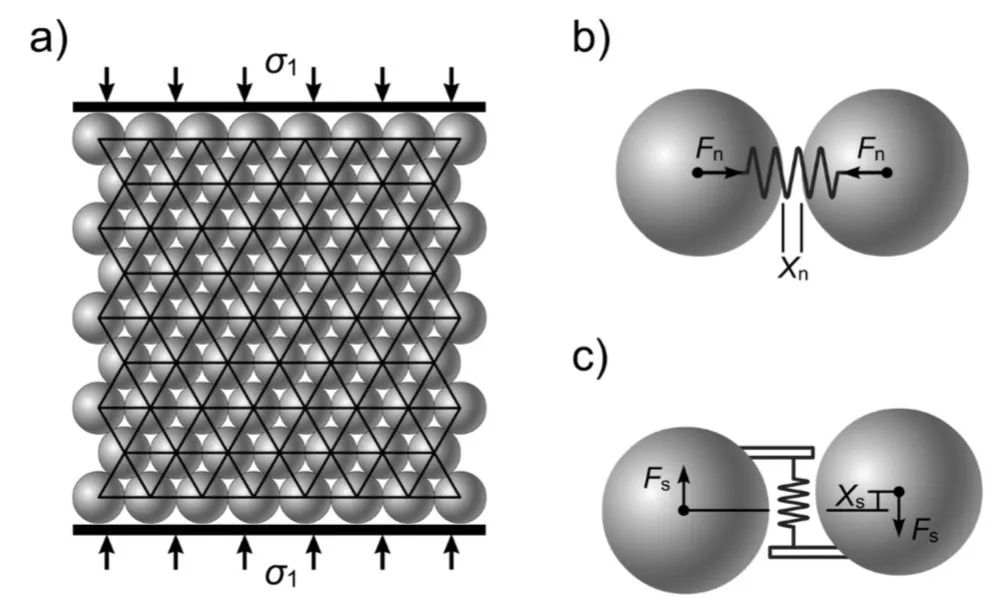
Fig 2. (a) A close-packed discrete element model. (b) Two elements are bonded by a breakable elastic spring along the normal direction and interact through a spring force (Fn). (c) Two elements also are bonded by a spring along the tangential direction to simulate the shear force (FS). Xn is the relative normal displacement, and Xs is the relative shear displacement.
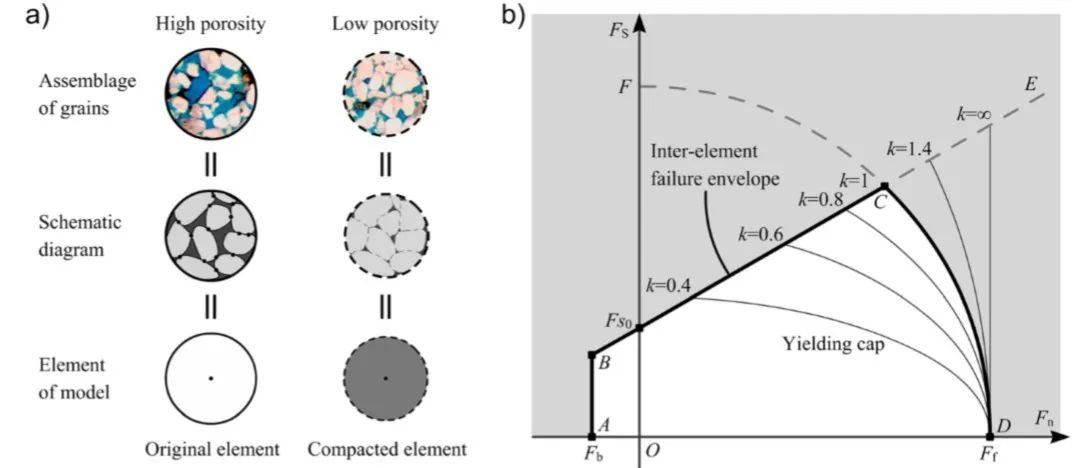
Fig 3. (a) A discrete element represents an assemblage of grains in porous sandstone. When the assemblage is compacted, its porosity and volume reduce. (b) Failure envelope of discrete element includes an elliptical yielding cap. An element will be compacted (shrink) when the force state of one of its bonds reaches the cap. Ff is the failure force; k is the aspect ratio of the yielding ellipse; Fb is the breaking force; and FS0 is the initial shear resistance (i.e., cohesion).
Liu C., Shi B., Pollard D. D., and Gu K. 2015. Mechanism of formation of wiggly compaction bands in porous sandstone: 2. Numerical simulation using discrete element method. Journal of Geophysical Research- Solid Earth, 120, 8153-8168.