大家一起学标准之IEC61400-1(13)
6.3.3.7 Extreme wind shear (EWS)
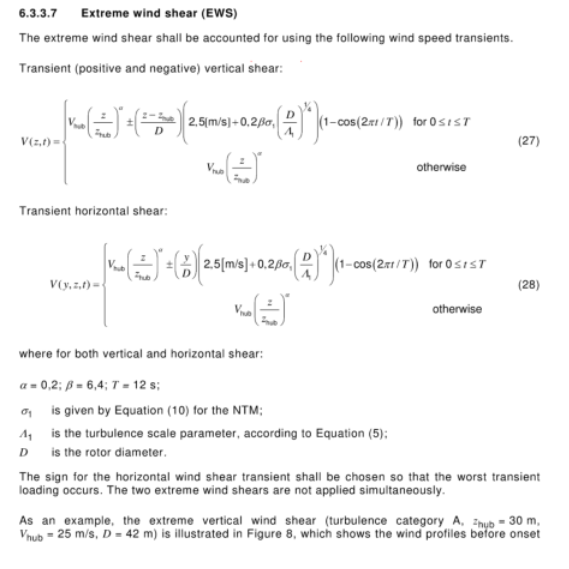
The extreme wind shear shall be accounted for using the following wind speed transients.
Transient (positive and negative) vertical shear:

Transient horizontal shear:

where for both vertical and horizontal shear:
alpha = 0.2; beta = 6.4; T= 12s;
σ1is given by Equation (10) for the NTM;
Lambda_1 is the turbulence scale parameter, according to Equation (5);
D is the rotor diameter.
The sign for the horizontal wind shear transient shall be chosen so that the worst transient loading occurs. The two extreme wind shears are not applied simultaneously.
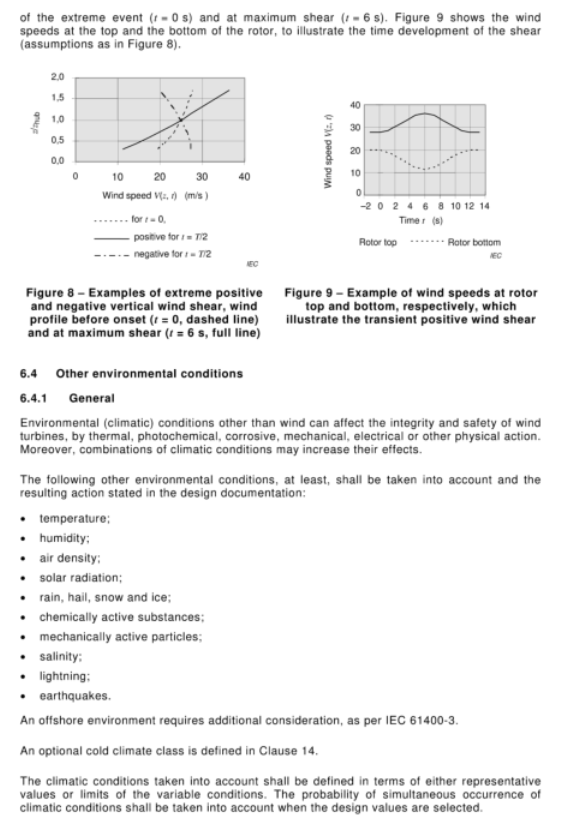
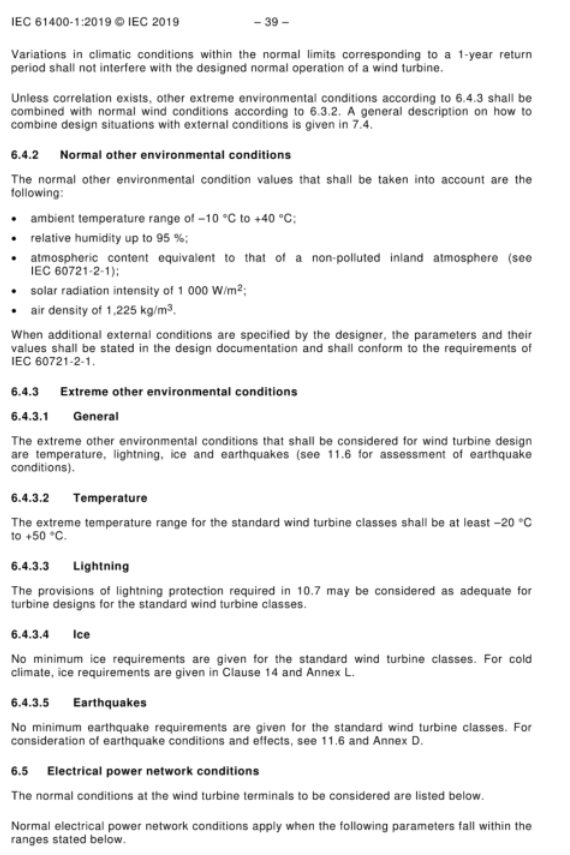
As an example, the extreme vertical wind shear (turbulence category A, z_hub = 30m, V_hub = 25m/s, D = 42m is illustrated in Figure 8, which shows the wind profiles before onset of the extreme event (t = 0s) and at maximum shear (t = 6s). Figure 9 shows the wind speeds at the top and the bottom of the rotor, to illustrate the time development of the shear (assumptions as in Figure 8).
Figure 8 – Examples of extreme positive and negative vertical wind shear, wind profile before onset (t = 0, dashed line) and at maximum shear (t = 6s, full line) Figure 9 – Example of wind speeds at rotor top and bottom, respectively, which illustrate the transient positive wind shear
6.4 Other environmental conditions
6.4.1 General
Environmental (climatic) conditions other than wind can affect the integrity and safety of wind turbines, by thermal, photochemical, corrosive, mechanical, electrical or other physical action. Moreover, combinations of climatic conditions may increase their effects.
The following other environmental conditions, at least, shall be taken into account and the resulting action stated in the design documentation:
·temperature;
·humidity;
·air density;
·solar radiation;
·rain, hail, snow and ice;
·chemically active substances;
·mechanically active particles;
·salinity;
·lightning;
·earthquakes.
An offshore environment requires additional consideration, as per IEC 61400-3.An optional cold climate class is defined in Clause 14.
The climatic conditions taken into account shall be defined in terms of either representative values or limits of the variable conditions. The probability of simultaneous occurrence of climatic conditions shall be taken into account when the design values are selected.
Variations in climatic conditions within the normal limits corresponding to a 1-year return period shall not interfere with the designed normal operation of a wind turbine.
Unless correlation exists, other extreme environmental conditions according to 6.4.3 shall be combined with normal wind conditions according to 6.3.2. A general description on how to combine design situations with external conditions is given in 7.4.
6.4.2 Normal other environmental conditions
The normal other environmental condition values that shall be taken into account are the following:
·ambient temperature range of -10 to +40;
·relative humidity up to 95 %;
·atmospheric content equivalent to that of a non-polluted inland atmosphere (see IEC 60721-2-1);
·solar radiation intensity of 1000W/m^2;
·air density of 1.225kg/m^3.
When additional external conditions are specified by the designer, the parameters and their values shall be stated in the design documentation and shall conform to the requirements of IEC 60721-2-1.
6.4.3 Extreme other environmental conditions
6.4.3.1 General
The extreme other environmental conditions that shall be considered for wind turbine design are temperature, lightning, ice and earthquakes (see 11.6 for assessment of earthquake conditions).
6.4.3.2 Temperature
The extreme temperature range for the standard wind turbine classes shall be at least-20 to +50.
6.4.3.3 Lightning
The provisions of lightning protection required in 10.7 may be considered as adequate for turbine designs for the standard wind turbine classes.
6.4.3.4 Ice
No minimum ice requirements are given for the standard wind turbine classes. For cold climate, ice requirements are given in Clause 14 and Annex L.
6.4.3.5 Earthquakes
No minimum earthquake requirements are given for the standard wind turbine classes. For consideration of earthquake conditions and effects, see 11.6 and Annex D.
6.5 Electrical power network conditions
The normal conditions at the wind turbine terminals to be considered are listed below.Normal electrical power network conditions apply when the following parameters fall within the ranges stated below.
·Voltage – nominal value (according to IEC 60038) ± 10 %.
·Frequency – nominal value ± 2 %.
·Voltage imbalance – the ratio of the negative-sequence component of voltage not exceeding 2 %.
·Auto-reclosing cycles – auto-reclosing cycle periods of 0.1 s to 5 s for the first reclosure and 10 s to 90 s for a second reclosure shall be considered.
·Outages – electrical network outages shall be assumed to occur 20 times per year. An outage of up to 6 h⁵ shall be considered a normal condition. An outage of up to 1 week shall be considered an extreme condition.
6.3.3.7 极端风切变(EWS)
应采用下述风速时程模型计算极端风切变载荷。
竖向、水平风切变共用参数说明:alpha=0.2;beta=6.4;总时长 T=12s;
sigma_1:常规湍流模型(NTM)公式 (10) 计算取值;
Lambda_1:湍流尺度参数,见公式 (5);
D:风轮直径。
水平风切变时程公式的正负号选取,应取产生最严苛瞬态载荷的工况;竖向极端风切变与水平极端风切变不可同时施加。
示例工况:湍流 A 类、轮毂高度 30 m、轮毂风速 25 m/s、风轮直径 42 m 的极端竖向风切变曲线见图 8;图 8 给出极端事件起始时刻(t=0s)与最大切变时刻(t=6s)的风速廓线。图 9 给出风轮顶部、底部风速随时间变化曲线,直观展示正向瞬态风切变的演化过程(工况参数同图 8)。
图 8 — 正向、负向极端竖向风切变示例;虚线:事件起始(t=0)风速廓线;实线:最大切变时刻(t=6s)廓线
图 9 — 风轮顶部、底部风速曲线,展示正向瞬态风切变演化规律
6.4 其他环境条件
6.4.1 总则
除风载荷外,各类环境(气候)条件会通过热作用、光化学作用、腐蚀作用、机械作用、电气作用及其他物理作用影响风机结构完整性与运行安全;多种气候条件叠加时,不利效应会进一步放大。
设计至少需考虑以下环境条件,并在设计文件中明确各类条件产生的载荷效应:
·温度;
·湿度;
·空气密度;
·太阳辐射;
·雨、冰雹、雪、覆冰;
·化学活性介质;
·机械磨损颗粒;
·盐雾 / 盐度;
·雷电;
·地震。
海上风机需额外遵循 IEC 61400-3 标准的海洋环境要求;第 14 章定义了可选低温气候风机等级。
所有纳入设计的气候条件,均需采用特征值或限值进行定义;选取设计参数时,需考虑多种气候条件同步发生的概率。
重现期 1 年的常规限值内气候波动,不得影响风机设计额定正常运行。
若无耦合关联,6.4.3 规定的各类极端环境条件,应与 6.3.2 常规风况组合计算;7.4 章节详细说明设计工况与外部环境条件的组合规则。
6.4.2 常规其他环境条件
设计需采用的常规环境基准参数如下:
·环境温度范围:-10 到+40;
·相对湿度最高 95%;
·大气组分等同于无污染内陆大气(参考标准 IEC 60721-2-1);
·太阳辐射强度:1000W/m^2;
·空气密度:1.225kg/m^3。
若设计方指定额外外部环境条件,需在设计文件中列明全部参数及取值,且参数需满足 IEC 60721-2-1 标准要求。
6.4.3 极端其他环境条件
6.4.3.1 总则
风机设计必须校核的极端环境条件包含:极端温度、雷电、覆冰、地震(地震工况评估见 11.6 节)。
6.4.3.2 温度
标准等级风机的极端温度区间至少为 -20到+50。
6.4.3.3 雷电防护
标准等级风机的防雷设计,采用 10.7 章节规定的防雷措施即可满足设计要求。
6.4.3.4 覆冰
标准通用风机等级无强制最低覆冰设计要求;低温气候专用风机的覆冰设计规定见第 14 章与附录 L。
6.4.3.5 地震
标准通用风机等级无强制最低抗震设计要求;地震工况与地震效应校核见 11.6 节与附录 D。
6.5 电网电气条件
风机接线端子处需校核的常规电网工况参数如下;仅当所有参数落在下述区间内,判定为常规电网工况:
·电压:额定电压(依据 IEC 60038)±10%;
·频率:额定频率 ±2%;
·电压不平衡度:电压负序分量占比不超过 2%;
·重合闸周期:首次重合闸间隔 0.1 s~5 s,二次重合闸间隔 10 s~90 s;
·停电故障:假定每年发生 20 次电网停电;单次停电时长≤6 h⁵ 属于常规工况;单次停电时长≤1 周属于极端电网工况。
简单总结
今天就学到这里,明天我们继续学习,每天十分钟大家一起学标准。