
首页/文章/ 详情

hypermesh入门_绝对精品教程-54页

6月前浏览478


第一章 mesh入门 

首先我们要了解什么是mesh,简单的说mesh就是网格的划分。有过有限元分析背景的人都知道,做有限元分析首先第一步工作就是建模,就是把分析对象按照一定的尺寸、比例划分成相互连接、不间断的网格单元,成为一个可以计算的力学模型,这是进行有限元计算的基础。其划分的结果对于以后计算的结果将产成直接的影响,或者说mesh是保证有限元分析结果准确的重要条件。 

下面我就最简单的分析对象——金属壳体,向大家讲述怎样进行一个物体的mesh。我们所用软件是HyperMesh,它对于有限元的前处理和后处理都具有比较强大功能。 

  • 第一节 软件环境 

首先,我们要了解工作的目标,即最终要把一个金属壳体处理成怎样的网格。打开练习一,这个文件中已经包含geom和放到中面的elems。 

我们现在要搞清的第一概念就是geom和elems的区别。Geom即为几何体,是我们分析对象的真实模型,实际物体的三维表现形式;elems即为网格单元,是我们分析对象的力学模型,是对实际物体的一种近似模拟,是把实际物体转换成可计算的力学和数学模型,它不是简单的线和面,是带有数据的线和面。 

在HyperMesh 中,我们把 geom 和 elems 统称为 comps,comps 可以理解为图层,这里的图层和CAD的图层的概念不同。这里comps是以后赋予模型材料和几何性质的一个最小单元,或者说对于不同材料性质和不同几何性质的elems要处于不同的comps中。每个comps 都会有个名字,所以同一个名字的comps包含两个部分,即XXX(名字)geom和XXX(名字)elems。当然几何体和力学模型是两个完全独立的部分,所以两者完全可以放在不同的comps 中的,对于图层名字的管理我们在下一章再做详细说明。 

对于一个金属壳体,我们知道金属板是具有均有厚度的,即在三维上它总是有个方向上是保持不变的,这样我们就可以用比较简单的二维单元来描述金属壳体,这个二维单元我们称壳体单元。我们把这个壳体单元赋予它真实模型的厚度(几何性质)和材料性质,并且把这层壳体单元放到金属壳体的中面上去,即完成了我们建模的任务。这就是对金属壳体的力学模型的建立过程,简单的说,就是对于金属壳体的中面用一层带有厚度和材料性质的网格单元来描述。 

把单元放到中面在HyperMesh 中是一个非常简单的命令,我会在以后想大家讲述。对于金属壳体来说,中面和上下表面是类似的,或者说基本一致。这样我们对于金属壳体来说,首先要做的是对于上表面或下表面进行网格划分,以后我们还要谈到选择上表面和选择下表面的细微不同,这里我先认为它是相同的。就练习一,我针对怎样进行一个表面的网格划分来让大家熟悉这个软件的命令。 

窗口下方是主菜单,共分7类,分别是Geom、1D、2D、3D、BCs、Tool、Post,每一类中有一些重复的比较经常使用的命令。
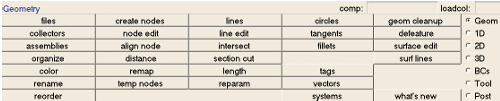
image.png

Geom:主要是对模型的修改和操作。 

1d:主要是对线单元的修改和操作。 

2d:是对品面单元的修改和操作。 

3d:是对固体单元的修改和操作。 

BCS:边界条件。 

TOOL:使用的方法。 

POST:后处理的命令。 

窗口右下方是对视图进行操作的一些命令,这些命令有快捷键。 

窗口右上方是灯光效果,对于mesh本身不很重要。 

窗口右侧是视图种类的选择。 


  • 第二节 hypermesh 软件的基本操作 

在hypermesh 中所有操作和命令都可以通过点击命令面板中的按钮实现,而通过键盘与鼠标的

组合可以方便快捷的实现一些基本操作。熟练掌握以下介绍的这些操作可以在工作中节省很多时间。 

一、模型的旋转与移动 

(1)模型的旋转:Ctrl+鼠标左键 

(2)模型的平移:Ctrl+鼠标右键 

(3)放大模型:敲击键盘z键后用鼠标划出所需的放大位置 

(4)模型复位:键盘F键; 

(5)模型的缩放:敲击键盘s键后,按住鼠标左键拖拽 

二、mesh 命令快捷键

image.png


在这里有一点需要说明的是,用快捷打开的命令在转变模型视图的时候会自动退出,有些情况下我们需要在一个命令完成前变换视图方式,在这种情况下就需要在命令面板中通过点击命令按钮来打开命令,而不能用快捷键打开。如在用automesh命令时,我们有时需要通过0-D与3-D转换来方便对所mesh面的选取。这时如果我们用快捷键F12打开automesh 命令,在 3-D 选取面后转换 0-D 时命令就会自动退出,这样我们刚才选取面的工作就浪费了。而通过点击命令按钮来打开的命令就不存在的问题,并且我们可以在这个命令上面叠加一个快捷键打开的命令,而从面板打开的命令仍然可以保持原来的设置。也就是说,通过点击命令按钮来打开的命令只要不点return退出,我们对这个命令做的设置(如方向点,选取的单元)都会保持不变。我们也可以利用这个特性方便我们的工作,在稍后的调节单元质量章节我们就会用这个特性方便我们工作。读者朋友可以在今后的工作中灵活的运用此特性。 


  • 第三节 命令面板的主要命令 

一.geom 的主要命令:

image.png


Create nodes: 是对点的操作。 

Node edit:  

Align:排列点。 

Distance:可以测量点和点距离,同时还可以改变距离,还可以测量角度,建立两点间的中点。 

Renmap:重新排列点,是所选的点均匀的分布在一根线上。(不是经常使用) 

Temp node: 可以删除点。 

Lines: 建立直线和曲线和建立中线 

Edit line:对线的编辑。包括:分割,合并,延长。 

Intersect:可以延某一个面切出来的表面特征的线。 

Section: 

Length: 

Reparam: 

Circles:可以建立一个圆,建立一段弧,可以找到圆的圆心。 

Tangents:找一根线的切线方向。 

Tags: 

Vectors: 

System:建立局部坐标系。 

Geom cleanup:是对模型的外表面的线进行操作的。可以忽略一些影响网格质量的线。 

Defeature:可以忽略一些小的导角。 

Surface edit: 对面的操作,可以切割一个面。 

Surflines: 

midsurface:建立中面。

二.2d 的主要命令:
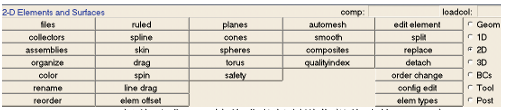
image.png


organize: 把单元或 suf 转移或者复 制道你想移动的comp 中。 

Color: 给 comp 辅以自己喜欢的颜色 

Rename: 重新对 comp 命名。 

Rule: 用于点对线,或者是点对点来生成element的方法。 

Spline:闭合的线进行 mesh 

Skin: 

Drag:沿着方向拉伸单元。 

Spin:做 washer 

Line drag:沿着线 mesh。 

Elem offset 把单元放到中面。 

Automesh:自动化分网格。 

Smooth:平滑单元间的节点。 

Edit element:编辑单元。 

Split:切割单元,主要用于切割固体单元,将四边形单元切割为三角形。 

Replace:两点合并为一点。 

Detach:分开合并在一起的单元。 

Order change:将一阶单元转换成二阶单元。 

三.tool
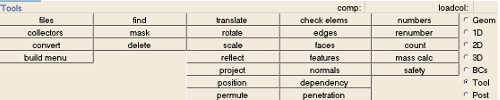
image.png


find:找到单元。 

mask:隐藏 

delete:删除 

translate:移动点,单元。 

rotate:旋转点,旋转单元。 

scale:缩放。 

reflect:反射单元。 


project:投影 

position:位置不同的点对点的转移单元。 

check elems:检查单元。 

edges:检查边界。 

Faces 检查固体单元边界 

normals:调整单元的法线方向。 

renumber:从新计算单元的信息。 

count:统计单元的信息。 


四.控制面板命令 

在整个hypermesh 界面的右下角,有一个控制面板,其中一些是模型的旋转、缩放的命令,十分容易理解,这里不作赘述,我们重点需要介绍的是 disp、global和vis 这几个命令。 

1.disp 即 display 在这个命令中可以控制模型操作的显示与否。

image.png 

上图显示即disp 命令面板,图中左侧的是可选择的操作对象,名字前面的方框中打勾的操作对象就可以显示在主操作面板中,通过鼠标左键选择,右键取消。 

图中右侧有一些控制命令,none为全部关掉,all为全部打开,reverse是反选。 

点击comp 前面的箭头,会出现一些选项,这些都是可以显示在主面板中的选项,不过我们在做建模工作时一般不需要。点击elems前面的双箭头,可以在element和geometry 之间切换,在建模工作时经常需要切换。 

2.global 命令
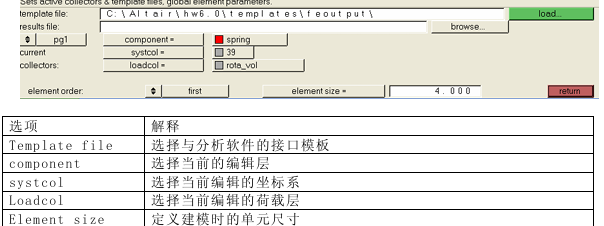
image.png


3.Option 命令 

软件中的一些选项,基本保持默认设置即可,对操作没有太多的影响。根据我们的经验,最好不要选取modeling中的 fix points。将 grahics 中的 engine 设置为performance;将 bitmap animation 和 view acceleration 都设置为 none。这样会提高显示效果,减少占用电脑资源。 

  • 第四节 操作对象的选取 

我们在做建模工作时,必然要选取操作对象,如点、单元、几何模型的表面等,当然我们可以用鼠标左键一个一个点击选取,但是这样做费时费力,hypermesh为我们提供了多种更加方便的选取方式,灵活的运用这些选取方式,并配合我们后面介绍的一些命令及其特点,可以方便的完成很多工作。下面我为大家一一介绍。 打开任何一个命令,如automesh,在标有element 的黄色 区域内点击鼠标左键,会出现一个复选框,这些都是选择单元的一些方法,我们称之为选择菜单。 

image.png

image.png


1.By window:可以通过鼠标左键定义一个选择区域,在这个区域内的单元都会被选中。这里有一个小敲门,hypermesh 可以记住上一次定义的框选区域,甚至是在不同的命令中,所以我们如果要选择一个区域,但要以另一个层为参考时,可以打开参考层进行框选,而后用disp命令关掉参考层,再进行选择,这样就可以选中我们所需要层的单元而不选择参考层的单元。但要注意不要转动或移动模型的位置。By window还有一个功能就是将选择好的对象去除,选好需要去除的对象区域后点击reject entities即可。 

2.Displayed:当前显示的所有单元。 

3.All:模型中的所有单元。 

4.Reverse:在所有显示的单元中反选。 

5.By collector;选择某一层中的所有单元。 

6.On plane:选择某一平面内的所有单元。 

7.Retrieve:调出存储的单元。 

8.Save:存储选择好的单元。 

9.By id:通过单元的ID 号选择。 

10.By assems: 选择一个 assembly 中的单元。 

11.By group: 选择接触类型的单元。 

12.Duplicate: 复 制所选择的单元。 

13.By config:通过单元类型选择单元。 

14.By set: 选择某一 set 包含的单元。 

15.By surface: 选择某一面上的单元。 

16.By adjacent: 选择制定单元周围的单元。 

17.By attached: 选择与指定单元相连的单元。 

18.By face: 选择与指定单元为同一面的单元。

在option 命令中modeling 的 feature angle 选项可以改变选择的单元区域。 
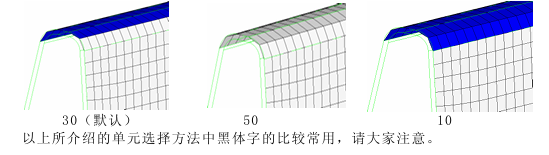
image.png


详细内容见附件


免责声明:


本页面/内容部分素材来源于互联网公 开 信 息,旨在传递更多信息,不代表本平台立场。

版权归原作者或机构所有,如涉及侵权,请通过平台联系我们,我们将在核实后第一时间处理。

本平台对转载内容的真实性、准确性不作任何保证,用户需自行判断并承担使用风险。


附件

免费E11-hypermesh入门_绝对精品教程-54页.pdf
HyperMesh
著作权归作者所有,欢迎分享,未经许可,不得转载
首次发布时间:2026-04-10
最近编辑:6月前
仿真支持爱好者
在仿真的路上越走越远
获赞 333粉丝 27文章 318课程 0
点赞
收藏
作者推荐

学术论文-脉冲式点焊钨极气体保护焊过程中电弧 - 熔池耦合的瞬态统一模型

ATransientUnifiedModelofArc-WeldPoolCouplingsduringPulsedSpotGasTungstenArcWeldingA.Traidia1,2,F.Roger*,11ENSTAParistech,DepartmentofMechanicsUME2AREVANP,TechnicalCenter*Correspondingauthor:ENSTAParistech,DepartmentofMechanicsUME,Chemindelahunière,91761Palaiseau,FRANCE,frederic.roger@ensta-paristech.frAbstract:AtransientfiniteelementmodelhasbeendevelopedtostudytheheattransferandfluidflowduringpulsedspotGTAweldingonstainlesssteel.Temperaturefield,fluidvelocityandelectromagneticfieldsarecomputedinsidethecathode,arc-plasmaandanodeusingaunifiedMHDformulation.Theevolutionoftheheatfluxandcurrentdensityatthetopsurfaceoftheanodearestudiedduringtheweldingprocess.Theelectricheatingfluxattheanodewhichrepresentstheenergyabsorbedbytheworkpiecefromtheelectronscomingfromthecathodeisfoundtobethemajormechanismofheating.Theproposednumericalmodelalsopermitstostudythetimeevolutionoftheweldpooldimensionsforbothconstantandpulsedcurrent.Acomparisonshowsthattheuseofapulsedcurrentweldinggivesawideranddeeperweldshapethanthemeanconstantcurrentwelding.Thepresentworklaysafoundationforthefuturedevelopmentofathree-dimensionalmodelformovingtorcharcwelding.Keywords:Heattransfer,Fluidflow,Arcplasma,Unifiedmodel,Marangonieffect.1、IntroductionDuetothewidespreaduseofGTAweldinginthemanufacturingindustry,thenumericalsimulationofsuchaprocessiscurrentlyingreatprogress.Themaingoalistostudytheimpactoftheweldingparameters(weldingcurrent,arclength,pulsefrequency,weldingspeed…)onthefinalweldshapeinordertoimprovetheweldingqualityandincreaseproductivity.Thecomplexityofthenumericalmodelingisduethestrongcouplingsbetweenmanyphysicsinvolvedinthisprocess.Theionizationoftheshieldinggasensuresthecurrentflowbetweenthetwoelectrodes,thentheheatingJouleeffectcreatesathermalplasmacomposedofelectrons,ionsandneutralspeciesatalargetemperaturerange;from300Ktomorethan20000K.Theworkpieceisthenheatedfromboththearc-plasmaconduction,andtheelectronsflowatthetopsurface.Dependingonthemeltingtemperatureoftheworkpiece,aweldpoolisformedinwhichthefluidflowisgovernedbytheMarangonieffectatthetopsurface,thebuoyancyforcesandtheelectromagneticforcescreatedbythecurrentflow.Thefluidflowinsidetheweldpoolisalsostronglycoupledtothetemperaturefieldandthedeformationofthetopfreesurface.ManynumericalmodelsofspotGTAWareavailableintheliterature[1-5].Mostofthemconsideronlyonepartoftheweldingprocess[14](eitherthecathode,orthearcplasma,ortheanode)whichleadstofixsomeboundaryconditionsthatdonotrepresenttherealsituations.Thebestwaytodealwiththeproblemistotakeintoaccountthethreeparts(anode,cathodeandarc-plasma)inaunifiedformalism.Theinterfacesbetweentheplasmaandtheelectrodesarethenconsideredasinternalboundaries.ThisapproachwasproposedbyLowkeandTanakaetal[5]andgivessatisfyingresultsforconstantcurrentwelding.Inthepresentwork,aunifiedfiniteelementmodelisintroducedtakingintoaccountthethreepartsoftheweldingprocess.Thetime-dependentmodelcansimulatepulsedcurrentweldinginwhichtheweldingcurrentvarieswithtimeatagivenfrequencybetweentwoconstantvalues;thepeakcurrentandthebackgroundcurrent.Thispermitstostudythetransientevolutionofsomephysicalquantitiesatthetransitionbetweenthepeakandbackgroundtimesbutalsotocompareweldingunderpulsedcurrentwithweldingunderthemeancorrespondingconstantcurrent.2.Mathematicalformulation1.1GoverningequationsThemathematicalformulationisbasedonthefollowingassumptions:ThestudyisrestrictedtospotGTAW;anaxisymmetriccoordinatesystemisused.ThearccolumnisassumedtobepureargonatLocalThermodynamicEquilibrium.Thegasplasmaandmoltenmetalareincompressible.AweakcouplingisconsideredbetweenthefreesurfacedeformationandtheMagnetoHydrodynamic(MHD)calculations.Thetemperature,velocityandpressurefieldsarecalculatedinthethreedomainsusingtheclassicalconservationequationswritteninaunifiedtransientformalismasfollows:Whereisvelocity,Tistemperature,ρispressure,ρisdensity,isanequivalentspecificheatthattakesintoaccountthelatentheatoffusionistheliquidfractionassumedtovarylinearlywithtemperatureinthemushyzoneandequals1intheweldpooland0elsewhere.kisthermalconductivityandμistheviscosity.TheBoussinesqapproximationisusedtocomputetheconvectionforcesinsidetheweldpool.βisthemetalthermalexpansionandistakenasthesolidustemperature.IntheweldpoolthevolumetricheatsourceistheJouleeffectandtheenthalpicflux,andinthearcplasmawetakeinadditiontheradiationlosses,usuallyapproximatedby,whereisthenetemissioncoefficientofargonthatvarieswithtemperature.ThedeterminationoftheelectromagneticforcesandthejouleeffectinbotharcplasmaandworkpiecerequiresthecomputationofthecurrentdensityjandthemagneticfluxB.Toachievethis,thecoupledcurrentcontinuityandthemagneticpotentialequationsarecomputedasfunctionoftheelectricpotentialVandthemagneticpotentialvectorAasfollows:Thecurrentdensity,electricfieldandmagneticfluxarethencomputedfromVandAasfollows:Itisimportanttonoticethattheeddycurrentcreatedbythetimevariationoftheweldingcurrentistakenintoaccountintheaboveexpressions.Thefreesurfacedeformationφ(r)isdescribedbythefollowingPDEobtainedfrom[2]:Whereφisthefreesurfacedepression,Paisthearcpressure,γisthemoltenmetalsurfacetensionandλisaLagrangianmultiplierusedtotakeintoaccountthemassconservationconstraint:1.2BoundaryconditionsThecomputationaldomainisshowninFigure1.Asseentheworpieceismadeoftwosubdomainsinordertouseafinermeshsizefortheweldpoolformation.AlltheboundaryconditionsarelistedinTable1;themostimportantpointsarediscussedbelow;Attheinterfacebetweenarcplasmaandtheanode(GD)thefollowingconditionsmustbesatisfied[5]:Figure1.Computationaldomain(dimensionsinmm)Thefirstconditionshowsthatthenormalheatfluxattheanodeiscomposedbytheheatingconductionfluxfromtheplasma,theheatingelectricflux(whichrepresentstheenergytransferredfromtheelectronstotheanode)andthecoolingradiationlosses.istheanodeworkfunctionandistheStefan-Boltzmannconstant.ThesecondconditionmeansthatthetotalshearstressisthesumofthearcdragforceandtheMarangoniforce.andarerespectivelyalocaltangentvectorandthenormalvectortothetopfreesurface(nisdirectedtowardtheplasmadomain).isthesurfacetensioncoefficient,whichhasbeenreportedtohaveabigimpactontheflowdirectionsinsidetheweldpool[1-4].ItsdependenceontemperatureTandsulfuractivityisconsideredusingtheexpressiondevelopedbySahooandDebRoyetal[6]asfollows:Alongtheinterfacebetweenthearcplasmaandthecathode(HIJB),thenormaldiscontinuityoftheheatfluxisexpressedasfollows:WhereiVandcarerespectivelytheargonionizationpotentialandthecathodeworkfunction.ijandejarerespectivelytheioncurrentandelectroncurrentcalculatedfrom:arerespectivelytheRichardson’sconstant,theeffectiveworkfunctionforthermionicemissionandtheelementarycharge.Table1:Boundaryconditions3.NumericalsimulationresultsThenumericalmodelisappliedtoanAISI304stainlesssteeldiskcontaining290ppmsulfurwith8mmthickness.ThethermophysicalpropertiesofAISI304ssarelistedintheappendix.Thepropertiesofpureargonaretakenfrom[7].Thegasinflowrateisfixedto30L/min.Table2liststheotherweldingparameters.Table2:WeldingparametersFigure2presentsthetimeevolutionofthecomputedsolutionattheendofthebackgroundtime(left)andthepeaktime(right)everyfiveperiods.Itisrepresentedthetemperaturefieldandtemperaturecontoursinsidethearcplasmaandtheelectrode,thenormalizedvelocityfieldandstreamlinesinsidethemoltenweldpool.Duringthepeaktimethearcisbell-shapedandthemaximumoftemperatureandvelocityfieldsarehigherthanduringthebackgroundtime.Theobtainedvaluesforthemaximumofplasma-jetvelocityandplasmatemperatureareingoodagreementwiththeliterature,infactfora150Acontinuouscurrentwelding17000Kforthemaximumtemperatureand150m/sforthemaximumvelocityarereviewed[5].Wecanalsonoticethatthevariationsoftemperatureandvelocityfieldsinsidetheplasmacolumnbetweenthepeaktimesarenegligible;thisisalsothecaseforthebackgroundtimes.Thedynamicoftheweldpoolflowisstudiedbyconsideringthestreamlinesofthevelocityfield.WecanclearlyidentifyineachfiguretwovorticesnamedAandB.TheyresultsfromtheMarangonieffectatthetopsurfaceoftheweldpool,thesizeofeachvortexisrelatedtobothtemperaturedistributionatthesurfaceandsulfurcontentoftheworkpiece.Detailsaboutthedynamicvariationofthesevorticesandtheirinfluenceontheweldpoolevolutionareavailableinourpreviousworks[4].Figure3showstheanodicheatfluxdistributionduringthetransitionfromthelastpeaktime(t=14.5s)tothelastpeaktime(15s).Duringthebackgroundtimethemaximumofanodicfluxisaround43W/mm².Thetransitionisthenveryfast;inapproximately15μstheheatfluxseemstostabilizeespeciallyatthecenterofthediskandreachesamaximumof56.6W/mm².Thenumericalmodelpermitstostudytheenergytransferbetweenthearcplasmaandtheworkpiece.Figure4showstheradialevolutionoftheheatfluxattheanodeatthelastpeakandbackgroundtimes(t=14.5sandt=15s).Ineachfigureitisrepresentedthetotalheatfluxanditselementarycontributions,namely;theelectricflux,theconductionfromthearcplasmaandtheradiationlosses.Figure2.MHDsolutionsatbackgroundtimes(left)andpeaktimes(right)fordifferentperiodsFigure3.EvolutionoftheanodicheatfluxatthetransitionbetweenthebackgroundtothepeaktimeFigure4.AnodicheatfluxanditselementarycontributionsatthelastperiodofheatingTheelectricfluxisfoundtobethemostsignificantfactorinbothpeakandbackgroundtimes.Itrepresentsaround80%ofthetotalenergytransferredtotheworkpiece.Thecontributionoftheconductiveheatfluxfromtheplasmarepresentaround30%andthecoolingradiationlossesareunder10%ofthetotalheatflux.Figure5showsthetimeevolutionoftheweldpoolhalf-widthanddepthforthepulsedcurrent80/160Aandthecontinuousmeancurrent120AEventhoughthetwocasesareenergeticallyequivalent,thepulsedcaseproducesadeeperandwiderweldpoolthanthecontinuouscase,especiallyfortheweldpooldepth.Thisconclusiongoeswithwhatiscommonlyobservedbywelders.Figure5.Evolutionoftheweldpoolsizeforthepulsedcurrent80/160Aandthemeancurrent120A4.ConclusionsAtransientunifiedmodelofpulsedspotGTAWhasdevelopedusingCOMSOLMultiphysics.Thenumericalsimulationallowedabetterunderstandingoftheheattransferbetweenthearcplasmaandtheelectrodes.Theheatingthermionicemissionattheanodewasfoundtobethemostimportantheatingeffect.Theresultsshowedthatforagivenlevelofenergy,itismoreinterestingtouseapulsedcurrentweldingthanthemeanconstantcurrenttogetabetterweldsize.5.ReferencesW.H.KimandS.J.Na.Int.J.HeatMassTran.,41,3213-3227(1998)H.G.Fan,H.L.TsaiandS.J.Na.Int.J.HeatMassTran.,44,417-428(2001)F.Lu,S.Yao,S.LouandY.Li.Comput.Mater.Sci.,29,371-378(2004)A.Traidia,F.RogerandE.Guyot.Int.J.Therm.Sci.,49,1197-1208(2010)M.TanakaandJ.J.Lowke.J.Phys.D:Appl.Phys.,40,R1-R23(2007)P.Sahoo,T.DebRoy,M.T.McNallan.Metall.Trans.B.,19B,483-491(1988)P.Fauchais,M.BoulosandE.Pfender,Thermalplasma,fundamentalsandapplications,(1994)6.AcknowledgementsThisresearchwassupportedbytheTechnicalCenterofweldingatAREVANP,FRANCE.TheauthorsaregratefultoLahceneCherfa,AlexanderChidleyandCatherineHolmfortheirhelpontheresultsprocessing.AppendixTable3:Materialpropertiesoftheusedmaterials.免责声明:本页面/内容部分素材来源于互联网公开信息,旨在传递更多信息,不代表本平台立场。版权归原作者或机构所有,如涉及侵权,请通过平台联系我们,我们将在核实后第一时间处理。本平台对转载内容的真实性、准确性不作任何保证,用户需自行判断并承担使用风险。
未登录
还没有评论
课程
培训
服务
行家
VIP会员 学习计划 福利任务
下载APP
联系我们
帮助与反馈

