基于MatDEM方法的盐碱土稳定化压实数值模拟

论文题目
Numerical Simulation of the Compaction of Stabilized Saline–Alkali Soil Using the MatDEM Method
Mingyu Wang1,Ruotong Wang1,Jinhua Gao1*
研究内容
Abstract: The high salt content, low permeability, and fragile structure of saline–alkali land severely constrain the construction and development of irrigation channels. Compaction is an effective means of improving the soil’s engineering performance. Previous studies in this f ield have mostly been limited to two-dimensional numerical simulations and generally lack systematic physical experiments to support their findings, resulting in an insuffi cient understanding of the three-dimensional deformation mechanis m and macroscopic mechanical response of soil during compaction. In view of the above limitations, this study adopts a comprehensive research framework of “physical experiment–numerical simulation”. Conducting indoor rolling model tests of control variables and simultaneously constructing the corresponding 2D and 3D discrete element models based on the MatDEM platform revealed the influence of curing agent dosage (10% and 25%), loosely laid sample thickness (10 cm and 30 cm), and number of rolling passes on the compaction effect. The test results show that the degree of compaction increases in a typical three-stage pattern of “rapid rise–slow growth–gradual stabilization” with the number of rolling passes, and the number of economic rolling passes is from 4 to 6. Increasing the dosage of the curing agent and reducing the thickness of application both significantly improve the uniformity of compaction and the final density. Numerical simulation further reveals that the 3D modelcan more accurately reflect the three-dimensional stress state of the soil and the spatial movement of particles, and that the simulation results are in higher agreement with the experimental data. The 2D model has greater computational efficiency and can capture the main compaction trends under specific simplified conditions, but it has deficiencies in quantitative accuracy. This study verified the effectiveness and advantages of MatDEM in simulating complex geotechnical compaction processes, providing theoretical support for anin-depth understanding of compaction mechanis ms andtheoptimization of construction parameters using discrete element methods.
Keywords: rolling test; MatDEM; saline–alkali soil; numerical simulation
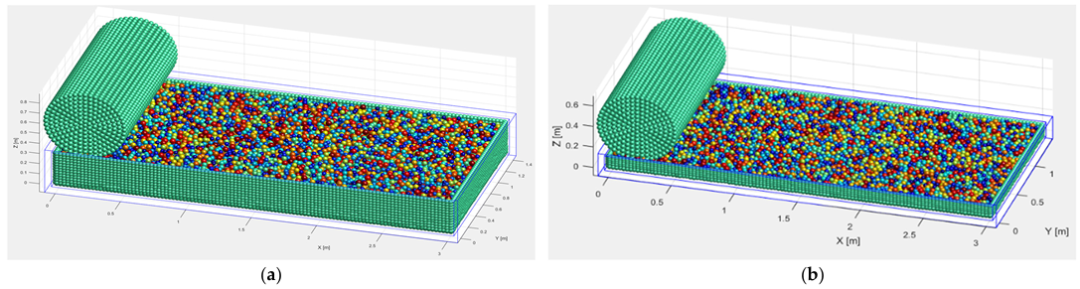
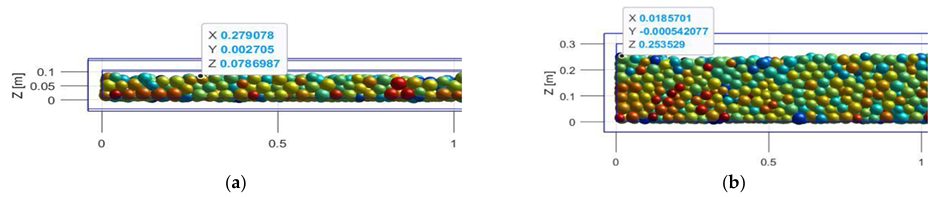
Fig.2 Three-dimensional model: (a) 30 cm soil sample loosely laid; (b) 10 cm soil sample loosely laid
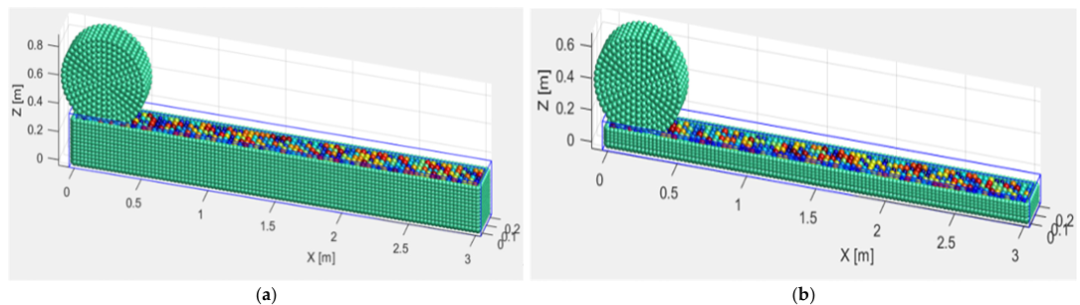
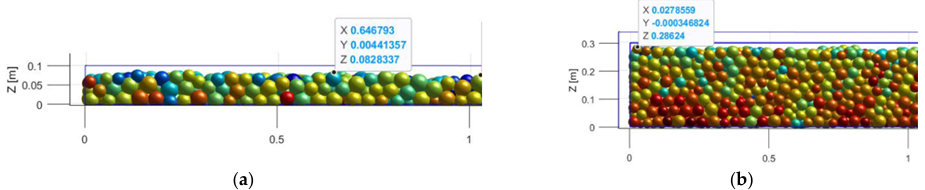
Fig.3 Two-dimensional model: (a) 30 cm soil sample loosely laid; (b) 10 cm soil sample loosely laid
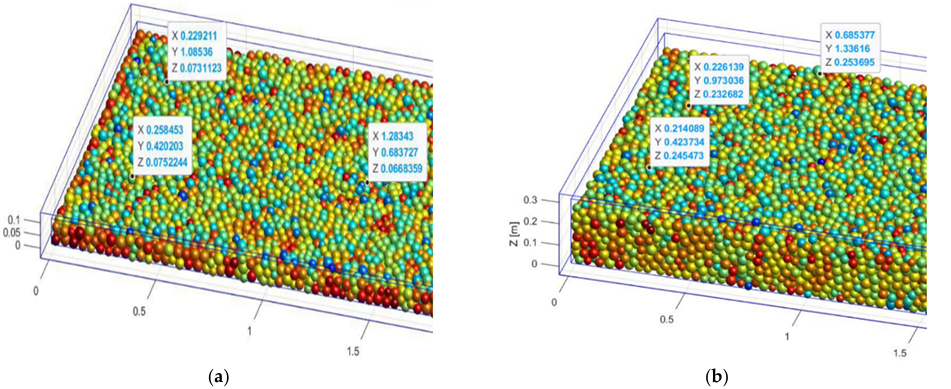
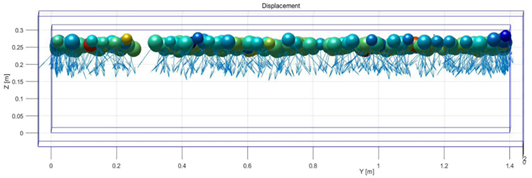
Fig.8 The 10% cement-stabilized soil after eight passes of 3D compaction: (a) 10 cm soil sample loosely laid (model excerpt); (b) 30 cm soil sample loosely laid (model excerpt)
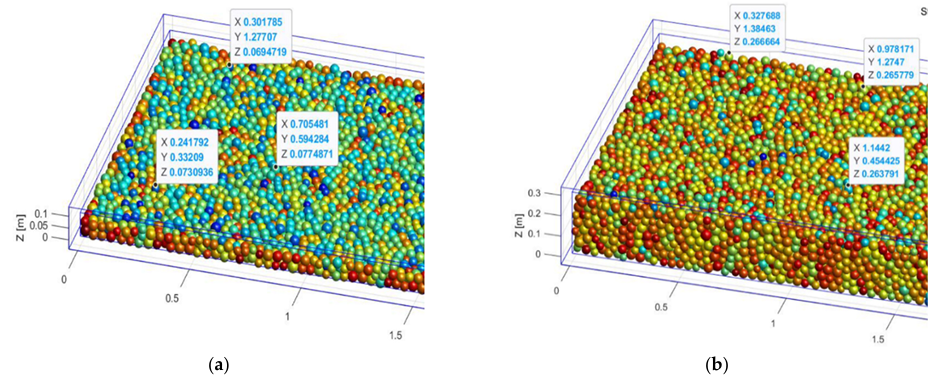
Fig.9 The 25% cement-stabilized soil after eight passes of 3D compaction: (a)10 cm soil sample looselylaid(modelexcerpt);(b)30 cm soil sample loosely laid(modelexcerpt)
了解详情
Wang M, Wang R, Gao J. Numerical Simulation of the Compaction of Stabilized Saline–Alkali Soil Using the MatDEM Method[J]. Applied Sciences, 2025, 15(20): 11221.