
指定级配的分层压缩法成样

前述文章讲述了基本的成样方法(简述PFC成样方法),其中通过对比也能感受到分层压缩法在均匀试样形成中的优越性。
前面介绍的成样方法中,试样只有两种粒径,其实已经讲述了如何根据级配计算颗粒数的方法。这里为了方便使用,给出指定级配的试样的分层压缩方法。
一、二维矩形试样
下面为参数部分:
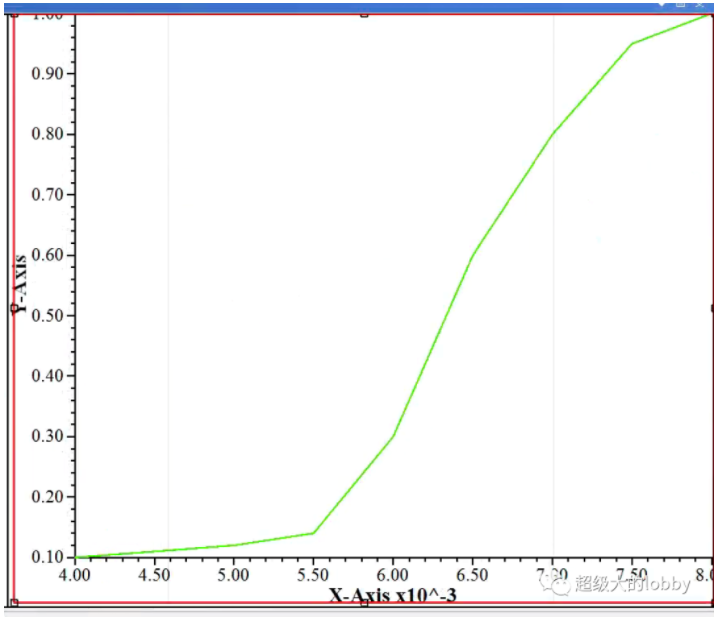
newdef parwidth=0.3height= width*2y_vel=10.0cengshu=8.0pengzhangxishu=5.0tbjipei=table.create("jipei")table(tbjipei,0.004)=0.1table(tbjipei,0.005)=0.12table(tbjipei,0.0055)=0.14table(tbjipei,0.006)=0.3table(tbjipei,0.0065)=0.6table(tbjipei,0.007)=0.8table(tbjipei,0.0075)=0.95table(tbjipei,0.008)=1poro=0.12;dengchaxian=0.02end@par
这里使用table记录级配,x和y分别是粒径和对应粒径的质量百分比。注意这里的粒径没有连续的变化,都是突变的,如果粒径分的足够细的话也就是曲线了。基本的参数还有尺寸以及层数,还有每次压缩时候区域的膨胀系数。
table可以显示出级配曲线:
之后进行分层压缩,这里预留了每层孔隙率变化的代码部分,读者可以自己体会一下注释部分。
newdef parwidth=0.3height= width*2y_vel=10.0cengshu=8.0pengzhangxishu=5.0tbjipei=table.create("jipei")table(tbjipei,0.004)=0.1table(tbjipei,0.005)=0.12table(tbjipei,0.0055)=0.14table(tbjipei,0.006)=0.3table(tbjipei,0.0065)=0.6table(tbjipei,0.007)=0.8table(tbjipei,0.0075)=0.95table(tbjipei,0.008)=1poro=0.12;dengchaxian=0.02end@pardomain extent [-height*10] [height*10]set random 10001wall generate box [-width*0.5] [width*0.5] [-height*0.5] [height*(pengzhangxishu-1)-height*0.5] expand 1.5cmat default model linear method deformability emod 100e6 kratio 1.5def create_sampletb_ceng=table.create("ceng_poro")loop n(1,cengshu)dibuzuobiao=-height*0.5 height*(n-1)/cengshudingbuzuobiao=-height*0.5 height*(n)/cengshupengzhangGaoDu=dingbuzuobiao height*(pengzhangxishu-1)/cengshucommandwall delete walls range id 3wall create id 3 vertices [-width*0.5*1.5] [pengzhangGaoDu] [width*0.5*1.5] [pengzhangGaoDu]endcommandporoceng=poro;-(n-(cengshu 1)*0.5)*dengchaxian/(cengshu-1)table(tb_ceng,n)=porocengkeligeoup=table.size(tbjipei)Vs=height*width*(1-poroceng)/cengshucenggName=string.build("ceng%1",n)loop m(1,keligeoup)keligid=keligeoup 1-mvslocal=0if keligid=1 thenvslocal=Vs*table.y(tbjipei,keligid)elsevslocal=Vs*(table.y(tbjipei,keligid)-table.y(tbjipei,keligid-1))endifkelinum=vslocal/(math.pi*(table.x(tbjipei,keligid)*0.5)^2)commandball generate radius [table.x(tbjipei,keligid)*0.5] number [math.ceiling(kelinum)] box [-width*0.5] [width*0.5] ...[dibuzuobiao] [pengzhangGaoDu] group @cenggName tries 20000ball attribute density 2.7e3 damp 0.7endcommandendloopcommandwall attribute yvel [-y_vel] range id 3solve time [(pengzhangGaoDu-dingbuzuobiao)/y_vel]wall attribute yvel 0 range id 3cycle 2000endcommandendloopend@create_samplesolvesave sample
成好的试样为:
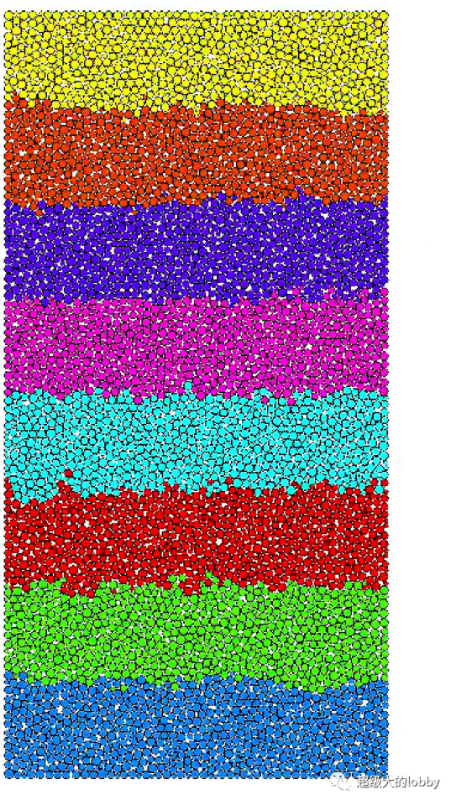
这里分了八层成样,对试样采用测量圆检测其孔隙率,方法在前述的成样方法中已讲述(简述PFC成样方法)
测量圆布置为:
.png?imageView2/0 "20220718152646-640 (1).png")
孔隙率分布为:
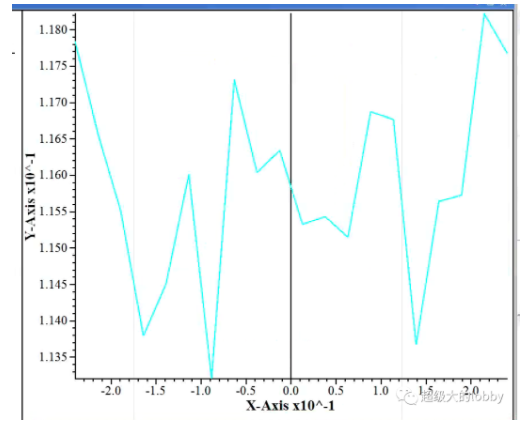
可以看出孔隙率与预计的要差一点,这是因为计算粒径的时候没有考虑到重叠,所以测量圆测的孔隙率要小一点。这个在成密样的时候会出现这个问题,所以可能之后的孔隙率要预设大一点。
二、三维方形试样
这里道理是差不多的,只是多了一个维度而已:
newdef parwidth=0.1height=width*2.0y_vel=10.0cengshu=8.0pengzhangxishu=5.0tbjipei=table.create("jipei")table(tbjipei,0.004)=0.1table(tbjipei,0.005)=0.12table(tbjipei,0.0055)=0.14table(tbjipei,0.006)=0.3table(tbjipei,0.0065)=0.6table(tbjipei,0.007)=0.8table(tbjipei,0.0075)=0.95table(tbjipei,0.008)=1poro=0.25;dengchaxian=0.02end@pardomain extent [-height*pengzhangxishu*2] [height*pengzhangxishu*2]set random 10001wall generate box [-width*0.5] [width*0.5] [-width*0.5] [width*0.5] [-height*0.5] [height*(pengzhangxishu-1)-height*0.5] expand 1.5cmat default model linear method deformability emod 100e6 kratio 1.5def create_sampletb_ceng=table.create("ceng_poro")loop n(1,cengshu)dibuzuobiao=-height*0.5 height*(n-1)/cengshudingbuzuobiao=-height*0.5 height*(n)/cengshupengzhangGaoDu=dingbuzuobiao height*(pengzhangxishu-1)/cengshucommandwall delete walls range id 2wall create id 2 vertices [-width*0.5*1.5] [-width*0.5*1.5] [pengzhangGaoDu] ...[width*0.5*1.5] [width*0.5*1.5] [pengzhangGaoDu] ...[width*0.5*1.5] [-width*0.5*1.5] [pengzhangGaoDu] ...[-width*0.5*1.5] [-width*0.5*1.5] [pengzhangGaoDu] ...[width*0.5*1.5] [width*0.5*1.5] [pengzhangGaoDu] ...[-width*0.5*1.5] [width*0.5*1.5] [pengzhangGaoDu]endcommandporoceng=poro;-(n-(cengshu 1)*0.5)*dengchaxian/(cengshu-1)table(tb_ceng,n)=porocengkeligeoup=table.size(tbjipei)Vs=height*width*width*(1-poroceng)/cengshucenggName=string.build("ceng%1",n)loop m(1,keligeoup)keligid=keligeoup 1-mvslocal=0if keligid=1 thenvslocal=Vs*table.y(tbjipei,keligid)elsevslocal=Vs*(table.y(tbjipei,keligid)-table.y(tbjipei,keligid-1))endifkelinum=vslocal/((4.0/3.0)*math.pi*(table.x(tbjipei,keligid)*0.5)^3)commandball generate radius [table.x(tbjipei,keligid)*0.5] number [math.ceiling(kelinum)] box [-width*0.5] [width*0.5] [-width*0.5] [width*0.5] ...[dibuzuobiao] [pengzhangGaoDu] group @cenggName tries 2000000ball attribute density 2.7e3 damp 0.7endcommandendloopcommandwall attribute zvel [-y_vel] range id 2solve time [(pengzhangGaoDu-dingbuzuobiao)/y_vel]wall attribute zvel 0 range id 2cycle 2000endcommandendloopend@create_samplesolveball delete range x [-width*0.5] [width*0.5] not y [-width*0.5] [width*0.5] not z [-height*0.5] [height*0.5] notsave sample_lifang
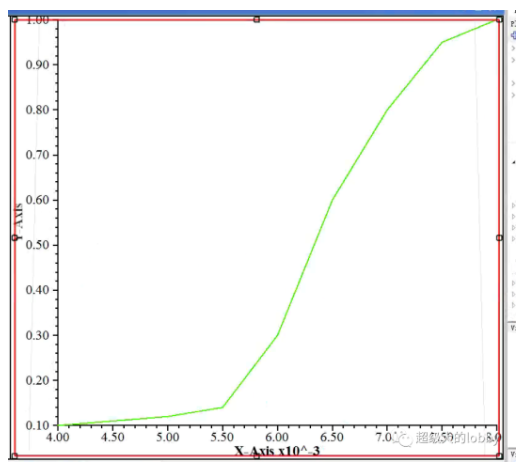
这里为了方便计算,试样级配稍微紧一点:
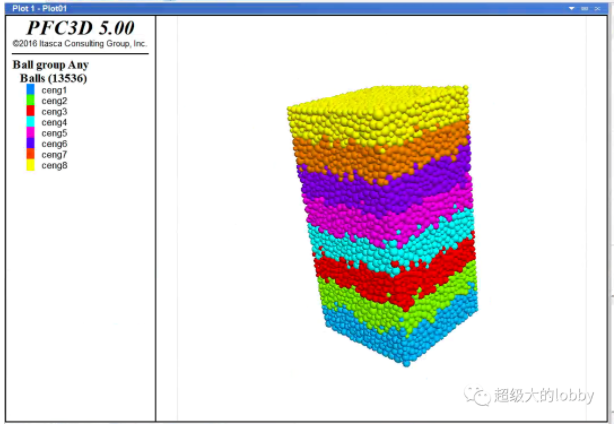
最后结果为:
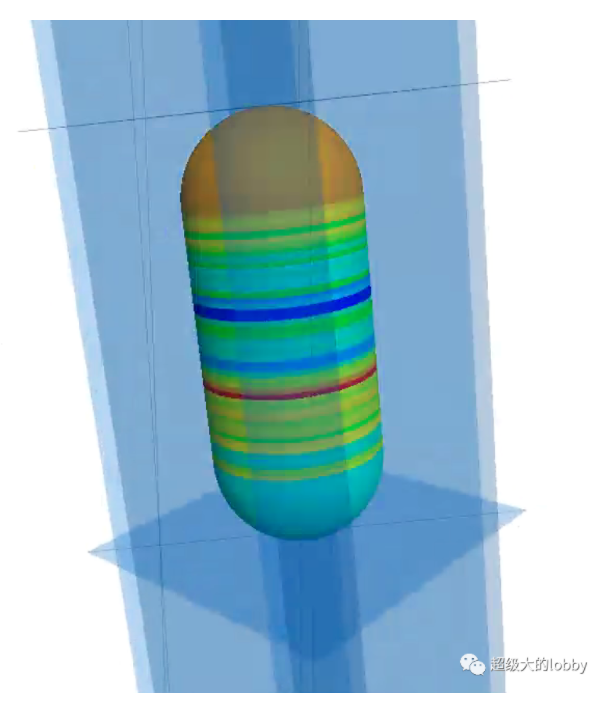
测量圆布置为:
检测结果为:
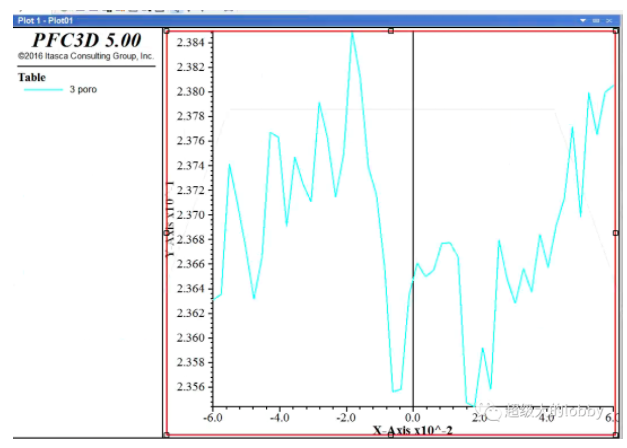
和二维一样,孔隙率会略低。
三、三维圆柱试样
这里算的时候有两个问题:
1)圆柱形内使用generate时,数目一直不够,于是我先方形generate,然后删除圆柱其余部分。不知道是不是版本问题,直接圆柱形generate生成的代码也保留在煮熟中,高版本的读者可以尝试一下。
2)圆柱体无摩擦平衡一直平衡不下来,经过检查,可能是可以facet很多有关系,将圆柱墙的facet减少,会容易平衡一点,但是圆柱形状也出不来,现在我也没想好比较好的办法,只能成样的时候加了fric加快平衡。
newdef parradshiyang=0.04height= radshiyang*4y_vel=100.0cengshu=8.0pengzhangxishu=5.0tbjipei=table.create("jipei")table(tbjipei,0.002)=0.1table(tbjipei,0.003)=0.14table(tbjipei,0.004)=0.3table(tbjipei,0.005)=0.6table(tbjipei,0.006)=0.8table(tbjipei,0.009)=1poro=0.25dengchaxian=0.02end@pardomain extent [-height*pengzhangxishu*2] [height*pengzhangxishu*2]set random 10001wall generate id 3 cylinder base 0 0 [-height*0.5*pengzhangxishu] axis 0 0 1 ...height [height*pengzhangxishu] radius [radshiyang] cap false falsewall create id 1 vertices [-radshiyang*1.5] [-radshiyang*1.5] [-height*0.5] ...[radshiyang*1.5] [radshiyang*1.5] [-height*0.5] ...[radshiyang*1.5] [-radshiyang*1.5] [-height*0.5] ...[-radshiyang*1.5] [-radshiyang*1.5] [-height*0.5] ...[radshiyang*1.5] [radshiyang*1.5] [-height*0.5] ...[-radshiyang*1.5] [radshiyang*1.5] [-height*0.5]cmat default model linear method deformability emod 10e9 kratio 1.5def create_sampletb_ceng=table.create("ceng_poro")loop n(1,cengshu)dibuzuobiao=-height*0.5 height*(n-1)/cengshudingbuzuobiao=-height*0.5 height*(n)/cengshupengzhangGaoDu=dingbuzuobiao height*(pengzhangxishu-1)/cengshucommandwall delete walls range id 2wall create id 2 vertices [-radshiyang*1.5] [-radshiyang*1.5] [pengzhangGaoDu] ...[radshiyang*1.5] [radshiyang*1.5] [pengzhangGaoDu] ...[radshiyang*1.5] [-radshiyang*1.5] [pengzhangGaoDu] ...[-radshiyang*1.5] [-radshiyang*1.5] [pengzhangGaoDu] ...[radshiyang*1.5] [radshiyang*1.5] [pengzhangGaoDu] ...[-radshiyang*1.5] [radshiyang*1.5] [pengzhangGaoDu]endcommandporoceng=poro-(n-(cengshu 1)*0.5)*dengchaxian/(cengshu-1)table(tb_ceng,n)=porocengkeligeoup=table.size(tbjipei)Vs=(math.pi*radshiyang^2)*height*(1-poroceng)/cengshucenggName=string.build("ceng%1",n)loop m(1,keligeoup)keligid=keligeoup 1-mvslocal=0if keligid=1 thenvslocal=Vs*table.y(tbjipei,keligid)elsevslocal=Vs*(table.y(tbjipei,keligid)-table.y(tbjipei,keligid-1))endif;kelinum=vslocal/((4.0/3.0)*math.pi*(table.x(tbjipei,keligid)*0.5)^3)kelinum=vslocal*4/math.pi/((4.0/3.0)*math.pi*(table.x(tbjipei,keligid)*0.5)^3)commandball generate radius [table.x(tbjipei,keligid)*0.5] number [math.ceiling(kelinum)] box [-radshiyang] [radshiyang] [-radshiyang] [radshiyang] ...[dibuzuobiao] [pengzhangGaoDu] group @cenggName tries 2000000ball delete range cylinder ...end1 0 0 [-height*0.5] end2 0 0 [pengzhangGaoDu] radius [radshiyang*0.96] not; ball generate radius [table.x(tbjipei,keligid)*0.5] number [math.ceiling(kelinum)] ...; group @cenggName tries 2000000 range cylinder ...; end1 0 0 [dibuzuobiao] end2 0 0 [pengzhangGaoDu] radius [radshiyang]ball attribute density 2.7e3 damp 0.7endcommandendloopcommandwall attribute zvel [-y_vel] range id 2solve time [(pengzhangGaoDu-dingbuzuobiao)/y_vel]wall attribute zvel 0 range id 2cycle 2000endcommandendloopend@create_sampleball delete range cylinder ...end1 0 0 [-height*0.5] end2 0 0 [height*0.5] radius [radshiyang] notcmat default type ball-ball model linear method deformability emod 10e9 kratio 1.5 property fric 0.2cmat default type ball-facet model linear method deformability emod 10e9 kratio 1.5 property fric 0.2cmat applysolvesave sample_yuanxing
如图为成好的试样:
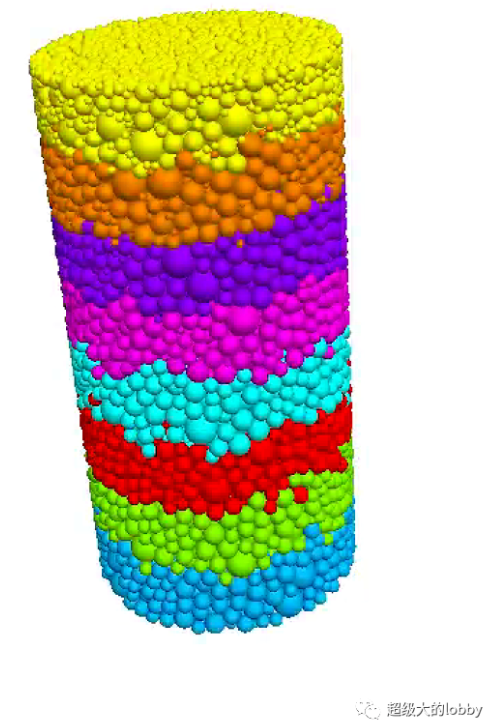
试样孔隙率分布为:
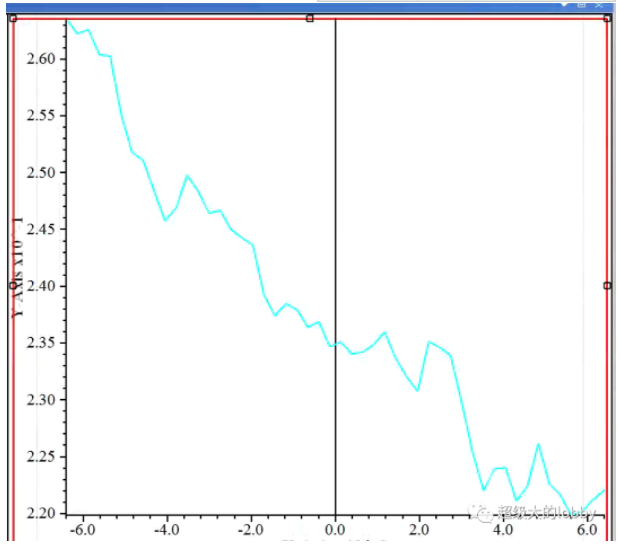
总的来说试样还是因为重叠量会比预设的孔隙率要低。
成样方法对试样的影响还没有仔细的研究,后面再有时间会再花时间去做一下比对。