【新文速递】2026年5月12日复合材料SCI期刊最新文章
今日更新:Composite Structures 2 篇,Composites Part A: Applied Science and Manufacturing 2 篇,Composites Part B: Engineering 1 篇
Composite Structures
Carbon fiber reinforced thermoplastic composites butt joining with laser-assisted metal tape placement welding method
Yang Cao, Yi Xiao, Jie Zhou, Haolei Ru, Junke Jiao
doi:10.1016/j.compstruct.2026.120441
碳纤维增强热塑性复合材料对接激光辅助金属带焊接法
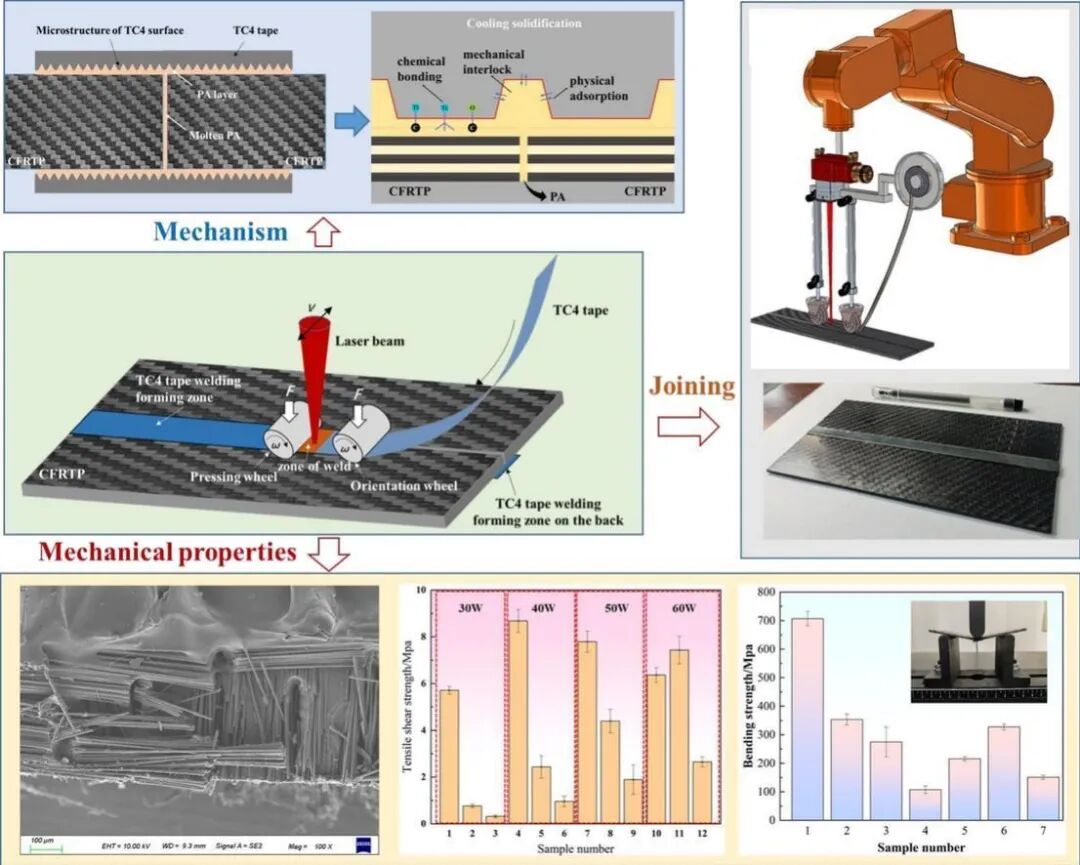
Carbon fiber reinforced thermoplastic composites (CFRTP) are key to lightweight structures, yet high-performance butt joints remain challenging. A laser-assisted welding method using a structured TC4 metal tape to achieve robust CFRTP–TC4 butt joints was developed in this paper. A systematic investigation was conducted on the welding mechanis m, joint performance, and failure behavior. The results indicate that under laser irradiation, a quenching effect was induced on TC4 surface, enhancing its hardness, wear and corrosion resistance. Driven by the combined action of mechanical interlocking, van der Waals forces, and chemical bonding, high-strength CFRTP butt joints were successfully fabricated. The joint fails via interlaminar tearing within the CFRTP, indicating strength exceeding the composite’s interlaminar capacity. A flexural strength of 353.37 MPa (50% of CFRTP) and high bending resistance are achieved.
碳纤维增强热塑性复合材料(CFRTP)是轻量化结构的关键,但高性能对接接头仍然具有挑战性。本文提出了一种采用结构化TC4金属带的激光辅助焊接方法,以实现坚固的CFRTP-TC4对接接头。对焊接机理、接头性能和失效行为进行了系统的研究。结果表明:在激光照射下,TC4表面产生淬火效应,提高了TC4的硬度、耐磨性和耐腐蚀性;在机械联锁、范德华力和化学键合的共同作用下,成功制备了高强度CFRTP对接接头。CFRTP内部的层间撕裂导致接头失效,表明强度超过复合材料的层间承载力。抗弯强度为353.37 MPa(为CFRTP的50%),具有较高的抗弯性能。
Fracture process zone and crack migration in pure mode II bonded composite joints: influence of pre-crack, stacking sequence, normalized crack-geometry
Ishan Manoj, Daniel Bernardes de Castro, John-Alan Pascoe, René Alderliesten
doi:10.1016/j.compstruct.2026.120440
纯II型粘结复合材料接头断裂过程区与裂纹迁移:预裂纹、堆积顺序、归一化裂纹几何形状的影响
This study examines how loading mode during pre-cracking, stacking sequence, and initial delamination ratio (a0/L) influence Mode II fracture characterization (GIIC ) of bonded composite joints. 3-point End-Notched Flexural tests were performed on Unidirectional (UD) and Quasi-Isotropic (QI) carbon fibre/epoxy laminates bonded with AF163-2 K adhesive. Results reveal that fracture toughness and crack migration are governed by the morphology of the Fracture Process Zone (FPZ). In UD laminates, Mode I pre-cracking forms localized FPZ, requiring intense plastic deformation to transition into shear-dominated FPZ, capturing the upper-bound fracture resistance. Conversely, Mode II pre-cracked specimens exhibited diffused shear FPZ, resulting in lower GIIC . In QI laminates, diffused FPZ by Mode II pre-cracking delays crack migration into the weaker interlaminar, promoting growth within the bond-layer. However, localized FPZ from Mode I pre-cracks requires intense plastic deformation and shear cracks for the crack to grow in the bond-layer, triggering earlier migration. The crack migration was sensitive to the “a0/L” ratio: a ratio of 0.4 induces independent interlaminar delamination, while 0.6 displays angular crack-migration. These mechanis ms remained invariant when the span-length was scaled, provided the normalized crack length was preserved. This study demonstrates that GIIC is process-dependent, underscoring the need to characterize fractures based on FPZ evolution.
本研究考察了预裂加载模式、堆叠顺序和初始分层率(a0/L)对粘结复合材料接头II型断裂表征(GIIC)的影响。采用AF163-2 K胶粘剂对单向(UD)和准各向同性(QI)碳纤维/环氧层压板进行三点端缺口弯曲试验。结果表明,断裂韧性和裂纹迁移受断裂过程区(FPZ)形貌的控制。在UD层压板中,I型预裂形成局部FPZ,需要强烈的塑性变形才能过渡到剪切主导的FPZ,从而获得上限断裂抗力。相反,II型预裂试件表现为扩散剪切FPZ,导致GIIC较低。在QI层压板中,II型预裂扩散的FPZ延迟了裂纹向较弱层间的迁移,促进了粘结层内的生长。然而,来自I型预裂纹的局部化FPZ需要强烈的塑性变形和剪切裂纹才能使裂纹在粘结层中扩展,从而触发更早的迁移。裂纹迁移对“a0/L”比值敏感,当a0/L比值为0.4时,产生独立的层间分层,而当a0/L比值为0.6时,产生角度裂纹迁移。这些机制保持不变,当跨度长度缩放,提供归一化的裂纹长度被保留。该研究表明,GIIC依赖于过程,强调了根据FPZ演化特征来描述裂缝的必要性。
Composites Part A: Applied Science and Manufacturing
Fracture behavior of multi-phased nanomaterial reinforced interpenetrating polymeric composites
Baosong Li, Suhail K. Siddique, Kishor Shingare, Abdallah Kamal, Abdullah Solayman, Dawei Zhang, Andreas Schiffer, Lianxi Zheng, Kin Liao
doi:10.1016/j.compositesa.2026.109926
多相纳米材料增强互穿聚合物复合材料的断裂行为
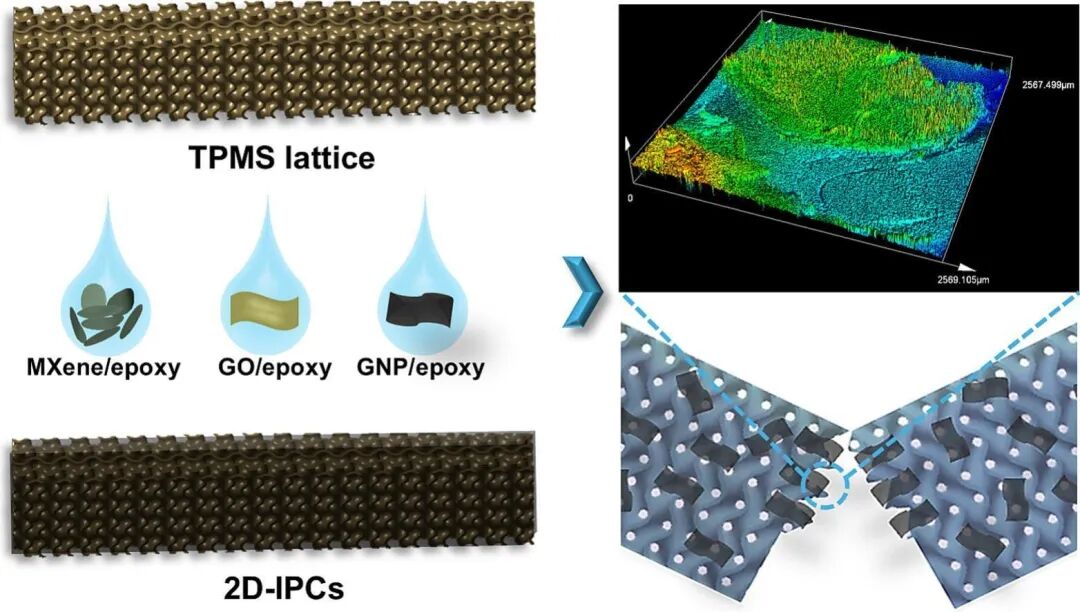
Interpenetrating phase composites (IPCs) rooting on triply periodic minimal surface architectures (TPMS) have attracted considerable attention owing to their exceptional mechanical properties. Fracture toughness under flexural loading is a critical parameter; however, it remains relatively underexplored for TPMS-based IPCs. In this work, IPCs incorporating a gyroid-structured TPMS lattice and a 2D-material-reinforced polymer matrix were fabricated via additive manufacturing, followed by an interpenetration process. 2D material fillers—MXene, graphene oxide, and graphene nanoplatelets—were individually incorporated into the polymer phase prior to the interpenetration process to fabricate 2D-material-reinforced IPCs (2D-IPCs). The resulting 2D-IPCs exhibited markedly superior fracture resistance compared to lattice/polymer IPCs. Comprehensive fractographic an alysis was performed to elucidate the underlying fracture mechanis ms. The findings indicate that the 2D‑IPCs exhibit hierarchical zigzag crack trajectories at three coupled scales—large (lattice‑guided), medium (epoxy‑mediated), and s mall (2D‑filler‑induced). TPMS architectures alter the crack propagation path, while the incorporated 2D materials activate additional toughening mechanis ms during deformation, suppressing crack growth and promoting significant crack deflection—thereby enhancing material toughness. Furthermore, finite element modeling was employed to uncover the fracture initiation behavior in IPCs. This work provides new insights into tailoring the fracture properties of IPCs by engineering the reinforcement phase and optimizing constituent material properties.
基于三周期最小表面结构(TPMS)的互穿相复合材料(IPCs)因其优异的力学性能而受到广泛关注。弯曲载荷下的断裂韧性是关键参数;然而,对于基于tpms的IPCs来说,这方面的探索仍然相对不足。在这项工作中,IPCs结合了一个陀螺结构的TPMS晶格和一个2d材料增强聚合物基体,通过增材制造,然后是一个互渗过程。在互渗过程之前,将二维材料填料(mxene、氧化石墨烯和石墨烯纳米片)单独掺入聚合物相中,以制造二维材料增强IPCs (2D-IPCs)。与晶格/聚合物IPCs相比,2D-IPCs具有明显更好的抗断裂性能。进行了全面的断口分析,以阐明潜在的断裂机制。研究结果表明,2D - IPCs在三个耦合尺度上表现出分层之字形裂纹轨迹:大尺度(晶格引导)、中尺度(环氧树脂介导)和小尺度(2D填料诱导)。TPMS结构改变了裂纹扩展路径,而加入的二维材料在变形过程中激活了额外的增韧机制,抑制了裂纹扩展并促进了显著的裂纹偏转,从而提高了材料的韧性。在此基础上,利用有限元模型揭示了IPCs的断裂起裂行为。这项工作为通过设计增强相和优化成分材料性能来定制ipc的断裂性能提供了新的见解。
Piezoresistive response and damage evolution of CNT/TPU/ABS nanocomposites under tensile loading
Z. Zhang, P. Goyal, J. Adrien, V.L. Tagarielli, E. Maire, Q. Li
doi:10.1016/j.compositesa.2026.109925
拉伸载荷下CNT/TPU/ABS纳米复合材料的压阻响应及损伤演化
We investigated the piezoresistive performance and damage evolution of carbon nanotube (CNT) reinforced polymer composites suitable for deformable electronics. CNT/TPU (Thermoplastic Polyurethane)/ABS (Acrylonitrile Butadiene Styrene) nanocomposites (TPU/ABS weight ratio: 4/1) were manufactured via solution-casting and hot-pressing. A low electrical percolation threshold of 0.1 wt% and a 70% improvement in elastic modulus at 1 wt% CNT loading were achieved, indicating effective CNT distribution and interfacial interaction. To study the mechanis m governing the piezoresistive responses of CNT/TPU/ABS, specimens underwent monotonic, stiffness-sensing, and progressive cyclic tests. The nanocomposite resistance exhibited three distinct responses to deformation under progressive cyclic tests. Notably, the volumetric conductivity results, decoupling the effects of applied strain and variation in conductivity on the electrical resistance, revealed the negative piezoresistivity of CNT/TPU/ABS during the unloading and reloading processes in the cyclic tests. This finding helps explain the resistance-strain response of similar nanocomposites based on the competition between the intrinsic piezoresistive effect and geometric changes. Furthermore, the in-situ electromechanical X-ray computed tomography (CT) test directly correlated the macroscopic electrical responses of CNT/TPU/ABS and its microstructural damage evolution. After void nucleation, the resistance was found to continue increasing during stress relaxation.
研究了适用于可变形电子器件的碳纳米管增强聚合物复合材料的压阻性能和损伤演变。采用溶液浇铸和热压法制备了碳纳米管/热塑性聚氨酯(TPU)/ABS(丙烯腈丁二烯苯乙烯)纳米复合材料(TPU/ABS重量比为4/1)。当碳纳米管负载为1 wt%时,电渗透阈值低至0.1 wt%,弹性模量提高70%,表明碳纳米管分布和界面相互作用有效。为了研究控制CNT/TPU/ABS压阻响应的机制,试样进行了单调、刚度传感和渐进循环试验。在渐进式循环试验中,纳米复合材料对变形表现出三种不同的响应。值得注意的是,体积电导率结果,解耦了外加应变和电导率变化对电阻的影响,揭示了CNT/TPU/ABS在卸载和再加载过程中的负压电阻率。这一发现有助于解释基于固有压阻效应和几何变化之间竞争的相似纳米复合材料的电阻-应变响应。此外,原位机电x射线计算机断层扫描(CT)测试直接将CNT/TPU/ABS的宏观电响应与其微观结构损伤演变联系起来。空穴成核后,电阻在应力松弛过程中继续增大。
Composites Part B: Engineering
Effect of a Rigid-Flexible-Rigid Sizing Agent on the Mechanical Enhancement of Carbon Fiber Composites
Lu Liu, Lei Zhao, Chao Fang, Lu-lu Wang, Duo-zhi Wang
doi:10.1016/j.composites b.2026.113749
刚性-柔性-刚性施胶剂对碳纤维复合材料力学增强的影响
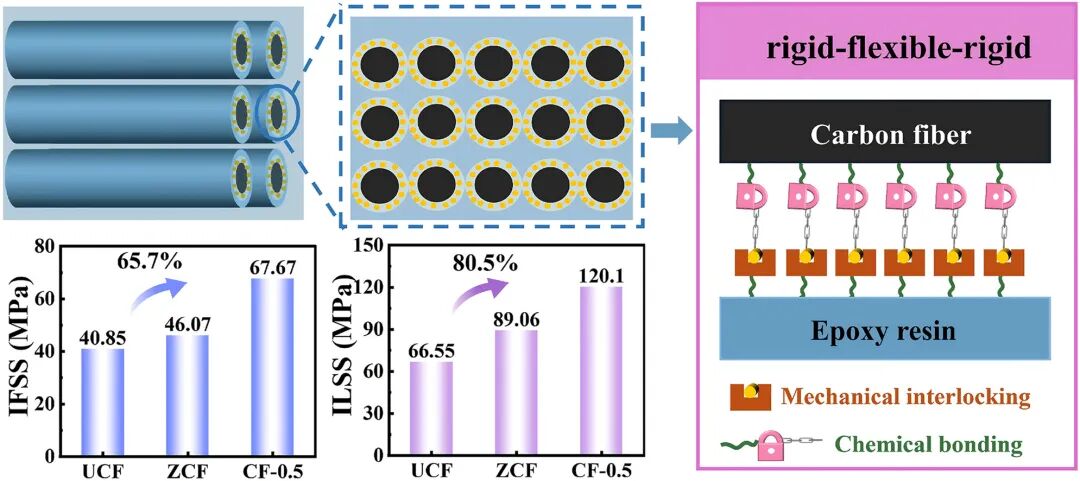
Carbon fiber/epoxy resin composites are extensively used in aerospace and defense applications; however, the surface of carbon fibers (CFs) is chemically inactive, leading to weak interfacial adhesion with resin matrices. This limited compatibility significantly reduces the overall mechanical performance of the CF/EP composites. To enhance the interfacial performance of CF/EP composites, a rigid flexible rigid sizing agent was developed by chemically modifying epoxy resin with m-xylylenediamine and incorporating silanized SiO2. Detailed characterization results demonstrated that this sizing agent markedly improved the surface wettability of CF and strengthened the interfacial bonding in the CF/EP composite systems. At an optimal nano- SiO2 mass fraction of CF-0.5, the sizing agent produces a homogeneous layer on the CF surface, leading to notable increases in surface roughness and surface energy. Mechanical tests indicate that the CF-0.5/EP composites achieve an interlaminar shear strength of 120.1 MPa and an interfacial shear strength of 67.67 MPa, corresponding to increases of 80.5% and 65.7%, respectively, compared to UCF/EP composites. In addition, the sizing agent exhibits excellent thermal stability and stable emulsion properties. This hybrid sizing approach provides a practical and effective method for improving the interfacial performance of CF/EP composites, thereby supporting their use in advanced applications, including aerospace and new energy.
碳纤维/环氧树脂复合材料广泛应用于航空航天和国防领域;然而,碳纤维(CFs)的表面是化学活性的,导致与树脂基体的界面附着力弱。这种有限的相容性显著降低了CF/EP复合材料的整体机械性能。为提高CF/EP复合材料的界面性能,采用间二胺对环氧树脂进行化学改性,并添加硅化SiO2,研制了一种刚柔型刚性施胶剂。详细表征结果表明,该施胶剂显著改善了CF的表面润湿性,增强了CF/EP复合体系中的界面结合。当纳米SiO2质量分数为CF-0.5时,施胶剂在CF表面形成均匀层,导致表面粗糙度和表面能显著提高。力学试验表明,CF-0.5/EP复合材料的层间抗剪强度为120.1 MPa,界面抗剪强度为67.67 MPa,比UCF/EP复合材料分别提高了80.5%和65.7%。此外,该施胶剂具有优良的热稳定性和稳定的乳液性能。这种混合施胶方法为提高CF/EP复合材料的界面性能提供了一种实用有效的方法,从而支持其在航空航天和新能源等先进应用中的应用。