非线性固体与结构力学有限元权威教程(第 7 版)英文版 电子书631页

非线性固体与结构力学有限元权威教程(第 7 版)(The-Finite-Element-Method-for-Solid-and-Structural-Mechanics)英文版 电子书
摘要:
本书为非线性固体与结构力学有限元第七版权威教程,系统讲解有限元法在材料非线性、几何非线性及接触问题中的理论与实现。全书从弱形式与伽辽金法出发,推导非线性方程组求解的牛顿法、修正牛顿法与拟牛顿法,覆盖粘弹性、弹塑性、广义塑性等本构模型,含 von Mises、Mohr‑Coulomb 等屈服准则。书中详述杆、梁、壳几何精确有限元列式,引入多尺度建模与自适应网格技术,提供接触约束、刚体耦合、热‑结构耦合等工程解法,配套 FEAPpv 程序源码,是有限元理论、算法与工程仿真的经典参考书。
The Finite Element Method for Solid and Structural Mechanics Seventh Edition
O.C. Zienkiewicz, CBE, FRS
Previously UNESCO Professor of Numerical Methods in Engineering International Centre for Numerical Methods in Engineering, Barcelona, SpainPreviously Director of the Institute for Numerical Methods in Engineering University of Wales Swansea, UK
R.L. Taylor
Professor in the Graduate School Department of Civil and Environmental Engineering University of California at Berkeley
Berkeley, CA, USA
D.D. Fox
Dassault Syste`mes SIMULIA
Providence, RI, USA
The Finite Element Method for Solid and Structural Mechanics
This book is dedicated to Olgierd Cecil Zienkiewicz and Juan Carlos Simo
Professor O.C. Zienkiewicz, CBE, FRS, FREng died on January 2, 2009. Prior to his death he was Professor Emeritus at the Civil and Computational Engineering Centre, University of Wales, Swansea and previously was Director of the Institute for Numerical Methods in Engineering at the University of Wales, Swansea, UK. He also held the UNESCO Chair of Numerical Methods in Engineering at the Technical University of Catalunya, Barcelona, Spain. He was the head of the Civil Engineering Department at the University of Wales, Swansea between 1961 and 1989. During this period he established that department as one of the primary centers of finite element research. In 1968 he became the Founder Editor of the International Journal for Numerical Methods in Engineering which still remains today the major journal in this field. The recipient of 27 honorary degrees and many medals, Professor Zienkiewicz was a member of five academies—an honor he received for his many contributions to the fundamental developments of the finite element method. In 1978, he became a Fellow of the Royal Society and the Royal Academy of Engineering. This was followed by his election as a foreign member to the US Academy of Engineering (1981), the Polish Academy of Science (1985), the Chinese Academy of Sciences (1998), and the National Academy of Science, Italy (Accademia dei Lincei) (1999). He published the first edition of this book in 1967.
Professor R.L. Taylor has more than 50 years’ experience in the modeling and simulation of structures and solid continua including 8 years in industry. He is Professor of the Graduate School and the Emeritus T.Y. and Margaret Lin Professor of Engineering at the University of California at Berkeley and also Corporate Fellow at Dassault Systèmes SIMULIA in Providence, Rhode Island. In 1991 he was elected to membership in the US National Academy of Engineering in recognition of his educational and research contributions to the field of computational mechanics. Professor Taylor is a Fellow of the US Association of Computational Mechanics— USACM (1996) and a Fellow of the International Association of Computational Mechanics—IACM (1998). He has received numerous awards including the Berkeley Citation, the highest honor awarded by the University of California at Berkeley, the USACM John von Neumann Medal, the IACM Gauss-Newton Congress Medal, and a Dr.-Ingenieur Ehrenhalber awarded by the Technical University of Hannover, Germany.
Dr. D.D. Fox has more than 26 years’ experience in the research and develop- ment of finite element technology. During the last 22 years he has worked at Dassault Systèmes SIMULIA, makers of the Abaqus finite element software program, where he has held various positions ranging from finite element software developer to development group manager. Currently, he is Senior Director in SIMULIA’s CTO Office responsible for research into innovative uses of simulation technology in science and engineering. Dr. Fox was awarded his doctoral degree in 1990 from the Division of Applied Mechanics at Stanford University, working under the supervi- sion of Professor Juan Carlos Simo. Dr. Fox is the author of many technical papers on finite element methods, including a seminal series on a stress resultant geometrically exact shell model that resulted in seven parts, covering the mathematical theory, lin- ear and nonlinear finite element implementation, thickness change effects, nonlinear constitutive behavior, transient dynamics simulation, and shell intersections. This highly cited series helped usher in the modern mathematical approach to computa- tional structural mechanics.
Preface
The present revision of The Finite Element Method was undertaken shortly before the passing in January 2009 of our close friend and co-author Olgierd C. (Olek) Zienkiewicz. His inspiration and guidance has been greatly missed in the intervening years, however, we hope that the essence of his writings is retained in the new work so that current and future scholars can continue to benefit from his insights and many contributions to the field of computational mechanics. The story of his life and works is summarized in International Journal for Numerical Methods in Engineering, 80, 2009, pp. 1–45.
It is 46 years since The Finite Element Method in Structural and Continuum Mechanics was first published. This book, which was the first dealing with the finite element method, provided the basis from which many further developments occurred. The expanding research and field of application of finite elements led to the second edition in 1971, the third in 1977, the fourth as two volumes in 1989 and 1991, and the fifth as three volumes in 2000. The size of each of these editions expanded geo- metrically (from 272 pages in 1967 to the sixth edition of nearly 1800 pages). This was necessary to do justice to a rapidly expanding field of professional application and research. Even so, much filtering of the contents was necessary to keep these editions within reasonable bounds.
In the present edition we have retained the complete works as three separate vol- umes, each one capable of being used without the others and each one appealing perhaps to a different audience.
The first volume The Finite Element Method: Its Basis and Fundamentals is designed to cover quite completely all the steps necessary to solve problems repre- sented by linear differential equations. Applications to problems of elasticity, field problems, and plate and shell structural problems form the primary basis from which the finite element steps are enumerated. After a summary of the basic equations in matrix form, chapters on applications to one- to three-dimensional problems are covered. Two methodologies are presented: weak forms (which may be used for any linear differential equation) and variational theorems which are restricted here to steady-state applications. The basic concepts include interpolation of solution variables, numerical integration to evaluate the final matrices appearing in the finite element approximation, and solution of the resulting matrix equations. Both steady- state and transient problems are covered at an early date to permit the methods to be used throughout the volume. The volume also covers the patch test, treatment of constraints arising from near incompressibility and transverse shear deformations in plates and shells, error estimation, adaptivity, and mesh generation.
In this volume we consider more advanced problems in solid and structural mechanics while in a third volume we consider applications in fluid dynamics. It is our intent that the present volume can be used by investigators familiar with the finite element method at the level presented in the first volume or any other basic textbook on the subject. However, the volume has been prepared such that it can stand alone.
The volume has been organized to cover consecutively two main subject areas. In the first part we consider nonlinear problems in solid mechanics and in the second part nonlinear rod and shell problems in structural mechanics.
In Chapters 1–9 we consider nonlinear problems in solid mechanics. In these chapters the special problem of solving nonlinear equation systems is addressed. We begin by restricting our attention to nonlinear behavior of materials while retaining the assumptions on s mall strain. This serves as a bridge to more advanced studies later in which geometric effects from large displacements and deformations are pre- sented. Indeed, nonlinear applications are of great importance today and of practical interest in most areas of engineering and physics. By starting our study first using a s mall strain approach we believe the reader can more easily comprehend the various aspects which need to be understood to master the subject matter. We cover in some detail formulations of material models for viscoelasticity, plasticity, and viscoplas- ticity which should serve as a basis for applications to other material models. In our study of finite deformation problems we present a series of approaches which may be used to solve problems including extensions for multiscale constitutive models, treat- ment of constraints such as near incompressibility, and rigid and multibody motions.
In the second part of the volume we consider problems in structural mechanics. This part of the book has been rewritten completely and presents an introduction to the mathematical basis used in many recent publications. The presentation is strongly guided by the works of the late Juan Carlos Simo who also influenced works by the second and third authors.
Chapter 10 presents a self-contained development of linear shell theory, which includes a review of mathematical preliminaries necessary for understanding the structural theory and its finite element implementation. Linear shell theory serves as a model problem for the recent trend toward a strong mathematical grounding of the finite element method; linear shell theory is a problem that embodies many impor- tant mechanical, geometrical, and numerical a nalysis concepts that benefit from this modern mathematical perspective. Rounding out the mathematical framework, a comprehensive subset of differential geometry and calculus on manifolds is given in Chapter 11. This chapter gives sufficient mathematical background for understand- ing the nonlinear continuum mechanics, nonlinear rod theory, and nonlinear shell theory covered in the subsequent chapters.
Chapter 12 summarizes the basic notation and some fundamental concepts in nonlinear three-dimensional continuum mechanics. This chapter revisits the presen- tation of geometrically nonlinear problems in Chapter 5 within a geometric frame- work. Specifically, the chapter presents a curvilinear coordinate vector expression of nonlinear continuum mechanics that forms a common departure point for the nonlinear geometrically exact rod and shell theories of Chapters 13 and 14. The primary goal these chapters is to present geometrically exact models in a way that is optimally suited for numerical implementation. Much of the complexity in rods and shells stems from the nature of the structural ana lysis (and, hence, is present in linear shell theory) rather than from the nonlinear kinematics or exact geometric treatment of the models. Important details, such as parameterization or the definition of stress resultants, can be isolated from the treatment of large deformation.
The volume concludes with a short chapter on computational methods that describes a companion computer program that can be used to solve several of the problem classes described in this volume.
We emphasize here the fact that all three of our volumes stress the importance of considering the finite element method as a unique and whole basis of approach and that it contains many of the other numerical an alysis methods as special cases.
Resources to accompany this book
Complete source code and user manual for program FEAPpv may be obtained at no cost from the author’s web page: www.ce.berkeley.edu/projects/feap.
R.L. Taylor and D.D. Fox
CHAPTER 1 General Problems in Solid Mechanics and Nonlinearity
1.1 Introduction
Many introductory texts on the finite element method discuss the solution for linear problems of elasticity andfield equations[1–3]. In practical applications the limitation of linear elasticity, or more generally of linear behavior, often precludes obtaining an accurate assess ment of the solution because of the presence of “nonlinear” effects and/or because the geometry has a “thin” dimension in one or more directions. In this book we describe extensions to the formulations introduced to solve linear problems to permit solutions to both classes of problems.
Nonlinear behavior of solids takes two forms: material nonlinearity and geometric nonlinearity. The simplest form of nonlinear material behavior is that of elasticity for which the stress isnot linearly proportional to the strain and is reversible. More general situations are those in which the loading and unloading response of the material is different. Typical here is the case of classical elastic-plastic behavior.
When the deformation of a solid reaches a state for which the undeformed and deformed shapes are substantially different, a state of finite deformation occurs. In this case it is no longer possible to write linear strain-displacement or equilibrium equations on the undeformed geometry. Even before finite deformation exists it is possible to observe buckling or load bifurcations in some solids and nonlinear equilib- rium effects need tobe considered. The classical Euler column, where the equilibrium equation for buckling includes the effect of axial loading, is an example of this class of problems. When the deformation is large the boundary conditions can also become nonlinear. Examples are pressure loading that remains normal to the deformed body and the case where the deformed boundary interacts with another body. This latter example defines a class known as contact problems and a lot of research is currently being conducted in this area. An example of a class of problems involving nonlinear effects in deformation measures, material behavior, and contact is the an alysis of a rolling tire. A typical mesh for a tire an alysis is shown in Fig. 1.1. The cross-section shown is able to model the layering of rubber and cords and the overall character of a tread. The full mesh is generated by sweeping the cross-section around the wheel axis with a variable spacing in the area which will be in contact with the roadway. A formulation in which the mesh is fixed and the material rotates is commonly used to perform the an alysis [4–8].
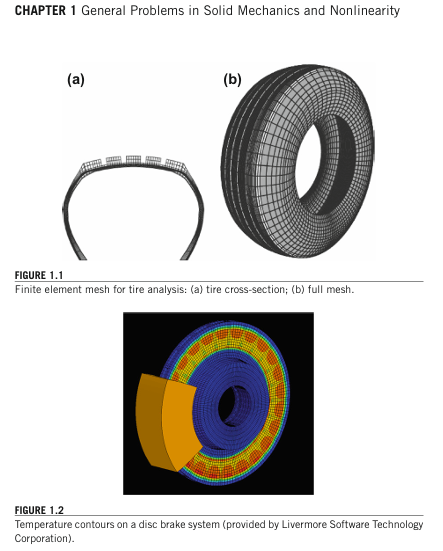
Temperature contours on a disc brake system (provided by Livermore Software Technology Corporation).
Other simulations combine the effects of mechanical behavior with loads gener- ated from thermal or other types of loading. For example, in Fig. 1.2 a typical disc brake system is illustrated with contours of temperature superposed on the model. Solution procedures for thermal an alysis are presented in Ref. [1] and may be com- bined with developments presented in this volume to achieve the solution illustrated in the figure.
Still other problems involve the combination of solid mechanics with compu- tational fluid dynamics. The class of applications can be very broad, ranging from high-speed flows to slow viscous flows. The subject of modeling and solving various types of fluid flow by finite element methods is covered in a companion volume [9].
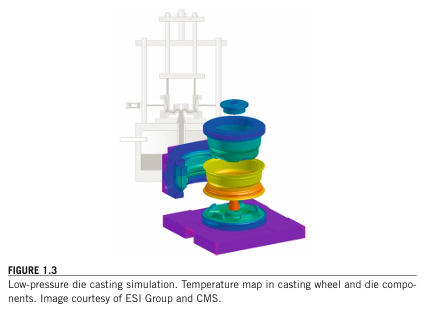
In Fig. 1.3the problem of low-pressure die casting is shown for a typical application. In this class of problems it is necessary to combine the fluid, thermal, and mechanical behavior of materials to achieve a solution.
Generally the accurate solution of solid problems which have one (or more) s mall dimension(s) compared to the others cannot be achieved efficiently using standard two- or three-dimensional finite element formulations. Traditionally separate theories of structural mechanics are introduced to solve this class of problems. A plate is a flat structure with one thin (s mall) direction, which is called the thickness. A shell is a curved structure in space with one such s mall thickness direction. Structures with two s mall dimensions are called beams,frames, or rods. A primary reason why use of standard two-or three-dimensionalfinite element formulations does not yield accurate solutions is the numerical ill conditioning which results in their algebraic equations. In this book we combine the traditional approaches of structural mechanics with a much stronger link to the full three-dimensional theory of solids to obtain formulations which are easily solved using standard finite element approaches.
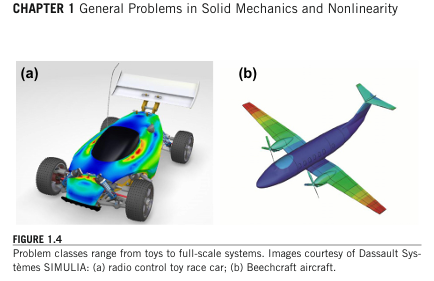
The scope of problems in computational solid and structural mechanics that can be solved today is indeed large and ranges from radio control toy race cars (Fig. 1.4a) to full-size aircraft (Fig. 1.4b). In this class of problems it is necessary to use both structural beam and shell elements as well as solid elements to achieve an accurate representation of the model.
On the cover is a NASA image of the International Space Station orbiting Earth. From the earliest days of the finite element method, aerospace engineering problems
have motivated significant research activity. For example, in the 1960s the manned space program was a national priority in the United States and many researchers worldwide were actively conducting research related to space structures. In such structures, modeling behavior using thin shells and flexible rods is common.
This book considers both solid and structural mechanics problems and formula- tions which make practical finite element solutions feasible. We divide the volume into two main parts. In the first part we consider problems in which the continuum theory of solids continues to be used, whereas in the second part we focus attention on theories of structural mechanics to describe the behavior of rods and shells, with plates being a special case of a flat shell.
In the present chapter we review the general equations for an alysis of solids in which deformations remain “s mall” but material behavior includes effects of a non- linear kind. We present the theory in both an indicial (or tensorial) form as well as in the matrix form commonly used in finite element developments. We also reformulate the equations of solids in a variational (Galerkin) form. In Chapter 2 we present a general scheme based on the Galerkin method to construct a finite element approx- imate solution to problems based on variational forms. In this chapter we consider both irreducible and mixed forms of finite element approximation and indicate where the mixed forms have distinct advantages. Here we also show how the linear problems of solids for steady-state and transient behavior become nonlinear when the material constitutive model is represented in a nonlinear form. Some discussion on the solution of transient nonlinear finite element forms is included. Since the form of the inertial effects is generally unaffected by nonlinearity, in the remainder of this volume we shall primarily confine our remarks to terms arising from nonlinear material behavior and finite deformation effects.
In Chapter 3 we describe various possible methods for solving nonlinear alge- braic equations. This is followed in Chapter 4by consideration of material nonlinear behavior and completes the development of a general formulation from which a finite element computation can proceed.
In Chapter 5we present a summary for the study of finite deformation of solids. Basic relations for defining deformation are presented and used to write variational (Galerkin) forms related to the undeformed configuration of the body and also to the deformed configuration. It is shown that by relating the formulation to the deformed body < a result is obtained which is nearly identical to that for the s mall deformation problem we considered when reviewing the s mall deformation theory in the early chapters of this volume. Essential differences arise only in the constitutive equations (stress-strain laws) and the addition of a new stiffness term commonly called the geo- metric or initial stress stiffness. For constitutive modeling we summarize inChapter 6 alternative forms for elastic and inelastic materials.
In Chapter 7 we discuss multiscale modeling in which behavior of locations in the finite element model is obtained from a detailed model of the material structure in a representative volume element (RVE). This provides an alternative method to describe constitutive equations for material that have complex structure.
Contact problems are discussed in Chapter 8. Here we summarize methods com- monly used to model the interaction ofintermittent contact between surfaces ofbodies.
In Chapter 9we show that an alyses of rigid and so-called pseudo-rigid bodies [10] may be developed directly from the theory of deformable solids. This permits the inclusion in programs of options for multibody dynamic simulations which combine deformable solids with objects modeled as rigid bodies.
In the second part of this book we study the behavior of problems in structural mechanics. In Chapter 10we present a full development of shell theory for the s mall strain, linear elastic theory. This covers the basic behavior on surfaces embedded in a three-dimensional space. Chapter 11 then presents the mathematical background necessary to develop the nonlinear theory. This is followed in Chapter 12by an appli- cation of the theory to nonlinear continuum mechanics and serves as a complement to the presentation in the first part of the volume. In Chapter 13the theory is reduced to create a finite rod theory which includes the effects of axial, bending, and shearing deformation. This part of the volume concludes with a development in Chapter 14 for the fully nonlinear shell model for transient and steady-state behavior.
In the final chapter we summarize the capabilities of a companion computer program (called FEAPpv) that is available at the authors’ website. This program may be used to address the class of nonlinear mechanics problems described in this volume.
1.2 S mall deformation solid mechanics problems
1.2.1 Strong form of equation: Indicial notation
In this general section we shall describe how the various equations of solid mechan- ics1 can become nonlinear under certain circumstances. In particular this will occur for solid mechanics problems when nonlinear stress-strain relationships are used.
1More general theories for solid mechanics problems exist that involve higher-order micro-polar or couple stress effects; however, we do not consider these in this volume.
The chapter also presents the notation and the methodology which we shall adopt throughout this book. The reader will note how simply the transition between forms for linear and nonlinear problems occurs.
The field equations for solid mechanics are given by equilibrium behavior (bal- ance of momentum), strain-displacement relations, constitutive equations, boundary conditions, and initial conditions [11–16].
In the treatment given here we will use two notational forms. Thefirstisa Cartesian tensor indicial form and the second is a matrix form (see Ref. [1] for additional details on both approaches). In general, we shall find that both are useful to describe particular parts of formulations. For example, when we describe large strain problems the development of the so-called “geometric” or “initial stress” stiffness is most easily described by using an indicial form. However, in much of the remainder, we shall find that it is convenient to use a matrix form. The requirements for transformations between the two will also be indicated.
In the sequel, when we use indicial notation an index appearing once in any term is called a free index and a repeated index is called a dummy index. A dummy index may only appear twice in any term and implies summation over the range of the index. Thus if two vectors ai and bi each have three terms (range is 3) the form aibi implies
aibi = a1b1 + a2b2 + a3b3
Note that a dummy index may be replaced by any other index without changing the meaning, accordingly
ai bi ≡ aj bj
1.2.1.1 Coordinates and displacements
For a fixed Cartesian coordinate system we denote coordinates as x , y , z or in index form as x 1 , x2 , x3. Thus the vector of coordinates is given by
x = x 1e1 + x2e2 + x3e3 = xi ei
in which ei are unitbase vectorsofthe Cartesian system and the summation convention described above is adopted.
Similarly, the displacements will be denoted as u 1 , u2 , u3 (or later as u, v, w) and the vector of displacements by
u = u 1e1 + u2e2 + u3e3 = ui ei
Generally, we will denote all quantities by their components and where possible the coordinates and displacements will be denoted as xi and ui, respectively, in which the range of the index i is 1, 2, 3 for three-dimensional applications (or 1, 2 for two-dimensional problems).
更多内容见附件
免责声明:
本页面/内容部分素材来源于互联网公 开 信 息,旨在传递更多信息,不代表本平台立场。
版权归原作者或机构所有,如涉及侵权,请通过平台联系我们,我们将在核实后第一时间处理。
本平台对转载内容的真实性、准确性不作任何保证,用户需自行判断并承担使用风险。