【新文速递】2026年1月1日固体力学SCI期刊最新文章
今日更新:Journal of the Mechanics and Physics of Solids 2 篇,Thin-Walled Structures 5 篇
Journal of the Mechanics and Physics of Solids
Electro-mechanical wrinkling of soft dielectric films bonded to hyperelastic substrates
Bin Wu, Linghao Kong, Weiqiu Chen, Davide Riccobelli, Michel Destrade
doi:10.1016/j.jmps.2025.106490
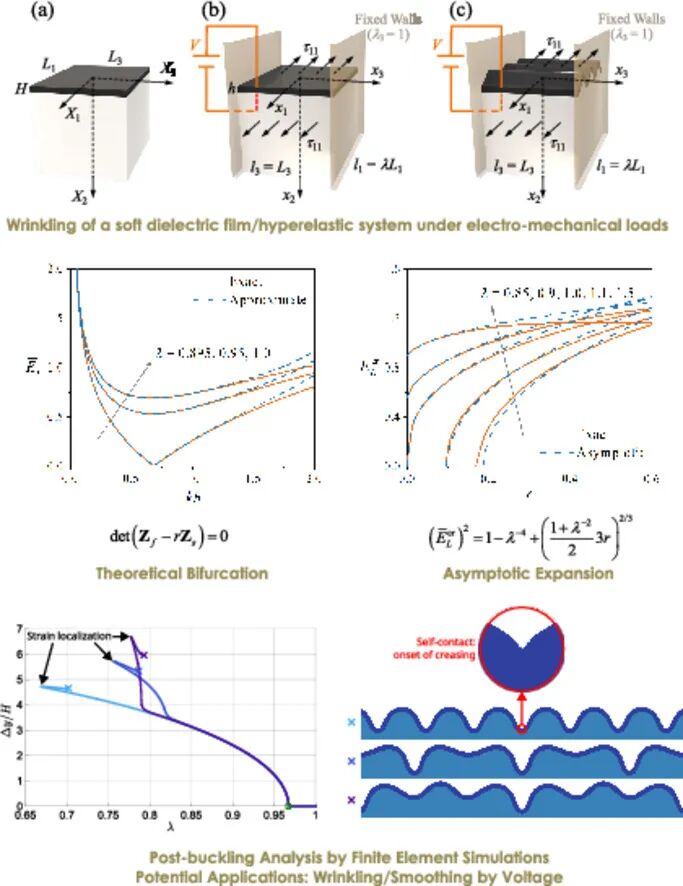
超弹性衬底上软介质薄膜的机电起皱
Active control of wrinkling in soft film-substrate composites using electric fields is a critical challenge in tunable material systems. Here, we investigate the electro-mechanical instability of a soft dielectric film bonded to a hyperelastic substrate, revealing the fundamental mechanis ms that enable on-demand surface patterning. For the linearized stability ana lysis, we use the Stroh formalis m and the surface impedance method to obtain exact and sixth-order approximate bifurcation equations that signal the onset of wrinkles. We derive the explicit bifurcation equations giving the critical stretch and critical voltage for wrinkling, as well as the corresponding critical wavenumber. We look at scenarios where the voltage is kept constant and the stretch changes, and vice versa. We provide the thresholds of the shear modulus ratio rc0 or pre-stretch λc0 below which the film-substrate system wrinkles mechanically, prior to the application of a voltage. These predictions offer theoretical guidance for practical structural design, as the shear modulus ratio r and/or the pre-stretch λ can be chosen to be slightly greater than rc0 and/or λc0, so that the film-substrate system wrinkles with a s m all applied voltage. Finally, we simulate the full nonlinear behavior using the Finite Element method (FEniCS) to validate our formulas and conduct a post-buckling an alysis. This work advances the fundamental understanding of electro-mechanical wrinkling instabilities in soft material systems. By enabling active control of surface morphologies via applied electric fields, our findings open new avenues for adaptive technologies in soft robotics, flexible electronics, s mart surfaces, and bioinspired systems.
在可调材料系统中,利用电场对软薄膜-基底复合材料的褶皱进行主动控制是一项关键挑战。在此,我们研究了与超弹性基底粘合的软电介质薄膜的电机械失稳现象,揭示了实现按需表面图案化的基本机制。对于线性化稳定性分析,我们采用斯特罗赫形式和表面阻抗法,获得了精确的和六阶近似的分岔方程,这些方程预示着褶皱的出现。我们推导出了给出褶皱临界拉伸和临界电压以及相应临界波数的显式分岔方程。我们考察了电压保持不变而拉伸变化的情况,以及拉伸保持不变而电压变化的情况。我们给出了剪切模量比 rc0 或预拉伸 λc0 的阈值,低于该阈值时,在施加电压之前,薄膜-基底系统就会发生机械褶皱。这些预测为实际结构设计提供了理论指导,因为剪切模量比 r 和/或预拉伸 λ 可以选择略大于 rc0 和/或 λc0,从而使薄膜-基底系统在施加较小电压时产生褶皱。最后,我们使用有限元方法(FEniCS)模拟了整个非线性行为,以验证我们的公式并进行后屈曲分析。这项工作推进了对软材料系统中机电褶皱不稳定性基本原理的理解。通过利用施加的电场实现对表面形态的主动控制,我们的发现为软机器人、柔性电子、智能表面和仿生系统中的自适应技术开辟了新的途径。
A stationary phase-based theory of diffraction: Modeling three-dimensional elastic wave diffraction from defect edges with arbitrary shapes
Zhengyu Wei, Fan Shi
doi:10.1016/j.jmps.2025.106498
基于定相的衍射理论:基于任意形状缺陷边缘的三维弹性波衍射建模
Elastic wave diffraction is strongly affected by both the finite size and geometric complexity of edges. Previous studies have primarily focused on diffraction from finite straight edges, particularly in applications such as seis mic wave exploration, ultrasonic imaging and noise control. However, modeling of elastodynamic diffraction from three-dimensional edges with arbitrary shapes remains underdeveloped, despite its importance in understanding the diffraction behavior of realistic defect geometries for accurate defect characterization. In this work, we develop an edge-segment stationary phase-based theory of diffraction (SPTD) for the accurate calculation of elastic wave diffraction from arbitrarily shaped 3D edges. Conventional edge-diffraction formulations, such as the incremental theory of diffraction (ITD), may suffer from non-physical amplitude fluctuations and even singular behavior when applied to rough or irregular edges, primarily due to the breakdown of the stationary-phase approximation at the elemental edge-segment level. To address this limitation, the proposed SPTD enforces the stationary-phase condition by projecting discretized edge segments onto virtual edges determined by the local diffraction Snell’s law. This formulation effectively suppresses non-physical amplitude fluctuations and singular contributions, thereby significantly improving the accuracy of predictions of diffraction waves. The SPTD model delivers consistently accurate results for a variety of edge geometries, such as straight, elliptical, and sinusoidal shapes, over a broad range of diffraction angles. In addition, the proposed SPTD model is used to examine the limitation of classical modeling methods. Notably, the classical geometrical theory of diffraction (GTD) is rederived within this framework, yielding a refined expression that extends its applicability to finite-length straight and curved edges, though it remains less general than the SPTD model.
弹性波衍射受边缘的有限尺寸和几何复杂性的强烈影响。以前的研究主要集中在有限直边的衍射,特别是在地震波勘探、超声成像和噪声控制等应用中。然而,从任意形状的三维边缘建立弹性动力学衍射模型仍然不发达,尽管它对于理解实际缺陷几何形状的衍射行为对于准确表征缺陷具有重要意义。在这项工作中,我们建立了一种基于边缘段固定相的衍射理论(SPTD),用于精确计算任意形状的三维边缘的弹性波衍射。传统的边缘衍射公式,如增量衍射理论(ITD),当应用于粗糙或不规则边缘时,可能会出现非物理振幅波动甚至奇异行为,这主要是由于在基本边缘段水平上的定相近似被击穿。为了解决这一限制,所提出的SPTD通过将离散的边缘段投影到由局部衍射斯涅尔定律确定的虚拟边缘上来强制执行定相条件。该公式有效地抑制了非物理振幅波动和奇异贡献,从而显著提高了衍射波预测的准确性。SPTD模型在广泛的衍射角度范围内,为各种边缘几何形状(如直线、椭圆和正弦形状)提供一致的精确结果。此外,本文还利用SPTD模型验证了传统建模方法的局限性。值得注意的是,经典的几何衍射理论(GTD)是在这个框架内重新推导的,产生了一个精炼的表达式,扩展了它对有限长直线和弯曲边缘的适用性,尽管它仍然不如SPTD模型一般。
Thin-Walled Structures
Experimental and numerical investigations of S700 high strength cold-formed steel built-up I-section short and long beam–columns
Chicheng Ma, Yuyin Wang, Andi Su, Ou Zhao
doi:10.1016/j.tws.2025.114460
S700型高强度冷弯型钢组合工字钢短、长梁柱的试验与数值研究
This paper presents an experimental and numerical study into structural performance of S700 high strength cold-formed steel built-up I-section beam–columns. An experimental programme, incorporating tensile coupon tests, measurements of initial geometric imperfections, a total of 22 beam–column tests, including 10 short beam–column tests and 12 long beam–column tests, was first conducted. Each built-up I-section was composed of two unlipped channel sections in a back-to-back manner, with arrangement of internal connection screws according to the relevant requirements of the American specification. A comprehensive numerical study, in which finite element models were established, validated by the test results and used to conduct parametric studies, was then performed. Based on the obtained experimental and numerical data, the beam–column design provisions, as set out in the European code (EC3) at both cross-section and member levels and the American specification (AISI) at stability level, were assessed for their applicability to S700 high strength cold-formed steel built-up I-section beam–columns. The evaluation results reveal that (i) EC3 yields overall slightly conservative ultimate load predictions, while more conservative EC3 ultimate load predictions were observed for Class 3 sections compared to Class 1 and 2 sections, (ii) AISI results in overall higher design accuracy and consistency than EC3, (iii) EC3 and AISI ultimate load predictions for short beam–columns are found to be more conservative than those for long beam–columns, and (iv) both EC3 and AISI exhibit higher design accuracy for the bending-dominant cases (i.e., with θ values decreasing), but some unsafe predictions for LBCs still exist due to the over-allowance for plasticity.
本文对S700型高强度冷弯型钢组合工字钢梁柱的结构性能进行了试验和数值研究。首先进行了一项试验方案,包括拉伸接头试验、初始几何缺陷测量、总共22次梁柱试验,包括10次短梁柱试验和12次长梁柱试验。每个组合式工字段由两个无唇槽段背靠背组成,内连接螺钉按美国规范相关要求布置。然后进行了全面的数值研究,其中建立了有限元模型,通过试验结果进行验证,并用于进行参数研究。根据获得的试验和数值数据,评估了欧洲规范(EC3)在截面和构件水平和美国规范(AISI)在稳定水平上的梁柱设计规定对S700型高强度冷弯型钢组合工字截面梁柱的适用性。评估结果显示:(i) EC3给出的极限荷载预测总体上略保守,而EC3对3类截面的极限荷载预测比1类和2类截面更为保守;(ii)与EC3相比,AISI的设计精度和一致性总体上更高;(iii) EC3和AISI对短梁柱的极限荷载预测比长梁柱的更保守。(iv) EC3和AISI在弯曲主导情况下(即θ值降低)都表现出更高的设计精度,但由于过度考虑塑性,对lbc的一些不安全预测仍然存在。
Self-swing of a thermo-responsive L-shaped rod partially resting on a hot plate
Yong Yu, Fangfei Liu, Chuanyang Huang, Kai Li
doi:10.1016/j.tws.2025.114464
部分放置在热板上的热响应l形棒的自摆动
In this work, we present a novel asymmetric L-shaped rod design that achieves self-swinging by deliberately extending auxiliary structures beyond the thermal boundary. Theoretical modeling, based on Hamilton’s principle and extending existing dynamic frameworks, reveals two distinct motion states: static and self-swing modes. Numerical simulations confirm these predictions and demonstrate how the system compensates for damping dissipation through thermal energy absorption, sustaining the self-swing. Experimental results align closely with theoretical predictions, validating the proposed mechanis m. Further numerical a nalysis examines key parameters—damping coefficient, gravitational acceleration, and thermal contraction coefficient—quantifying their influence on swing amplitude and frequency. The proposed L-shaped rod introduces a simple yet functionally powerful geometry that breaks symmetry to unlock directional self-swing, offering a novel mechanis m for harvesting low-grade thermal energy. By combining theoretical modeling with experimental validation, this work not only deepens the understanding of asymmetric self-excited dynamics in thermo-responsive systems but also provides a practical and scalable design framework for future applications in thermal energy harvesting and untethered micro-robotics.
在这项工作中,我们提出了一种新的非对称l形杆设计,通过故意将辅助结构延伸到热边界之外来实现自摆动。理论建模基于汉密尔顿原理并扩展现有的动力学框架,揭示了两种截然不同的运动状态:静态和自摆动模式。数值模拟证实了这些预测,并演示了系统如何通过吸收热能来补偿阻尼耗散,维持自摆。实验结果与理论预测密切一致,验证了所提出的机制。进一步的数值分析检验了关键参数——阻尼系数、重力加速度和热收缩系数——量化了它们对摆动幅度和频率的影响。l型杆引入了一种简单但功能强大的几何结构,打破了对称性,解锁了定向自摆动,为收集低等级热能提供了一种新的机制。通过理论建模和实验验证相结合,本研究不仅加深了对热响应系统中不对称自激动力学的理解,而且为热能收集和无系绳微型机器人的未来应用提供了一个实用和可扩展的设计框架。
Data-physics Coupling Drive An alysis of Penetration Resistance Mechanis m for Thin UHMWPE Laminate
Kaiying Wang, Yiding Wu, Xuan Zhou, Yilei Yu, Lizhi Xu, Guangfa Gao
doi:10.1016/j.tws.2025.114468
超薄聚乙烯层合板抗侵彻机理的数据物理耦合驱动分析
Research on the penetration resistance mechanis m of ultra-high molecular weight polyethylene laminates (UHMWPEL) is of significant importance for understanding their ballistic performance, which can guide the design of UHMWPEL with appropriate specifications for different anti-penetration scenarios. To reduce computational, temporal and financial costs in engineering research, deep learning (DL) technique was applied to investigate the intrinsic penetration resistance mechanis m of thin UHMWPEL. Based on traditional ballistic test and finite element model (FEM), a coupling drive between DL and dimensional an alysis theory was employed. The influence of the coupling effects of spherical projectile diameter and mass penetrating UHMWPEL of the same thickness was studied, thereby enhancing the understanding of its penetration resistance mechanis m. The results demonstrate that the ballistic limit velocity (Vbl) of thin UHMWPEL decreases with increasing projectile diameter, while the peak energy absorption values of all five curves occur near their respective Vbl. In contrast, the ballistic limit energy increases with projectile diameter. A predominantly linear relationship was observed between the normalized energy absorption ratio and the normalized velocity ratio, with the fitting line bidirectionally converging at two extreme points on the two extreme lines toward. The optimized artificial neural network (ANN) model successfully predicted the object physical variables, including residual velocity of projectile, energy absorbed by UHMWPEL, and normalized energy absorption ratio, with mean relative errors all below 10% (minimum: 2.23%). It is found that DL technology can provide reliable physical variable data for engineering research at significantly lower costs compared to traditional experimental and numerical simulation methods. By forming a data-physics coupling drive between DL and dimensional ana lysis, this methodology has successfully revealed fundamental dimensionless relationship and penetration resistance mechanis m.
对超高分子量聚乙烯复合材料(UHMWPEL)抗穿透机制的研究对于理解其防弹性能具有重要意义,这能够指导针对不同防穿透场景设计具有适当规格的 UHMWPEL。为降低工程研究中的计算、时间和资金成本,将深度学习(DL)技术应用于探究薄型 UHMWPEL 的内在抗穿透机制。基于传统的防弹测试和有限元模型(FEM),采用深度学习与量纲分析理论的耦合驱动。研究了相同厚度的 UHMWPEL 被不同直径和质量的球形弹丸穿透时的耦合效应,从而加深了对其抗穿透机制的理解。结果表明,薄型 UHMWPEL 的防弹极限速度(Vbl)随弹丸直径的增大而减小,而所有五条曲线的峰值能量吸收值均出现在各自 Vbl 附近。相反,防弹极限能量随弹丸直径的增大而增大。观察到归一化能量吸收率与归一化速度比之间存在主要的线性关系,拟合线在两条极端线上的两个极端点双向收敛。优化的人工神经网络(ANN)模型成功预测了物体的物理变量,包括弹丸的剩余速度、超高分子量聚乙烯纤维吸收的能量以及归一化能量吸收率,平均相对误差均低于 10%(最小值:2.23%)。发现深度学习技术能够以显著低于传统实验和数值模拟方法的成本为工程研究提供可靠的物理变量数据。通过在深度学习与量纲分析之间形成数据 - 物理耦合驱动,该方法成功揭示了基本的无量纲关系和抗穿透机制。
Nonlinear chaotic and periodic responses of obliquely stiffened sigmoid FG cylindrical shells under principal torsional parametric, subharmonic, and 1:2 internal resonances
Kamran Foroutan, Farshid Torabi
doi:10.1016/j.tws.2025.114463
斜加劲s形FG圆柱壳在主扭参数、次谐波和1:2内共振下的非线性混沌和周期响应
This paper examines the nonlinear dynamic (ND) behaviors of obliquely stiffened sigmoid functionally graded (OSSFG) cylindrical shells (CSs) exposed to the combined external and torsional loading. Both the CSs and the oblique stiffeners (OSs) are modeled as sigmoid functionally graded (SFG) materials, with composition varying through the thickness from metal-rich at the bottom and top surfaces to ceramic-rich at the mid-plane. The governing nonlinear motion equations are formulated by employing Donnell’s shell theory (DST) together with von Kármán’s nonlinear strain–displacement relations. A mechanical model is then established for SFG-CSs reinforced with two intersecting series of OSs, where the stiffener angles may either be similar or differ. To discretize the system, Galerkin’s approach is employed, transforming the equations to a nonlinear dynamical model with two degrees of freedom that incorporates quadratic and cubic nonlinearities together with external and torsional excitations. The investigation primarily focuses on the ND behaviors of the system under subharmonic resonance (order 1/2), the 1:2 internal resonance, and the principal torsional parametric resonance. By applying the method of multiple scales (MMSs), a four-dimensional set of nonlinear averaged equations is obtained. Numerical simulations are then carried out for the first time to uncover essential dynamic behaviors of the system, including phase portraits, Poincaré maps, and waveform plots, thereby demonstrating how variations in material gradation and stiffener angles influence the nonlinear response of the shells.
本文研究了斜加筋s型梯度功能圆柱壳在外力和扭转复合载荷作用下的非线性动力特性。CSs和斜加强筋(OSs)都被建模为s型功能梯度(SFG)材料,其成分随厚度的变化而变化,从底部和顶部表面的富金属到中间表面的富陶瓷。采用Donnell壳理论(DST)和von Kármán的非线性应变-位移关系建立了控制非线性运动方程。在此基础上,建立了两串相交的肋板加筋SFG-CSs的力学模型,其中肋板加筋角度可能相似,也可能不同。为了使系统离散化,采用伽辽金方法,将方程转换为包含二次和三次非线性以及外部和扭转激励的两自由度非线性动力学模型。主要研究了系统在次谐波共振(1/2阶)、1:2内部共振和主扭参量共振下的ND行为。采用多尺度法,得到了一组四维非线性平均方程。然后进行了首次数值模拟,揭示了系统的基本动态行为,包括相位肖像,庞加莱图和波形图,从而展示了材料级配和加强角的变化如何影响壳的非线性响应。
Experimental Study on Prefabricated CFST Columns with Bolt-Coupler Baseplate Connections under Compression
Md Ashraful Habib, Md Kamrul Hassan, Swapan Saha, Bulbul Ahmed, Mohammad Ghannam
doi:10.1016/j.tws.2025.114465
预应力钢管混凝土预制柱-螺栓连接底板受压试验研究
This paper investigates the structural behaviour of prefabricated concrete-filled steel tubular columns (CFST) with bolt-coupler baseplate (BCB) connections under compression experimentally. BCB connection is an innovative solution that simplifies the construction process and reduces costs. Experimental investigations were conducted on 10 column specimens (5 stub columns and 5 slender columns) to understand the effectiveness of BCB connections used in prefabricated CFST (PCFST) columns to transfer the load of the upper column to the lower column. Four CFST columns without connection and six PCFST with BCB connections were prepared. Results showed that prefabricated CFST stub columns with BCB connections achieved comparable or slightly higher ( ≈ 1.4 % ) load-carrying capacity than CFST columns without connections. For CFST slender columns with BCB connections, the 87% increase in height compared to the stub columns resulted in a slightly lower load-carrying capacity ( ≈ 1.5 % ) than that of CFST columns without connections. The ultimate compressive strength of the proposed prefabricated CFST columns, along with 19 previously reported tests with various connections, was used to evaluate the predictive accuracy of the existing design codes (EC4 and AS 2327). Findings indicated that the connection type significantly impacts design strength and that must be considered. Cost an alysis confirmed that BCB connections are more economical than splice plate blind bolted connections (by 77%) and conventional precast RC column connections (by 65%), validating the proposed system’s superior structural performance and cost-effectiveness.
本文通过试验研究了预制钢管混凝土柱(CFST)与螺栓-连接板(BCB)连接在受压条件下的结构性能。BCB连接是一种创新的解决方案,简化了施工过程,降低了成本。通过10根柱试件(5根短柱和5根细长柱)的试验研究,了解预制钢管混凝土(PCFST)柱采用BCB连接将上柱荷载传递给下柱的有效性。制备了4根无连接的CFST柱和6根有BCB连接的PCFST柱。结果表明,与没有连接的CFST柱相比,具有BCB连接的预制CFST短柱的承载能力相当或略高(≈1.4%)。对于有BCB连接的CFST细长柱,与短柱相比,高度增加了87%,但承载能力略低于无连接的CFST细长柱(≈1.5%)。建议的预制CFST柱的极限抗压强度,以及之前报道的19种不同连接的试验,用于评估现有设计规范(EC4和AS 2327)的预测准确性。研究结果表明,连接类型对设计强度有显著影响,必须予以考虑。成本分析证实,BCB连接比拼接板盲栓连接(节约77%)和传统预制RC柱连接(节约65%)更经济,验证了该系统优越的结构性能和成本效益。