【新文速递】2025年10月9日固体力学SCI期刊最新文章

今日更新:Journal of the Mechanics and Physics of Solids 1 篇
Journal of the Mechanics and Physics of Solids
A stress-sensitive precipitate nucleation model beyond classical nucleation theory
Khanh Dang, Laurent Capolungo
doi:10.1016/j.jmps.2025.106374
一个超越经典形核理论的应力敏感相形核模型
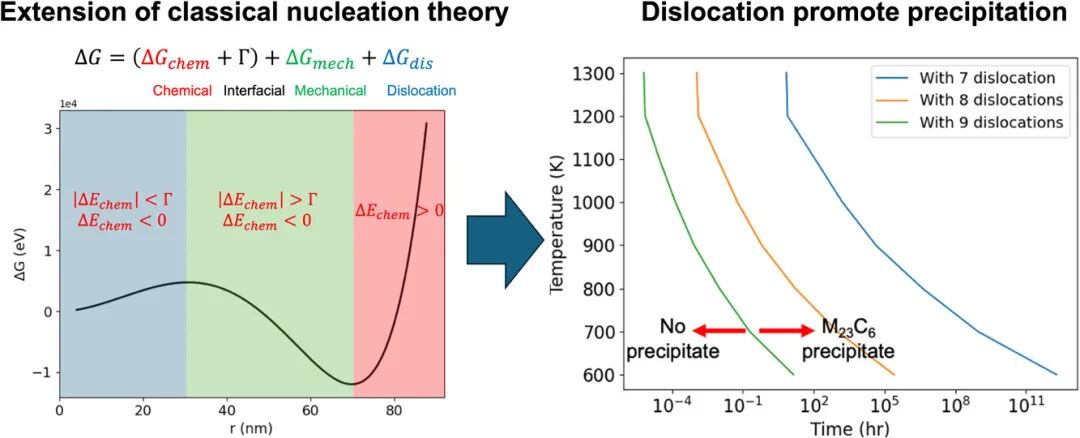
The dynamic evolution of precipitates and second phases dictates the strength and stability of most engineering alloys. By design, or as a consequence of thermo-mechanical ageing, engineering metals and alloys often form precipitates of second phases when subjecting to diverse thermal and mechanical loads. Precipitation is governed by several factors, including the alloy’s composition, processing/operating temperature, and stresses – either as a result of external loads or from residual stresses. However, state-of-the-art models for precipitate nucleation (i.e., classical nucleation theory) typically lacks consistent method to capture the effects of externally applied and/or internal stresses on nucleation; thereby severely limiting the applicability of these models to complex materials systems and to representative loading scenarios. In this work, we extend upon classical nucleation theory to account for the effect of stresses on precipitation kinetics and thermodynamics. This is achieved via the use of an Eshelbian micromechanics framework keeping track of (i) the stress build up resulting from second phase formation as a function of mechanical load and, (ii) the effects of dislocations on precipitate formation. This new model is applied to σ precipitate in Fe-Cr binary alloys and M23C6 precipitate in 316H stainless steel (SS). Simulations demonstrate the important role of both the remotely applied loads and dislocation pile ups on precipitate nucleation.
大多数工程合金的强度和稳定性取决于析出相和第二相的动态演变。在设计过程中,或者由于热机械时效的影响,工程金属和合金在承受各种热和机械载荷时往往会形成第二相的析出物。析出过程受多种因素影响,包括合金成分、加工/操作温度以及应力(无论是外部载荷引起的还是残余应力)。然而,目前最先进的析出物成核模型(即经典成核理论)通常缺乏一致的方法来捕捉外部施加应力和/或内部应力对成核的影响,从而严重限制了这些模型在复杂材料系统和代表性加载场景中的适用性。在这项工作中,我们对经典成核理论进行了扩展,以考虑应力对析出动力学和热力学的影响。这是通过采用埃谢尔比微力学框架实现的,该框架追踪了(i)第二相形成所导致的应力累积与机械载荷之间的关系,以及(ii)位错对沉淀物形成的影响。这一新模型应用于 Fe-Cr 二元合金中的 σ 沉淀物和 316H 不锈钢(SS)中的 M23C6 沉淀物。模拟结果表明,远场施加的载荷和位错堆积对沉淀物的形核都起着重要作用。