NFX|叶片复合材料比对-纳米碳管or石墨烯

Abstract
Nanocomposites reinforced with carbon nanotubes (CNTs) or graphene-based materials have garnered increasing attention for improving the structural performance of engi-neering systems, owing to their exceptional mechanical properties. Accordingly, the mechanical behaviors and applicability of both nanocomposites have been intensively investigated, but the studies on both composites have been mostly investigated separately. In this context, this study intends to investigate which is better for wind turbine blade applications, where both lightweight and high-strength and high-durability are critical. The comparisons are made in terms of static bending and torsion, free vibration and fatigue life which are an alyzed by finite element a nalyses. Finite element wind turbine models are generated based on the 61.5 m SNL reference design by Sandia National Laboratories, incorporated with the appropriate theories for deriving the ef-fective material properties and evaluating the fatigue lives. The comparative numerical experi-ments are carried out for CNT- and graphene-reinforced wind turbine blades as well as the con-ventional glass fiber reinforced (GFRP) one. The numerical results reveal that the performance of conventional GFRP wind blade has been remarkably improved when GFRP was replaced with carbon-based nanocomposites. Between two nanocomposites, the graphene-reinforced composite is found to be better suited for wind turbine applications.
1. Introduction
The recent escalation in global energy demand, combined with the urgent need to mitigate climate change caused by greenhouse gas emissions, has led to growing interest in renewable energy technologies. Among available options, wind energy stands out as one of the most prom-ising forms of future energy, alongside solar power, due to its minimal geographical constraints and potential for large scale power generation. As the wind energy sector continues to expand, efforts to increase their size for improved energy output have accelerated, introducing a series of engineering challenges such as higher structural loads, increased mass, and the demand for enhanced fatigue resistance. Notably, the blade has a direct impact on both the system’s energy generation efficiency and structural reliability. To address these issues, various advanced mate-rials have been investigated for their potential to improve strength and reduce weight, including basalt fiber composites [1, 2], carbon fiber composites [3], and bamboo-based natural fiber com-posites [4, 5].
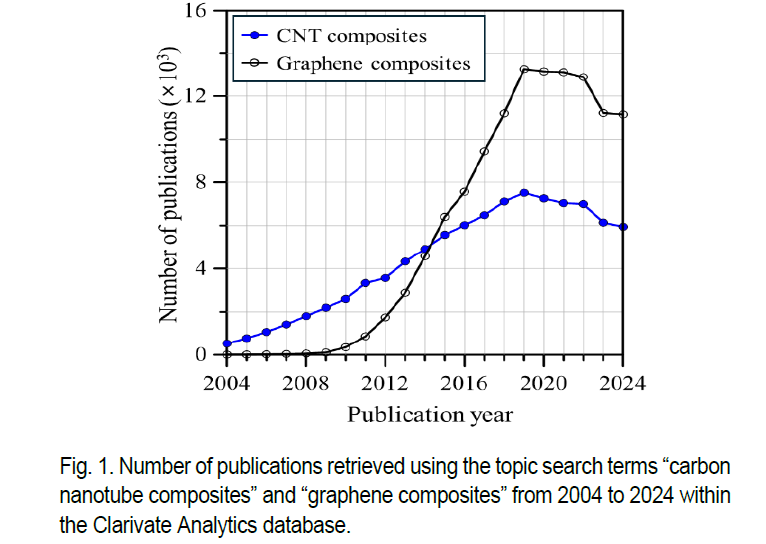
Nanocomposites incorporating advanced nanomaterials have attracted substantial interest, particularly with the rapid progress in nanotechnology since the early 21st century. Compared to conventional composites, nanocomposites exhibit much shorter surface-to-surface interparticle distances and significantly larger interfacial areas of nanofillers at the same volume fraction, which contribute to their superior strength to weight performance [6]. Among various candidates, carbon nanotubes (CNTs) and graphene-based materials have emerged as the most prominent nanofillers due to their exceptional mechanical and physical properties. These materials have found widespread applications across diverse sectors, including aerospace, automotive, elec-tronics and s mart sensors, construction, and biomedical engineering. Fig. 1 illustrates the publication trends over the past two decades based on a topic search for “carbon nanotube composites” and “graphene com-posites” using the Clarivate An alytics database, confirming the continued research activity in this field.
The integration of nanomaterials into the wind turbine blades has been the focus of numerous studies. Ma and Zhang [7], for instance, evaluated the potential of CNT/polymer nanocompo-sites by examining both structural integrity and multifunctional capabilities, highlighting their superior mechanical strength, fa-tigue resistance, and thermal and electrical properties, while also pointing out challenges such as poor dispersion and high costs. Similarly, Buyuknalcari et al. [8] emphasized that the per-formance of CNT composites is strongly influenced by factors including nanotube diameter, alignment, interfacial interactions, and dispersion quality. Boncel et al. [9] presented a comprehen-sive review of the experimental and theoretical studies pub-lished to date, offering a systematic overview of the potential for CNT composites in wind blade applications. In contrast, despite the high potential of graphene-based materials as nanofillers, studies applying them to wind turbine blades have remained lim-ited. Therefore, the authors of this study previously investigated the application of graphene platelets (GPLs) to a full scale wind blade model, an alyzing key mechanical performances such as bending and vibration responses, deflection and stress concen-tration due to fatigue cracking, weight reduction, and cost effec-tiveness [10-13].
Despite the excellent mechanical performance of both CNTs and graphene-based fillers, their characteristics differ signifi-cantly in terms of mechanical properties, dispersion, fabrication, and cost-effectiveness, as demonstrated by Su et al. [6], who conducted a comprehensive a nalysis of multi-walled carbon nanotubes (MWCNTs)- and GPLs-reinforced nanocomposites. Punetha et al. [14] reviewed various covalent and non-covalent functionalization techniques applied to CNTs and graphene, and compared their effects on the mechanical, electrical, and ther-mal properties of the resulting composites, along with improve-ments in dispersion. They pointed out that, compared to CNTs, graphene presents greater challenges in dispersion or alignmen using techniques such as mechanical stretching, electrical fields, magnetic fields, and spinning processes. Additional compara-tive studies have also been reported, including structural perfor-mance evaluations using finite element an alysis (FEA) [15], and assess ments of sensor applicability [16]. Given that material-level differences can significantly influence the structural behav-ior of large-scale composite systems such as wind turbine blades, the choice of nanofillers must be guided by a careful bal-ance between structural reliability and economic viability, high-lighting the importance of quantitative evaluation during the de-sign process.
To address these issues, this study compares the structural performance of wind turbine blades reinforced with CNT- and graphene-based materials, focusing on bending and torsional stiffness, vibration behavior, and fatigue life. Furthermore, an economic an alysis is performed to comprehensively assess the practical feasibility of CNT and graphene reinforcements. Sec-tion 2 details the material modeling techniques for the nanocom-posites and the development of a full-scale finite element model of the wind turbine blade. Section 3 presents the results of the structural simulations and economic evaluation based on the developed model. Finally, Section 4 summarizes the main find-ings and significance of this study.
2. Finite element modeling
2.1 Material modeling
Nanocomposites reinforced with CNTs or graphene-based materials have attracted sustained interest in advanced materi-als engineering due to their exceptional combination of low weight and high strength. However, these materials are prone to aggregation within the composite matrix as a result of inter-molecular interactions such as van der Waals forces and di-pole–dipole interactions. This aggregation often leads to a dete-rioration of material properties, which remains a major unre-solved issue highlighted in numerous studies. While the disper-sion of CNTs can be improved to some extent through external forces, including mechanical stretching, electrical fields, and spinning processes, graphene-based reinforcements continue to pose significant challenges in terms of effective dispersion control [14]. In addition, the Halpin–Tsai model, which is widely used to estimate the properties of fiber-reinforced composites, has been reported to yield significantly reduced accuracy at higher weight fractions of reinforcement [17, 18]. To address these limitations, the present study restricts the weight fraction of nanofillers to a maximum of 0.3 wt%, based on the results shown in Fig. 2, in order to improve the accuracy of material modeling and minimize the influence of aggregation-related property degradation in nanocomposites.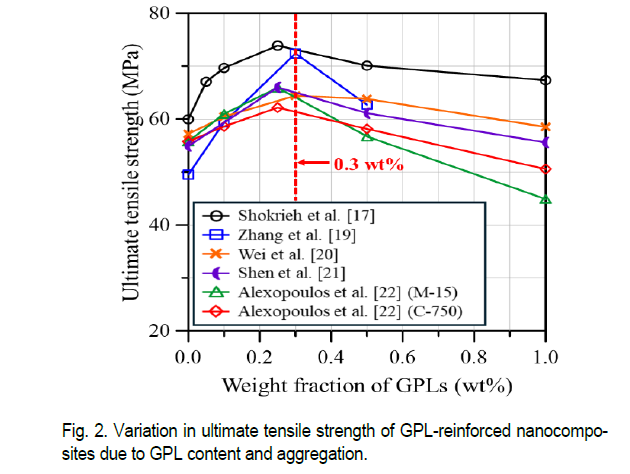
It should also be noted that the use of single-walled carbon nanotubes (SWCNTs) and monolayer graphene sheets in in-dustrial applications remains limited due to their substantially high production costs. In this study, therefore, the an alysis fo-cused on more cost-effective alternatives: MWCNTs and GPLs.
The Poisson’s ratio ν and the density ρ of the resulting nanocomposites,namely carbon nanotube reinforced composites(CNTRCs) and graphene platelet reinforced composites(GPLRCs), were calculated using the rule of mixtures given by

Here, M and V denote the material property and volume fraction,while the subscripts eff, nano, and m refer to the effective property of the nanocomposite, the nanofiller, and the matrix, respectively.
In contrast, the elastic modulus E was estimated with higher accuracy using the Halpin–Tsai model [23,24], which considers the size and shape of the nanofillers, which is given by
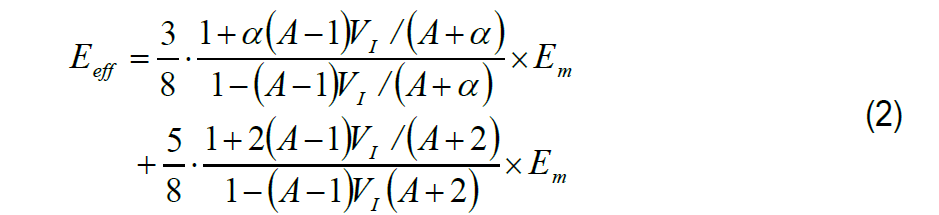
with  ,
,  ,
, 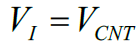 for CNTRC. Here,
  ,
,  , and
, and  denote the length, diameter,and wall thickness of the CNT, respectively. The values used in this study are
 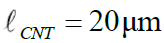 ,
, 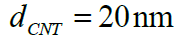 ,
, 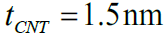 ,For GPLRC,
 ,
,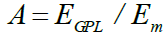 ,
,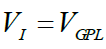 ,Here, L, W, L = 2.5µm,w=1.5µm,and t=1.5nm [24]
This study assumed that the MWCNTs and GPLs were uniformly dispersed and exhibited isotropic behavior within the matrix.Table 1 presents the material properties of the matrix and nanofillers used in the study, along with the calculated properties of the nanocomposites based on Eqs. (1) and (2).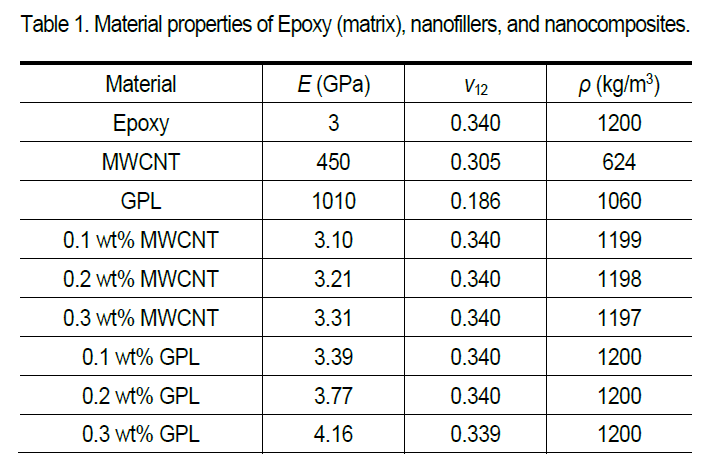
As highlighted by Kim and Cho [25], a full replacement of glass fiber reinforced composites in wind turbine blades with nanocomposites such as CNTRCs or GPLRCs may lead to a significant reduction in fatigue life due to the relatively poor fatigue performance of nanocomposite materials. To address this issue with a more practical and realistic approach, this study considers a limited application in which only the matrix of the conventional glass fiber composite is substituted with a nanocomposite.Accordingly, it should be clearly noted that the weight fractions of nanofillers specified in this study are defined with respect to the matrix material, not the entire glass fiber reinforced composite (GFRP).
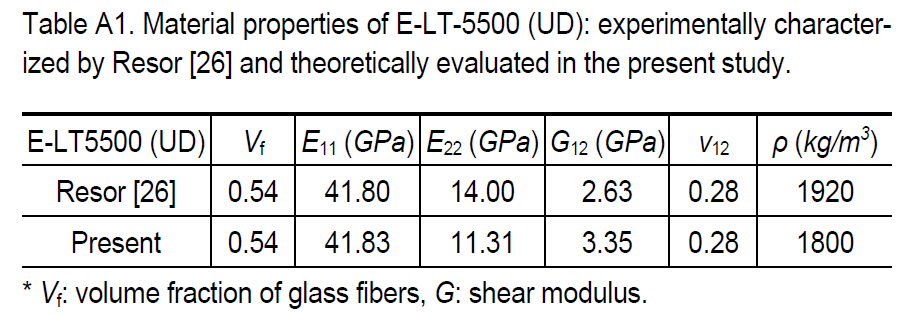
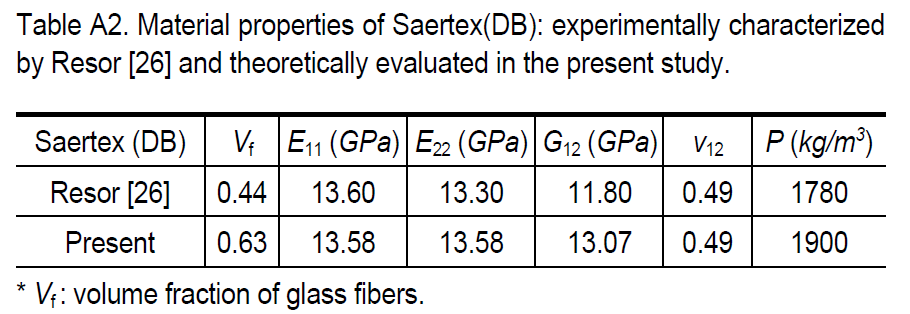
The wind turbine blade model used in this study is based on the SNL (Triax) composite, a material fabricated by combining unidirectional and bidirectional glass fiber laminates—specifically,E-LT-5500 (UD) and Saertex (DB). To accurately determine the material properties of SNL (Triax), the properties of ELT-5500 (UD) and Saertex (DB) were theoretically derived. The Halpin–Tsai model was employed for E-LT-5500 (UD), while classical laminate theory was applied to Saertex (DB). The reliability of the derived theoretical values was validated by comparing them with experimental data reported by Resor [26]. Tables A1 and A2 in Appendix present a comparison between the theoretical and experimental properties of E-LT-5500 (UD) and Saertex (DB), while Table 2 summarizes the resulting properties of the combined SNL (Triax) composite, which is hereafter referred to as GFRP, along with those of the nanocomposite-reinforced GFRP.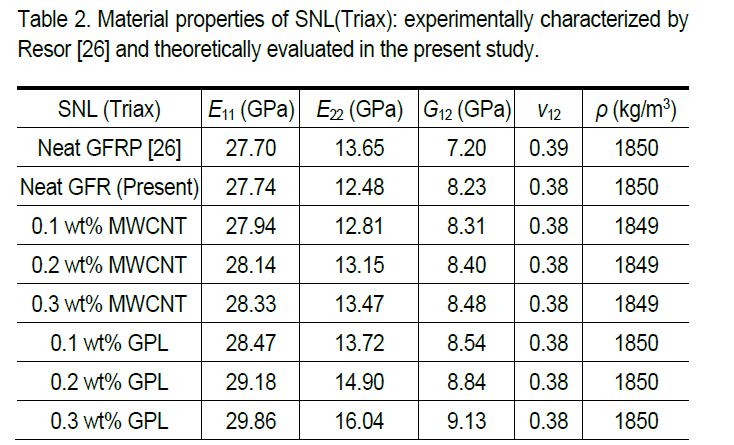
2.2 Blade modeling
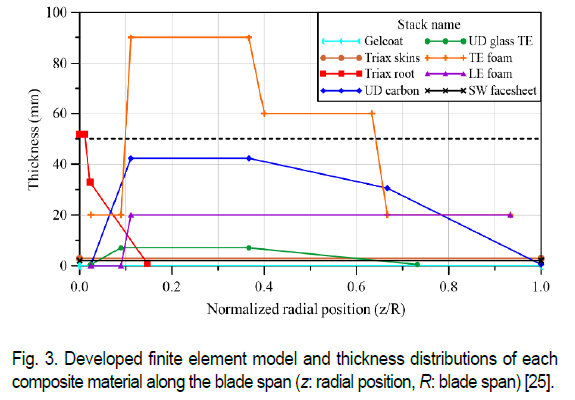
Wind turbine blades are typically composed of laminated composites in which various materials are functionally distrib-uted to meet structural requirements. To ensure high accuracy in computational a nalysis, it is essential to precisely model not only the blade geometry but also the detailed configuration of the composite layups. In this study, a 5MW-class wind turbine blade was selected as the reference model for finite element an alysis. The geometry and material modeling of the blade was developed based on the design data of the SNL 61.5 m blade model reported by Resor [26]. The blade geometry accounts for spanwise variations in airfoil profiles, chord length, twist angle, and aerodynamic center. The composite layups were modeled to vary according to the spanwise location and across seven key structural sections: the leading edge (LE), LE panel, spar cap, trailing edge (TE), TE reinforcement, TE panel, and shear web. Fig. 3 illustrates the variation in thickness of each composite ma-terial along the blade span. Additional details on the blade model can be found in the report by Resor [26].
In aerodynamic load ana lysis of wind turbine blades, compu-tational fluid dynamics (CFD) and blade element momentum theory (BEMT) are commonly employed. In this study, aerody-namic loads were computed using BEMT, which offers a bal-ance between computational efficiency and accuracy. The de-tailed methodology for aerodynamic load calculations based on BEMT can be found in the authors’ previous publications [10,12]. Fig. 4 presents the stress distribution at the rated wind speed of 11.4 m/s, as obtained from the finite element model developed in this study.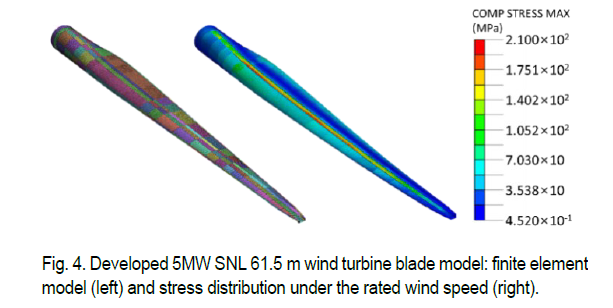
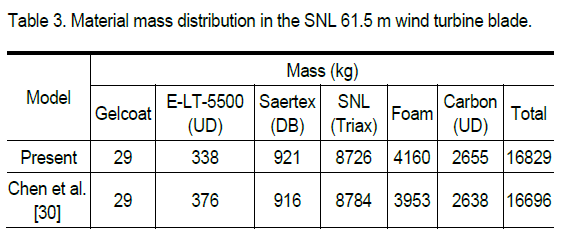
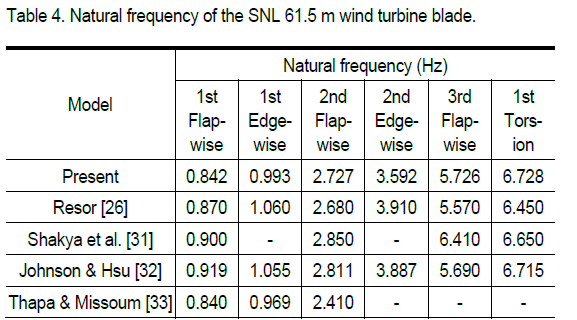
To ensure the validity of the various an alyses and results pre-sented in Section 3, it is essential to verify the reliability of the wind turbine blade model developed in this study. For numerical simulation, the commercial finite element an alysis software midas NFX was used. The an alysis model was created using four-node quad elements, with an element size of 0.08 meters by 0.08 meters, consistent with the mesh size reported in Resor [26]. To accurately capture the laminated composite structure of the blade and its load transfer behavior, ‘composite shell prop-erties’ within midas-NFX were assigned to the elements. Tables 3 and 4 compare the mass and natural frequencies of the pre-sent model with those from previous studies, while Fig. 5 pre-sents a comparison of deflection and torsional deformation be-havior. The results indicate a good agreement in mechanical characteristics between the present and reference models, con-firming the reliability of the simulation results of this study.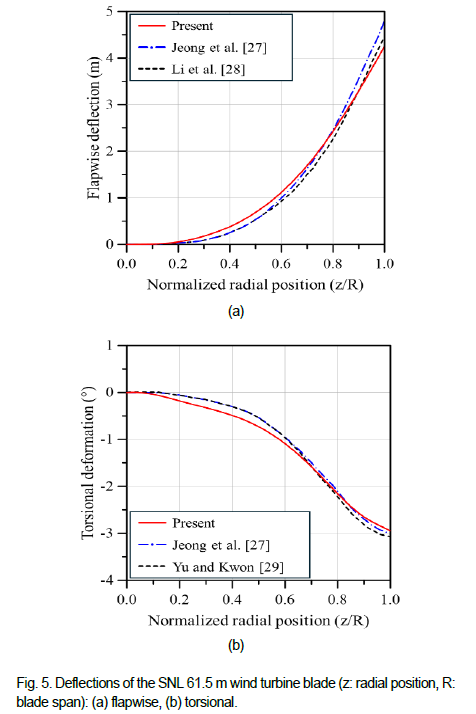
3. Numerical results
In the design of engineering structures, a thorough evaluation of both mechanical performance and cost-effectiveness is es-sential to ensure structural safety and long-term sustainability. This becomes particularly important when advanced materials such as nanocomposites are introduced, as uncertainties in their behavior may lead to unexpected outcomes. In this context, the present study aims to assess the structural performance and cost-effectiveness of wind turbine blades reinforced with either MWCNTs or GPLs, and to evaluate the applicability of these nanocomposites in wind blades. This section presents a sys-tematic an alysis in which the MWCNT- and GPL-reinforced glass fiber composites, developed using the Halpin-Tsai model and classical laminate theory as described in Section 2, are ap-plied to the validated wind turbine blade model. The resulting bending and torsional behavior, vibration characteristics, fatigue performance, and cost a nalysis are comprehensively examined.
3.1 Static bending and torsional deformation 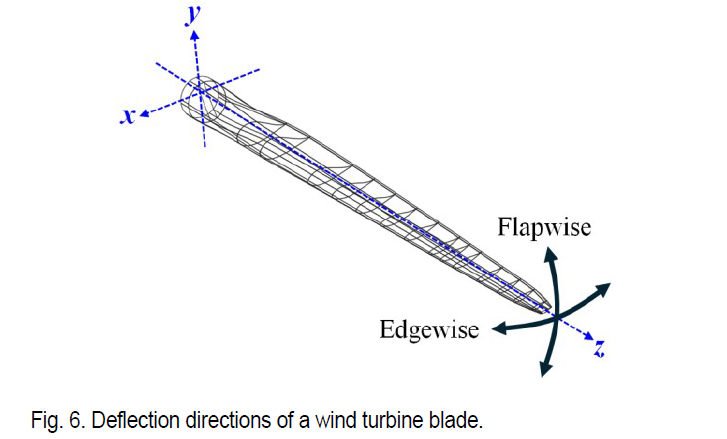
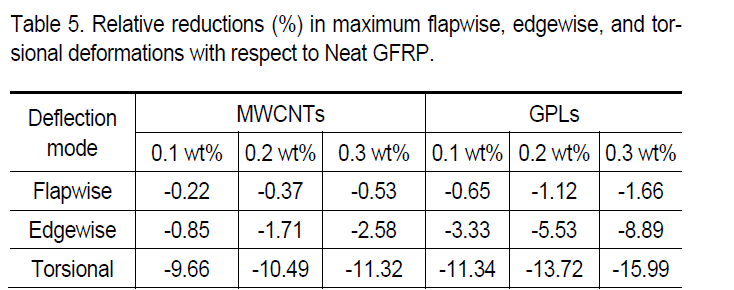
As shown in Fig. 6,the deflection behavior of wind turbine blades is generally categorized into flapwise and edgewise di-rections. Among these, flapwise deflection tends to be greater than edgewise deflection due to the influence of aerodynamic loads. In evaluating the global structural response of engineer-ing systems, it is important to consider not only bending defor-mation but also torsional deformation. For wind turbine blades in particular, torsional behavior about the spanwise axis is a crit-ical factor in structural reliability. Table 5 presents the relative reductions in maximum flapwise and edgewise deflections, as well as torsional deformation, with respect to the weight fraction of nanofillers when MWCNT- and GPL-reinforced glass fiber composites are applied to the blade. The results indicate that increasing the weight fraction of nanofillers leads to an overall reduction in deformation, which is attributed to the improved stiff-ness of the glass fiber composites. Among the different deformation modes, torsional deformation showed the greatest reduction, followed by edgewise and then flapwise deflection. Notably, even at a low reinforcement level of 0.3 wt%, the max-imum torsional deformation was reduced by approximately 11 percent with MWCNTs and 16 percent with GPLs. These find-ings suggest that reinforcing glass fiber composites with nano-materials can provide meaningful structural enhancement with-out a significant increase in blade weight, and that GPLs may offer greater reinforcement effectiveness than MWCNTs. While presenting higher nanofiller weight fractions could make the ob-served trend more evident, contents beyond 0.3 wt% were in-tentionally excluded to prevent modeling uncertainties, as out-lined in Section 2.1.
3.2 Free vibration
Vibration characteristics are considered a critical factor in evaluating the safety of rotating structures., In the case of wind turbine blades, the potential for resonance must be carefully ex-amined during the design and verification stages. In this study, the natural frequencies of wind turbine blades reinforced with MWCNTs and GPLs were an alyzed, and the results are sum-marized in Table 6. The ana lysis showed that, in all reinforced cases, the natural frequencies increased compared to those of the neat GFRP blade. This trend was more pronounced when GPLs were used as reinforcement, indicating a greater impact on stiffness than MWCNTs. 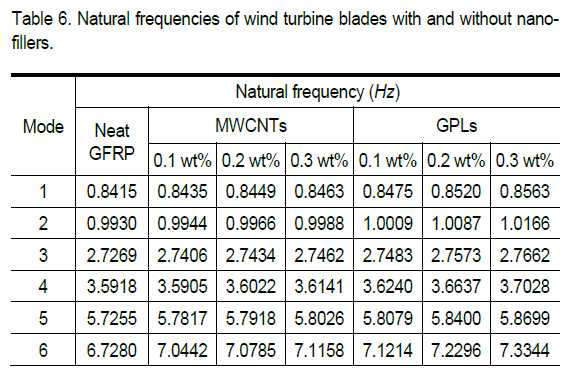
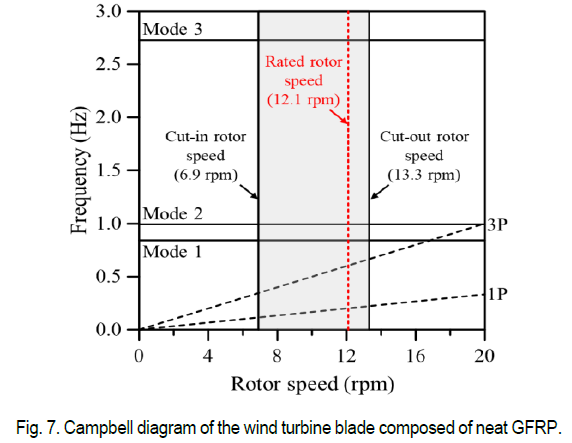
When evaluating the vibration characteristics of rotating struc-tures such as wind turbine blades, Campbell diagrams are widely used to visualize the interaction between natural frequen-cies and estimated excitation frequencies, thereby enabling the assess ment of potential resonance conditions. Fig. 7 presents the Campbell diagram for a wind turbine blade made of neat GFRP. In this diagram, 1P refers to the rotor's rotational frequency,while 3P corresponds to the blade shadowing frequency,which occurs as the blade passes in front of the tower.These are critical harmonic excitations that must be considered in blade design. As shown in Fig. 7, the natural frequencies of the neat GFRP blade do not intersect with either 1P or 3P within the typical operating speed range of the rotor, indicating a low likelihood of resonance. Furthermore, when nanofillers are introduced,the first and second mode natural frequencies increase(see Table 6), which widens the separation from harmonic excitations and enhances resonance safety. In particular, the blade reinforced with GPLs exhibits higher natural frequencies than the one reinforced with MWCNTs, suggesting that GPLs offer better structural safety against potential resonance.
3.3 Fatigue life estimation
Wind turbine blades are continuously subjected to cyclic wind loads and unpredictable environmental conditions throughout their service life. These factors can adversely affect the longterm structural integrity of the blade. Among them, fatigue caused by repeated loading is one of the primary mechanis ms that compromise structural health, as micro-defects can accumulate over time, develop into cracks, and eventually lead to failure. Therefore, quantitative evaluation of fatigue life, alongside yielding and buckling, is a critical design consideration in the structural a nalysis of wind turbine blades. Based on this context,this section presents a comparative an alysis of the fatigue life of wind turbine blades reinforced with MWCNTs and GPLs,respectively.
The ideal approach for evaluating the fatigue life of wind turbine blades is to apply a long-term fatigue load spectrum that reflects the entire design life of the structure. However, directly acquiring long-duration time histories of wind speed and using it for experimental or numerical fatigue life assess ment is often impractical due to the significant cost and time required. Therefore,in engineering practice, alternative methods that rely on short-term data combined with probabilistic modeling are commonly adopted to estimate long-term structural responses. In this study, to simulate realistic wind conditions, short-term wind speed data over a 60-minute period was generated based on long-term observations at European offshore wind farms, which follow a Weibull distribution with shape parameter α = 2.0 and scale parameter β = 15.0 as given by Zhang et al. [34]:

Wind turbine blades operate under highly irregular and variable environmental conditions, which result in complex load cycles that include various frequencies. To evaluate the accumulated fatigue damage in the blade, these complex stress cycles must be decomposed into their frequency components to define the corresponding stress amplitudes. In this study, aerodynamic loads corresponding to each wind speed were calculated using BEMT, and these loads were applied to a finite element model
to extract time-domain stress data. A fast Fourier transform(FFT) was then used to convert the time-domain stress responses into the frequency domain. Fig. 8 illustrates an example of the stress response obtained in the time domain and the corresponding fatigue load spectrum after frequency-domain transformation.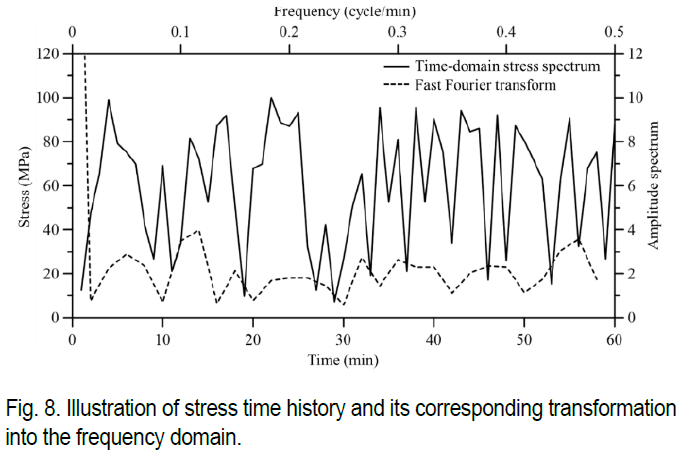
The S–N curves commonly used for fatigue life evaluation are typically derived under zero mean stress conditions. As a result,they do not adequately represent the complex stress environments experienced by real structures, where alternating and mean stresses coexist. To address this limitation, the concept of equivalent stress was introduced to account for the effect of mean stress. In this study, equivalent stress was calculated using the Goodman diagram, as follows

where,  is the equivalent stress corresponding to the equivalent mean stress
  , which is 0 in this study,
  is the amplitude stress, and
  is the mean stress,
  is the ultimate stress of the material . By applying the resulting equivalent stress to the material’s S–N curve, the number of cycles to fatigue failure N can be estimated according to

where, N is the number of cycles to failure, is the ultimate strength of material,  is the equivalent stress, and b is inverse of the slope of the S-N curve.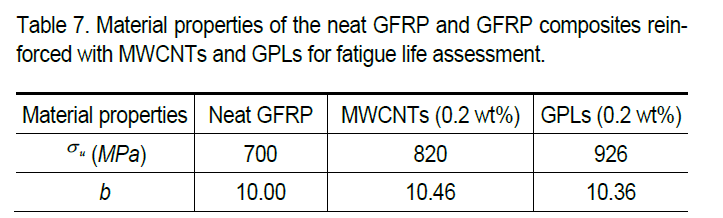
Table 7 summarizes the material properties of the glass fiber composites used in this study for calculating the number of cycles to fatigue failure 𝑁 based on Eq. (5). The table includes the properties of neat GFRP as well as those of the composites reinforced with 0.2 wt% of MWCNTs and GPLs. The properties of neat GFRP were adopted from Resor [26], while the values for the MWCNT- and GPL-reinforced composites were estimated by incorporating the stress increase ratio corresponding to the number of cycles to failure, as reported in the fatigue test results of Yavari [35]. While nanocomposites showed the best performance at 0.3 wt%, material properties for fatigue life assess ment(e.g., S-N curves) are limitedly reported in the literature. To obtain reliable outcomes, 0.2 wt% of nanofillers was selected in this study, as the required material data is documented in the
literature [35]. Fig. 9 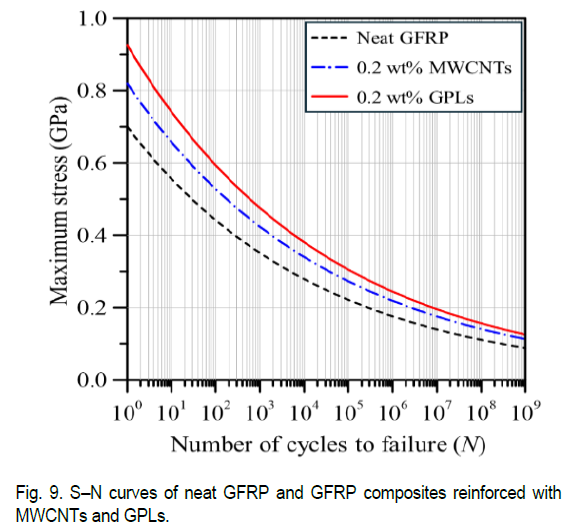
presents the S–N curves developed using these material properties.Subsequently, the accumulated fatigue damage can be evaluated based on the number of fatigue cycles and the number of corresponding cycles from each stress amplitude to failure. In this study, the accumulated fatigue damage was calculated using Miner’s rule, which is defined by

where D is the cumulative fatigue damage,  and
and  are the numbers of the load cycles and cycles to failure, respectively.The fatigue life of the blade was then determined using the accumulated damage, as given by

The fatigue life was evaluated by dividing the blade region into twenty sub-regions, as shown in Fig. 10, and the fatigue lives of critical eight sub-regions from the blade root are presented in this paper.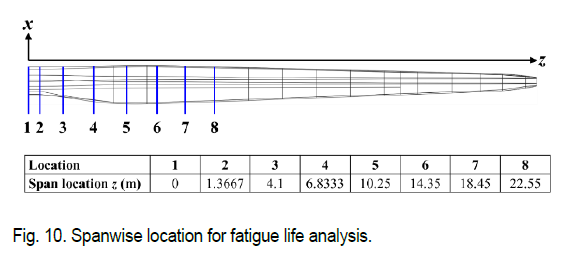
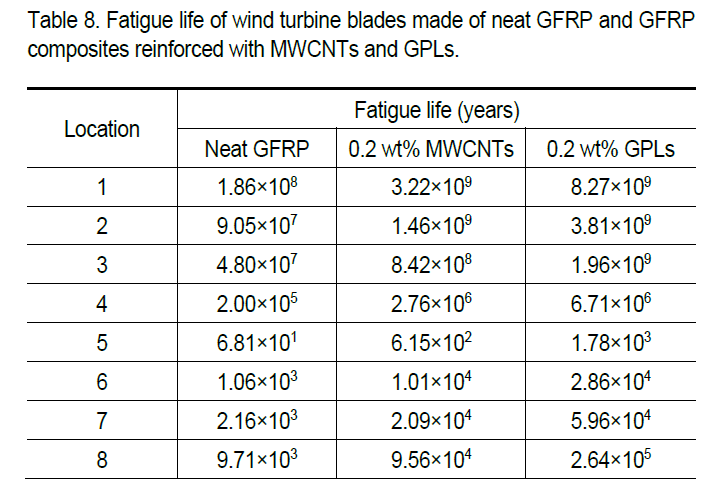
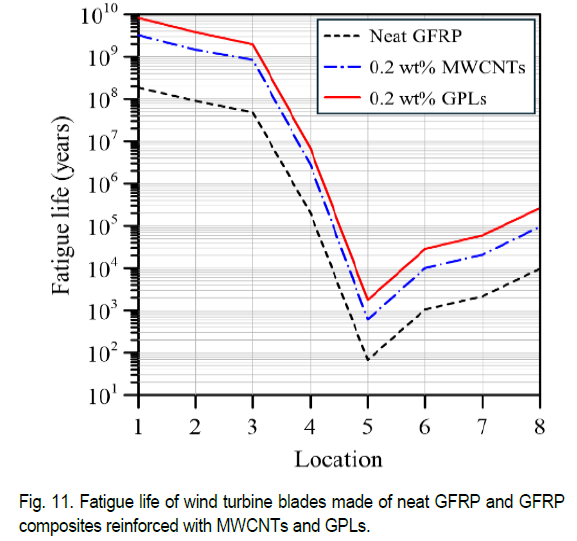
Fig. 11 and Table 8 present the predicted fatigue life of wind turbine blades along the spanwise direction, comparing blades made of neat GFRP with those reinforced with MWCNTs and GPLs. Where, “Location” refers to the spanwise position along the blade, as shown in Fig. 10. The results indicate that nanomaterial reinforcement leads to a substantial improvement in fatigue life relative to the neat GFRP case. Between the two reinforced cases, the blade incorporating GPLs demonstrated superior fatigue resistance. Notably, at Location 5—where the shortest fatigue life was predicted—the neat GFRP blade had an estimated life of approximately 68 years, while the blades re-inforced with MWCNTs and GPLs showed substantial increases, reaching around 615 years and 1,780 years, respectively. These results suggest that even a s mall addition of 0.2 wt% nan-ofillers to the matrix of glass fiber composites can lead to re-markable improvements in fatigue durability. Moreover, the en-hancement appears to be more pronounced with GPL reinforce-ment than with MWCNTs.
3.4 Cost-benefit an alysis
This section an alyzes the economic feasibility of applying the two types of nanofillers to wind turbine blades, with a focus on comparing the total material cost required for blade fabrication. The unit prices of the primary materials used in this study are summarized in Table 9. 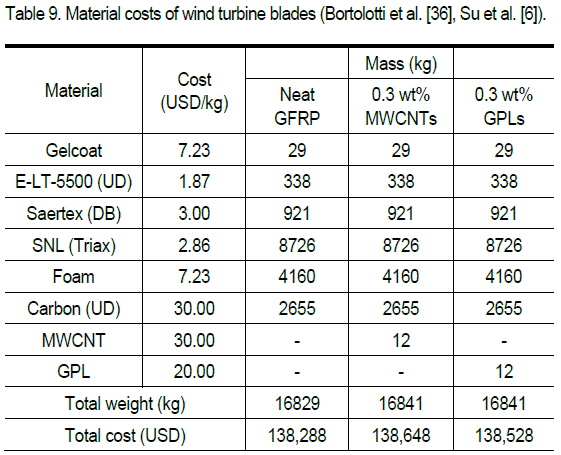
Based on these values, the total mate-rial cost for a single blade is estimated to be approximately 138,288 USD. Given that 0.3 wt% of neat GFRP matrix corre-sponds to about 12 kilograms, the additional material cost incurred by incorporating MWCNTs and GPLs is approximately 360 USD and 240 USD, respectively. These values account for less than 0.3 percent of the total material cost. Considering the associated improvements in structural stiffness and fatigue life, the use of these nanofillers appears to be economically feasible. However, since this a nalysis does not account for production costs, labor, or other associated expenses, a more comprehen-sive economic a nalysis would be required for practical imple-mentation.
4. Conclusion
This study investigated the structural performance, dynamic response, fatigue resistance, and cost-effectiveness of wind tur-bine blades enhanced with CNT and graphene-based nano-fillers, using the 61.5-meter SNL blade as a 5 MW-class refer-ence model for the simulations. The developed numerical model was validated by comparing key results such as deflection, tor-sion, material mass, and natural frequencies with values re-ported in the literature. As nanofillers, MWCNTs and GPLs were selected based on their cost-effectiveness and practical applica-bility. These nanofillers were incorporated into the matrix of the SNL(Triax) composite, which was used as the primary material for the blade model.Structural performance and fatigue life were evaluated for wind turbine blades incorporating s mall amounts (0.1 to 0.3 wt%) of MWCNT- and GPL-reinforced nanocomposites. Compared to neat GFRP, both nanofillers improved bending, torsion, and vibration characteristics. Notably, GPL reinforce-ment yielded more pronounced enhancements in structural per-formance compared to MWCNTs. Fatigue life an alysis was then carried out for blades reinforced with 0.2 wt% of each nanofiller. In the midspan region, where the most critical loading conditions are observed, the fatigue life increased substantially, rising from about 68 years for the neat GFRP blade to approximately 615 years with MWCNT reinforcement and 1,780 years with GPL re-inforcement. From a cost perspective, the incorporation of incurred by incorporating MWCNTs and GPLs is approximately 360 USD and 240 USD, respectively. These values account for less than 0.3 percent of the total material cost. Considering the associated improvements in structural stiffness and fatigue life, the use of these nanofillers appears to be economically feasible. However, since this an alysis does not account for production costs, labor, or other associated expenses, a more comprehen-sive economic a nalysis would be required for practical imple-mentation.
5. Conclusion
This study investigated the structural performance, dynamic response, fatigue resistance, and cost-effectiveness of wind tur-bine blades enhanced with CNT and graphene-based nano-fillers, using the 61.5-meter SNL blade as a 5 MW-class refer-ence model for the simulations. The developed numerical model was validated by comparing key results such as deflection, tor-sion, material mass, and natural frequencies with values re-ported in the literature. As nanofillers, MWCNTs and GPLs were selected based on their cost-effectiveness and practical applica-bility. These nanofillers were incorporated into the matrix of the SNL(Triax) composite, which was used as the primary material for the blade model.
Structural performance and fatigue life were evaluated for wind turbine blades incorporating s mall amounts (0.1 to 0.3 wt%) of MWCNT- and GPL-reinforced nanocomposites. Compared to neat GFRP, both nanofillers improved bending, torsion, and vibration characteristics. Notably, GPL reinforce-ment yielded more pronounced enhancements in structural per-formance compared to MWCNTs. Fatigue life an alysis was then carried out for blades reinforced with 0.2 wt% of each nanofiller. In the midspan region, where the most critical loading conditions are observed, the fatigue life increased substantially, rising from about 68 years for the neat GFRP blade to approximately 615 years with MWCNT reinforcement and 1,780 years with GPL re-inforcement. From a cost perspective, the incorporation of nanofillers increased the overall material cost of the blade by less than 0.3%, indicating that such reinforcement can be imple-mented without compromising economic feasibility. Nanocom-posites reinforced with MWCNTs and GPLs appear to be prom-ising solutions for improving both the structural performance and service life of wind turbine blades. Between the two, GPL rein-forcement demonstrates greater potential in terms of both struc-tural efficiency and cost-effectiveness.
While the present study demonstrates the advantages of CNT and graphene-based nanofillers for wind turbine blade applica-tions, further studies are needed to refine their optimal content and distribution within the composite. Follow-up investigations are underway to address these aspects in more depth.
References
[1]N. M. Chikhradze, F. D. S. Marquis and G. S. Abashidze, Hybrid fiber and nanopowder reinforced composites for wind turbine blades, Journal of Materials Research and Technology, 4 (1) (2015) 60-67.
[2]A. N. Mengal, S. Karuppanan and A. A. Wahab, Basalt carbon hybrid composite for wind turbine rotor blades: A short review, Advanced Materials Research, 970 (2014) 67-73.
[3]J. Paquette, J. van Dam and S. Hughes, Structural testing of 9m carbon fiber wind turbine research blades, 45th AIAA Aero-space Sciences Meeting and Exhibit, AIAA, Reno, Nevada, USA (2007).
[4]J. W. Holmes, P. Brøndsted, B. F. Sørensen, Z. Jiang, Z. Sun and X. Chen, Development of a bamboo-based composite as a sustainable green material for wind turbine blades, Wind Engi-neering, 33 (2) (2009) 197-210.
[5]J. Shen-xue, Z. Qi-sheng and J. Shu-hai, On structure, produc-tion, and market of bamboo-based panels in China, Journal of Forestry Research, 13 (2) (2002) 151-156.
[6]X. Su, R. Wang, X. Li, S. Araby, H. C. Kuan, M. Naeem and J. Ma, A comparative study of polymer nanocomposites contain-ing multi-walled carbon nanotubes and graphene nanoplatelets, Nano Materials Science, 4 (3) (2022) 185-204.
[7]P. C. Ma and Y. Zhang, Perspectives of carbon nanotubes/pol-ymer nanocomposites for wind blade materials, Renewable and Sustainable Energy Reviews, 30 (2014) 651-660.
[8]F. N. Buyuknalcaci, Y. Polat, T. A. Negawo, E. Döner, M. S. Alam, T. Hamouda and A. Kilic, Carbon nanotube-based nano-composites for wind turbine applications, in Polymer-based Nanocomposites for Energy and Environmental Applications, M. Jawaid and M. M. Khan (eds), Woodhead Publishing, UK (2018) 635-661.
[9]S. Boncel, A. Kolanowska, A. W. Kuziel and I. Krzyżewska, Car-bon nanotube wind turbine blades: How far are we today from laboratory tests to industrial implementation?, ACS Applied Nano Materials, 1 (12) (2018) 6542-6555.
[10]H. J. Kim and J. R. Cho, Effects of graphene reinforcement on static bending, free vibration, and torsion of wind turbine blades, Materials, 17 (13) (2024) 3332.
[11]H. J. Kim and J. R. Cho, Exploratory study on the application of graphene platelet-reinforced composite to wind turbine blade, Polymers, 16 (14) (2024) 2002.
[12]H. J. Kim and J. R. Cho, In-depth study on the application of a graphene platelet-reinforced composite to wind turbine blades, Materials, 17 (16) (2024) 3907.
[13]H. J. Kim and J. R. Cho, Numerical study on the static bending response of cracked wind turbine blades reinforced with gra-phene platelets, Nanomaterials, 14 (24) (2024) 2020.
[14]V. D. Punetha, S. Rana, H. J. Yoo, A. Chaurasia, J. T. McLes-key, M. S. Ramasamy, N. G. Sahoo and J. W. Cho, Functional-ization of carbon nanomaterials for advanced polymer nano-composites: A comparison study between CNT and graphene, Progress in Polymer Science, 67 (2017) 1-47.
[15]N. Gariya and A. Shaikh, Comparative a nalysis between gra-phene and carbon nanotube reinforced epoxy composite, Ma-terials Today: Proceedings, in press (2023).
[16]X. Wang, E. G. Lim, K. Hoettges and P. Song, A review of car-bon nanotubes, graphene and nanodiamond based strain sen-sor in harsh environments, C, 9 (4) (2023) 108.
[17]M. Shokrieh, M. Es mkhani, H. R. Shahverdi and F. Vahedi, Ef-fect of graphene nanosheets (GNS) and graphite nanoplatelets (GNP) on the mechanical properties of epoxy nanocomposites, Science of Advanced Materials, 5 (2012) 260-266.
[18]Y. Zare and K. Y. Rhee, The mechanical behavior of CNT re-inforced nanocomposites assuming imperfect interfacial bond-ing between matrix and nanoparticles and percolation of inter-phase regions, Composites Science and Technology, 144 (2017) 18-25.
[19]Y. Zhang, Y. Wang, J. Yu, L. Chen, J. Zhu and Z. Hu, Tuning the interface of graphene platelets/epoxy composites by the co-valent grafting of polybenzimidazole, Polymer, 55 (19) (2014) 4990-5000.
[20]J. Wei, R. Atif, T. Vo and F. Inam, Graphene nanoplatelets in epoxy system: dispersion, reaggregation, and mechanical prop-erties of nanocomposites, Journal of Nanomaterials, 2015 (1) (2015) 561742.
[21]M.-Y. Shen, T.-Y. Chang, T.-H. Hsieh, Y.-L. Li, C. L. Chiang, H. Yang and M.-C. Yip, Mechanical properties and tensile fatigue of graphene nanoplatelets reinforced polymer nanocomposites, Journal of Nanomaterials, 2013 (2013) 565401.
[22]N. D. Alexopoulos, Z. Paragkamian, P. Poulin and S. K. Kourkoulis, Fracture related mechanical properties of low and high graphene reinforcement of epoxy nanocomposites, Com-posites Science and Technology, 150 (2017) 194-204.
[23]J. C. Halpin and J. L. Kardos, The Halpin-Tsai equations: A review, Polymer Engineering & Science, 16 (5) (1976) 344-352.
[24]M. A. Rafiee, J. Rafiee, Z. Wang, H. Song, Z. Z. Yu and N.Koratkar, Enhanced mechanical properties of nanocomposites at low graphene content, ACS Nano, 3 (12) (2009) 3884-3890.
[25] H. J. Kim and J. R. Cho, Numerical a nalysis of fatigue life of wind turbine blades reinforced with graphene platelets, Applied Sciences, 15 (4) (2025) 1866.
[26] B. R. Resor, Definition of a 5 MW/61.5 m wind turbine blade reference model, Technical Report SAND2013-2569; 463454,Sandia National Laboratories, Albuquerque, NM, USA (2013).
[27] M. S. Jeong, M. C. Cha, S. W. Kim, I. Lee and T. Kim, Effects of torsional degree of freedom, geometric nonlinearity, and gravity on aeroelastic behavior of large-scale horizontal axis wind turbine blades under varying wind speed conditions, Journal of Renewable and Sustainable Energy, 6 (2) (2014) 023126.
[28] Z. Li, B. Wen, X. Dong, Z. Peng, Y. Qu and W. Zhang, Aerodynamic and aeroelastic characteristics of flexible wind turbine blades under periodic unsteady inflows, Journal of Wind Engineering and Industrial Aerodynamics, 197 (2020) 104057.
[29] D. O. Yu and O. J. Kwon, A coupled CFD-CSD method for predicting HAWT rotor blade performance, 51st AIAA Aerospace Sciences Meeting including the New Horizons Forum and Aerospace Exposition, AIAA, Grapevine, Texas, USA (2013).
[30] Z. J. Chen, K. A. Stol and B. R. Mace, Wind turbine blade optimisation with individual pitch and trailing edge flap control, Renewable Energy, 103 (2017) 750-765.
[31] P. Shakya, M. R. Sunny and D. K. Maiti, A parametric study of flutter behavior of a composite wind turbine blade with bendtwist coupling, Composite Structures, 207 (2019) 764-775.
[32] E. L. Johnson and M. C. Hsu, Isogeometric an alysis of ice accretion on wind turbine blades, Computational Mechanics, 66 (2)(2020) 311-322.
[33] M. Thapa and S. Missoum, Uncertainty quantification and global sensitivity a nalysis of composite wind turbine blades, Reliability Engineering & System Safety, 222 (2022) 108354.
[34] C. Zhang, H. P. Chen and T. L. Huang, Fatigue damage assess ment of wind turbine composite blades using corrected blade element momentum theory, Measurement, 129 (2018)
102-111.
[35] F. Yavari, M. A. Rafiee, J. Rafiee, Z. Z. Yu and N. Koratkar,Dramatic increase in fatigue life in hierarchical graphene composites,ACS Applied Materials & Interfaces, 2 (10) (2010)
2738-2743.
[36] P. Bortolotti, D. Berry, R. Murray, E. Gaertner, D. Jenne, R.Damiani, G. Barter and K. Dykes, A detailed wind turbine blade cost model, Technical Report NREL/TP-5000-73585, National Renewable Energy Laboratory (NREL), USA (2019)
Appendix
A. Material properties of E-LT-5500 (UD) and Saertex (DB)
Author

From

Original Article
DOI 10.1007/s12206-025-0000-0