首页/文章/ 详情

使用 COMSOL 5 和 MATLAB 进行多物理场建模-电子书英文版-547页

6月前浏览654

LICENSE,DISCLAIMEROFLIABILITY,ANDLIMITEDWARRANTY

Bypurchasingorusingthisbook(the“Work”),youagreethatthislicensegrantspermissiontousethecontents containedherein,butdoesnotgiveyoutherightofownershiptoanyofthetextualcontentinthebookorownershipto anyoftheinformationorproductscontainedinit.ThislicensedoesnotpermituploadingoftheWorkontotheInternet oronanetwork(ofanykind)withoutthewrittenconsentofthePublisher.Duplicationordisseminationofanytext, code,simulations,images,etc.containedhereinislimitedtoandsubjecttolicensingtermsfortherespectiveproducts, andpermissionmustbeobtainedfromthePublisherortheownerofthecontent,etc.,inordertoreproduceornetwork anyportionofthetextualmaterial(inanymedia)thatiscontainedintheWork.

MERCURYLEARNINGANDINFORMATION(“MLI”or“thePublisher”)andanyoneinvolvedinthecreation,writing,or productionofthecompaniondisc,accompanyingalgorithms,code,orcomputerprograms(“thesoftware”),andany accompanyingWebsiteorsoftwareoftheWork,cannotanddonotwarranttheperformanceorresultsthatmightbe obtainedbyusingthecontentsoftheWork.Theauthor,developers,andthePublisherhaveusedtheirbesteffortsto insuretheaccuracyandfunctionalityofthetextualmaterialand/orprogramscontainedinthispackage;we,however, makenowarrantyofanykind,expressorimplied,regardingtheperformanceofthesecontentsorprograms.TheWork issold“asis”withoutwarranty(exceptfordefectivematerialsusedinmanufacturingthebookorduetofaulty workmanship).

Theauthor,developers,andthepublisherofanyaccompanyingcontent,andanyoneinvolvedinthecomposition, production,andmanufacturingofthisworkwillnotbeliablefordamagesofanykindarisingoutoftheuseof(orthe inabilitytouse)thealgorithms,sourcecode,computerprograms,ortextualmaterialcontainedinthispublication.This includes,butisnotlimitedto,lossofrevenueorprofit,orotherincidental,physical,orconsequentialdamagesarising outoftheuseofthisWork.

Thesoleremedyintheeventofaclaimofanykindisexpresslylimitedtoreplacementofthebook,andonlyatthe discretionofthePublisher.Theuseof“impliedwarranty”andcertain“exclusions”varyfromstatetostate,andmight notapplytothepurchaserofthisproduct.


MULTIPHYSICS

MODELING

UsingCOMSOL®5andMATLAB®

RogerW.Pryor,PhD


Copyright©2016byMERCURYLEARNINGANDINFORMATIONLLC.Allrightsreserved.

Thispublication,portionsofit,oranyaccompanyingsoftwaremaynotbereproducedinanyway,storedinaretrieval systemofanytype,ortrans mittedbyanymeans,media,electronicdisplayormechanicaldisplay,including,butnot limitedto,photocopy,recording,Internetpostings,orscanning,withoutpriorpermissioninwritingfromthepublisher.

Publisher:DavidPallai

MERCURYLEARNINGANDINFORMATION

22841QuicksilverDrive

Dulles,VA20166

info@merclearning.com

www.merclearning.com

(800)232-0223

RogerW.Pryor.MultiphysicsModelingUsingCOMSOL®5andMATLAB®

ISBN:978-1-938549-98-4

Thepublisherrecognizesandrespectsallmarksusedbycompanies,manufacturers,anddevelopersasameansto distinguishtheirproducts.Allbrandnamesandproductnamesmentionedinthisbookaretrademarksorservicemarks oftheirrespectivecompanies.Anyomissionormisuse(ofanykind)ofservicemarksortrademarks,etc.isnotan attempttoinfringeonthepropertyofothers.

LibraryofCongressControlNumber:2015910193151617321 Thisbookisprintedonacid-freepaper.

Ourtitlesareavailableforadoption,license,orbulkpurchasebyinstitutions,corporations,etc.Foradditional information,pleasecontacttheCustomerServiceDept.at800-232-0223(tollfree).

Allofourtitlesareavailableindigitalformatatauthorcloudware.comandotherdigitalvendors.Companionfiles (figuresandcodelistings)forthistitleareavailablebycontactinginfo@merclearning.com.Thesoleobligationof MERCURYLEARNINGANDINFORMATIONtothepurchaseristoreplacethedisc,basedondefectivematerialsorfaulty workmanship,butnotbasedontheoperationorfunctionalityoftheproduct.

CONTENTS

Preface

Introduction

Chapter1 ModelingMethodologyUsingCOMSOLMultiphysics5.x

        GuidelinesforNewCOMSOLMultiphysics5.xModelers

                HardwareConsiderations

                SimpleModelSetupOverview

                BasicProblemFormulationandImplicitAssumptions

        1DWindowHeatFlowModels

                1D1PaneWindowHeatFlowModel

                1D2PaneWindowHeatFlowModel

                1D3PaneWindowHeatFlowModel

        FirstPrinciplesasAppliedtoModelDefinition

        SomeCommonSourcesofModelingErrors

        References

        SuggestedModelingExercises

Chapter2 MaterialsPropertiesUsingCOMSOLMultiphysics5.x

        MaterialsPropertiesGuidelinesandConsiderations

        COMSOLMaterialsPropertiesSources

        OtherMaterialsPropertiesSources

        MaterialPropertyEntryTechniques

                MultipaneWindowModel

                SetBoundaryConditions

        References

Chapter3 0DElectricalCircuitInterfaceModelingUsingCOMSOLMultiphysics 5.x

        GuidelinesforElectricalCircuitInterfaceModelingin5.x

                Electrical/ElectronicCircuitConsiderations

                SimpleElectricalCircuitInterfaceModelSetupOverview

                BasicProblemFormulationandImplicitAssumptions

        0DBasicCircuitModels

                0DResistor-CapacitorSeriesCircuitModel

                0DInductor-ResistorSeriesCircuitModel

                0DSeries-ResistorParallel-Inductor-CapacitorCircuitModel

                0DBasicCircuitModelsAnalysisandConclusions

        FirstPrinciplesasAppliedto0DModelDefinition

        References

        SuggestedModelingExercises

Chapter4 1DModelingUsingCOMSOLMultiphysics5.x

        Guidelinesfor1DModelingin5.x

               1DModelingConsiderations

        1DBasicModels

                1DKdVEquationModel

                1DTelegraphEquationModel

                1DTelegraphEquationModelSummaryandConclusions

                1DSphericallySymmetricTransportModel

                1DSphericallySymmetricTransportModelAnimation

        FirstPrinciplesasAppliedto1DModelDefinition

        References

        SuggestedModelingExercises

Chapter5 2DModelingUsingCOMSOLMultiphysics5.x

Guidelinesfor2DModelingin5.x

        2DModelingConsiderations

2DBasicModels

        2DElectrochemicalPolishingModel

        2DHallEffectModel

FirstPrinciplesasAppliedto2DModelDefinition

References

SuggestedModelingExercises

Chapter6 2DAxisymmetricModelingUsingCOMSOLMultiphysics5.x

Guidelinesfor2DAxisymmetricModelingin5.x

       2DAxisymmetricModelingConsiderations

2DAxisymmetricHeatConductioninaCylinderModel

2DAxisymmetricBasicModels

        2DAxisymmetricCylinderConductionModel

        2DAxisymmetricTransientHeatTransferModel

FirstPrinciplesasAppliedto2DAxisymmetricModelDefinition

References

SuggestedModelingExercises

Chapter7 2DSimpleMixedModeModelingUsingCOMSOLMultiphysics5.x

Guidelinesfor2DSimpleMixedModeModelingin5.x

        2DSimpleMixedModeModelingConsiderations

2DSimpleMixedModeModels

        2DElectricImpedanceSensorModel

        2DMetalLayeronaDielectricBlockModel

        HeatTransfer2(ht2)Interface

FirstPrinciplesasAppliedto2DSimpleMixedModeModelDefinition

References

SuggestedModelingExercises

Chapter8 2DComplexMixedModeModelingUsingCOMSOLMultiphysics5.x

Guidelinesfor2DComplexMixedModeModelingin5.x

        2DComplexMixedModeModelingConsiderations

2DComplexMixedModeModels

        2DCopperElectroplatingModel

        2DCopperElectroplatingModelSummaryandConclusions

        2DElectrocoalescenceOil/WaterSeparationModel

        Time-DependentSolver2

2DElectrocoalescenceOil/WaterSeparationModelSummaryand Conclusions

FirstPrinciplesasAppliedto2DComplexMixedModeModelDefinition

References

SuggestedModelingExercises

Chapter9 3DModelingUsingCOMSOLMultiphysics5.x

Guidelinesfor3DModelingin5.x

     3DModelingConsiderations

3DModels

        3DSpiralCoilMicroinductorModel

        3DSpiralCoilMicroinductorModelSummaryandConclusions

        3DLinearMicroresistorBeamModel

        MultiphysicsThermalLinearElastic1(te1).

        HeatTransferinSolids(ht).

FirstPrinciplesasAppliedto3DModelDefinition

References

SuggestedModelingExercises

Chapter10 PerfectlyMatchedLayerModelsUsingCOMSOLMultiphysics5.x

GuidelinesforPerfectlyMatchedLayer(PML)Modelingin5.x

      PerfectlyMatchedLayer(PML)ModelingGuidelinesandCoordinate  Considerations

PerfectlyMatchedLayerModels

        Buildingthe2DConcaveMetallicMirrorPMLModel

        Buildingthe2DEnergyConcentratorPMLModel

FirstPrinciplesasAppliedtoPMLModelDefinition

References

SuggestedModelingExercises

Chapter11BioheatModelsUsingCOMSOLMultiphysics5.x

GuidelinesforBioheatModelingin5.x

        BioheatModelingConsiderations

        BioheatTransferModels

        2DAxisymmetricMicrowaveCancerTherapyModel

FirstPrinciplesasAppliedtoBioheatModelDefinition

References

SuggestedModelingExercises

Appendix  A Brief Introduction to LiveLinkTM for MATLAB®A.

Appendix  A Brief Introduction to COMSOL Application Builder B.

Index


PREFACE

Thepurposeofthisbookistointroducehands-onmodelbuildingandsolvingwith COMSOLMultiphysics®softwareversion5toscientists,engineers,andotherpersons interestedinexploringthebehaviorofphysicaldevicestructuresbuiltonacomputer(avirtualprototype),beforegoingtotheworkshoporlaboratoryandtryingtobuildthe whatever-it-is(arealprototype).

Themodelspresentedhereinarebuiltwithinthecontextofthelawsofthephysical world(appliedphysics)andareexploredinlightofFirstPrincipleAnalysistechniques. Aswithanyothermethodofproblem-solution,theinformationobtainedthroughthe useofsolutionstothesecomputersimulations(virtualprototypes)isonlyasaccurateas thematerialsproperties’valuesandthefundamentalassumptionsemployedtobuild thesesimulations.

Theprimaryadvantageofthecombinationofcomputersimulation(virtual prototyping)andFirstPrinciplesAnalysistoexploreartifacts(devicestructures)isthat themodelercantryasmanydifferentapproachestothesolutionofthesameunderlying problemasareneededinordertogetitright(orclosethereto)forthefirsttime,before fabricationofthedevicecomponentsandtheassembleddevice(realprototype)inthe workshoporlaboratory.

ACKNOWLEDGMENTS

IwouldliketothankDavidPallaiofMercuryLearningandInformationforhis ongoingencouragement.Iwouldalsoliketothankthemanystaffmembersof COMSOL,Inc.fortheirhelpandencouragement.

IwouldespeciallyliketothankBeverlyE.Pryor,mywife,forherpatienceand encouragementduringthecreationofthemanuscriptofthisbook.Anyresidualerrors inthisworkaremineandminealone.

RogerW.Pryor,PhD

July 2015

INTRODUCTION

COMSOLMultiphysicssoftwareisapowerfulFiniteElement(FEM),Partial DifferentialEquation(PDE)solutionengine.ThebasicCOMSOLMultiphysics5.x softwarehasovertwentyfive(25)add-onmodulesthatexpandthecapabilitiesofthe basicsoftwareintoabroadcollectionofapplicationareas:AC/DC,Acoustics,Batteries andFuelCells,CFD,ChemicalReactionEngineering,Electrodeposition, Geomechanics,HeatTransfer,MEMS,Microfluidics,Plas ma,RF,StructuralMechanics andSubsurfaceFlow,tonameafew.TheCOMSOLMultiphysicssoftwarealsohas othersupportingsoftware,suchas:theOptimizationModule,theMaterialLibrary Module,theCADImportModuleandLiveLink™interfacesforseveralengineering softwareprograms.

Inthisbook,scientists,engineers,andothersinterestedinexploringthebehaviorof differentphysicaldevicestructuresthroughcomputermodelingareintroducedtothe techniquesofhands-onbuildingandsolvingmodelsthroughthedirectapplicationof thebasicCOMSOLMultiphysicssoftware,alongwithsomesamplesusingtheAC/DC, ChemicalReactionEngineering,HeatTransfer,MEMS,andRFmodules.Thenextto thelasttechnicalchapterexplorestheuseofPerfectlyMatchedLayersintheRF Module.ThefinaltechnicalchapterexplorestheuseoftheBioheatEquationinthe HeatTransferandRFModules.

Themodelspresentedhereinarebuiltwithinthecontextofthephysicalworld (appliedphysics)andarepresentedinlightofFirstPrincipleAnalysistechniques.The demonstrationmodelsemphasizethefundamentalconceptthattheinformationderived fromthemodelingsolutionsthroughuseofthesecomputersimulationsisonlyasgood asthematerialscoefficientsandthefundamentalassumptionsemployedinbuildingthe models.

ThecombinationofcomputersimulationandFirstPrinciplesAnalysisgivesthe modelertheopportunitytotryavarietyofapproachestothesolutionofthesame problemasneededinordertogetthedesignrightornearlyrightintheworkshopor laboratorybeforethefirstdevicecomponentsarefabricatedandtested.Themodeler canalsousethephysicaldevicetestresultstomodifythemodelparametersandarrive atanimprovedsolutionmorerapidlythanbysimplyusingthecutandtrymethodology.

CHAPTERTOPICS

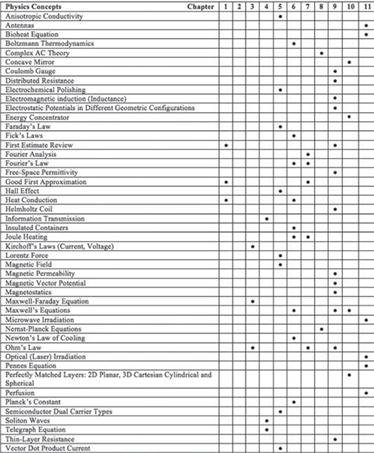
Theeleven(11)technicalchaptersinthisbookdemonstratetothereaderthehands ontechniqueofmodelbuildingandsolving.TheCOMSOLconceptsandtechniques usedinthesechaptersareshowninFigureInt.1.
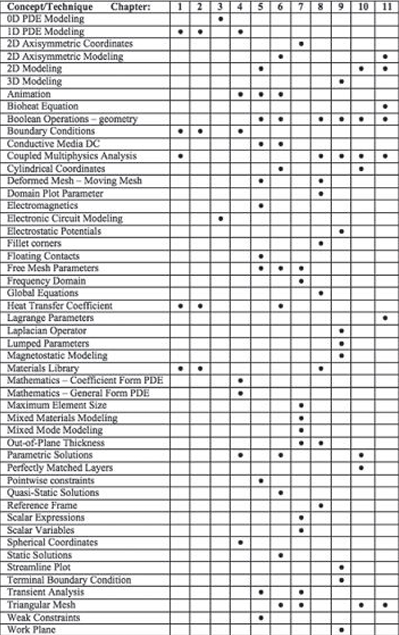
image.png

FIGUREINT.1COMSOLConceptsandtechniques

TheCOMSOLmodulesemployedinthevariousmodelsinspecificchaptersareshown inFigureInt.2,andthephysicsconceptsandtechniquesemployedinthevarious modelsinspecificchaptersareshowninFigureInt.3.
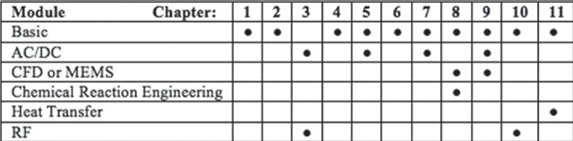
image.png

FIGUREINT.2COMSOLModulesemployed

image.png

FIGUREINT.3PhysicsConceptsandtechniques

Theinformationinthesethreefigureslinktheoverallpresentationofthisbookto theunderlyingmodeling,mathematical,andphysicalconcepts.Inthisbook,incontrast tosomeotherbookswithwhichthereadermaybefamiliar,keyancillaryinformation is,inmostcases,containedinthenotes.

NOTE

Pleasebesuretoread,carefullyconsider,andapply,asneeded,eachnote.


CHAPTER1.MODELINGMETHODOLOGY

Chapter1providesanoverviewofthemodelingprocessbydiscussingthe fundamentalconsiderationsinvolved:thehardware(computerplatform),thecoordinate systems(physics),theimplicitassumptions(lowerdimensionalityconsiderations),and FirstPrinciplesAnalysis(physics).Threerelativelysimple1Dmodelsarepresented thatbuildandsolve,forcomparison,single-,double-,andtriple-panethermalinsulationwindowstructures.Commentsarealsoincludedoncommonsourcesofmodeling errors.

CHAPTER2.MATERIALSPROPERTIES 

Chapter2discussesvarioussourcesofmaterialspropertiesdata,includingthe COMSOLMaterialLibrary,basicandexpandedmodule,aswellasprintandInternet sources.Amulti-panelthermalinsulationwindowstructuremodeldemonstratesthree techniquesforenteringmaterialproperties:user-defineddirectentry,user-defined parameters,andmaterialdefinitions.Alsoincludedareinstructionsforbuildingauser definedmateriallibraryforstoragewithinCOMSOL5.x. 

CHAPTER3.0DELECTRICALCIRCUITINTERFACE 

COMSOL5.xuseszero-dimensionalmodelstoprovideforthemodelingof electricalcircuitry.Themodelsinthischapterillustratetechniquesformodelingvarious basiccircuits:aresistor-capacitorseriescircuit,aninductor-resistorseriescircuit,anda seriesresistor,parallelinductor-capacitorcircuit.Considerationsforthepropersetupof thecircuitsarediscussedalongwiththebasicsofproblemformulationandtheimplicit assumptionsbuiltintoCOMSOL5.xrelativetoelectricalcircuitmodeling. 

CHAPTER4.1DMODELING 

ThefirstpartofChapter4modelsthe1DKdVEquation.TheKdVEquationisa powerfultoolthatisusedtomodelsolitonwavepropagationindiversemedia(e.g. physicalwavesinliquids,electromagneticwavesintransparentmedia,etc.).Itiseasily andsimplymodeledwitha1DPDEmodemodel. 

ThesecondpartofChapter4modelsthe1DTelegraphEquation.TheTelegraph Equationisapowerfultoolthatisusedtomodelwavepropagationindiverse trans missionlines.TheTelegraphEquationcanbeusedtothoroughlycharacterizethe propagationconditionsofcoaxiallines,twinpairlines,microstriplines,etc.The TelegraphEquationiseasilyandsimplymodeledwitha1DPDEmodemodel. 

ThelastpartofChapter4isa1DSphericallySymmetricTransportmodelthat illustratesthetechniqueofsimplifyingmodelswithsphericalcomponentsfrom3Dto 1Dbyassumingthattheyareessentiallysymmetrical.


更多内容见附件


免责声明:

本页面/内容部分素材来源于互联网公 开 信 息,旨在传递更多信息,不代表本平台立场。

版权归原作者或机构所有,如涉及侵权,请通过平台联系我们,我们将在核实后第一时间处理。

本平台对转载内容的真实性、准确性不作任何保证,用户需自行判断并承担使用风险。

附件

免费D18-使用 COMSOL 5 和 MATLAB 进行多物理场建模-电子书英文版-547页.pdf
Comsol
著作权归作者所有,欢迎分享,未经许可,不得转载
首次发布时间:2026-04-07
最近编辑:6月前
仿真支持爱好者
在仿真的路上越走越远
获赞 333粉丝 27文章 318课程 0
点赞
收藏
作者推荐

几百种材料的应力应变拉伸曲线图集_前半部分

AtlasofStress-StrainCurvesSecondEditionCopyright◎2002byASMInternational®AllnightsreservedNopartofthisbookmaybereproduced,storedinaretrievalsystem,ortransmitted,inanyformorbyanymeans,electronic,mechanical,photocopying,recording,orotherwise,withoutthewrittenpermissionofthecopyrightowner.Firstprinting,December2002Greatcareistakeninthecompilationandproductionofthisbook,butitshouldbemadeclearthatNOWARRANTIES,EXPRESSORIMPLIED,INCLUDING,WITHOUTLIMITATION,WARRANTIESOFMERCHANTABILITYORFITNESSFORAPARTICULARPURPOSE,AREGIVENINCONNECTIONWITHTHISPUBLICATION.AIthoughthisinformationisbelievedtobeaccuratebyASM,ASMcannotguaranteethatfavorableresultswillbeobtainedfromtheuseofthispublicationalone.Thispubli-cationisintendedforusebypersonshavingtechnicalskill,attheirsolediscretionandrisk.SincetheconditionsofproductormaterialuseareoutsideofASM'scontrol,ASMassumesnoliabilityorobligationinconnectionwithanyuseofthisinformation.Noclaimofanykind,whetherastoproductsorinformationinthispublication,andwhetherornotbasedonnegligence,shallbegreaterinamountthanthepurchasepriceofthisproductorpublicationinrespectofwhichdamagesareclaimed.THEREMEDYHEREBYPROVIDEDSHALLBETHEEXCLUSIVEANDSOLEREMEDYOFBUYER,ANDINNOEVENTSHALLEITHERPARTYBELIABLEFORSPECIAL,INDIRECTORCONSEQUENTIALDAMAGESWHETHERORNOTCAUSEDBYORRESULTINGFROMTHENEGLIGENCEOFSUCHPARTY.Aswithanymaterial,evaluationofthematerialunderend-useconditionspriortospecificationisessential.Therefore,specifictestingunderactualconditionsisrecommended.Nothingcontainedinthisbookshallbeconstruedasagrantofanyrightofmanufacture,sale,use,orreproduction,incon-nectionwithanymethod,process,apparatus,product,composition,orsystem,whetherornotcoveredbyleterspatent,copyright,ortrademark,andnothingcontainedinthisbookshallbeconstruedasadefenseagainstanyallegedinfringementofletterspatent,copy-right,ortrademark,orasadefenseagainstliabilityforsuchinfringement.Comments,criticisms,andsuggestionsareinvited,andshouldbeforwardedtoASMInternational.PreparedunderthedirectionoftheASMInternationalTechrnicalBookCommittee(2001-2002),CharlesA.Parker,Chair:PreparedwithassistancefromtheASMInternationalMaterialsPropertiesDatabaseCommittee,PJ.Sikorsky,Chair.ASMInternationalstaffwhoworkedonthisprojectincludedCharlesMoosbrugger,TechnicalEditor;VeronicaFlint,AcquisitionsEditor;BonnieSanders,ManagerofProduction;CarolTerman,ProductionProjectManager;andScotHenry,AssistantDirectorofReferencePublications.LibraryofCongressCataloging-in-PublicationDataAtlasofstress-straincurves.—2nded.p.cm.SAN:204-586—T.p.verso.ISBN:0-87170-739-X1.Stress-straincurves—Atlases.2.Metals—Testing.I.ASMInternational.TA460.A862002620.1'63—dc212002027674ASMInternational®MaterialsPark,OH44073-0002www.asminternationalorgPrintedintheUnitedStatesofAmericaContentsPreface........................................................................................................................................ivRepresentationofStress-StrainBehavior..................................................................1FerrousMetals....................................................................................................................21CastIron(CI)........................................................................................................................23CarbonSteel(CS)..............................................................................................................67AlloySteel(AS)..................................................................................................................93High-StrengthSteel(HS).............................................................................................129StainlessSteel(SS).........................................................................................................161ToolSteel(TS)...................................................................................................................269NonferrousMetals.........................................................................................................277CastAluminum(CA)......................................................................................................279WroughtAluminum(WA)............................................................................................299AluminumLaminates(LA).........................................................................................503Copper(Cu)..........................................................................................................................515Magnesium(Mg)...............................................................................................................555Nickel(Ni)...........................................................................................................................631ReactiveandRefractoryMetals(RM)................................................................705Titanium(Ti).......................................................................................................................729PureMetalsandMiscellaneousAlloys(MA)................................................799AlloyIndex..................................................................................................................809UNSIndex........................................................................................................................815PrefaceInthisinformationage,mechanicalpropertydataareplentiful.However,locatingneededinformationquickly,judgingthevalidityofthedata,andmakingreasonedcomparisonsofdatacanbedaunting.Stress-straincurvescondensemuchinformationaboutthemechanicalbehaviorofmetalsintoaconvenientform.Fromthesebasiccurvestheengineercanextractsuchinformationasthestrength,ductility,forma-bility,elasticity,andotherinformationusefulinpredictingtheper-formanceofaparticularalloyunderstress.ASMInternationalpublishedthefirsteditionoftheAtlasofStress-StrainCurves,acollectionofover550curves,in1986.Thisbook,alongwiththeAtlasofFatigueCurves,AtlasofCreepandStress-RuptureCurves,andtheAtlasofStress-CorrosionandCorrosionFatigueCurves,hasformedasetofusefulmaterialspropertyresourcesfortheengineer,materialsscientist,anddesigner.Welloverthreeyearsago—withtheencouragement,assistance,andguidanceoftheASMTechnicalBooksandMaterialsPropertiesDatabaseCommittees—ASMInternationalembarkedontheprojecttocreatethisupdated,expanded,andimprovedSecondEditionoftheAtlasofStress-StrainCurves.Someoftheoverridinggoalsofthisprojecthavebeento:●Addcurvesformaterialsthatareespeciallyusefultokeyindustries,includingaerospace,automotive,andheavymanufacturingSeekoutcurveswitha“pedigree”soreaderscantracethesourceoftheinformationandhavesomeindicationregardingitsreliability●Includeasmuchpertinentinformationaspossibleforeachcurve.Factorssuchasheat-treatcondition,productform,thickness,spec-imensize,orientation,history,testingtemperature,andtestingrateallaffectmaterialsperformanceandmaybehelpfulwheninter-pretingthecurves●NormalizethepresentationofthecurvestofacilitatecomparisonsamongdifferentmaterialsWefeelASMInternationalhasbeenreasonablysuccessfulinachievingtheseobjectivesinthiseditin.Manypeopleareinvolvedinaprojectofthissize,andwewouldliketothankthosewhohavecontributedto,orassisted,thiseffortFirstandforemost,ASMInternationalthanksthematerialsresearcherswhocreatedtheoriginalcurves--withouttheireffortsthisvolumewouldnotexist.DonnaM.Walker,FASM,StressolversInc.,andVeronicaFlint,ASMstaff,initiatedtheprojecttoreviseandexpandthisbook.ASMInternationalthanksthemfortheireffortsinhelpingtodefinethegoalsforthisprojectandinacquiringmanyofthenewcurvestobeaddedtothebook.SpecialthanksareextendedtoSpecialMetals,GilKaufman,FASM,KaufmanAssociates,andBuceBoardman,FASM,Deere&Company,fortheircontributionsofstress-straincurves.HiroOkamotoandhisassociatesperformedthehugetaskofredrawingthecurvestonormalizetheirpresentation,andwearegrate-fulfortheiraccurateandtimelywork.Theorganizationandfinalqualityofthedataasseeninthebookaremyresponsibility,andanyerrors,omissions,ormisclassificationsofalloysaremine.IthankHeatherLampman,theprincipalcopyedi-tor,andthemembersoftheASMInternationalproductionstaff,whohaveworkeddiligentlytokeepanyerrorstoaminimum.However,inanyendeavorofthisscope,therewillbemistakes.Corrections,com-ments,andcriticismsareinvited.Itshouldbenotedthatmostofthedataincludedinthisbookarenotspecifiedasbeingminimum,typical,orhavinganydefinedconfi-dencelevelassociatedwiththem.Thereadermaywanttorefertothesourceofaparticularcurvetofindadditionaldetails.The"Introduction"inthisbookprovidesareviewoftheinformationthatcanbeextractedfromstress-straincurves,aclarificationoftermsusedindescribingmechanicalbehavior,andaguidetothelimitationsoftheaccuracyandprecisionoftheinformationgiven.CharlesMoosbruggerTechnicalEditorASMInternationalRepresentationofStress-StrainBehaviorCharlesMoosbrugger,ASMInternationalITISAPPROPRIATEthatacollectionofstress-straincurvesisnamedanatlas.Anatlasisacollectionoffigures,charts,ormaps,SonamedbecauseearlybookspicturedtheGreekTitan,Atlas,onthecoverortitlepage,strainingwiththeweightoftheworldandheavensonhisshoulders.Thisconceptofvisualizingthereactiontomechani-calstressiscentraltodevelopmentanduseofstress-straincurves.Thisintroductorysectionprovidesareviewofthefundamentalsofthemechanicaltestingthatisrepresentedinthecurves.Themathemat-icalinterpretationofaspectsofthecurveswillaidinanalysisofthecurves.Alistoftermscommontostress-strainbehaviorisgivenattheendofthissection.(Ref1,2).TensileTestingThesimplestloadingtovisualizeisaone-dimensionaltensiletest,inwhichauniformslendertestspecimenisstretchedalongitslongcen-tralaxis.Thestress-straincurveisarepresentationoftheperformanceofthespecimenastheappliedloadisincreasedmonotonicallyusuallytofracture.Stress-straincurvesareusuallypresentedas:●“Engineering”stress-straincurves,inwhichtheoriginaldimensionsofthespecimensareusedinmostcalculations.●"True"stress-straincurves,wheretheinstantaneousdimensionsofthespecimenateachpointduringthetestareusedinthecalcula-tions.Thisresultsinthe“true”curvesbeingabovethe“engineer-ing”curves,notablyinthehigherstrainportionofthecurves.Thedevelopmentofthesecurvesisdescribedinthefollowingsec-tions.Todocumentthetensiontest,anengineeringstress-straincurveisconstructedfromtheload-elongationmeasurementsmadeonthetestspecimen(Fig.1).Theengineeringstress,S,plottedonthisstress-straincurveistheaveragelongitudinalstressinthetensilespecimen.Fig.1Engineeringstress-straincurve.Intersectionofthedashedlinewiththecurvedeterminestheoffsetyieldstrength.Itisobtainedbydividingtheload,P,bytheoriginalareaofthecrosssec-tionofthespecimen,Ao:Thestrain,e,plottedontheengineeringstress-straincurve,istheaver-agelinearstrain,whichisobtainedbydividingtheelongationofthegagelengthofthespecimen,δ,byitsoriginallength,Lo:Becauseboththestressandthestrainareobtainedbydividingtheloadandelongationbyconstantfactors,theload-elongationcurvehasthesameshapeastheengineeringstress-straincurve.Thetwocurvesfre-quentlyareusedinterchangeably.Theunitsofstressareforce/lengthsquared,andthestrainisunitless.Thestrainaxisofcurvestraditionallyaregivenunitsofin./in.ormm/mmratherthanbeinglistedasapurenumber.Strainissometimesexpressedasapercentelongation.Theshapeofthestress-straincurveandvaluesassignedtothepointsonthestress-straincurveofametaldependonits:●Composition●Heattreatmentandconditioning●Priorhistoryofplasticdeformation●Thestrainrateoftest●Temperature●Orientationofappliedstressrelativetothetestspecimensstructure●SizeandshapeTheparametersthatareusedtodescribethestress-straincurveofametalarethetensilestrength,yieldstrengthoryieldpoint,ultimateten-silestrength,percentelongation,andreductioninarea.Thefirstthreearestrengthparameters;thelasttwoindicateductility.Thegeneralshapeoftheengineeringstress-straincurve(Fig.1)requiresfurtherexplanation.Thiscurverepresentsthefullloadingofaspecimenfrominitialloadtorupture.Itisa“full-range”curve.Oftenengineeringcurvesaretruncatedpastthe0.2%yieldpoint.ThisisthecaseofmanyofthecurvesinthisAtlas.Othertestdataarepresentedasa“full-range”curvewithan“expandedrange”todetailtheinitialpartsofthecurve.LinearSegmentofCurvesFromtheorigin,0,theinitialstraight-lineportionistheelasticregion,wherestressislinearlyproportionaltostrain.Whenthestressisremoved,ifthestraindisappears,thespecimenisconsideredcom-pletelyelastic.Thepointatwhichthecurvedepartsfromthestraight-linepropor-tionality,A,istheproportionallimit.Modulusofelasticity,E,alsoknownasYoung'smodulus,istheslopeofthisinitiallinearportionofthestress-straincurve:whereSisengineeringstressandseisengineeringstrain.Modulusofelasticityisameasureofthestiffnessofthematerial.Thegreaterthemodulus,thesteepertheslopeandthesmallertheelasticstrainresult-ingfromtheapplicationofagivenstress.Becausethemodulusofelas-ticityisneededforcomputingdeflectionsofbeamsandotherstructuralmembers,itisanimportantdesignvalue.Themodulusofelasticityisdeterminedbythebindingforcesbetweenatoms.Becausetheseforcescannotbechangedwithoutchangingthebasicnatureofthematerial,themodulusofelasticityisoneofthemoststructure-insensitiveofthemechanicalproperties.Generally,itisonlyslightlyaffectedbyalloyingadditions,heattreat-ment,orcoldwork(Ref3).However,increasingthetemperaturedecreasesthemodulusofelasticity.Atelevatedtemperatures,themod-ulusisoftenmeasuredbyadynamicmethod(Ref4).TypicalvaluesofmodulusofelasticityforcommonengineeringmaterialsaregiveninTable1(Ref5).Resilienceistheabilityofamaterialtoabsorbenergywhendeformedelasticallyandtoreturnitwhenunloaded.Thispropertyusu-allyismeasuredbythemodulusofresilience,whichisthestrainenergyperunitvolume,Uo,requiredtostressthematerialfromzerostresstotheyieldstress,Sx.Thestrainenergyperunitvolumeforanypointonthelineisjusttheareaunderthecurve:Fromthedefinitionofmodulusofelasticityandtheabovedefinition,themaximumresilienceoccursattheyieldpointandiscalledthemod-ulusofresilience,UR:Thisequationindicatesthattheidealmaterialforresistingenergyloadsinapplicationswherethematerialmustnotundergopermanentdistor-Table1TypicalvaluesformodulusofelasticityFig.2Stress-straincurvesforselectedsteels.Source:Ref7tion,suchasmechanicalsprings,isonehavingahighyieldstressandalowmodulusofelasticity.Forvariousgradesofsteel,themodulusofresiliencerangesfrom100to4500kJ/m³(14.5to6501bf·in./in.³),withthehighervaluesrep-resentingsteelswithhighercarbonoralloycontents(Ref6).ThiscanbeseeninFig.2,wherethemodulusofresilienceforthechromium-tungstenalloywouldbethegreatestofthesteels,becauseithasthehighestyieldstrengthandsimilarmodulusofelasticity.ThemodulusofresilienceisrepresentedasthetriangularareasunderthecurvesinFig.3.Figure2showsthatwhilethemodulusofelasticityisconsistentforthegivengroupofsteels,theshapesofthecurvespasttheirpropor-tionalitylimitsarequitevaried(Ref7)Fig.3Comparisonofstress-straincurvesforahigh-strengthhigh-carbonspringsteelandalower-strengthstructuralsteel.PointAistheelasticlimitofthespringsteel;pointBistheelasticlimitofthestructuralsteel.Thecross-hatchedtrian-glesarethemodulusofresilience(UR).Thesetwoareasaretheworkdoneonthematerialstoelongatethemortherestoringforcewithinthematerials.NonlinearSegmentofCurvestoYieldingTheelasticlimit,B,onFig.1,maycoincidewiththeproportional-itylimit,oritmayoccuratsomegreaterstress.Theelasticlimitisthemaximumstressthatcanbeappliedwithoutpermanentdeformationtothespecimen.Somecurvesexhibitadefiniteyieldpoint,whileothersdonot.Whenthestressexceedsavaluecorrespondingtotheyieldstrength,thespecimenundergoesgrossplasticdeformation.Iftheloadissubsequentlyreducedto0,thespecimenwillremainpermanentlydeformed.MeasuresofYielding.Thestressatwhichplasticdeformationoryieldingisobservedtobegindependsonthesensitivityofthestrainmeasurements.Withmostmaterials,thereisagradualtransitionfromelastictoplasticbehavior,andthepointatwhichplasticdeformationbeginsisdifficulttodefinewithprecision.Intestsofmaterialsunderuniaxialloading,threecriteriafortheinitiationofyieldinghavebeenused:theelasticlimit,theproportionallimit,andtheyieldstrength.Elasticlimit,shownatpointBinFig.1,isthegreateststressthematerialcanwithstandwithoutanymeasurablepermanentstrainremainingafterthecompletereleaseofload.Withincreasingsensitiv-ityofstrainmeasurement,thevalueoftheelasticlimitisdecreaseduntilitequalsthetrueelasticlimitdeterminedfrommicrostrainmeas-urements.Withthesensitivityofstraintypicallyusedinengineeringstudies(10-4mm/mmorin./in.),theelasticlimitisgreaterthanthepro-portionallimit.Determinationoftheelasticlimitrequiresatediousincrementalloading-unloadingtestprocedure.Forthisreason,itisoftenreplacedbytheproportionallimit.Theyieldstrength,shownatpointYSinFig.1,isthestressrequiredtoproduceasmallspecifiedarnountofplasticdeformation.Theusualdefinitionofthispropertyistheoffsetyieldstrengthdeterminedbythestresscorrespondingtotheintersectionofthestress-straincurveoffsetbyaspecifiedstrain(seeFig.1).IntheUnitedStates,theoffsetisusu-allyspecifiedasastrainof0.2%or0.1%(e=0.002or0.001).Offsetyieldstrengthdeterminationrequiresaspecimenthathasbeenloadedtoits0.2%offsetyieldstrengthandunloadedsothatitis0.2%longerthanbeforethetest.TheoffsetyieldstrengthisreferredtoinISOStandardsastheproofstress(Rpo,1orRpo,2).IntheENstandardsformaterialsthatdonothaveayieldphenomenonpresent,the0,2%proofstrength(Rpo,2)or0,5%(Rpo,5)isdetermined.Thenonpropor-tionalelongationiseither0.1%,0.2%,or0.5%.Theyieldstrengthobtainedbyanoffsetmethodiscommonlyusedfordesignandspeci-ficationpurposes,becauseitavoidsthepracticaldifficultiesofmeasur-ingtheelasticlimitorproportionallimit.Somematerialshaveessentiallynolinearportiontotheirstress-straincurve,forexample,softcopperorgraycastiron.Forthesemate-rials,theoffsetmethodcannotbeused,andtheusualpracticeistodefinetheyieldstrengthasthestresstoproducesometotalstrain,forexample,e=0.005.TheEuropeanStandardforgeneral-purposecop-perrod,EN12163(Ref8),givesapproximate0,2%proofstrength(Rpo,2)forinformation,butitisnotarequirement.Thisapproachisfol-lowedforothermaterialforms(barandwire),butforsomecoppertubes,amaximumRpo,2isspecifiedForcopperalloypressurevesselplateandsomespringstrip,aminimumRpo,2isspecified.MaterialswithYieldPointPhenomenon.Manymetals,particu-larlyannealedlow-carbonsteel,showalocalized,heterogeneoustypeoftransitionfromelastictoplasticdeformationthatproducesayieldpointinthestress-straincurve.Ratherthanhavingaflowcurvewithagradualtransitionfromelastictoplasticbehavior,suchasFig.4(a),metalswithayieldpointproduceaflowcurveoraload-elongationdia-gramsimilartoFig.4(b).Theloadincreasessteadilywithelasticstrain,dropssuddenly,fluctuatesaboutsomeapproximatelyconstantvalueofload,andthenriseswithfurtherstrain.Fig.4t(I)in(d)u(e)ou(aliz)s(e)yiel(dpl)din(ots)g(o)wi(fs)t(t)h(r)ean(ss)-up(str)p(a)ie(n)r.(y(a)ip(n)to(i)nint(u)oA(u)san(y)d(ie)la(d)ire(ng)lat(c)iv(o)e(n)dly(i)tco(io)nn.s(t(b)a)nt(D)iy(s)cie(o)l--ingstressBtoCInENstandardsformaterialsexhibitingayieldpoint,theupperyieldstrength,ReHmaybespecified.Theupperandloweryieldstress(ReH₃ReL)arespecifiedinsomeENandISOstandardsinunitsofN/mm²(1N/mm²=1MPa).EN10027-1(Ref9)notestheterm“yieldstrength”asusedinthisEuropeanstandardreferstoupperorloweryieldstrength(ReHorReL),proofstrength(Rp),ortheproofstrengthtotalextension(R),dependingontherequirementspecifiedintherelevantproductstandard.Thisservesasacautionthatthedetailsonhowthe“yieldstrength”or“yieldpoint”isdefinedmustbeknownwhenmakinganycomparisonsorconclusionsastothematerialscharacteristics.Typicalyieldpointbehavioroflow-carbonsteelisshowninFig.5.Theslopeoftheinitiallinearportionofthestress-straincurve,desig-natedbyE,isthemodulusofelasticity.Theloadatwhichthesuddendropoccursiscalledtheupperyieldpoint.Theconstantloadiscalledtheloweryieldpoint,andtheelongationthatoccursatconstantloadiscalledtheyield-pointelongation.Thedeformationoccurringthrough-outtheyield-pointelongationisheterogeneous.Attheupperyieldpoint,adiscretebandofdeformedmetal,oftenreadilyvisible,appearsatastressconcentrationsuchasafillet.Coincidentwiththeformationoftheband,theloaddropstotheloweryieldpoint.Thebandthenpropagatesalongthelengthofthespecimen,causingtheyield-pointelongation.Fig.5Typicalyieldpointbehavioroflow-carbonsteelIntypicalcases,severalbandsformatseveralpointsofstresscon-centration.Thesebandsaregenerallyatapproximately45°totheten-sileaxis.TheyareusuallycalledLüdersbands,Hartmannlines,orstretcherstrains,andthistypeofdeformationissometimesreferredtoasthePioberteffect.Theyarevisibleandcanbeaestheticallyundesir-able.WhenseveralLüdersbandsareformed,theflowcurveduringtheyield-pointelongationisirregular,eachjogcorrespondingtothefor-mationofanewLüdersband.AftertheLüdersbandshavepropagatedtocovertheentirelengthofthespecimentestsection,theflowwillincreasewithstraininthetypicalmanner.Thismarkstheendoftheyield-pointelongation.ThetransitionfromundeformedtodeformedmaterialattheLüdersfrontcanbeseenatlowmagnificationinFig.6.TheroughsurfaceareasaretheLüdersbandsinthelow-carbonsteel.Thesebandsarealsoformedincertainaluminum-magnesiumalloys.NonlinearSegmentofContinuedDeformationStrainHardening.Thestressrequiredtoproducecontinuedplasticdeformationincreaseswithincreasingplasticstrain;thatis,themetalstrainhardens.Thevolumeofthespecimen(area×length)remainsconstantduringplasticdeformation,AL=A₀Lo,andasthespecimenelongates,itscross-sectionalareadecreasesuniformlyalongthegagelength.Initially,thestrainhardeningmorethancompensatesforthisdecreaseinarea,andtheengineeringstress(proportionaltoloadP)continuestorisewithincreasingstrain.Eventually,apointisreachedwherethedecreaseinspecimencross-sectionalareaisgreaterthantheincreaseindeformationloadarisingfromstrainhardening.Thiscondi-tionwillbereachedfirstatsomepointinthespecimenthatisslightlyweakerthantherest.Allfurtherplasticdeformationisconcentratedinthisregion,andthespecimenbeginstoneckorthindownlocally.Thestrainuptothispointhasbeenuniform,asindicatedonFig.1.Becausethecross-sectionalareaisnowdecreasingfarmorerapidlythantheabilitytoresistthedeformationbystrainhardening,theactualloadrequiredtodeformthespecimendecreasesandtheengineeringstressdefinedinEq1continuestodecreaseuntilfractureoccurs,atX.Thetensilestrength,orultimatetensilestrength,S,isthemax-imumloaddividedbytheoriginalcross-sectionalareaofthespecimen:Thetensilestrengthisthevaluemostfrequentlyquotedfromtheresultsofatensiontest.Actually,however,itisavalueoflittlefundamentalsignificancewithregardtothestrengthofametal.Forductilemetals,thetensilestrengthshouldberegardedasameasureofthemaximumloadthatametalcanwithstandundertheveryrestrictiveconditionsofuniaxialloading.Thisvaluebearslittlerelationtotheusefulstrengthofthemetalunderthemorecomplexconditionsofstressthatusuallyareencountered.Formanyyears,itwascustomarytobasethestrengthofstructuralmembersonthetensilestrength,suitablyreducedbyafactorofsafetyThecurrenttrendistothemorerationalapproachofbasingthestaticdesignofductilemetalsontheyieldstrength.However,becauseofthelongpracticeofusingthetensilestrengthtodescribethestrengthofmaterials,ithasbecomeafamiliarproperty,andassuch,itisausefulidentificationofamaterialinthesamesensethatthechemicalcompo-sitionservestoidentifyametaloralloy.Furthermore,becausetheten-silestrengthiseasytodetermineandisareproducibleproperty,itisusefulforthepurposesofspecificationandforqualitycontrolofaproduct.Extensiveempiricalcorrelationsbetweentensilestrengthandpropertiessuchashardnessandfatiguestrengthareoftenuseful.Forbrittlematerials,thetensilestrengthisavaliddesigncriterion.MeasuresofDuctility.Currently,ductilityisconsideredaqualita-tive,subjectivepropertyofamaterial.Ingeneral,measurementsofductilityareofinterestinthreerespects(Ref10):●Toindicatetheextenttowhichametalcanbedeformedwithoutfractureinmetalworkingoperationssuchasrollingandextrusion●Toindicatetothedesignertheabilityofthemetaltoflowplasticallybeforefracture.Ahighductilityindicatesthatthematerialis“for-giving”andlikelytodeformlocallywithoutfractureshouldthede-signererrinthestresscalculationorthepredictionofsevereloads.Toserveasanindicatorofchangesinimpuritylevelorprocessingconditions.Ductilitymeasurementsmaybespecifiedtoassessma-terialquality,eventhoughnodirectrelationshipexistsbetweentheductilitymeasurementandperformanceinservice.Theconventionalmeasuresofductilitythatareobtainedfromthetensiontestaretheengineeringstrainatfracture,es,(usuallycalledtheelongation)andthereductioninareaatfracture,q.Elongationandreductioninareausuallyareexpressedasapercentage.Bothofthesepropertiesareobtainedafterfracturebyputtingthespecimenbacktogetherandtakingmeasurementsofthefinallength,Lf,andfinalspec-imencrosssection,Af:Becauseanappreciablefractionoftheplasticdeformationwillbeconcentratedintheneckedregionofthetensionspecimen,thevalueofefwilldependonthegagelengthLooverwhichthemeasurementwastaken(seethesectionofthisarticleonductilitymeasurementintensiontesting).Thesmallerthegagelength,thegreaterthecontributiontotheoveralelongationfromtheneckedregionandthehigherthevalueofer.Therefore,whenreportingvaluesofpercentageelongation,thegagelength,Lo,shouldalwaysbegiven.Reductioninareadoesnotsufferfromthisdifficulty.Thesevaluescanbeconvertedintoanequivalentzero-gage-lengthelongation,eoFromtheconstancyofvolumerelationshipforplasticdeformation(AL=A₀Lo):更多内容见附件免责声明:本页面/内容部分素材来源于互联网公开信息,旨在传递更多信息,不代表本平台立场。版权归原作者或机构所有,如涉及侵权,请通过平台联系我们,我们将在核实后第一时间处理。本平台对转载内容的真实性、准确性不作任何保证,用户需自行判断并承担使用风险。
有附件
未登录
还没有评论
课程
培训
服务
行家
VIP会员 学习计划 福利任务
下载APP
联系我们
帮助与反馈